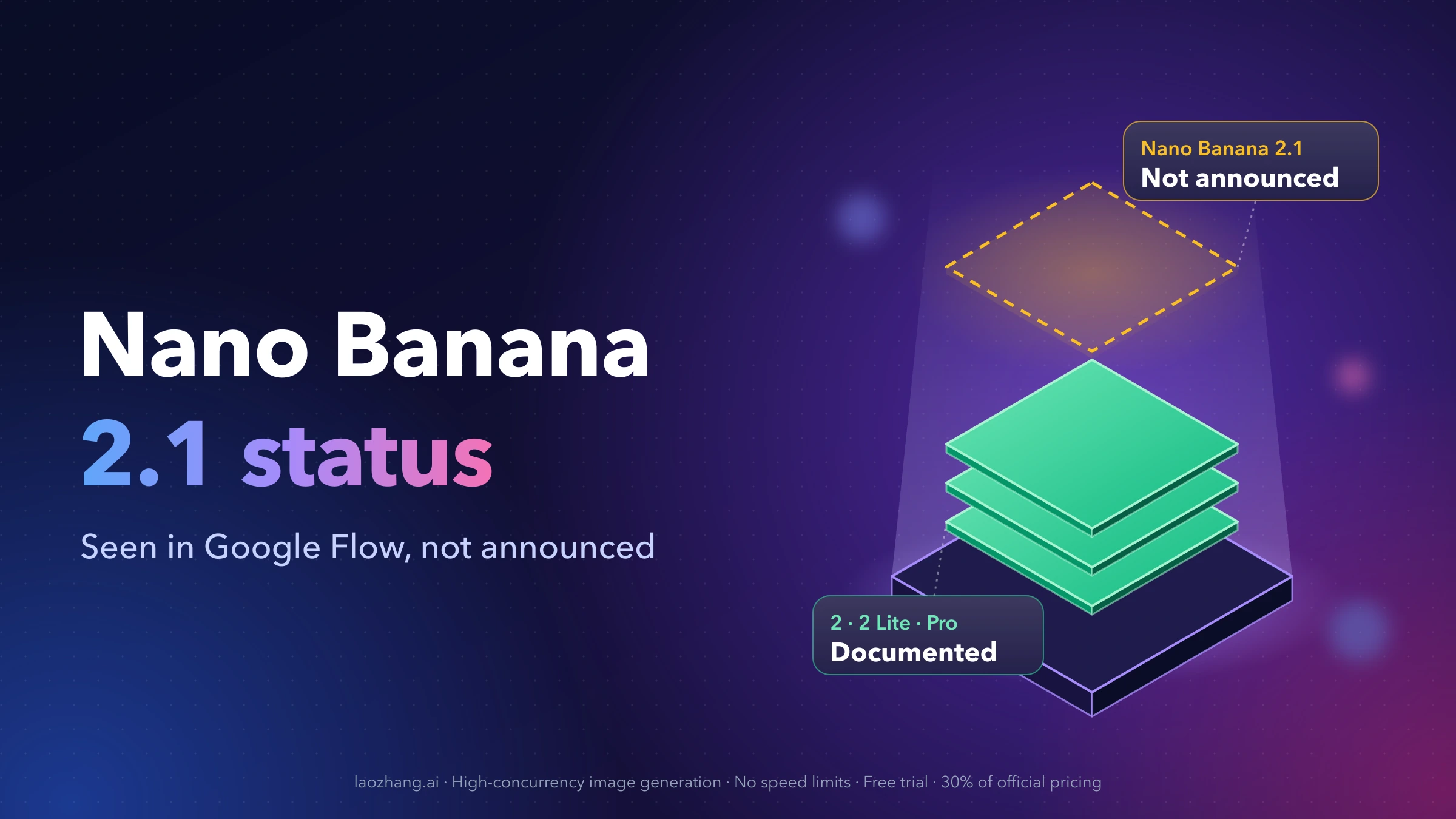
No. As of October 6, 2026, Google has not announced or documented Nano Banana 2.1. Since October 5, users have reported the name in the model picker of Google Flow, Google's AI video-making tool, and that is the only place it has shown up. Google has published no blog post, release note, API model ID, price or spec sheet for it, and the Gemini app, Google AI Studio and the Gemini API don't list it.
What that means for you depends on where you make images:
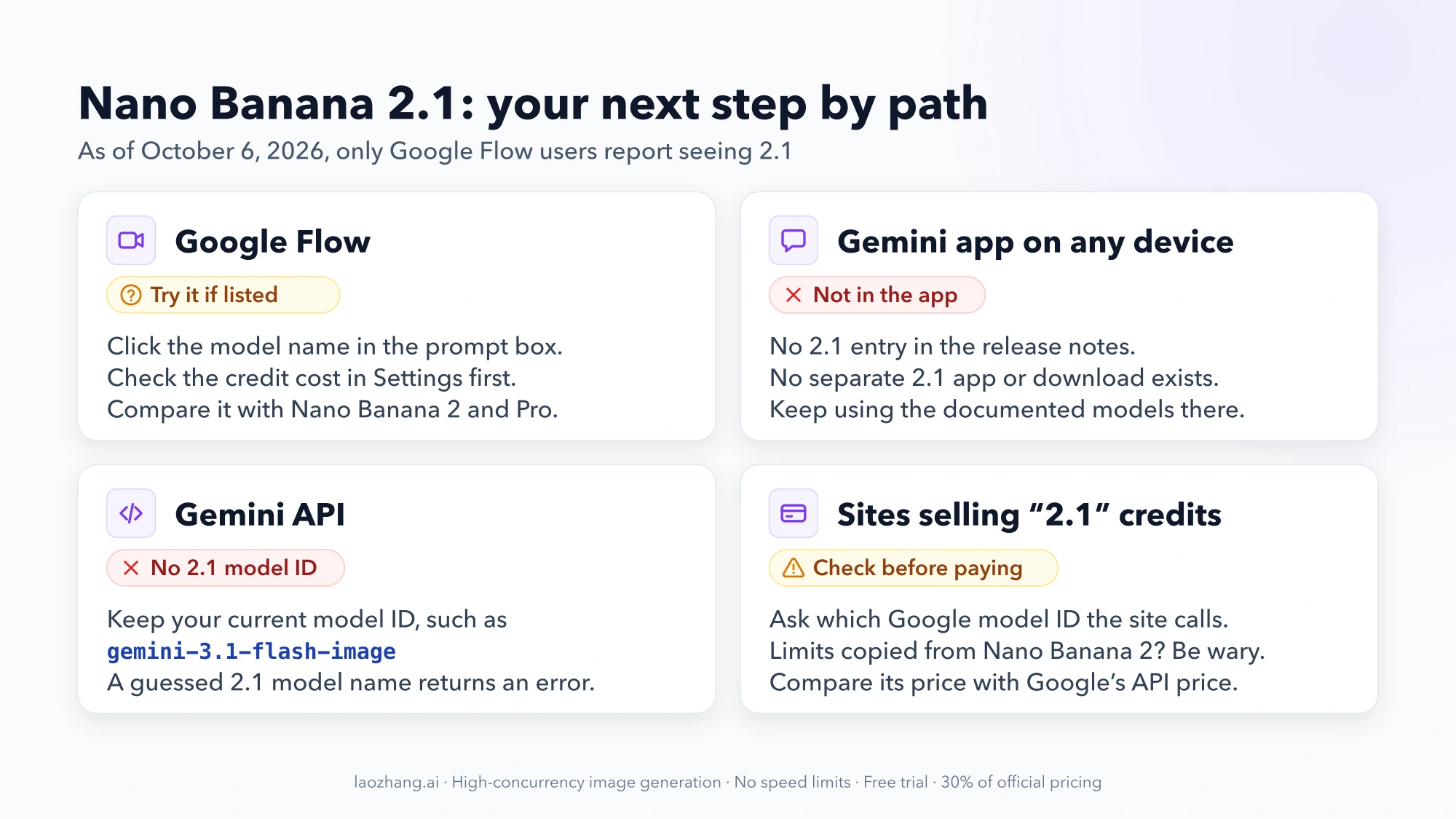
- Google Flow: if your model menu shows Nano Banana 2.1, you can try it. Nobody outside Google knows what it changes, which accounts get it, or what it costs in credits.
- Gemini app, AI Studio or the Gemini API: nothing to switch to. Keep using Nano Banana 2 (
gemini-3.1-flash-image), Nano Banana 2 Lite (gemini-3.1-flash-lite-image) or Nano Banana Pro (gemini-3-pro-image). - A website selling "Nano Banana 2.1" credits: the name alone proves nothing. Ask which Google model ID the site actually calls before you pay.
Nano Banana 2.1 status in each Google product (as of October 6, 2026)
"Showing up in one product's menu" and "released" are different states. A release from Google normally comes with an announcement, a model ID for developers, a price and documentation. Nano Banana 2.1 has none of those yet.
| Where you'd look | Nano Banana 2.1 status | What Google officially offers there |
|---|---|---|
| Google Flow model picker | Reported by users since October 5, 2026; no Google announcement | The Flow models help page lists Nano Banana Pro, Nano Banana 2 and Nano Banana 2 Lite only |
| Gemini API | No model ID | The API changelog's newest entry is September 22, 2026; the last new image model was Nano Banana 2 Lite on June 30, 2026 |
| Gemini API pricing | No price row | Pricing covers Nano Banana 2, 2 Lite and Pro |
| Google AI Studio | Not listed | The Nano Banana model page shows three models: 2 Lite, 2 and Pro |
| Google DeepMind model page | Not listed | The Gemini Image page names the same three |
| Gemini app (web, Android, iOS) | No release note | The newest Gemini app release note is dated September 30, 2026 and is about skills |
So the honest label for Nano Banana 2.1 today is "visible to some Google Flow users, unannounced." It isn't a product Google has released to developers or to the Gemini app.
How Nano Banana 2.1 appeared: a silent rollout in Google Flow
The name surfaced in two steps, both reported by people outside Google:
- September 27, 2026: TestingCatalog reported that references inside the Google Flow web build, which earlier said "Nano Banana 2.5 Flash," had been changed to "Nano Banana 2.1." Its headline noted that Google had not announced the model, and the article said there was no timeline and no description of what would change compared with Nano Banana 2.
- October 5, 2026: posts on Reddit (r/GoogleFlow "Nano Banana 2.1 Just appeared," r/GeminiAI "Nano Banana 2.1 is rolling out now.") and X said the model was selectable in Flow. AICoder described it as a silent rollout based on community screenshots, with no blog post, model page update, API model ID or changelog entry behind it. TestingCatalog posted on X that 2.1 "appears to be available on Google Flow right now," adding that its output "seems similar to what Nano Banana Pro generates."
Those are reports and first impressions, not a spec. Several basic questions remain open:
- Which accounts, plans and countries see Nano Banana 2.1 in Flow.
- Whether it is a Flash-tier model like Nano Banana 2 or a Pro-tier one. The "2.1" number suggests a small step up from Nano Banana 2, but that is an inference from the name.
- Whether it is the model Google will eventually announce under that name, or a test that gets renamed or pulled.
What Nano Banana 2.1 can do, costs and when it ships: unknown
Google hasn't published a release date, capabilities, resolution limits, a price, a Flow credit cost or an API model ID for Nano Banana 2.1. Any number you see attached to it comes from someone other than Google.
Be careful with spec lists borrowed from the model before it. Some generator sites describe "Nano Banana 2.1" with up to 4K output and up to 14 reference images. Google publishes no specs for 2.1 at all; 4K output is something it documents for Nano Banana 2, not for 2.1. Until Google publishes a model card or API entry for 2.1, the safest assumption is that you don't know how it differs.
What to use right now: the three documented Nano Banana models
These are the models Google does document, with the same names in Flow, the Gemini API and AI Studio. API prices are Google's paid-tier estimates per output image, as of October 6, 2026.
| Model | API model ID | Output sizes | Grounding with Google Search | Approx. API price per image |
|---|---|---|---|---|
| Nano Banana 2 Lite | gemini-3.1-flash-lite-image | 0.5K, 1K, 2K, 4K | No | $0.0336 at 1K |
| Nano Banana 2 | gemini-3.1-flash-image | 0.5K, 1K, 2K, 4K | Yes, including image search | $0.067 at 1K, $0.151 at 4K |
| Nano Banana Pro | gemini-3-pro-image | 1K, 2K, 4K | Yes | $0.134 at 1K–2K, $0.24 at 4K |
Model IDs and specs come from the Google AI Studio Nano Banana page; prices come from the Gemini API pricing page, which bills image output by tokens ($30, $60 and $120 per 1M output image tokens for Lite, 2 and Pro). Text input, thinking tokens and Search grounding are billed separately. Every image from these models carries an invisible SynthID watermark.
Nano Banana 2 Lite is Google's fastest and lowest-cost option, Nano Banana 2 is the standard model, and Nano Banana Pro is aimed at complex designs and fine detail. If you're choosing between the last two, see Nano Banana 2 vs Pro: Which Should Be Your Default?.
If you use Google Flow
Open a project and click the model name in the prompt box. If Nano Banana 2.1 is in the list, you can select it like any other image model. If it isn't, there is no setting or waitlist Google has published to get it.
Before you rely on it:
- Check the cost first. Google's Flow credits page publishes no credit costs for image models, so there is no published cost for 2.1 either. Open Settings at the top right of the prompt box to see what a generation costs on your account. Everyone gets 50 Flow credits a day; Google AI Plus, Pro and Ultra plans add monthly credits on top.
- Check which model is active. Google's own help pages disagree about Flow's default image model, so look at the model name in the prompt box rather than assuming.
- Compare on your own prompts. Run the same prompt on Nano Banana 2.1, Nano Banana 2 and Nano Banana Pro. Early impressions that 2.1 looks close to Pro are one poster's view, not a benchmark.
- Keep a fallback for client work. An unannounced model has no published spec or price, and Google could rename or remove it without notice.
Google Flow is available to users 18 and older in a list of countries that includes the United States, and features can differ by country.
If you use the Gemini app on the web, Android or iOS
There is no Nano Banana 2.1 in the Gemini app as far as Google's release notes show, and no separate Nano Banana 2.1 app or download. The Gemini app's image tool runs the documented Nano Banana models. For what you can do there without paying, see How to Use Nano Banana for Free (and When It Isn't Free).
If you call the Gemini API
Don't change your model IDs. Google has no 2.1 endpoint, so there is nothing to migrate to, and guessing a name such as "nano-banana-2.1" or a made-up gemini- string will just return an error. If you still have code pointing at the old preview IDs, fix those instead: gemini-3.1-flash-image-preview and gemini-3-pro-image-preview were shut down on June 25, 2026, after the GA models arrived on May 28.
Useful next reads for API work:
- Nano Banana 2 Thinking Level: Set Minimal or High and Know What to Measure if you want to trade speed for quality on
gemini-3.1-flash-image. - Nano Banana Pro API Pricing: 1K, 2K & 4K Costs for budgeting Pro at higher resolutions.
- Nano Banana API Troubleshooting: 400, 429, 503, NO_IMAGE, Timeouts when calls fail.
If you'd rather pay a flat price per request than Google's token-based billing, laozhang.ai lists gemini-3.1-flash-image at $0.055, gemini-3.1-flash-lite-image at $0.025 and gemini-3-pro-image at $0.09 per call as of October 6, 2026 (price list). It charges for every HTTP 200 response even when no image comes back, and it doesn't offer Nano Banana 2.1 either. Per-call and per-image-token prices aren't directly comparable, so price out your own resolution and failure rate before switching.
Before you pay a "Nano Banana 2.1" website: check what it actually runs
Several sites already sell "Nano Banana 2.1" generations with credits, and some go further with a "Nano Banana 3" that Google hasn't announced. None of them is a Google product, and none of those claims is backed by a Google document. A version name on a landing page doesn't tell you which model produced the image.
Because Google has published no API model ID for 2.1, a site can't point to a documented Google endpoint for it. Before you buy credits, look for:
- A named upstream model. Does the site say which provider and model ID it calls, for example
gemini-3.1-flash-image? A page that only repeats "Nano Banana 2.1" doesn't answer that. - Specs that match a Google document. If the listed limits are identical to Nano Banana 2's, you may simply be buying Nano Banana 2 under a new label.
- A price you can compare. Put the per-image cost next to Google's API prices in the table above, or next to the free Gemini app route.
- A refund policy for failed or unwanted outputs.
A SynthID check can show that an image was made with Google AI, but it won't tell you which Nano Banana version made it. For how that watermark works, see What Is SynthID? Google's AI Watermarking Explained.
How to tell when Nano Banana 2.1 is officially released
Google's own pages are the signals to watch; a model showing up in Flow's menu isn't one of them. A real release usually shows several of these within days of each other, and you can check them yourself:
- A post on the Google blog or Google DeepMind blog naming Nano Banana 2.1.
- A new entry in the Gemini API changelog with a model ID.
- A price row on the Gemini API pricing page.
- Nano Banana 2.1 added to the AI Studio Nano Banana page or the DeepMind Gemini Image page.
- Nano Banana 2.1 on the Flow models help page or in the Gemini app release notes.
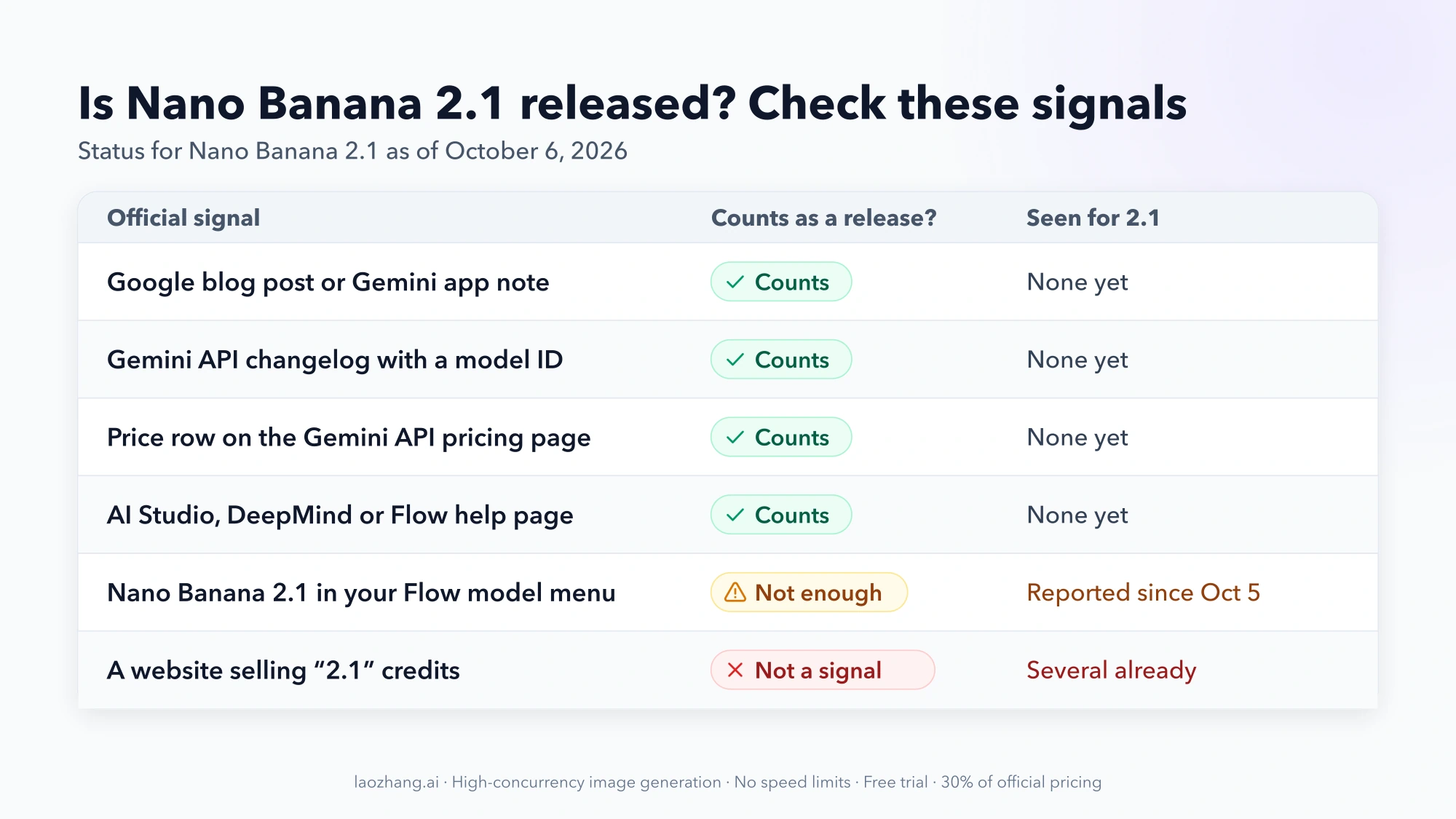
Until at least one of these appears, treat any release date, price or spec you see for 2.1 as a guess.
Nano Banana 2.1 FAQ
What is the Nano Banana 2.1 release date?
Google hasn't given one. As of October 6, 2026, the model is only reported in the Google Flow model picker, starting October 5, without an announcement. Any specific date you see elsewhere is a prediction.
What version of Nano Banana is out right now?
Three versions are officially available: Nano Banana Pro (introduced in November 2025), Nano Banana 2 (February 26, 2026, generally available in the API since May 28, 2026) and Nano Banana 2 Lite (June 30, 2026). The original Nano Banana from August 2025 was Gemini 2.5 Flash Image. Nano Banana 2.1 is visible to some Flow users but not released.
Is Nano Banana 2.1 available in the Gemini app or on iOS?
Not according to Google. The Gemini app release notes, the newest dated September 30, 2026, don't mention it, and there is no separate Nano Banana 2.1 app. On iPhone, the Gemini app gives you the documented Nano Banana models.
Is Nano Banana 2.1 better than Nano Banana Pro or Nano Banana 2?
Nobody can say yet. Google hasn't described what changed, and the only public comparison is TestingCatalog's first impression that its output looks similar to Nano Banana Pro's. If you have it in Flow, test it on your own prompts against both.
Is Nano Banana 2.1 the same as Qwen-Image-2.1 or Kling 2.1?
No. Qwen-Image-2.1 and Kling 2.1 are models from other companies that happen to share the "2.1" version number. Nano Banana is Google's name for its Gemini image models.