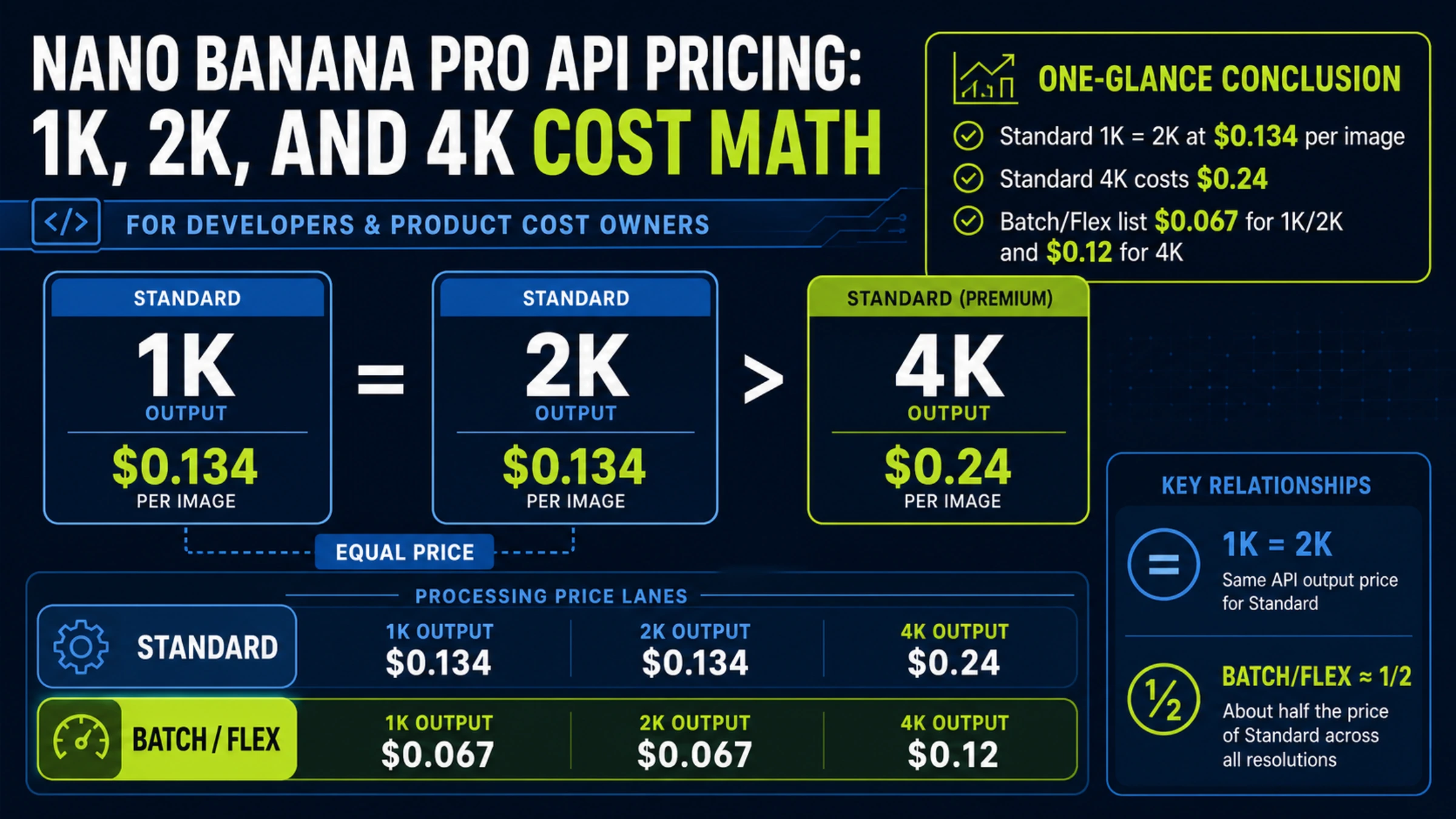
As of 2026-08-05, Google's official Nano Banana Pro API model, gemini-3-pro-image, costs $0.134 per 1K or 2K output and $0.24 per 4K output on Standard processing. Batch and Flex list $0.067 for 1K/2K and $0.12 for 4K.
Those are Gemini Developer API list prices in USD. They are not Gemini App subscription prices, reseller rates, local tax-inclusive totals, or a guarantee that every request produces an accepted asset. The useful budget starts with the list price, then adds inputs, grounding, retries, and acceptance rate.
Rate-card overview: 1K and 2K share an output price; 4K and on-demand Standard require more budget.
The official 1K, 2K, and 4K rate card
| Output size | Standard | Batch | Flex | 1,000 Standard outputs |
|---|---|---|---|---|
| 1K | $0.134 | $0.067 | $0.067 | $134 |
| 2K | $0.134 | $0.067 | $0.067 | $134 |
| 4K | $0.24 | $0.12 | $0.12 | $240 |
The Gemini Developer API pricing page explains the unusual 1K/2K equality. An output from 1K through 2K consumes 1,120 image-output tokens, while a 4K output consumes 2,000. At the Standard image-output rate of $120 per million tokens, Google publishes the ready-to-use equivalents above.
The same table marks the Free Tier as unavailable for Nano Banana Pro API. Free experiments or quotas visible in Google interfaces belong to a different product surface; they should not be entered as a $0 API line item in a production budget.
Make sure “Nano Banana” means the right model
The nickname now covers several API models. A price can be current and still be wrong for your request if the model ID differs.
| Product name | Current model ID | Relevant output price |
|---|---|---|
| Nano Banana Pro | gemini-3-pro-image | This page: $0.134 at 1K/2K, $0.24 at 4K Standard |
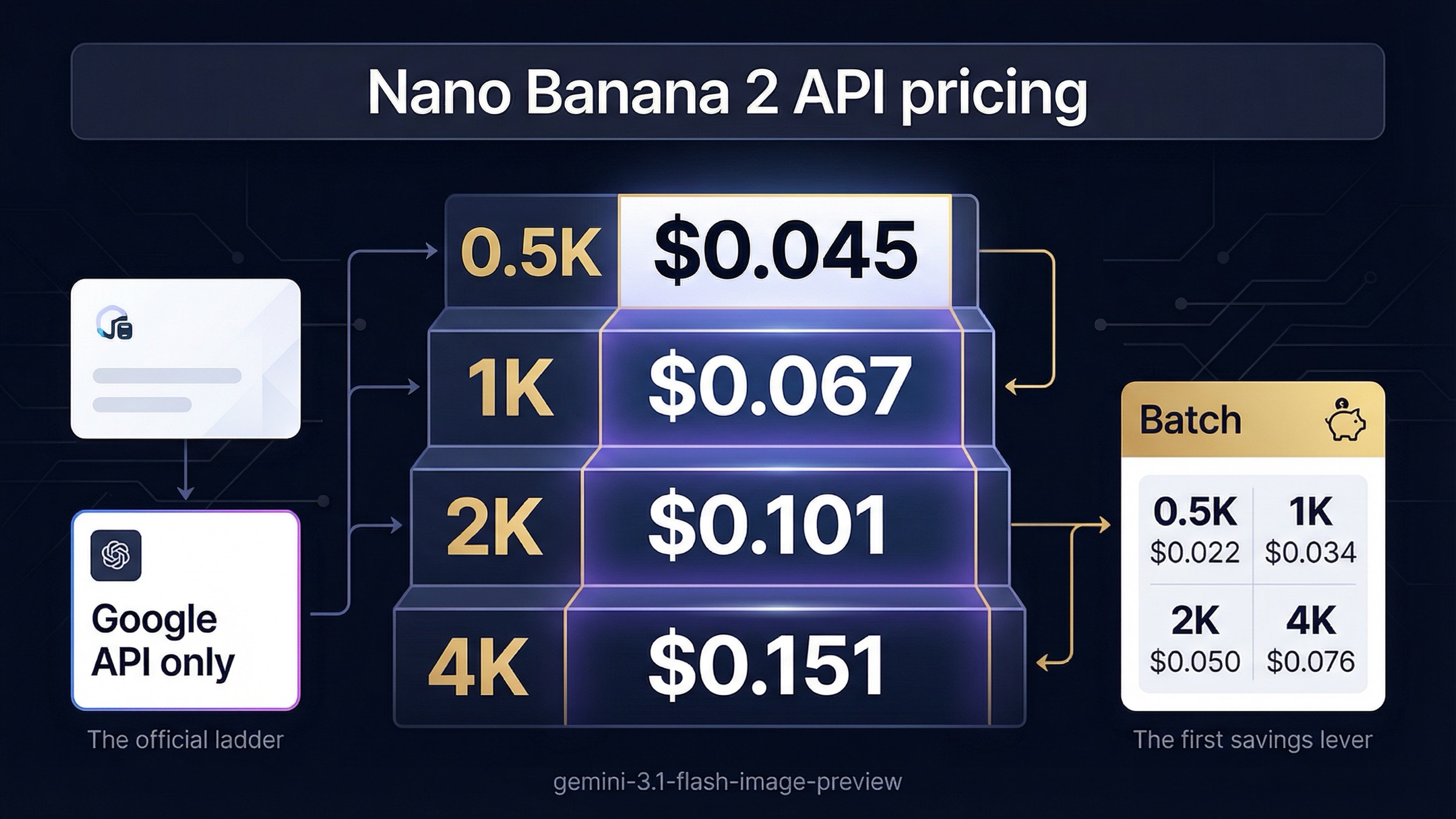
| Nano Banana 2 | gemini-3.1-flash-image | $0.067 at 1K, $0.101 at 2K, $0.151 at 4K Standard |
| Nano Banana 2 Lite | gemini-3.1-flash-lite-image | 1K only, $0.0336 Standard |
| Nano Banana | gemini-2.5-flash-image | Legacy route; not a source for Pro pricing |
Google's image-generation guide and Nano Banana Pro model card use the stable ID gemini-3-pro-image. An older gemini-3-pro-image-preview string is not the current route to copy into new code or cost sheets.
If your request actually uses gemini-3.1-flash-image, use the separate Nano Banana 2 API pricing guide. Mixing its $0.067/$0.101/$0.151 ladder with Pro's $0.134/$0.24 rate creates a budget that matches no model.
Turn the per-image rate into a production budget
The next table is deterministic output-only math. It deliberately excludes input images, prompt tokens, Search grounding, rejected results, taxes, and currency conversion.
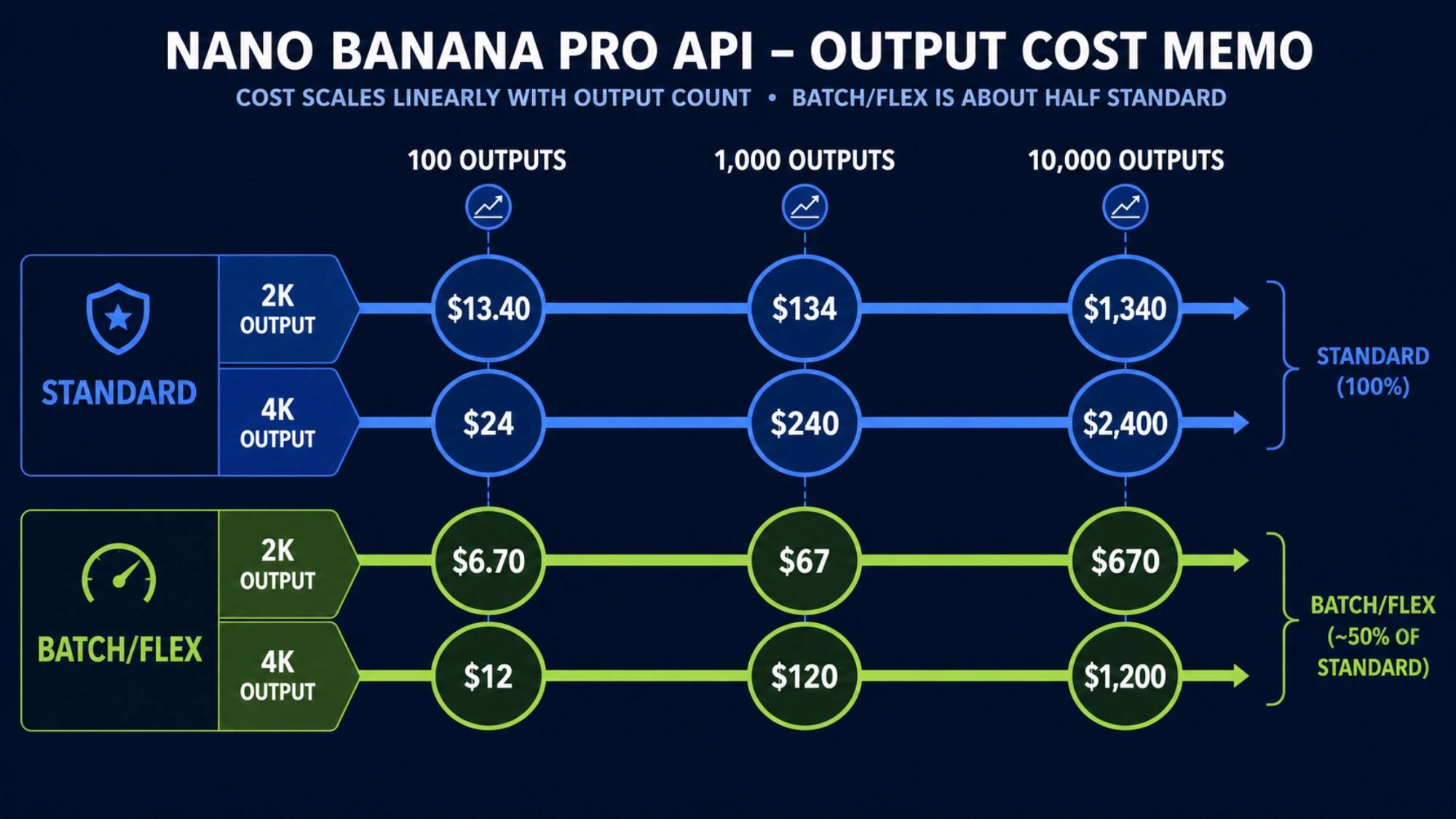
Output-only spend at three volumes; reference inputs, grounding, retries, and local billing are added later.
| Output count | Standard 1K/2K | Standard 4K | Batch/Flex 1K/2K | Batch/Flex 4K |
|---|---|---|---|---|
| 100 | $13.40 | $24 | $6.70 | $12 |
| 1,000 | $134 | $240 | $67 | $120 |
| 10,000 | $1,340 | $2,400 | $670 | $1,200 |
For a 1,000-image campaign, moving from Standard 2K to Standard 4K adds $106 in output charges. Moving the same 2K workload to an eligible Batch or Flex path reduces the output baseline from $134 to $67. Those deltas are large enough to deserve explicit product decisions rather than a hidden default.
Volume multiplication is the easy part. The harder question is whether “1,000 images” means 1,000 API outputs or 1,000 assets that passed review. If a workflow generates variants and discards some, the latter costs more.
Choose resolution from the delivery surface
Equal API output price does not make 1K and 2K operationally identical. The files can differ in storage, transfer, decoding, resizing, and downstream processing cost. Pick the smallest output that preserves the delivered result.
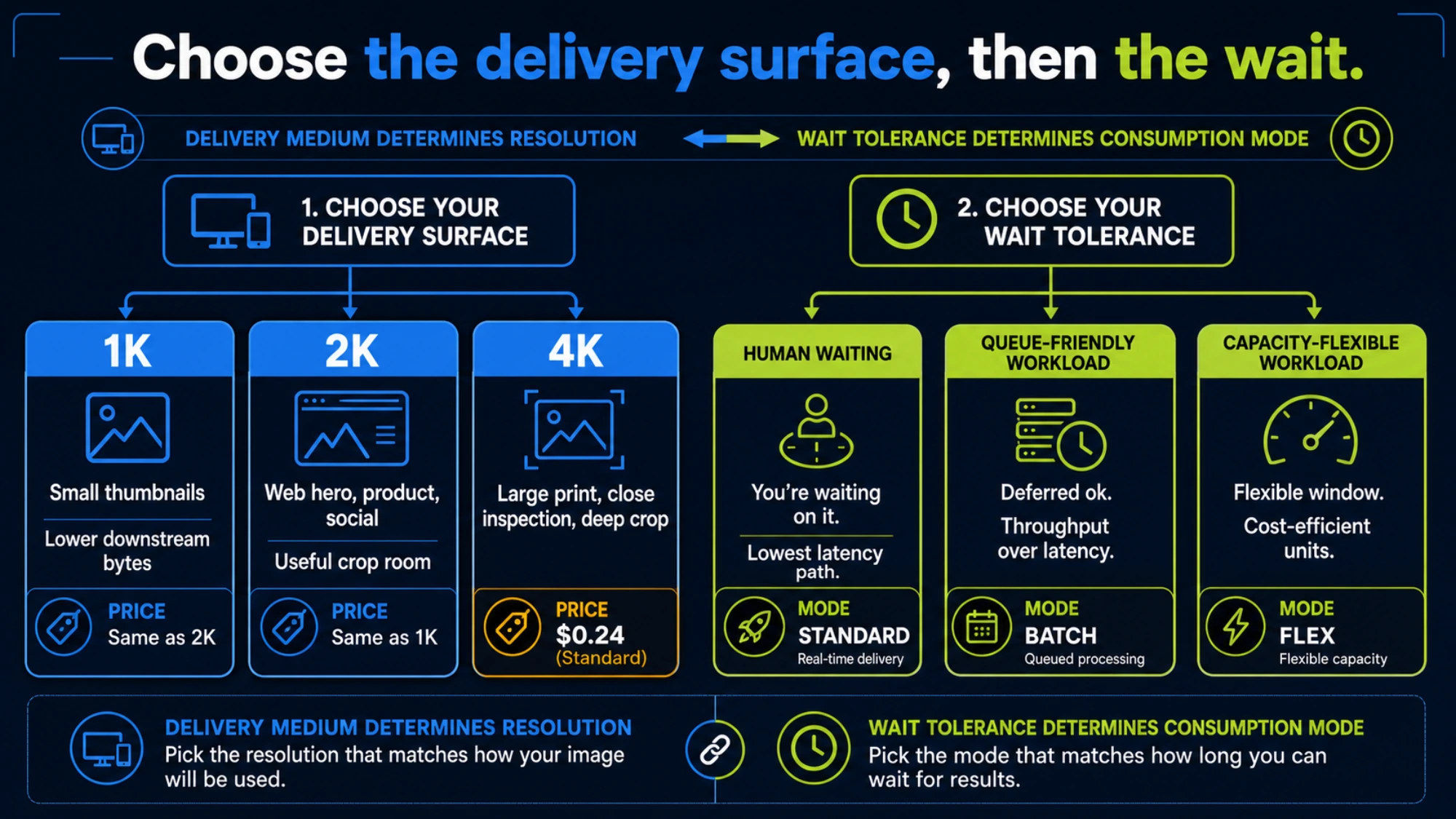
Choose resolution from the delivered medium, then choose Standard, Batch, or Flex from acceptable wait time.
- Use 1K when the asset remains a small thumbnail or in-app preview and the system benefits from smaller files. The API output charge is not lower, but the rest of the stack may be.
- Start most screen-first work at 2K when a hero image, presentation, product asset, or social creative needs crop room. It carries the same API output charge as 1K.
- Pay for 4K when native pixels survive into delivery: large print, close inspection, deep crops, or high-resolution archival masters. For 1,000 Standard outputs, the premium over 2K is $106.
“Always choose 2K because it is free” is too broad. A more accurate rule is: choose 2K instead of 1K when the extra pixels are useful and downstream size is acceptable; choose 4K only when the final medium can expose the difference.
Choose consumption mode from latency, not price alone
Standard, Batch, and Flex share a model and rate card, but not an operating contract.
Standard is the straightforward choice for an interactive editor, user-facing generation, or any request where someone is waiting for the result. Its higher list price buys the normal on-demand path.
Batch fits catalog generation, scheduled campaign variants, and offline queues. Google documents batch image generation as a higher-throughput option with delayed completion. Before designing around it, verify the current job lifecycle, queue limits, and completion behavior rather than assuming it behaves like a synchronous call at half price.
Flex currently lists the same output equivalents as Batch for Nano Banana Pro. That price match does not make Flex and Batch interchangeable, and it does not promise capacity or latency. Use it only when the workload can tolerate its current service characteristics.
A production routing rule can therefore be simple: keep human-waiting requests on Standard; send delay-tolerant work to a supported lower-cost mode after implementing its lifecycle and recovery path.
Add the costs the headline omits
A complete estimate is better expressed as variables:
total billed cost = output + prompt/reference input + grounding + retries/rejects + tax/currency
For Standard Nano Banana Pro, Google lists text/image input at $2 per million tokens. One input image is set at 560 tokens, equivalent to about $0.0011. Batch and Flex list an input-image equivalent of about $0.0006. A single reference is small beside a $0.134 output, but a multi-reference edit repeated at scale should not be rounded to zero.
Search grounding is another separate meter. Google's pricing page provides a shared Gemini 3 allowance and then a per-search-query rate. A submitted request may result in more than one Google Search query, with each query billed. Do not add a fixed “grounding fee per request”; measure the queries actually used. If the workflow never enables grounding, this line remains zero.
Local billing can add tax, card fees, or currency conversion. Use:
local-currency budget = USD estimate × settlement exchange rate × (1 + tax and payment fees)
The official availability list and account eligibility also matter. Language does not establish the deployment region, and list price does not establish an account's live capacity.
Budget by accepted asset, not by request
The output rate is a planning primitive. The operating metric is usually cost per accepted asset:
cost per accepted asset = total billed usage / accepted outputs
Suppose a team needs 1,000 accepted 2K assets but produces 1,250 Standard outputs to get them. Output alone is 1,250 × $0.134 = $167.50, so the output portion of accepted-asset cost is $0.1675—not $0.134. Reference inputs, grounding, and local billing sit on top.
Google's public rate card does not provide a universal promise that every failed request is billed or that every failure is free. The defensible method is to record the model ID, mode, image size, returned usage, billed amount, and acceptance result. Reconcile the estimate against the actual bill rather than inventing a failure policy.
A pre-launch cost checklist
Before approving the budget, verify these six items:
- The request uses
gemini-3-pro-image, not Nano Banana 2 or an old preview ID. - Image size is set intentionally to 1K, 2K, or 4K instead of inheriting an unnoticed default.
- Human-waiting traffic stays on Standard; delayed work uses Batch/Flex only after its lifecycle is implemented.
- Reference-image count and Search grounding appear as explicit cost variables.
- The estimate includes expected attempts per accepted asset, not just desired final count.
- Current project limits are checked in AI Studio, as Google's rate-limit guidance says active limits depend on the project tier.
For the next estimate, enter the exact model ID, output size, processing mode, and target volume in the table above, then calibrate it with billed usage and acceptance results from a small representative workload. The list-price baseline is $0.134 for 1K/2K and $0.24 for 4K on Standard, or $0.067 and $0.12 on Batch/Flex; the operating decision should use cost per accepted asset.