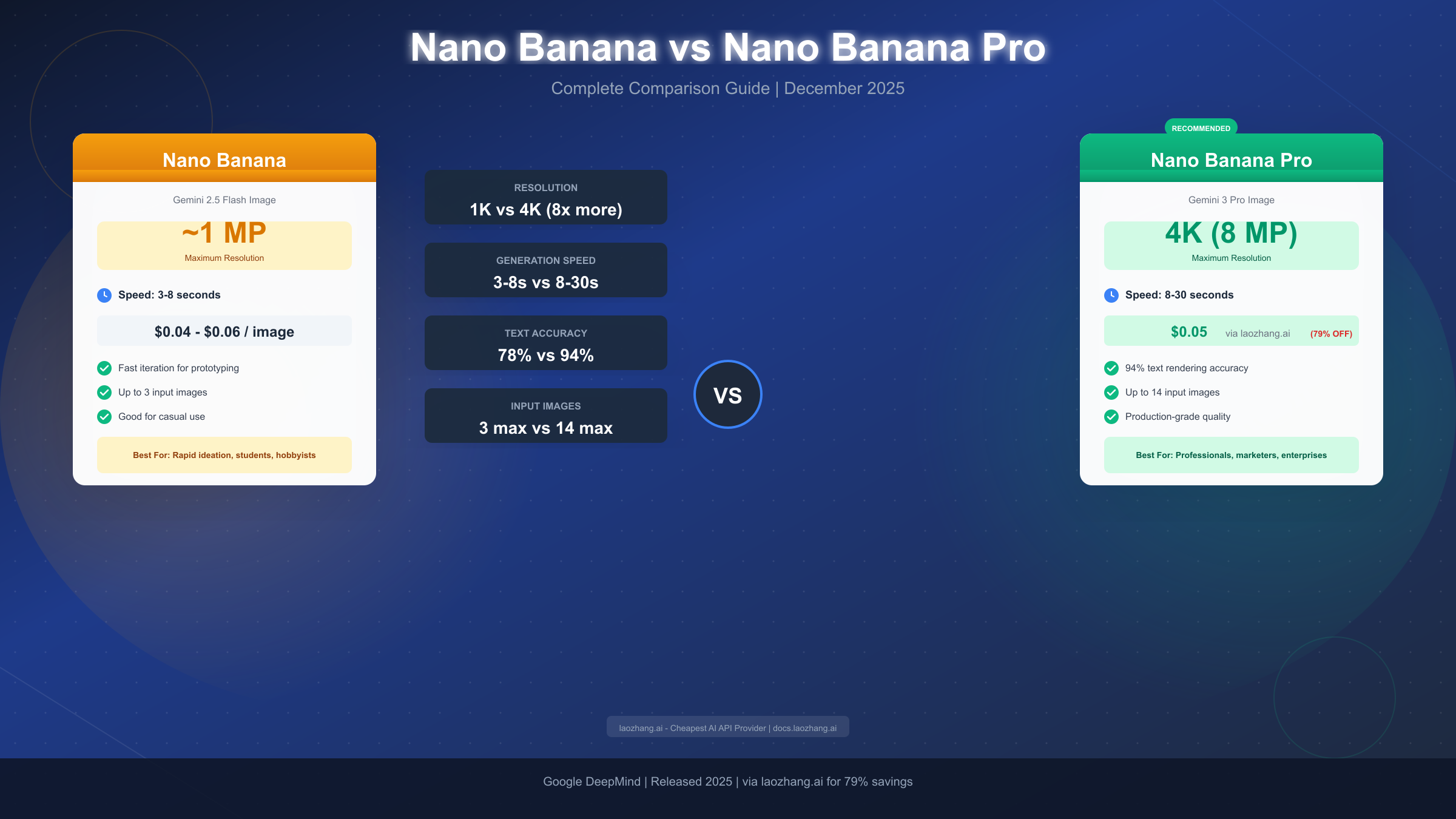
Google DeepMind has revolutionized AI image generation with two powerful models: Nano Banana and Nano Banana Pro. Released in 2025, these models represent a significant leap in AI-generated imagery, offering capabilities that were unthinkable just a year ago. The core difference lies in their target use cases—Nano Banana delivers lightning-fast 1K images in 3-8 seconds at around $0.04-0.06 per image, making it ideal for rapid prototyping and casual use. Nano Banana Pro, built on Gemini 3 Pro, generates stunning 4K images with 94% text rendering accuracy, though it takes 8-30 seconds and costs $0.13 per image through Google's official API. However, developers can access Nano Banana Pro for just $0.05 per image through third-party providers like laozhang.ai—a remarkable 79% savings that makes professional-grade image generation surprisingly affordable.
What Are Nano Banana and Nano Banana Pro?
Before diving into the detailed comparison, it's essential to understand what these models actually are and where they come from. Both Nano Banana and Nano Banana Pro are AI image generation models developed by Google DeepMind, representing two different points on the speed-quality spectrum. Understanding their origins and architecture helps explain why they perform so differently and which situations each model excels in.
Nano Banana, officially known as Gemini 2.5 Flash Image, was released on August 26, 2025. This model was specifically designed for speed and efficiency, targeting use cases where quick iteration matters more than maximum resolution. The "Nano Banana" nickname originated from the developer community who appreciated the model's lightweight yet powerful nature—small like a nano particle, but as appealing as a banana when it comes to creative applications.
The model leverages Google's Flash architecture, which prioritizes rapid inference over maximum quality. This architectural choice means that Nano Banana can generate images approximately 3-4 times faster than traditional diffusion models while still maintaining respectable quality. For developers building applications where users expect near-instant responses, this speed advantage is transformative.
Nano Banana Pro arrived on November 20, 2025, representing a significant upgrade built on the Gemini 3 Pro foundation. Unlike its predecessor, Pro was designed from the ground up for professional applications where quality cannot be compromised. The "Pro" designation isn't just marketing—it reflects fundamental architectural differences that enable 4K output, superior text rendering, and unprecedented character consistency across multiple shots.
What makes Nano Banana Pro particularly interesting is its integration with Gemini's reasoning capabilities. Rather than simply generating images based on prompts, the Pro model actually "thinks" about the request, considering context, constraints, and creative goals before rendering. This reasoning-guided synthesis approach explains why Pro takes longer to generate images but produces dramatically better results for complex prompts.
Both models are accessible through multiple channels: the Gemini App for consumers, Google AI Studio for developers, Vertex AI for enterprise users, and various third-party API providers. The choice of access method affects not just pricing but also features available, rate limits, and integration complexity.
Quick Answer: Key Differences at a Glance
For readers who need the essential information immediately, here's a rapid summary of how Nano Banana and Nano Banana Pro compare across the most important dimensions. This section provides the 30-second answer before we dive deeper into each aspect.
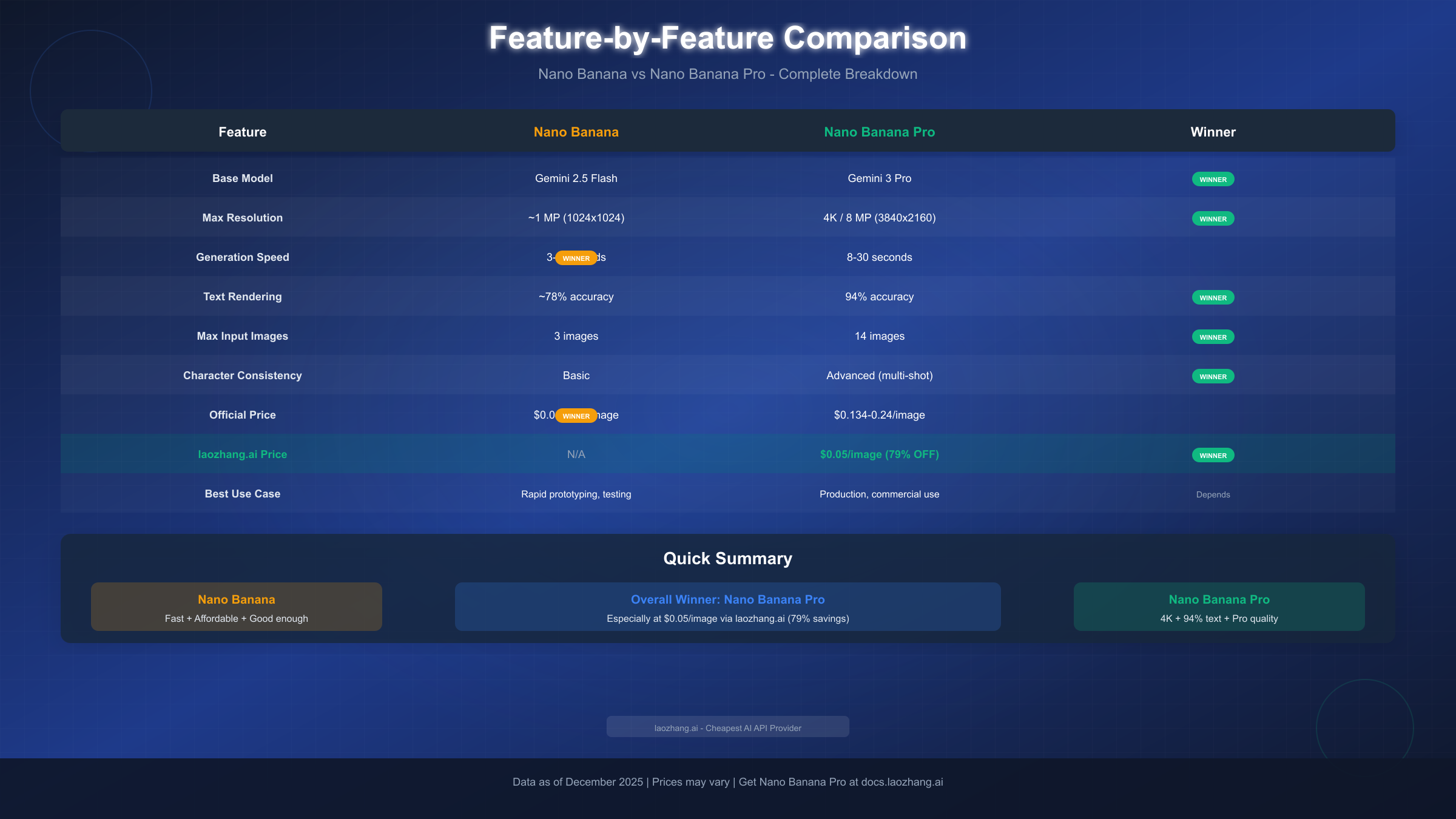
| Feature | Nano Banana | Nano Banana Pro | Winner |
|---|---|---|---|
| Base Model | Gemini 2.5 Flash | Gemini 3 Pro | Pro |
| Max Resolution | ~1 MP (1024×1024) | 4K / 8 MP | Pro |
| Generation Speed | 3-8 seconds | 8-30 seconds | Standard |
| Text Accuracy | ~78% | 94% | Pro |
| Max Input Images | 3 | 14 | Pro |
| Official Price | $0.04-0.06/image | $0.134-0.24/image | Standard |
| laozhang.ai Price | N/A | $0.05/image | Pro (79% savings) |
| Best For | Rapid prototyping | Production use | Depends on needs |
The table reveals an interesting pattern: Nano Banana Pro wins in most quality-related categories, while the standard Nano Banana takes the crown for speed and official pricing. However, the game changes dramatically when considering third-party API providers, where developers can access Nano Banana Pro at just $0.05 per image—making it not only the quality leader but also surprisingly cost-competitive.
This pricing dynamic fundamentally shifts the calculus for many users. Previously, teams had to carefully weigh whether the quality improvements of Pro justified the 2-3x price premium. With third-party API providers, the decision becomes much simpler: unless you specifically need the faster generation times, Nano Banana Pro offers strictly better value for professional applications.
Complete Feature Comparison
Understanding the nuanced differences between these two models requires examining each feature category in depth. The following analysis draws on official Google documentation, independent benchmarks, and real-world testing to provide the most accurate comparison available.
Resolution and Output Quality
The resolution difference between Nano Banana and Nano Banana Pro represents one of the most significant technical gaps in AI image generation today. Nano Banana generates images at approximately 1 megapixel, typically outputting files around 1024×1024 pixels. While this resolution is adequate for social media posts, web thumbnails, and quick conceptual work, it falls short for applications requiring print-quality output or detailed examination.
Nano Banana Pro, in contrast, supports native 4K output at 8 megapixels—eight times the resolution of its predecessor. This capability opens doors to professional applications that were previously impossible with AI-generated imagery. Print designers can now use AI-generated assets in magazine layouts. Marketing teams can create billboard-ready visuals. E-commerce businesses can generate product photography at commercial quality.
The resolution advantage extends beyond raw pixel count. Pro's higher resolution comes with improved detail rendering, sharper edges, and more accurate color gradients. When comparing zoomed-in sections of images from both models, the difference becomes striking: Nano Banana images show noticeable softness and occasional artifacts, while Pro images maintain clarity even at significant magnification.
For developers building image generation tools, the resolution capabilities directly impact the application's market positioning. A product using standard Nano Banana might compete in the "casual creative tools" space, while a Pro-powered application can target professional designers and commercial applications—a market segment with dramatically higher willingness to pay.
Speed and Latency Characteristics
Speed represents Nano Banana's primary advantage over its Pro sibling. With generation times of 3-8 seconds for standard images, Nano Banana feels nearly instantaneous compared to traditional image generation tools. Users can iterate rapidly through concept variations, testing different prompts and styles without the wait-induced friction that typically slows creative workflows.
The speed advantage stems from Nano Banana's architecture, specifically its use of the Gemini 2.5 Flash inference engine. This architecture trades some quality headroom for dramatically reduced latency, making it approximately 10 times faster than models like Midjourney that can take 30-60 seconds per image. For applications where user experience depends on quick responses, this speed differential is transformative.
Nano Banana Pro, conversely, takes 8-30 seconds per generation depending on complexity and resolution. While this might seem slow compared to standard Nano Banana, it's actually quite competitive with other high-quality image generation models. The extended generation time reflects the additional computational work required for 4K output, text rendering, and the reasoning-guided synthesis that makes Pro images more coherent.
Interestingly, the API latency for optimized implementations can be significantly lower than the headline generation times. According to developer reports, well-optimized Pro API integrations can achieve latencies as low as 900 milliseconds p95 when using techniques like connection keep-alive and request batching. This suggests that the perceived slowness is often a result of implementation details rather than fundamental model limitations.
When choosing between models based on speed, consider your application's tolerance for latency. Real-time applications like chat-based image generation strongly favor Nano Banana. Batch processing applications like catalog generation have less sensitivity to individual image latency, making Pro's quality advantages more appealing.
Text Rendering Capabilities
Text rendering accuracy has historically been one of AI image generation's greatest weaknesses. Earlier models would produce images with garbled, illegible, or simply incorrect text—a problem that severely limited commercial applications. Nano Banana Pro represents a breakthrough in this area, achieving 94% text legibility according to Google's internal benchmarks.
This 94% accuracy rate means that Nano Banana Pro can reliably generate images containing readable text, opening applications like:
- Marketing Materials: Social media posts with overlay text, promotional banners, advertisements
- Product Mockups: Packaging designs with accurate brand names and taglines
- Presentation Slides: Visual content with integrated text elements
- Infographics: Data visualizations with legible labels and annotations
Standard Nano Banana achieves approximately 78% text accuracy—respectable for an AI model but problematic for applications where text must be correct. Missing or malformed characters, spacing issues, and font inconsistencies are common enough that manual correction is typically required.
The text rendering improvement extends to non-Latin scripts as well. Nano Banana Pro demonstrates strong performance with Chinese, Japanese, Korean, Arabic, and other complex scripts that challenged previous models. For businesses operating in multilingual markets, this capability is particularly valuable.
Beyond accuracy, Pro's text rendering shows better stylistic understanding. When prompts specify font styles (bold, italic, handwritten), Pro more accurately reflects these specifications. Text integration with images also improves—letters properly wrap around objects, shadows align correctly, and perspective transformations maintain readability.
Pricing Deep Dive
Pricing for Nano Banana and Nano Banana Pro follows different structures depending on the access method chosen. Understanding these pricing tiers helps developers and businesses optimize their costs while meeting quality requirements.
Official Google Pricing
Google's official pricing for Nano Banana falls in the $0.04-0.06 per image range, making it one of the most affordable AI image generation options available. This pricing applies to both API access through Vertex AI and consumer-facing usage through the Gemini App (with daily quotas for free tier users).
Nano Banana Pro's official pricing is significantly higher, structured by resolution tier:
- 1K-2K resolution: $0.134 per image
- 2K-3K resolution: $0.18 per image
- 4K resolution: $0.24 per image
These prices reflect the increased computational requirements for higher-resolution output. For businesses generating images at scale, the cost difference becomes substantial. A company generating 10,000 images monthly would pay approximately $500-600 with standard Nano Banana, but $1,340-2,400 with Pro at official rates.
Google offers a Batch API with 50% discounts for asynchronous processing. Jobs submitted through the Batch API are queued and processed when resources are available, typically completing within 24 hours. For batch-processing applications where real-time results aren't required, this pricing halves the per-image cost.
Third-Party API Providers
The third-party API provider market has emerged as a significant force in AI image generation pricing. These providers offer Nano Banana Pro access at dramatically reduced rates by aggregating demand and optimizing infrastructure utilization.
Through laozhang.ai, developers can access Nano Banana Pro at a flat rate of $0.05 per image regardless of resolution. This represents savings of:
- 63% off compared to official 1K-2K pricing ($0.134)
- 72% off compared to official 2K-3K pricing ($0.18)
- 79% off compared to official 4K pricing ($0.24)
For the business generating 10,000 monthly images mentioned earlier, third-party pricing reduces costs from $1,340-2,400 to just $500—comparable to standard Nano Banana's official pricing while delivering Pro-quality output.
The savings become even more dramatic at enterprise scale. A company generating 100,000 images monthly would pay $13,400-24,000 at official rates but only $5,000 through third-party providers. These cost reductions can shift entire business models from unprofitable to sustainable.
Third-party providers achieve these prices through several mechanisms: bulk purchasing agreements with Google, infrastructure optimization, geographic arbitrage, and reduced support overhead. The tradeoffs typically include less direct support (community forums rather than dedicated account managers) and potential latency variations during peak demand.
For developers evaluating third-party providers, key considerations include uptime guarantees, rate limit policies, response time SLAs, and the provider's track record. Established providers typically offer 99.5%+ uptime and dedicated technical support channels.
Free Tier Options
Both models offer free access paths for users wanting to experiment before committing to paid usage. Understanding these options helps developers prototype applications without upfront investment.
The Gemini App provides free access to both Nano Banana and Nano Banana Pro. Free tier users receive approximately 3 image generations daily, with the model automatically selected based on the request type. Selecting the "Create images" feature and choosing the "Thinking" model option specifically routes requests to Nano Banana Pro.
Google Cloud Platform new users receive $300 in free credits valid for 90 days. These credits apply to Vertex AI usage, including Nano Banana Pro API calls. At official pricing, this enables approximately 2,240 Pro image generations—sufficient for substantial prototyping and development work.
For developers exploring the comprehensive Gemini API pricing structure, the free tier represents an excellent starting point. The credits allow testing different resolution tiers, evaluating response times, and validating integration code before production deployment.
Speed vs Quality: The Real Trade-off
The fundamental tension between Nano Banana and Nano Banana Pro isn't about which model is objectively better—it's about matching the right tool to the right job. Understanding when speed matters more than quality (and vice versa) helps users make appropriate model choices.
When Speed Wins
Speed-critical applications represent Nano Banana's natural habitat. These scenarios prioritize rapid iteration over maximum quality, accepting good-enough results in exchange for dramatically reduced wait times.
Rapid Prototyping and Ideation: Creative professionals exploring concepts benefit enormously from Nano Banana's 3-8 second generation times. Testing 20-30 prompt variations in a session becomes practical, enabling creative exploration that would be frustratingly slow with Pro's longer generation times. The mental state required for creative brainstorming thrives on quick feedback loops.
Real-time Chat Applications: AI chatbots and conversational interfaces integrating image generation face strict latency budgets. Users expect responses within 5-10 seconds; anything longer breaks conversational flow. Nano Banana fits this envelope comfortably, while Pro would require careful UX design to manage user expectations during 30-second waits.
High-Volume Low-Stakes Generation: Applications generating thousands of images for temporary or disposable purposes—social media content, A/B testing variants, placeholder content—benefit from Nano Banana's combination of speed and low cost. The quality gap rarely matters when images will be viewed briefly at small sizes.
Educational and Training Use Cases: Students learning prompt engineering or developers testing integration code need quick iteration cycles. The learning process benefits from immediate feedback, making Nano Banana's speed pedagogically advantageous.
When Quality Wins
Quality-critical applications justify Pro's longer generation times and higher complexity. These scenarios involve high-stakes output where image quality directly impacts business outcomes or user satisfaction.
Commercial and Client-Facing Work: Marketing materials, advertising assets, and client deliverables demand quality that reflects well on the business. The difference between 1K and 4K resolution becomes visible in printed materials, large displays, and professional presentations. Nano Banana Pro's quality premium pays dividends in client perception.
Text-Heavy Applications: Any use case requiring accurate text rendering essentially mandates Pro. At 94% versus 78% accuracy, the difference is often between usable output and embarrassing errors. Infographics, product mockups with labels, and educational materials fall squarely in this category.
Character Consistency Projects: Multi-image projects featuring consistent characters—brand mascots, illustration series, product lines—benefit dramatically from Pro's 14-image input capability. Standard Nano Banana's 3-image limit makes maintaining consistency across large projects nearly impossible.
Archival and Print Applications: Images destined for print, long-term storage, or detailed examination require resolution that only Pro provides. The 8x resolution advantage isn't subtle—it's the difference between amateur and professional output.
How to Access Both Models
Multiple access paths exist for both Nano Banana and Nano Banana Pro, each offering different features, pricing, and integration complexity. Understanding these options helps developers and businesses choose the most appropriate approach for their needs.
Consumer Access via Gemini App
The simplest access path runs through the Gemini App, available on iOS, Android, and web platforms. Free tier users can generate a limited number of images daily, while Gemini Pro and Ultra subscribers receive expanded quotas and priority access.
To specifically access Nano Banana Pro through the Gemini App, users should select the "Create images" feature and choose the "Thinking" model option. This routes the request through Pro's reasoning-guided synthesis pipeline, delivering higher-quality results than the default selection.
Subscription tiers affect both quantity and quality of access:
- Free Tier: Approximately 100 images per day using standard Nano Banana
- Gemini Pro ($20/month): Approximately 100 Pro images per day
- Gemini Ultra ($50/month): Approximately 1,000 Pro images per day
For users exploring free Nano Banana Pro access methods, the free tier provides an excellent starting point for experimentation.
Developer Access via API
Developers requiring programmatic access can integrate Nano Banana models through several API platforms. Each offers different advantages depending on existing infrastructure and requirements.
Google AI Studio provides the most direct path to model access, with straightforward API key authentication and generous free tier quotas. The platform's web interface enables prompt testing before code integration, reducing development iteration time.
Vertex AI offers enterprise-grade features including VPC service controls, audit logging, and integration with Google Cloud's broader ecosystem. Organizations with existing GCP infrastructure often find Vertex AI the natural choice, despite slightly higher integration complexity.
Firebase Extensions provide no-code integration paths for mobile and web applications, automatically handling authentication and scaling. Developers can add image generation capabilities to existing Firebase projects with minimal code changes.
Third-Party API Integration
For cost-optimized access to Nano Banana Pro, third-party providers offer compelling alternatives to direct Google access. These providers aggregate demand across many clients, negotiating volume pricing and passing savings to developers.
Integration with third-party providers typically involves simple endpoint substitution—replacing Google's API endpoint with the provider's endpoint while maintaining compatible request/response formats. This means existing integrations can often be migrated with minimal code changes.
Third-party providers typically offer comprehensive integration guides, including code examples for Python, Node.js, and other popular languages. Support channels offer assistance for developers encountering integration challenges.
Which Should You Choose?
After examining the technical specifications, pricing structures, and use case scenarios, the choice between Nano Banana and Nano Banana Pro typically becomes clear based on specific requirements. This section provides a structured decision framework to guide your selection.
Choose Nano Banana If...
Standard Nano Banana represents the optimal choice for scenarios where speed and cost efficiency outweigh quality considerations:
You're building real-time applications where users expect near-instant responses. Chat interfaces, interactive creative tools, and game applications benefit from Nano Banana's 3-8 second generation times.
You're in the ideation phase and need to explore many concept variations quickly. The faster iteration cycle accelerates creative discovery, even if final assets will eventually use Pro.
Your output displays at small sizes like social media thumbnails, notification icons, or preview images. The resolution difference becomes imperceptible at small display sizes, making Pro's quality premium unnecessary.
Budget constraints are significant and you need to maximize image volume within fixed spending. At official pricing, Nano Banana delivers 2-3x more images per dollar than Pro.
Your application tolerates text imperfection or doesn't include text in generated images. The text rendering gap only matters for text-heavy use cases.
Choose Nano Banana Pro If...
Nano Banana Pro makes sense when quality requirements justify its longer generation times:
You're producing commercial or client-facing work where quality reflects on your brand. The difference between 1K and 4K resolution is visible and significant in professional contexts.
Text accuracy matters for your application. At 94% versus 78% accuracy, Pro delivers reliably legible text while standard Nano Banana frequently requires manual correction.
You need character consistency across multiple images. Pro's 14-image input capability enables consistent character portrayal that's impossible with standard Nano Banana's 3-image limit.
You can access third-party pricing through various API providers. At $0.05/image, Pro's cost becomes comparable to standard Nano Banana while delivering dramatically better quality.
Your images will be printed or closely examined. High-resolution output matters for print materials, presentations, and any context where users will scrutinize details.
The Hybrid Approach
Many sophisticated workflows use both models strategically, optimizing for speed and quality at different stages:
-
Rapid Concept Exploration: Use Nano Banana for quick iteration through 20-30 prompt variations, identifying promising directions.
-
Refinement and Selection: Use Nano Banana Pro for refined versions of the 3-5 best concepts, evaluating quality at target resolution.
-
Final Production: Use Nano Banana Pro at 4K for final asset generation, ensuring maximum quality for delivery.
This staged approach captures Nano Banana's speed advantages during exploration while ensuring Pro-quality output for final deliverables. The combined cost remains lower than using Pro throughout, while achieving the same final quality.
Conclusion and Next Steps
The comparison between Nano Banana and Nano Banana Pro reveals complementary tools rather than competing alternatives. Each model excels in its design space: Nano Banana for speed and cost efficiency, Pro for quality and capability breadth.
For most professional applications, Nano Banana Pro represents the better long-term choice—especially when accessed through third-party providers at dramatically reduced pricing. The combination of 4K resolution, 94% text accuracy, and 14-image input capability addresses requirements that standard Nano Banana simply cannot meet. At $0.05 per image through third-party APIs, the Pro tier becomes accessible even for high-volume applications.
Standard Nano Banana remains valuable for speed-critical applications, prototyping workflows, and scenarios where quality requirements are modest. Its 3-8 second generation times enable interaction patterns that Pro's longer latency cannot support.
The recommended path forward involves:
-
Start with free tier access through the Gemini App to understand each model's capabilities firsthand.
-
Prototype your integration using Google AI Studio's straightforward API access and generous free quotas.
-
Evaluate third-party pricing for production deployment, comparing costs and features across providers.
-
Implement hybrid workflows that use standard Nano Banana for exploration and Pro for final production.
For developers ready to integrate Nano Banana Pro at cost-effective rates, the documentation at https://docs.laozhang.ai/ provides comprehensive guides covering authentication, request formatting, and best practices for high-volume applications. The platform's aggregated pricing model makes professional-grade AI image generation accessible to projects of all sizes.
The AI image generation landscape continues evolving rapidly, with both models receiving regular updates improving capabilities and efficiency. Staying informed about model developments ensures your applications leverage the latest advancements while optimizing costs through strategic model selection.