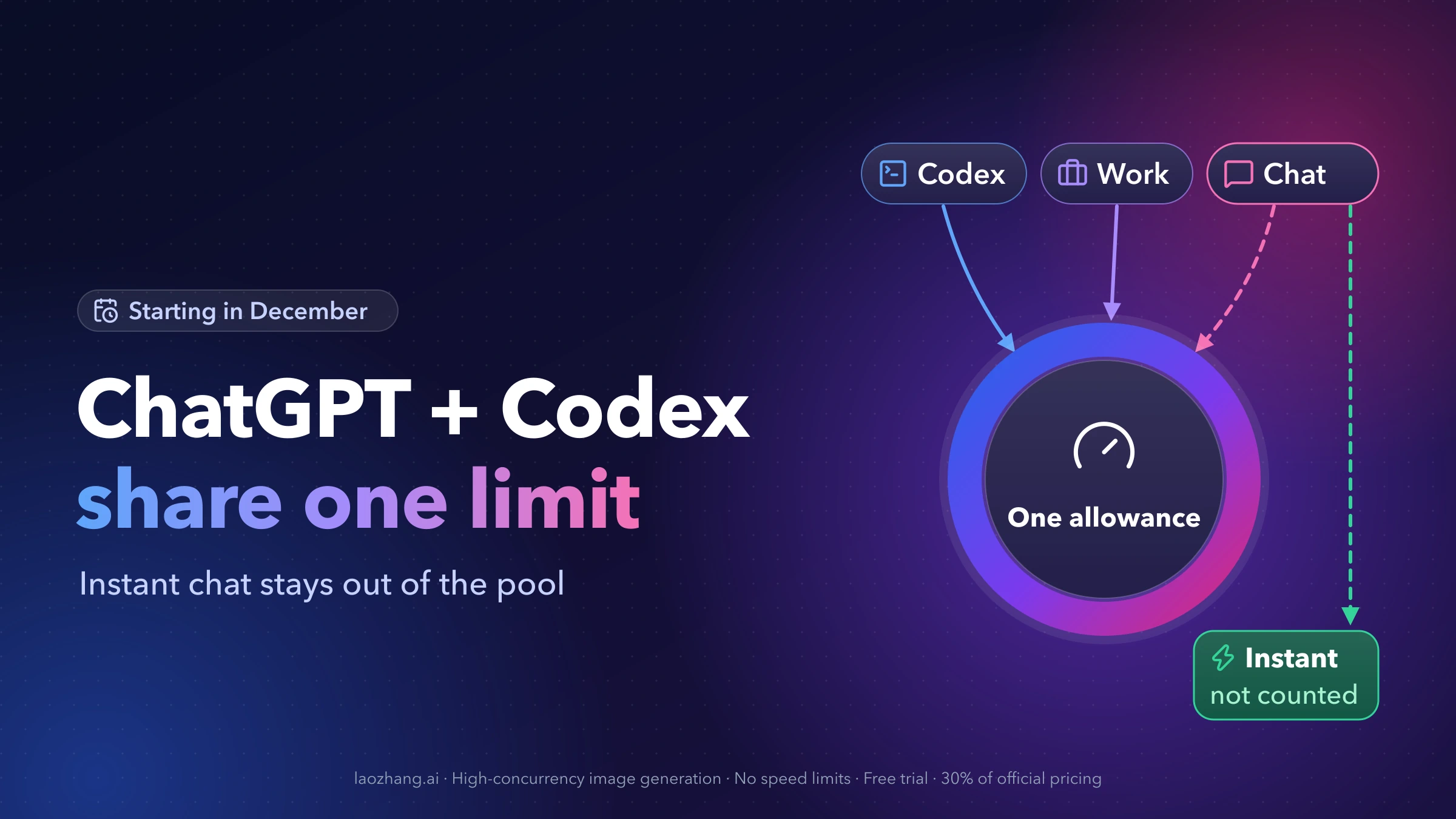
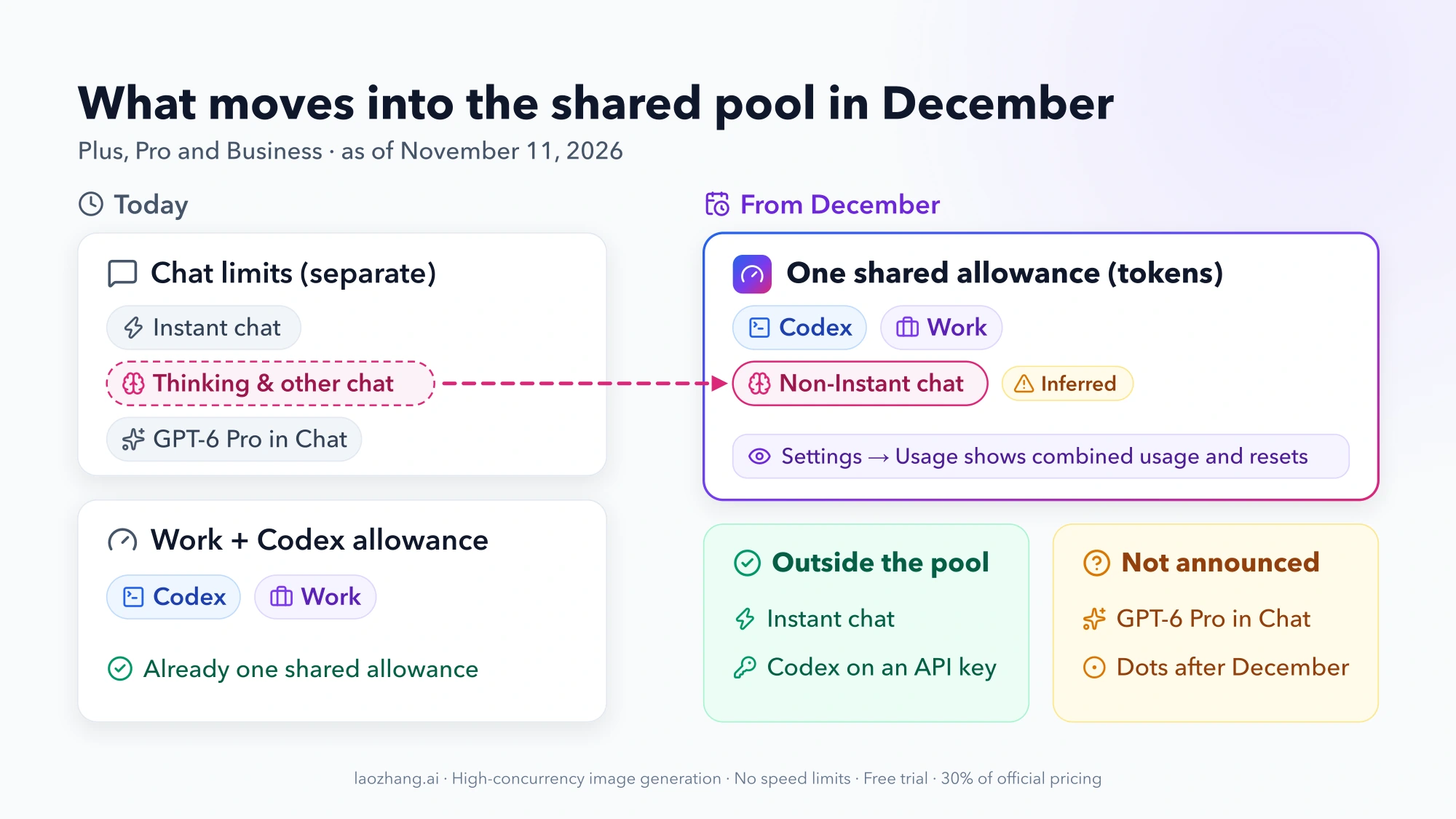
Starting in December 2026, ChatGPT Plus, Pro and Business plans get one usage allowance shared across ChatGPT and Codex, measured in tokens. That is the whole of OpenAI's announcement in its help article Understanding ChatGPT and Codex usage limits. The practical meaning is narrower than "everything merges": Work and Codex already share one allowance today, so the new part is regular ChatGPT chat joining that pool. Instant chat will not draw from your usage.
If you use Codex every day and also run long, higher-reasoning chats, those two habits will compete for the same budget from December. If your chats are mostly quick Instant questions, OpenAI's wording says they stay outside the pool. Several things that decide how much this hurts are still unpublished as of November 11, 2026: the exact start day, the size of the combined pool for each plan, how many tokens chat models consume, and what happens to Go, Free, Enterprise and Edu. The useful move right now is to record your current Codex usage so you have something to compare against when the switch lands.
What joins the shared pool in December: Chat, not Work or Codex
The December change does not merge Codex with Work. OpenAI's help page on managing usage in Work and Codex already says "Work and Codex share the usage allowance included with your plan." What joins is regular chat in ChatGPT. Here is the before-and-after by surface, with each row marked as stated by OpenAI, inferred from its wording, or not yet published.
| Surface | Today (as of November 11, 2026) | From December | Status |
|---|---|---|---|
| Codex (app, CLI, IDE, cloud tasks) | Shared Work + Codex allowance | Stays in the shared allowance, now also shared with Chat | Stated |
| ChatGPT Work | Same allowance, pricing and credits as Codex | Same, plus Chat | Stated |
| Instant chat | Separate chat limits | "Will not draw from your usage" | Stated |
| Other chat (Thinking or higher-reasoning conversations) | Separate chat limits | Draws from the shared allowance | Inferred: Instant is the only exemption OpenAI names |
| GPT-6 Pro in Chat (Pro, Business, Enterprise) | Own message limits, separate from Work + Codex | Not stated | Unknown |
| Voice in the Codex desktop app | Uses Codex budget at $0.05 per minute | Not stated separately | Today's rule |
| Image generation in Work and Codex | Uses included limits about 3–5x faster on average | Not stated separately | Today's rule |
| ChatGPT for Excel (Plus and Pro) | Already shares the Work + Codex limit | Not stated separately | Today's rule |
| Dots (Pro, Business Premium) | Separate from default usage "for now" | Not stated | Unknown |
| Codex with an API key | Billed at API rates, outside plan usage | Not affected by the plan pool | Today's rule |
The Voice, image and Excel rows come from OpenAI's Codex pricing page. The inference in the second chat row matters most for heavy chat users. OpenAI says "more advanced models and complex tasks generally use more of your allowance" and exempts only Instant, so any chat that isn't Instant should be expected to count. OpenAI has not published a per-mode list.
OpenAI also states two things about the experience after the switch. You will see "combined remaining usage and reset times in Settings → Usage." And at the limit you can "wait for it to reset, upgrade your plan, or buy credits." OpenAI adds that it expects "most users won't need to wait for their usage to reset more often than they do now." That is an expectation, not a number or a guarantee.
Which plans the December change names: Plus, Pro and Business
The help article names three plan families: Plus, Pro and Business. It says nothing about Go, Free, Enterprise or Edu. Some summaries say those plans are "not included," but OpenAI's text only lists the plans that are covered and is silent on the rest.
| Plan | Codex and Work today | Named in the December article? |
|---|---|---|
| Plus ($20/month) | Included; 5-hour and weekly windows | Yes |
| Pro 100, Pro 200, Pro 500 | Included; no 5-hour limit in Work and Codex, weekly allowance applies | Yes ("Pro") |
| Business Standard and Premium seats | Included; Standard has the same 5-hour estimates as Plus | Yes ("Business") |
| Go ($8/month) and Free | GPT-6 Luna at Standard speed in the desktop app, subject to rollout | No |
| Enterprise and Edu | Flexible pricing: no fixed rate limits, usage scales with credits. Without it: same per-seat limits as Plus for most features | No |
The plan details come from the Codex pricing page and OpenAI's Pro tiers help page. Pro numbers moved recently. On October 29, 2026, OpenAI's Codex lead Tibo Sottiaux announced on X a doubling of usage limits for all Pro tiers and Business Premium, and the reduction planned for Pro 200 was canceled. On November 8 he posted the multiples compared with Plus: Pro 100 = 10x, Pro 200 = 20x, Pro 500 = 50x. The help page confirms the doubling but gives no multiples, so treat those figures as his statement. Whether the multiples carry over to the combined pool is not stated.
If you are on Go and weighing Plus mainly for Codex, the December change is one more factor. ChatGPT Go vs Plus: Features, Usage Limits, and Codex covers that choice.
What OpenAI has not published yet (as of November 11, 2026)
These gaps decide how much the change affects you. None of them appear in OpenAI's help articles, the Codex pricing page or posts from OpenAI staff as of November 11, 2026:
- The start day. The article says "starting in December" and gives no date.
- The size of the combined pool for any plan, or whether it is larger than today's Work + Codex allowance.
- How many tokens chat models consume compared with Codex models.
- Whether chat follows the 5-hour and weekly windows that Work and Codex use today.
- What happens to GPT-6 Pro in Chat, which today has its own message limits.
- Whether dots stay separate after December. Tibo said on October 29 that dot usage "will still continue to be separate from your default usage," with extended dot limits offered "for now." A GitHub issue asking whether that survives December (#60585) had no answer as of November 11.
- Go, Free, Enterprise and Edu. Not named either way.
- How banked and purchased resets work on the combined pool. Today they are described for the Work + Codex allowance only.
Plus users have pushed back in public. Open GitHub issues such as #58530 and #58655 ask OpenAI to keep high-reasoning ChatGPT separate from Codex and to publish limits and per-model consumption before the change. Neither had an OpenAI reply as of November 11, 2026.
Measure your Codex usage baseline now, before the switch
The only way to tell after December whether chat is eating your coding budget is to know what a normal week looks like now. Today your Work + Codex meter shows only Work and Codex. Chat is not in it yet, so this is a clean baseline.
- Find your meters. In ChatGPT, open Settings → Usage to see the 5-hour and weekly allowance and their reset times. In an active Codex CLI session, type
/status. How to Check Your ChatGPT Plus Usage Quota and Reset Time walks through both screens. - Log one ordinary week. At the start and end of each coding session, note the percentage left in the 5-hour window and in the weekly allowance, the reset times, the model and reasoning effort, and whether the work ran locally or as cloud tasks.
- Count your non-Instant chat habit separately. You cannot see its token cost today, so record activity instead: how many Thinking or long-document chats you run on a typical day, and whether you generate images in Chat.
- Note when you hit a wall. Which window stopped you, after how many sessions, and on which day of the week.
- Repeat the same week after the switch. Use the same kind of work. If you now hit the 5-hour limit after two sessions where you used to get four, and your chat count stayed the same, chat is the difference.
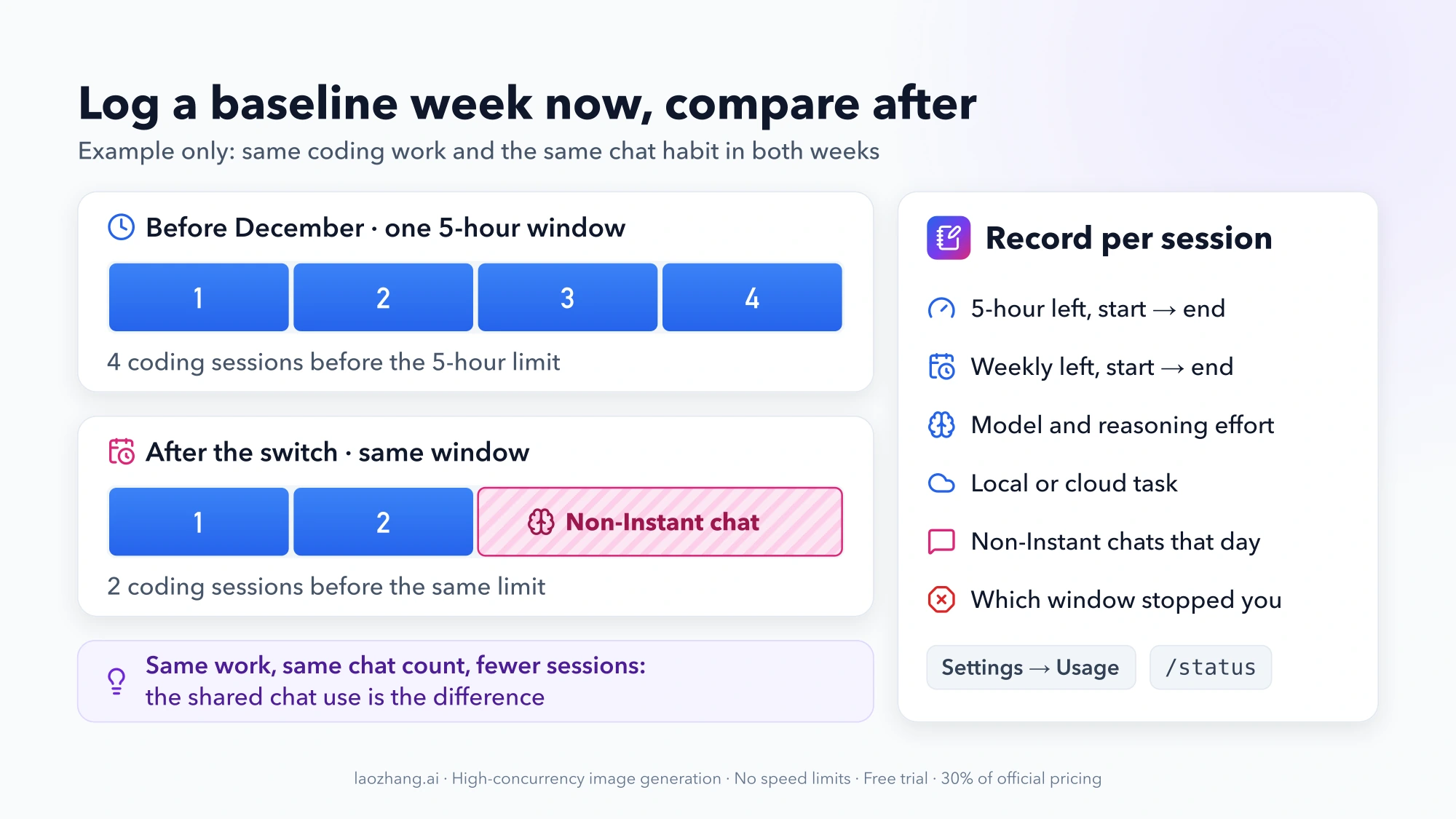
Keep the record short. A row per session is enough:
| Date | Session | 5-hour left (start → end) | Weekly left (start → end) | Model / effort | Local or cloud | Non-Instant chats that day |
|---|---|---|---|---|---|---|
| Nov 12 | Morning refactor | 100% → 35% | 82% → 71% | GPT-6.1 Sol / medium | Local | 6 |
The numbers in that row are a format example, not a measurement.
For reference, OpenAI's current estimates for Plus and Standard Business are 5–45 local messages per 5 hours on GPT-6 Astra, 15–160 on GPT-6.1 Sol, 35–285 on GPT-6.1 Terra, 15–150 on GPT-6 Sol and 350–3,000 on GPT-6 Luna. OpenAI calls these "estimates, not guaranteed message counts," and they describe today's Work + Codex allowance. Nobody has said what they become once chat shares the pool.
How often do Codex usage limits reset? The 5-hour and weekly windows
Codex on Plus and Standard Business uses two windows at once: a 5-hour window and a weekly window. You need allowance left in both to keep going. A new 5-hour window starts with your first Work or Codex message after the previous window ends, not on a fixed clock. That is why you can hit the 5-hour limit with weekly usage still left. OpenAI documents no separate daily limit. Pro 100, Pro 200 and Pro 500 currently have no 5-hour limit in Work and Codex, only the weekly allowance.
Resets come in three kinds today. An automatic reset happens when a window ends. A banked reset is saved to your account and used from Settings → Usage in the ChatGPT desktop app. A purchased instant reset is available to eligible personal Plus and Pro accounts, depending on billing country. A purchased reset refreshes both the 5-hour and weekly Work + Codex allowance and starts a new weekly period with your next request. These rules are documented for today's allowance. OpenAI has not said how they apply once chat joins.
What drains a shared allowance faster: model, effort, Fast mode, images
After December, a single expensive habit in either product draws down the budget for both. OpenAI lists these factors for Work and Codex today:
- Model choice. Bigger models use more for the same task.
- Reasoning effort. Higher effort uses more and "does not always produce a better result." OpenAI notes that Astra at Low effort can outperform Sol at High.
- Fast mode. It uses included allowance at 2.5x the Standard rate.
- Cloud tasks can use more than local messages.
- Larger inputs and outputs and multi-step tasks. OpenAI's tips include trimming prompts, limiting source material, shortening
AGENTS.mdand connecting fewer MCP servers. - Image generation uses included limits about 3–5x faster on average.
- Voice in the desktop app uses Codex budget at $0.05 per minute.
Credit prices give a rough sense of the gap between models. On the Codex pricing page, output costs 1,250 credits per million tokens on GPT-6 Astra, 250 on GPT-6.1 Sol and 12.5 on GPT-6 Luna. That is a ratio of 1,250 : 250 : 12.5 = 100 : 20 : 1. OpenAI warns that "credit prices alone don't determine included subscription usage," so use the ratio to rank models, not to predict your allowance. It roughly matches the 5-hour estimates above, where Astra allows 5–45 messages and Luna 350–3,000.
One thing that will not help: switching models after you hit the limit. OpenAI states that "switching models does not restore allowance in a shared usage pool." Once chat is in the pool, that applies to switching between chat and Codex as well.
Will ChatGPT chats eat your Codex budget? Decide by usage pattern
Find the row closest to how you work. The effects are judgments from OpenAI's published rules. Until pool sizes are public, nobody can put a number on them.
| How you use ChatGPT and Codex | Likely effect in December | What to change first |
|---|---|---|
| Codex daily, chat mostly quick Instant questions | Small: Instant chat does not draw from usage | Keep quick lookups on Instant; keep your baseline log anyway |
| Codex daily on Plus and long Thinking or document chats | Most exposed: both habits draw from one allowance | Lower reasoning effort where results hold up; move simple questions to Instant; check Settings → Usage before a large Codex task |
| Rarely use Codex, heavy non-Instant chat | Chat becomes token-metered; impact depends on the unpublished pool size | Watch Settings → Usage in the first December week before changing plans |
| Pro 100, 200 or 500 | No 5-hour limit in Work and Codex today; weekly allowance at 10x, 20x or 50x Plus per Tibo Sottiaux | Check how GPT-6 Pro in Chat and dots are treated once OpenAI publishes it |
| Business Standard or Premium seat | Named in the change; limits follow your seat | Ask your workspace admin how credits are handled before your team hits the limit |
| Go or Free | Not named; Codex today is GPT-6 Luna in the desktop app | Nothing to prepare yet |
When the combined meter runs out, these are the legitimate options OpenAI documents:
- Let the active turn finish. If you hit the limit mid-turn, the agent can continue that turn, subject to fair use.
- Wait for the reset, or use a banked reset if you have one.
- Buy credits. Plus and Pro can buy credits to keep using eligible features. A purchased instant reset is a separate option for eligible personal accounts.
- Upgrade. Moving from Plus to Pro 100 removes the 5-hour window in Work and Codex today. Only upgrade if your baseline shows the 5-hour window, not the weekly one, is what stops you.
- Run extra local Codex work on an API key. OpenAI says "all users may also run extra local chats using an API key, with usage charged at standard API rates." Signing in with ChatGPT uses plan usage. An API key uses API pricing and stays outside the plan pool. OpenAI's ChatGPT Work and Codex help article covers the sign-in difference. To point Codex at a different provider, see Connect Codex to a Third-Party Model API Without Guessing the Protocol.
If a Codex request fails with a 429 and you are not sure which meter stopped it, Codex 429 After Retries: Find the Limit That Owns the Request separates plan usage from API and workspace limits. Whether a limit follows your account, workspace or API project is a different question from this one. Are Codex Limits Shared Across Accounts? covers it.
ChatGPT and Codex shared limits: short answers
Are Codex and Work merging in December? No. They already share one allowance. December adds regular ChatGPT chat to that allowance on Plus, Pro and Business.
Does Instant chat count against the shared ChatGPT and Codex limit? No. OpenAI states that "Instant chat will not draw from your usage." That is the only exemption it names. It does not mean Instant has no limits of its own.
What date in December do ChatGPT and Codex start sharing usage? OpenAI has not given a day. The help article says only "starting in December." Settings → Usage will show the combined remaining usage once the change is live.
Will the current Codex 5-hour estimates still apply after the merge? OpenAI has not said. The 5–45 (Astra) to 350–3,000 (Luna) message ranges describe today's Work + Codex allowance without chat.
Can Plus users still use GPT-6 Astra in Codex? Yes. Today Plus includes Astra in Work and Codex, but not GPT-6 Pro in Chat. Astra is also the model that drains the allowance fastest. GPT-6 Astra Access: Plus Gets It in Work and Codex, Not Chat has the details by plan.
Will dots stay separate from the shared pool? For now, yes, on Pro and Business Premium. Whether that holds after December has not been announced. Dot billing begins November 18, 2026, and work a dot hands to Work or Codex threads is billed separately at standard rates, per OpenAI's dots help page.