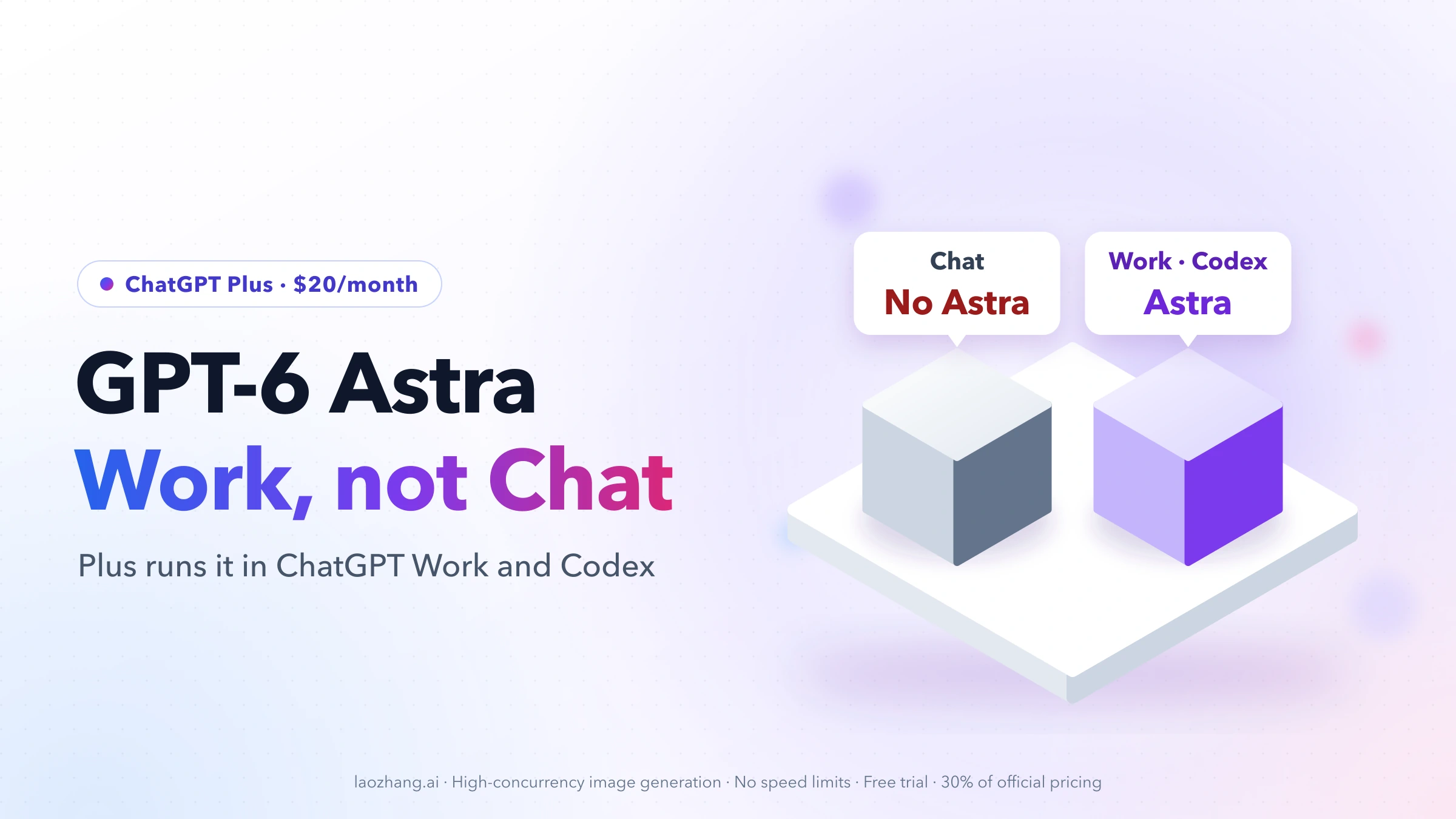
"ChatGPT Astra" is the name people use for GPT-6 Astra, the model OpenAI released in early September 2026 and calls its most intelligent yet. Whether you can use it today depends on two things: your plan, and which part of ChatGPT you are in. As of October 6, 2026:
- Plus ($20/month): Astra is included in ChatGPT Work and Codex, not in standard Chat. OpenAI estimates 5–45 local messages per five-hour window. In Chat, Plus runs GPT-5.6 Sol.
- Pro $100, Pro $200, Business and Enterprise: Astra is also in standard Chat, labeled GPT-6 Pro, with its own usage limit.
- Free and Go: no Astra on any surface.
- API: model ID
gpt-6-astra, $10 per 1M input tokens and $50 per 1M output tokens. A ChatGPT subscription does not pay for API calls.
For most work, start with GPT-6.1 Sol and switch to Astra only for tasks Sol gets wrong or stalls on. On Plus, Sol's estimated allowance is roughly three times larger per window, and in the API it costs a fifth as much per input and output token.
Where GPT-6 Astra runs on each ChatGPT plan (as of October 6, 2026)
OpenAI's Help Center article GPT-5.6 and GPT-6 Pro in ChatGPT puts it this way: "GPT‑6 Pro, powered by GPT‑6 Astra, is available in ChatGPT for Pro $100, Pro $200, Business and Enterprise plans." It adds: "Plus plans include GPT‑6 Astra in ChatGPT Work and Codex." Plan prices and Work/Codex allowances come from the ChatGPT and Codex pricing page.
| Plan (US price, before tax) | Standard Chat | ChatGPT Work and Codex | Astra Ultrafast |
|---|---|---|---|
| Free ($0) | No Astra (GPT-5.6 Luna) | No Astra (GPT-6 Luna in the desktop app, subject to rollout) | No |
| Go ($8/month) | No Astra (GPT-5.6 Luna) | No Astra (GPT-6 Luna in the desktop app, subject to rollout) | No |
| Plus ($20/month) | No Astra (GPT-5.6 Sol at Instant, Medium and High) | GPT-6 Astra, about 5–45 local messages per five hours | No, even with purchased credits |
| Pro $100 and Pro $200 | GPT-6 Pro, powered by Astra, with a weekly limit | GPT-6 Astra, no five-hour limit (weekly limits may apply) | No, even with purchased credits |
| Pro $500 | Not named in the Help Center's GPT-6 Pro list | GPT-6 Astra, no five-hour limit (weekly limits may apply) | Yes: included usage first, then credits |
| Business ($20 per user/month billed annually, $25 monthly, 2+ users) | GPT-6 Pro, sharing an allowance with GPT-5.6 Sol Pro | GPT-6 Astra, about 5–45 local messages per five hours | No |
| Enterprise and Edu | GPT-6 Pro on Enterprise, if workspace model-access permissions allow it | Astra once a workspace owner enables model access (off by default at launch) | Eligible plans only; off by default on Enterprise |
Three details in that table cause most of the confusion:
- ChatGPT Work and Codex are one allowance. OpenAI's pricing page says Work "uses the same pricing, credits, and usage limits as Codex," and that allowance is separate from Chat.
- "GPT-6 Pro" is not the Pro plan. GPT-6 Pro is a model option inside Chat; the Pro plan is the $100, $200 or $500 subscription. Business and Enterprise get GPT-6 Pro without being on a Pro plan.
- The message ranges are estimates. OpenAI says they "are not fixed message limits"; your usage dashboard shows the real remaining amount.
Why Plus users don't see Astra in the Chat model picker
Plus users can't select Astra in standard Chat because Plus doesn't include it there. On paid plans, Chat's thinking levels Instant, Medium, High and Extra High run on GPT-5.6 Sol, and a separate Pro level holds the Pro models. On Plus, Instant, Medium and High are included; Extra High and the Pro level are not. GPT-6 Pro sits under the Pro level, so a Plus account has no route to Astra from the Chat picker.
The launch post said Astra would come to "all ChatGPT Plus, Pro, Business and Enterprise users" in the days after its first limited release. That is also true once you separate the surfaces: Plus users got Astra in ChatGPT Work and Codex. During the rollout, the Help Center warned that "availability can differ between Chat, Work and Codex," and the Chat-versus-Work split is that difference.
Plus users have pushed back on this in an OpenAI Developer Community thread with more than 28,000 views. According to posters there, OpenAI Support confirmed the split but could not say whether Plus will ever get Astra in standard Chat. OpenAI has made no announcement either way.
If you want more from Chat specifically, the upgrade that adds Astra there is Pro or Business, not Extra High on Plus. If you're still choosing between the cheaper plans, ChatGPT Go vs Plus: Features, Usage Limits, and Codex covers what each includes on the Codex side.
How to open GPT-6 Astra in ChatGPT Work, Codex or Chat
The shortest route on Plus is the ChatGPT desktop app, available for macOS, Windows and Linux:
- Update the app first. Open Menu > Check for Updates and install the latest version. OpenAI says to do this even if you just updated through the automatic prompt or the update icon in the sidebar.
- Switch to Work. Use the toggle above the message box to select Work instead of Chat.
- Pick GPT-6 Astra from the model options and describe the task. The work counts against your shared Work and Codex allowance.
In Codex, Plus includes Codex on the web, in the CLI, in the IDE extension and on iOS. The Codex CLI needs version 0.153.0 or newer to offer Astra. During a CLI session, /status shows how much of your limit is left.
On Pro $100, Pro $200, Business and Enterprise, you can also use Astra in standard Chat. Choose the Pro thinking level, then GPT-6 Pro. Enterprise users only see it if the workspace's model-access permissions allow it.
GPT-6 Astra not showing up: six checks in order
Work through these in order. The first one that matches is usually the answer.
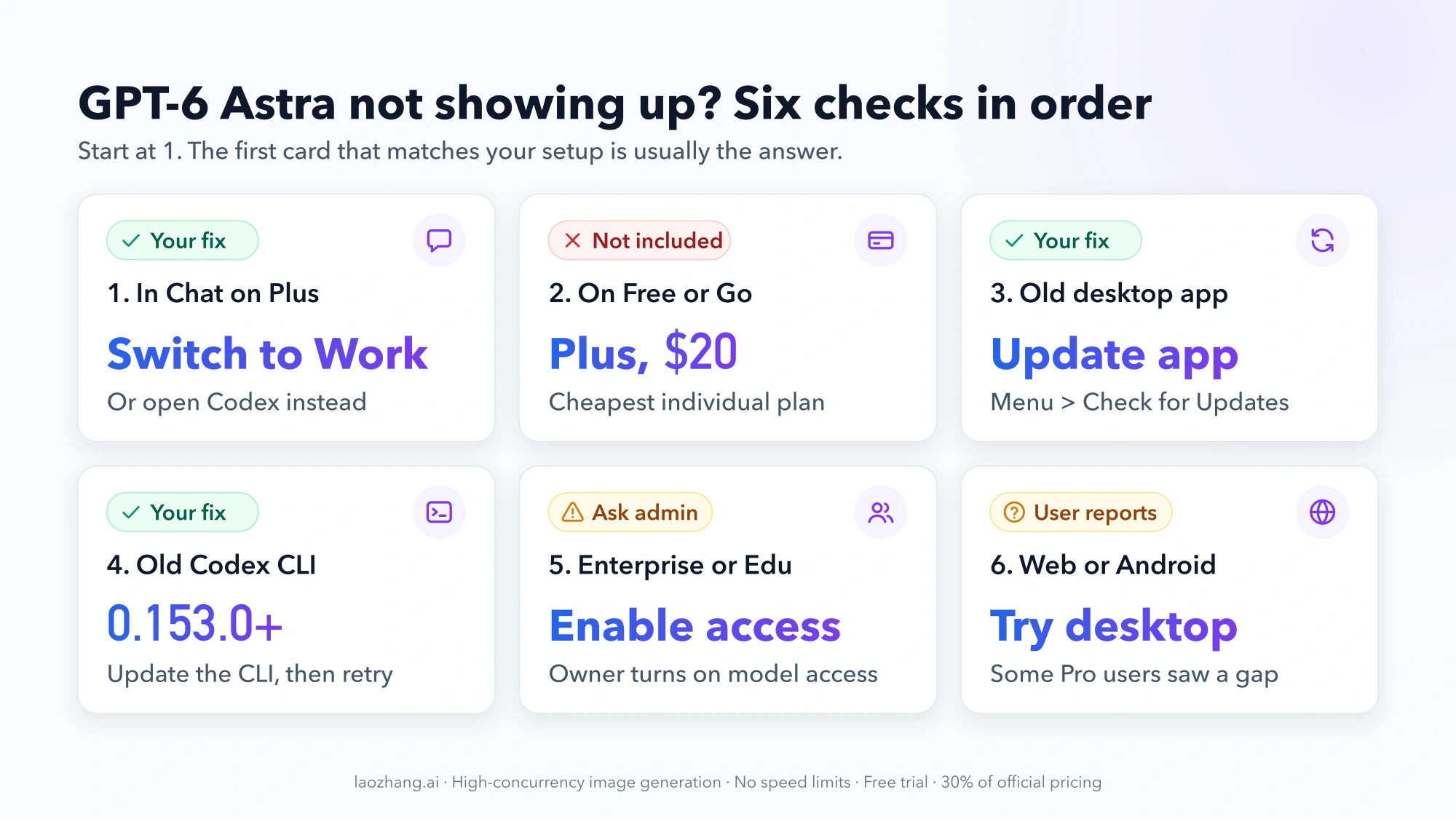
- You're in Chat on Plus. This is expected. Switch to Work or open Codex.
- You're on Free or Go. Neither plan includes Astra on any surface, so stop here unless you plan to upgrade. Plus is the cheapest individual plan that includes it.
- The desktop app is out of date. Run Menu > Check for Updates even if the app updated itself recently.
- Your Codex CLI is older than 0.153.0. Update the CLI. Older versions don't list Astra.
- Your workspace hasn't enabled it. On Enterprise and Edu, the workspace owner must enable model access, and Astra was off by default at launch. Ask your admin. Business and Enterprise access also depends on workspace permissions.
- You're on the web or a phone. In the community thread above, some Pro subscribers said they saw Astra only in Work and Codex on the web and Android, while the desktop app worked. These are user reports, not documented behavior, but trying the desktop app is a quick test.
One more case looks like a missing model but isn't. On Pro $200, once you hit the GPT-6 Pro weekly limit, ChatGPT switches you to GPT-5.6 Thinking at Medium on its own. On Pro $100, GPT-6 Pro and GPT-5.6 Sol Pro share one weekly allowance, so switching between them doesn't add messages. OpenAI Support can't reset usage limits. After that, you wait for the reset or buy credits for Work and Codex.
GPT-6 Astra usage limits: about 5–45 messages per five hours on Plus
On Plus and Standard Business, OpenAI estimates 5–45 local Astra messages per five-hour window in Work and Codex. That is the smallest range of any GPT-6 model. The figures below are OpenAI's estimates from its pricing page, as of October 6, 2026:
| Model in Work and Codex | Estimated local messages per 5 hours (Plus and Standard Business) |
|---|---|
| GPT-6 Astra | 5–45 |
| GPT-6.1 Sol | 15–160 |
| GPT-6 Sol | 15–150 |
| GPT-6 Luna | 350–3,000 |
Several things decide where you land in that range:
- Task size. Model choice, context, reasoning, tool use, retrieval and caching all count. Big repositories and long sessions sit near the bottom of the range, and cloud tasks can use more than local messages.
- Weekly limits. Weekly limits may apply on top of the five-hour window. Pro plans currently have no five-hour limit, but weekly limits can still apply.
- Speed mode. Fast mode draws included usage at 2.5× the Standard rate, and Astra Ultrafast at 8×.
OpenAI's tips for making the allowance last are practical. Keep prompts precise. Give only the files you need. Define the output format and length up front. Keep AGENTS.md files small. Turn off MCP servers you aren't using, because each one adds context to every message.
GPT-6 Pro limits in standard Chat
GPT-6 Pro in Chat has its own limit, separate from Work and Codex. OpenAI says plainly that "A Pro subscription does not include unlimited use of the GPT-6 Pro model." It doesn't publish exact GPT-6 Pro message counts. Business Standard and Premium share their included allowance between GPT-6 Pro and GPT-5.6 Sol Pro.
What happens when your Astra allowance runs out
If you hit the limit in the middle of a task, the agent can finish that turn, subject to fair-use limits. After that, you have three options:
- Buy credits. Plus and Pro users can buy credits without upgrading. Business, Edu and Enterprise plans with flexible pricing buy workspace credits.
- Use an API key. Any user can run extra local chats with an API key and pay standard API rates.
- Switch models. GPT-6.1 Sol or GPT-6 Luna draw much less from the same pool.
Credits are charged per million tokens. In Work and Codex, Astra costs 250 credits per 1M input tokens, 25 per 1M cached input tokens and 1,250 per 1M output tokens. GPT-6.1 Sol costs 50, 2.5 and 250. Astra therefore burns five times as many credits as GPT-6.1 Sol on input and output.
Take one task with 20,000 fresh input tokens, 80,000 cached input tokens and 4,000 output tokens:
- Astra: 20,000 × 250/1M + 80,000 × 25/1M + 4,000 × 1,250/1M = 5 + 2 + 5 = 12 credits
- GPT-6.1 Sol: 1 + 0.2 + 1 = 2.2 credits
- Astra Ultrafast: 6 × 12 = 72 credits (Pro $500 and eligible Enterprise and Edu only)
What a credit costs in dollars depends on your plan or agreement, so treat these as relative figures, not a bill. Fast mode on purchased credits is billed at 2× the Standard rate. The tier itself is explained in OpenAI Ultrafast vs Sol: $7.20 vs $0.22 for the Same Request.
GPT-6 Astra API pricing: $10 input and $50 output per 1M tokens
In the OpenAI API, the model ID is gpt-6-astra. Standard pricing is $10 per 1M input tokens and $50 per 1M output tokens, as of October 6, 2026, on OpenAI's API pricing page. Prices are in USD and exclude tax.
gpt-6-astra tier, per 1M tokens | Input | Cached input | Cache writes | Output |
|---|---|---|---|---|
| Standard, up to 272K input tokens | $10.00 | $1.00 | $12.50 | $50.00 |
| Standard, over 272K input tokens (whole request) | $20.00 | $2.00 | $25.00 | $75.00 |
| Batch or Flex, up to 272K | $5.00 | $0.50 | $6.25 | $25.00 |
| Fast, up to 272K | $20.00 | $2.00 | $25.00 | $100.00 |
| Ultrafast, up to 272K | $60.00 | $6.00 | $75.00 | $300.00 |
| Ultrafast, over 272K | $120.00 | $12.00 | $150.00 | $450.00 |
For comparison, gpt-6.1-sol Standard costs $2 input, $0.10 cached input, $2.50 cache writes and $10 output. gpt-6-luna costs $0.10, $0.01, $0.125 and $0.50. Astra is five times GPT-6.1 Sol on input and output and ten times on cached input. Regional processing (data residency) endpoints add 10%.
Your ChatGPT subscription does not cover any of this. OpenAI's pricing page says "API token prices are separate from subscription usage." The free API tier can't call gpt-6-astra at all. If you don't have a key yet, OpenAI API Key: How to Get One, Use It, and What It Costs walks through setup.
API specs that change how you call gpt-6-astra
These come from the GPT-6 Astra model page and OpenAI's GPT-6 guide:
- Context: 1,050,000-token context window, 128,000 max output tokens, knowledge cutoff April 30, 2026. Text and image in, text out.
- Reasoning effort:
low,medium,high,xhighandmax. There is nonone. If your code sendsnoneorminimal, start withlow. Reasoning tokens bill as output; see Are Reasoning Tokens Billed? OpenAI, Claude, and Gemini Costs. - Tools: Chat Completions works for requests without tools, but tool calling requires the Responses API. Responses supports web search, file search, image generation, code interpreter, hosted shell, apply patch, skills, computer use, MCP and tool search. Chat Completions vs Responses API: Which One Should You Use? explains the switch.
- Not supported: fine-tuning.
- Rate limits: Tier 1 gets 500 RPM and 500,000 TPM. Tier 2 gets 5,000 RPM and 1M TPM, Tier 3 5,000 RPM and 2M TPM, Tier 4 10,000 RPM and 4M TPM, and Tier 5 15,000 RPM and 40M TPM.
- Ultrafast: set
service_tiertoultrafast. It is open to every API user at low default limits: 500,000 TPM on Tiers 1–3, 1M on Tier 4 and 5M on Tier 5. It runs on US data residency or global processing only.
Worked example: one request costs $0.48 on Astra and $0.088 on GPT-6.1 Sol
Use the same request as before: 20,000 fresh input tokens, 80,000 cached input tokens and 4,000 output tokens, at Standard short-context rates.
- GPT-6 Astra: 20,000 × $10/1M + 80,000 × $1/1M + 4,000 × $50/1M = $0.20 + $0.08 + $0.20 = $0.48
- GPT-6.1 Sol: 20,000 × $2/1M + 80,000 × $0.10/1M + 4,000 × $10/1M = $0.04 + $0.008 + $0.04 = $0.088
- GPT-6 Astra on Batch or Flex: $0.10 + $0.04 + $0.10 = $0.24
- GPT-6 Astra on Ultrafast: $1.20 + $0.48 + $1.20 = $2.88
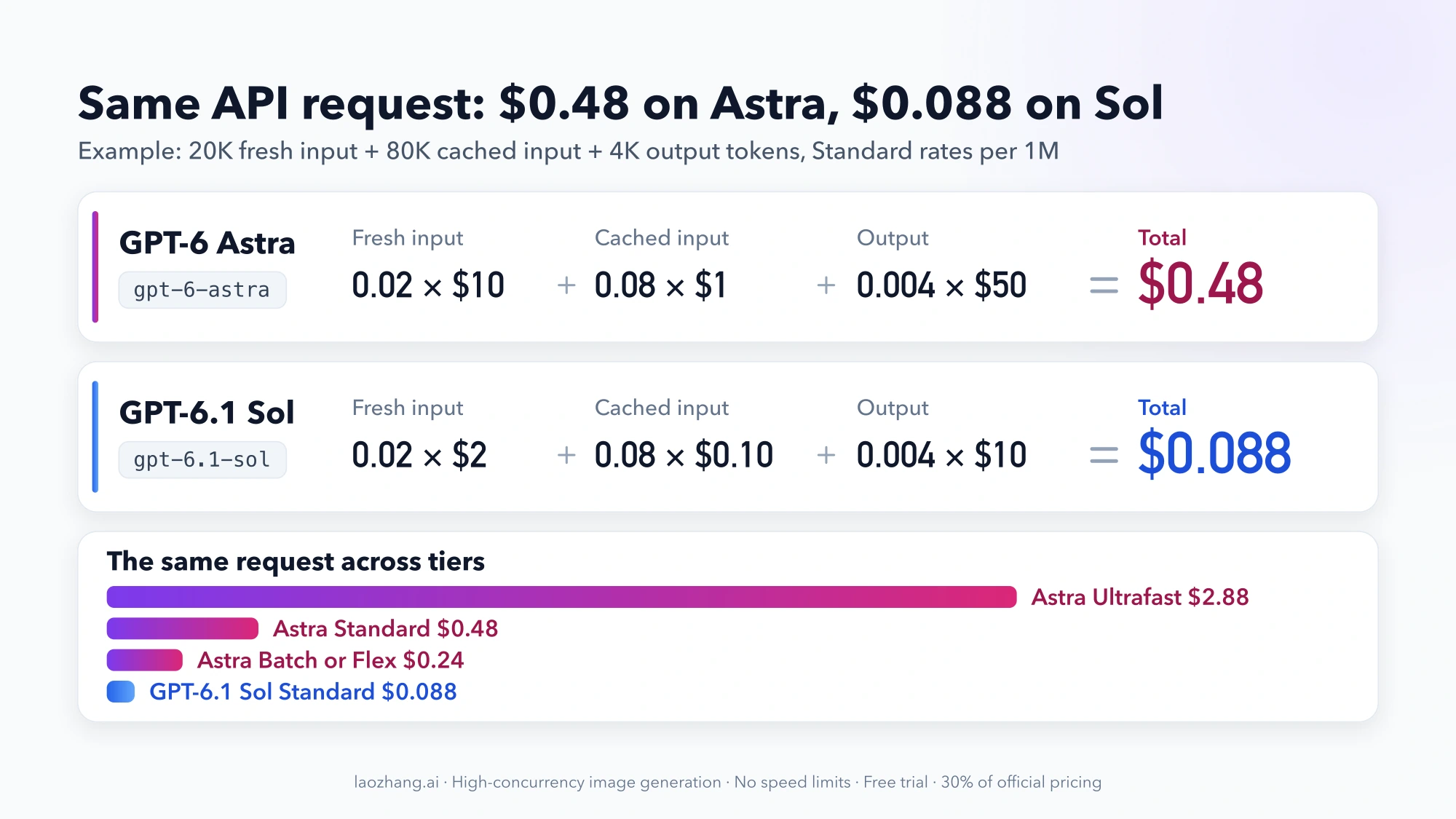
At these token counts, Astra costs about 5.5 times as much as GPT-6.1 Sol. Watch the 272K line too. A request with 300,000 fresh input tokens and 5,000 output tokens costs 300,000 × $20/1M + 5,000 × $75/1M = $6.00 + $0.375 = $6.38. At short-context rates, the same tokens would cost $3.25.
These figures assume the two models use the same number of tokens. They exclude retries, tool fees and cache-write charges. Real tasks differ, because the models spend different amounts of reasoning on the same problem. For long-context, caching and batch scenarios against Anthropic's top model, see GPT-6 Astra vs Claude Fable 5.1 API Cost: Where the Tie Breaks.
If you already send several vendors' models through one OpenAI-compatible key, the third-party gateway laozhang.ai lists gpt-6-astra at the same Standard token rates: $10 input, $1 cached input and $50 output up to 272K, and $20, $2 and $75 above it (its page was updated October 5, 2026). That page doesn't document the Responses-only tools, Fast or Ultrafast tiers, zero data retention or rate limits. It also doesn't give you ChatGPT Work or Codex. For most US developers, the official API is the more direct route.
Is GPT-6 Astra better than GPT-6.1 Sol? Which to make your default
Astra is OpenAI's strongest model, but GPT-6.1 Sol is the better default for most people. OpenAI's own guide describes Astra as "highest intelligence" for "the most demanding reasoning, coding, and professional work." It describes GPT-6.1 Sol as "near-Astra performance for complex work at a lower cost" and tells you to "compare it with Astra on your tasks." Neither model is in Chat on Plus: GPT-6.1 Sol is also limited to Work and Codex.
Here is a decision rule that follows from the prices and allowances above:
| Your situation | Default | Move to Astra when |
|---|---|---|
| Plus, everyday Work or Codex tasks | GPT-6.1 Sol (15–160 messages per 5 hours) | Sol fails, loops, or misses a requirement you've already clarified |
| Long multi-step jobs across code, browsers and apps where a failed run is expensive | Astra | Already Astra; on Plus, check the remaining allowance before starting |
| API workload at scale | GPT-6.1 Sol, or GPT-6 Luna for simple, high-volume calls | Your evaluation shows Sol's errors cost more than Astra's roughly 5× token price |
| Pro or Business, hard questions in Chat | GPT-6 Pro | Already Astra; watch the weekly limit |
| Proof-of-concept exploit work | Not Astra | Never: Astra refuses higher-risk cyber tasks such as proof-of-concept exploits |
OpenAI's benchmark table supports Astra's lead over the previous generation, but treat it as vendor data. All scores were run at the highest reasoning effort, and OpenAI notes that outputs may differ slightly from ChatGPT. The table compares Astra with GPT-5.6 Sol and Claude Fable 5.1, not with GPT-6.1 Sol, which shipped later:
| Benchmark (OpenAI-reported) | GPT-6 Astra | GPT-5.6 Sol | Claude Fable 5.1 |
|---|---|---|---|
| Terminal-Bench 4.0 | 57.9% | 37.3% | 55.8% |
| DeepSWE v1.1 | 74.1% | 72.7% | 67.4% |
| OSWorld 2.0 | 72.6% | 65.7% | – |
| Artificial Analysis Intelligence Index v4.1.1 | 61.2 | 60.9 | 65.7 |
| Humanity's Last Exam (with tools) | 57.2% | – | 65.0% |
Claude Fable 5.1 leads on two of those rows, so "best at everything" isn't supported. In OpenAI's OSWorld latency simulation, Astra took about 40 minutes per task versus about 75 for GPT-5.6 Sol. OpenAI also says that in several evaluations Astra used substantially fewer output tokens, so its estimated API cost per task came in lower than earlier models despite the higher token price. That is OpenAI's own evaluation. Test it on your work before you count on it. For GPT-6.1 Sol's numbers against Anthropic, see GPT-6.1 Sol vs Claude Opus 5.5: Half the Price, 1/6 the Task Cost. For the cheaper end of the family, see GPT-6 Luna vs. Sol pricing: calculate the cost of your workload.
One more trade-off: Astra runs extra safety checks. They can slow, pause or stop legitimate work, including defensive security work. In ChatGPT and Codex, a paused task may ask you to review an action before it continues. In the API, the task stops.
Questions about ChatGPT Astra access, price and release
Can I use GPT-6 Astra for free?
No. Free and Go don't include Astra in Chat, Work or Codex; their Work and Codex model is GPT-6 Luna. The API's free tier can't call gpt-6-astra either. The cheapest way in is Plus at $20 a month, which gives you Astra in Work and Codex only.
Does ChatGPT Plus include GPT-6 Astra?
Yes, but only in ChatGPT Work and Codex. OpenAI estimates 5–45 local messages per five hours there, shared with all your other Work and Codex usage. In standard Chat, Plus runs GPT-5.6 Sol at Instant, Medium or High.
Will Plus get GPT-6 Astra in standard Chat later?
There's no announcement. OpenAI documents Astra in Chat only as GPT-6 Pro on Pro $100, Pro $200, Business and Enterprise. Community posters say Support couldn't commit to a date.
Is GPT-6 Pro the same as the ChatGPT Pro plan?
No. GPT-6 Pro is the Chat option powered by GPT-6 Astra. The Pro plan is a subscription at $100, $200 or $500 a month. Business and Enterprise users can get GPT-6 Pro without a Pro plan, and Plus users can't get it at all.
When was GPT-6 Astra released?
In early September 2026. OpenAI started with a limited set of organizations and opened it to paid ChatGPT plans and the API over the following days. Wikipedia lists the limited preview on September 3 and public release on September 4. GPT-6 Sol and GPT-6 Luna followed on September 22, and GPT-6.1 Sol on September 29.
Is there a GPT-6.1 Astra?
No. OpenAI's current lineup has GPT-6 Astra at the top, with GPT-6.1 Sol below it. Posts about a "6.1 Astra" are speculation.
Does my ChatGPT subscription pay for GPT-6 Astra API calls?
No. API tokens are billed separately, at $10 input and $50 output per 1M tokens on Standard. The link goes the other way: once your Work or Codex allowance runs out, you can keep running local chats with an API key and pay API rates.