Ultrafast and Sol are not two options on the same menu. Ultrafast is a service tier of the OpenAI API, alongside Standard, Batch, Flex and Fast. Sol is a model family: GPT-6.1 Sol, GPT-6 Sol and GPT-5.6 Sol. The real choice is which model you run on which tier. Since October 8, 2026, when OpenAI switched on Ultrafast for GPT-6.1 Sol, there are two models to choose from at that speed:
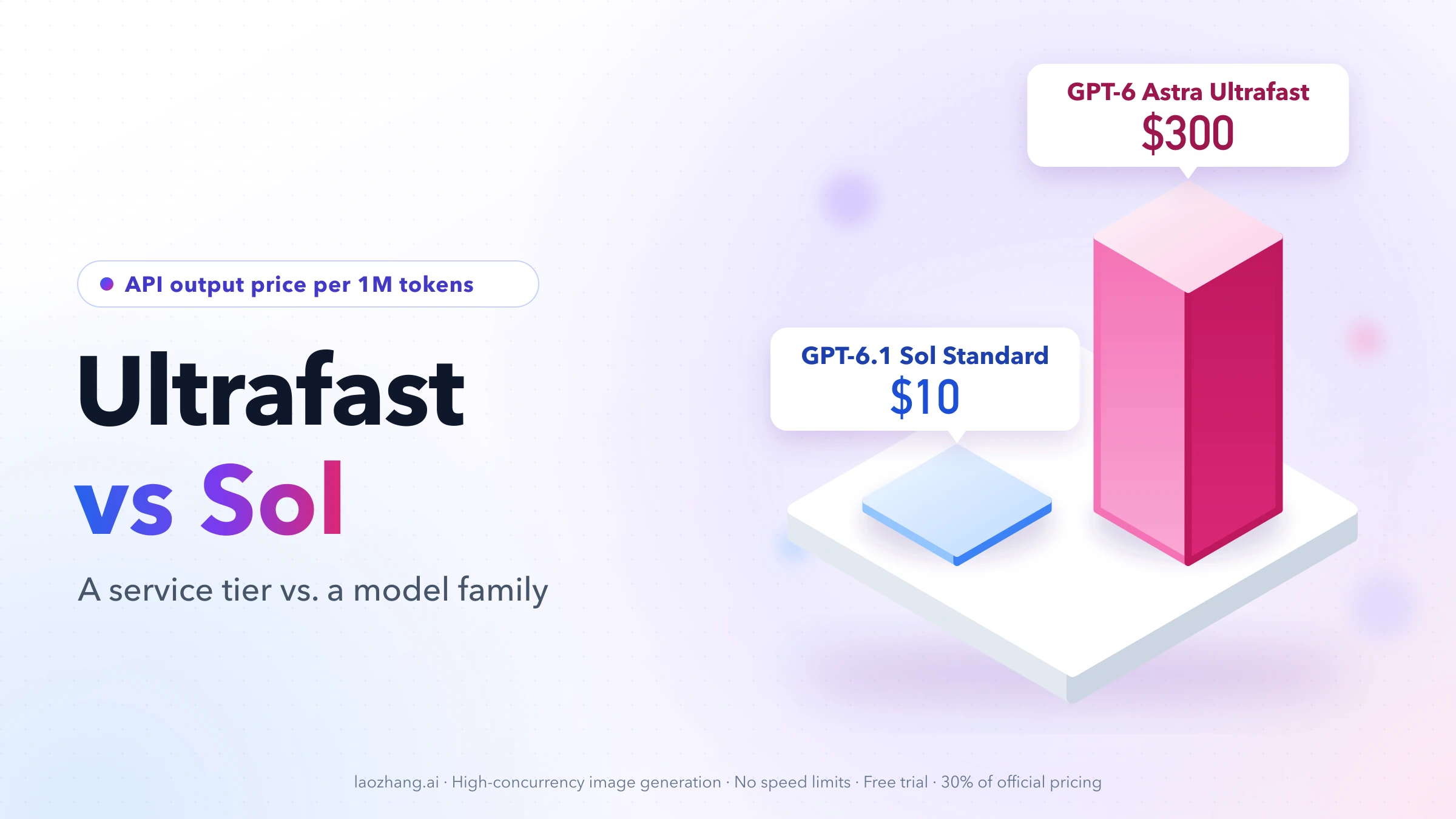
- GPT-6.1 Sol Ultrafast costs $12 input and $60 output per 1M tokens, 6× Sol's Standard rate. Every API account can call it by sending
gpt-6.1-solwithservice_tier: "ultrafast". In Codex and ChatGPT Work it needs Pro $500 or an eligible Enterprise or Edu plan. - GPT-6 Astra Ultrafast costs $60 input and $300 output per 1M tokens, 6× Astra's Standard rate and 5× Sol Ultrafast's input and output rates. Access is the same.
- GPT-5.6 Sol, the model OpenAI first previewed Ultrafast with, is not in the current Ultrafast guide and has no Ultrafast price.
Take one request with 50,000 fresh input tokens, 200,000 cached input tokens and 10,000 output tokens. At list price it costs $0.22 on GPT-6.1 Sol Standard, $1.32 on GPT-6.1 Sol Ultrafast, $1.20 on GPT-6 Astra Standard and $7.20 on GPT-6 Astra Ultrafast. Sol at top speed and Astra at normal speed now cost about the same, so the first decision is whether a workload needs speed or Astra's extra capability. Only work that needs both justifies Astra Ultrafast, at 5.45 times the price of Sol Ultrafast. The sections below show who has access, how the rates are built, and when each premium is worth paying.
Ultrafast vs Sol: a service tier and a model family
Ultrafast is how a request is served; Sol is which model answers it. OpenAI's Ultrafast mode guide describes it as "the fastest service tier in the OpenAI API" and adds: "Use it when speed justifies the higher cost." You select it with a request parameter, service_tier, not with a model name.
The confusion has a history. In August 2026, OpenAI previewed Ultrafast with GPT-5.6 Sol as its only model, so "GPT-5.6 Sol Ultrafast" spread as if it were a product name. On September 29, OpenAI released GPT-6.1 Sol (API ID gpt-6.1-sol) and, in the same post, launched GPT-6 Astra Ultrafast and promised GPT-6.1 Sol Ultrafast "in the coming days." That arrived on October 8, according to the API changelog. "GPT-6.1 Sol Ultrafast" is therefore shorthand for one model on one tier, and the same model still runs on Standard and Fast.
"Fast" is a separate, cheaper tier. It is the current name of what OpenAI called Priority processing until July 30, 2026, and it costs 2× Standard.
Which Sol models can run on Ultrafast as of October 10, 2026
GPT-6.1 Sol and GPT-6 Astra are the two models on Ultrafast. The guide now says Ultrafast "is broadly available for GPT-6 Astra and GPT-6.1 Sol" and that it "is available to all API users."
| Model | Standard and Fast tiers | Ultrafast in the API | Ultrafast in Codex and ChatGPT Work |
|---|---|---|---|
| GPT-6.1 Sol | Yes | All API users since October 8, 2026, with separate rate limits | Pro $500 and eligible Enterprise and Edu plans |
| GPT-6 Astra | Yes | All API users since September 29, 2026, with separate rate limits | Pro $500 and eligible Enterprise and Edu plans |
| GPT-5.6 Sol | Standard at a promotional price; Fast in Codex | Not in the current guide; no Ultrafast price | Not listed |
The October 8 changelog entry adds Ultrafast for gpt-6.1-sol in the Responses API and says it "is available to all API users, subject to rate limits, with global processing and US and EU data residency." The API pricing table now has a gpt-6.1-sol row on its Ultrafast tab, and the Codex speed page says "Ultrafast supports GPT-6 Astra and GPT-6.1 Sol."
GPT-5.6 Sol is the open question. Until early October the guide told organizations with an OpenAI account team to ask for "preview access for GPT-5.6 Sol." The current version no longer mentions that model, and no OpenAI page says whether the preview ended. If you need Sol on Ultrafast today, the model ID to use is gpt-6.1-sol.
Outside OpenAI, AWS announced on October 8 that Ultrafast mode for GPT-6.1 Sol is available on Amazon Bedrock. Bedrock's prices and regions are set by AWS, so check them on Bedrock's own pricing page rather than assuming OpenAI's rates.
OpenAI Ultrafast pricing: $12/$60 for GPT-6.1 Sol, $60/$300 for Astra
Ultrafast costs 6× the Standard rate of the same model, and both models now have a published Ultrafast rate. These are the API list prices per 1M tokens for requests with up to 272,000 input tokens, as of October 10, 2026:
| Model and tier | Input | Cached input | Cache writes | Output |
|---|---|---|---|---|
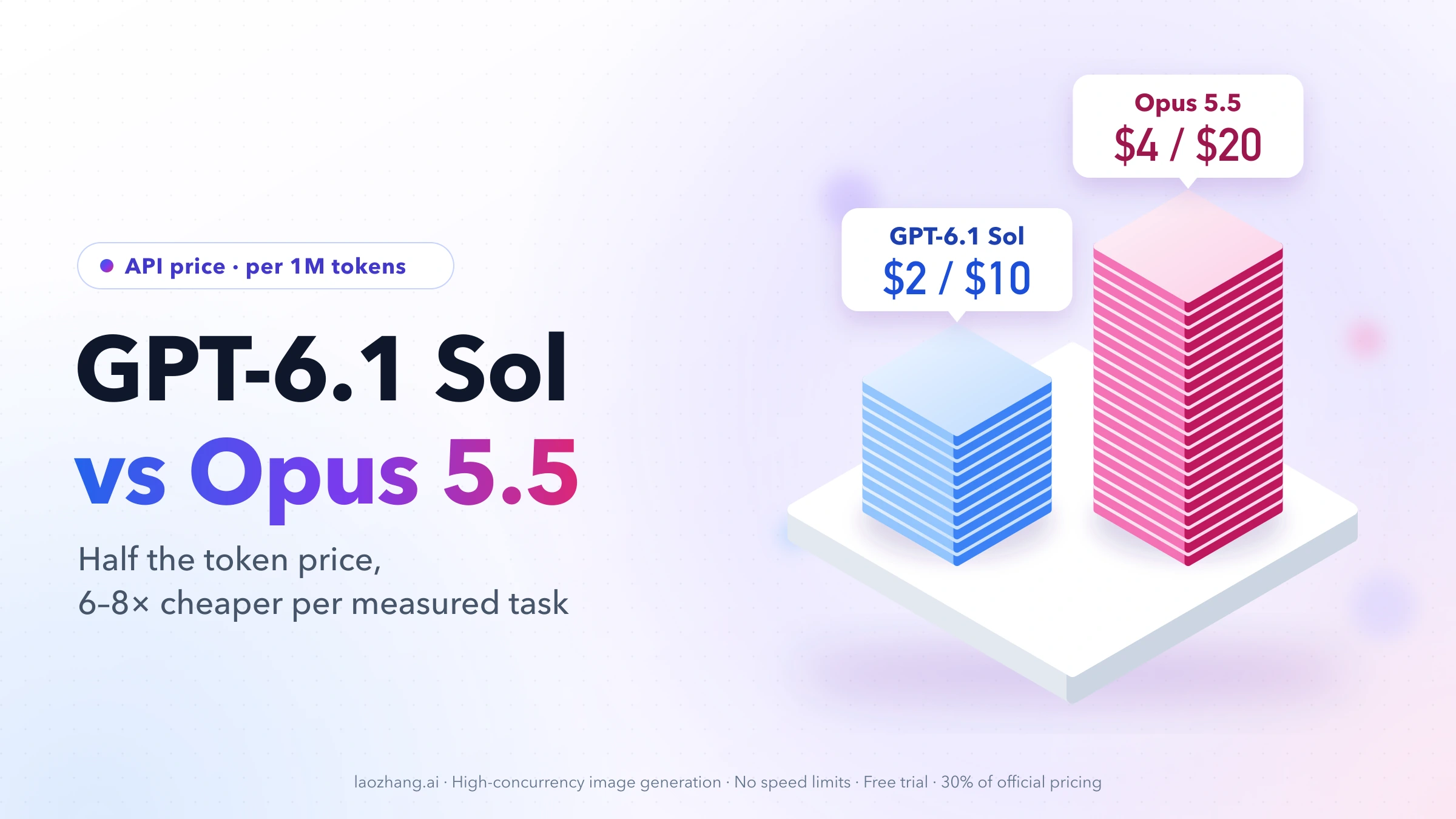
| GPT-6.1 Sol, Standard | $2.00 | $0.10 | $2.50 | $10.00 |
| GPT-6.1 Sol, Fast | $4.00 | $0.20 | $5.00 | $20.00 |
| GPT-6.1 Sol, Ultrafast | $12.00 | $0.60 | $15.00 | $60.00 |
| GPT-5.6 Sol, Standard (promotional) | $4.00 | $0.40 | $5.00 | $20.00 |
| GPT-6 Astra, Standard | $10.00 | $1.00 | $12.50 | $50.00 |
| GPT-6 Astra, Fast | $20.00 | $2.00 | $25.00 | $100.00 |
| GPT-6 Astra, Ultrafast | $60.00 | $6.00 | $75.00 | $300.00 |
Three conditions change these numbers. Above 272,000 input tokens, long-context rates apply: GPT-6.1 Sol Ultrafast becomes $24 input, $1.20 cached input, $30 cache writes and $90 output, and GPT-6 Astra Ultrafast becomes $120 input and $450 output. Regional processing (data residency) endpoints add 10%. GPT-6.1 Sol Ultrafast supports US and EU data residency, while GPT-6 Astra Ultrafast supports only US data residency and global processing. And the GPT-5.6 Sol rate is promotional; the pricing page guarantees it only "at least through November 21, 2026."
OpenAI's rollout announcement calls the Sol price "just 1.2x the cost of Astra." That compares Sol Ultrafast with Astra on Standard: $12 against $10 input and $60 against $50 output. Against Astra Ultrafast, Sol Ultrafast is one fifth of the price for input and output, and one tenth for cached input ($0.60 against $6.00).
Before October 8, the $12 input, $0.60 cached input and $60 output figures circulated as VentureBeat's estimate, derived by applying the 6× multiplier to Sol's Standard rate. The published price matched that estimate. The estimate did not include the $15 cache-write rate.
Cost of one request: $1.32 on Sol Ultrafast, $7.20 on Astra Ultrafast
The same request costs $1.32 on GPT-6.1 Sol Ultrafast and $7.20 on GPT-6 Astra Ultrafast, so Astra at top speed costs 5.45 times as much, or $5.88 more per request. The request is the one from the opening: 50,000 uncached input tokens, 200,000 cached input tokens and 10,000 output tokens. That is 250,000 input tokens in total, inside the short-context band. Cache-write charges are left out.
The formula is (0.05 × input rate) + (0.2 × cached input rate) + (0.01 × output rate):
| Model and tier | Calculation | Cost |
|---|---|---|
| GPT-6.1 Sol, Standard | 0.05 × $2 + 0.2 × $0.10 + 0.01 × $10 | $0.22 |
| GPT-6.1 Sol, Fast | 0.05 × $4 + 0.2 × $0.20 + 0.01 × $20 | $0.44 |
| GPT-6.1 Sol, Ultrafast | 0.05 × $12 + 0.2 × $0.60 + 0.01 × $60 | $1.32 |
| GPT-5.6 Sol, Standard | 0.05 × $4 + 0.2 × $0.40 + 0.01 × $20 | $0.48 |
| GPT-6 Astra, Standard | 0.05 × $10 + 0.2 × $1 + 0.01 × $50 | $1.20 |
| GPT-6 Astra, Fast | 0.05 × $20 + 0.2 × $2 + 0.01 × $100 | $2.40 |
| GPT-6 Astra, Ultrafast | 0.05 × $60 + 0.2 × $6 + 0.01 × $300 | $7.20 |
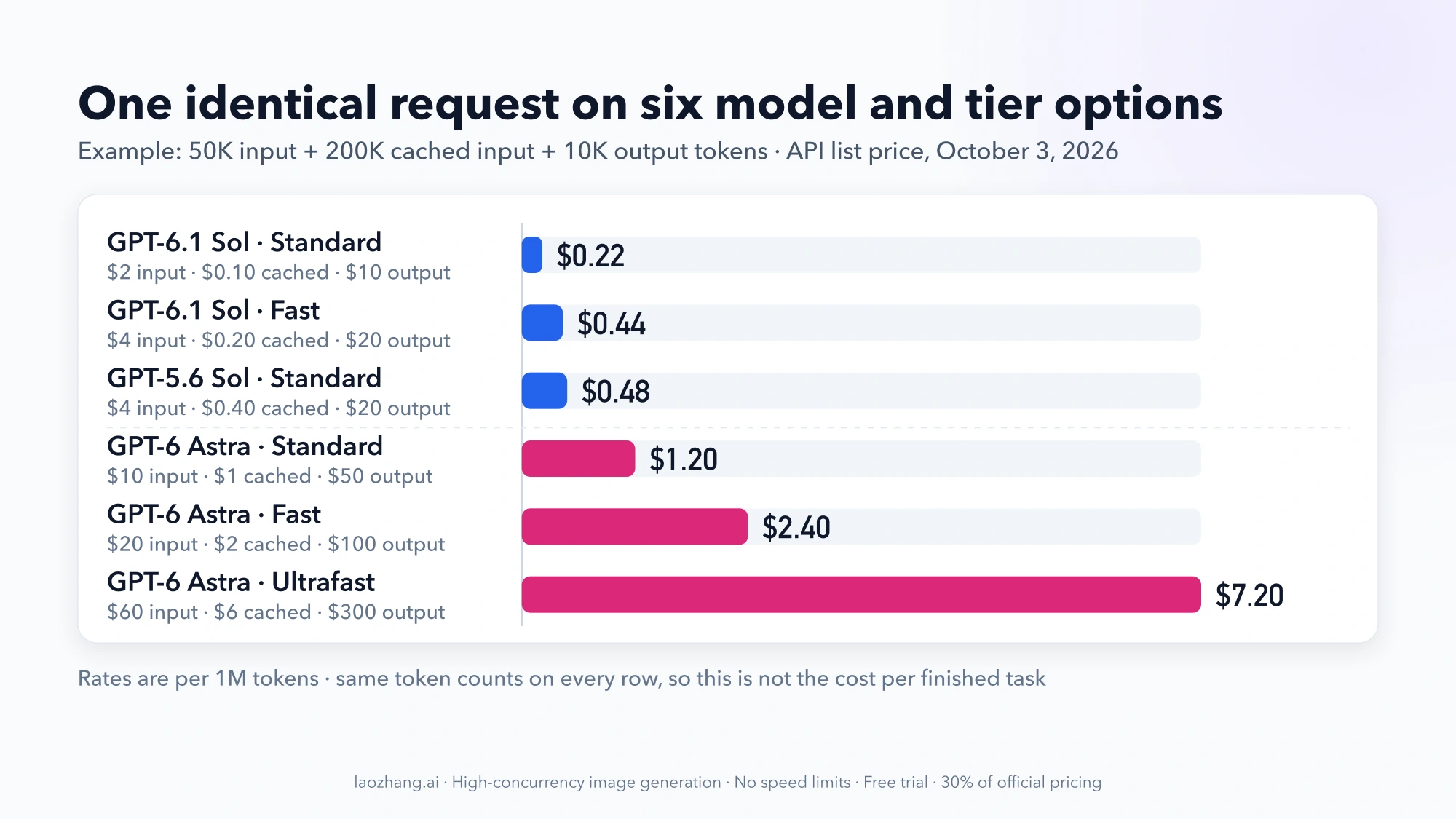
Three things are worth reading off this table. First, the tier multiplier is uniform: Sol Ultrafast is 6× Sol Standard and 3× Sol Fast, whatever your token mix. Second, the gap between models moves with the mix. Astra's input and output rates are 5× Sol's, but its cached input rate is 10×, so the more of your prompt is cached, the wider the gap. Third, Sol Ultrafast lands next to Astra Standard. For this cache-heavy request it costs 1.1× as much ($1.32 against $1.20). With no cached input at all (250,000 fresh input tokens and 10,000 output), the ratio rises to OpenAI's 1.2×: $3.60 on Sol Ultrafast against $3.00 on Astra Standard, with $0.60 on Sol Standard and $18.00 on Astra Ultrafast.
At volume the differences compound. A thousand of the cached requests a day for 30 days come to $6,600 on Sol Standard, $39,600 on Sol Ultrafast and $216,000 on Astra Ultrafast.
This compares list price for an identical request. Different models spend different numbers of tokens on the same job, so it is not a cost per completed task. For how far those two measures can drift apart, see GPT-6.1 Sol vs Claude Opus 5.5: Half the Price, 1/6 the Task Cost.
How fast is Ultrafast: up to 8× faster output than Standard
OpenAI says both Ultrafast models generate output up to 8 times as fast as the same model on Standard. Every published speed figure is an "up to" maximum for generating output tokens, and none of them describes how long your whole task takes.
| Figure | Applies to | Source |
|---|---|---|
| Up to 8× GPT-6.1 Sol Standard | GPT-6.1 Sol Ultrafast | OpenAI's October 8 rollout announcement; the September 29 post says "in Codex" |
| Up to 8× GPT-6 Astra in Standard mode | GPT-6 Astra Ultrafast in Codex | OpenAI's Codex speed page |
| Up to 6× in the API, up to 300 tokens per second | GPT-6 Ultrafast | VentureBeat's account of OpenAI's DevDay materials |
| Up to 14× Standard, up to 750 output tokens per second | GPT-5.6 Sol Ultrafast preview, powered by Cerebras | OpenAI's August 13 preview post |
OpenAI is explicit about the scope of its Codex figure: "This comparison measures token generation speed, not billing rates or overall task completion time." Network round trips, tool execution and input processing sit outside the multiplier. OpenAI's documentation gives no tokens-per-second figure for GPT-6.1 Sol on any tier, and none for GPT-6 Astra on Standard or Fast; the 300 figure comes from VentureBeat's report. So you cannot tell from published numbers which of the two Ultrafast models is faster, and none of the figures above come from an independent benchmark.
For a rough sense of scale, 10,000 output tokens at the reported ceiling of 300 tokens per second take about 33 seconds to generate. Because no Standard-mode rate is published, how many seconds Ultrafast saves over Standard on your workload is something only your own timings can tell you.
Calling Ultrafast in the API: service_tier, WebSockets, rate limits
Set model to gpt-6.1-sol (or gpt-6-astra) and service_tier to ultrafast on the Responses API. OpenAI's code samples use gpt-6-astra; the guide's instructions name both model IDs. This is the HTTP form with the Sol model ID:
curl https://api.openai.com/v1/responses \
  -H "Authorization: Bearer $OPENAI_API_KEY" \
  -H "Content-Type: application/json" \
  -d '{
    "model": "gpt-6.1-sol",
    "input": "Explain why the sky is blue in one sentence.",
    "service_tier": "ultrafast"
  }'
HTTP works, but OpenAI steers you to a persistent connection. The guide strongly recommends WebSockets, "especially for agentic applications that make many tool calls in quick succession. Without a persistent connection, network overhead can reduce the latency gains." In the Python SDK that means opening one connection with client.responses.connect(), sending each turn with connection.response.create(...) with the same model and service_tier values, and passing the previous response's ID as previous_response_id so later turns and tool results reuse the same connection.
Three limits decide whether the tier fits your workload:
- Rate limits. Ultrafast has its own limits, separate from Standard and Fast, and the defaults are higher for Sol than for Astra (table below). Higher limits go through an OpenAI account team.
- Data residency. "Ultrafast mode for GPT-6.1 Sol supports US and EU data residency and global processing. GPT-6 Astra Ultrafast supports US data residency and global processing only." If you need EU processing, Sol is the only Ultrafast option.
- Models. Only
gpt-6.1-solandgpt-6-astraare documented for Ultrafast. What the API returns whenservice_tier: "ultrafast"is sent with another model is not documented.
OpenAI now names its paid API usage tiers Build ($5 in total credit purchases), Launch ($100) and Grow ($500). These are the default Ultrafast limits for each:
| API usage tier | GPT-6.1 Sol Ultrafast | GPT-6 Astra Ultrafast |
|---|---|---|
| Build | 1,000,000 tokens per minute | 500,000 tokens per minute |
| Launch | 4,000,000 tokens per minute | 1,000,000 tokens per minute |
| Grow | 40,000,000 tokens per minute | 5,000,000 tokens per minute |
Ultrafast in Codex: Pro $500 and 8× your included usage
In Codex and ChatGPT Work, Ultrafast is a plan feature, not something you can buy by the token. The Codex speed page says "Ultrafast supports GPT-6 Astra and GPT-6.1 Sol" and that it "is available in Codex and ChatGPT Work on Pro $500 and eligible Enterprise and Edu plans." It also says "other self-serve plans don't have access to Ultrafast at launch, even with purchased credits." That excludes Plus, Business and the $100 and $200 Pro plans. On Pro $500, Ultrafast draws on your included usage first, then on your credits once that allowance runs out. In Enterprise workspaces it is off by default until an owner enables it for selected users or the whole workspace. GPT-6.1 Sol Ultrafast supports inference residency in the United States and Europe (EEA and Switzerland); GPT-6 Astra Ultrafast supports the United States only.
On plans without Ultrafast, GPT-6.1 Sol in Codex has Standard and Fast. You toggle Fast with /fast in the CLI, or persist it with service_tier = "fast" plus [features].fast_mode = true in config.toml.
Billing uses two different multipliers, and neither one describes speed:
| Mode in Codex | Draw on included subscription limits | Purchased credits and Enterprise pay-as-you-go |
|---|---|---|
| Fast | 2.5× Standard | 2× Standard |
| GPT-6.1 Sol Ultrafast | 8× Standard | 6× Standard |
| GPT-6 Astra Ultrafast | 8× Standard | 6× Standard |
The Codex pricing page sets Standard credit rates per 1M tokens at 50 input, 2.5 cached input and 250 output for GPT-6.1 Sol, and 250, 25 and 1,250 for GPT-6 Astra. Codex credit billing has no separate cache-write charge. Run the example request through those rates:
| Model and mode in Codex | Credits for the example request |
|---|---|
| GPT-6.1 Sol, Standard | 0.05 × 50 + 0.2 × 2.5 + 0.01 × 250 = 5.5 |
| GPT-6.1 Sol, Fast (2×) | 11 |
| GPT-6.1 Sol, Ultrafast (6×) | 33 |
| GPT-6 Astra, Standard | 0.05 × 250 + 0.2 × 25 + 0.01 × 1,250 = 30 |
| GPT-6 Astra, Ultrafast (6×) | 180 |
The ratios match the API: Astra Ultrafast costs 5.45 times as many credits as Sol Ultrafast, and Sol Ultrafast costs about the same as Astra Standard. What a credit is worth in dollars depends on your plan. Included subscription usage drains faster still, at 8×, and OpenAI warns against estimating it from token prices.
If you run Codex with an API key, none of this applies: "Codex uses API token pricing instead, and ChatGPT credit multipliers don't apply." For where each plan can use Astra, see GPT-6 Astra Access: Plus Gets It in Work and Codex, Not Chat. For how Sol's credit billing compares with the cheaper Luna model, see GPT-6 Luna vs. Sol pricing: calculate the cost of your workload, which covers GPT-6 Sol, the predecessor of GPT-6.1 Sol.
Which to use now: Sol Standard, Sol Ultrafast or Astra Ultrafast
Start from GPT-6.1 Sol on Standard and move up only when a specific cost of waiting, or a specific quality gap, justifies it. The prices below are for the example request.
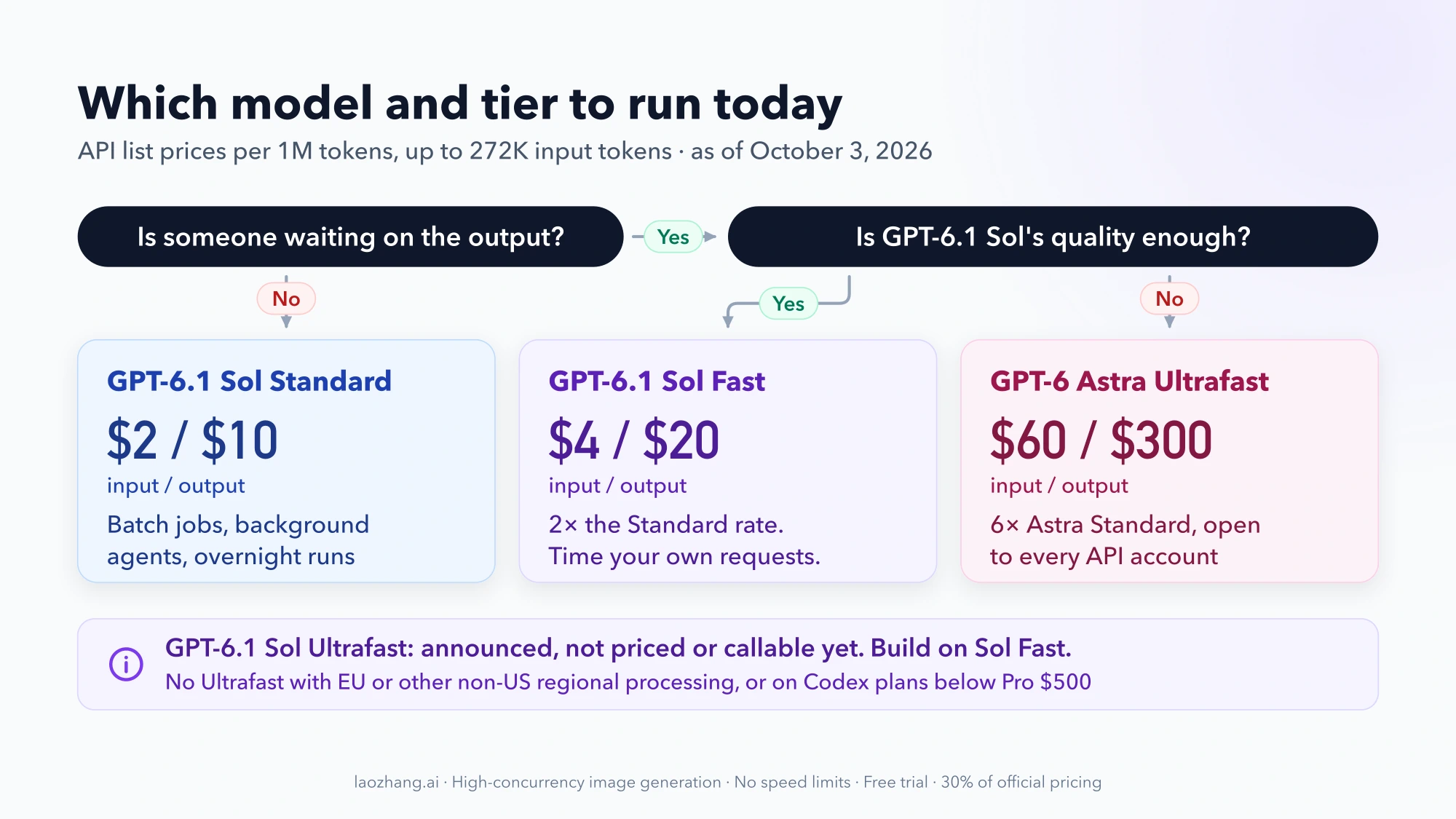
- Nobody is waiting on the output: GPT-6.1 Sol Standard. Batch jobs, background agents and overnight runs gain nothing from generation speed. At $0.22, this is the baseline everything else is measured against.
- Latency matters a little and Sol's quality is enough: GPT-6.1 Sol Fast. It doubles the bill to $0.44. No tokens-per-second figure is published for it, so time your own requests on Fast and Ultrafast before committing.
- Someone is waiting on long output and Sol's quality is enough: GPT-6.1 Sol Ultrafast. At $1.32 it costs 6× Standard and 3× Fast. OpenAI names debugging an outage, agents navigating apps and live experiences "where every second counts" as the work it was built for. The premium pays off only where the wait itself is the cost.
- Sol's answers are not good enough, but nobody is waiting: GPT-6 Astra Standard. At $1.20 it costs about the same as Sol Ultrafast. That is the real trade at this price point: Astra's quality at normal speed, or near-Astra quality at up to 8× the output speed.
- You need Astra's quality and its top speed: GPT-6 Astra Ultrafast. At $7.20 it costs $5.88 more than Sol Ultrafast per request. Reserve it for work where you have seen Sol fall short and someone is waiting on the result.
Three conditions rule Ultrafast out, or narrow it, regardless of budget. Your Codex or ChatGPT plan is below Pro $500 and you are not on an eligible Enterprise or Edu plan. Your agent spends most of its time in tool calls and network round trips, where faster token generation moves the total very little. Or you need EU or other non-US regional processing. That rules out Astra Ultrafast, while Sol Ultrafast supports EU data residency.
Questions about Sol, Astra and Ultrafast
Is GPT-6 Astra better than GPT-6.1 Sol?
By OpenAI's own description, yes on capability: it calls GPT-6 Astra its most capable frontier model overall and positions GPT-6.1 Sol as near-Astra intelligence. Sol wins on price. On every tier, its input and output rates are one fifth of Astra's and its cached input rate is one tenth.
Which OpenAI model is the fastest?
By published maximums, GPT-5.6 Sol on Ultrafast, at up to 750 output tokens per second, but OpenAI announced it as a limited preview in August 2026, and the current Ultrafast guide no longer lists it. Every API account can call two models on Ultrafast, GPT-6 Astra and GPT-6.1 Sol, and OpenAI says each generates output up to 8 times as fast as its Standard mode. It publishes no tokens-per-second figure for either, so there is no official answer to which of the two is faster.
How much does GPT-6.1 Sol Ultrafast cost?
In the API, $12 per 1M input tokens, $0.60 cached input, $15 cache writes and $60 output, for requests up to 272,000 input tokens. Above that it is $24, $1.20, $30 and $90. That is 6× GPT-6.1 Sol's Standard rate, and OpenAI published it on October 8, 2026. In Codex on purchased credits it costs 6× Sol's Standard credit rate, and on Pro $500 included usage it draws 8×.
Can I use GPT-5.6 Sol Ultrafast in the API?
Not as a self-serve option. GPT-5.6 Sol Ultrafast was offered as a limited preview that organizations requested through an OpenAI account team, and it has no public price. The current Ultrafast guide lists only GPT-6 Astra and GPT-6.1 Sol and no longer mentions the preview. For Sol on Ultrafast today, call gpt-6.1-sol with service_tier: "ultrafast".
Is OpenAI Ultrafast available on ChatGPT Plus?
No. In Codex and ChatGPT Work, Ultrafast requires Pro $500 or an eligible Enterprise or Edu plan, and buying credits on another self-serve plan does not unlock it. Plus subscribers can use GPT-6.1 Sol on Standard, and on Fast where it is available. Ultrafast in the API is a separate route: it is billed per token to an API account, not to a ChatGPT plan.