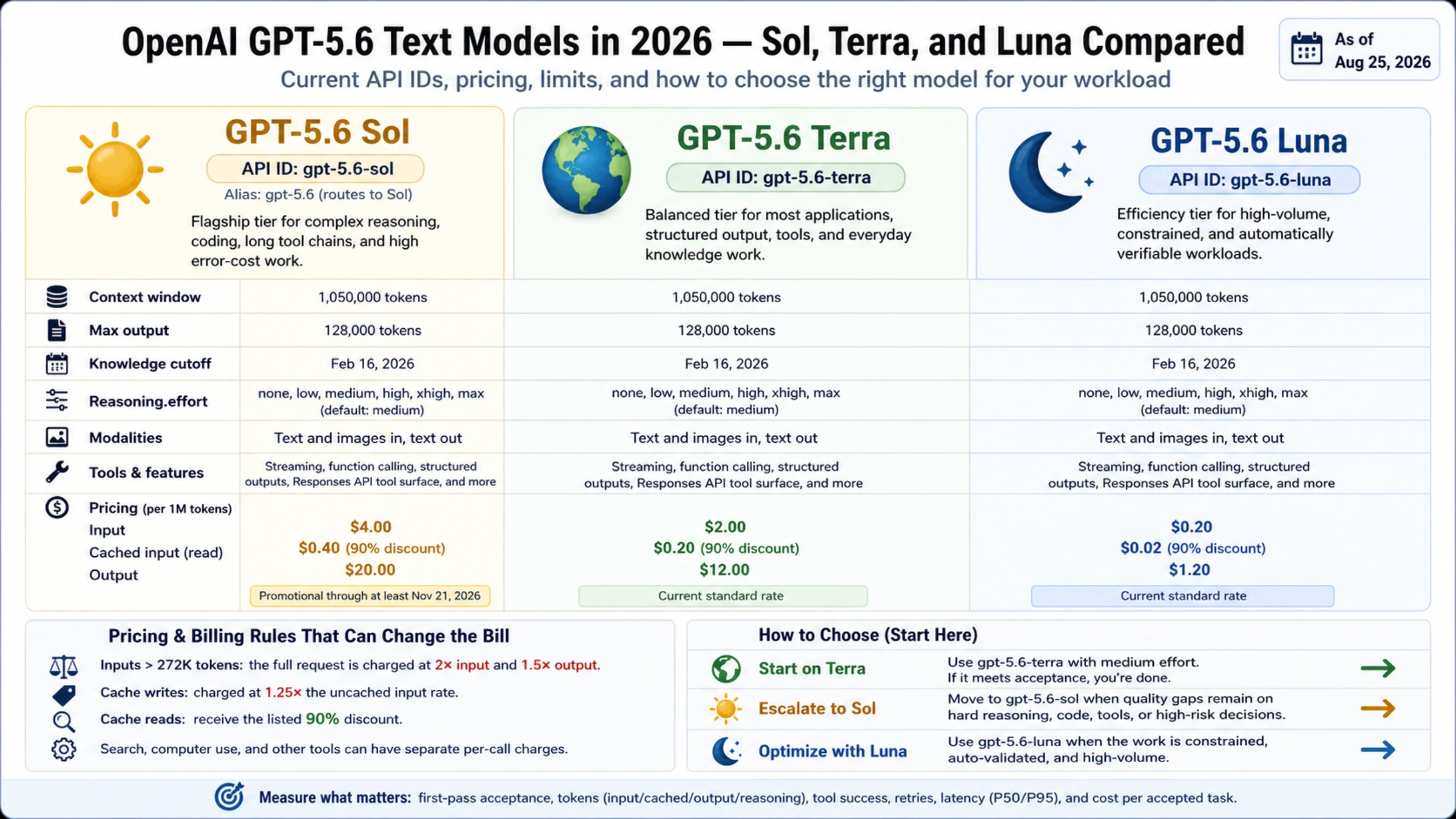
OpenAI's current general-purpose text-and-code lineup is no longer a long ladder of unrelated GPT names. As of August 25, 2026, the main family is GPT-5.6 Sol, Terra, and Luna: a flagship tier, a balanced tier, and a high-volume efficiency tier.
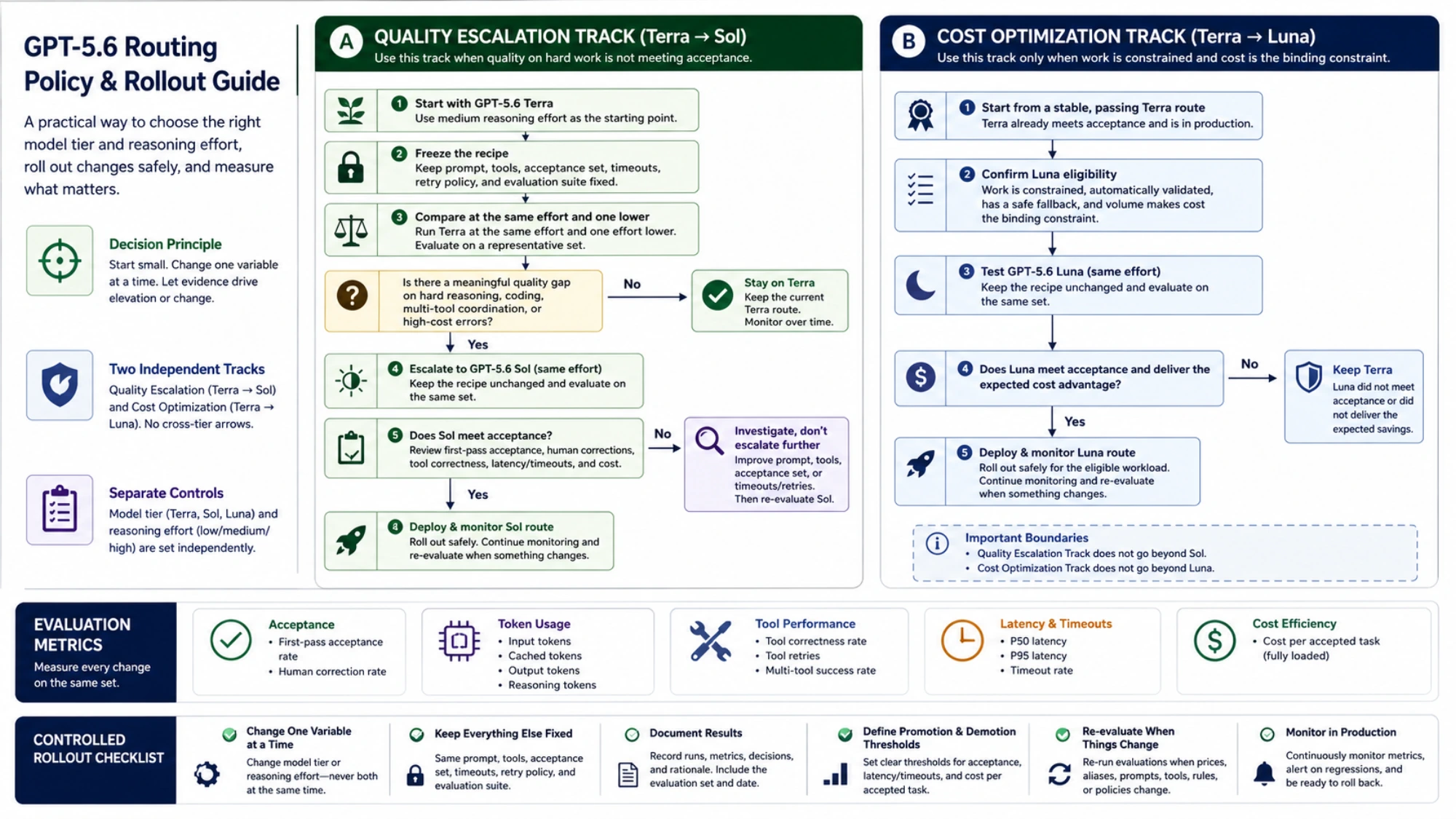
For a new API workload, gpt-5.6-terra is the most useful baseline. Move to gpt-5.6-sol when difficult reasoning, coding, or tool coordination produces a measurable quality gap. Move down to gpt-5.6-luna when the workload is constrained, automatically verifiable, and large enough for the price difference to matter.
That is an API selection rule, not a promise about what a particular ChatGPT plan exposes. Chat, ChatGPT Work, Codex, and the API have different access and usage rules. A model name in one product surface does not create an API entitlement in another.
The current family and the exact IDs
OpenAI's live model catalog recommends Sol for complex reasoning and coding, Terra for a balance of intelligence and cost, and Luna for cost-sensitive, high-volume workloads.
| Model | API model ID | Good first candidate for | A weak reason to choose it |
|---|---|---|---|
| GPT-5.6 Sol | gpt-5.6-sol; alias gpt-5.6 also routes to Sol | Complex professional work, hard code changes, long tool chains, high error costs | It is the flagship |
| GPT-5.6 Terra | gpt-5.6-terra | Most new applications, structured output, tools, everyday knowledge work | It sounds like a compromise |
| GPT-5.6 Luna | gpt-5.6-luna | Classification, extraction, transformation, batch processing with reliable validation | It has the lowest token rate |
The unsuffixed gpt-5.6 value is an alias for Sol, not a fourth member of the family. OpenAI's model guidance says Terra roughly occupies the mini tier from earlier GPT-5 families, while Luna roughly occupies the nano tier. That describes the product ladder; it does not guarantee behavioral equivalence with an older mini or nano model.
Model choice is only the first control. All three support reasoning.effort values none, low, medium, high, xhigh, and max, with medium as the default. A disciplined team picks a model tier and then finds the lowest effort that still meets its acceptance criteria. Running Sol at max for every request gives away much of the control the family was designed to provide.
What is shared—and what the specification cannot tell you
The three model pages list the same 1,050,000-token context window, 128,000 maximum output, and February 16, 2026 knowledge cutoff. Each accepts text and images and produces text. Streaming, function calling, structured outputs, and a broad Responses API tool surface are supported.
Those shared limits remove an easy but misleading selection rule: Sol is not the choice simply because it has the biggest published context window. The meaningful differences show up in task success, token efficiency, latency, retries, tool behavior, and output length.
OpenAI's GPT-5.6 release reports gains across coding, knowledge work, browsing, tool use, science, and cybersecurity. Those results are useful provider evidence, but they are not an evaluation of your prompts, data, tool definitions, or acceptance threshold. A benchmark lead can coexist with a worse cost per successful task in a narrow production workflow.
A representative evaluation should capture at least:
- first-pass acceptance rate and the amount of human correction;
- input, cached input, output, and reasoning tokens;
- correct tool selection, tool arguments, and retry count;
- P50 and P95 latency, timeouts, and operational failures;
- cost per accepted task, not merely cost per request.
This is why Luna can be an excellent extractor with a strict schema and a poor default for open-ended professional analysis. It is also why Terra can beat Sol economically even when Sol has the higher per-request success rate: the quality difference must be large enough to pay for the price and latency difference.
API pricing on August 25, 2026
The current direct API text-token rates are per one million tokens:
| Model | Input | Cached input | Output | Important status |
|---|---|---|---|---|
| GPT-5.6 Sol | $4.00 | $0.40 | $20.00 | Promotional through at least November 21, 2026 |
| GPT-5.6 Terra | $2.00 | $0.20 | $12.00 | Current standard rate |
| GPT-5.6 Luna | $0.20 | $0.02 | $1.20 | Current standard rate |
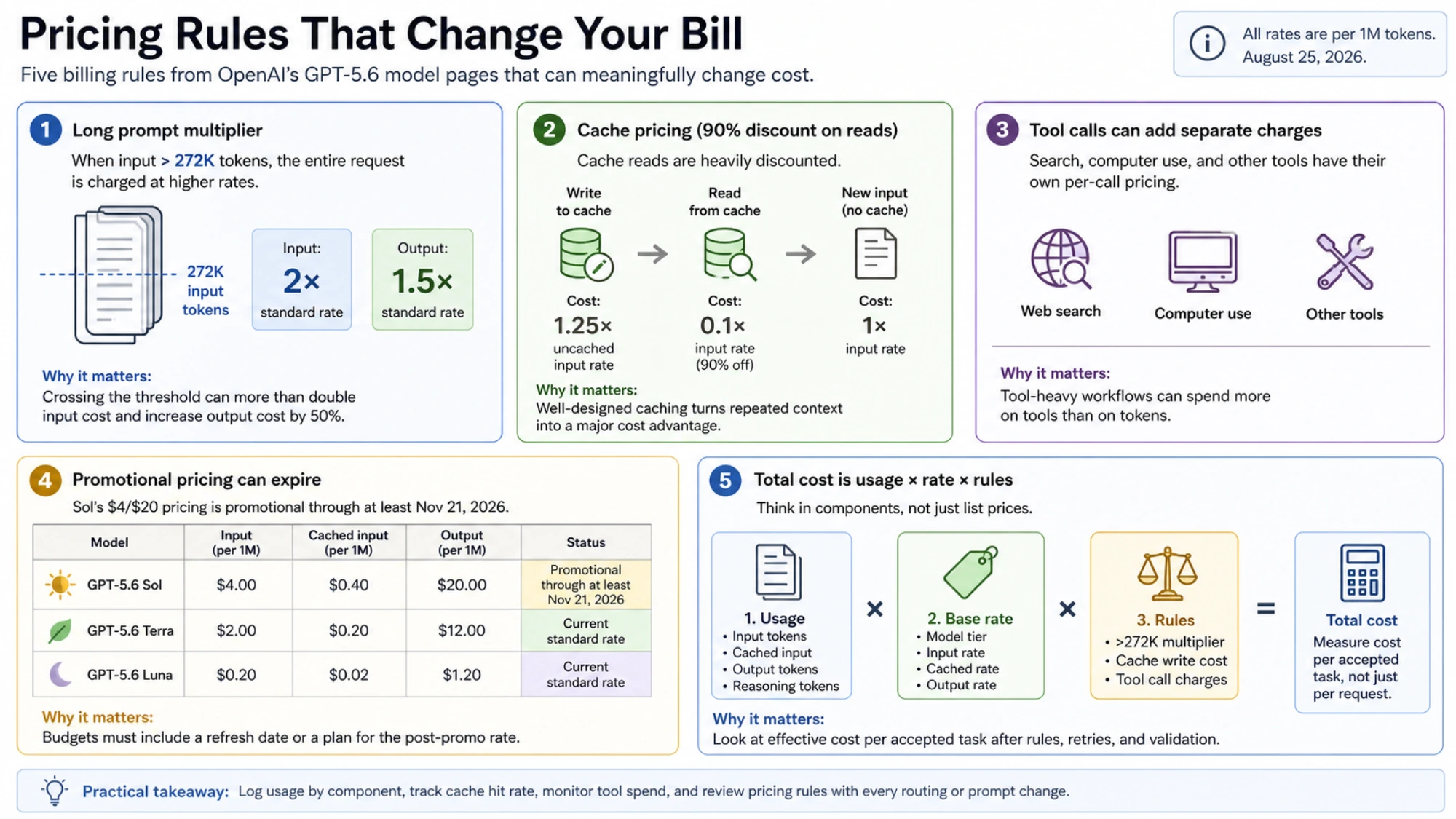
These values come directly from the current Sol, Terra, and Luna model pages. Sol's $4/$20 rate is explicitly promotional; any long-lived budget must include a refresh date or a scenario for the later rate.
For a simple same-token illustration, consider a request using 100,000 input tokens and 10,000 output tokens, with no cache, tools, or long-context multiplier:
- Sol:
0.1 × $4 + 0.01 × $20 = $0.60 - Terra:
0.1 × $2 + 0.01 × $12 = $0.32 - Luna:
0.1 × $0.20 + 0.01 × $1.20 = $0.032
This calculation compares token rates, not equivalent completed work. It also omits rules that can materially change the bill. When a prompt exceeds 272K input tokens, the model pages say the full request is charged at 2× input and 1.5× output. Explicit cache writes cost 1.25× the uncached input rate; successful cache reads receive the listed 90% discount. Search, computer use, and other tools can have separate per-call charges.
The practical consequence is simple: do not build a routing policy from the input-price column alone. Measure actual output and reasoning use, cache hit behavior, retries, and acceptance.
Choose by failure mode, not by prestige
Sol belongs where failure is expensive
Put Sol into the test set when the work involves cross-file code changes, multi-constraint analysis, long-running agents, polished professional deliverables, or decisions that are expensive to review or redo. Sol also makes a useful quality ceiling: establish what the strongest tier can achieve before deciding whether Terra closes enough of the gap.
Do not pay the flagship premium for a task that already passes reliably on a lower tier. A fixed classification label or short normalization job may show no useful gain.
Terra is a strong default because it reveals the boundary
Terra offers the full current GPT-5.6 reasoning and tool model while costing half as much as Sol on input and 40% less on output at the current rates. It is a practical middle starting point when a team has no trustworthy internal benchmark yet.
If Terra passes, you can test Luna for savings. If it fails, the pattern of failure tells you whether Sol, a higher reasoning effort, a better prompt, or a narrower tool contract is the right change.
Luna needs guardrails, not optimism
Luna is compelling for high-volume classification, extraction, rewriting, candidate generation, and preprocessing. The best targets have an explicit schema, automatic validation, short outputs, and a safe fallback. Where a subtle error is hard to detect, the apparent savings can reappear as review labor or downstream incidents.
Migrate without changing every variable at once
OpenAI recommends that teams moving from GPT-5.5 or GPT-5.4 keep their current reasoning setting as a baseline, then test the same GPT-5.6 setting and one level lower on representative work. That makes token-efficiency improvements visible instead of hiding them behind a simultaneous jump to max.
A controlled migration looks like this:
- Freeze the prompt, tool definitions, acceptance set, timeout, and retry policy.
- Record the old model at its current reasoning effort.
- Test the corresponding GPT-5.6 tier at the same effort.
- Test that GPT-5.6 tier one effort lower.
- Change Sol, Terra, or Luna only after the effort comparison identifies a remaining quality or cost problem.
For historical context, the dedicated GPT-5.4 versus GPT-5.2 migration guide and GPT-5.4 versus GPT-5 mini comparison explain older tradeoffs. They should not replace the live GPT-5.6 model pages for a new deployment.
A clean Responses API baseline
Model tier and reasoning effort are independent in a Responses API request:
curl https://api.openai.com/v1/responses \
  -H "Authorization: Bearer $OPENAI_API_KEY" \
  -H "Content-Type: application/json" \
  -d '{
    "model": "gpt-5.6-terra",
    "reasoning": {"effort": "medium"},
    "input": "Extract renewal date, notice period, and termination liability from this contract. Return JSON."
  }'
In production, log the effective model, effort, usage, latency, tool outcomes, schema validation, retries, and human edits. A handful of good-looking responses is not enough to choose a default.
The durable answer is a routing policy
Use Terra as the baseline, Sol as the quality escalation, and Luna as the cost optimization. Give each route measurable promotion and demotion criteria. Re-run the evaluation when a price, alias, model page, tool behavior, or prompt changes.
For a new workload today, gpt-5.6-terra with medium is a defensible start. Escalate when difficult reasoning or tool coordination fails acceptance. Test Luna when results are stable, automated checks are strong, and volume makes cost the binding constraint. That policy will age better than a static ranking of model names.