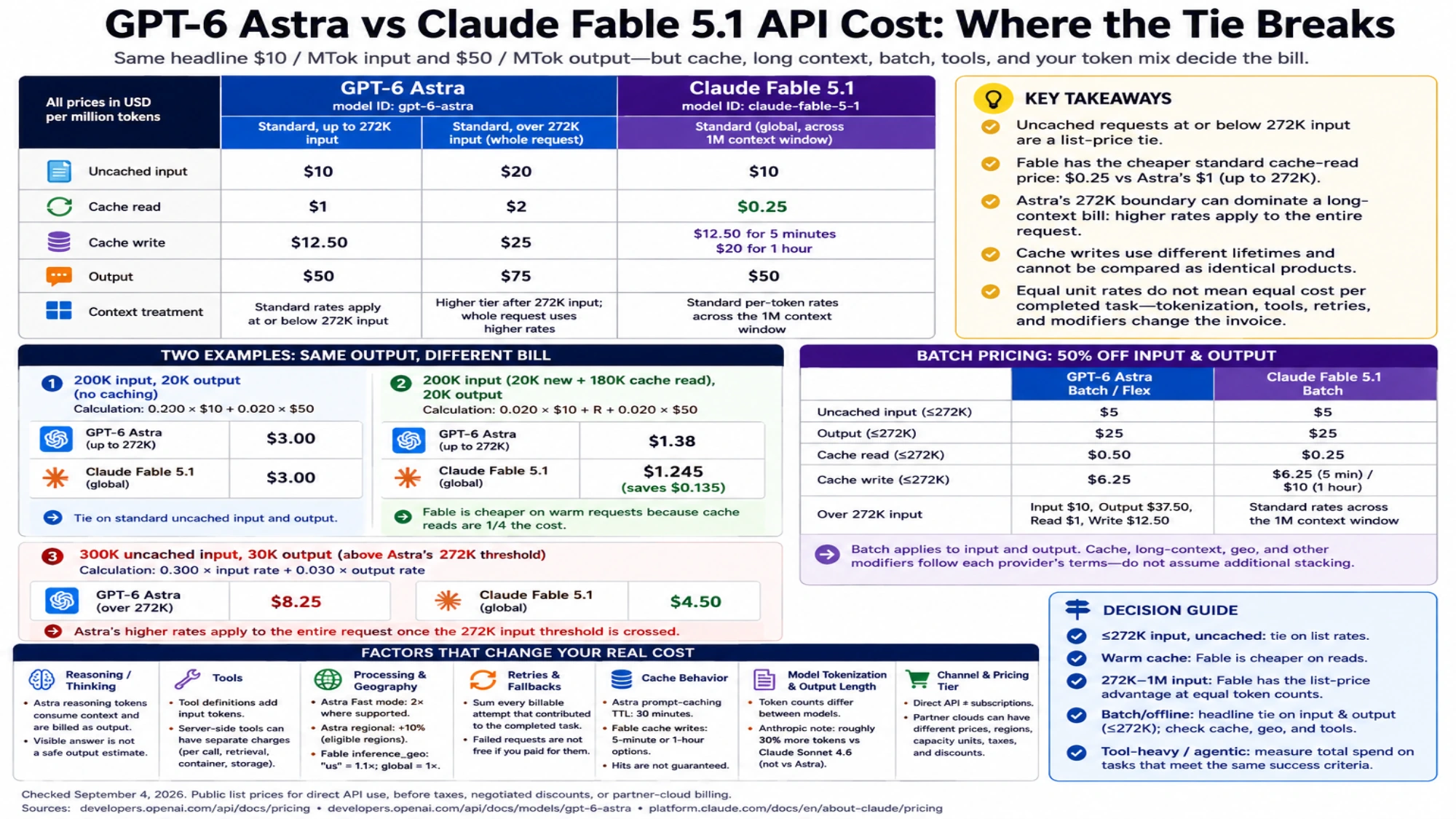
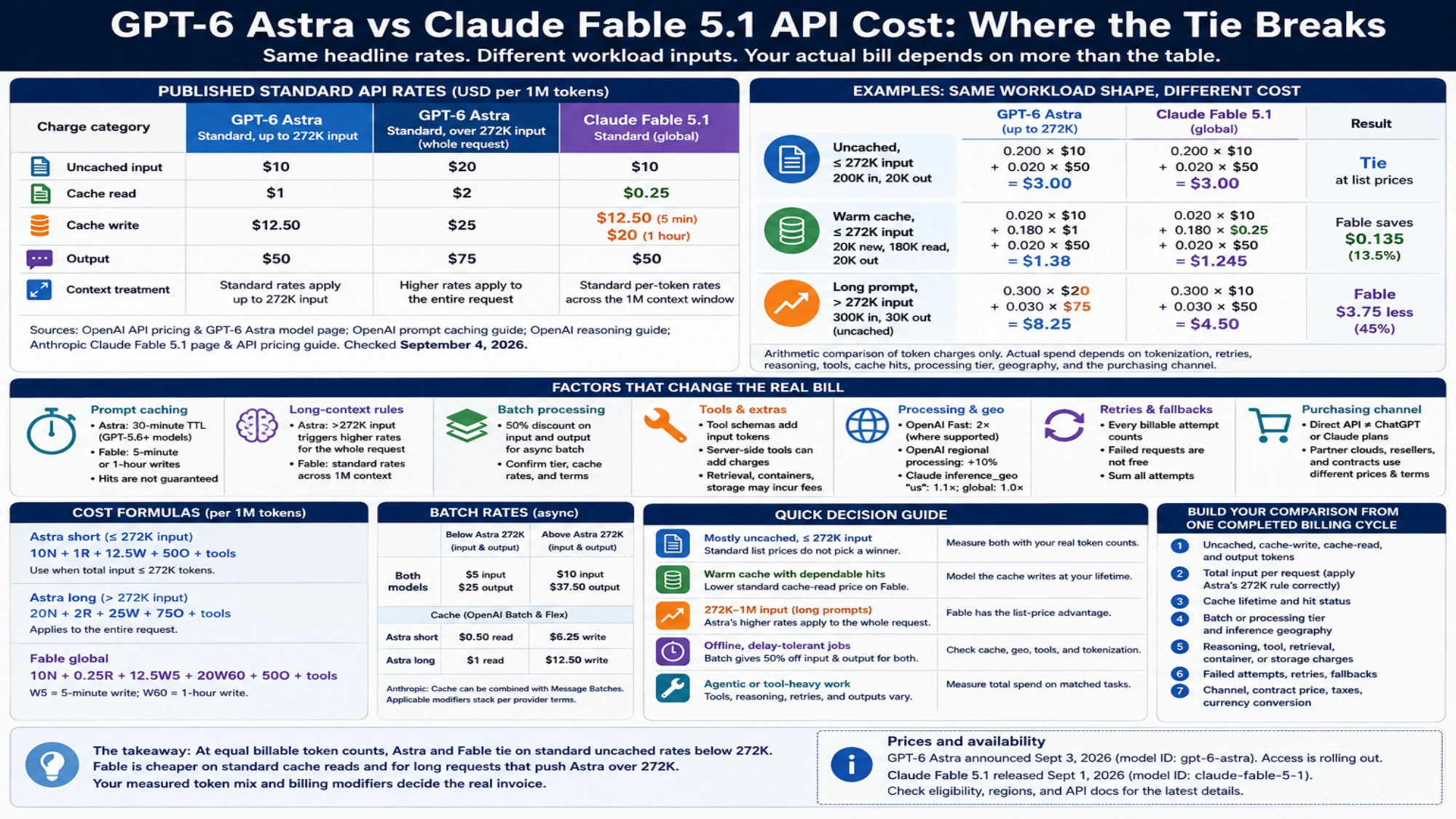
GPT-6 Astra and Claude Fable 5.1 have the same headline Standard API rates: $10 per million input tokens and $50 per million output tokens. That tie is real, but narrow. It applies to uncached Astra requests with no more than 272K input tokens and to Fable's standard global API pricing. It does not settle what a production workload will cost.
Cache reads are cheaper on Fable. Long prompts trigger an across-the-board uplift on Astra. Cache writes use different lifetimes and cannot be compared as if they were identical products. Batch jobs can restore a headline tie, while tools, processing tier, geography, retries, and each model's own token count can move the invoice again.
The rates and availability below were checked against first-party documentation on September 5, 2026. They are public list prices for direct API use, before taxes, negotiated discounts, or partner-cloud billing.
The rates that belong in your spreadsheet
All figures are US dollars per million tokens. “Astra long” applies when a request contains more than 272K input tokens. OpenAI applies those higher rates to the entire request, not only to the portion above 272K.
| Charge category | GPT-6 Astra Standard, up to 272K input | GPT-6 Astra Standard, over 272K input | Claude Fable 5.1 Standard |
|---|---|---|---|
| Uncached input | $10 | $20 | $10 |
| Cache read | $1 | $2 | $0.25 |
| Cache write | $12.50 | $25 | $12.50 for 5 minutes; $20 for 1 hour |
| Output | $50 | $75 | $50 |
| Published context treatment | Higher tier after 272K input | Whole request uses higher tier | Standard per-token rates across the 1M context window |
OpenAI publishes Astra's rates and whole-request threshold on its API pricing page and GPT-6 Astra model page. Anthropic publishes Fable's model details on the Claude Fable 5.1 page and explains caching, context, and geographic modifiers in its Claude API pricing guide.
This table leads to four useful conclusions:
- Uncached requests at or below 272K input tokens are a list-price tie. Equal token counts produce equal input and output charges.
- A warm cache favors Fable on read price. Its $0.25 cache-read rate is one quarter of Astra's $1 short-context rate.
- Astra's 272K boundary can dominate a long-context bill. Once crossed, its uncached input and cache rates double and its output rate rises by 50% for the whole request.
- A cache write is not a like-for-like line item without a lifetime. OpenAI's prompt-caching guide documents a 30-minute TTL for GPT-5.6-and-newer models. Fable offers five-minute and one-hour writes at different prices.
Two calculations show why the answer changes
Suppose a request has 200K input tokens and produces 20K output tokens, with no caching. Both models cost:
0.200 × $10 + 0.020 × $50 = $3.00
Now suppose the same 200K input consists of 20K new tokens and a 180K cache read. The output is still 20K tokens:
- Astra:
0.020 × $10 + 0.180 × $1 + 0.020 × $50 = $1.38 - Fable:
0.020 × $10 + 0.180 × $0.25 + 0.020 × $50 = $1.245
Fable saves 13.5 cents on this warm request because the models' standard uncached input and output rates still match; only the cache-read rate differs. Whether you actually realize that saving depends on stable prompt prefixes, cache lifetime, routing, and a real hit. A published cache price is not a promised hit rate.
The larger break appears above Astra's long-context threshold. For a request with 300K uncached input tokens and 30K output tokens:
- Astra:
0.300 × $20 + 0.030 × $75 = $8.25 - Fable:
0.300 × $10 + 0.030 × $50 = $4.50
That is an arithmetic comparison of token charges, not a cost-per-task verdict. The two APIs may tokenize the same source differently, generate different output lengths, invoke different tools, or need different numbers of attempts. Anthropic's tokenizer note says the tokenizer used by Claude 4.7 and later can produce roughly 30% more tokens than Claude Sonnet 4.6 for the same text, depending on the workload. That is an earlier-Claude comparison—not a conversion rate between Fable and Astra. Use each API's own token counts.
Use billable categories, not visible text
A reliable estimate starts with metered usage, not character counts or the final answer on screen. Treat each model separately and express token quantities in millions:
Astra short = 10N + 1R + 12.5W + 50O + tools
Astra long = 20N + 2R + 25W + 75O + tools
Fable global = 10N + 0.25R + 12.5W5 + 20W60 + 50O + tools
Here, N is uncached input, R is cache-read input, W is Astra cache-write input, W5 and W60 are Fable's five-minute and one-hour cache writes, and O is output. Select the Astra formula using the request's total input count; do not apply the long rate only to tokens after 272K.
Map the response before calculating: Responses reports total input, so subtract input_tokens_details.cached_tokens and input_tokens_details.cache_write_tokens for ordinary input. Claude Messages reports ordinary input in input_tokens; cache reads and writes are separate.
Then add the parts a token-only estimate misses:
- Reasoning and generated tokens. OpenAI's reasoning guide explains that Astra's invisible reasoning tokens consume context and are billed as output. The visible response is therefore not a safe output estimate.
- Tool payloads and calls. Tool definitions add input tokens. Server-side tools can carry separate per-call, retrieval, container, or storage charges. Anthropic's tool-use pricing notes say client-side tools do not have a separate tool fee, but their definitions and model messages still count as tokens.
- Retries and fallbacks. Sum every billable attempt that contributed to the completed task. A failed request is not free merely because its result was discarded.
- Processing and geography. OpenAI Fast mode uses a 2× modifier where supported, and eligible regional processing adds 10%. Claude's
inference_geo: "us"applies a 1.1× modifier across input, output, cache writes, and cache reads;globaluses standard rates.
For tool-calling Astra requests, OpenAI's current model guide requires the Responses API even though the model also supports Chat Completions. Anthropic's release notes say Fable 5.1 does not support the any or named-tool forms of tool_choice; unsupported use returns a 400 response. Those implementation details can affect a migration test, but they do not establish which model completes your task more cheaply.
Batch pricing creates another tie—with conditions
Both providers advertise a 50% discount on input and output for asynchronous batch processing. For an uncached request at or below Astra's 272K threshold, the headline Batch rates therefore match again at $5 input and $25 output per million tokens.
OpenAI also lists Astra Batch and Flex cache rates explicitly. In the short tier they are $0.50 for cache reads and $6.25 for cache writes; above 272K they become $1 and $12.50, while input and output become $10 and $37.50. Anthropic says prompt caching can be combined with Message Batches and that applicable cache and data-residency modifiers stack.
Do not halve a Standard invoice by assumption. Confirm that the request used the asynchronous Batch API or the documented OpenAI processing tier, then price the cache and regional lines under that provider's rules. Batch latency and queueing also make it unsuitable for some interactive workloads, even when its token bill is lower.
Availability and purchasing channel come before the comparison
OpenAI announced GPT-6 Astra in its API changelog on September 3, 2026, with access rolling out in stages. Its API model ID is gpt-6-astra. A public model page and price table do not prove that every API organization, project, region, or product can call it. Check the model list or make a permitted test request from the organization that will pay the bill.
Anthropic's release notes record Claude Fable 5.1 on September 1, 2026. Its model ID is claude-fable-5-1, and Anthropic lists it as active for the Claude API and several partner platforms. Account eligibility and regional availability can still differ.
These direct-API rates are not ChatGPT or Claude subscription allowances. They also do not determine an Amazon Bedrock, Google Cloud, Microsoft Foundry, reseller, or private enterprise invoice. Partner platforms can use their own prices, regions, capacity units, taxes, and contract discounts. Compare the channel you can actually purchase, not a rate copied from another channel.
A decision rule for common workloads
Mostly uncached requests below 272K input: the public token rates do not pick a winner. Measure each model's actual input, output, and retry count on the same completion standard.
Repeated prompts with dependable cache hits: Fable has the lower standard cache-read price. Compare warm and cold runs separately, and include cache writes at the lifetime you actually use.
Requests between 272K and 1M input tokens: at equal billable token counts, Fable has the clearer list-price advantage because Astra's higher rates apply to the entire request. Before accepting a large bill, test whether retrieval, file selection, or conversation compaction can keep Astra below the threshold without reducing task success.
Offline, delay-tolerant jobs: both models return to matching headline input and output Batch rates below Astra's threshold. Cache behavior, long prompts, geography, tools, and actual tokenization can still break the tie.
Agentic or tool-heavy work: neither price table can name a universal winner. Record tool schemas, reasoning or thinking usage, server-side tool charges, retries, and output tokens for every attempt. Compare total spend for tasks that meet the same acceptance criteria.
Build the comparison from one completed billing cycle
Export usage for a representative set of requests rather than extrapolating from one prompt. For each model, retain:
- uncached input, cache-write, cache-read, and output token counts;
- total input per request, so Astra's 272K rule is applied correctly;
- cache lifetime and hit status;
- batch or processing tier and inference geography;
- reasoning, tool, retrieval, container, or storage charges;
- failed attempts, retries, and fallbacks;
- the purchased channel, contract price, taxes, and currency conversion.
Calculate each request under its provider's categories, then reconcile the result against the provider invoice. Group requests by workload shape—short interactive calls, warm-cache agent loops, long-context analysis, and batch jobs—because an average can hide the exact threshold or cache pattern driving spend.
The honest answer is conditional: at equal billable token counts, Astra and Fable tie on standard uncached list rates below 272K; Fable is cheaper for standard cache reads and for long requests that push Astra over 272K. Everything beyond that requires your measured token mix and billing modifiers.