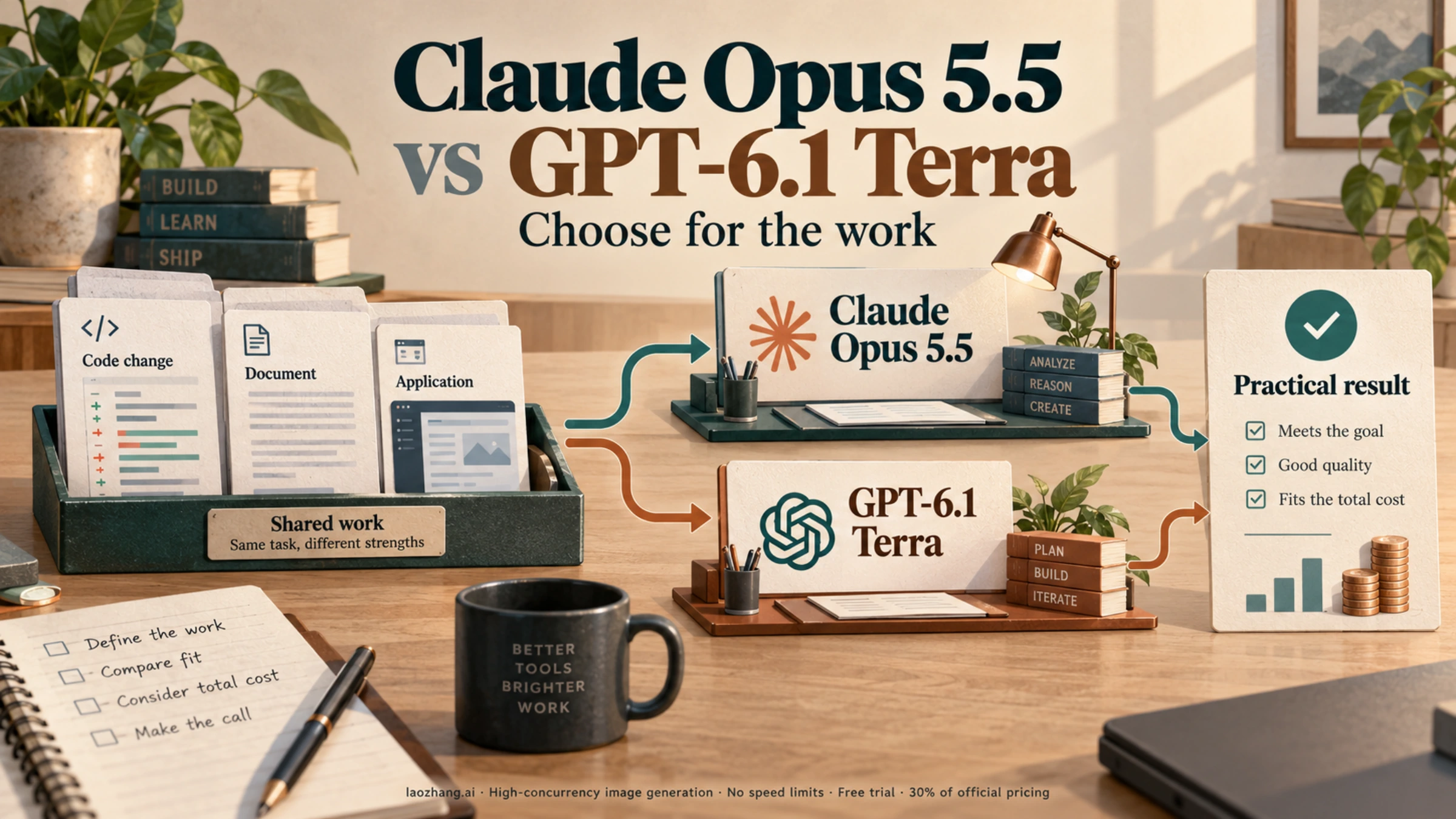
Start with GPT-6.1 Terra when you need an inexpensive model for repeatable work with clear acceptance checks. Put Claude Opus 5.5 first on your evaluation list when difficult coding or text reasoning matters more than the lowest token bill. That recommendation combines two different kinds of evidence: Terra's lower published API rates and Opus's higher Artificial Analysis Intelligence Index result at the tested settings. It does not establish a winner for every repository, document, or screen-based task. OpenAI pricing, Anthropic pricing, and the Terra and Opus benchmark pages supply those baselines.
For visual work and computer use, Terra is a sensible candidate to try early: OpenAI explicitly positions it for interpreting images and acting on screens. That is a capability and product-fit argument, not proof that it beats Opus on your application. For someone already paying for an AI subscription, the first decision is simpler: test the model available in the product you actually use before treating API prices as a reason to buy another plan. OpenAI's Terra product update describes its intended uses and access.
This comparison uses documentation and published third-party results checked on October 28, 2026. We have not run a head-to-head test of these models.
Choose a starting point for the job
The following are evaluation recommendations, rather than claims of measured superiority on these individual tasks.
| Your work | Try first | What would change the choice? |
|---|---|---|
| Repeated extraction, classification, short drafts, or bounded code edits | Terra | Required details are missed, retries accumulate, or review costs outweigh the token savings. |
| Difficult debugging, substantial code changes, or reasoning over conflicting requirements | Opus, with Terra as the cost comparison | Terra passes the same acceptance checks with comparable review effort and a lower total cost. |
| Understanding screenshots, checking visual assets, or operating an application | Terra in a supported tool environment | The actual workflow has more mistakes, interruptions, or recovery work than the Opus alternative. |
| Work inside an existing subscription | The available model in that product | Another product demonstrably improves the task enough to justify its separate price and limits. |
For coding, define success before judging the answer: the requested behavior works, relevant tests pass, and the diff stays within scope. A confident explanation and an attractive demo are weak substitutes for those checks. For a screen-based task, inspect the final application state and any unintended edits. For writing, judge whether the result preserves the supplied facts and fits its intended audience.
Make sure you are comparing Terra, not Sol
The exact direct API identifiers are gpt-6.1-terra and claude-opus-5-5. GPT-6.1 Sol and GPT-5.6 Terra are different comparison targets; their reviews and prices cannot simply be relabeled. The official Terra model page and Opus 5.5 model page give the specifications below.
| Direct API specification | GPT-6.1 Terra | Claude Opus 5.5 |
|---|---|---|
| Input and output | Text and image input; text output | Text and image input; text output |
| Context window | 1,050,000 tokens; maximum input of 922,000 | 1 million tokens |
| Standard maximum output | 128,000 tokens | 128,000 tokens |
| Reasoning control | none, low, medium, high, xhigh, max; default medium | Always-on adaptive thinking; effort controls depth; default medium |
Context capacity tells you what can fit, not how reliably a model will use every detail. Test questions whose answers depend on distant or easily overlooked parts of your material. Also distinguish native output from tools: a text-output model can call a separate image-generation tool without becoming a native image-output model.
Terra is available in ChatGPT Work and Codex, on the plans named in OpenAI's announcement, and is not available in Chat. Enterprise access depends on workspace and administrator settings; browser and computer use have separate setup requirements. Check your actual product's model list and limits. API token charges do not describe a subscription's message allowance. OpenAI's access announcement.
API pricing: the four-to-one ratio has a boundary
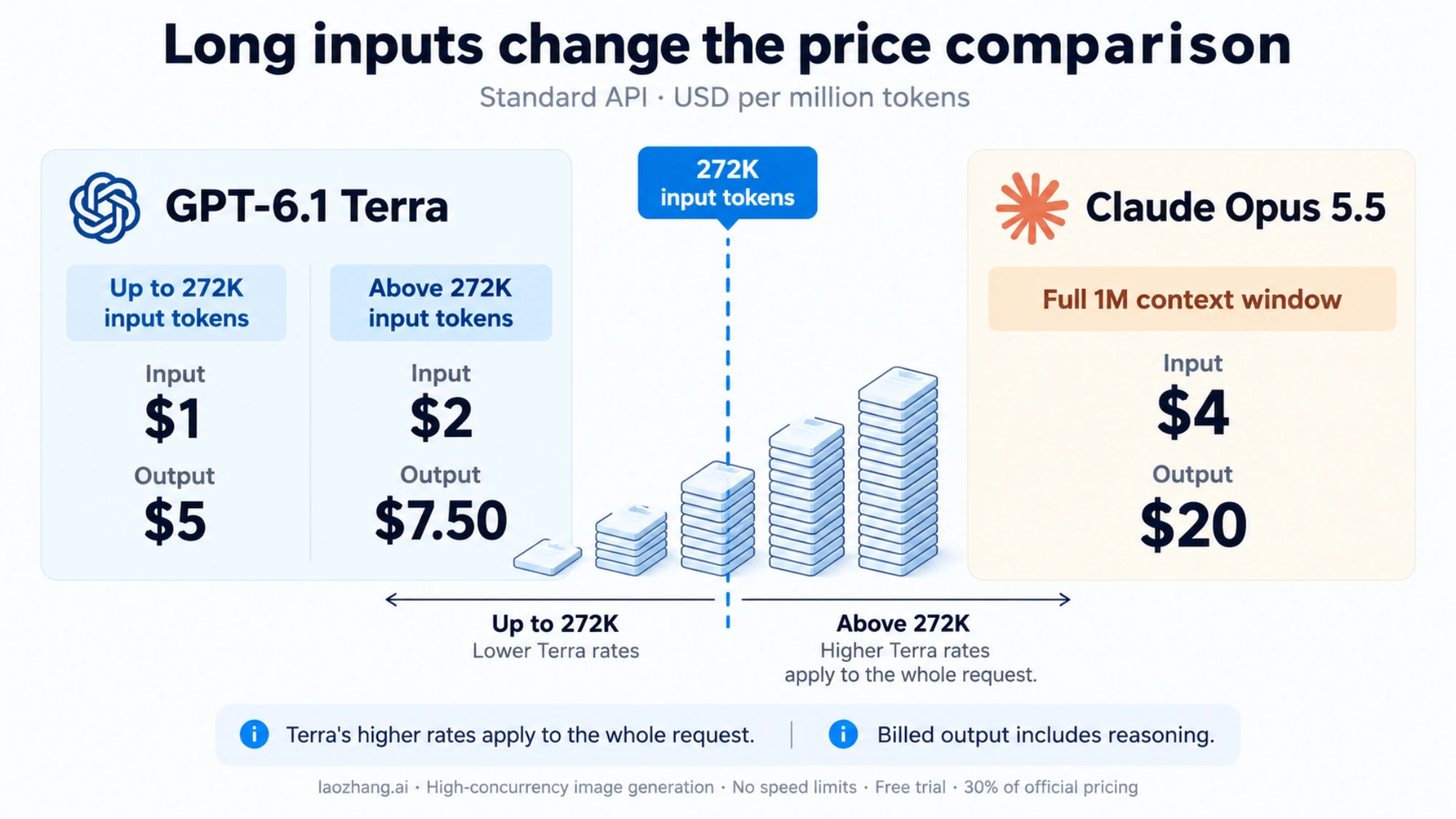
At up to 272,000 input tokens, Opus's Standard uncached input and output rates are four times Terra's. Above that threshold, Terra charges the higher rates for the whole request, including its output. Opus keeps standard rates across its full 1M context window. These are direct-provider USD rates per million tokens, checked October 28, 2026. OpenAI's rate card, Terra's long-context rule, and Anthropic's rate card.
| Standard API charge per million tokens | Terra: input at or below 272K | Terra: input above 272K | Opus 5.5: full context window |
|---|---|---|---|
| Uncached input | $1 | $2 | $4 |
| Output, including reasoning | $5 | $7.50 | $20 |
| Cache-hit input | $0.05 | $0.10 | $0.20 |
Cache writes have separate prices and different retention periods, so the cache-hit row is not the full cost of introducing caching. Batch, Fast, regional processing, tools, taxes, and partner platforms can also change the bill. Keep those conditions consistent when comparing invoices.
What the rates mean for a request
For a request without caching or extra charges:
Cost = uncached input tokens × input rate ÷ 1,000,000 + billed output tokens × output rate ÷ 1,000,000.
These examples apply the official Standard rates to identical billed token quantities. They are calculations, not measured task costs.
| Assumed usage per request | Terra | Opus 5.5 |
|---|---|---|
| 10,000 input + 2,000 output tokens | $0.02 | $0.08 |
| 100,000 input + 20,000 output tokens | $0.20 | $0.80 |
| 300,000 input + 20,000 output tokens | $0.75 | $1.60 |
The last row is why “Opus costs four times as much” needs a qualifier. Terra remains cheaper for those assumed quantities, but the gap narrows above its long-context threshold. A growing conversation can cross the threshold even if the latest user message is short; budget against the request's input count.
The output column must include internal reasoning. Both providers bill that work as output even when it is absent from the visible answer. OpenAI exposes usage.output_tokens_details.reasoning_tokens; Anthropic exposes usage.output_tokens_details.thinking_tokens. Those are breakdowns within billed output, so do not add them to the inclusive output total a second time. Use response usage data rather than counting the words on screen. OpenAI reasoning billing and Anthropic thinking billing.
What the benchmark says about quality—and cost
Artificial Analysis currently reports an Intelligence Index score of 42 for GPT-6.1 Terra at High effort, versus 58 for Claude Opus 5.5 at “Max, Default Fallback.” Its weighted cost per Intelligence Index task is $0.26 for Terra and $10.04 for Opus in those configurations. These are the October 28 snapshot values from the Terra page and Opus page.
That makes Opus worth evaluating when quality on difficult text tasks is the main constraint. It also makes Terra worth evaluating when a workload must scale economically. The result does not tell you that Opus succeeds on 58% of your tasks or that Terra will complete your work for $0.26.
There are two reasons to keep the distinction clear:
- The tested settings differ. Terra High and Opus Max/Default Fallback are neither the same effort setting nor an established equal-compute comparison. These results also do not compare the two models at their defaults.
- The task and denominator are specific. The v5.0 index combines knowledge work, coding, science, and general tasks, primarily in English and text. Its per-task cost weights evaluation costs, including the relevant token and cache charges. It is not the cost of a successful customer support case, accepted pull request, or finished report. AA's intelligence methodology and metric definitions.
A practical way to use the evidence is to assign different tests to different uncertainties. Use repository tasks to decide coding fit, real documents to decide analysis quality, and actual screens to decide computer-use reliability. A general text index cannot settle all three.
Which one is faster?
There is no defensible single speed winner from the figures used here. Artificial Analysis's snapshot lists 90.9 standardized output tokens per second for Terra High and 98.4 for Opus Max/Default Fallback. Opus has the higher output-phase rate in that measurement; this does not establish that it returns a useful answer sooner or finishes a job faster. Terra performance and Opus performance.
AA's default performance workload uses approximately 10K input tokens, with rolling 72-hour median results from its US test environment. Output speed measures the streaming phase. Waiting before the answer, tool execution, response length, and additional attempts all affect the elapsed time a user experiences. AA's performance methodology.
Measure the interval that matters to your product. For an interactive assistant, record time to the first useful answer as well as completion. For a coding agent, start the clock at the request and stop when the change passes its acceptance checks. A quicker stream is helpful, but an extra revision can erase that advantage.
Before switching an agent, check the integration
For a custom API agent, model quality is only one part of the choice. Terra requires the Responses API for tool calling. An existing client using another endpoint needs that compatibility check before its results can be meaningfully compared. Terra API documentation.
Opus 5.5 also has specific constraints. It rejects manual thinking enable/disable controls and the old budget_tokens setting. Forced tool_choice values of any or a named tool return HTTP 400. Thinking history is bound to the model and conversation, and older computer-tool support varies by platform. Test your actual tool loop, saved history, and fallback behavior. Anthropic's Opus 5.5 changes.
If you are moving an existing Opus integration, our Claude Opus 5.5 API and migration guide walks through the compatibility checks. For a Terra–Opus comparison, the important consequence is that replacing a model name alone does not produce equivalent agent environments.
Run a comparison that can change your decision
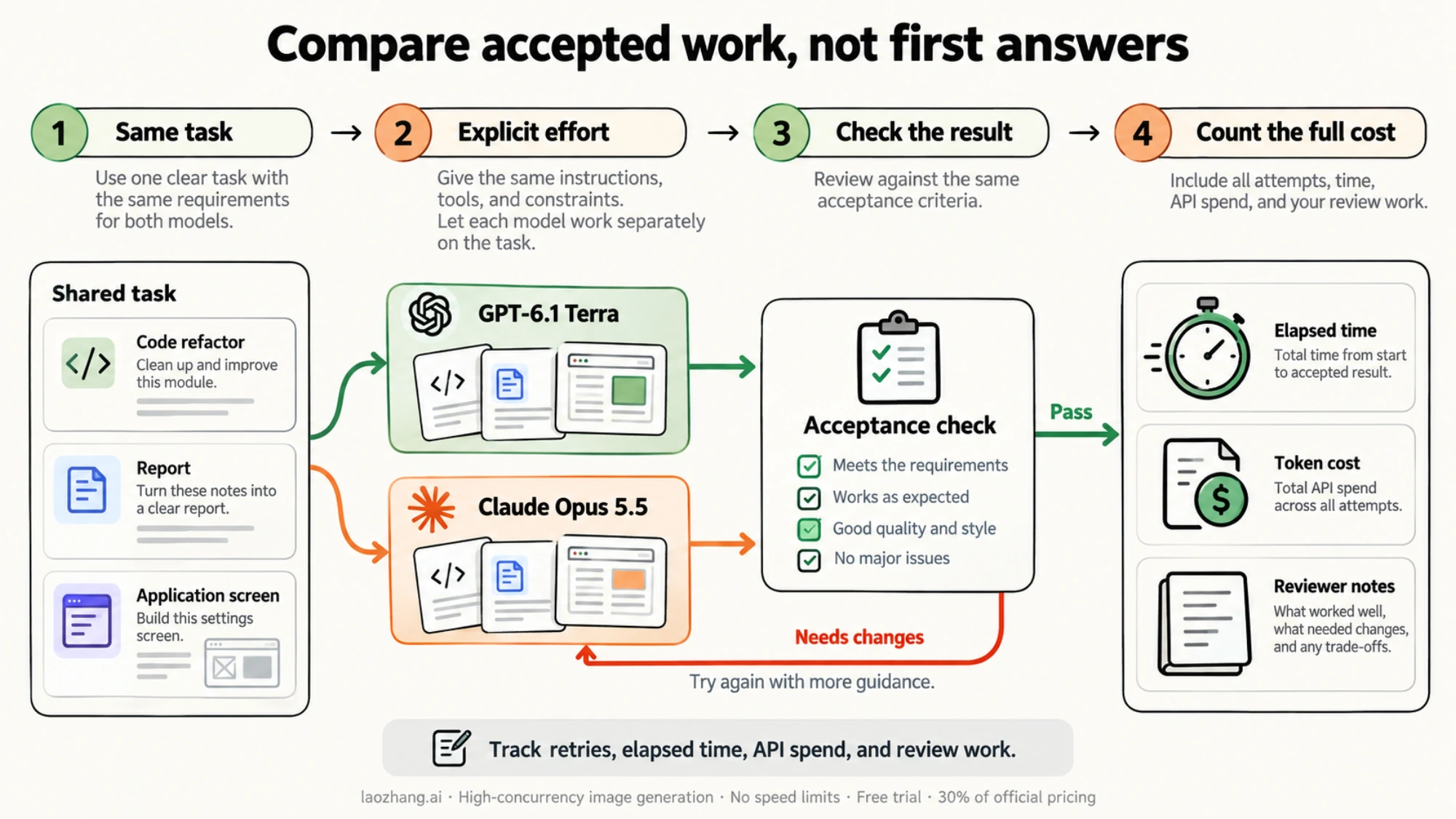
Use a small, representative set of completed jobs for which you can judge correctness. Include ordinary work and the expensive failures you want to avoid. Then:
- Give both models the same task material and acceptance criteria. Keep relevant files, tool access, and time limits comparable. Record any unavoidable product differences.
- Set effort explicitly. Start at a setting you would actually deploy. If one model fails, test whether increasing effort fixes the problem within your cost and time limits.
- Record the complete attempt. Keep billed input and output, cache charges, tool costs, elapsed time, retries, and reviewer corrections. Subscription tests should instead track the product's applicable limits and time spent.
- Choose by accepted results. Keep Terra where its output meets the bar economically. Pay for Opus where the improvement is repeatable and worth the additional cost or wait. If neither meets the bar, revise the workflow rather than choosing the less bad first answer.
For example, when comparing a code refactor, count every model attempt needed to reach the same passing test suite and review standard. Divide the total API spend by the number of accepted tasks, while keeping human review time visible as a separate measure. That gives you a business-relevant cost comparison; a leaderboard score cannot supply it for you.
Common questions
Is GPT-6.1 Terra four times cheaper than Claude Opus 5.5?
Its Standard input and output rates are one quarter of Opus's for requests with at most 272K input tokens. That is a token-price comparison. Larger inputs, reasoning volume, caching, and retries can change the final ratio. OpenAI pricing and Anthropic pricing.
Is Opus 5.5 definitely better for coding?
No. Its stronger result in AA's mixed text index is a reason to include it in a demanding coding evaluation, not proof that it wins on your repository. The cited comparison uses Terra High and Opus Max/Default Fallback. Judge the actual changes, tests, and review work under settings you would use. AA's index methodology.
Should I change subscriptions because Terra's API is cheaper?
API prices alone cannot answer that. Terra is offered in ChatGPT Work and Codex, rather than Chat, and account access and product limits matter. Compare the work you can complete in your current product with the alternative before buying or switching a plan. OpenAI's Terra availability details.