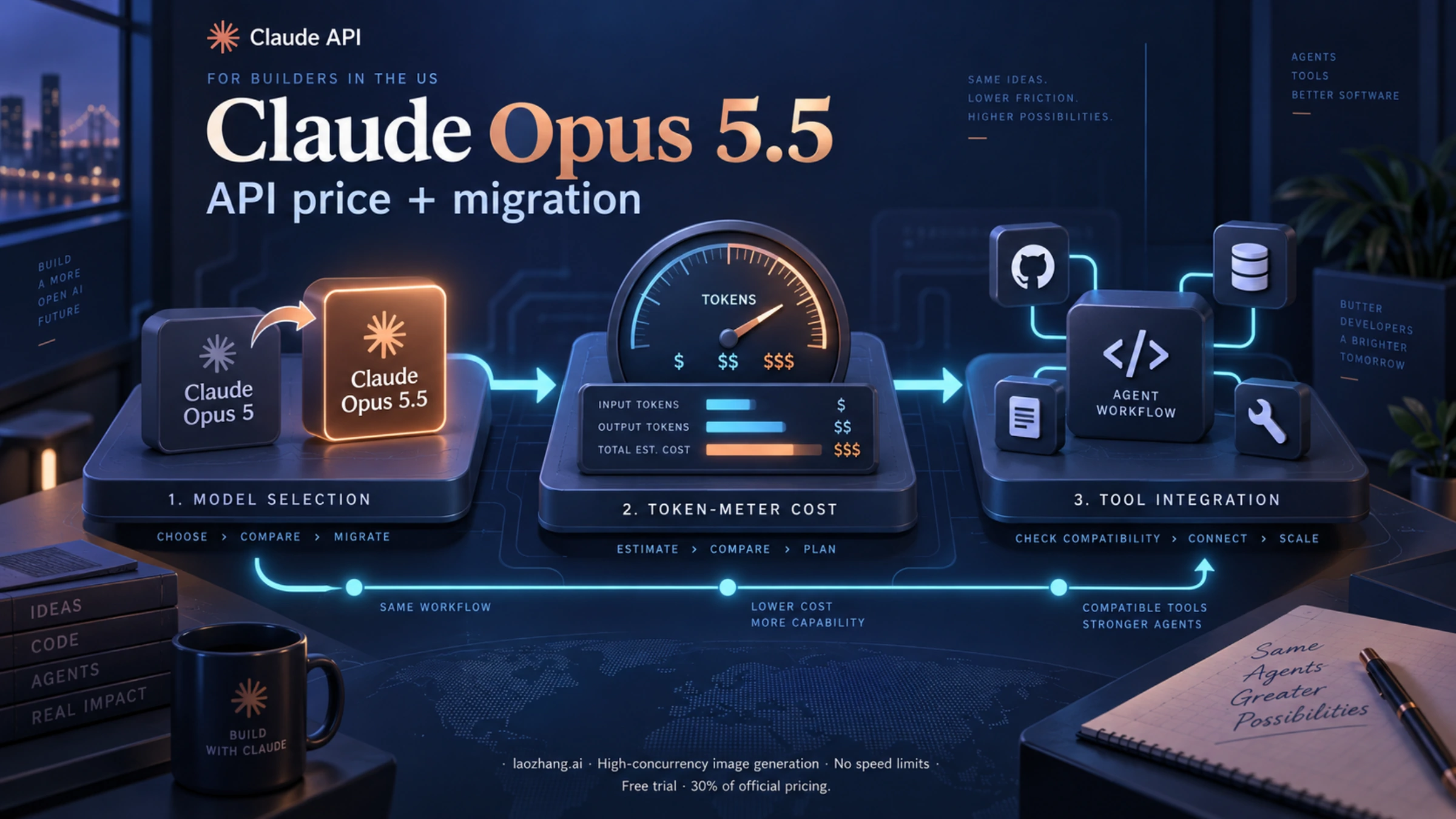
Claude Opus 5.5 is available under claude-opus-5-5 on the direct Claude API. Anthropic released it on September 22, 2026, with a one-million-token context window, a 128K standard maximum output, and list prices of $4 per million input tokens and $20 per million output tokens. Those rates are 20% below Opus 5's $5/$25 rates for the same token mix. They do not guarantee a 20% reduction on every invoice, since caching, effort, output length, and platform charges can change the bill. Anthropic's model specifications and migration guide provide the current baseline.
If you use Claude Code or the Claude app, first check that your plan and account show Opus 5.5; a subscription is a separate purchase from API token billing. If you operate a Messages API client, budget a compatibility pass before changing production traffic. Adaptive thinking is always on, and several previously valid request settings now return HTTP 400.
Pick the model ID for your access route
The direct Claude API ID is claude-opus-5-5. Anthropic also lists Opus 5.5 for Amazon Bedrock, Google Cloud, Microsoft Foundry, and Claude Platform on AWS. The published Bedrock ID is anthropic.claude-opus-5-5; use the model ID and endpoint specified for your chosen platform rather than copying a direct API request into a cloud client. Anthropic's model page lists the IDs and platforms.
The published platform list does not establish access in a particular region or account. Check the model selector or your provider's model listing and entitlement before scheduling a cutover. For Claude Code, the Claude app, and subscription plans, use their product controls and limits rather than applying the API price table below to a seat subscription. Anthropic's launch announcement describes increased five-hour limits for eligible paid plans but gives no universal message allowance that can be promised to an individual user.
What does Claude Opus 5.5 cost on the direct API?
These are Anthropic's published USD prices per million tokens for standard direct API use. A cache read is charged differently from uncached input; creating a cache entry has its own rate. The Opus 5.5 rate card lists the charges and the Batch discount.
| Meter | Opus 5.5 price per million tokens |
|---|---|
| Uncached input | $4 |
| Output | $20 |
| Five-minute cache write | $5 |
| One-hour cache write | $8 |
| Cache read | $0.20 |
The Batch API discounts input and output by 50%. Anthropic also offers a Fast mode research preview with $8 input and $40 output per million tokens, so do not use the standard $4/$20 rates to estimate a Fast request. Check Fast availability and the relevant feature rates on your actual route. Cloud providers and resellers can have different billing terms, and the table excludes taxes and any extra platform or tool charges. Anthropic describes Fast mode and its pricing.
Compare identical token volumes before comparing tasks
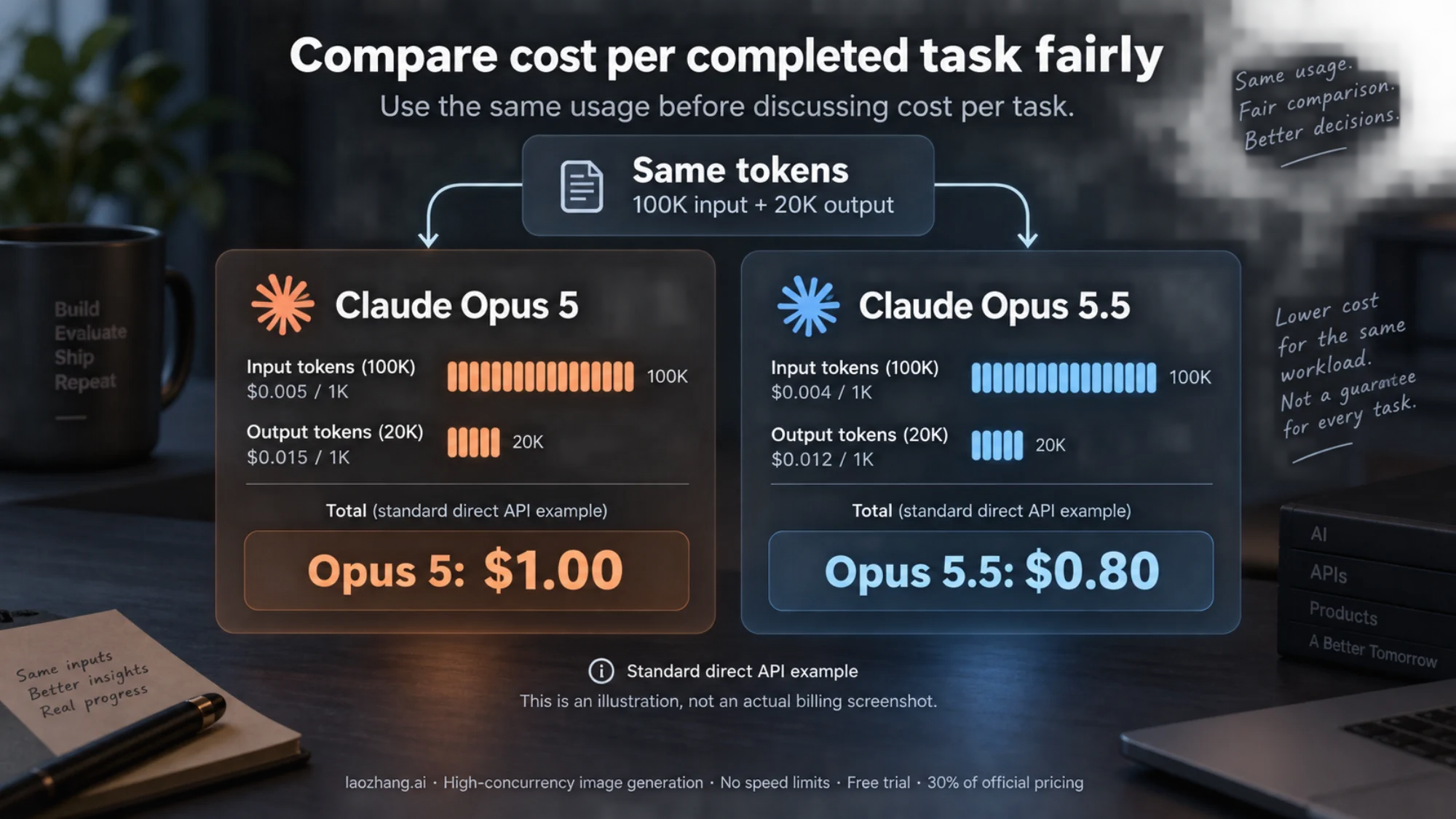
Suppose a job sends 100,000 uncached input tokens and receives 20,000 output tokens, with no cache writes, tool charges, or other billable features. At the standard direct API rates:
| Model | Calculation | Illustrative total |
|---|---|---|
| Opus 5.5 | 0.1 × $4 + 0.02 × $20 | $0.80 |
| Opus 5 | 0.1 × $5 + 0.02 × $25 | $1.00 |
The Opus 5 comparator is Anthropic's published Opus 5 price. On this same-token example, Opus 5.5 costs $0.20 less, or 20%. A separate 200,000-token cache read would cost $0.04 at Opus 5.5's $0.20 rate versus $0.10 at Opus 5's $0.50 rate. Add cache writes, reads, output, and any other applicable charges for your own estimate.
Anthropic reports 40% lower typical cost per completed task at default settings, attributing it to the lower rate and fewer tokens used. That is a vendor workload result, not another rate-card discount to stack on top of the $0.80 example. A task with different prompts, effort, retries, or success criteria may save a different amount. Read Anthropic's launch comparison, then use your own completed-task logs for a production budget.
Why a model-string swap can fail
For an existing Messages API integration, start by changing claude-opus-5 to claude-opus-5-5 in development. Then check the request and response behavior that Anthropic calls out in its Opus 5.5 migration guide:
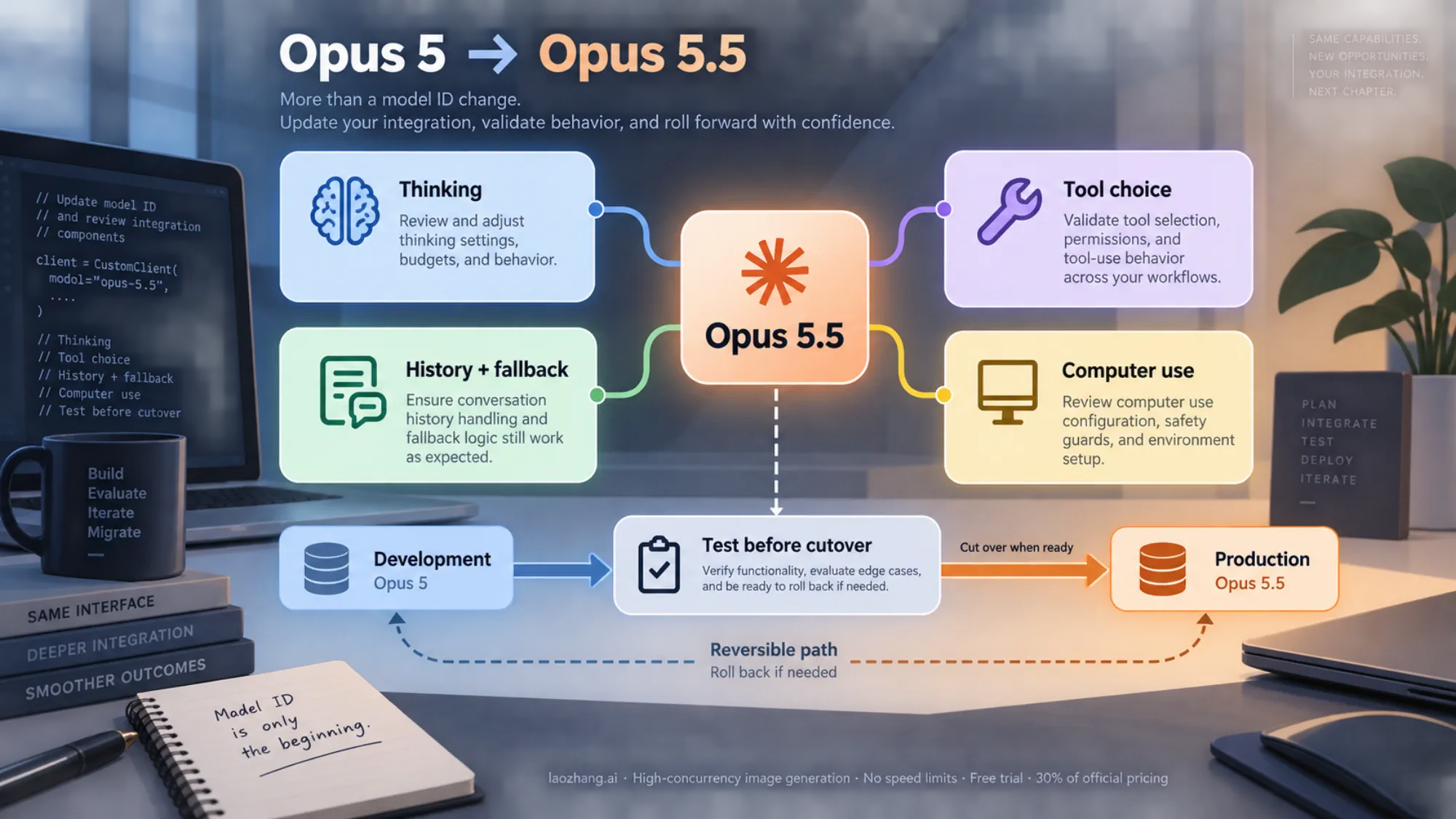
- Thinking settings: Opus 5.5 has always-on adaptive thinking. Requests that set
thinking.typetodisabledorenabledwith a token budget fail with HTTP 400. Remove that field and choose aneffortlevel. The new default ismedium, whereas Opus 5's default washigh; compare at an explicit level when evaluating quality, cost, and latency. - Forced tool selection:
tool_choiceset toanyor a namedtoolfails with HTTP 400. Useautowith strict tool use or structured outputs where they fit the contract. Confirm that your tool workflow still produces the required result. - Thinking history and fallback: Read response blocks by type and return thinking blocks unchanged with tool results. A router switching from Opus 5.5 to most other models cannot carry its thinking blocks across. Edits to earlier messages, tools, or the system prompt can also invalidate replayed thinking, with enforcement depending on account creation date and platform. Test your actual conversation and fallback path.
- Computer use: On the Claude API and Google Cloud, the old
computer_20251124tool type fails; Anthropic specifiescomputer_toolset_20260801and changes to the agent loop. The old type continues to work on Amazon Bedrock. Follow the platform branch in the migration guide before changing the tool declaration.
One change may not produce an error but can still break your interface: text between tool calls moves into progress-update thinking blocks. If your UI displays those updates, choose a supported thinking.display setting and render the returned non-empty blocks. Otherwise the UI can appear quiet while tools run. This behavior and the beta option for showing updates are documented in the migration guide.
Claude Managed Agents have a narrower documented migration: Anthropic says no change beyond the model name is required there. The checklist above concerns custom Messages API code, especially clients that control thinking, tools, streaming, or fallback.
A practical cutover decision
Make the switch if your chosen product or API route exposes the model, your client passes the relevant migration checks, and a representative set of tasks meets your quality and cost targets. Keep a reversible Opus 5 path while testing. Record input, output, cache reads and writes, retries, effort, task completion, and latency; compare like-for-like tasks rather than relying on one short prompt or the headline price alone. Anthropic's benchmark and speed figures are provider measurements, not independent evidence for your own workflow. The official migration checklist recommends a development test and a new cost and latency baseline before production traffic moves.
The direct API price and model ID are published; your account's access and your completed-task cost still require a check on the route and workload you actually use.