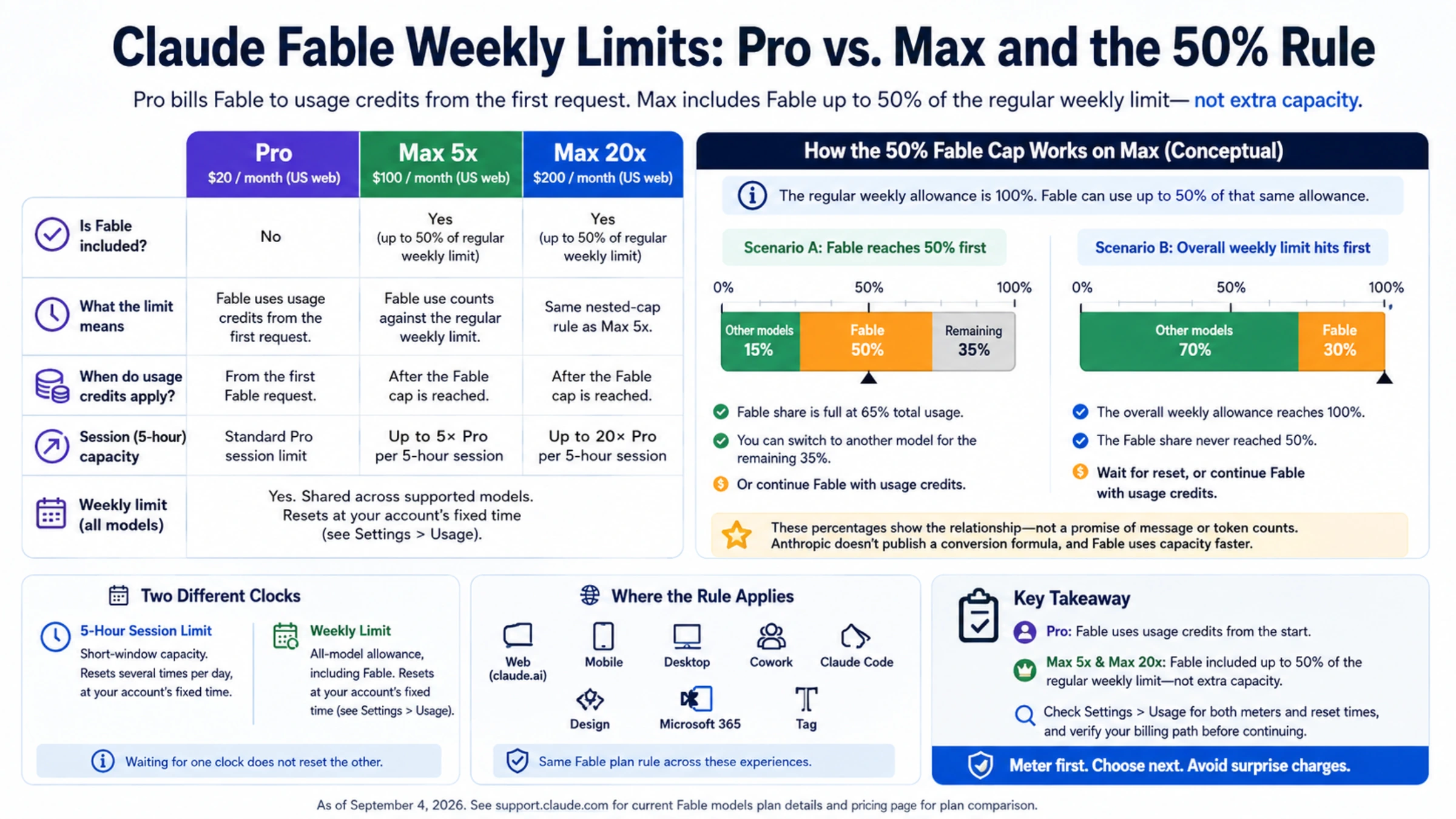
Claude Pro uses paid credits for Fable 5.1 from the first request. Max includes Fable, but only up to 50% of its regular weekly allowance. That share sits inside the allowance used by other models; it is not extra capacity. These rules also apply to Fable 5, according to Anthropic's current Fable plan guidance, checked September 19, 2026.
If Fable stops working, start with Settings > Usage. A full Fable share, a full all-model weekly allowance, a five-hour session limit, and an unavailable credit balance call for different next steps. If Claude unexpectedly switches to Opus, read the notice: a safety-triggered switch does not mean you have run out of Fable usage.
| Individual plan | Included Fable allowance | When paid credits apply |
|---|---|---|
| Pro | None | From the first Fable request |
| Max 5x | Up to 50% of the regular shared weekly allowance | When an applicable included limit is reached, if credits are enabled and available |
| Max 20x | The same 50% rule | When an applicable included limit is reached, if credits are enabled and available |
How Max's 50% weekly Fable cap works
Think of the regular Max weekly allowance as 100 units. Fable can consume at most 50 of those units as included usage. Every unit spent on Fable also reduces the regular allowance.
Two illustrative weeks show why both limits matter:
- 15 units on other models, then 50 on Fable: total usage reaches 65. Fable's included share is full, but 35 units remain for other models, subject to any other applicable limits.
- 70 units on other models, then 30 on Fable: total usage reaches 100. The shared weekly allowance is exhausted before Fable reaches its own ceiling.
These are examples of how the limits fit together, not a token-accounting formula. Anthropic says Fable consumes plan capacity faster than other models but does not publish a conversion from the usage meter to messages, tokens, or dollars. Fable 5 and Fable 5.1 fall under the Fable allowance; switching between versions does not create a fresh weekly pool. Source: Fable models on your plan.
When the Fable share is full and regular capacity remains, selecting another included model may let you continue within your subscription. When the shared weekly allowance is full, switching models cannot replenish it. You can wait for the displayed reset or deliberately use paid credits.
A five-hour reset does not restore the weekly allowance
Max has session and weekly limits. Its 5x and 20x labels describe per-session capacity relative to Pro, not a published weekly token multiplier. In particular, the Max 20x name is not evidence that it includes four times the weekly Fable tokens of Max 5x. Both tiers have the same stated 50% Fable ceiling within their respective regular weekly allowances. See Anthropic's Max plan explanation.
The five-hour session window and the weekly window run separately. Your next session reset can arrive while the weekly limit remains exhausted; spare weekly capacity does not bypass a session limit. Check the account's reset times in Settings > Usage instead of assuming that every account resets on Monday or at midnight.
A long conversation can also run into a length limit, which is different from spending the allowance for a time window. Starting a new conversation may address the conversation's length, but it does not restore a depleted weekly allowance. Model choice, effort, files, tools, and conversation length affect consumption, and subscription use across Claude's apps and Claude Code shares usage. Anthropic explains these distinctions in its usage and length limits guide.
For planning, watch the meter during a few representative tasks. A report based on someone else's short chats cannot reliably predict the allowance needed for your long coding sessions or large documents. There is no official universal number of Fable prompts per week.
Extra usage means separately paid credits
Usage credits are a prepaid balance, separate from your subscription's recurring allowance. Credit-funded requests are billed at standard API rates. Adding funds does not enlarge the included weekly pool or change its reset time. On Pro, Fable uses this balance from the beginning; on Max, credits can support continued use after an applicable included limit is reached. Source: managing usage credits.
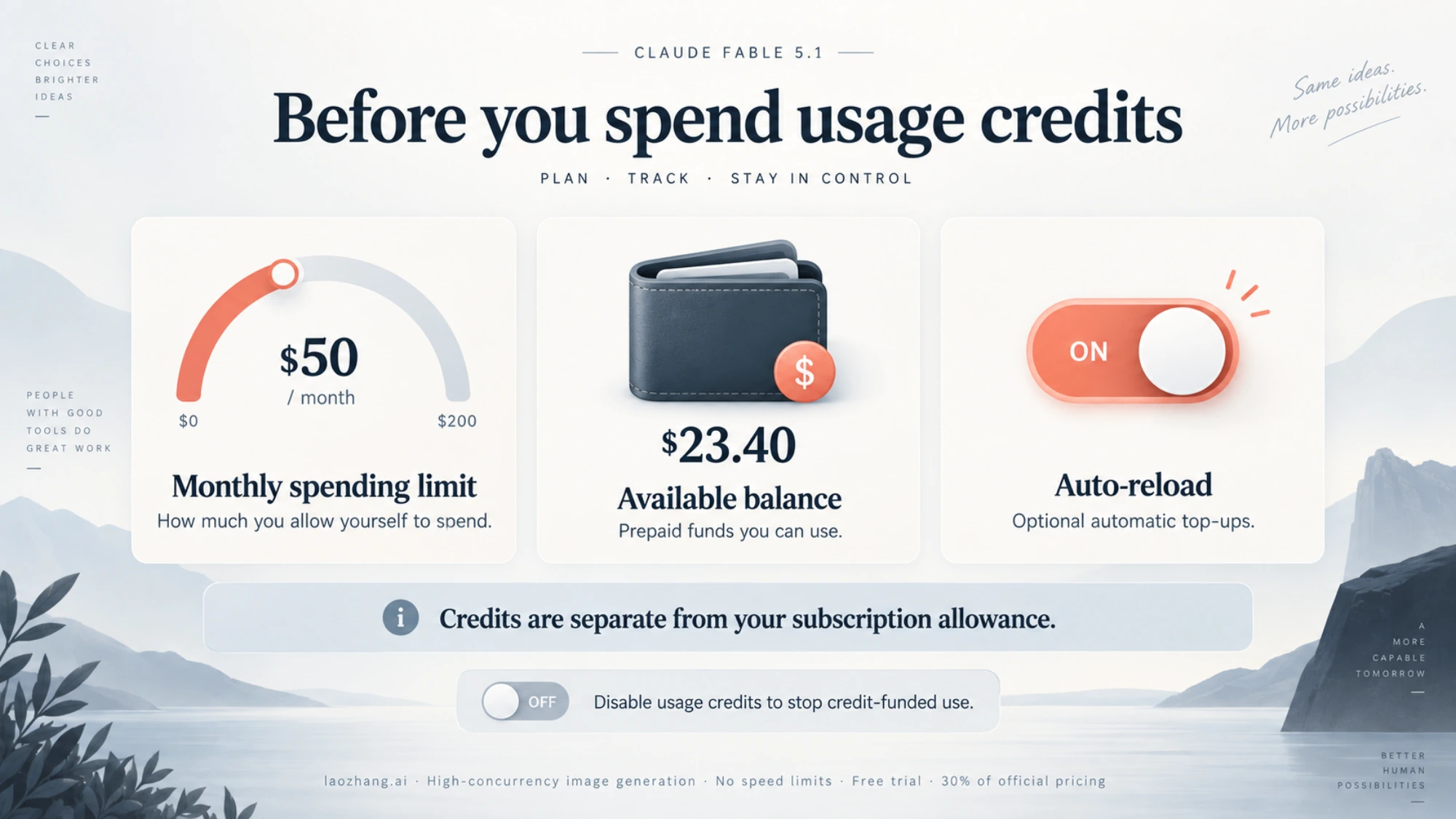
Before starting paid usage, open Settings > Usage > Usage credits and check three controls:
- Monthly spending limit: use Adjust limit to set the amount you are prepared to spend on extra usage.
- Available balance: use Add funds when you intentionally want more prepaid credit. A positive balance is separate from permission to spend within the monthly limit.
- Auto-reload: decide whether the balance should refill automatically. This is optional; do not assume that a depleted balance will stop future purchases if you have enabled it.
You also need to enable usage credits and provide a payment method. If you subscribed through a mobile app, enable credits and buy them on the web. To stop credit-funded usage, disable usage credits in the same settings. Switching off auto-reload alone controls replenishment; it is not the same as disabling spending from an existing balance.
If paid continuation is unavailable, inspect the balance and spending limit before concluding that Claude has imposed a new model quota. Conversely, a request that keeps working after included capacity runs out may be spending credits. Check the credit controls before a long unattended task.
Most jurisdictions do not impose an expiry on purchased credits, but regional rules differ. Japan's purchased credits expire six months after purchase under the rules introduced September 10, 2026. Promotional credits have their own terms. Use the account's displayed balance and expiry information rather than assuming that every kind of credit lasts indefinitely. Source: usage credit FAQ.
Switching away from Fable: quota choice or safety fallback?
There are two distinct reasons to end up using another model.
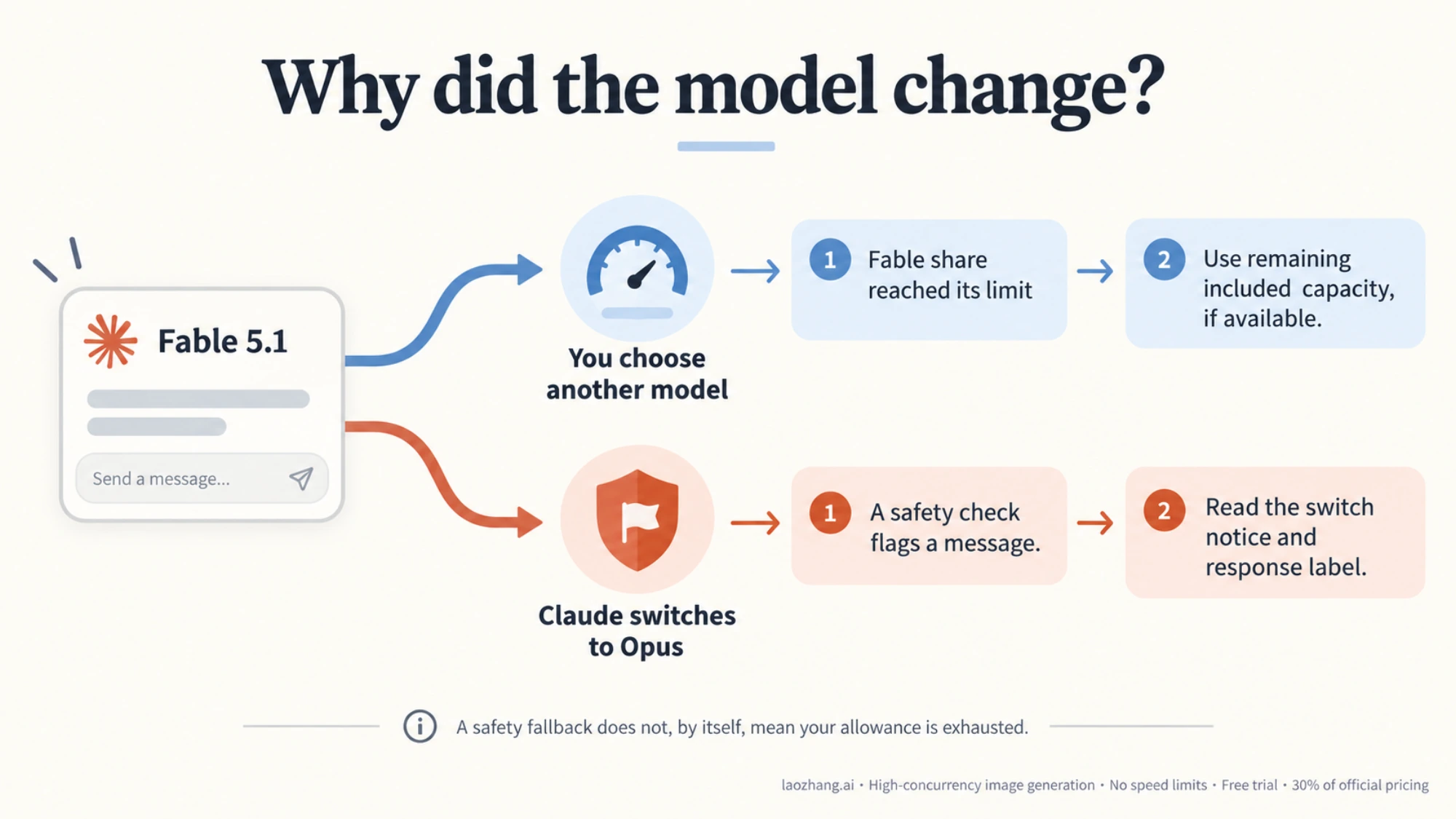
You can choose another model to conserve or use remaining subscription capacity. For example, after reaching Max's Fable share, you might select a model covered by the remaining regular allowance. The Claude model comparison covers differences that matter when choosing a substitute. On Pro, selecting an included model also avoids Fable's requirement to use credits from the first request.
Claude can automatically switch a flagged Fable conversation to Opus. This safety fallback is enabled by default. Claude shows a notice and labels the model that answered, and the model picker remains on Opus until you change it manually. That behavior is not, by itself, evidence that a weekly or session limit was reached. Anthropic documents it in why Claude switched models in your Fable conversation.
To control automatic fallback, use Settings > Capabilities > Switch models when a message is flagged. In Claude Code, the corresponding control is under Config > MODEL & OUTPUT. Turning it off pauses a blocked request rather than automatically continuing with another model; it does not disable safeguards. Changing the picker back to Fable may lead to another flag if the same conversation content triggers the check.
The point at which the request was blocked also affects billing:
| Safety fallback event | Anthropic's documented billing treatment |
|---|---|
| Fable blocks the input before generating an answer | Only the Opus request is charged, at Opus rates |
| Fable is blocked while streaming an answer | Fable's input and already streamed tokens are charged, followed by the Opus continuation |
These are the documented fallback billing rules, not a measured bill from our account. A blocked Fable response is therefore not necessarily free, and a model switch is not necessarily a quota workaround.
Claude Code: check access and billing before a long session
Selecting Fable 5.1 in Claude Code requires version 2.1.257 or later. The official plan guidance says 2.1.255 and the Claude Code model docs say 2.1.257, but npm never published 2.1.253 through 2.1.256, so 2.1.257 is the first build that meets both. Claude's web, desktop, and mobile apps offer model selection through their model pickers. If the model is still missing in Code after updating, Fable 5.1 Not Available in Claude Code? Diagnose It by Symptom walks through the version, picker, credit, and organization checks.
Subscription-authenticated Claude Code shares the Pro or Max usage allowance with Claude's apps. Direct API use has separate billing and limits; paying for Pro or Max does not create an API balance. Before interpreting a terminal session against the app's usage meter, confirm which account and billing method the session uses. The Claude Code plan guide covers the broader subscription choice.
Max 5x and Max 20x have US web prices of $100 and $200 per month, respectively, in the Max plan documentation. Compare a subscription change with your actual credit spending and workload. A larger session allowance can be useful, but neither price establishes a fixed number of Fable tasks per week.
The earlier free-credit promotion has expired
As of September 19, 2026, neither of the earlier promotions should be treated as current included Fable access. The temporary Fable 5 subscription promotion ended July 19 and never covered Fable 5.1. The separate $100 promotional credit offer for eligible Pro and Team Standard accounts expired September 17 at 11:59 PM Pacific Time, regardless of when the credits were claimed. Source: official promotion terms.
Those promotional credits were standard usage credits usable on any model, not a separate Fable 5.1 grant. Once promotional funds ran out, other available credits or auto-reload could support continued use without a separate transition message. An old promotional screenshot therefore does not tell you whether a request is free today.
What to check when Fable stops or changes models
| What happened | Check first | Next step |
|---|---|---|
| Fable requires payment on Pro | Usage credits settings | Choose an included model or enable paid usage deliberately |
| Max's Fable share is full | Remaining regular weekly capacity | Select another included model if capacity remains, wait, or use credits |
| The all-model weekly allowance is full | Displayed weekly reset time | Wait for that reset or choose paid continuation |
| The session limit is reached | Displayed session reset time | Wait for the session reset or check available paid continuation |
| Credit-funded use will not continue | Credit balance and monthly spending limit | Adjust only the control you intend to change |
| Claude unexpectedly answers with Opus | Switch notice and response label | Distinguish safety fallback from a usage-limit message |
For an interruption, the most useful information is the exact notice, the relevant usage meter, its reset time, and whether credits are enabled. Those four checks distinguish waiting for included capacity from choosing to pay for more—and keep an automatic safety switch from being mistaken for a depleted weekly allowance.