Claude Code has no price of its own. It comes with a Claude subscription: Pro at $20 a month (or $200 for a year), Max 5x at $100 a month, or Max 20x at $200 a month. Those are US prices before tax as of September 25, 2026, from Anthropic's pricing page. All three plans run the same Claude Code in the terminal and your IDE, with Opus, Sonnet and Haiku included. The extra money buys room. Max 5x gives you five times Pro's allowance in each five-hour session, and Max 20x gives you twenty times. Both Max tiers still have a weekly limit.
The short rule: start on Pro. Move to Max 5x when Pro's limits stop you on most working days even after routine work runs on Sonnet, or when the usage credits you buy on Pro would fall by more than $80 a month. Apply the same test to Max 20x with the $100 gap above Max 5x. Heavy Fable users are the exception, because Pro pays for every Fable request with credits while Max includes Fable inside its weekly limit.
Pro vs Max 5x vs Max 20x: what you pay and what you get
| Pro | Max 5x | Max 20x | |
|---|---|---|---|
| Price (US, before tax) | $20/month, or $200/year (about $16.67/month) | $100/month | $200/month |
| Billing options | Monthly or annual | Monthly only | Monthly only |
| Claude Code in the terminal and IDEs | Included | Included | Included |
| Allowance per five-hour session | Baseline | 5x Pro | 20x Pro |
| Weekly limit across all models | Yes | Yes | Yes |
| Opus, Sonnet, Haiku | Included | Included | Included |
| Fable 5 and 5.1 | Paid with usage credits from the first request | Up to 50% of the weekly limit, then credits or another model | Up to 50% of the weekly limit, then credits or another model |
| Usage credits for overflow | Available | Available | Available |
Prices and plan terms come from the pricing page, the Pro plan and Max plan help articles, and the Fable plan rules. App-store subscriptions and non-US prices can differ, so check claude.ai/upgrade for your own checkout price.
The pricing page also lists "Higher output limits for all tasks", early access to new features and "Priority access at high traffic times" for Max. None of these is quantified. The Pro help article also mentions priority access during high-traffic periods, so priority access alone is a weak reason to upgrade.
What "5x" and "20x" actually measure: no published token limit
The multiples apply to the per-session allowance, the budget that resets every five hours. Every paid plan also has a weekly limit across all models, reset at a fixed time assigned to your account and shown in Settings > Usage. Anthropic adds that it may limit usage in other ways, such as weekly or monthly caps. It does not publish the weekly limits as multiples of Pro, and it publishes no message count, token quota or hours for any plan. A fixed "messages per five hours" figure for Pro or Max is an outside estimate, not a plan term.
Divide each session multiple by the price and one detail stands out. Pro gives 1 unit of session allowance for $20 and Max 5x gives 5 units for $100, so both work out to 0.05 per dollar. Max 20x gives 20 units for $200, or 0.10 per dollar. Max 5x buys a bigger session at the same rate as Pro; only Max 20x is cheaper per unit of session allowance. That ratio covers the five-hour window only and says nothing about the weekly limit.
Which plan fits how you use Claude Code
| How you work | Plan to start with | What would change the answer |
|---|---|---|
| A few Claude Code sessions a week, limits rarely stop you | Pro, monthly | Annual Pro saves $40 a year ($200 vs $240) once you know you will keep it |
| Pro's five-hour limit stops you on most working days, even with routine work on Sonnet | Max 5x | If the stops come from the weekly limit rather than the session limit, run the monthly-total test below first |
| Max 5x still stops you on most working days, or you run parallel agents and loops for hours | Max 20x | Check /usage for one loop or MCP server that eats a large share before paying $100 more |
| You want Fable regularly | Max 5x or Max 20x | Fable can use up to half of Max's weekly limit; past that, it bills credits again |
| Heavy bursts a few weeks a year, quiet months otherwise | Pro plus usage credits with a monthly cap, or Console API credits for the sprint | If the bursts become monthly, compare totals against Max |
| Two or more people working for one business | Team plan | Team seats have their own per-member limits and a two-seat minimum |
Anthropic's own advice follows the same shape: upgrade to Max 5x "if you consistently hit limits and need more capacity for larger repositories", and from Max 5x to Max 20x if you still consistently hit limits. Its other options are usage credits, Console API credits "for intensive coding sprints", or waiting for the reset (Claude Code with Pro or Max).
Before you pay more, check whether the plan is the problem
A limit that arrives early is not always a sign that you need a bigger plan. Four things in Claude Code change how fast a plan runs out, and each can be fixed for free.
1. Which model is running
Since Claude Code v2.1.280, the default model is Opus 5.5 on Pro and Max. Before that version, Pro defaulted to Sonnet 5 (model configuration). If you are on Pro, never picked a model and recently updated, you are now running Opus without having chosen it. Anthropic's Claude Code help says Sonnet is "the right choice for the large majority of coding work" and that Opus "costs several times more per turn than Sonnet" (models, usage and limits). It gives no exact multiplier.
Switch with /model mid-session without losing the conversation. /model opusplan plans with Opus and executes with Sonnet. For the trade-offs between models, see Claude Sonnet vs Opus vs Haiku vs Fable. If you stay on Opus, lowering Opus 5.5 effort is another lever. The Claude Code changelog guide shows how to check which version you run.
2. How much context each turn carries
Every turn resends the conversation, your CLAUDE.md and the files Claude has read. One long session that spans several tasks costs more per turn as it grows. Run /clear when you switch tasks and /compact when you need to keep going on a long one.
3. What /usage says is using your plan
On Pro and Max, /usage in Claude Code shows your plan bars and a breakdown of recent usage (Claude Code cost docs):
- Attribution: the share of recent usage that went to skills, subagents, plugins and individual MCP servers.
- Behavior flags: long context or cache misses, flagged when one of them accounts for 10% or more of recent usage.
- Loops: the heaviest
/loopor scheduled tasks, with per-run tokens.
Press d or w to switch between the last 24 hours and the last 7 days. The figures are approximate and come from this machine's session history only, so claude.ai and other computers are missing. The dollar figure in the Session block is for API users; on Pro and Max it "isn't relevant for billing purposes". For a full walkthrough, see Claude Code /usage: Read Limits, Resets, and Usage Monitors. If cache misses show up, Claude Code cache miss token costs explains the causes.
4. Which account is paying
If an ANTHROPIC_API_KEY environment variable is set, Claude Code uses that key instead of your subscription. The result is API charges "rather than using your subscription's included usage" (Claude Code with Pro or Max). Run /status to see the active account, and /login to switch from a Console login to your subscription.
Automation counts too. claude -p, the Claude Agent SDK and third-party apps built on it all draw from your subscription limits. A separate monthly Agent SDK credit was announced for June 15, 2026 and then paused, so it is not available (Agent SDK with your plan). A nightly script that runs claude -p spends from the same allowance you need in the morning.
When Pro runs out: wait, add credits, or switch to the API
Claude Code does not get its own allowance. Your usage on claude.ai, Claude Desktop, Claude Code in the terminal and Claude Code in VS Code or JetBrains all counts against the same plan limits (usage and length limits). A long chat in the browser leaves less for the terminal. Moving to another app does not give you more. The same pool covers Cowork; see Claude Cowork Pricing for that side.
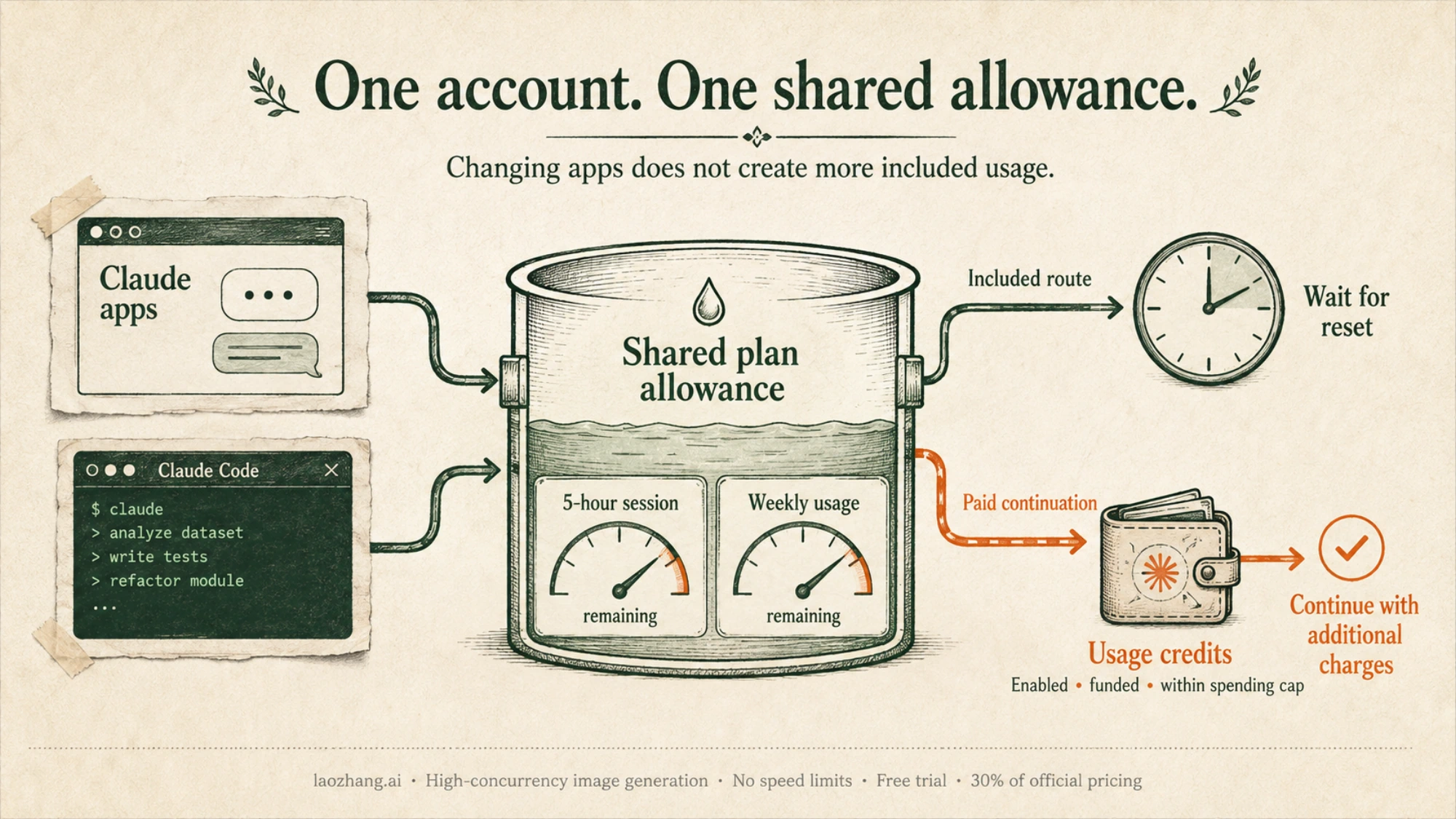
When the allowance is gone, you can wait for the five-hour or weekly reset, or pay for the extra work with usage credits. A third option, the Claude API, leaves the plan out of the picture.
Usage credits: overflow at standard API rates
Usage credits let Pro and Max subscribers keep working past the included limits, charged separately at standard API rates.
- Turn them on in Settings > Usage on claude.ai. In Claude Code,
/usage-creditsopens that page when you are signed in with your subscription. - Set a monthly spend limit. Auto-reload is optional. The daily redemption limit is $2,000.
- While credits are on,
/usagein Claude Code shows this month's credit spend against your limit. - Credits do not move the five-hour reset.
- Usage bundles prepay at a discount: $50 of usage for $45, $250 for $200, or $1,000 for $700. Pro and Max can buy up to $2,000 of discounted bundles a month.
What overflow costs per model
Credits and the Claude API use the same per-token rates (pricing page, API section):
| Model | Input per million tokens | Output per million tokens | Cache reads per million tokens |
|---|---|---|---|
| Opus 5.5 | $4 | $20 | $0.20 |
| Sonnet 5.5 | $2 | $10 | $0.10 |
| Haiku 5.5 (prompts up to 100K tokens) | $0.10 | $0.50 | $0.01 |
| Fable 5.1 | $10 | $50 | $0.25 |
To get a feel for scale, take an assumed 1 million fresh input tokens plus 100,000 output tokens. That costs $3.00 on Sonnet 5.5 ($2.00 + $1.00), $6.00 on Opus 5.5 ($4.00 + $2.00) and $15.00 on Fable 5.1 ($10.00 + $5.00). A cache-heavy Opus 5.5 turn mix of 5 million cache reads, 300,000 fresh input and 100,000 output comes to $4.20 ($1.00 + $1.20 + $2.00). Those token counts are assumptions, not a measured session, and cache writes are left out. The point is the ratio: at the same token counts, overflow costs twice as much on Opus 5.5 as on Sonnet 5.5, and five times as much on Fable 5.1. Model details are in Claude Opus 5.5: API Price, Model ID, and Migration Checks.
The API instead of a subscription
You can also sign Claude Code in to a Claude Console account and pay per token instead of drawing on a plan. Pro does not include Console API usage; the two are billed separately. For a rough scale, Anthropic reports that across enterprise deployments the average API-billed Claude Code cost is "around $13 per developer per active day and $150-250 per developer per month", with 90% of users under $30 per active day (Claude Code cost docs).
That is an enterprise average with an unstated model mix, not a forecast for you. Its monthly range happens to sit between the Max 5x and Max 20x prices. Because Anthropic does not express plan allowances in tokens, the average cannot tell you how much of that work a Max plan would cover. The API route fits short, intense sprints, CI jobs you want billed apart from your personal plan, or teams that need spend controls. To set one up, see how to get a Claude API key.
Does Max pay for itself? Compare the monthly total
A Max upgrade only saves money if it replaces enough of what you would otherwise pay on top of Pro. Price the same finished month of work under each option:
Monthly total = subscription + usage credits consumed + any separate API spend
Call your credit spend on Pro C, and the credits you would still need on Max 5x C′. Max 5x is cheaper when C − C′ is more than $80, the gap between $100 and $20. At exactly $80 the two cost the same. The threshold is $100 from Max 5x to Max 20x, and $180 from Pro straight to Max 20x.
| Illustrative month, same work | Pro | Max 5x (case A) | Max 5x (case B) |
|---|---|---|---|
| Subscription | $20 | $100 | $100 |
| Usage credits consumed | $110 | $45 | $20 |
| Total | $130 | $145 | $120 |
| Charges the upgrade avoids | $65 | $90 | |
| Result | Max costs $15 more | Max saves $10 |

In case A, Pro's $110 of credits is more than $80, and upgrading still loses money, because Max 5x does not absorb all of it. These are sample budgets, not measured plan throughput. Two points decide which case you are in:
- Count credits consumed, not credits bought. A $250 bundle with $140 left unused is $110 of spend, not $250. Use the monthly spend shown in Settings > Usage or the credits row in
/usage. - Estimate C′ from when the credits were spent. Credits spent while only the five-hour session was full, with weekly room left, are what a five-times-larger session targets directly. Credits spent after the weekly limit ran out depend on Max's weekly limit, and Anthropic does not publish that as a multiple of Pro. If most of your overflow happens at the end of the week, C′ is harder to predict. A cautious estimate keeps more of it.
Fable changes the arithmetic. On Pro, every Fable request is credit spend. On Max, Fable draws on the regular weekly limit, up to half of it, with no extra fee. A Pro user with a large Fable credit bill can therefore cross the $80 line sooner. Fable still shares the weekly pool with every other model, though, so it is not "50% extra". Claude Fable 5.1 usage limits explains the details.
Upgrading, downgrading and dates that affect the choice
- Upgrade billing. Moving to a higher tier is charged pro rata for the rest of the billing cycle. From annual Pro to Max, any remaining Pro balance larger than the Max price becomes account credit for future subscription charges. Google Play upgrades charge the full new price and convert unused value into extra days (Max plan billing).
- Counters after an upgrade. Anthropic does not document whether this week's usage counters reset when you upgrade mid-week. Don't plan a deadline around an instant reset.
- Saved limit reset. With the Opus 5.5 launch on September 22, 2026, subscribers received a limit reset to use when they choose. It refills either the five-hour or the weekly limit, depending on the reset shown. "If you downgrade or cancel before using your reset, it's no longer available." The button is on the web and Claude Desktop, not in the Claude Code terminal. Claude Opus 5.5 Limit Reset: When to Spend It covers timing and the October 22, 2026 expiry.
- Higher five-hour limits since September 22. The Opus 5.5 announcement says five-hour limits went up on Pro, Max and Team. It does not say by how much.
- Weekly Claude Code limits since September 14. They are 25% above the level before the May–September promotion, which is about 17% below the promotional level (1.25 ÷ 1.5 ≈ 0.83) (promotion details). If you judged Pro during the promotion (May 13 to September 13), your weekly Claude Code room was larger than it is now. The five-hour increase points the other way. Claude Code weekly limits after September 14 has the dates.
Quick answers
Does Claude Code cost extra if I already pay for Pro?
No. Claude Code is included in Pro, Max 5x and Max 20x, and it is not available on the Free plan. You only pay more if you turn on usage credits, use Fable on Pro, or Claude Code bills an API key instead of your subscription.
Does Max unlock models that Pro can't use?
Not for Opus, Sonnet or Haiku. All three are on Pro. The model difference is Fable, which Pro pays for with credits and Max includes up to half of the weekly limit.
Is Max 20x worth it over Max 5x?
Max 20x costs $100 more and gives four times Max 5x's session allowance, making it the only tier with more session allowance per dollar than Pro. It is worth it when Max 5x consistently stops you, or when Max 20x would save more than $100 of credits in a month. If Max 5x already covers your sessions and you stop on the weekly limit, the benefit is harder to predict, since the weekly multiple is not published.
Are two Pro subscriptions better than one Max 5x?
On fees alone, two Pro plans cost $40 and five cost $100. But each account keeps its own session and weekly limits, nothing is pooled, and Fable still bills credits on each one. You also have to split work and context across logins. Read Anthropic's consumer terms before running several personal subscriptions. Max 5x gives one account five times Pro's session allowance.
Should a small team buy Max or the Team plan?
For a business with at least two people, the Team plan includes Claude Code on both seat types. A Standard seat costs $25 per member monthly or $20 annually, with 1.25x Pro's per-session allowance. A Premium seat costs $125 monthly or $100 annually, with 6.25x. Each member has their own weekly limit.
Can I try Claude Code before paying?
Claude Code is not on the Free plan. See Claude Code Free Trial in 2026 and Does Claude Pro Have a Free Trial? for what exists and who qualifies.