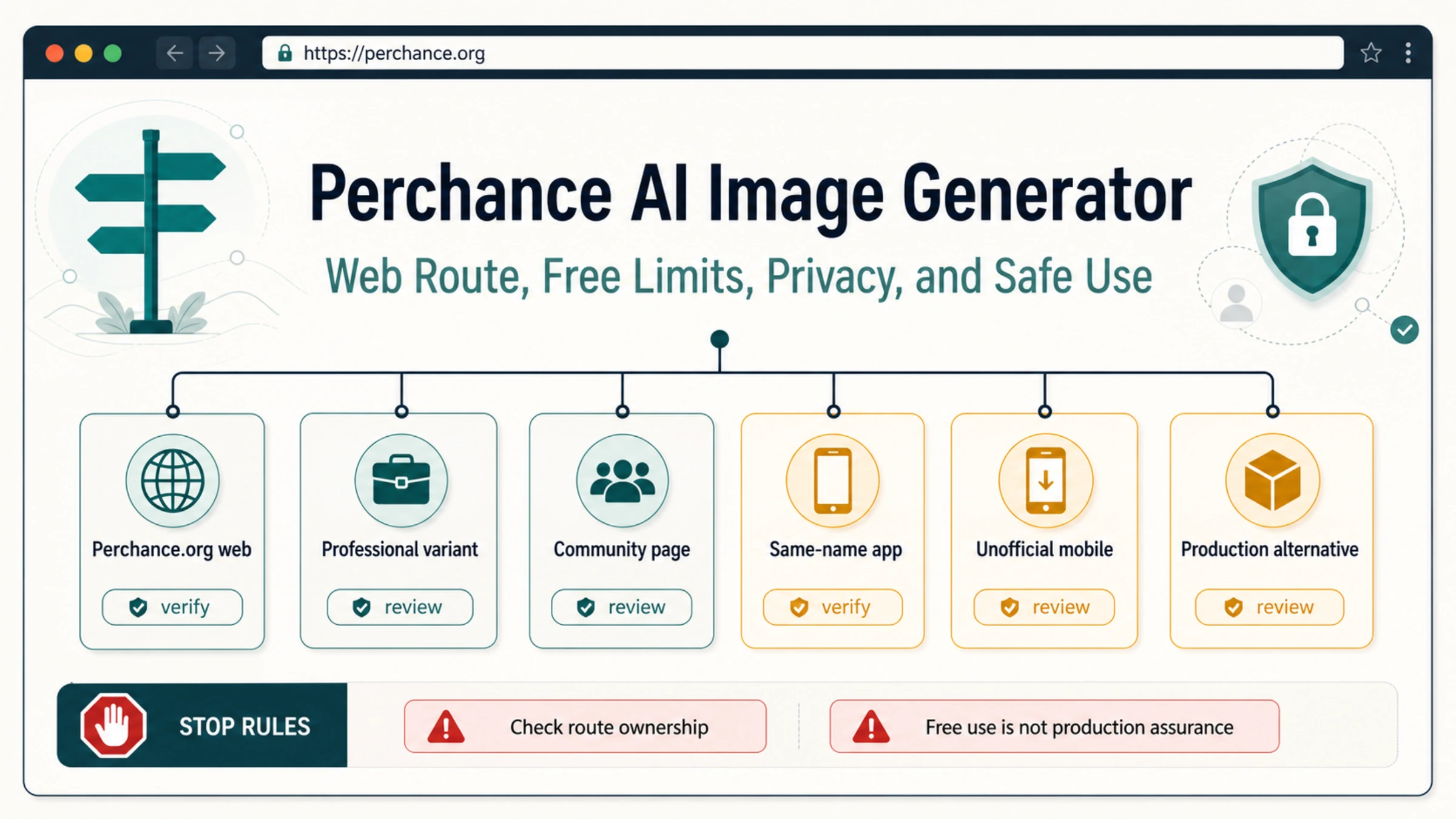
Perchance.org is the route to start with when you want quick casual text-to-image generation in a browser. Use the web generator first, treat professional and community pages as variants, and treat same-name app or unofficial mobile routes as separate contracts until their ownership is clear.
The free/no-signup appeal is real enough for low-risk ideation, but it is not a promise of guaranteed speed, uptime, asset history, or production assurance. Before using output for client, brand, private, or repeatable work, check the public-gallery behavior, avoid sensitive prompts on community pages, and move to a production route when editing depth, character consistency, team workflow, or legal review matters.
Three facts matter before you start. As of October 29, 2026, the two perchance.org pages that promise image to image open behind Perchance's own "Not as described" moderation warning, so do not count on Perchance for editing an uploaded picture. Perchance's Terms of Service, last updated July 18, 2026, still allow commercial use without attribution but now say users must be at least 18. And no public developer API is documented on perchance.org.
Short answer: which Perchance image generator route should you use?
Start with the Perchance.org AI image generator when the job is fast browser-based text-to-image. It is the cleanest starting point because it keeps the core Perchance promise in one place: prompt in, images out, no normal account gate before a basic generation attempt.
As of October 29, 2026, that page is titled "AI Image Generator (free, no sign-up, unlimited)." Opened without logging in, it shows a Description box for your prompt, an Art Style dropdown (Painted Anime was preselected), a generate button, and a "show private gallery" button. A note says it was built with Perchance's text-to-image-plugin, with the brain button using the ai-text-plugin. The login link in the top bar is for people who create their own generators, not a gate in front of this one.
The next decision is not whether Perchance is "good" in the abstract. It is which Perchance route owns your prompt, gallery behavior, and expectations.
| Route | Best fit | Watch before relying on it |
|---|---|---|
| Perchance.org web generator | Quick casual text-to-image, prompt exploration, low-risk idea boards | Shared infrastructure, no production SLA, limited workflow history |
| Professional variant | More controls or a different Perchance-hosted interface | Route-specific controls do not prove a universal paid Pro plan |
| Community or niche generator page | Style-specific experiments and community prompt wrappers | Anyone can create pages, so avoid private or sensitive data |
| Same-name app-store route | Mobile exploration only after checking ownership, seller, and subscriptions | A same-name app is not automatically the Perchance.org web route |
| Unofficial mobile route | Community convenience when trust, updates, and data handling are acceptable | Treat it as a separate contract, not a Perchance.org default |
| Production alternative | Private assets, consistent characters, editing, team history, or reviewed commercial work | Pick based on workflow needs, not only image quality |
The practical rule is simple: use Perchance when friction matters more than control. Switch when the image will carry private information, brand value, client approval, repeated character identity, or a production deadline.
Does Perchance do image to image? Both i2i pages are flagged "Not as described"
Not dependably. As of October 29, 2026, the two perchance.org pages built around image to image both open behind a warning from Perchance's own moderation system:
| Page | Title shown | What opens first |
|---|---|---|
| perchance.org/free-image-to-image | "Qwen Image to Image" | "This page was flagged by Perchance's moderation system: Not as described. It may not do what its title or description says." Last reviewed: October 28, 2026 |
| perchance.org/image-to-image | "Image to Image Generator" | The same "Not as described" warning |
The warning comes with "Continue to page" and "Leave" buttons, and the free-image-to-image page also notes that visitors see a content warning. "Not as described" is Perchance's label for a page whose behavior does not match its title. Search snippets for /image-to-image have shown an older, broader wording of the warning ("It may contain malicious or misleading code"); the page itself showed only the "Not as described" label as of October 29, 2026. That check stopped at the warning: no image was uploaded, so whether either page transforms an upload today is not verified.
Community answers point the same way. Replies in the r/perchance subreddit say "There is no i2i in perchance," and another warns that any generator claiming to do it is lying. Those threads are 4 to 12 months old, and a page could change after its creator asks Perchance for a review, so treat the flag as the current state rather than a permanent rule.
The main generator is built around a text prompt: its visible controls are the Description box, the Art Style dropdown, and the generate button. If you need to start from your own picture, use a tool built for editing instead:
- For browser editing and photo-to-photo changes, see Best Free AI Image Editor in 2026.
- If "Qwen image to image" is what you were after, the model itself is covered in Qwen-Image-2.1: Run It Locally, in ComfyUI or via the $0.04 API.
- If you are a developer looking for an image-to-image endpoint, start with the Free Image to Image API Guide.
Do not upload private photos, faces of other people, or client images to a flagged page just to test it. The privacy policy's advice to treat every community page like a random website applies twice when Perchance itself says the page may not do what it claims.
What the free, no-signup, "unlimited" promise really covers
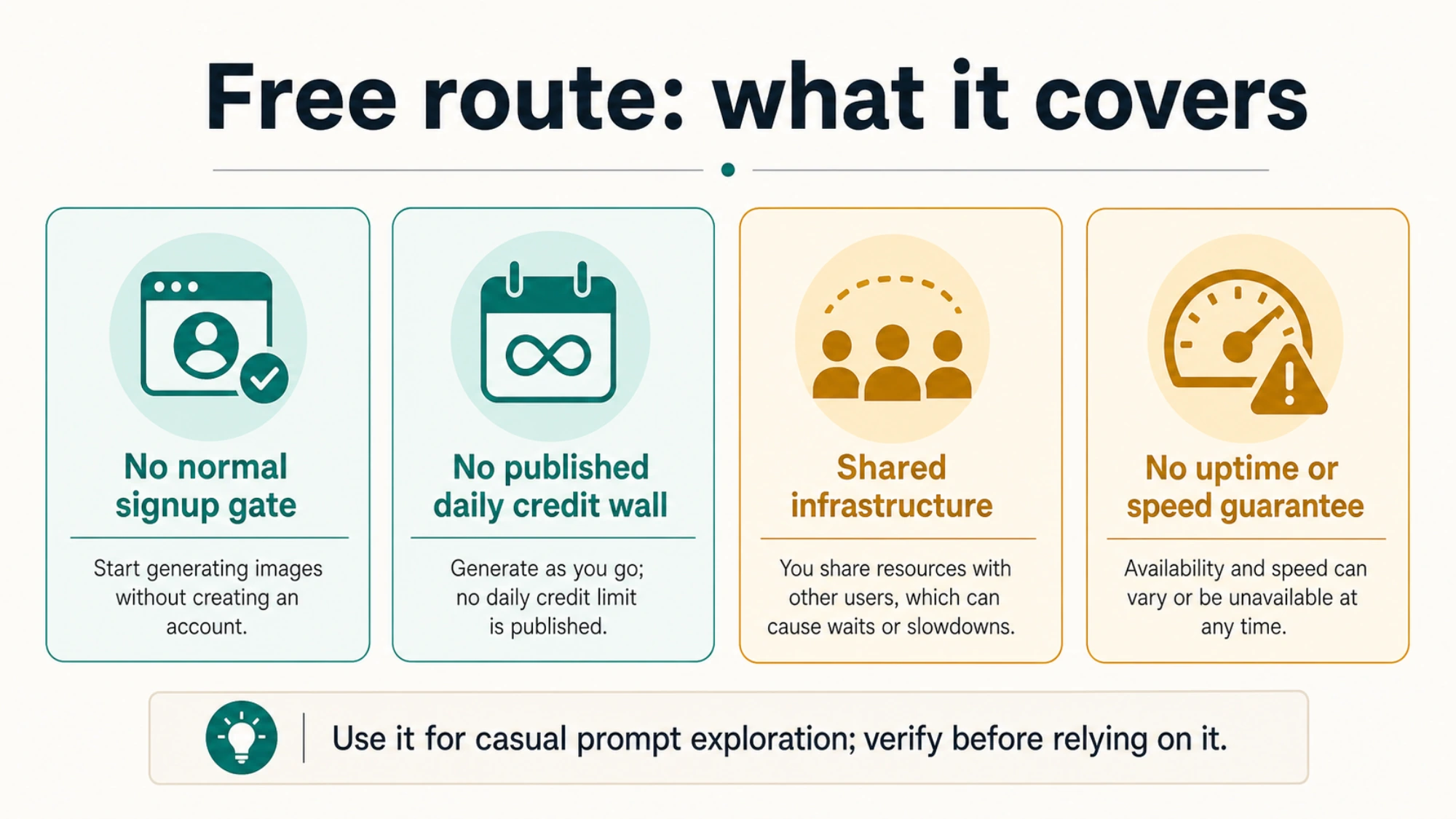
Perchance's appeal is that the web route removes much of the usual image-generator friction. You can open the generator and try prompts without creating the kind of account, plan, or credit workflow that many mainstream tools require. That makes it useful for mood boards, rough concepts, style exploration, thumbnails, quick fiction visuals, and other low-stakes experiments.
The safer way to phrase the access promise is "no normal signup gate and no published daily credit wall" for the ordinary web route, not "guaranteed unlimited production capacity." Shared public tools can slow down, ask for verification, change behavior, or become temporarily unavailable. Perchance's own terms also reserve room for service changes and interruptions, so build no serious schedule around the assumption that every generation will always be immediate.
The free route is enough when the output can be regenerated, discarded, or replaced without business damage. It is not enough when you need predictable throughput, saved team history, account-level asset management, exact output dimensions, private project controls, or a vendor relationship that can be reviewed by legal or procurement.
That distinction matters because "free" can tempt people to skip the route check. Perchance can be a strong first draft lane, but a first draft lane is not the same thing as a production workspace.
How is Perchance free? Ads instead of a paywall
The web generator carries ads rather than a subscription or credit wall. Perchance's Privacy Policy says those ads run in sandboxed iframes and cannot access the text or images you type or paste into a Perchance page.
Perchance generator variants: main, professional, niche, and community pages
Multiple Perchance image-generator pages can appear useful because Perchance is not only one locked product screen. It hosts generator pages, and those pages can differ by prompts, controls, styles, galleries, or community framing. That is why one page may look like the default text-to-image tool while another feels like a "professional" or niche generator.
The safest way to handle variants is to treat them as routes, not model versions. A page title that mentions professional controls, realism, anime, full body, or a specific style does not automatically prove a different official model, a paid Perchance tier, or a guaranteed quality level. It may simply be a different Perchance-hosted interface around a related generation workflow.
Use the main web generator when you want the least surprising starting point. Use a professional or niche page when its controls visibly match the job and the prompt is not sensitive. Use community pages for playful experiments, not for private customer assets, confidential concepts, unreleased product imagery, or likeness-sensitive work.
If a variant asks you to save to a gallery, join a chat, load extra assets, or trust a custom page with important content, slow down. The variant may be useful, but the page owner and data behavior matter more than the style promise.
Which Perchance page is the "fast" or "professional" generator?
Several of the most visible Perchance image pages are separate generators with their own titles. As of October 29, 2026:
| Address | Title or description the page gives itself |
|---|---|
| perchance.org/ai-text-to-image-generator | "AI Image Generator (free, no sign-up, unlimited)", the main page |
| perchance.org/image-generator-professional | "Fast Free AI Image Generator (no limit, no sign-up)" |
| perchance.org/aiimagegenerator | Describes itself as a fast, unlimited, no-login generator |
| An "Advanced AI Image Generator" page | Says it uses Stable Diffusion |
| perchance.org/ai-photo-generator | "AI Photo Generator (realistic, free, no sign-up, no limits)" |
| perchance.org/ai-character-generator | Character-focused generator |
So the "Perchance AI image generator professional" page people look for lives at /image-generator-professional, and it is the one that calls itself fast. Words like "fast," "professional," "advanced," or "realistic" are claims by whoever made the page, not a measured speed or a Perchance paid plan. Of the six, only the Advanced page names its model. Pick the page whose controls fit your prompt, and keep the same privacy rules on all of them.
Is Perchance safe for commercial images?
Perchance's Terms of Service are more permissive than many review summaries imply. In the version last updated July 18, 2026, the terms' FAQ answers the commercial question directly: you are free to use Perchance's AI-generated images and text however you want, attribution is not required, and Perchance does not own or claim copyright on what you create.
The same terms add a rule that matters before any of that: the services are intended for users who are at least 18, and people under 18 are not permitted to use or register for them.
That is the starting answer, not the whole production answer. A permissive platform statement does not solve every commercial risk around AI images. Serious use still has to consider:
- whether the image depicts a real person or a lookalike
- whether a brand, character, product, or trademark is recognizable
- whether the prompt included private customer or company information
- whether the generator route used a public gallery or community page
- whether your buyer, marketplace, client, or employer requires AI disclosure, provenance, or indemnity
- whether the image needs repeatable style, editable layers, exact dimensions, or revision history
For a blog thumbnail, personal fiction concept, temporary storyboard, or internal brainstorm, Perchance output may be practical. For an ad campaign, marketplace listing, client deliverable, paid game asset, or identity-sensitive image, treat the Perchance terms as one input in a wider review. The terms can tell you what Perchance claims about its platform. They cannot guarantee that every generated image is free from likeness, trademark, policy, or downstream buyer problems.
Is Perchance AI safe? Content warnings, the 18+ rule, and same-name apps
For an adult making casual images on the main page, Perchance is reasonably safe to use, provided you keep private material out of your prompts. The real risks sit in five places, and each one is a separate check:
| Check | What Perchance says or shows | What to do |
|---|---|---|
| Who the page belongs to | The privacy policy says anyone can create a generator, so treat each page "like it's a random page on the internet" and never input private or sensitive data | Use the main page for ordinary prompts; be more careful on community pages |
| Content warning before a page opens | Perchance's moderation flags some community pages, for example "Not as described" on both image-to-image pages as of October 29, 2026 | Read the reason; leave if the page will not do what you came for |
| Age | The terms (last updated July 18, 2026) say users must be at least 18 | Perchance is not for kids or teens, including its image generators |
| Apps with the same name | Google Play and the App Store list apps called "Perchance AI Image Generator"; a top answer in r/perchance says there is "No official app for now, only perchance.org" | Treat any app as a separate company with its own data and billing terms |
| What gets stored | Nothing from the image generator, unless you save to a public gallery or use a generator's save button | See the privacy checklist below |
A content warning is Perchance's moderation label, not a malware scan result. It tells you Perchance's moderators think the page breaks a rule, such as doing something other than its title promises. The absence of a warning only means a page has not been flagged.
Privacy checklist before you type a prompt or save to a gallery
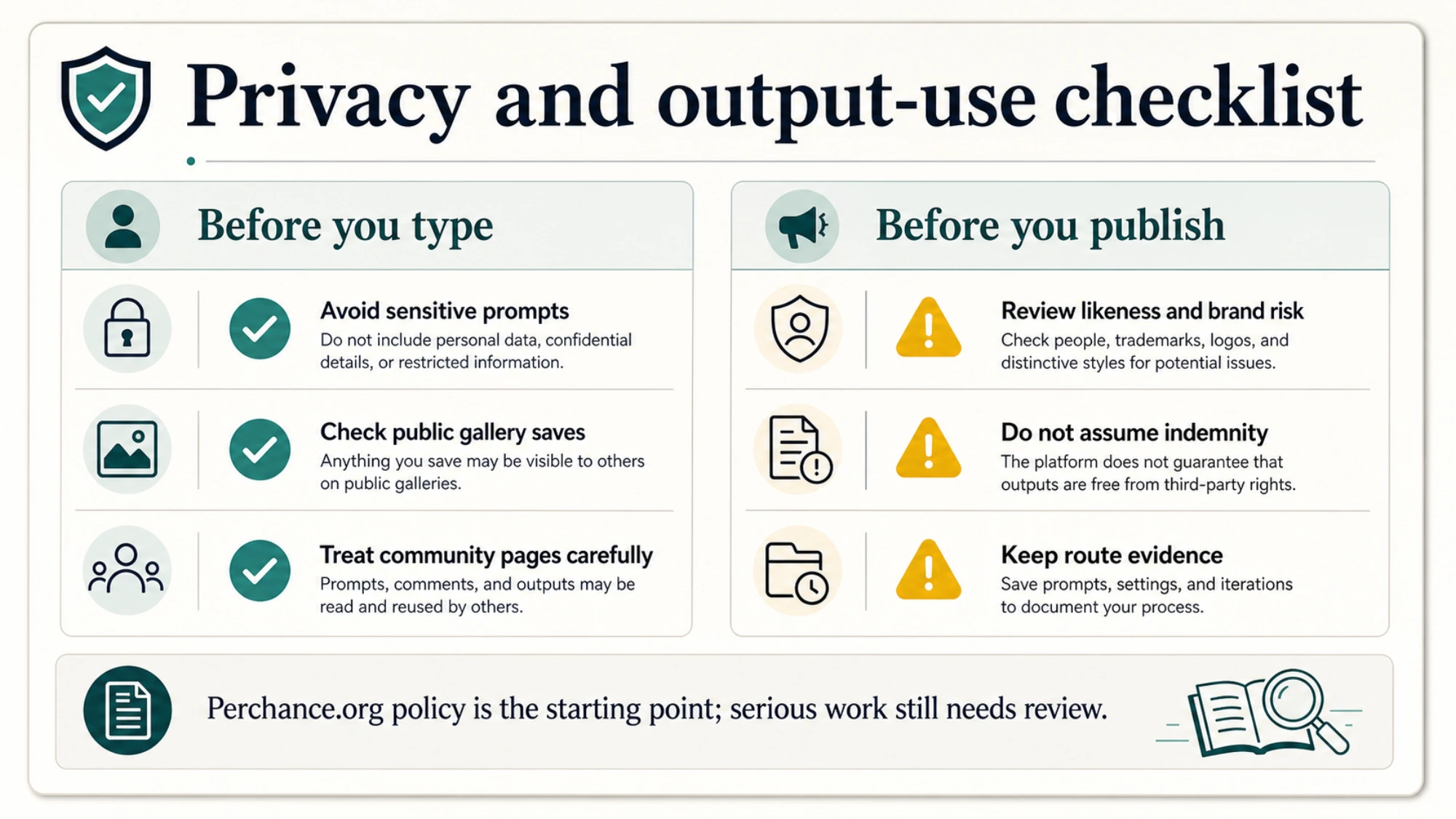
Perchance's Privacy Policy gives a useful but route-sensitive privacy picture. As of October 29, 2026, it says the text-to-image-plugin does not store your data on the server, but if you save an image to a public gallery with the heart button, that image is saved to the server. The ai-text-plugin behind chat and story tools also does not store data, except on generators with a "save" button, which upload what you save so it can be shared. Ads run in sandboxed iframes and cannot read what you type into a Perchance page.
The main generator also has a "show private gallery" button. The policy does not say what that gallery keeps or where, so do not treat it as a secure archive for anything you would not want exposed.
Those are useful protections, but the same policy also warns that anyone can create a generator page and that users should treat each page like a random internet page. That warning is the part many casual users miss.
Use this checklist before entering anything sensitive:
| Before you type | Why it matters |
|---|---|
| Remove private names, customer data, unreleased product details, and internal files | A no-storage statement is not permission to put confidential data into arbitrary public pages |
| Prefer the main Perchance.org route for ordinary tests | It reduces confusion compared with random community pages |
| Avoid public gallery saves and "save" buttons for private work | Those saves are the explicit storage exceptions |
| Be careful with uploaded references or likeness prompts | Privacy policy language is not a likeness or consent review |
| Keep route evidence for serious output | You may need to explain which route produced the asset and what policy you relied on |
For private work, the safest prompt is the one that still makes sense after removing sensitive specifics. If removing the specifics breaks the job, Perchance is probably not the right route for that prompt.
Feature boundaries: editing, img2img, video, characters, API, and saved workflow
Perchance is strongest as a low-friction text-to-image route. The more the job depends on advanced control, the more route-specific the answer becomes.
Text-to-image is the baseline. You enter a prompt, use available controls, and generate images. Seeds or nearby variations can help with exploration, but they should not be treated as a full character-consistency system. Some pages and tutorials discuss more controlled or consistent outputs, but those workflows need to be tested on the exact page you plan to use.
Image-to-image, inpainting, video generation, and advanced editing should be handled with caution. On perchance.org itself, the two image-to-image pages carry Perchance's "Not as described" flag as of October 29, 2026 (details in the image-to-image section above). A same-name app listing may advertise broader image or video capabilities, but an app-store route is not the same thing as the ordinary Perchance.org web generator. A community page may offer a special workflow, but that special workflow belongs to that page, not to every Perchance route.
Perchance API: no public developer API documented
As of October 29, 2026, no public developer API is documented on perchance.org. The pieces with "plugin" in their names, such as the text-to-image-plugin and the ai-text-plugin, are building blocks for people who make generators inside Perchance, not keys or endpoints you call from your own app.
So the API boundary is the same as the editing one. Unless Perchance.org itself documents and owns an official developer API, do not build a production integration around an assumed endpoint. For developer workflows, production image pipelines, audit logs, or multi-user asset history, a documented API provider or first-party model platform is a better fit. If you searched for a Perchance API because you need image to image in code, the Free Image to Image API Guide covers image-to-image API options.
That does not make Perchance weak. It makes the tool honest: it is excellent when you need speed, play, and low account friction; it is less suitable when repeatability, editability, auditability, and vendor review are part of the job.
When Perchance is enough, and when to switch
Use Perchance when the task has a low cost of failure. It is good for fast prompt exploration, mood boards, rough thumbnails, scene ideas, character vibes, story inspiration, and casual social visuals where regeneration is acceptable.
Switch tools when the output needs one of five things:
- privacy: confidential concepts, client data, internal product plans, unreleased assets, or private references
- control: precise composition, exact dimensions, inpainting, object replacement, layered editing, or brand templates
- consistency: recurring characters, repeated products, stable style systems, or multi-image campaigns
- workflow: saved history, team review, account governance, audit logs, or predictable billing
- assurance: production timeline, vendor terms, commercial review, API documentation, or support expectations
For broader no-cost exploration after Perchance, compare other browser options in Best Free AI Image Generator Online. For a wider market shortlist, use Best Free AI Image Generator. Read those after the Perchance route decision is clear; otherwise, a tool list can distract from the more urgent trust boundary.
Troubleshooting quick checks
If Perchance fails, slows down, or asks for verification, do not immediately assume every route is broken. Work through the route and browser layers first.
If a page opens with a moderation warning instead of the generator, that is not an outage: Perchance has flagged that one page, and the flag does not apply to the main generator. Otherwise, start with the basics. First, reload the main web generator and try a shorter, lower-risk prompt. If the page is busy, a simpler prompt helps separate prompt complexity from service friction. Second, test another Perchance.org variant only if the content is safe for that route. Third, disable aggressive blockers only if you are comfortable with the privacy tradeoff, because public web tools often rely on ads, scripts, or verification layers. Fourth, avoid repeatedly saving to public galleries while debugging private or client-related prompts.
If a same-name app behaves differently from the Perchance.org web route, treat that as expected. Seller, subscription, storage, and feature claims belong to that app route unless Perchance.org itself links and owns it. Do not pay for an app or rely on app-only video/editing claims because the web generator was useful.
When the same prompt must produce consistent characters, edited images, or repeatable production assets, troubleshooting Perchance may be the wrong use of time. Move to a workflow built for that requirement instead of trying to force a casual generator into a production system.
FAQ
Is Perchance AI Image Generator really free?
The ordinary Perchance.org web route is useful because it removes normal signup and credit friction. Treat that as a free access route, not a guaranteed production capacity promise. Shared infrastructure, verification, interruptions, and route changes can still affect use. The page carries ads instead of a paywall, and Perchance's privacy policy says those ads run in sandboxed iframes that cannot read what you type.
Do I need an account to use Perchance?
Basic web generation does not normally require an account. Accounts may still matter for creating, saving, or managing generator pages, and app or unofficial routes can have their own requirements.
What does "unlimited" mean for Perchance?
Use "no published daily credit wall" as the safer operational phrase. It does not guarantee speed, uptime, automation, or high-volume production throughput.
Can I use Perchance images commercially?
Yes, under Perchance.org's Terms of Service last updated July 18, 2026: you can use generated images however you want, attribution is not required, and Perchance claims no copyright on them. The terms also limit use to people 18 and older. Commercial use still needs review for likeness, trademarks, brand rules, confidential prompts, marketplace policy, disclosure, and indemnity requirements.
Is the Perchance AI Image Generator app official?
Probably not. As of October 29, 2026, Google Play and the App Store list apps named "Perchance AI Image Generator," while a top answer in the r/perchance subreddit says there is "No official app for now, only perchance.org." Treat a same-name app as a separate route unless Perchance.org clearly links to it and proves ownership. Check the seller, subscription terms, privacy behavior, and feature claims before treating it as connected to the web generator.
Does Perchance have an official API?
Do not assume one. As of October 29, 2026, no public developer API is documented on perchance.org; its text-to-image-plugin and ai-text-plugin are for building generators inside Perchance. If a production build needs an API, use only a documented route that clearly states account ownership, billing, data handling, limits, and support expectations. For image-to-image in code, see the Free Image to Image API Guide.
Does Perchance support image-to-image, inpainting, or video?
Not dependably. As of October 29, 2026, perchance.org/free-image-to-image ("Qwen Image to Image") and perchance.org/image-to-image both open behind Perchance's "Not as described" moderation warning, and community answers say Perchance has no real image-to-image. The ordinary web route should be trusted for text-to-image only. If a page or app advertises editing, inpainting, or video, verify that exact route before relying on it, or use a dedicated editor such as those in Best Free AI Image Editor in 2026.
Is Perchance good for consistent characters?
It can help explore character looks, but consistent characters across many images need testing on the exact route. For repeated production characters, use a workflow built around references, history, and revision control.
Is it safe to enter private prompts into Perchance?
Avoid sensitive prompts, especially on community generator pages. The Privacy Policy says the text-to-image-plugin does not store your data on the server, but saving to a public gallery with the heart button does store the image, and the policy itself tells you to treat each generator page like a random website.
Is Perchance safe for kids?
No. Perchance's Terms of Service, last updated July 18, 2026, say the services are intended for users who are at least 18 and that people under 18 are not permitted to use or register for them. That covers the image generators as well as chat and story tools.
When should I choose another AI image generator?
Choose another route when the job needs private uploads, advanced editing, stable characters, team history, exact brand control, documented API behavior, predictable throughput, or formal commercial review.