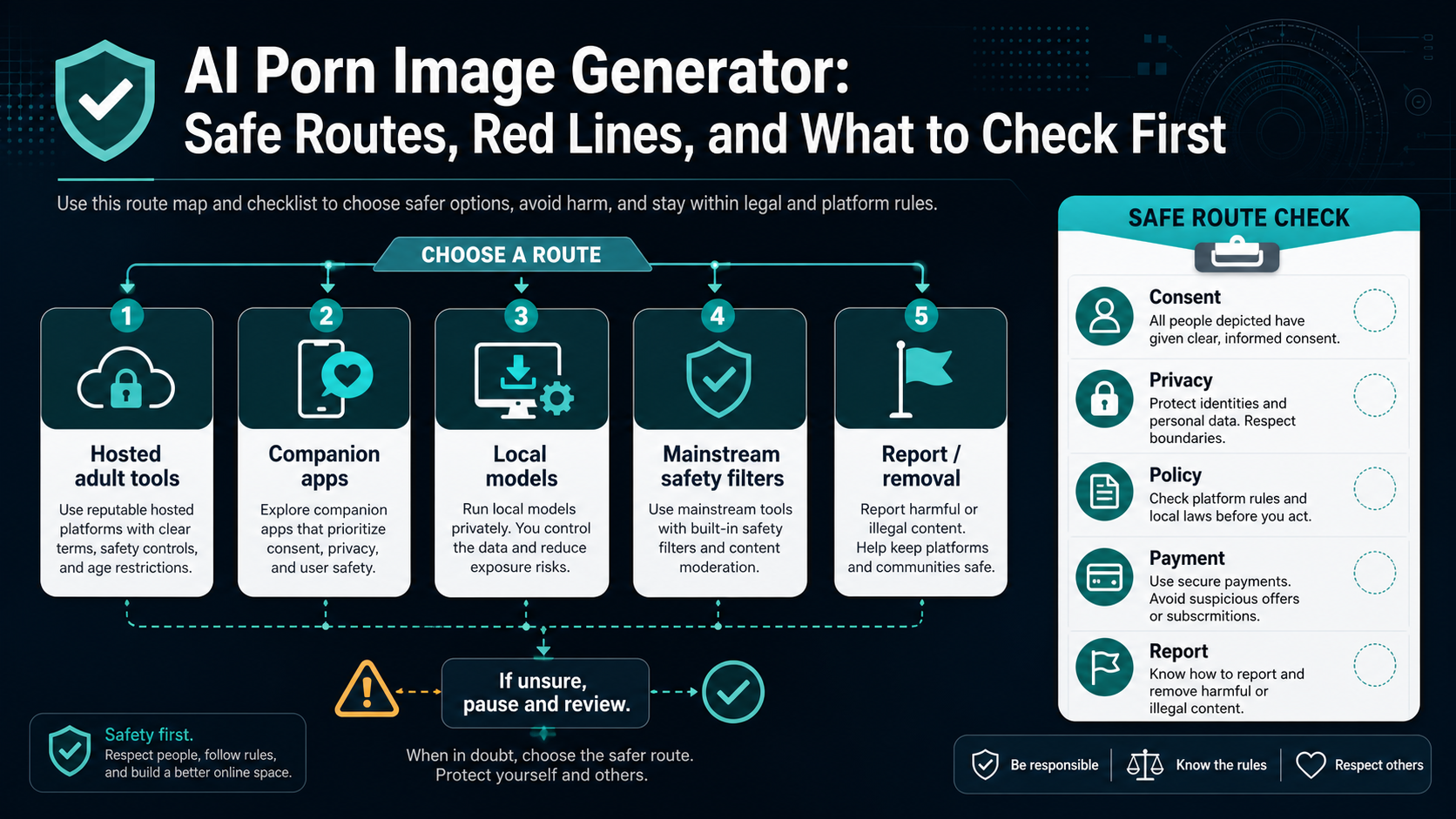
Adult AI image generation should start with route, consent, and upload privacy before any tool name. Fictional consenting-adult image work may be evaluated, but real-person likeness, unclear consent, private source uploads, or anyone under 18 should stop before tool evaluation; existing harmful images need a report or removal path, not another generator.
| Route | Use it when | Stop or verify first |
|---|---|---|
| Hosted adult generator | The work is fictional, adult, low-risk, and you can accept provider-owned rules. | Verify age gate, gallery visibility, retention, deletion, output rights, support, and payment owner. |
| Companion app or chat-plus-image route | You are already inside a companion product and only need its own image feature. | Separate fantasy chat features from image upload, likeness, and publication rights. |
| Local model workflow | You need maximum control over files, prompts, and model choices. | Local control does not remove law, consent, likeness, storage, or distribution responsibility. |
| Mainstream safety-filtered provider | The job is ordinary creative work, brand-safe image generation, or developer production. | Treat adult or real-person rejections as policy boundaries, not bugs to bypass. |
| Report or removal route | An intimate image already exists without consent, or the person was under 18 in the source material. | Preserve evidence and use a reporting or removal path instead of regenerating or reposting. |
The phrase "AI porn image generator" is useful only as a market bridge: it points to a risky route choice, not a safe product category. The practical screen is who owns the upload, policy, retention, payment, output rights, and removal response. Sources checked on May 18, 2026 show that FTC and NCMEC treat AI-created intimate images as a real harm surface, while mainstream image providers such as OpenAI and Google apply content filters rather than acting as adult-generator routes.
Start by classifying the route, not the vendor
The fastest safe answer is to decide which route you are actually considering. A hosted adult generator, a companion app with an image feature, a local model workflow, a mainstream filtered image API, and a reporting path solve different jobs. They also move risk to different owners.
Hosted adult generators are convenience routes. They may be useful for fictional adult character work or low-risk private exploration, but the provider controls the account, gallery, model, moderation, payment, deletion process, and terms updates. A working prompt box proves that a service is reachable. It does not prove that uploads are private, outputs are licensed for your use, or deletion actually reaches all stored copies.
Companion apps are narrower. Some products combine chat, roleplay, and generated images. That does not make the image route safer; it usually means the reader must inspect two contracts at once: the companion service and the image-generation pipeline. If a service invites relationship-style use, be stricter about likeness, consent, private uploads, and public sharing because the emotional framing can make boundary mistakes feel casual.
Local workflows give the most file and prompt control, but they are not a legal exemption. Running a model locally can reduce exposure to unknown web services and can help technical users keep source files in their own environment. It also moves storage, model selection, extension safety, output handling, and distribution choices onto the user. If the same image would be nonconsensual, exploitative, harassing, or unlawful through a hosted service, local generation does not fix the underlying problem.
Mainstream providers are often the wrong route for adult generation and the right route for ordinary production. OpenAI's image generation docs state that prompts and generated images are filtered before output is returned, and Google Vertex AI Imagen documentation describes safety-filter blocking and adult-content categories. Treat those blocks as provider policy boundaries. Do not turn a filtered production tool into a bypass target.
Red lines before any adult image tool
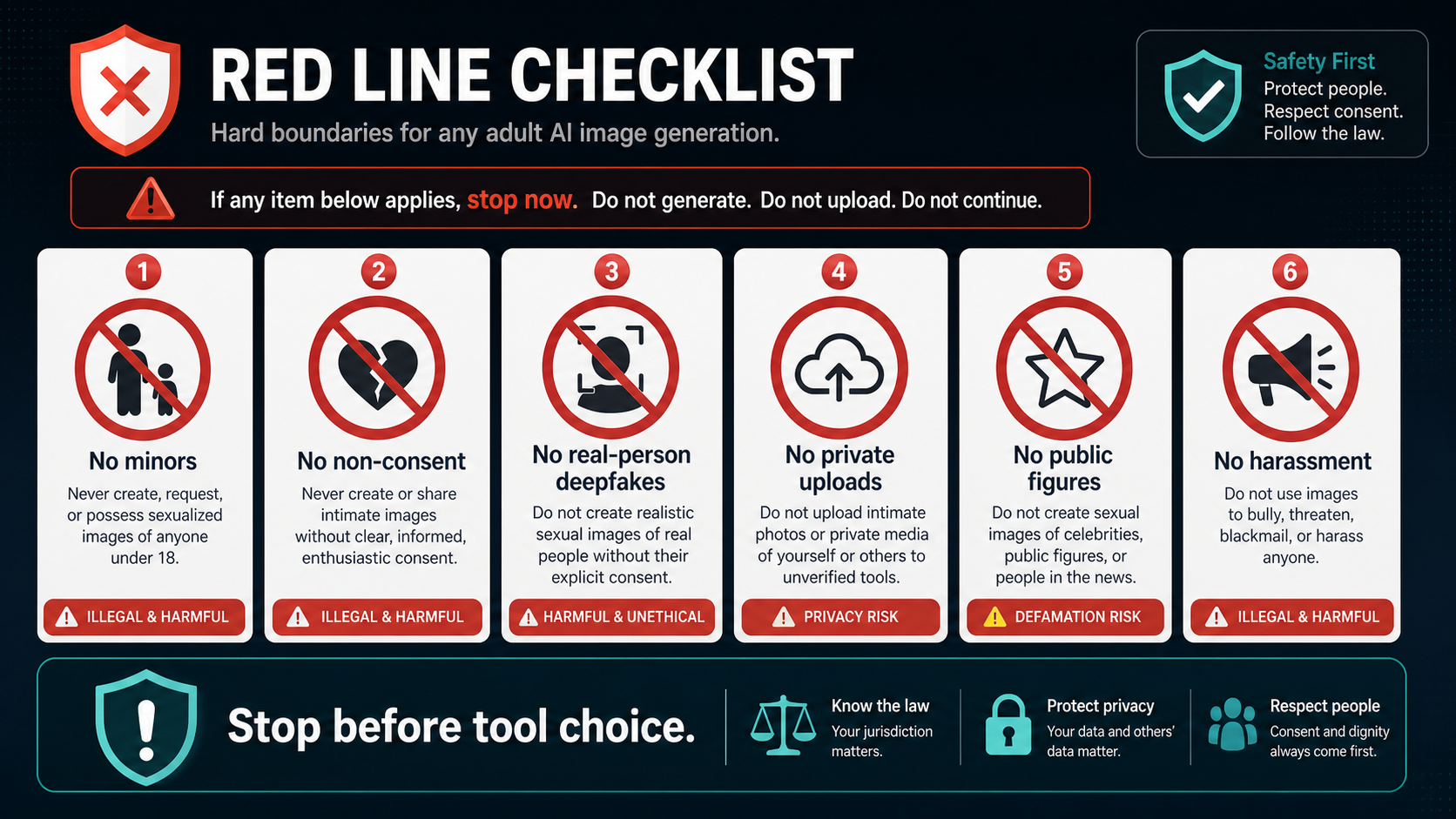
Some cases should stop before the reader evaluates tool quality, price, or prompt freedom. The most important split is whether the image is fictional and consensual or tied to a real person, private source material, unclear consent, or a minor.
Stop when the request involves a person under 18, even if the source file is old, altered, synthetic, or presented as a joke. NCMEC's Take It Down route is built for people whose nude, partially nude, or sexually explicit image or video was taken before they were 18, including altered or AI-generated material. That belongs in a removal workflow, not a generator workflow.
Stop when the request involves a real person who did not agree to the image. FTC consumer guidance on nonconsensual distribution of intimate images explicitly includes AI-created images in the harm pattern. U.S. federal law has also moved in this direction: H.R.633, the TAKE IT DOWN Act, targets nonconsensual intimate visual depictions and covers computer-generated or digitally altered material.
Stop when the input is a private upload whose retention, deletion, training use, staff review, gallery visibility, or support owner is unclear. Private source images are the point where a casual tool test becomes hard to unwind. Even if the output is never published, the upload may connect sensitive material to an account, IP address, payment identity, support ticket, or third-party processor.
Stop when the goal is harassment, humiliation, impersonation, sexualized public-figure content, blackmail, or distribution pressure. A service that accepts a prompt does not make the purpose safe. The route screen is meant to prevent the reader from confusing technical possibility with permission.
A hosted adult generator needs proof before upload or payment
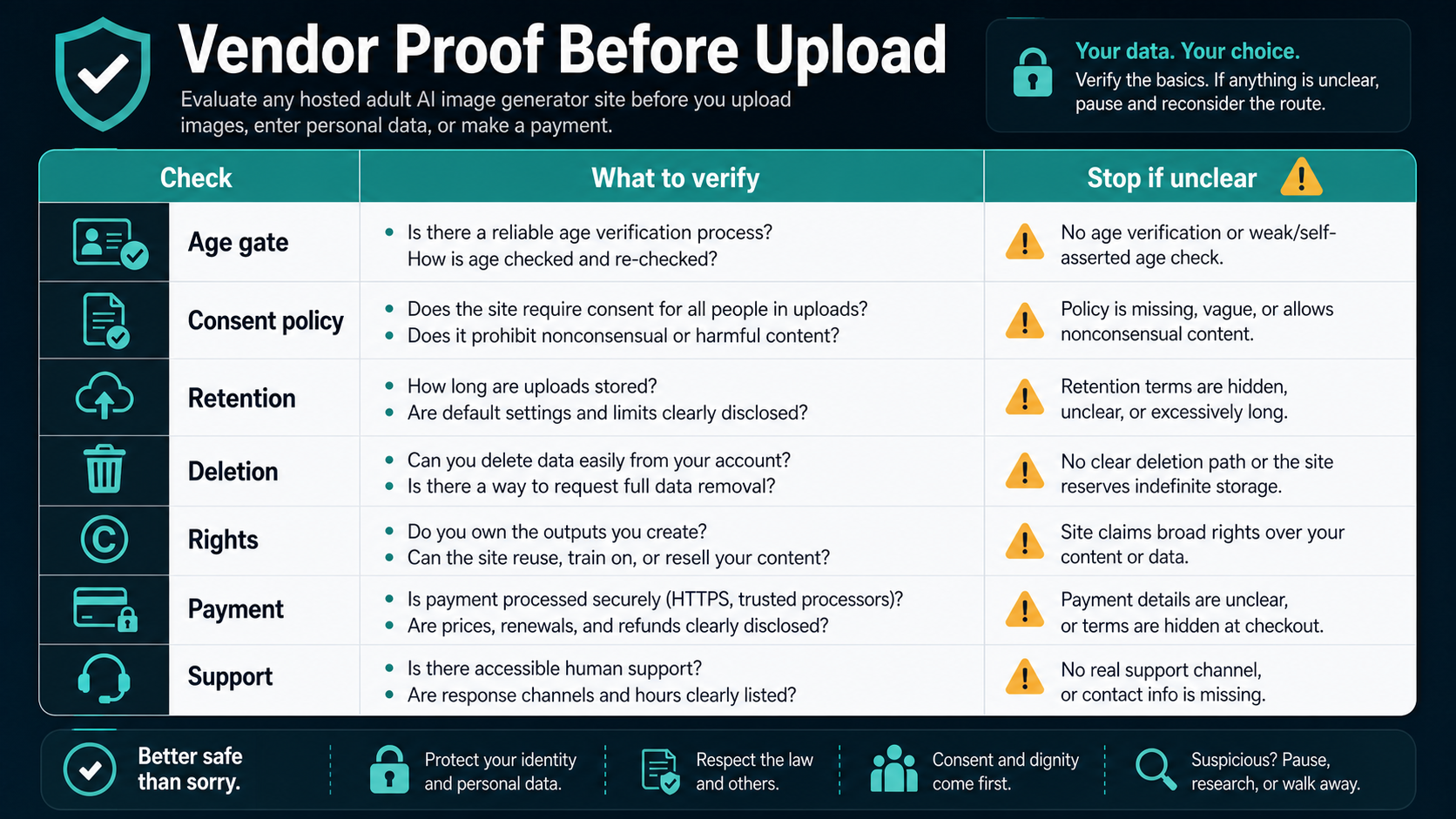
A hosted adult generator is only worth testing if the provider can answer the questions that matter before the image leaves your device. Start with the claims that sound operational: free, private, no login, adult-friendly, deleted, commercial use, no watermark, high resolution, unlimited, or safe. Each claim needs a narrower proof question.
| Provider claim | What to verify | Why it changes the decision |
|---|---|---|
| Free | Credits, queues, export size, watermark, paid gates, and fair-use limits. | Free testing is not the same as free production. |
| Private | Public gallery defaults, staff review, prompt storage, upload retention, training use, and processors. | "Private" may only mean not shown on a public profile. |
| Deleted | How prompts, uploads, outputs, account records, and known copies are removed. | Deletion language is weak unless the path is documented. |
| Commercial use | Plan terms, input rights, model license, resale limits, attribution, and jurisdiction. | Adult content and client work can carry separate restrictions. |
| No login | Whether export, history, deletion, billing, or support requires identity later. | No signup for the first prompt is not no data processing. |
| Adult-friendly | Age gate, consent rules, prohibited content, report process, and moderation. | Adult permission does not mean no rules. |
If a service cannot answer those questions clearly, keep the test disposable. Use only public, fictional, non-sensitive prompts. Avoid source-image uploads. Do not use the result for client work, resale, identity-based content, or anything that would be hard to retract. A low-friction adult prompt box can be useful for idea exploration, but it should not inherit trust it has not earned.
Payment creates another risk layer. Adult-oriented services can change payment processors, card acceptance, refund handling, account access, and download limits quickly. Before paying, check who bills you, what appears on statements, whether failed generations consume credits, how refunds are handled, and whether account deletion also removes generated media. A vendor that cannot explain billing and deletion should not receive sensitive uploads.
Local generation gives control, not a permission slip
Local generation is the strongest technical route when the main problem is upload exposure or prompt control. A local Stable Diffusion-style workflow, ComfyUI graph, or controlled private server can keep prompts, source files, models, and outputs closer to the user. It can also make iteration more repeatable because the user controls model files, seeds, extensions, and storage.
That control is valuable only when the user is prepared to own the responsibility. Local workflows require trusted model sources, safe extension habits, enough storage, backup discipline, malware caution, license review, and a plan for how outputs are stored or deleted. The absence of a hosted provider also means fewer external stop signs. The user's own red lines need to be stronger, not weaker.
Use local generation for fictional, consensual, private creative work when upload exposure is the main concern and the user understands the technical burden. Do not use local generation to create or distribute nonconsensual intimate images, minor-related material, deceptive real-person content, harassment, or rights-infringing outputs. For the broader lower-filter route question outside this adult-specific context, Uncensored AI Image Generator covers how "uncensored" claims differ from privacy, rights, and production safety.
Why mainstream image models reject these prompts
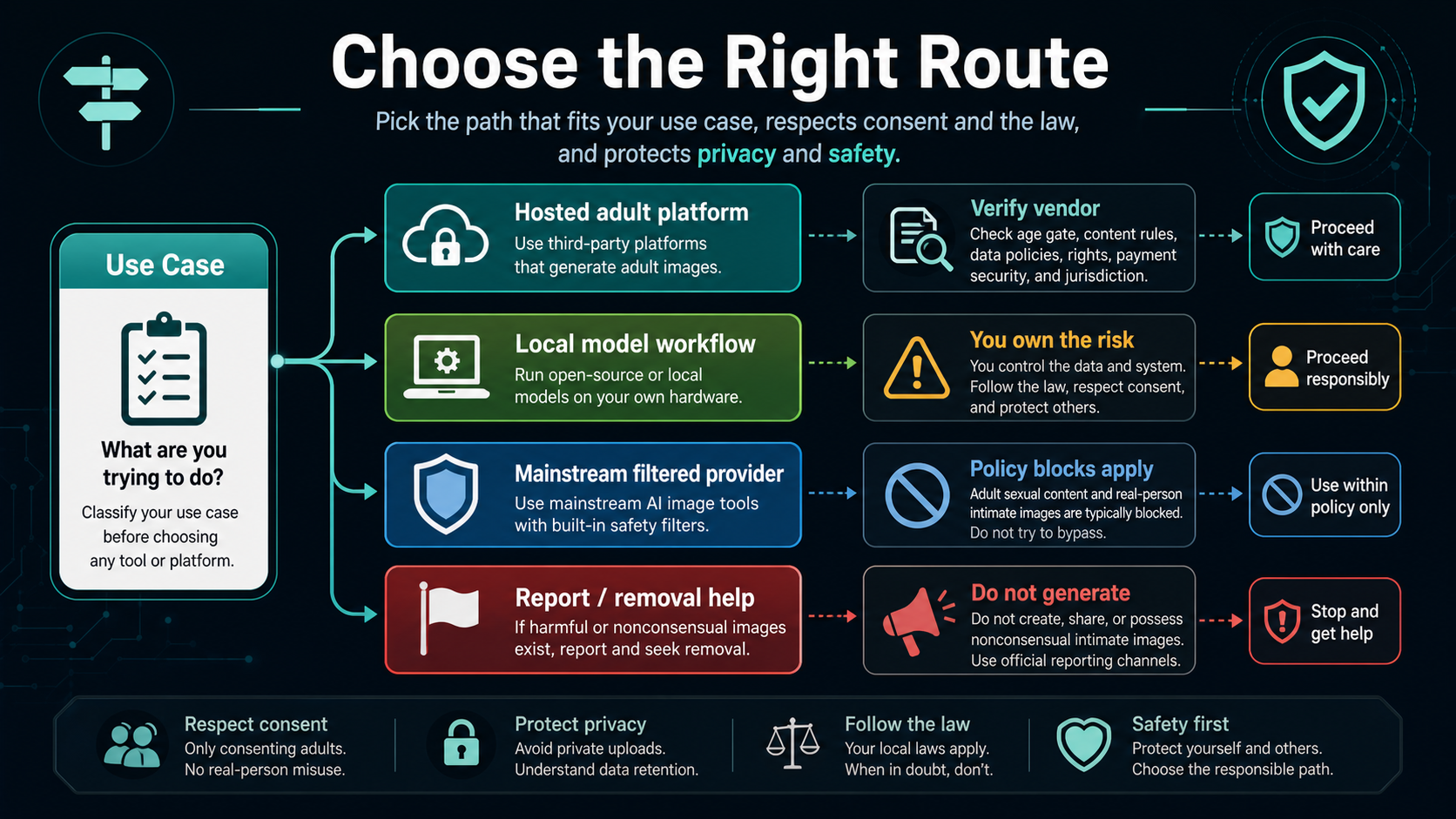
Mainstream image tools are usually designed as general creative products, not adult-generator products. When OpenAI or Google-style systems reject sexual, likeness, or unsafe requests, the rejection is not a random malfunction to work around. It is part of the product boundary.
That matters for developers and teams. If the job is ordinary product imagery, ads, education, social graphics, internal design, thumbnails, or brand-safe creative work, a mainstream filtered provider may be the correct route precisely because it has clearer policy, account, support, billing, and audit behavior. If the goal is adult content or real-person sexualized material, the reader should not assume the same provider is secretly the right tool with a different prompt.
The practical interpretation is simple: filtered tools are production routes for policy-governed work. Adult-specific hosted tools and local workflows are separate route categories with separate proof requirements. Report/removal routes are a third category when harm already exists. Mixing those categories creates bad decisions, especially when mainstream docs and adult-generator listicles appear beside each other in a tool-selection session.
If harm already exists, switch to report and removal
When the problem is an existing nonconsensual intimate image, the useful next action is not another image generator. Preserve evidence, avoid reposting, and use a reporting or removal path. The correct route depends on age, platform, country, and where the image appears, but the first move is to treat the content as a harm case rather than a creative tool decision.
For U.S.-oriented readers, the FTC's consumer guidance explains steps for targets of nonconsensual distribution of intimate images, including AI-created images. NCMEC Take It Down is relevant for people whose nude, partially nude, or sexually explicit image or video was taken before age 18, including altered or AI-generated material. Platform report forms, web-index removal tools, and legal counsel may also matter, but the article should not pretend one workflow covers every jurisdiction.
If you are helping someone else, do not download, regenerate, edit, or circulate the image just to inspect it. Record URLs, timestamps, account names, messages, and platform context where possible. Follow the platform's reporting instructions and preserve communications that show lack of consent or threats. The goal is removal and safety, not better generation.
The final evaluation checklist
Use this checklist before trusting any adult AI image generator route:
- Is every person depicted fictional or clearly consenting, and is everyone 18 or older?
- Are you avoiding real-person likeness, private source uploads, public-figure sexualization, harassment, and coercive use?
- Do you know who owns the route: hosted provider, companion app, local workflow, mainstream model, or report/removal path?
- Can the provider explain prompt storage, upload retention, gallery visibility, training use, and deletion?
- Can the provider explain output rights, commercial use, resale limits, and jurisdiction?
- Can you use a low-risk fictional prompt instead of uploading sensitive source material?
- If paying, do you know the billing owner, credit behavior, refund path, and account deletion process?
- If using local generation, do you trust the model, extensions, storage, and license path?
- If a mainstream provider blocks the request, are you treating that as a policy boundary rather than a bypass challenge?
- If the problem is existing harm, have you switched from generation to report, removal, and evidence preservation?
The safest adult AI image workflow is not the loosest prompt box. It is the route that still makes sense after consent, likeness, upload privacy, provider policy, payment proof, and removal options have been checked. If any one of those checks fails, the better answer is to stop, use a lower-risk fictional test, choose a different route, or move into report and removal.
FAQ
Is an adult AI image generator legal?
It depends on the content, people involved, jurisdiction, consent, age, rights, and distribution. Fictional consenting-adult creative work is a different risk category from nonconsensual real-person imagery, minor-related material, harassment, impersonation, or private uploads. Use legal advice for real disputes; use the route screen above before any tool test.
Are free adult image generators safe for private uploads?
Not by default. Free access proves only that the first prompt box is reachable. Before uploading anything private, verify retention, deletion, training use, gallery defaults, account identity, support owner, and payment or credit behavior. If those are unclear, use only low-risk fictional text prompts or do not use the service.
Should I use a local model instead of a hosted adult generator?
Use local generation when upload privacy and control matter enough to justify setup, storage, model-source review, extension safety, and output responsibility. Local generation reduces some provider exposure, but it does not remove consent, likeness, law, copyright, or distribution boundaries.
Why does ChatGPT, OpenAI image generation, or Google Imagen reject adult prompts?
Those routes are safety-filtered general image products. A rejection can mean the request crosses the provider's policy boundary, especially for sexual, likeness, minor, nonconsensual, or unsafe content. Treat that as a route signal rather than a bug.
What if someone made an AI intimate image of me without consent?
Do not regenerate or repost it. Preserve evidence, report it to the platform, and use removal resources that match the situation. FTC guidance covers nonconsensual intimate images including AI-created images, and NCMEC Take It Down is relevant when the person was under 18 in the source material.