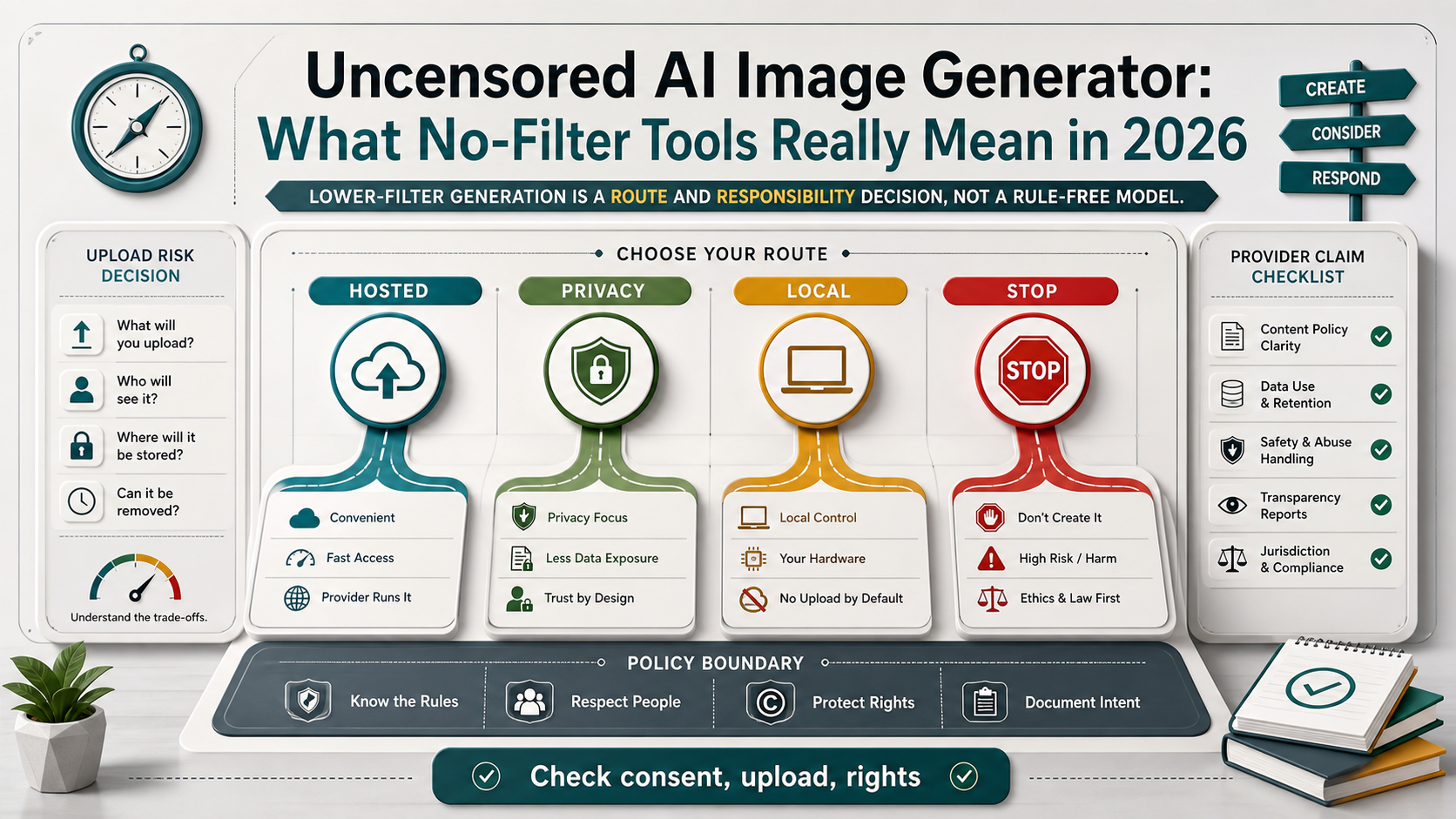
Lower-filter image generators exist, but the first choice is not a magic rule-free model; it is who controls the upload, policy, payment, output rights, and responsibility. Use hosted adult tools for fast testing, privacy-first hosted routes when model choice and account terms matter, local self-hosting when control matters most, and mainstream filtered tools for ordinary design work. Claims about free access, no login, deletion, 4K output, commercial rights, and gallery privacy should be checked on the exact provider before you upload or pay.
| Route | Use it when | Avoid it when |
|---|---|---|
| Hosted adult image tool | You need fast low-friction testing and can accept provider-owned rules. | You need strong privacy, stable rights, or sensitive source-image uploads. |
| Privacy-first hosted route | You want more model choice but still need a managed service. | The provider cannot clearly explain deletion, gallery visibility, training use, or commercial rights. |
| Local self-hosted workflow | You need maximum control over files, models, and iteration. | You cannot handle setup, storage, security, and responsibility for the output. |
| Mainstream filtered tool | The job is ordinary brand, product, or client-safe image creation. | You are trying to force adult, likeness, or policy-bypassing content through a filtered product. |
| Stop | The request involves minors, non-consensual intimate imagery, harassment, exploitation, or an identifiable person without permission. | There is no safe route to continue. |
Stop before tool choice when the request involves a minor, a non-consensual intimate image, an identifiable real person without permission, harassment or exploitation, or a private source image whose retention and rights terms you have not checked.
What no-filter can and cannot mean
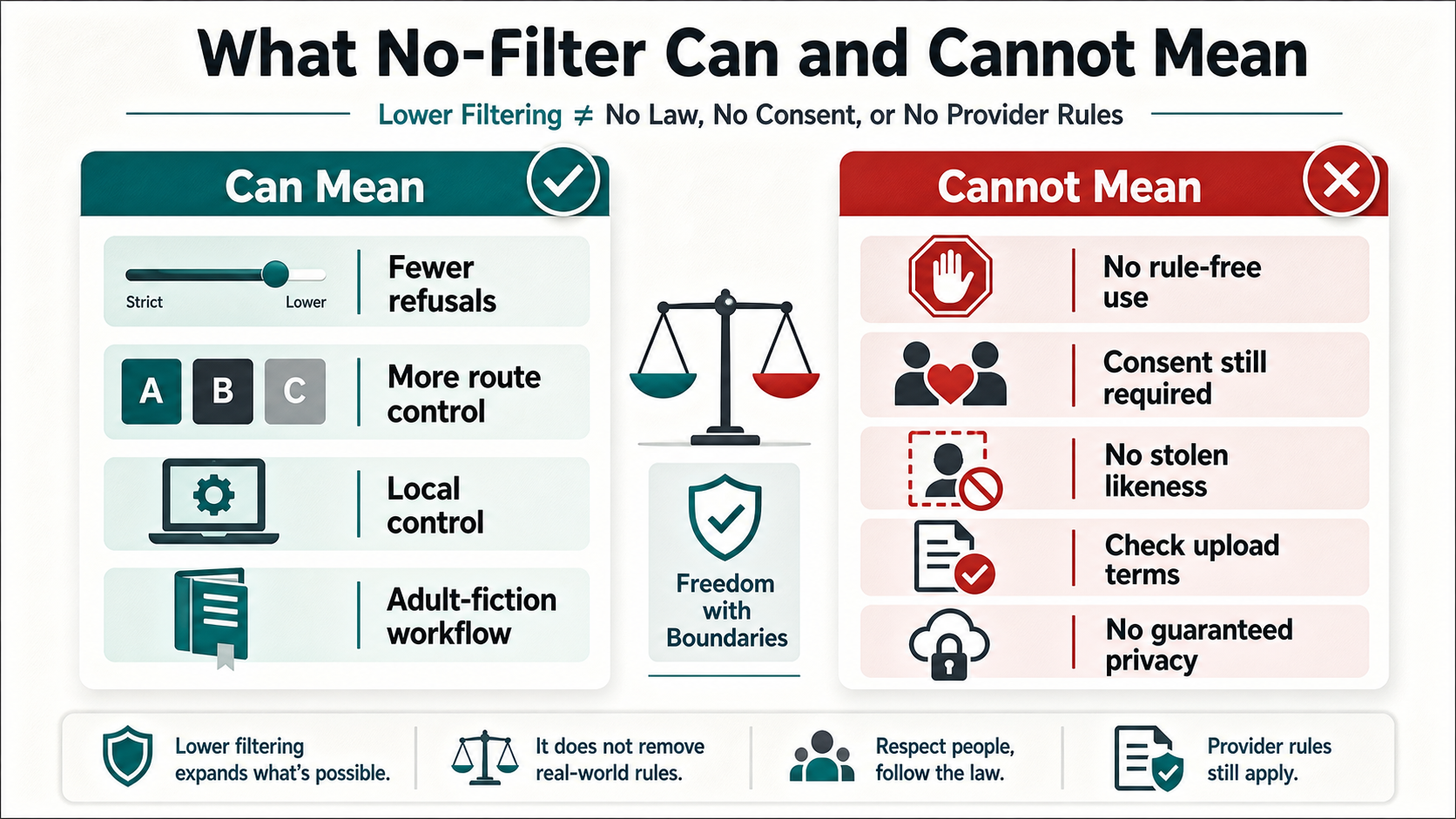
"No filter" usually means fewer visible prompt refusals. It does not mean no law, no terms, no payment rules, no hosting policy, no privacy tradeoff, no model license, or no responsibility for how an image is used. The phrase is useful only after it is translated into a route: a hosted adult platform, a privacy-first hosted model service, a local workflow, a mainstream filtered product, or a hard stop.
That split matters because the same landing-page promise can hide different contracts. A hosted adult image tool may allow NSFW text prompts but still ban minors, non-consensual intimate imagery, real-person exploitation, harassment, illegal content, or rights-infringing uploads. A local workflow may remove the hosted provider from the prompt loop, but it also moves storage, model choice, extension hygiene, output distribution, and lawful-use decisions onto the user. A mainstream image product may feel stricter, but its restrictions can be the safer answer for brand, client, educational, or public work.
Official platform policies point in the same direction. Google's Generative AI prohibited use policy, Hugging Face's content policy, Civitai's safety center, and OpenAI's Native Image Generation System Card all treat minors, non-consensual sexual content, likeness misuse, harassment, illegal material, and safeguard circumvention as serious boundary areas. The exact rules differ by route, but no legitimate route makes those boundaries disappear.
Hosted adult tools are fast, but provider-owned
Use a hosted adult image tool when speed matters more than control. These services can be useful for fictional adult character work, low-risk idea testing, or experimenting with styles that mainstream tools reject. They usually reduce the friction that brought the reader to the no-filter market: fewer refusals, faster prompt boxes, adult categories, private-generation claims, instant downloads, or paid packs.
That convenience is provider-owned. The provider owns the account system, model route, gallery behavior, billing, support, moderation policy, takedown process, and terms updates. If the service changes its model, adds a payment wall, removes a category, tightens moderation, changes export size, or alters the deletion policy, the user has limited leverage. No-filter marketing should be treated as a current product claim, not a durable contract.
Examples checked in May 2026 show why route language is safer than ranking language. BasedLabs markets no-restriction image generation and many model choices. Uncensored Chat markets NSFW image generation, editing, instant downloads, and private-generation claims. ZenCreator markets zero filters, 4K output, pricing packs, privacy, and commercial-rights language while still requiring adult users and prohibiting illegal, minor, and non-consensual content. Those examples can help a reader know what to inspect; they do not prove a universal best tool.
Before creating an account or uploading anything, ask what the hosted provider actually controls. Is the image public by default? Are generations reviewed? Are uploads retained or used to improve the service? Can files be deleted? Does the account email connect the work to a billing identity? Are outputs allowed for commercial use? Does the provider explain what happens when a report or takedown request arrives? A fast prompt box is useful only after those questions match the risk level of the work.
Privacy-first hosted routes still need a contract check
Use a privacy-first hosted route when the work needs more model choice or stronger privacy language than a basic adult prompt box, but the user does not want to run everything locally. This route can include hosted model ecosystems, privacy-marketed generators, encrypted or account-based generation services, and paid products that position themselves around private output rather than public community galleries.
The benefit is middle-ground control. A privacy-first service can offer better model selection, clearer paid plans, fewer public-gallery defaults, better deletion language, or more predictable account support than a casual free tool. It can also help users who cannot run local generation because they lack GPU hardware, storage, or the patience to maintain model files and extensions.
The risk is false comfort. "Private" can mean many things: not shown publicly, encrypted at rest, not used for training, deleted after a window, hidden from other users, protected behind account access, or simply not marketed as a community gallery. Those meanings are not interchangeable. A provider can be private for prompt history but not uploads, private for paid accounts but not free trials, or private for generation but still retain billing, support, abuse-prevention, and log data.
Check privacy claims at the route level. Read the terms and privacy policy for prompts, uploaded references, generated images, account identifiers, payment records, support tickets, deletion requests, and third-party processors. If the provider relies on another model host or gateway, identify that upstream route too. A wrapper can promise convenience, but the underlying model, storage, payment processor, and moderation stack may each carry separate rules.
Local generation gives control, not permission
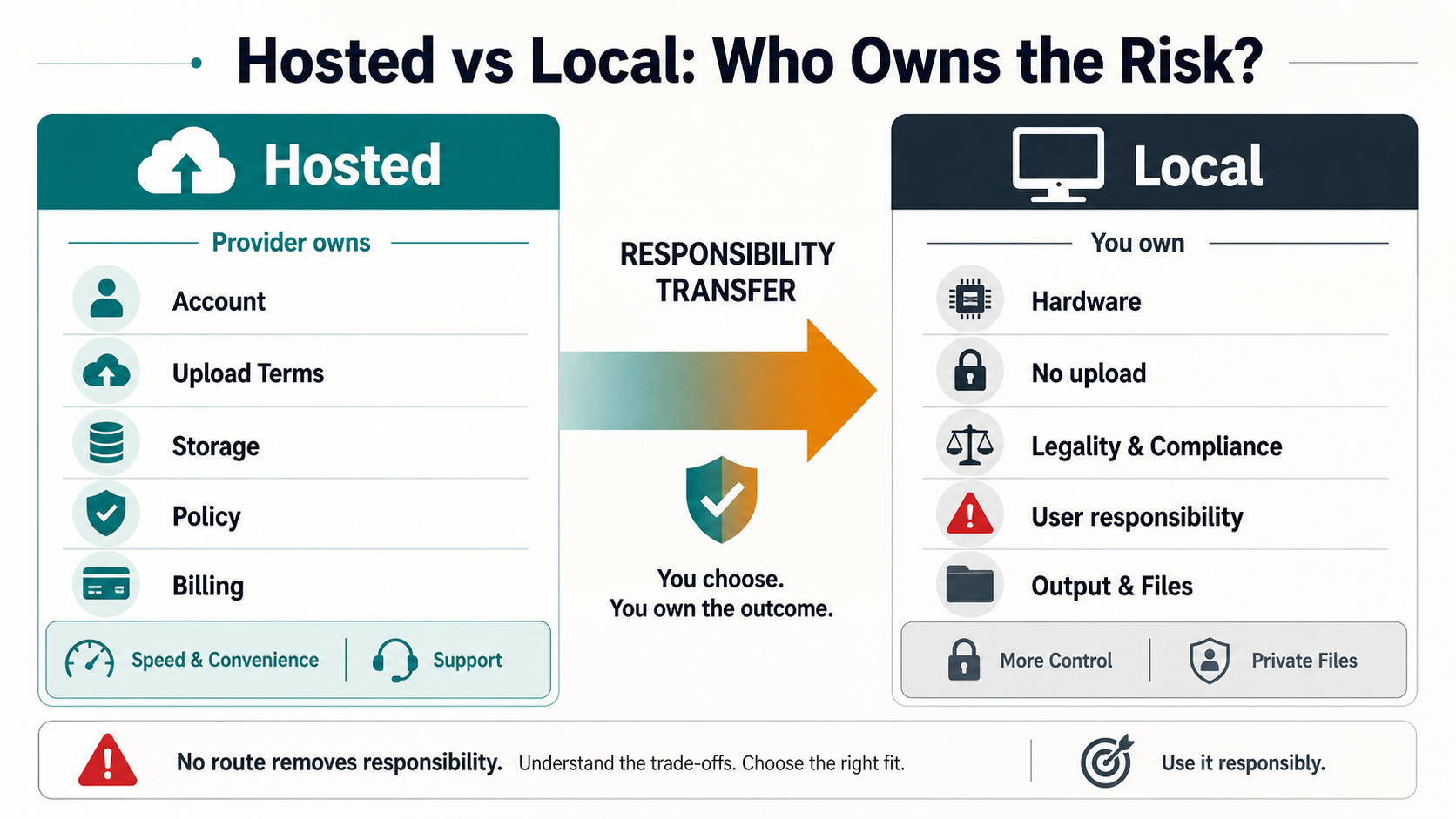
Use local generation when the real need is control: prompts, source files, model choice, workflow repeatability, and reduced hosted-upload exposure. Stable Diffusion and FLUX-style workflows can run on a local machine or a server the user controls. Tools such as AUTOMATIC1111, ComfyUI, and other local interfaces make it possible to choose checkpoints, LoRAs, ControlNet-style inputs, inpainting routes, upscalers, seeds, and repeatable workflows without depending on a single hosted prompt box.
Local is often the closest technical answer to low filtering because the hosted service is no longer the moderator of every prompt. It can also be the best answer for sensitive but lawful creative experimentation, private iteration, or workflows where the source files should not be sent to an unknown website. For a broader non-adult restriction-routing branch, AI Image Generator No Restrictions covers local control, no-sign-up testing, and commercial-safe work in a wider context.
The tradeoff is responsibility. Local generation requires hardware or controlled infrastructure, enough storage for models and outputs, trusted model sources, safe extension habits, license review, backup discipline, and security hygiene. A local workflow also removes some external friction that might otherwise stop a bad request. That makes the user's own stop rules more important, not less important.
Local generation should not be framed as permissionless generation. If an image would be non-consensual, exploitative, harassing, illegal, deceptive, or rights-infringing through a hosted product, running the same workflow locally does not make the output safe to create, store, share, or publish. Local control solves upload exposure and prompt-control problems; it does not solve consent, likeness, child-safety, copyright, or distribution problems.
Mainstream filtered tools are still the right route for ordinary work
Use a mainstream filtered tool when the work is ordinary design, brand, marketing, education, product, social, or client delivery. The user may get more refusals, but the route usually comes with clearer policy boundaries, account controls, billing records, product support, provenance behavior, and a lower chance of accidentally relying on a fragile adult-market provider claim.
That is especially important when the output will leave a private testing context. Public campaigns, client deliverables, ads, packaging, social posts, marketplace images, educational materials, and product pages need repeatability and support more than the loosest prompt box. A stricter tool can be the more professional route because it gives teams a clearer answer when a stakeholder asks how the image was created, what inputs were used, whether likeness rights were handled, and which policy governs the output.
Mainstream filtered tools are not a moral replacement for adult tools; they solve a different job. Use them when the goal is safe production. Do not use them as a bypass target. Trying to force adult, likeness, or prohibited content through a filtered product usually wastes time and creates account, policy, or trust risk.
Audit provider claims before upload, payment, or publication
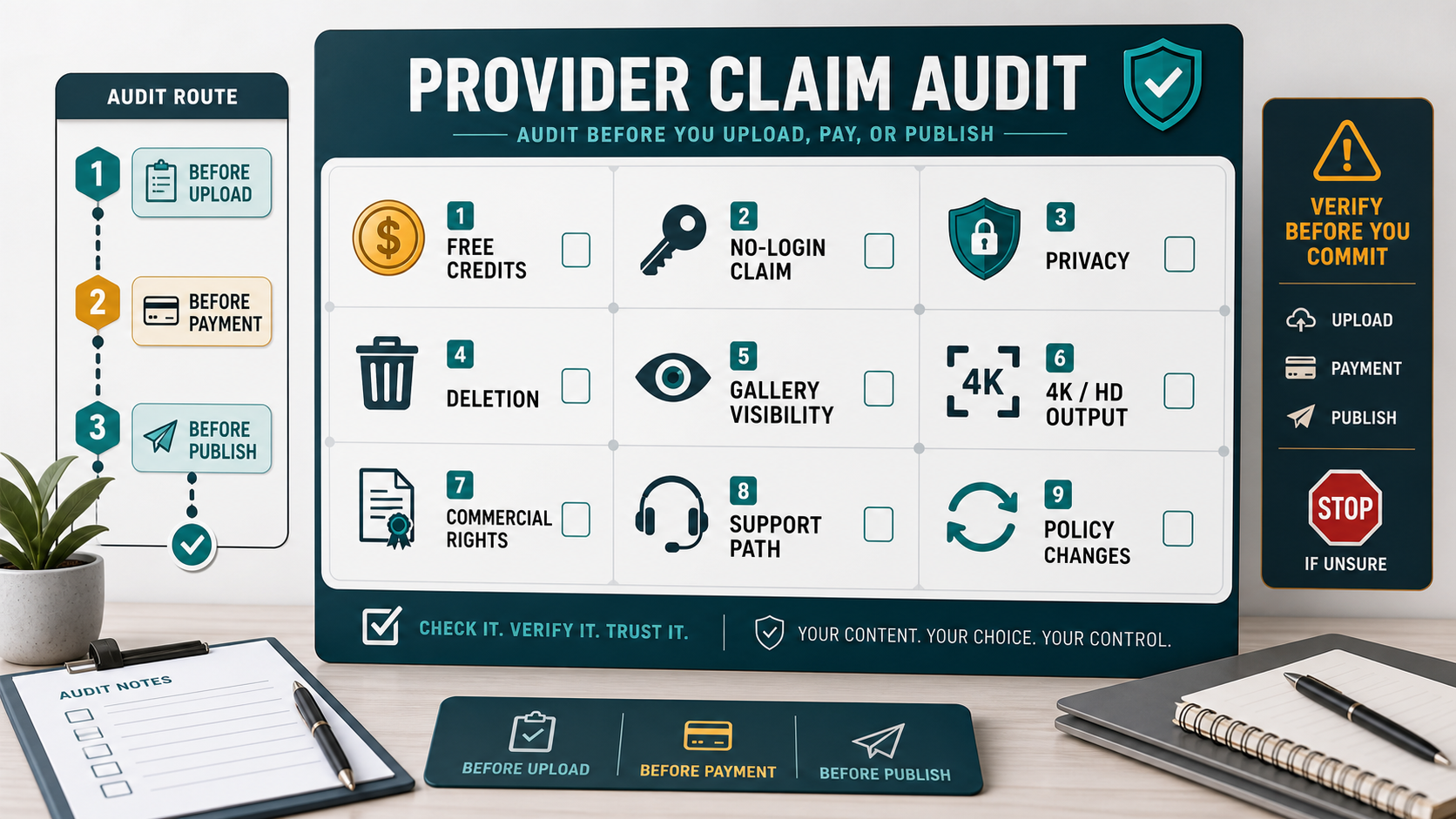
The risky claims are the ones that sound operational: free, unlimited, no login, private, encrypted, deleted, commercial use, no watermark, 4K, no restrictions, instant download, safe for creators, or adult-friendly. Each claim needs a narrower question before it can be trusted.
| Claim | What to verify | Safer interpretation until verified |
|---|---|---|
| Free | Credits, queue limits, export size, watermark, paid gates, and fair-use limits. | Free testing, not free production. |
| No login | Whether full-resolution export, history, deletion, and support require an account. | No account for first use, not no data processing. |
| Private | Prompt storage, upload retention, gallery defaults, staff review, training use, and processors. | Hidden from public view at best. |
| 4K or high resolution | Whether the output is native generation, upscale, paid export, or marketing language. | A route-specific export claim. |
| Commercial use | Plan terms, model license, input rights, attribution, resale limits, and jurisdiction. | Not safe until the exact route grants it. |
| No restrictions | Terms, abuse rules, payment-processor limits, hosting limits, minor and consent policies. | Lower prompt filtering, not rule-free use. |
| Deletion | How to delete prompts, uploads, outputs, account data, and known copies. | Unclear until a deletion path is documented. |
The audit should happen before three commitments: uploading a real source image, paying for a plan, or publishing an output. After an upload, the privacy question has already become harder. After payment, account and billing data connect to the work. After publication, rights, likeness, and takedown problems become public.
The US legal and platform context is also moving. The FTC's Take It Down Act business guidance says covered platforms must provide notice and removal processes for non-consensual intimate images, including AI-created or altered digital forgeries, with Section 3 enforcement effective May 19, 2026. That is not a universal legal answer for every country or every use, but it is a clear signal that non-consensual intimate image workflows are not a harmless edge case.
Source-image and likeness boundaries
The highest-risk branch is not a text prompt about a fictional character. It is a source image involving a real person, a private file, an adult context, or a recognizable likeness. Once a tool receives a source image, the user has to think about retention, review, training, deletion, support, and downstream output rights. The risk is higher again if the person did not consent to that use.
Use a hard stop for minors, non-consensual intimate imagery, real-person sexualization without permission, harassment, exploitation, doxxing, impersonation, blackmail, revenge content, and private files whose terms are unclear. Do not soften that rule just because a tool accepts the upload. Acceptance by a prompt box is not consent, legality, or publication permission.
Lower-risk source images still need discipline. Owned product images, consenting adult references, synthetic references, licensed stock, and self-created characters are easier to route, but they still require term checks. If the provider uses uploads to improve models, shows outputs in a public gallery, retains files after deletion requests, or does not explain commercial rights, the route may be wrong even for otherwise lawful work.
Use minimization when a source image is necessary. Crop unnecessary context, remove metadata where appropriate, avoid identifiable backgrounds, use synthetic or owned references when possible, and keep sensitive material local unless a provider has the right contract. The safer question is not "Will the generator accept this?" It is "Should this file leave my control at all?"
Decision checklist
Name the restriction first. "I want fewer refusals on fictional adult prompts" is a different job from "I want to upload a real person's photo", "I need commercial rights", "I need no account", or "I need private iteration." Once the real restriction is named, the route usually becomes obvious.
| Real job | Start with | Do not skip |
|---|---|---|
| Fictional adult or character experimentation | Hosted adult tool or local workflow | Consent, age, provider policy, gallery visibility, and account terms. |
| Private source-image iteration | Local workflow or a provider with clear upload terms | Retention, training use, deletion, and support owner. |
| Maximum prompt control | Local self-hosted workflow | Model source, license, storage, and output responsibility. |
| Fast low-risk testing | Hosted adult tool | Treat prompts and outputs as disposable unless terms say otherwise. |
| Brand, client, or public production | Mainstream filtered tool or explicit provider contract | Output rights, attribution, support, and repeatability. |
| Real-person likeness or intimate content | Stop unless explicit consent and route terms are clear | No minors, no non-consensual use, no harassment, no exploitation. |
Do not pay for a low-filter tool until the provider answers the claims that matter for the job. Do not upload a source image until the retention and rights path is clear. Do not publish an output until the route grants the rights needed for that use. The strongest no-filter decision is often not a tool name; it is choosing the route that makes the risk visible before the first generation.
FAQ
Is any no-filter image tool truly rule-free?
No. A tool can reduce prompt refusals, allow adult categories, support local generation, or market itself as low restriction, but law, consent, IP rights, platform terms, payment rules, hosting rules, and provider policies still apply. Treat rule-free language as marketing until the exact route proves a narrower claim.
Which route is best for adult fictional images?
For fast fictional adult testing, a hosted adult tool can be practical if the user accepts provider-owned rules and checks privacy, gallery, deletion, and rights terms. For more control, local generation is stronger but requires setup and responsibility. For public, client, or brand use, a mainstream filtered route or explicit contract is usually safer.
Are local Stable Diffusion workflows safer than hosted adult tools?
They are safer for upload control when the files stay on hardware or infrastructure the user controls. They are not automatically safer for legality, consent, likeness, copyright, or publication. Local generation shifts control and responsibility to the user.
Can a no-login tool still store my prompts or images?
Yes. No login only describes account friction. It does not prove that prompts, uploads, generated images, logs, device data, or support data are not processed, stored, reviewed, or shared with service providers. Check the privacy policy and deletion route before uploading anything sensitive.
Can outputs be used commercially?
Only if the exact route grants the rights needed for that use. Commercial permission can depend on the provider, plan, model license, input material, prompt, jurisdiction, attribution rules, and output category. Do not infer commercial rights from free, no-filter, private, or high-resolution marketing language.
What should stop the workflow immediately?
Stop for minors, non-consensual intimate imagery, sexualized real-person likeness without permission, harassment, exploitation, blackmail, doxxing, copyrighted or private source files without rights, and any provider route that cannot explain retention, deletion, upload handling, or output rights for the job.