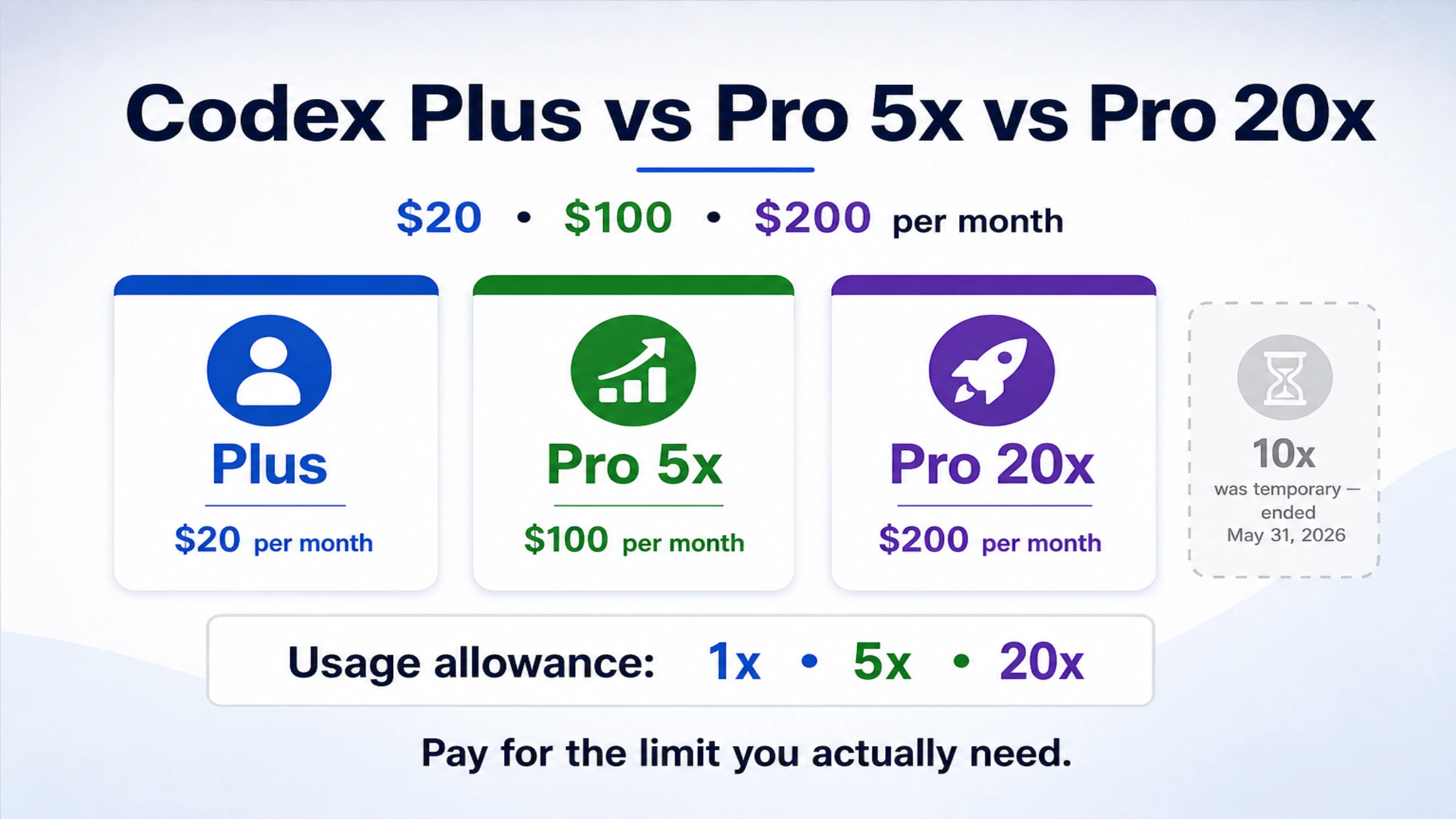
The current individual Codex choices are ChatGPT Plus at $20 per month, Pro 5x at $100, and Pro 20x at $200. There is no standing “Pro 10x” tier today. That label came from a temporary Codex promotion that raised the new $100 plan from its standard 5x allowance to as much as 10x through May 31, 2026.
For most developers, Plus is the right starting point. Move to Pro 5x only after your own Usage Dashboard shows that limits repeatedly interrupt valuable work. Pro 20x makes sense when 5x is already too small or when a sustained, high-intensity workload can justify another $100 every month. A bigger multiplier is more usage allowance—not five or twenty times the speed, intelligence, or output quality.
| Current plan | US list price | Standing usage relationship | The practical fit |
|---|---|---|---|
| Plus | $20/month | baseline | regular coding where an occasional reset is acceptable |
| Pro 5x | $100/month | 5x Plus usage | daily, long sessions that repeatedly outgrow Plus |
| Pro 20x | $200/month | 20x Plus usage | consistently heavy work that already strains 5x |
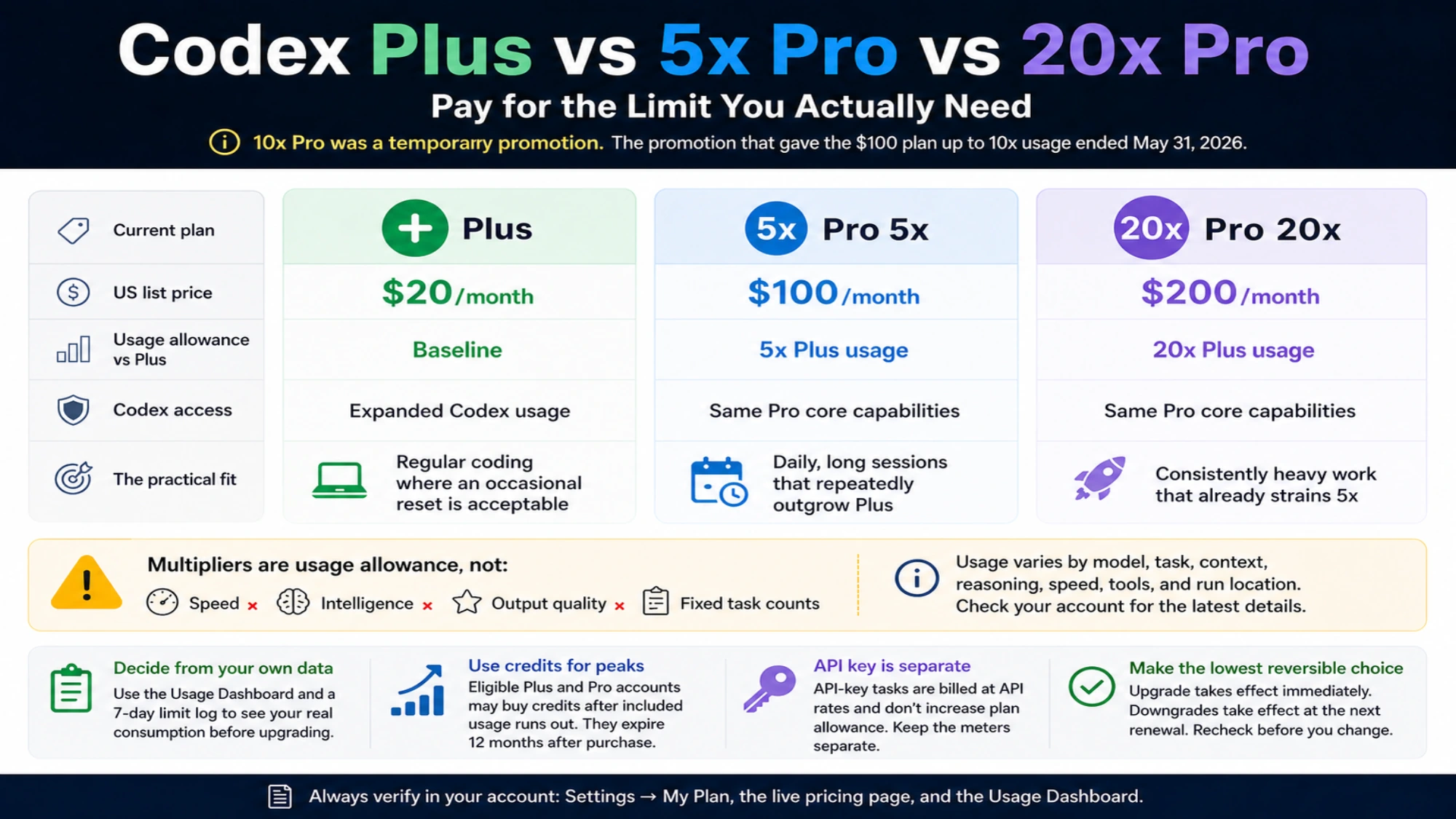
OpenAI describes the two Pro tiers as having the same core capabilities; their main difference is allowance. Check the current Pro tier explanation and the live Codex pricing table before paying, because model access, ranges, and credit options can change.
The 10x plan existed as a promotion, not a permanent tier
The stale name is understandable. In its May 29, 2026 release notes, OpenAI said the new $100 Pro plan had a standard 5x allowance but would temporarily receive up to 10x more Codex usage than Plus. The promotion ended on May 31. The existing $200 option also remained on its then-current Codex promotion through that date.
The durable comparison is therefore Plus versus Pro 5x versus Pro 20x. If an old screenshot or article says “10x Pro,” translate it into a dated question: was it describing the temporary doubled allowance on the $100 plan? Do not assume an account bought today will receive that historical multiplier. The account's current plan selector and Usage Dashboard outrank an old table.
This also explains why anecdotes conflict. Someone who used Pro 5x during the promotion experienced a different allowance from someone using the same named tier later. Neither experience supplies a timeless task count.
Price and multiplier are only the first calculation
ChatGPT Plus costs $20 per month. Pro 5x costs five times as much and advertises five times the Plus usage. As a rough planning ratio, both are $20 per “Plus-equivalent” allowance unit. Pro 20x costs ten times as much as Plus while advertising twenty times the usage, or $10 per relative unit.
That arithmetic does not prove Pro 20x is the best value. Allowance is not cash, cannot be resold, and has value only when you use it on work you would otherwise delay or move elsewhere. It also does not mean you can safely reproduce the tier by stacking accounts. The calculation is useful for one narrow purpose: showing that the $200 plan is designed for utilization, not casual insurance.
Three costs matter more than the headline ratio:
- Unused capacity. A $200 subscription is expensive if most of its allowance expires unused.
- Interrupted work. A limit reached in the middle of a release, incident, or paid delivery can cost more than the plan difference.
- Overflow cost. Eligible Plus and Pro accounts may buy credits after included usage runs out, so occasional peaks do not automatically require a permanent upgrade.
Your decision should compare the monthly price difference with those three observed costs, not with a guessed number of prompts.
Use a seven-day limit log before upgrading
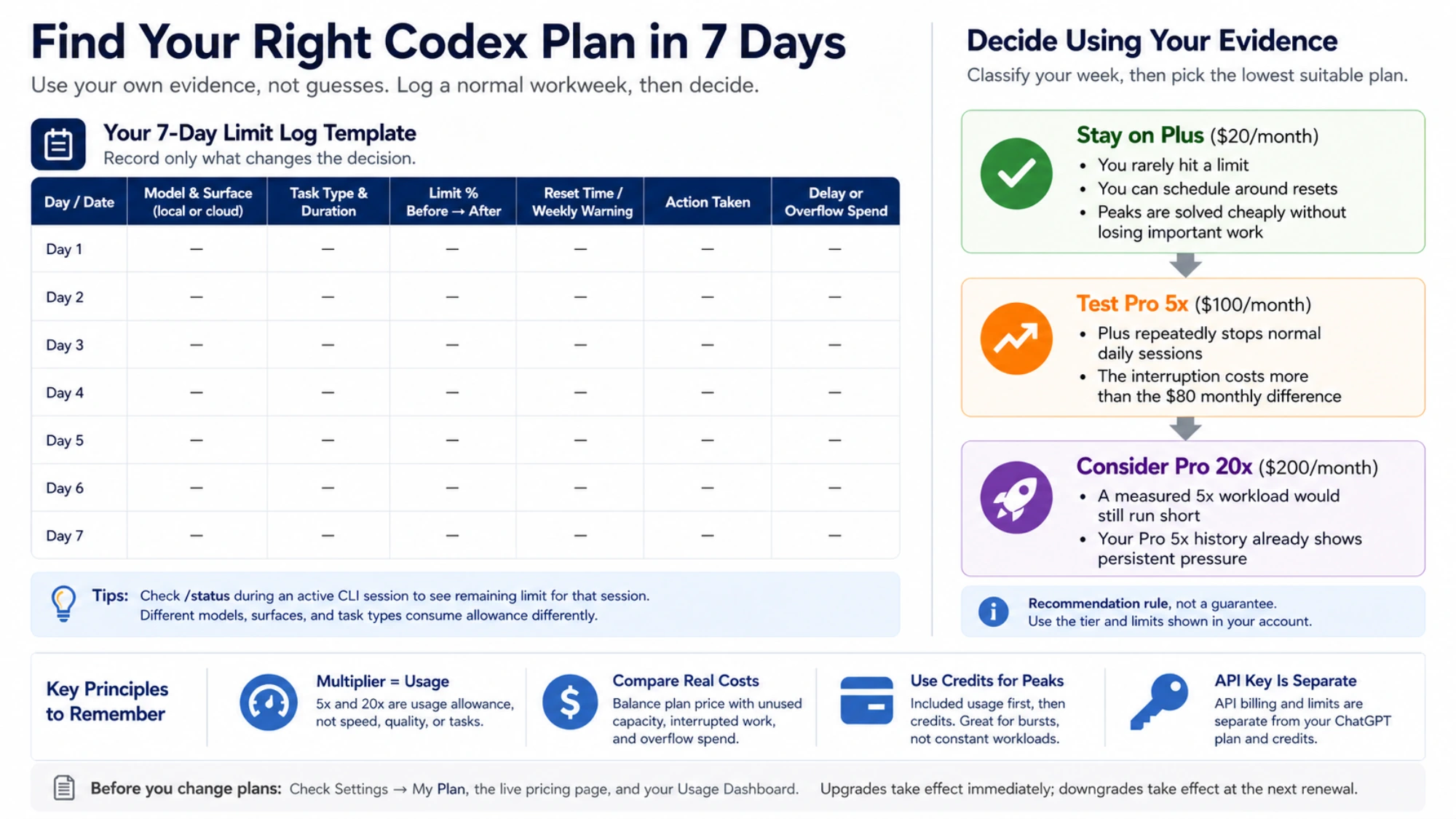
Open the Codex Usage Dashboard and record one normal workweek. During an active CLI session, /status can show the remaining limit available to that session. For each meaningful run, keep only the information that changes the decision:
| What to record | Why it matters |
|---|---|
| model and local or cloud surface | different models and surfaces consume allowance differently |
| task type and duration | a repository migration is not comparable to a tiny edit |
| limit percentage before and after | exposes which work consumes the window |
| reset time or weekly warning | separates a short pause from a persistent capacity problem |
| action taken | shows whether waiting, a smaller model, or credits solved it |
| actual delay or overflow spend | turns frustration into a cost you can compare |
OpenAI's Codex plan guidance says usage varies with model, run location, task complexity, context, reasoning, speed, and tools. The pricing page also says local messages and cloud tasks can share a five-hour window, while additional weekly limits may apply. That is why somebody else's “messages per day” estimate is a weak purchasing basis.
At the end of the week, classify the result:
- Stay on Plus if you rarely hit a limit, can schedule around resets, or solve peaks cheaply without losing important work.
- Test Pro 5x if Plus repeatedly stops normal daily sessions and the interruption costs more than the $80 monthly difference.
- Consider Pro 20x if a measured 5x workload would still run short, or if your current Pro 5x history already shows persistent pressure that justifies another $100.
This is a recommendation rule, not a guarantee. Use the tier and limits displayed in your own account at purchase time.
Credits can be cheaper than carrying a larger plan all month
Eligible Plus and Pro users may be offered additional credits after included usage is exhausted. According to OpenAI's current credits guidance, included plan usage is consumed first; purchased credits then extend supported work. Availability varies, and supported agentic features can draw from the same balance.
Credits fit bursty demand: one migration week, a release crunch, or an unusually large review. A permanent Pro upgrade fits recurring demand. Compare your last month's overflow spend with the upgrade difference. If occasional credits cost well below $80, Pro 5x may be unnecessary. If credits plus lost time regularly approach the gap, a higher tier becomes easier to justify.
Do not enable auto top-up merely to avoid seeing a limit. Set a deliberate budget if you use it. Credits are non-transferable, generally non-refundable except where law requires, and expire 12 months after purchase. They can also be shared across supported features, so the Codex balance may not tell the whole story unless you inspect recent usage.
An API key is a separate bill, not extra plan allowance
The Codex pricing page says extra local tasks can run with an API key at standard API rates. That can be a good route when the work is local, programmatic, attributable to a project, and easier to budget per token. It does not increase the ChatGPT plan's included allowance, and it should not be treated as a substitute for every cloud task or plan-bound capability.
Keep the meters separate:
- ChatGPT login spends the plan's Codex allowance and, after that, eligible credits.
- API-key mode spends from the selected API organization or project under API billing and rate limits.
- A workspace can have its own seat, policy, or credit owner.
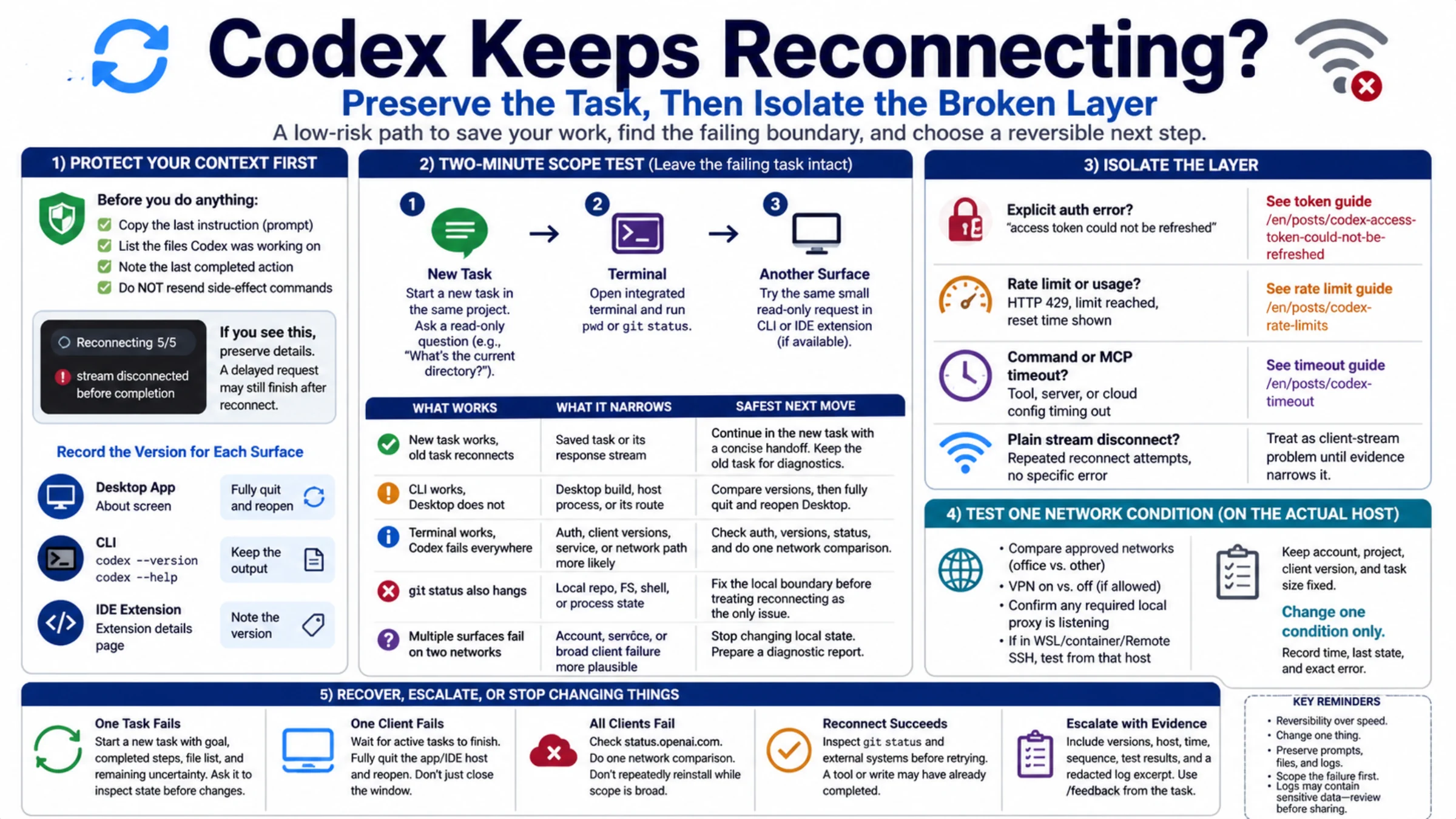
If a limit message does not match the route you think you are using, first identify the meter with the account and workspace limit checklist. If the request actually failed with HTTP 429, use the Codex rate-limit diagnostic rather than buying a plan blindly.
Make the lowest reversible choice
Choose Plus when you lack evidence. It is the cheapest way to learn your real consumption. Upgrade to Pro 5x when the same limitation repeats across normal weeks, not because one large task was inconvenient. Choose Pro 20x when you already have enough sustained work to use the capacity, not because its relative-unit arithmetic looks attractive.
OpenAI says an upgrade takes effect immediately, while moving to a lower tier takes effect at the next renewal. Recheck Settings → My Plan, the live pricing page, and the Usage Dashboard immediately before changing. The best plan is not the one with the largest number; it is the smallest one that keeps your valuable work moving without paying every month for headroom you do not use.