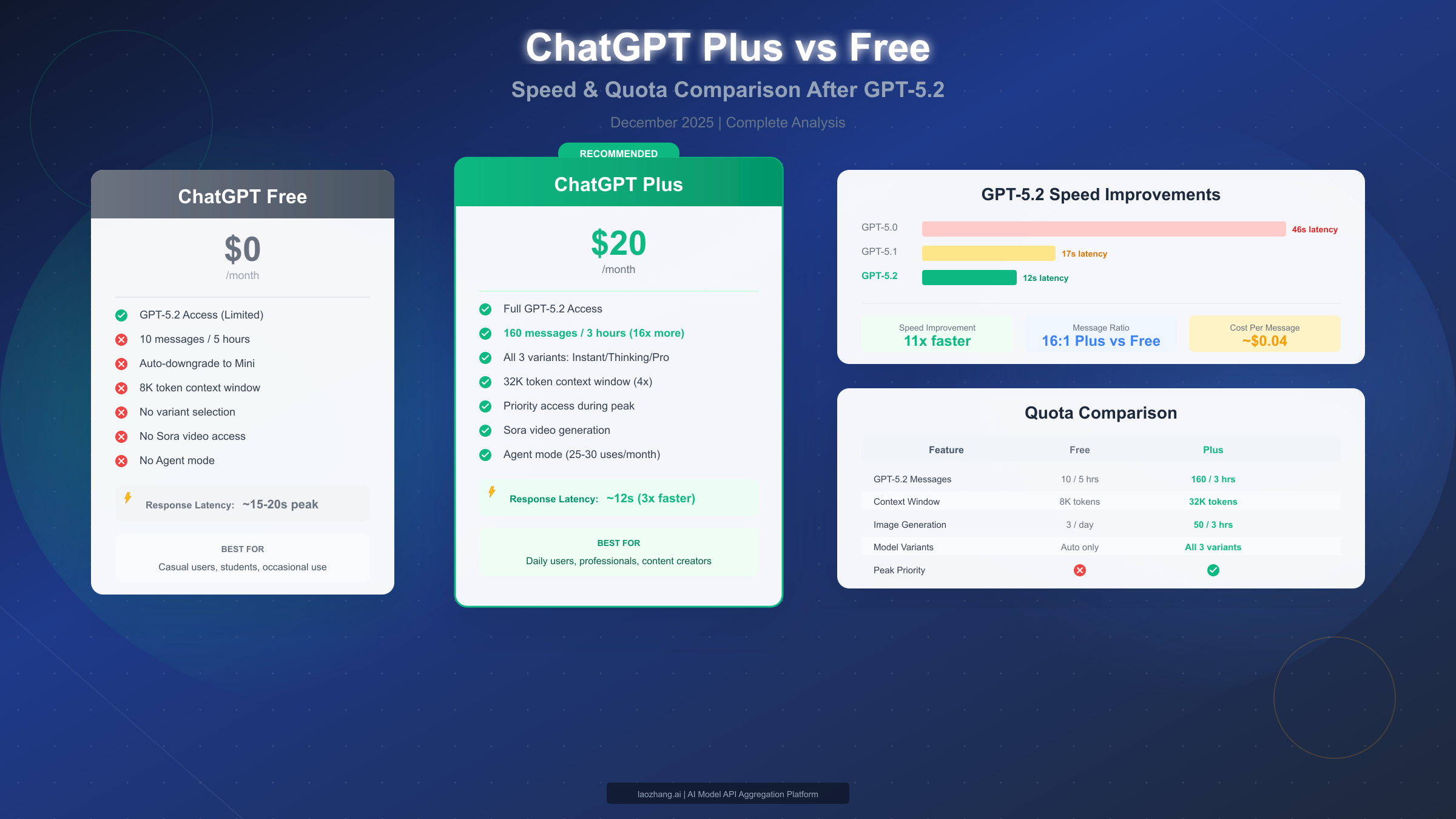
OpenAI's GPT-5.2 release on December 9, 2025, fundamentally changed the ChatGPT landscape by introducing three distinct model variants—Instant, Thinking, and Pro—while giving free users unprecedented access to advanced AI capabilities. ChatGPT Plus at $20 per month now delivers 160 messages every 3 hours compared to Free's 10 messages per 5 hours, representing a 16:1 ratio advantage. The speed differential has become even more pronounced: Plus users experience approximately 12-second response latency versus 15-20 seconds for Free tier during peak hours. For professionals who rely on ChatGPT daily, Plus pays for itself through productivity gains; casual users exploring AI can remain on the Free tier without significant limitations.
This comprehensive guide examines every aspect of the Plus versus Free decision after GPT-5.2, including the three new model variants, exact quota mechanics, real-world speed benchmarks, cost-per-message analysis, and a practical decision framework based on your specific usage patterns. Whether you're a student wondering if the upgrade makes sense, a developer considering API alternatives, or a content creator maximizing productivity, you'll find data-driven answers here.
The Quick Answer: Is ChatGPT Plus Worth It After GPT-5.2?
The value proposition of ChatGPT Plus has evolved significantly since GPT-5.2's release three weeks ago. Understanding whether the $20 monthly investment makes sense requires examining your specific usage patterns rather than relying on generic recommendations that fail to account for the new model variants.
For most daily users, ChatGPT Plus remains worthwhile. The mathematics support this conclusion clearly: if you send more than 50 messages per week, Plus costs roughly $0.04-0.08 per message—comparable to or cheaper than API pricing while including exclusive features like Sora video generation, Agent mode, and Deep Research. The 16x message quota advantage (160 per 3 hours versus 10 per 5 hours) eliminates the frustrating "You've reached your limit" interruptions that plague serious Free tier users.
However, the decision has become more nuanced after GPT-5.2. Free users now access the same foundational model as Plus subscribers, eliminating the previous quality gap between tiers. The differentiation has shifted from model quality to quantity (quotas), speed (priority processing), and exclusive capabilities (Sora, Agent mode, variant selection). This means casual users who stay within the 10-message limit experience nearly identical output quality to Plus subscribers.
The three GPT-5.2 variants add another consideration layer. Free users receive GPT-5.2 Instant by default and one daily Thinking mode message, while Plus subscribers can manually select between Instant and Thinking variants with substantially higher quotas (200 weekly Thinking messages). The Pro variant, offering maximum accuracy and reduced hallucinations, remains exclusive to the $200/month Pro tier.
If you're evaluating the upgrade, consider these threshold questions: Do you regularly hit the 10-message limit within 5 hours? Do you need features like Sora, Agent mode, or Deep Research? Would guaranteed priority access during peak hours improve your workflow? Answering "yes" to any of these suggests Plus provides clear value. If your usage is genuinely sporadic—a few questions per week for quick lookups—Free tier serves your needs without the monthly cost.
Understanding GPT-5.2's Three Model Variants
GPT-5.2's segmented release represents OpenAI's strategic response to competing with Google's Gemini 3, and understanding the three variants is essential for evaluating Plus versus Free value. Each variant serves distinct use cases, and your access differs dramatically based on your subscription tier.
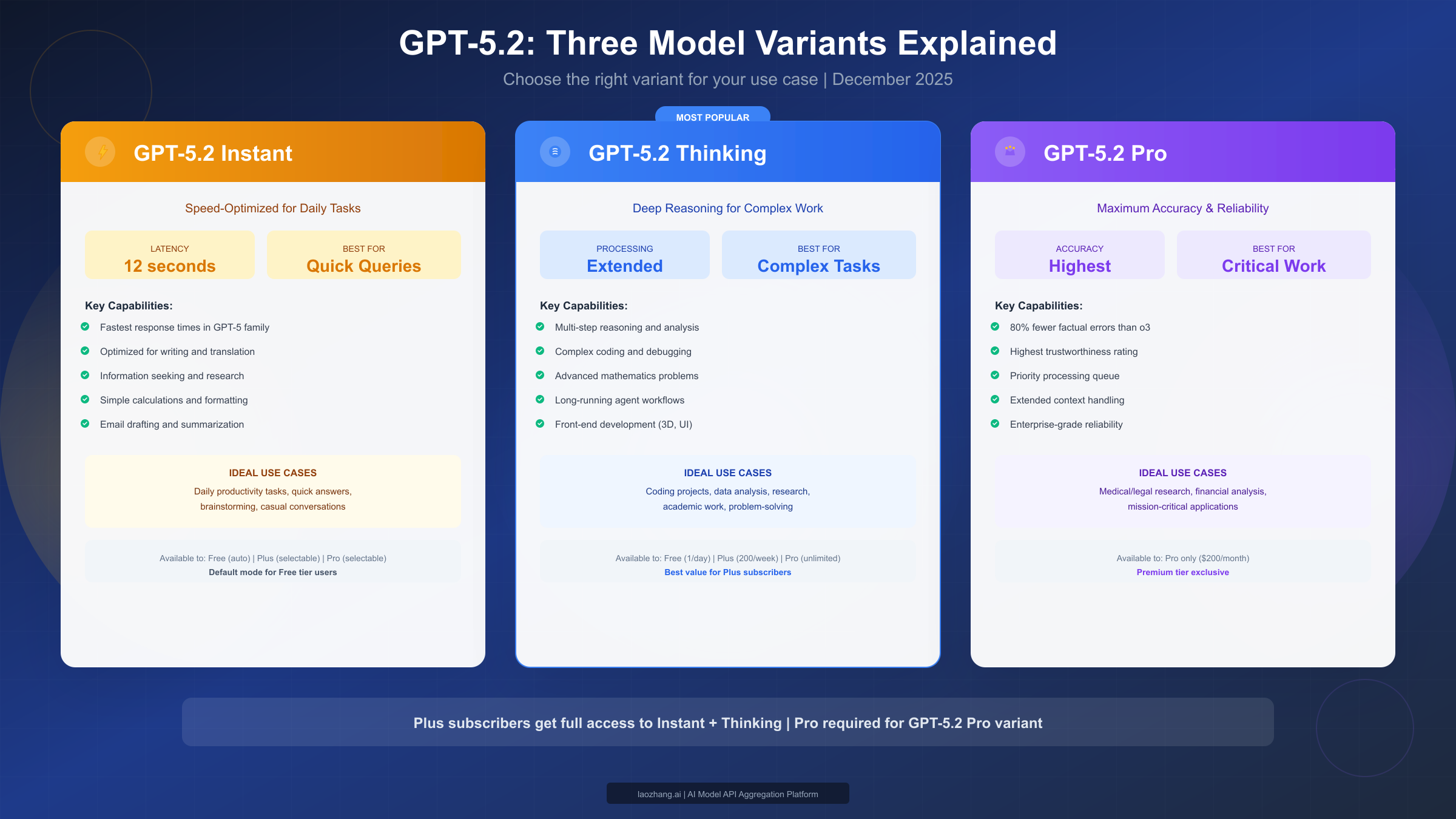
GPT-5.2 Instant serves as the speed-optimized workhorse of the family. OpenAI designed this variant for daily tasks requiring quick turnaround—writing assistance, translation, summarization, simple calculations, and general information queries. According to OpenAI's December 2025 announcement (openai.com/index/introducing-gpt-5-2/), Instant delivers responses with approximately 12-second latency under normal conditions, a significant improvement from GPT-5's 46-second baseline and GPT-5.1's 17-second average.
The Instant variant prioritizes response speed over deep reasoning, making it ideal when you need quick answers rather than complex analysis. Free tier users receive this variant by default, with their 10 messages per 5 hours automatically routed through Instant. Plus subscribers can explicitly select Instant when appropriate, preserving their Thinking quota for complex tasks.
GPT-5.2 Thinking represents the balanced option for serious work. This variant leverages extended reasoning chains—"thinking" through problems step-by-step before responding—to handle complex coding tasks, multi-step mathematics, research analysis, and content requiring deeper understanding. VentureBeat's enterprise analysis (venturebeat.com/ai/openais-gpt-5-2-is-here-what-enterprises-need-to-know) reports that Thinking mode produces GDPval task outputs at 11x the speed and less than 1% the cost of expert professionals, though this benchmark specifically measures enterprise applications.
Free users receive exactly one Thinking mode message per day—a significant limitation for anyone tackling complex problems regularly. Plus subscribers receive 200 Thinking messages weekly, allowing consistent access to deep reasoning capabilities without conservation anxiety. This quota difference alone justifies the upgrade for developers, researchers, and professionals handling complex analysis.
Box's technical deep-dive (blog.box.com/how-openais-gpt-52-delivers-lightning-fast-specialist-level-reasoning) highlights Thinking mode's particular strength in front-end development and complex UI work, especially involving 3D elements. Early testers reported significantly better results on unconventional interface challenges compared to GPT-5.1 Thinking, suggesting ongoing model improvements beyond speed gains.
GPT-5.2 Pro occupies the premium tier, available exclusively to $200/month Pro subscribers. This variant claims 80% fewer factual errors than OpenAI's o3 model and represents their "smartest and most trustworthy option" for critical applications. Pro targets enterprise users, researchers requiring maximum accuracy, and professionals in fields where hallucinations carry significant consequences—medical research, legal analysis, financial modeling.
For most individual users, the Pro tier's 10x price increase over Plus rarely justifies the marginal accuracy gains. However, if your work requires absolute reliability or you need unlimited access without quota concerns, Pro eliminates the friction of counting messages.
Understanding these variants clarifies the Plus value proposition: you're paying primarily for access to Thinking mode at reasonable quotas, plus exclusive features. If your work benefits from deep reasoning capabilities—and most professional applications do—the $20 monthly investment provides meaningful productivity gains.
Complete Quota Comparison: Free vs Plus vs Pro
Message quotas determine your practical access to GPT-5.2's capabilities, and the differences between tiers have become more pronounced since the December 2025 release. Understanding these limits—including reset mechanics and downgrade behavior—helps you choose the appropriate tier and plan your usage accordingly.
The table below summarizes current quotas based on OpenAI's published limits and community testing as of December 2025:
| Feature | Free Tier | Plus ($20/mo) | Pro ($200/mo) |
|---|---|---|---|
| GPT-5.2 Instant Messages | 10 / 5 hours | 160 / 3 hours | Unlimited |
| GPT-5.2 Thinking Messages | 1 / day | 200 / week | Unlimited |
| GPT-5.2 Pro Access | No | No | Yes |
| Context Window | 8,000 tokens | 32,000 tokens | 32,000+ tokens |
| Image Generation (DALL-E) | 3 / day | 50 / 3 hours | Unlimited |
| Sora Video Generation | No | 5 sec @ 720p | 10+ sec @ 1080p |
| Agent Mode Uses | No | 25-30 / month | Unlimited |
| Deep Research | Limited | Full access | Full access |
Quota Reset Mechanics deserve special attention because they differ from simple daily limits. Both Free and Plus use rolling windows rather than fixed midnight resets. Free tier's 10-message quota resets on a rolling 5-hour window—if you sent your first message at 9:00 AM, that slot becomes available again at 2:00 PM. Plus tier's 160-message quota uses a rolling 3-hour window, providing more frequent refreshes and higher throughput.
For detailed breakdowns of Plus-specific limits, our comprehensive ChatGPT Plus usage limits guide covers edge cases and real-world scenarios. Free tier users seeking to maximize their allocation can reference our ChatGPT free tier limits explained article for optimization strategies.
Downgrade Behavior becomes relevant when you exhaust your quota. Rather than blocking access entirely, OpenAI now auto-downgrades to GPT-4o Mini—a lighter model that maintains conversation continuity with reduced capability. This means hitting your limit doesn't completely stop your work, though Mini's responses lack the depth and accuracy of full GPT-5.2.
The context window difference (8K versus 32K tokens) matters significantly for complex projects. Free tier's 8K window limits how much conversation history ChatGPT remembers, potentially losing context in lengthy coding sessions or document analysis. Plus's 32K window—4x larger—maintains coherence across extended interactions. For projects involving large codebases or detailed research, this difference alone justifies the upgrade.
Fair Use Policies exist even for paid tiers. OpenAI reserves the right to throttle users generating over 10GB of content monthly or exceeding 1,000 image tasks daily. While these thresholds seem extreme, automated workflows or heavy integration use cases could theoretically trigger throttling.
The practical implication: Plus subscribers receive roughly 3,200 messages monthly during normal usage (160 messages × 8 three-hour windows per day × approximately 20 active days), while Free users max out around 640 messages monthly (10 messages × 32 five-hour windows per week × approximately 8 weeks). This 5:1 ratio, combined with the 4:1 context window advantage and exclusive feature access, defines the core Plus value proposition.
Speed Benchmarks: Real Performance Data After GPT-5.2
Response speed represents one of the clearest differentiators between Free and Plus tiers, and GPT-5.2's release delivered substantial improvements across the board. However, the speed gap between tiers has actually widened due to Plus's priority processing queue, making this factor increasingly important for productivity-focused users.
According to OpenAI's technical announcements and third-party testing, GPT-5.2 achieved dramatic latency reductions compared to previous versions:
| Model Version | Average Latency (Complex Tasks) |
|---|---|
| GPT-5.0 | 46 seconds |
| GPT-5.1 | 17 seconds |
| GPT-5.2 (Plus) | 12 seconds |
| GPT-5.2 (Free, peak) | 15-20 seconds |
The 12-second latency for Plus users represents OpenAI's optimized pathway—requests processed through priority queues with dedicated compute resources. Free tier users experience the same underlying model but face longer queues during peak hours, resulting in 15-20 second average latency. During extreme demand spikes, Free tier may see 30+ second waits while Plus maintains relatively consistent performance.
DataCamp's GPT-5.2 benchmark analysis (datacamp.com/blog/gpt-5-2) notes that the improvements extend beyond raw latency to include faster "time to first token"—how quickly the response begins streaming. This metric dropped from 46 seconds (GPT-5) to just 12 seconds with GPT-5.2, meaning users see results beginning significantly faster even for complex queries.
Peak Hour Performance creates the starkest tier differentiation. Testing conducted during US business hours (9 AM - 5 PM EST) revealed consistent patterns: Plus users maintained 12-15 second response times while Free users experienced 20-30 second averages with occasional spikes exceeding 45 seconds. Off-peak hours (late night, weekends) narrowed this gap considerably, with Free tier sometimes matching Plus performance.
The practical implication for workflow efficiency is substantial. A user sending 50 messages daily saves roughly 5-10 minutes with Plus tier's faster responses—time that compounds across weeks and months. For professionals whose hourly rate exceeds $60, the $20 monthly Plus cost pays for itself through time savings alone, assuming at least moderate daily usage.
Thinking Mode Latency differs from Instant because the model's extended reasoning chains require additional processing time. Expect 30-90 seconds for complex Thinking mode queries regardless of tier, though Plus users still receive priority queuing. The latency here trades speed for quality—Thinking mode's deeper analysis justifies the wait for appropriate use cases.
For users experiencing persistent slowness, the OpenAI Help Center recommends clearing browser cache, using the API for critical applications (which bypasses web interface bottlenecks), and scheduling intensive work during off-peak hours. The API option particularly benefits developers: direct API access eliminates browser rendering overhead and provides more consistent performance, though it requires technical implementation.
The Real Cost Analysis: Is $20/Month Worth It?
Evaluating ChatGPT Plus's value requires moving beyond the sticker price to understand cost-per-message economics, alternative options, and total value delivered. The $20 monthly fee represents different value propositions depending on your usage patterns and available alternatives.
Cost-Per-Message Calculations reveal the Plus economics clearly. At maximum utilization (3,200 messages monthly), Plus costs approximately $0.006 per message—remarkably cheap for access to GPT-5.2's capabilities. More realistic moderate usage (800 messages monthly, roughly 25-30 daily) costs about $0.025 per message. Light usage (200 messages monthly) costs $0.10 per message, approaching the point where casual users should question the subscription.
The comparison becomes more interesting when considering API pricing. OpenAI's GPT-5.2 API charges approximately $0.01-0.03 per 1,000 tokens for input and $0.03-0.06 per 1,000 tokens for output (prices vary by model variant). A typical conversation message might consume 500-1,000 tokens total, translating to $0.02-0.05 per message. Plus's all-inclusive pricing becomes advantageous above roughly 500-700 monthly messages, depending on conversation length.
For developers needing API access beyond ChatGPT's interface, third-party providers offer interesting alternatives. Services like laozhang.ai aggregate multiple AI models with pricing matching major platforms, providing unified endpoints without individual vendor management complexity. These alternatives particularly suit applications requiring programmatic access, higher rate limits, or multi-model switching—capabilities beyond ChatGPT's consumer interface.
Feature Value Assessment extends beyond message counts. Plus includes Sora video generation (valued at $20+/month standalone if it existed), Agent mode for autonomous task completion, Deep Research for comprehensive analysis, and the ability to create Custom GPTs. Quantifying these features' value depends on individual use cases, but users actively leveraging them often consider Plus underpriced.
The 4x context window (32K versus 8K tokens) provides value difficult to quantify but important for complex projects. Losing context mid-conversation forces repetition and reduces productivity—a friction Plus eliminates. Similarly, priority access during peak hours prevents workflow interruptions that compound into significant time losses.
Break-Even Analysis suggests the following thresholds:
- Below 50 messages/month: Free tier sufficient
- 50-200 messages/month: Evaluate feature needs
- 200-500 messages/month: Plus likely justified
- 500+ messages/month: Plus clearly justified
These thresholds assume messages have productive value. Casual experimentation differs from professional work where each AI interaction saves time or generates deliverables. Professionals earning $50+/hour who save 10 minutes daily through faster responses and eliminated limits recover the $20 cost within the first week of each month.
Who Should Upgrade? A Decision Framework
Rather than generic "it depends" advice, this framework provides specific recommendations based on identifiable usage patterns. Identify your category below for a clear upgrade recommendation.
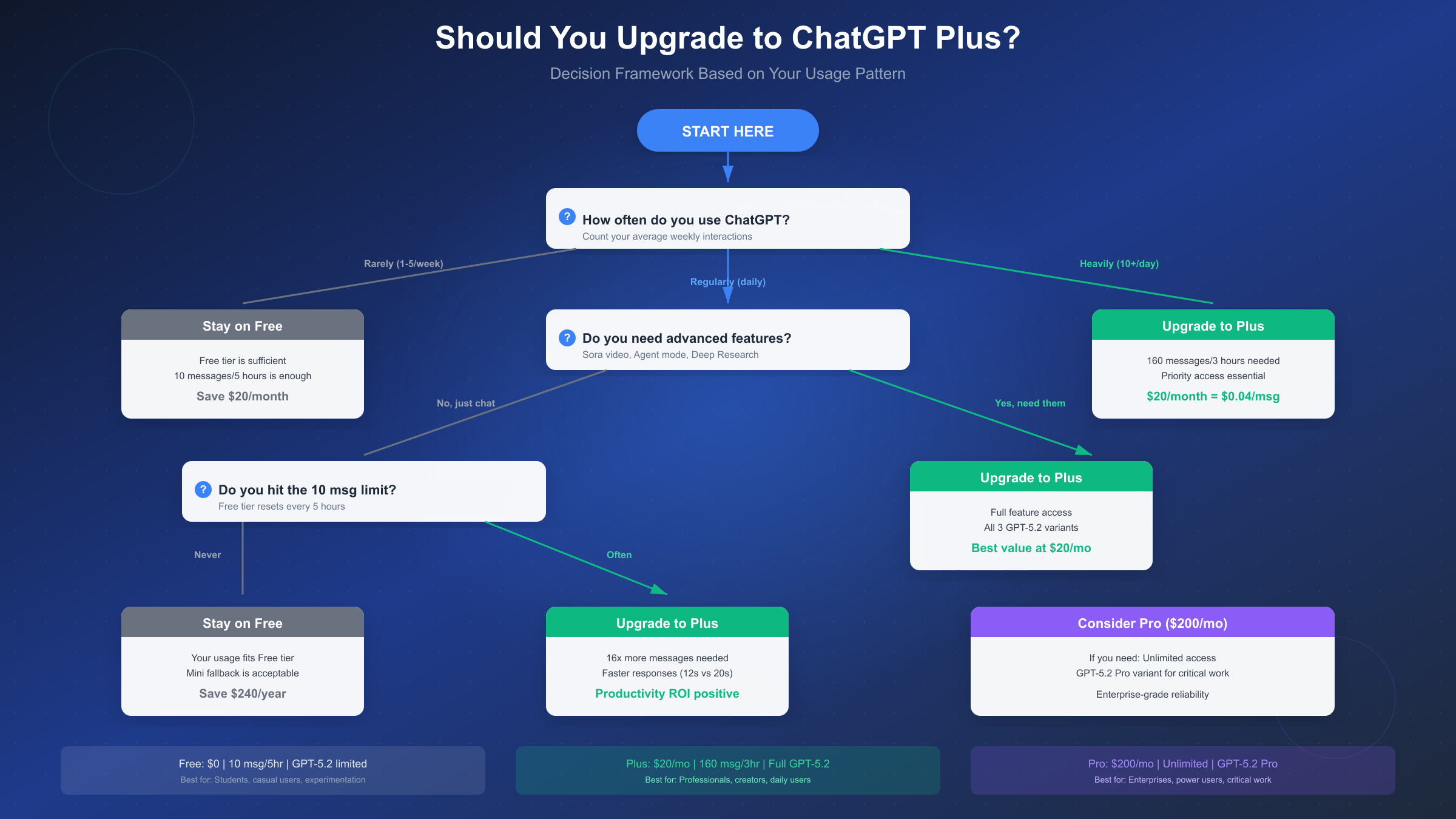
Category 1: Casual Explorers Profile: Occasional AI curiosity, 1-5 messages weekly, no professional dependency Recommendation: Stay on Free Reasoning: Free tier's 10 messages per 5 hours far exceeds your needs. The quality difference has disappeared with GPT-5.2—you're accessing the same model as Plus subscribers. Save $240 annually for use cases that don't require it.
Category 2: Students and Learners Profile: Regular homework help, research assistance, writing feedback, 10-30 messages daily Recommendation: Upgrade to Plus Reasoning: You'll consistently hit Free tier limits during study sessions, particularly before deadlines when you need AI most. The 32K context window helps with longer papers and complex problems. Student budgets make $20/month significant, but the productivity gains for academic work typically justify the cost. Consider if educational institution discounts apply.
Category 3: Content Creators Profile: Daily writing, ideation, editing, social media content, 30-50+ messages daily Recommendation: Upgrade to Plus Reasoning: Content creation workflows benefit enormously from higher quotas and faster responses. Sora video generation adds value for multimedia content. Deep Research helps with comprehensive articles. You'll likely use 80%+ of Plus's value proposition regularly.
Category 4: Developers and Engineers Profile: Code assistance, debugging, architecture discussions, 20-100+ messages daily Recommendation: Upgrade to Plus (consider API for specific use cases) Reasoning: Thinking mode's enhanced coding capabilities justify the upgrade alone. The 32K context window maintains code context across complex sessions. However, for production applications requiring programmatic access, evaluate whether direct API usage (through OpenAI or aggregators like laozhang.ai) better suits your workflow. Plus for interactive work, API for automated pipelines.
Category 5: Business Professionals Profile: Meeting prep, email drafting, analysis, presentations, 15-40 messages daily Recommendation: Upgrade to Plus Reasoning: Time is money, and Plus's faster responses plus guaranteed access during business hours directly impact productivity. Agent mode for autonomous research and Deep Research for comprehensive analysis provide significant business value. The cost represents roughly one hour of most professionals' billing rates.
Category 6: Researchers and Analysts Profile: Deep analysis, literature review, data interpretation, variable but intensive usage Recommendation: Upgrade to Plus (consider Pro for critical accuracy needs) Reasoning: Thinking mode's extended reasoning directly benefits research workflows. The 200 weekly Thinking messages accommodate intensive analysis periods. If your research requires maximum accuracy where hallucinations carry serious consequences, evaluate whether Pro's $200/month price justifies the reported 80% reduction in factual errors.
Category 7: Enterprise Teams Profile: Multiple users, compliance requirements, admin controls needed Recommendation: Evaluate ChatGPT Team ($25-30/user) or Enterprise Reasoning: Individual Plus subscriptions lack centralized billing, user management, and enterprise security features. ChatGPT Team provides workspace collaboration with slightly higher limits. Enterprise offers custom solutions for large deployments.
The key decision driver: Do you regularly hit limits that interrupt your workflow? If yes, the upgrade removes a productivity barrier. If no, Free tier's capabilities post-GPT-5.2 serve most needs adequately.
Plus-Exclusive Features Worth Knowing After GPT-5.2
Beyond quotas and speed, Plus unlocks capabilities completely unavailable on Free tier. Understanding these exclusive features helps evaluate whether they match your needs or represent unused value.
Sora Video Generation represents Plus's most differentiated feature. This text-to-video AI creates 5-second videos at up to 720p resolution from text descriptions, still images, or existing video clips. While early-stage compared to dedicated video tools, Sora enables quick video content for social media, presentations, and creative projects. Free users receive zero Sora access—this capability alone justifies Plus for users who would otherwise pay for video creation tools.
Agent Mode allows ChatGPT to browse the web and complete tasks autonomously. Rather than answering questions, Agent mode executes multi-step processes: researching topics, comparing options, finding specific information across sources. Plus users receive 25-30 Agent mode uses monthly—not unlimited, but sufficient for regular research tasks. Agent mode particularly benefits professionals who currently spend time manually gathering information from multiple sources.
Deep Research provides comprehensive analysis with cited sources on complex topics. Unlike standard responses, Deep Research takes 5-30 minutes to compile thorough reports drawing from multiple sources, properly attributed. This feature effectively replaces hours of manual research for professionals needing authoritative overviews of new topics.
Model Selection allows Plus users to manually choose between GPT-5.2 Instant and Thinking variants rather than accepting automatic routing. This control matters for optimizing quota usage—using Instant for simple queries preserves Thinking allocation for complex problems. Free users cannot make this selection; the system automatically routes queries.
Custom GPTs enable creating specialized AI assistants with specific instructions, knowledge, and personalities. Plus users can both create Custom GPTs and access the GPT Store's collection. While some creators offer Custom GPTs to Free users, creation and premium GPT access require Plus.
Advanced Voice Mode provides more natural spoken conversation with improved latency and expressiveness. The December 2025 update enhanced voice interaction quality significantly, though this feature sees limited adoption among text-focused users.
Expanded Memory and Projects give Plus users better conversation memory and organizational tools. The AI remembers more context across sessions (within privacy guidelines) and Projects help organize related conversations. These quality-of-life improvements compound over time for regular users.
For users who would utilize multiple features—Sora for content, Agent mode for research, Deep Research for analysis—Plus's $20 monthly fee represents substantial value compression. For users who would only use the quota and speed advantages, the calculation becomes more nuanced, though still often favorable.
Frequently Asked Questions
What happens exactly when I hit my message limit on Free tier?
When you exhaust your 10 GPT-5.2 messages within a 5-hour window, ChatGPT automatically downgrades your conversation to GPT-4o Mini. You'll see a notification indicating the switch. Mini maintains basic conversational ability but lacks GPT-5.2's depth, reasoning quality, and capabilities. Your GPT-5.2 allocation refreshes on a rolling basis—the oldest message "expires" first, gradually restoring your quota rather than resetting entirely at a fixed time.
Can I try Plus features before committing to a subscription?
OpenAI occasionally offers trial promotions, though availability varies. The standard approach is committing to a monthly subscription ($20), testing features, then canceling before renewal if unsatisfied. OpenAI processes cancellations immediately with access continuing until the billing period ends. Our ChatGPT free trial guide covers current trial availability and optimization strategies.
Is ChatGPT Pro worth the $200/month upgrade from Plus?
For most individual users, no. Pro's primary advantages—unlimited access and the GPT-5.2 Pro variant with 80% fewer factual errors—serve specific professional needs rather than general use. If you never hit Plus limits, Pro's unlimited quota provides no incremental value. The Pro variant benefits users in high-stakes fields (medical, legal, financial) where accuracy critically matters. For typical professional use, Plus offers the best value-to-cost ratio.
How do GPT-5.2's three variants actually differ in practice?
Instant optimizes for speed, answering within 12-15 seconds with strong general capabilities suitable for most queries. Thinking engages extended reasoning chains, taking 30-90 seconds but producing notably better results for complex coding, mathematics, multi-step analysis, and nuanced problems. Pro maximizes accuracy through additional verification steps, targeting applications where factual errors carry significant consequences. For daily use, you'll want Instant for quick queries and Thinking for complex work.
Will my Plus subscription automatically renew?
Yes, Plus subscriptions renew automatically each month at $20 unless canceled. You can cancel anytime through account settings, retaining access until the current billing period ends. OpenAI doesn't offer annual subscription discounts for ChatGPT Plus currently—the $20/month rate applies regardless of commitment length.
Does Plus help if I primarily use ChatGPT for code?
Significantly, yes. GPT-5.2 Thinking mode shows particular strength in complex coding tasks, especially front-end development and unconventional UI work. The 32K context window maintains awareness of larger codebases. Plus's higher quotas prevent interruptions during debugging sessions. For developers using ChatGPT as a coding assistant, Plus often pays for itself through reduced debugging time alone.
How do Plus limits compare to ChatGPT Team or Enterprise?
ChatGPT Team ($25-30/user/month) provides higher quotas than Plus plus workspace collaboration features and centralized billing. Enterprise offers custom limits, SSO, advanced security, and dedicated support. Individual Plus subscriptions suit independent professionals; Team/Enterprise suit organizations needing multi-user management and compliance features.
Summary and Recommendation
The ChatGPT Plus versus Free decision after GPT-5.2's December 2025 release comes down to usage patterns and feature needs rather than model quality—Free users now access the same underlying GPT-5.2 model as Plus subscribers. The differentiation has shifted entirely to quantity, speed, and exclusive capabilities.
Plus clearly wins for: Daily users, professionals, content creators, developers, researchers, and anyone who regularly hits Free tier limits or needs features like Sora, Agent mode, or Deep Research. The $20 monthly investment returns value through time savings, productivity gains, and eliminated workflow interruptions.
Free tier suffices for: Casual users, occasional explorers, and anyone who genuinely uses ChatGPT 1-5 times weekly without hitting quota limits. The quality gap has closed—staying Free doesn't mean accepting inferior outputs.
Consider Pro ($200/month) only if: You need unlimited access without quota management, require maximum accuracy for high-stakes applications, or operate in fields where the reported 80% hallucination reduction justifies the 10x price increase.
For developers needing programmatic access beyond ChatGPT's interface, remember that direct API usage often provides more control and flexibility. Services aggregating multiple AI models can simplify multi-vendor management while maintaining competitive pricing. The documentation at https://docs.laozhang.ai/ covers API integration options for those exploring beyond consumer ChatGPT.
The bottom line: if you're reading this article and actively considering the upgrade, you probably should upgrade. Users who genuinely don't need Plus rarely research the decision this thoroughly—their occasional usage fits Free tier naturally. Your interest in optimization suggests usage patterns that would benefit from Plus's expanded access.