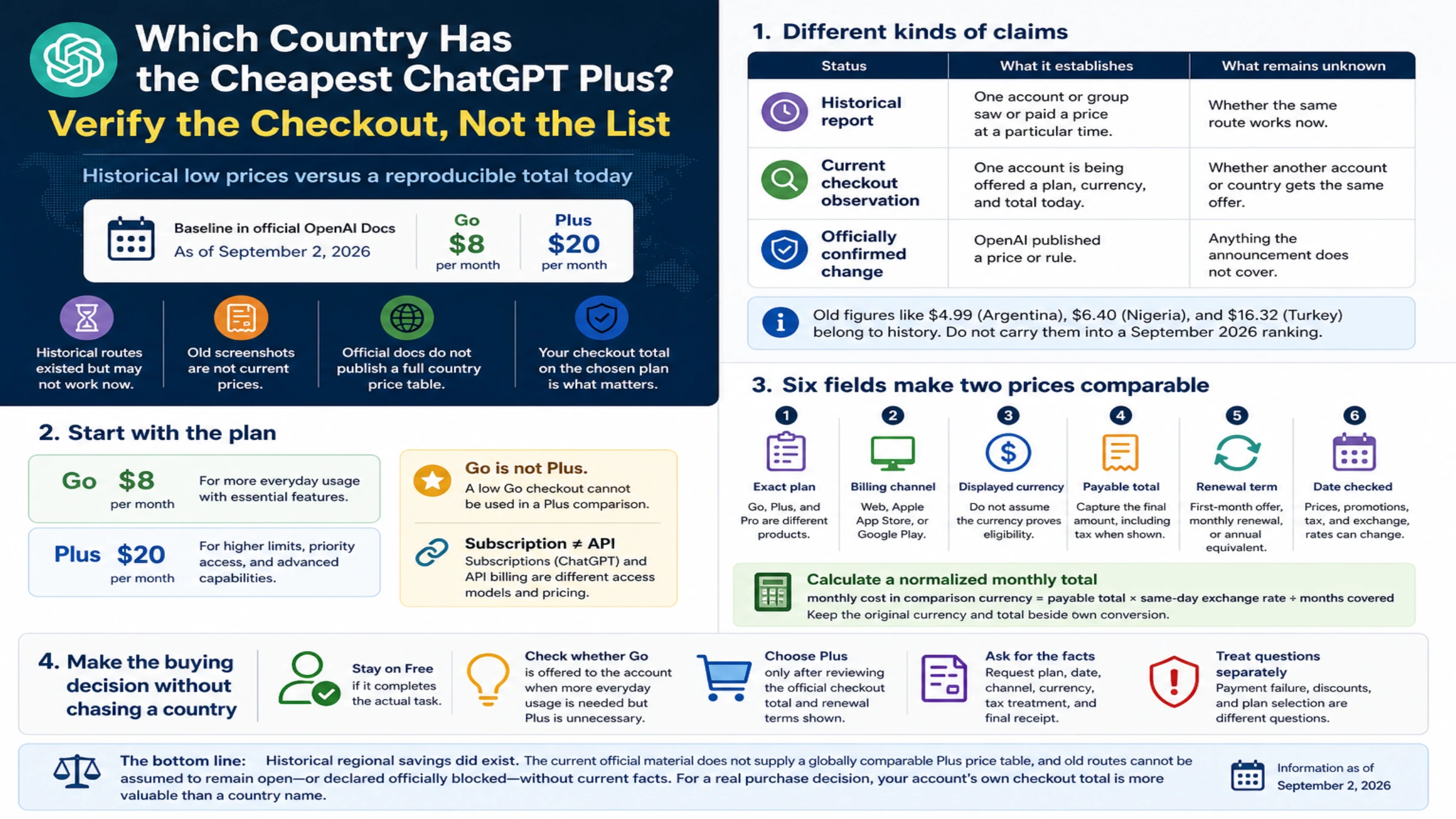
The official sources cited here do not establish which country currently has the cheapest ChatGPT Plus subscription. OpenAI offers localized pricing, but its currency list is not a table of comparable final prices. Your useful starting point is the Plus checkout available to your account, including its billing channel, taxes, and renewal terms. OpenAI’s multi-currency billing guide.
OpenAI’s Plus help page lists a $20 monthly baseline. A lower figure in a regional guide can reflect a local offer, a different plan, an app-store price, or an older purchase. Check those conditions before treating it as a price you can obtain today.
“It existed” and “it works now” are different claims
| Status | What it establishes | What remains unknown |
|---|---|---|
| Historical report | One account or group saw or paid a price at a particular time | Whether the same route works now |
| Current checkout observation | One account is being offered a plan, currency, and total today | Whether another account or country gets the same offer |
| Officially confirmed change | OpenAI published a price or rule | Anything the announcement does not cover |
A historical receipt can establish what one account paid at the time. To compare it with a current offer, you still need the exact plan, date, currency, tax treatment, billing channel, and renewal terms. Without those details, an old country-price figure is a lead to investigate, not a current Plus price.
A payment route that no longer works also needs a specific diagnosis. A failed card payment does not establish a country-wide block, and a past success does not establish current eligibility. Use the current checkout and the account’s payment notice instead of assuming either outcome.
Start with the plan, because Go is not Plus
Go and Plus are separate subscriptions. Compare the Plus offer with another Plus offer; consider Go separately if it meets your needs at a lower total cost.
A low Go checkout cannot be inserted into a Plus country ranking. Before comparing prices, decide which plan meets the task. The Go versus Plus guide covers that separate feature and usage decision.
ChatGPT subscriptions also are not interchangeable with API billing. OpenAI’s Plus documentation states that API usage is billed separately. A low per-token API estimate is not a cheaper Plus subscription; it pays for API requests rather than the Plus product.
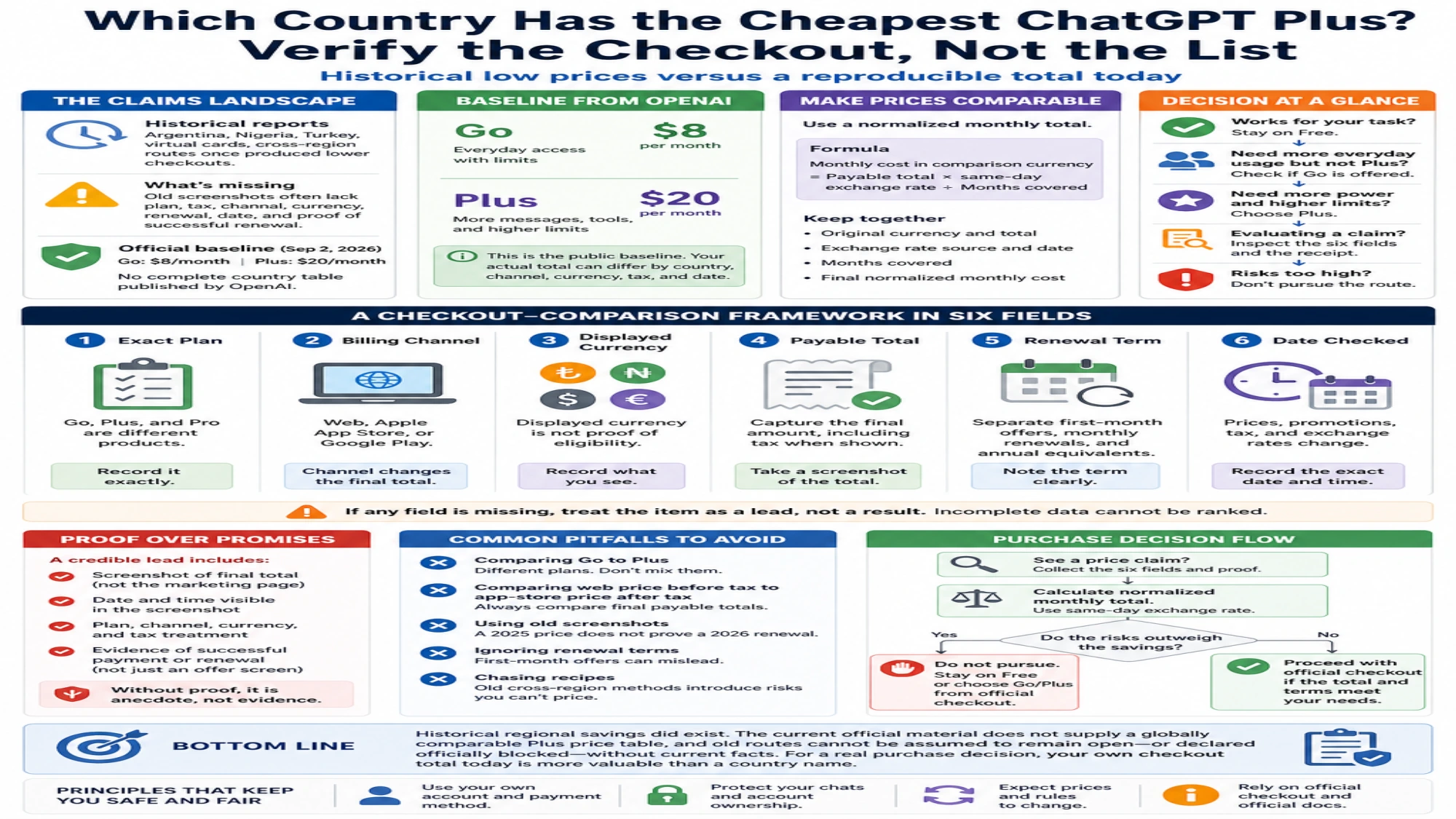
Six fields make two prices comparable
A country name and a converted dollar amount are not enough. Record:
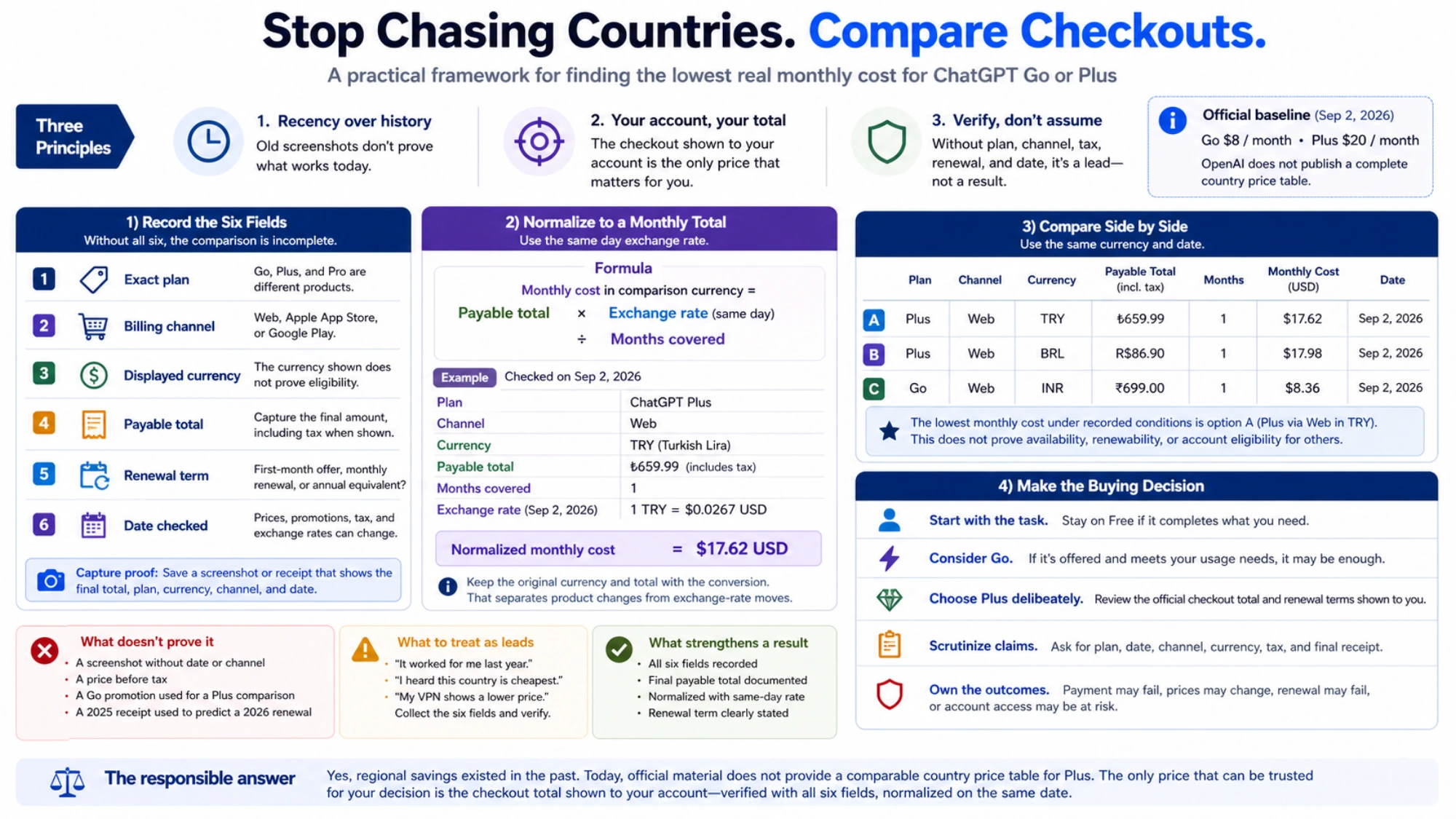
- Exact plan: Go, Plus, and Pro are different products.
- Billing channel: web, Apple App Store, or Google Play.
- Displayed currency: do not assume the currency proves account eligibility.
- Payable total: capture the final amount, including tax when checkout shows it.
- Renewal term: separate a first-month offer, monthly renewal, and annual equivalent.
- Date checked: prices, promotions, tax, and exchange rates can change.
If a comparison omits one of these, treat it as a lead rather than a result. A web price before tax cannot be ranked against an app-store debit after tax. A Go promotion cannot be called cheap Plus. A 2025 screenshot cannot establish a 2026 renewal.
Calculate a normalized monthly total
The useful number is the amount the account would actually pay, normalized on one date:
monthly cost in comparison currency = payable total × same-day exchange rate ÷ months covered
Keep the original currency and total beside the conversion. That makes it possible to distinguish a product price change from an exchange-rate movement later.
This method answers a limited but honest question: “Which of these documented checkouts costs less under the recorded conditions?” It does not prove that the winner is available to everyone or will renew at the same price.
Why old cross-region recipes should stay historical
Past recipes often combined a VPN, a regional account, a local payment instrument, a virtual card, or a shared login. Even if one route once completed checkout, it introduced facts that a price table cannot capture: whether the account details matched the user, whether recurring payments continued, who controlled the payment instrument, who could access conversation history, and who could recover the account.
A claim about account-ban probability is not useful without a sample size, observation period, and clear definition of the outcome. A precise-looking percentage cannot substitute for those details.
Concrete outcomes are more useful: a card can be declined, the offered price can change, renewal can fail, a third party can retain account access, or a shared user can read private chats. These are conditions to inspect, not proof that every old route has been globally blocked.
One failed attempt does not establish a platform-wide block either. It may involve a different plan, channel, account, payment method, tax treatment, or date. Without matched observations or an official statement, treat the route as unconfirmed rather than inventing a cause.
Make the buying decision without chasing a country
- Stay on Free if it completes the actual task.
- Check whether Go is offered to the account when more everyday usage is needed but Plus is unnecessary.
- Choose Plus only after reviewing the official checkout total and renewal terms shown to the account.
- Ask a country-price claim for its plan, date, channel, currency, tax treatment, and final receipt before relying on it.
- Treat payment failure, discounts, and plan selection as separate questions rather than forcing them into a cheapest-country table.
For a purchase decision, compare the account’s final checkout and renewal terms with another documented offer on the same basis. That can identify the cheaper option available to you without claiming a permanent worldwide winner.