Seedance 2.5 is ByteDance's newest video-creation model as of August 26, 2026. It doubles the single-pass duration of 2.0 to 30 seconds, accepts a much larger reference set, and adds more targeted editing. That makes it the logical first test for longer stories and complicated, reference-led production.
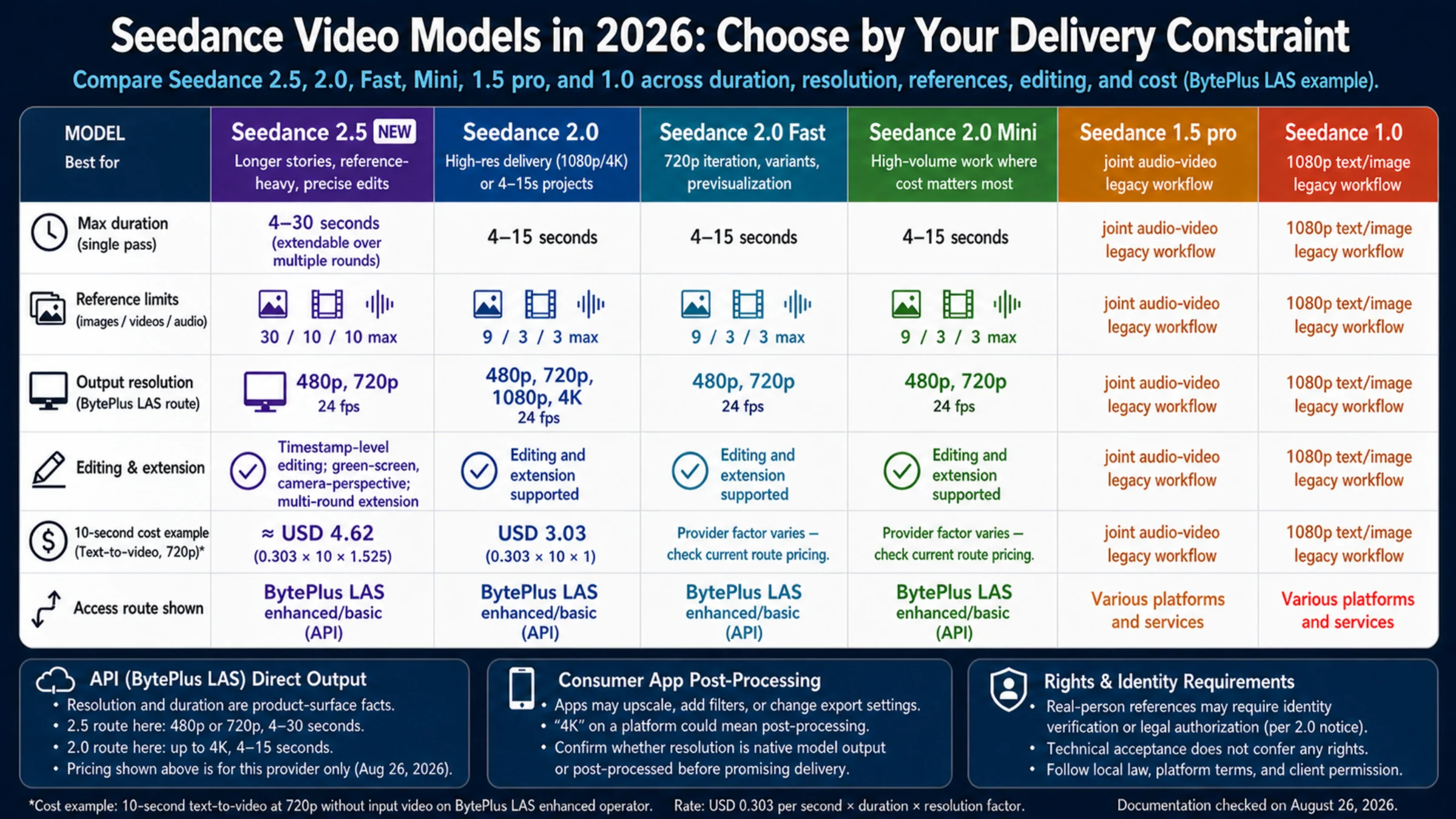
It is not an automatic replacement for every Seedance route. In the currently documented BytePlus LAS operator, 2.5 outputs 480p or 720p, while 2.0 can output 1080p and 4K. The same documentation also makes a 720p 2.5 generation more expensive than a comparable 2.0 generation. The useful decision begins with the delivery constraint, not the version number.
The two-minute choice
Start with Seedance 2.5 when at least one of these conditions is hard to negotiate:
- one pass needs to run longer than 15 seconds;
- the scene depends on many image, video, or audio references;
- a local change should be addressed by timestamp instead of regenerating the whole clip;
- multi-round extensions need to preserve one audiovisual language.
Start with Seedance 2.0 when the current BytePlus LAS route must deliver 1080p or 4K, or when a 4–15 second clip already fits the brief. Test 2.0 Fast or 2.0 Mini for 720p iteration, variants, previsualization, and volume work where cost matters more than access to the enhanced tier.
Keep 1.5 pro or 1.0 in a legacy workflow only when migration has a measurable cost. They remain relevant model names on some services, but their role is historical compatibility rather than a six-way contest with 2.5.
What changed across the Seedance generations
ByteDance's current model directory lists Seedance 2.5, 2.0, 1.5 pro, and 1.0 as distinct releases. The progression is easier to understand as a change in the creative contract:
| Release | What it changed | Practical implication |
|---|---|---|
| Seedance 1.0 | Text/image-to-video, 1080p, native multi-shot storytelling | Established the visual, motion, and shot-continuity foundation |
| Seedance 1.5 pro | Joint audio-video generation, multilingual speech, stronger audiovisual narrative | Made dialogue, effects, music, and motion part of one generation |
| Seedance 2.0 | Mixed text/image/video/audio references, editing and extension, 15-second output | Turned reference-led direction into the core workflow |
| Seedance 2.5 | 30-second generation, far more references, timestamp-level editing | Moves from making a clip toward completing a longer creative unit |
Seedance 1.0's technical announcement described 1080p text- and image-driven generation and native multi-shot sequences. Seedance 1.5 pro added jointly generated sound and picture, including multilingual speech and synchronized ambience. Its own release notes also acknowledge remaining weaknesses in complex-motion stability, multi-character dialogue, and singing; “newer than 1.0” was never the same as “finished for every performance.”
Seedance 2.0 supports text, image, video, and audio inputs together. ByteDance lists up to nine images, three video clips, and three audio clips, plus a maximum 15-second multi-shot audiovisual output. Editing and extension already exist here. The 2.5 leap is capacity, duration, and precision—not the invention of editing from scratch.
Seedance 2.5 is built around a larger unit of work
ByteDance launched Seedance 2.5 on July 31, 2026. A single pass can generate up to 30 seconds of audio and video, and the result can be extended over multiple rounds. The reference ceiling grows to 30 images, 10 video clips, and 10 audio clips.
Those numbers matter when the brief has dependencies. A product campaign may need a locked pack shot, a performer, a location, a camera-motion reference, a music cue, and an existing edit rhythm. Supplying more of that context in one request can reduce the manual handoff between separately generated shots. It does not guarantee consistency; it gives the model a wider controlled input envelope.
Timestamp-level editing is the other consequential change. A request can target a specific moment in the audio or video rather than treating the whole 30-second clip as disposable. The launch material also names green-screen, camera-perspective, and reference-based editing. For an editor, the test is therefore not just “which raw clip looks nicer?” It is “which model gets to an approved revision with fewer full regenerations?”
The API surface changes the answer
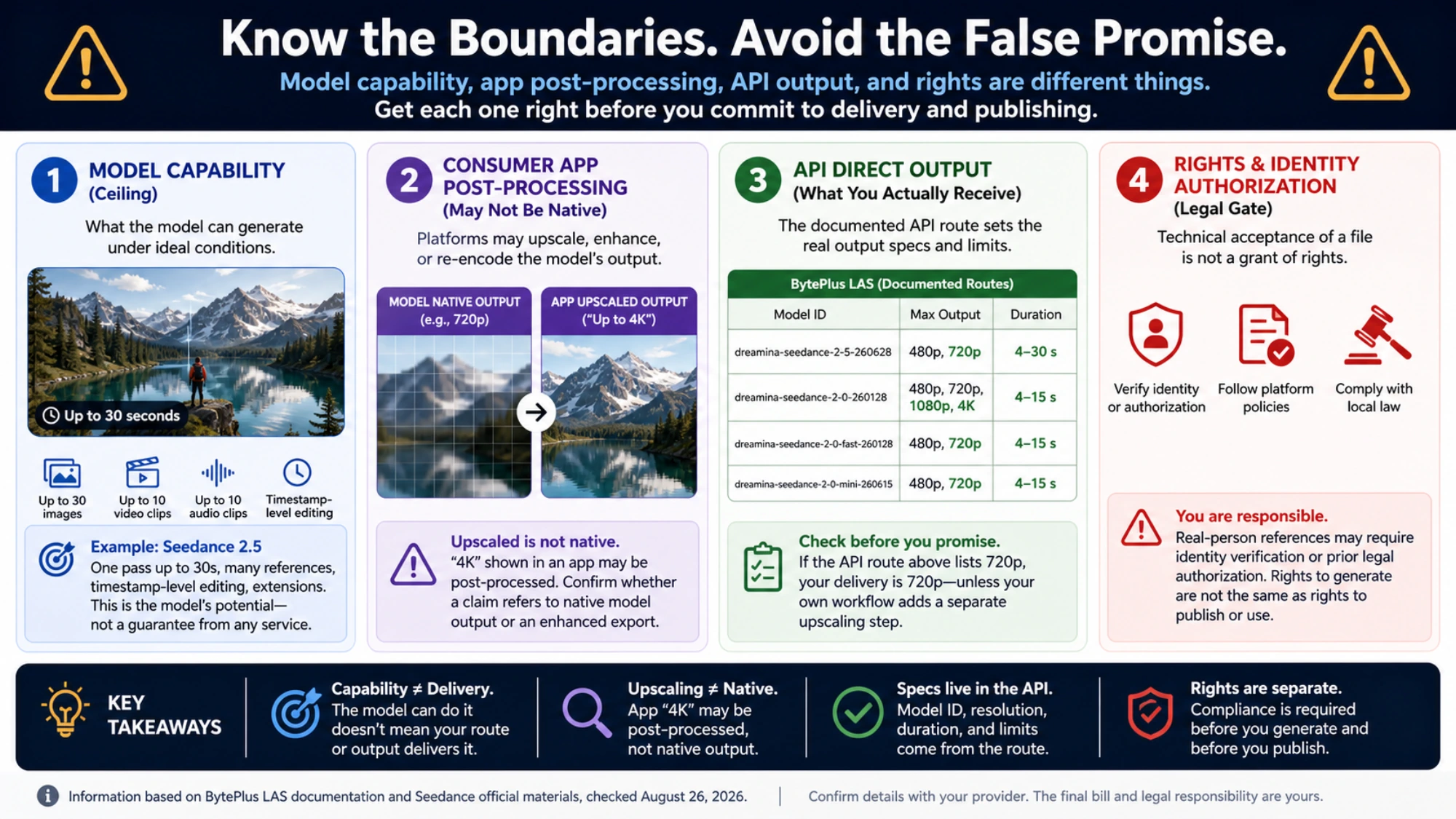
The phrase “Seedance 2.5 supports 30 seconds” is a model-level fact. Resolution, model ID, region, billing, and request parameters belong to a product surface.
The current BytePlus LAS enhanced/basic video-generation documentation lists these routes:
| BytePlus LAS model ID | Output in this surface | Duration |
|---|---|---|
dreamina-seedance-2-5-260628 | 480p, 720p; 24 fps | 4–30 seconds |
dreamina-seedance-2-0-260128 | 480p, 720p, 1080p, 4K; 24 fps | 4–15 seconds |
dreamina-seedance-2-0-fast-260128 | 480p, 720p; 24 fps | 4–15 seconds |
dreamina-seedance-2-0-mini-260615 | 480p, 720p; 24 fps | 4–15 seconds |
All four routes in that document support text-to-video, first-frame and first/last-frame image-to-video, combined references, and video editing. The 2.5 route allows up to 30 reference images; the 2.0 family allows up to nine.
This resolves an apparent contradiction. A platform may advertise a 4K Seedance 2.5 result while the direct API route above lists 720p. The platform could be applying super-resolution or a separate export step. Confirm whether “4K” names native model output, post-processing, or simply the final container before committing a delivery promise.
A cost example that belongs to one provider
BytePlus LAS bills its enhanced operator at USD 0.303 per second, multiplied by billable duration and a resolution factor. For a 720p generation without an input video, the current factor is 1 for 2.0 and 1.525 for 2.5.
For one 10-second text-to-video task:
- Seedance 2.0:
0.303 × 10 × 1 = USD 3.03 - Seedance 2.5:
0.303 × 10 × 1.525 = USD 4.62075, approximately USD 4.62
This is a documentation-based estimate for the BytePlus LAS operator checked on August 26, 2026—not a universal Seedance price. A request with input video bills input plus output duration and uses another factor. Standard ModelArk inference, consumer subscriptions, and third-party gateways have different rate cards. The provider's final bill controls.
Run one migration test that can fail honestly
Choose a brief that represents the most expensive failure in your real workflow. Fix the same performer or product references, a spoken line, two camera changes, one required action, and one delivery resolution. Ask for a 10-second version on every candidate. Add a 25-second version for 2.5.
Record four outcomes: compliance with the hard output spec, first-pass usability, reason for every regeneration, and total cost including retries. A cheaper request that needs three extra generations is not the cheaper delivery. A 2.5 clip that avoids manual stitching may justify its premium even if the per-call estimate is higher.
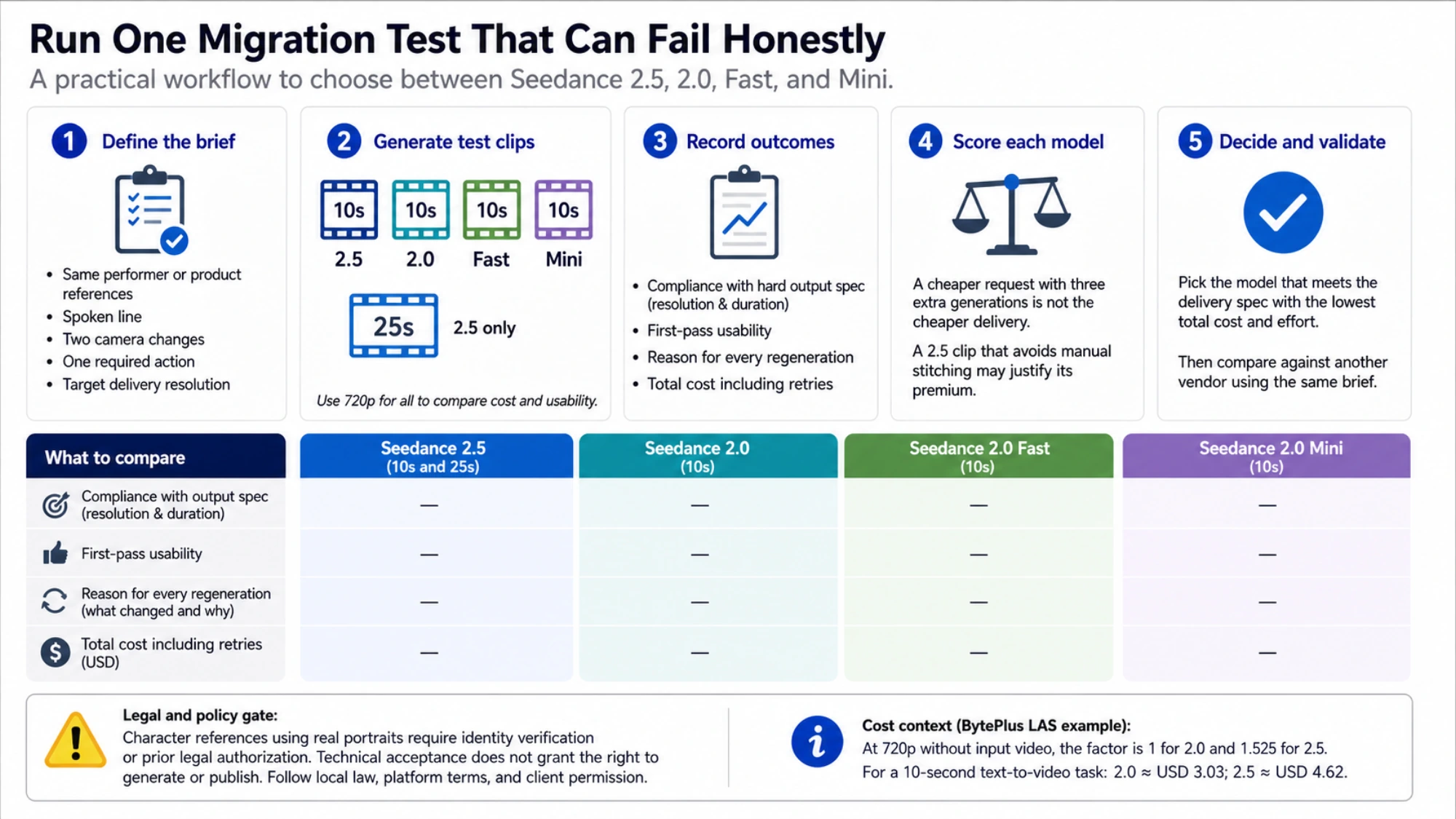
Treat real-person material as a separate gate. The 2.0 launch page says character references using real portraits require identity verification or prior legal authorization. Technical acceptance of a file does not grant the right to generate or publish it; local law, platform terms, and client permission still apply.
Once the internal Seedance choice is clear, compare it with another vendor using the same brief. For a focused adjacent test, see Veo 3.1 versus Seedance 2.0. Keeping the brief fixed makes the result more useful than importing someone else's overall ranking.