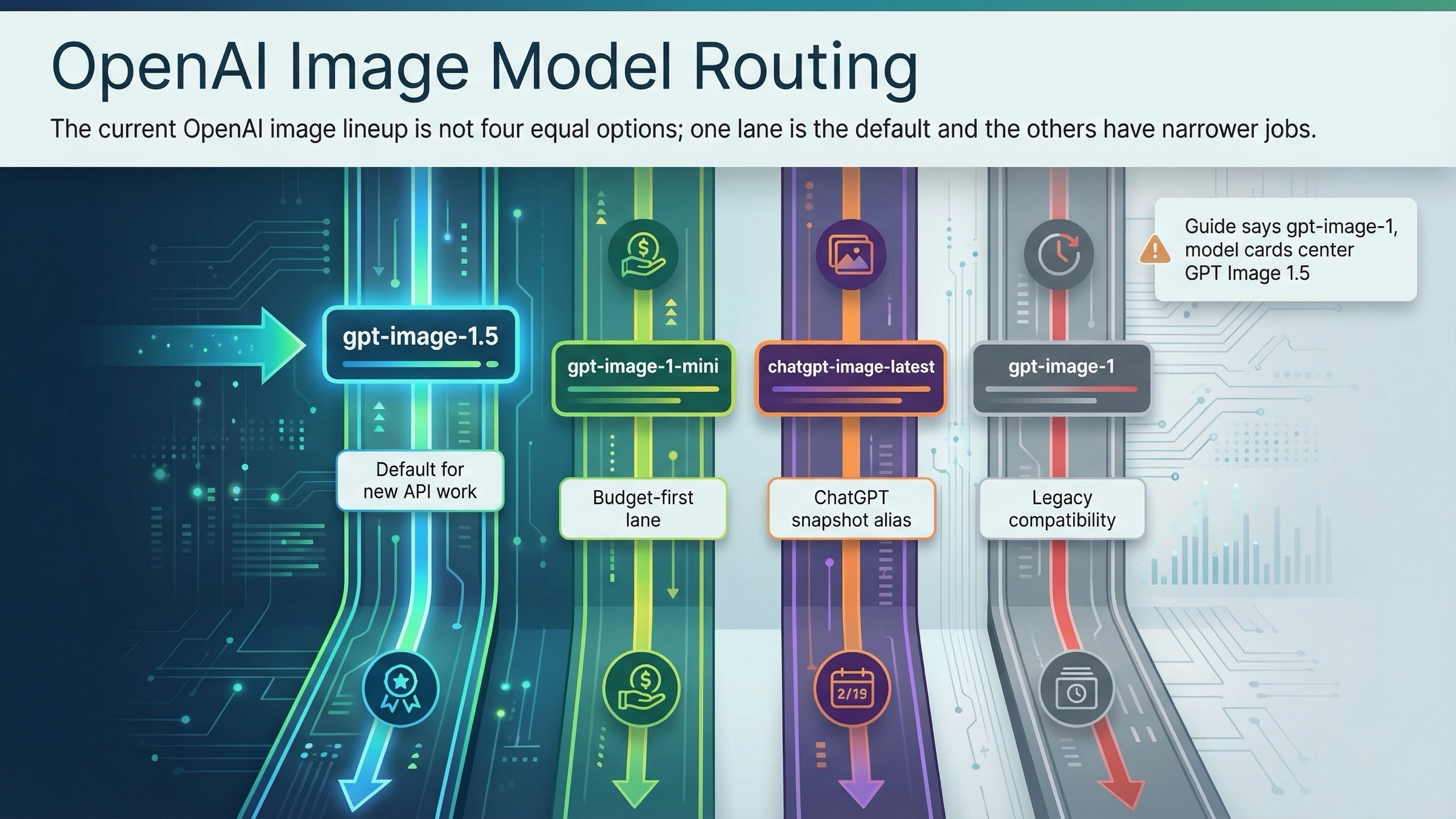
If you are choosing among OpenAI image generation API models right now, the clean default is simple: use gpt-image-1.5 for most new production work, use gpt-image-1-mini when cost is the first constraint, keep gpt-image-1 only for legacy compatibility, and use chatgpt-image-latest only when you intentionally want the moving image snapshot currently used in ChatGPT.
That answer matters because OpenAI's current docs still make this keyword feel more confusing than it should. On March 23, 2026, the current all-model catalog lists GPT Image 1.5 as the state-of-the-art image generation model and shows the full family beside chatgpt-image-latest, GPT Image 1, and gpt-image-1-mini. But the current Images and vision guide still says the latest image generation model is gpt-image-1. If you only skim one page, you can leave with the wrong default.
The safest way to route this query is to treat the current model cards and model catalog as the source of truth for the lineup, then use the guide pages to resolve workflow details. That gives you one practical rule instead of four tabs worth of partial answers.
If your next question is "show me working code," the better follow-up is our OpenAI image generation API example or the broader OpenAI image API tutorial. This page is narrower on purpose. It is here to help you choose the right model before you wire up the wrong one.
TL;DR
- Use
gpt-image-1.5for most new OpenAI image API work. - Use
gpt-image-1-miniwhen budget matters more than the flagship lane. - Use
chatgpt-image-latestonly when you intentionally want the image snapshot used in ChatGPT. - Keep
gpt-image-1for migration, not as a fresh default.
The current OpenAI image-model lineup in one table
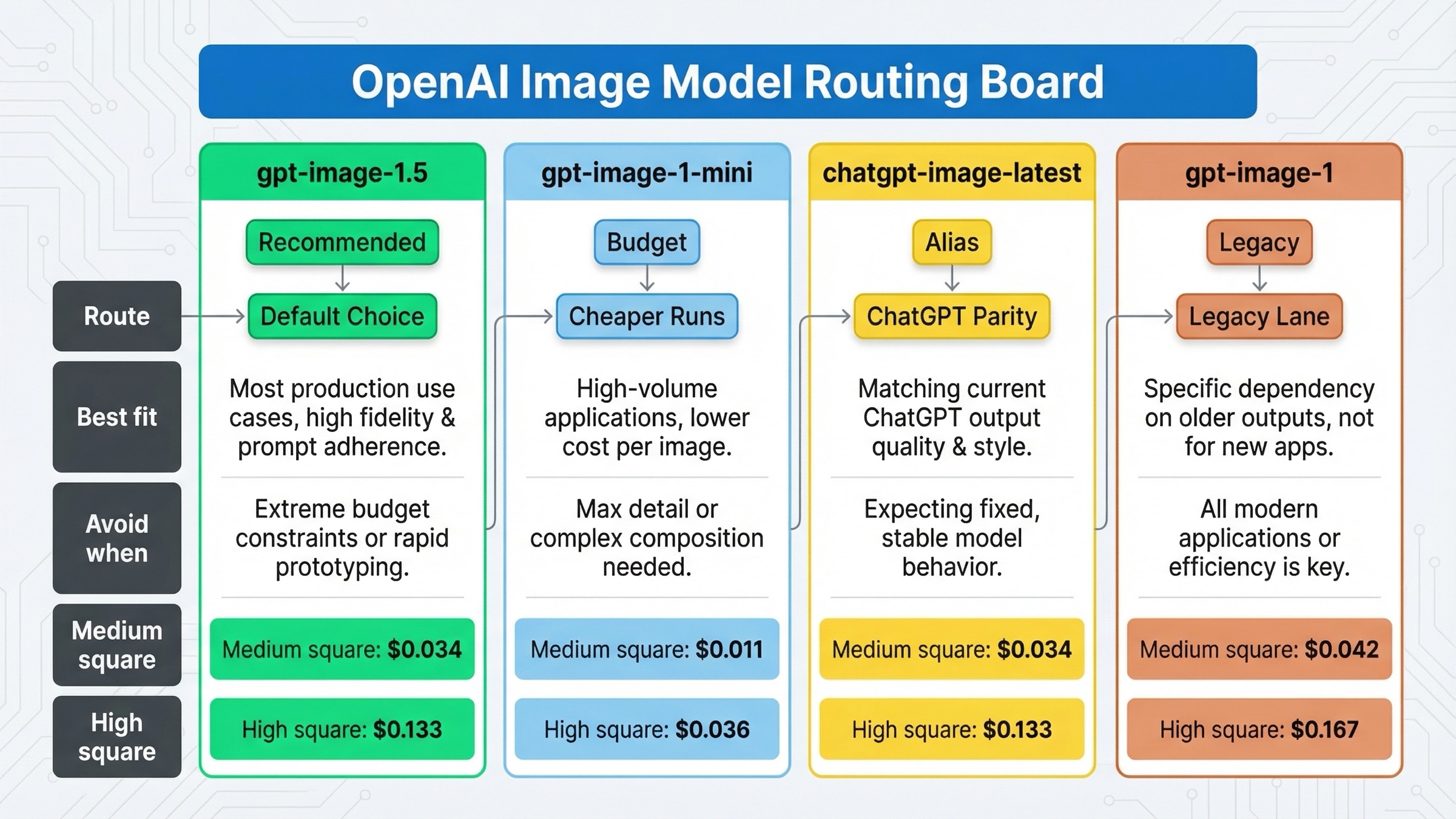
The table below is the shortest honest routing answer based on the official model pages rechecked on March 23, 2026.
| Model | Current role | 1024x1024 medium | 1024x1024 high | Best fit | Why not the default in every case |
|---|---|---|---|---|---|
gpt-image-1.5 | Current flagship | $0.034 | $0.133 | Most new production image generation and editing work | Costs more than mini, so it is not always the cheapest lane |
gpt-image-1-mini | Current budget lane | $0.011 | $0.036 | Budget-first generation, prototyping, and high-volume workloads | The docs position it as the cost-efficient version of GPT Image 1, not the flagship lane |
chatgpt-image-latest | ChatGPT alias | $0.034 | $0.133 | Cases where you specifically want the image snapshot used in ChatGPT | It is a moving alias, so it is less clean than a stable explicit model ID for many teams |
gpt-image-1 | Previous model | $0.042 | $0.167 | Legacy compatibility and older integrations | It is now the previous image generation model, not the best new default |
Three decisions fall out of that table.
First, gpt-image-1.5 is the safest current starting point for most builders. It is the current flagship, the current docs center it as the latest image model, and it is cheaper than GPT Image 1 on the current official price cards.
Second, gpt-image-1-mini is the real low-cost option, not a footnote. If your workload is prototype-heavy, bulk-oriented, or simply constrained by budget, mini deserves a real benchmark before you assume you need the flagship.
Third, chatgpt-image-latest is not just another spelling of gpt-image-1.5. Right now the visible pricing matches, but the model page says it points to the image snapshot currently used in ChatGPT. That means it is useful for ChatGPT parity, not automatically the cleanest stable API default.
Why gpt-image-1.5 is the safest default right now
The reason to default to gpt-image-1.5 is not only that OpenAI labels it as the latest image generation model. The stronger reason is that it is the easiest current model to defend in production decisions.
The current GPT Image 1.5 model page does three useful things at once. It identifies the model as the current flagship, it exposes the current per-image price ladder, and it shows the supported image endpoints directly on the model card. That gives you one stable object to document in code, team notes, and future change reviews.
That matters because the market around this keyword is still split between three different questions:
- which model is current
- which model is cheapest
- which API surface should I use
When those questions are mixed together, people often pick a model name too early from whichever page they landed on first. gpt-image-1.5 is the safest correction because it is the current flagship without the moving-alias ambiguity of chatgpt-image-latest.
It is also the best default if you care about editing and higher-value image workflows rather than only raw generation. The current guide pages and model cards keep centering the flagship lane for the strongest image-generation experience, and the price delta versus GPT Image 1 now favors the newer model instead of the older one. That means there is much less reason to keep anchoring new work on GPT Image 1 just because it was the old familiar name.
If you need the full code path after choosing the flagship, go straight to the OpenAI image generation API example. The route should be: choose gpt-image-1.5 first, prove one direct request works, then decide whether you actually need a cheaper lane or a different API surface.
When gpt-image-1-mini is actually the better pick
A lot of pages mention gpt-image-1-mini as if it were just a cheaper afterthought. That is too weak. Mini is the right answer whenever cost is the first business question and the flagship quality premium is not yet justified.
The official gpt-image-1-mini model page calls it a cost-efficient version of GPT Image 1, and the current price gap is real enough to change architecture decisions. On March 23, 2026, the medium 1024x1024 price card is $0.011 for mini versus $0.034 for GPT Image 1.5. At high quality, it is $0.036 for mini versus $0.133 for GPT Image 1.5.
That difference matters if you are:
- running internal prototypes
- generating large batches of images where perfect output is not the first concern
- validating whether an image feature deserves more spend
- shipping high-volume internal tools rather than premium customer-facing creative work
The right way to think about mini is not "the small version of the flagship." The docs do not position it that way. The right way to think about it is "the budget lane OpenAI currently exposes for image generation." That makes mini a pricing decision first and a quality question second.
The mistake to avoid is defaulting to mini only because the name sounds cheaper, without asking whether the downstream cost of retries, cleaner output, or better edit behavior would erase the savings. Mini is strongest when your workflow can absorb more variation in exchange for a lower bill. It is weaker when image quality mistakes are expensive.
If your main question after model routing is the exact monthly cost curve, the more detailed answer lives in our OpenAI image generation API pricing guide. This page only needs to make the routing point: mini is a first-class budget lane, not a throwaway option.
What chatgpt-image-latest is really for
chatgpt-image-latest keeps tripping people up because it can look both more current and less specific than gpt-image-1.5 at the same time.
The current chatgpt-image-latest model page gives the key sentence: it points to the image snapshot currently used in ChatGPT. That is the core meaning of the alias. It exists to expose the ChatGPT image lane through the API.
That makes it useful in a few real cases:
- you want to mirror the image behavior users currently see in ChatGPT
- your benchmark is ChatGPT parity rather than a frozen explicit model ID
- you intentionally want the moving ChatGPT snapshot, not a stable named family
What it does not automatically mean is "this is the safest production default because it sounds newest." That is the wrong inference.
Right now the visible price cards for chatgpt-image-latest and gpt-image-1.5 match. The current per-image ladder is the same, and the current rate-limit table is also the same on the public model pages. But parity in the current price card is not the same thing as parity in routing semantics. A moving alias is still a moving alias.
That is why the cleaner operator rule is this:
- choose
gpt-image-1.5when you want a stable explicit image model decision - choose
chatgpt-image-latestonly when the fact that it tracks ChatGPT is itself the reason you want it
If you want the deeper alias-versus-explicit comparison, we already have a dedicated page on chatgpt-image-latest vs gpt-image-1.5. This page keeps the shorter rule: do not choose the alias by accident.
Keep gpt-image-1 for migration, not for a fresh default
The current GPT Image 1 model page labels it as the previous image generation model. That one word, previous, should control how you use it.
GPT Image 1 still matters in two cases.
The first is migration. If you have older prompts, older tests, or older image workflows pinned to GPT Image 1, you need a clean reference point before you move them. In that case, keeping GPT Image 1 in the conversation is useful because you are making a compatibility decision, not a fresh default decision.
The second is SERP cleanup. A lot of stale pages and old tutorials still center GPT Image 1. If you are reading across page one, you need to know that GPT Image 1 has not disappeared. It has simply been demoted from the default recommendation.
What you should not do is treat GPT Image 1 as the safest place to start a new integration just because more older content mentions it. The current official price cards no longer support that habit. On March 23, 2026, GPT Image 1 medium 1024x1024 is $0.042, which is higher than GPT Image 1.5 at $0.034. At high quality, GPT Image 1 is $0.167, again above GPT Image 1.5 at $0.133.
So the right migration rule is:
- keep GPT Image 1 when you need legacy comparison or compatibility
- move new decisions to GPT Image 1.5 or mini depending on whether quality or budget comes first
That is a much cleaner rule than pretending GPT Image 1 is still the center of the lineup.
Model choice is not the same as API-surface choice
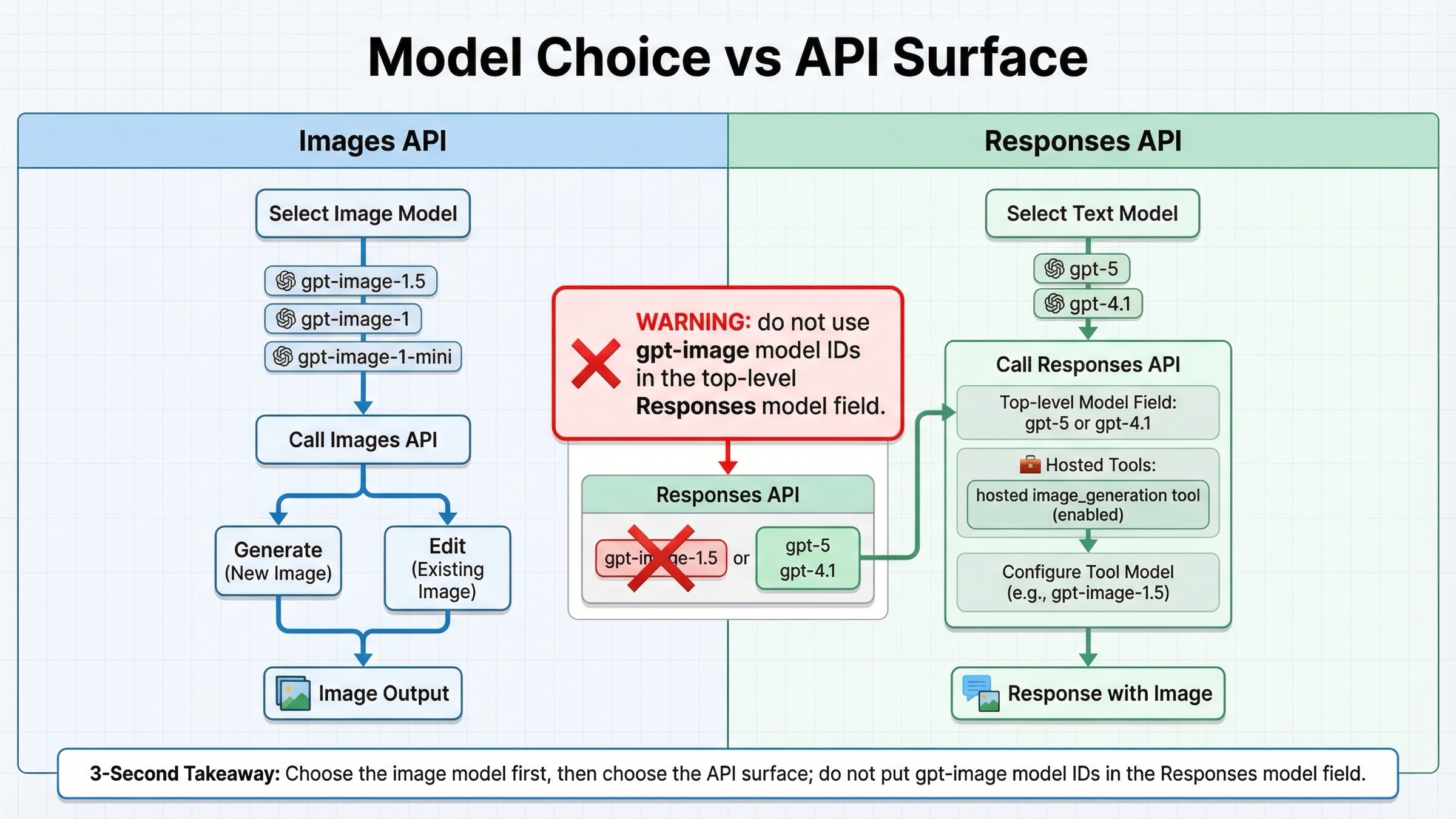
This is the second reason the keyword stays messy. Even after you choose the right model family, you can still put it in the wrong API surface.
OpenAI's current Images and vision guide says you can generate or edit images using the Image API or the Responses API. That is true. But it does not mean the same model names belong in the same fields everywhere.
The current Responses image-generation guide makes the important distinction explicit: the hosted image_generation tool runs with GPT Image models behind the scenes, but gpt-image-1.5, gpt-image-1, and gpt-image-1-mini are not valid values for the top-level model field in the Responses API. For that field, OpenAI says to use a text-capable mainline model such as gpt-4.1 or gpt-5.
That means there are really two separate routing questions:
- Which image model family should shape my image-generation decision?
- Am I using the direct Images API, or am I using the Responses API with the hosted image-generation tool?
If you only need direct image generation or editing, the shortest path is still the direct Images API. If you need image generation inside a bigger multimodal or agentic flow, then the Responses tool path makes more sense. But that is an API-surface decision, not a reason to pick the wrong image model name.
This is also why this article stays separate from the full tutorial pages. The model-selection answer should come first. The code path can come second.
Access and rollout checks before you blame the model name
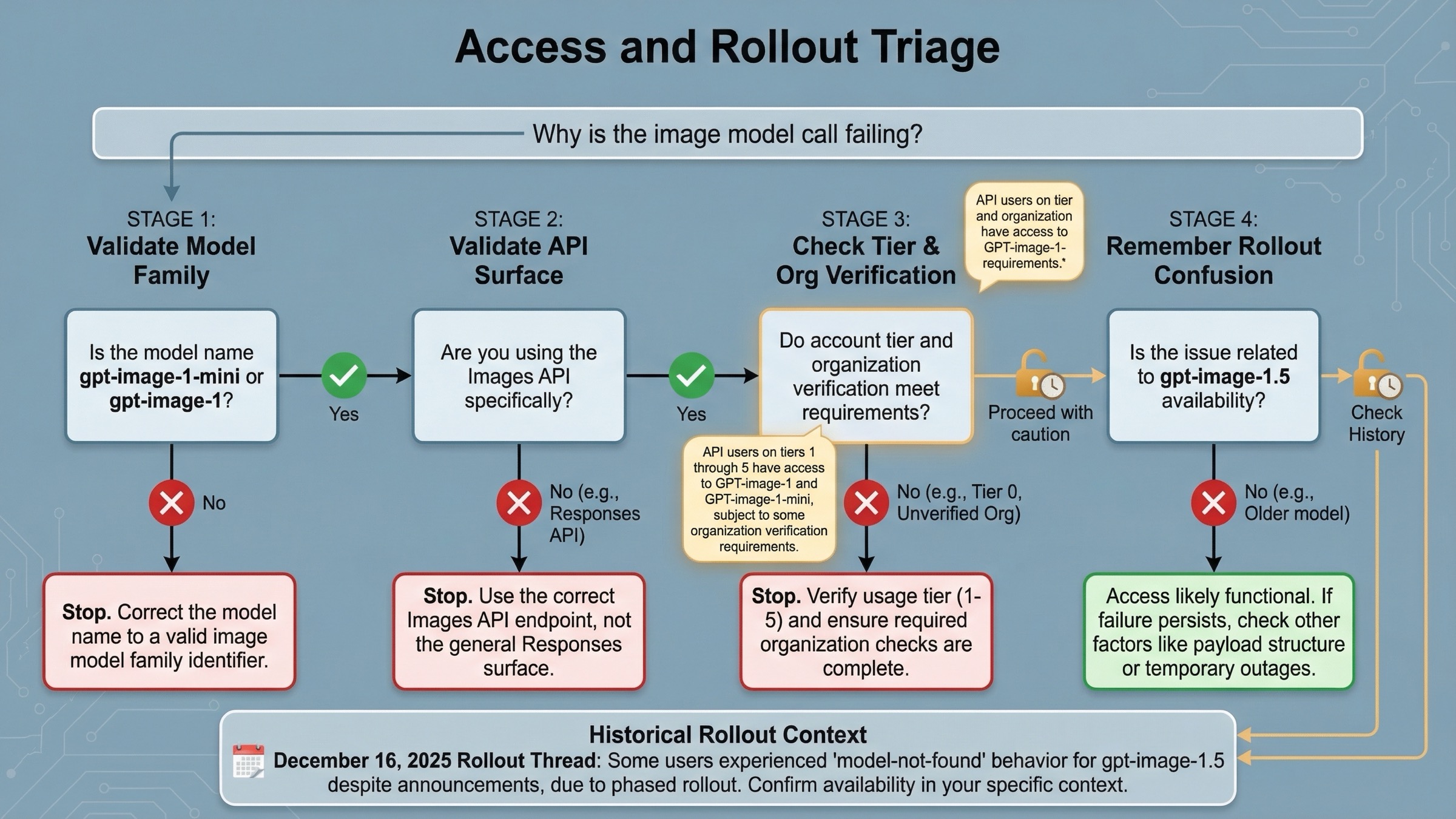
Sometimes the model choice is correct and the request still fails. In this keyword cluster, that usually means the problem is access, rollout history, or org state rather than the routing logic itself.
The current API Model Availability by Usage Tier and Verification Status page says GPT-image-1 and GPT-image-1-mini are available to API users on tiers 1 through 5, with some access subject to organization verification. The current API Organization Verification article also says verified organizations can unlock image generation capabilities in the API.
That matters because "the model does not work" and "the account is not ready to use it" are different problems.
There is also a rollout-history reason this keyword keeps surfacing. In OpenAI's own December 16, 2025 developer-community announcement thread, some users could still see only gpt-image-1 in the models endpoint and were getting "The model gpt-image-1.5 does not exist" while the rollout was still in progress. That does not describe today's steady-state lineup, but it explains why older forum answers and cached snippets can keep pushing the wrong expectation.
The clean troubleshooting order is:
- confirm you picked the right current model family
- confirm you are using the right API surface
- confirm the org, project, and usage tier can actually access the image model
- only then start rewriting prompts or SDK code
If your actual failure mode is a verification or 403 problem, use the dedicated OpenAI image generation API verification guide instead of continuing to swap model names blindly.
Final recommendation
If you want the shortest reliable decision rule for March 23, 2026, use this one:
- pick
gpt-image-1.5for most new OpenAI image generation API work - pick
gpt-image-1-miniwhen cost is the main reason you are evaluating models - keep
gpt-image-1only for older integrations, migration work, or legacy comparisons - pick
chatgpt-image-latestonly when you intentionally want the moving ChatGPT image snapshot
That rule beats the current page one because it does what most ranking pages still do not do: it turns the lineup into a real decision instead of a pile of model cards.
If you are still early and want the shortest possible path, choose gpt-image-1.5, run one direct Images API request, and only move off that default if your budget or your ChatGPT-alignment requirement gives you a concrete reason to. That is a much safer sequence than trying to solve model choice, Responses routing, pricing, and verification in the same first step.
FAQ
Is GPT Image 1.5 really the latest if one OpenAI guide still says gpt-image-1?
Yes. As checked on March 23, 2026, the current model catalog and the GPT Image 1.5 model page position GPT Image 1.5 as the current flagship image lane. The confusion comes from the current Images and vision guide still using older wording in one section.
When should I use chatgpt-image-latest instead of gpt-image-1.5?
Use chatgpt-image-latest only when you intentionally want the image snapshot currently used in ChatGPT. If you want the cleaner stable default for general API work, use gpt-image-1.5.
Can I put gpt-image-1.5 in the Responses model field?
No. OpenAI's current Responses image-generation guide says GPT Image model IDs are not valid values for the top-level Responses model field. Use a text-capable mainline model such as gpt-5 or gpt-4.1 with the hosted image_generation tool.
Is there a free tier for the current OpenAI image API models?
The current public model pages for GPT Image 1.5, gpt-image-1-mini, and chatgpt-image-latest all show Free not supported. Treat paid Tier 1 access as the practical starting point for current OpenAI image generation API use.