Short answer as checked on March 23, 2026: use gpt-image-1.5 for most real API work. Use chatgpt-image-latest only when you specifically want the image snapshot currently used in ChatGPT. That is the cleanest way to read OpenAI's current model naming, pricing, and snapshot behavior without overcomplicating the decision.
This matters because the two names can look more different than they are in day-to-day pricing, yet more similar than they are in long-term routing risk. On the current official model pages, both names show the same visible price card and the same current rate-limit table. If you stop there, it is easy to conclude that choosing one or the other is mostly stylistic.
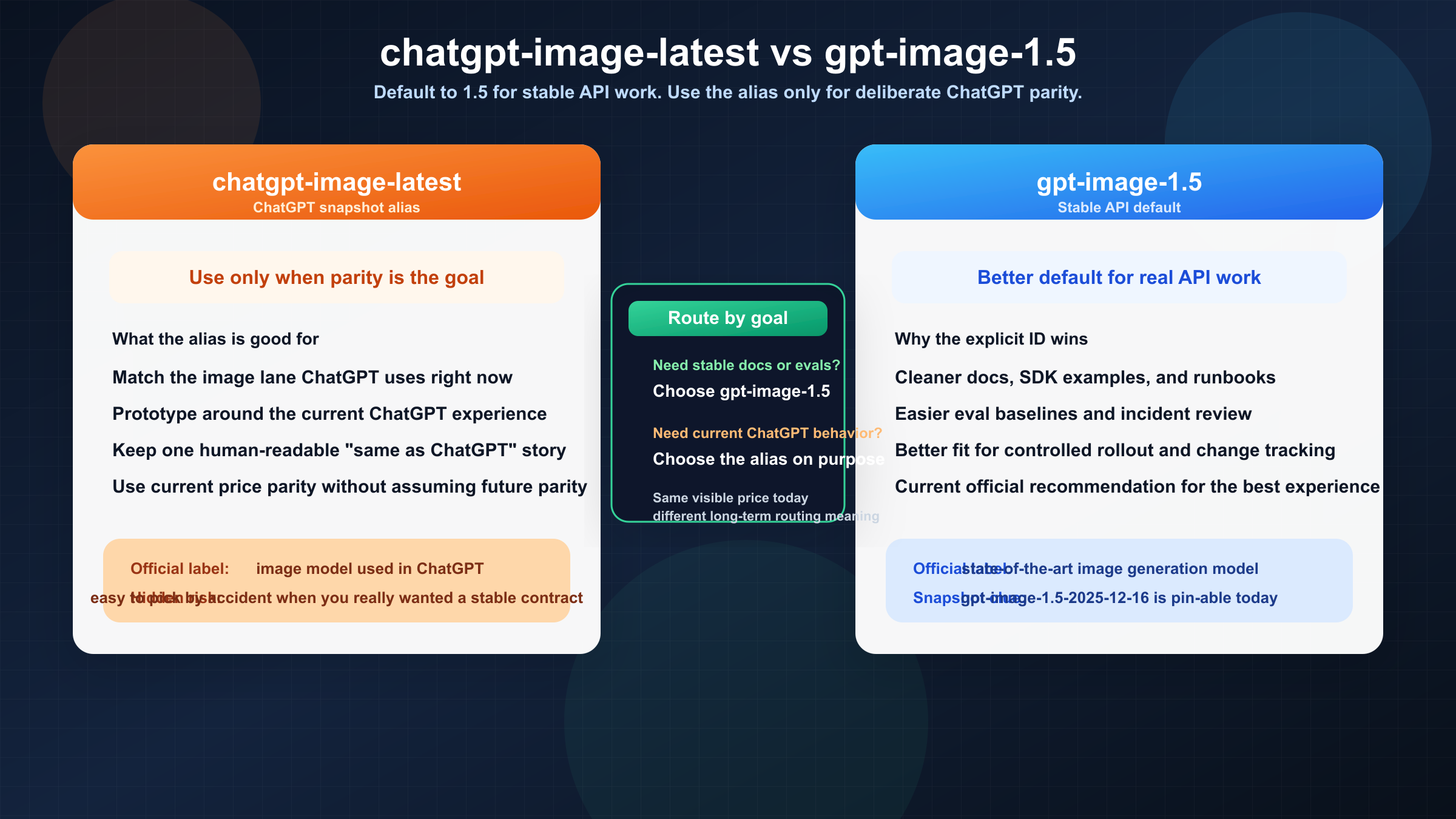
That is the trap. The real difference is not today's listed price. The real difference is what kind of contract you are choosing. chatgpt-image-latest points to the image snapshot currently used in ChatGPT. gpt-image-1.5 is the explicit API model family, and its page currently exposes the dated snapshot gpt-image-1.5-2025-12-16. If your team cares about reproducibility, controlled rollout, or documentation that should still make sense in six months, that difference is the whole story.
TL;DR
| Question | Better answer | Why |
|---|---|---|
| You need the safest default for production API work | gpt-image-1.5 | It is the explicit current model family and it exposes a dated snapshot you can pin. |
| You want the image lane ChatGPT is using right now | chatgpt-image-latest | The alias page says it points to the image snapshot currently used in ChatGPT. |
| You care about reproducible evals, benchmark baselines, or staged rollout | gpt-image-1.5 | Explicit model IDs are easier to document, compare, and revisit later. |
| You only compared the current price tables and saw no difference | Still gpt-image-1.5 | Current listed pricing parity does not remove alias-drift risk. |
| You are writing docs or sample code for general developers | gpt-image-1.5 | It is the clearer long-term reference model ID. |
| Your actual product goal is "match ChatGPT image behavior" | chatgpt-image-latest | In that narrower case, the alias is the point. |
The practical rule is simple. If you want a stable thing to build around, benchmark, and explain, choose gpt-image-1.5. If you want current ChatGPT image behavior as your moving target, choose chatgpt-image-latest deliberately rather than by accident.
What these two names actually mean
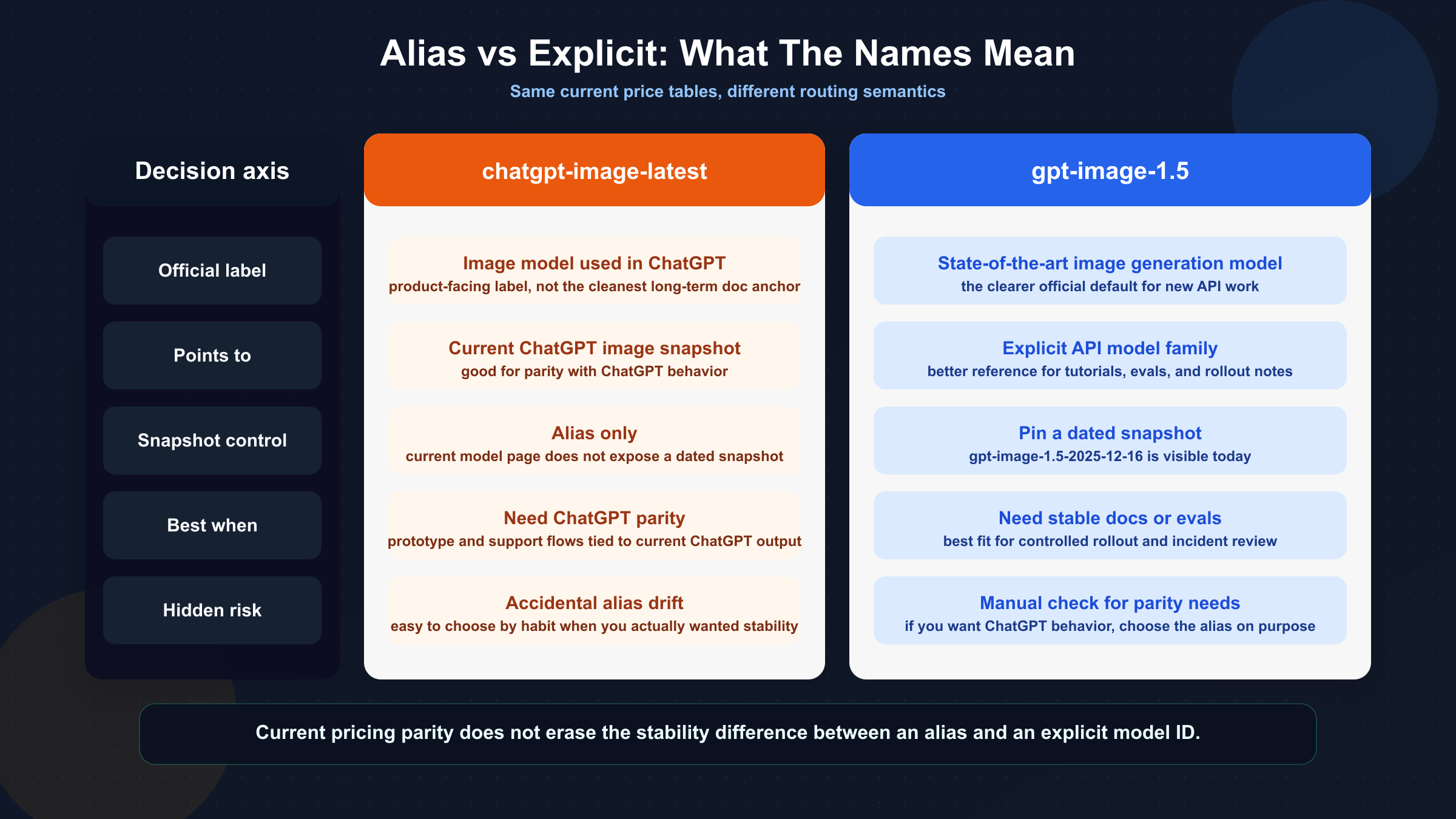
OpenAI's current models directory already tells you most of what you need to know if you read the labels carefully. It lists GPT Image 1.5 as the state-of-the-art image generation model and chatgpt-image-latest as the image model used in ChatGPT. Those are not interchangeable descriptions. One is a product recommendation for the image model family. The other is a routing label tied to ChatGPT's current image surface.
The current chatgpt-image-latest model page makes that even more explicit. It says the name points to the image snapshot currently used in ChatGPT. That wording matters because it tells you the alias is supposed to follow ChatGPT. It is useful when "whatever ChatGPT is on right now" is exactly what you want. It is less useful when you want the opposite: a stable reference you can pin, document, and compare against older runs later.
The current gpt-image-1.5 model page tells a different story. It positions GPT Image 1.5 as the latest image generation model and currently shows a dated snapshot, gpt-image-1.5-2025-12-16. That does not magically freeze every workflow by itself, but it gives you a cleaner anchor for production decisions. You can say what you are using, when you started using it, and what changed if you later move to something newer.
That is why this article should not be read as a classic "A is better than B" quality showdown. The better frame is this: are you choosing a stable API model reference, or are you choosing the ChatGPT image lane as a moving alias?
If you are asking the question as a developer or product team, the answer is usually already tilted toward the stable reference. The only time the ChatGPT alias becomes the better answer is when matching ChatGPT behavior is itself the requirement.
This also explains why the keyword keeps showing up even though the official docs exist. The docs describe the two names accurately, but they do not turn that naming difference into one operational rule. Readers are left to infer too much from separate pages.
Where the two names are the same today
The reason this comparison feels confusing is that a lot of the current visible facts do match.
On March 23, 2026, the current chatgpt-image-latest and gpt-image-1.5 model pages both show the same visible price ladder: $8.00 image input, $2.00 cached image input, $32.00 image output, plus $5.00 text input, $1.25 cached text input, and $10.00 text output. The current rate-limit tables also match: Free not supported, and Tier 1 starts at 100,000 TPM and 5 IPM on both pages.
That parity matters because it removes one lazy argument people often make. There is no obvious current list-price reason to choose the ChatGPT alias over gpt-image-1.5, and there is no obvious current list-price penalty for choosing the explicit model ID either. If your decision process begins and ends at the current tables, the two names really do look almost identical.
The same thing is true for a lot of current API-surface behavior. The official image-generation guide says GPT Image models share the same API surface, and the guide's Responses examples treat gpt-image-1.5 and chatgpt-image-latest as overlapping current options for the action parameter in image-generation workflows. The OpenAI changelog also shows the two names moving together on several dated milestones:
- December 16, 2025: both were released
- December 19, 2025: both were added to the Responses API image-generation tool
- January 9, 2026: both were covered by the fidelity fix for
/v1/images/edits - February 10, 2026: both gained Batch API support
OpenAI's December 16, 2025 ChatGPT Images launch post reinforces the same point from the product side. The post says GPT Image 1.5 in the API delivers the same improvements as ChatGPT Images, including stronger preservation and editing than GPT Image 1. That matters because it undercuts one common fear behind this keyword: you do not need the ChatGPT alias just to stay on the newest quality lane.
That is important because it keeps the article honest. This is not a case where one name is obviously crippled or obviously different in today's visible documentation. For many current workflows, both names land on broadly the same part of the stack.
But that is exactly why the stable-versus-moving distinction matters more, not less. When current pricing and current support look similar, the choice stops being about today's visible surface and becomes more about what you are optimizing for tomorrow:
- stable documentation
- reproducible testing
- rollout control
- or ongoing parity with whatever ChatGPT is currently using
That is the real fork in the road. The more similar the current spec sheet looks, the more valuable the naming semantics become.
If your team is still sorting out the broader OpenAI image stack, our OpenAI image API tutorial is the better companion for setup and endpoint basics. This article is narrower: it is about choosing the right model ID once you already know you are inside OpenAI's image family.
Why gpt-image-1.5 is the better production default
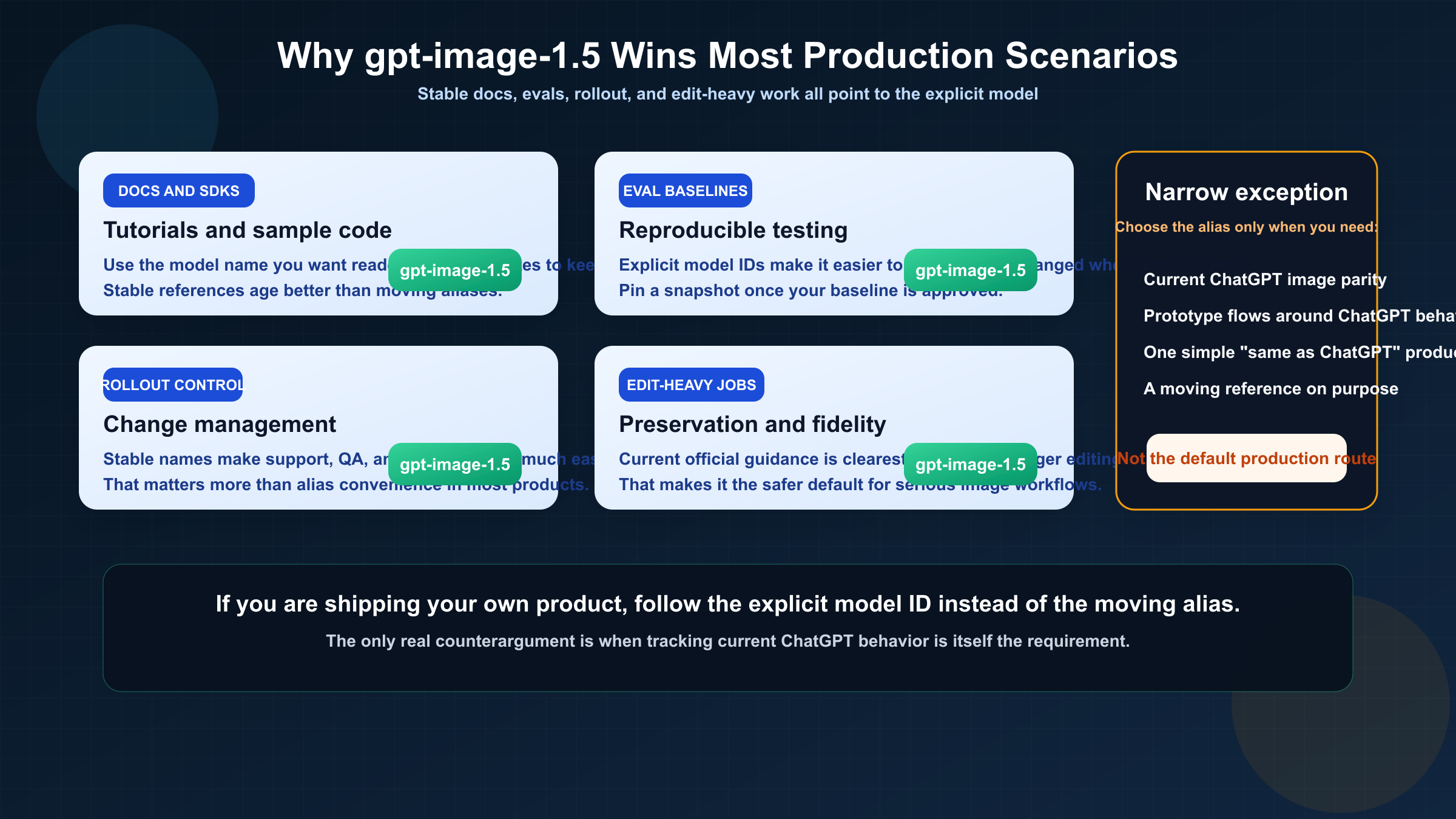
The strongest argument for gpt-image-1.5 is not "the alias is fake." The alias is real and documented. The stronger argument is that most production teams benefit more from explicit model identity than from following ChatGPT automatically.
Start with documentation. If you are writing internal runbooks, public tutorials, SDK examples, or evaluation notes, gpt-image-1.5 is the cleaner object to describe. It is the model OpenAI currently presents as the state-of-the-art image generation model, and it has a dated snapshot on the model page. That makes it easier to answer basic operational questions later: What were we testing? What changed? Why did this output drift? Which version was our benchmark based on?
Then consider rollout control. Alias names are convenient precisely because they can keep following the latest product surface. That is great when you want convenience and current behavior. It is less great when a product owner asks for a careful migration or when a support team needs to know whether a behavior change happened because the prompt changed, the pipeline changed, or the underlying alias target changed. An explicit model family gives you a more defensible default for those conversations.
There is also the recommendation signal. The official image-generation guide recommends gpt-image-1.5 for the best experience. That matters because it tells you what OpenAI wants new developers to reach for when the goal is not specifically "mirror ChatGPT." If your product is its own product, rather than a shadow of ChatGPT, following the explicit recommended model is usually the safer move.
The guide also gives gpt-image-1.5 one especially useful workflow-level detail: it says the model preserves the first five input images with higher fidelity. That is the kind of detail teams building edit-heavy workflows, brand-preservation flows, or multi-image composition pipelines actually care about. Even if the alias currently lands on the same practical behavior, the explicit documentation is centered on gpt-image-1.5, not on "trust the alias and hope the behavior line remains obvious."
This is where the production argument becomes clearest. Stable teams do not optimize only for the shortest model name. They optimize for clarity in:
- experiments
- issue reports
- billing reviews
- customer-facing consistency
- migration notes
gpt-image-1.5 is simply easier to defend in those contexts.
There is a second-order reason too. When a model name is explicit, your decision stays explicit. Teams that start on aliases often discover later that nobody remembers whether the alias was chosen for a reason or just because it was visible in an example. Teams that start on a stable model ID usually have a cleaner paper trail.
If you need a rough operator rule, it is this: if you would be annoyed six months from now by not knowing exactly what your image pipeline was pinned to, do not choose the alias as your default.
When chatgpt-image-latest is still the right choice
There are real cases where chatgpt-image-latest is not only defensible, but correct.
The clearest case is ChatGPT parity. If your product, workflow, or benchmark is specifically trying to align with the image behavior users see in ChatGPT, then the alias is the point. In that situation, stability is not the main value. Alignment is. You are not trying to freeze behavior. You are trying to follow the ChatGPT image lane as it evolves.
That can matter in a few practical scenarios.
One is product matching. Maybe your support team compares API outputs against what internal users or customers are already seeing in ChatGPT. Maybe you are building training, QA, or creative review flows where "does this behave like ChatGPT right now?" is the real evaluation question. If that is the actual job, then chatgpt-image-latest is more honest than pretending you want a static reference.
Another is prototyping. Early-stage teams sometimes care more about moving with the current consumer experience than about freezing a stable backend contract. If you are rapidly exploring prompts, creative directions, or UX assumptions and you know you will harden the system later, choosing the alias can be a rational short-term move. It lowers mental overhead because you are intentionally tracking the live ChatGPT image surface.
There is also a communications reason. Some teams want one sentence that non-developers can understand: "We are using the current ChatGPT image model." The alias helps that sentence stay true. An explicit model ID helps technical control more than it helps product storytelling.
But notice what all of those cases have in common. They are not accidents. They are deliberate reasons to want the ChatGPT lane. That is the right mental model for the alias. If you choose chatgpt-image-latest, it should be because you want what the alias means, not because you never stopped to think about it.
This is also why the article's recommendation is not anti-alias. It is anti-accidental-alias. The wrong use of chatgpt-image-latest is treating it as a cleaner or cooler spelling of gpt-image-1.5. The right use is choosing it because following ChatGPT is itself the requirement.
If your real question is broader than alias routing and you are mostly trying to understand today's OpenAI image price structure, our OpenAI image generation API pricing guide is the better next read. That page covers the cost ladder across GPT Image 1.5, gpt-image-1-mini, chatgpt-image-latest, and the legacy GPT Image 1 lane.
How to choose without regretting it
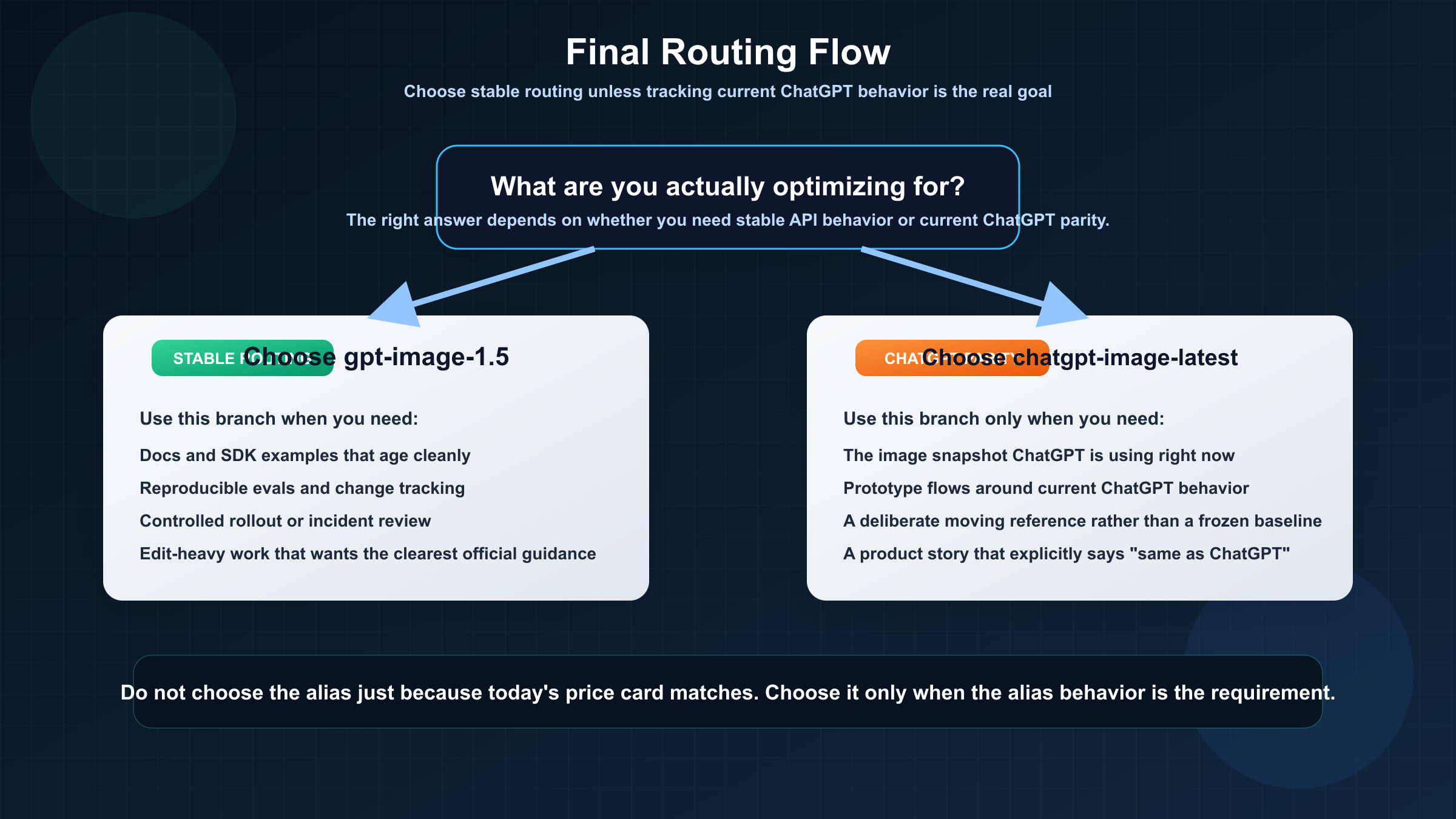
The fastest safe decision is to route by job, not by curiosity.
If your job is shipping a production feature, use gpt-image-1.5.
If your job is writing samples, tutorials, or internal docs that should still feel correct after a few release cycles, use gpt-image-1.5.
If your job is running reproducible evals or keeping a clean benchmark history, use gpt-image-1.5.
If your job is matching whatever ChatGPT image behavior users are seeing right now, use chatgpt-image-latest.
If your job is rapid prototyping around the ChatGPT experience itself, chatgpt-image-latest is reasonable, but be honest that you are trading away some long-term clarity for parity and convenience.
The most useful operator checklist is short:
-
Do I need a stable named model for docs, testing, or rollout control?
If yes, choosegpt-image-1.5. -
Do I specifically want to track the image snapshot currently used in ChatGPT?
If yes, choosechatgpt-image-latest. -
Would a moving alias cause confusion in incident review, eval baselines, or pricing conversations later?
If yes, do not default to the alias. -
Is my team choosing the alias for a real product reason, or just because the name sounds current?
If there is no real reason, choosegpt-image-1.5. -
Do edit fidelity and multi-image preservation matter?
If yes, anchor your testing and documentation ongpt-image-1.5, because that is where the current official guide is clearest. -
Do I need a frozen baseline for evaluations or change management?
If yes, start withgpt-image-1.5and pin the dated snapshot once your baseline is approved.
This is also the right place to keep one pricing caveat in mind. Some community reports from the December 2025 rollout showed developers being surprised by gpt-image-1.5 usage accounting, especially text output tokens appearing in image-generation responses. That does not mean the alias is the safer cost choice. It means any move onto the newer routing surface deserves a quick billing sanity check on your real workload before you scale it up.
In practice, a lot of teams do not need a long committee process here. The clean path is:
- start with
gpt-image-1.5 - keep a short note explaining why you chose it
- switch to
chatgpt-image-latestonly if parity with ChatGPT is genuinely more important than explicit model control
That rule is simple enough to survive turnover, documentation drift, and future release notes. That is exactly what a good default should do.
If your broader migration question is about old versus new OpenAI image models rather than alias routing, the better comparison is GPT Image 1 vs GPT Image 1.5. That article covers legacy compatibility, staged migration, and why GPT Image 1 still shows up in the ecosystem.
FAQ
Does chatgpt-image-latest currently cost more than gpt-image-1.5?
Not on the current public model pages checked on March 23, 2026. Today the visible price card and current rate-limit table match. The stronger difference is routing semantics, not the listed price.
Can I treat chatgpt-image-latest as a permanent synonym for gpt-image-1.5?
That is the wrong assumption. The alias page says it points to the image snapshot currently used in ChatGPT. That makes it useful for ChatGPT parity, but weaker as a permanent production reference than the explicit gpt-image-1.5 model family.
If both names support the same current API surface, why not just use the alias?
Because overlapping capability today does not remove the long-term advantages of explicit model identity. Most production teams care about reproducibility, documentation clarity, and controlled rollout at least as much as they care about convenience.
When is chatgpt-image-latest actually the better answer?
When your real goal is to track current ChatGPT image behavior. If that is what you are optimizing for, the alias is not a compromise. It is the correct routing choice.