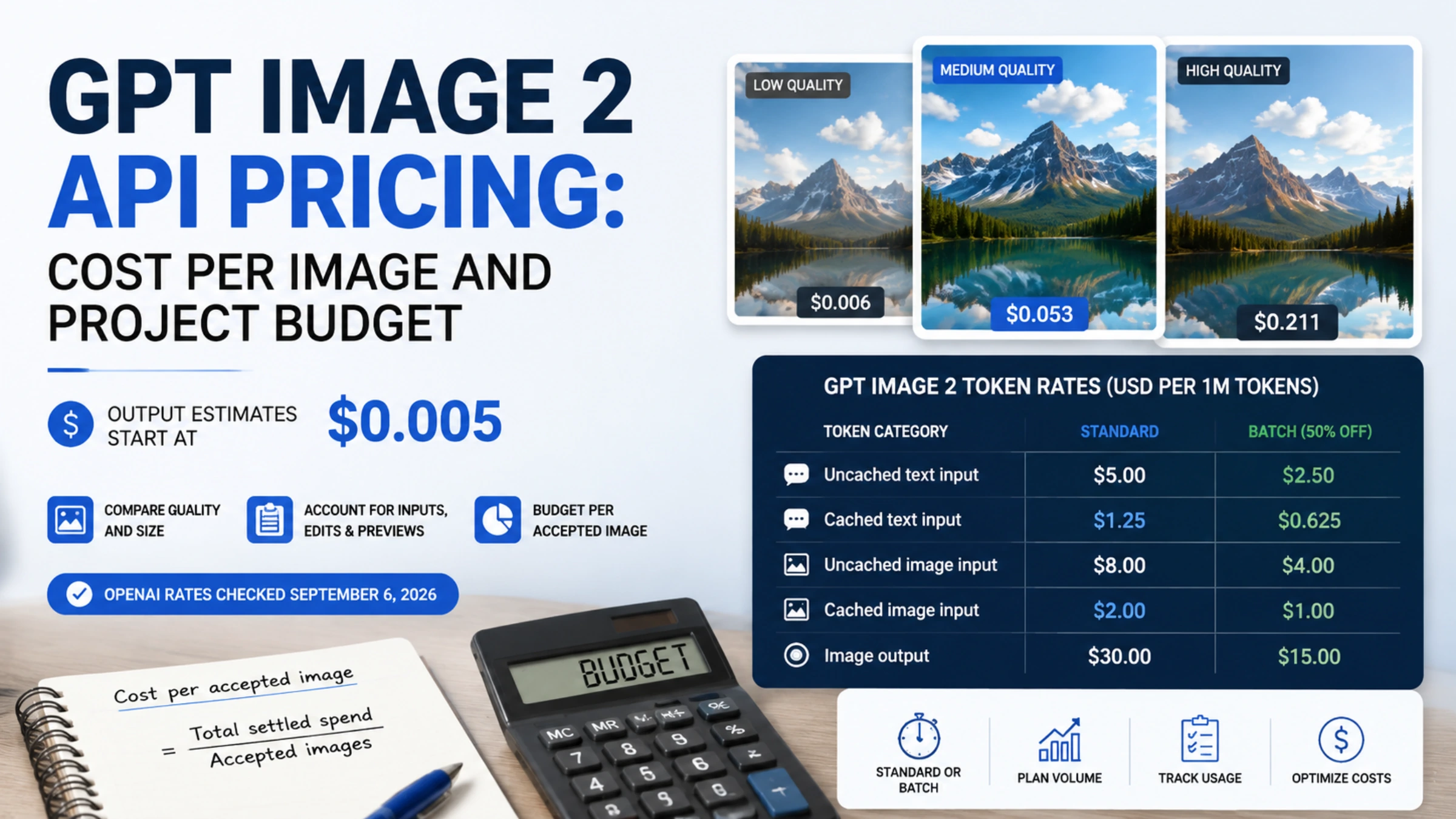
GPT Image 2 costs an estimated $0.006, $0.053, or $0.211 per 1024×1024 output at low, medium, or high quality. Text prompts and reference images add input charges. These are OpenAI's Standard output estimates, checked September 6, 2026, rather than fixed prices for an entire request. OpenAI's image cost guide is the source for the figures.
For a quick budget, 1,000 medium square outputs therefore mean approximately $53 in image output charges. Your project budget should also allow for inputs, paid variations and edits, and any extra model usage. The useful final measure is what you spend for each image you actually accept.
All prices below are in US dollars for the direct OpenAI API, excluding taxes, currency conversion, and third-party provider charges. ChatGPT subscriptions and API usage have separate billing.
What one GPT Image 2 output costs
The official estimates vary with both quality and dimensions:
| Output size | Low | Medium | High |
|---|---|---|---|
| 1024×1024 | $0.006 | $0.053 | $0.211 |
| 1024×1536 | $0.005 | $0.041 | $0.165 |
| 1536×1024 | $0.005 | $0.041 | $0.165 |
These are rounded output-only Standard estimates. They do not include text or image inputs. The lowest displayed figure, $0.005, describes a particular quality and size; it is not a universal price for every GPT Image 2 request. Source: OpenAI.
The nonsquare results are less expensive in this table even though they contain more pixels. That is not a typo: OpenAI explains that a larger nonsquare image can use fewer tokens than a smaller or square image. Do not extrapolate the cost by multiplying pixels. Choose the dimensions your application needs, then check the estimate for that exact combination.
For 2K or 4K work, use the calculator in the official guide. Supported examples include 3840×2160 and 2160×3840; a 4096×4096 image is not interchangeable with those examples. GPT Image 2 permits a maximum edge of 3840 pixels, dimensions in multiples of 16, and at most 8,294,400 pixels. OpenAI describes output above 2K as experimental. No single 4K price follows from the smaller-size table. Size requirements.
Calculate the whole request from its token usage
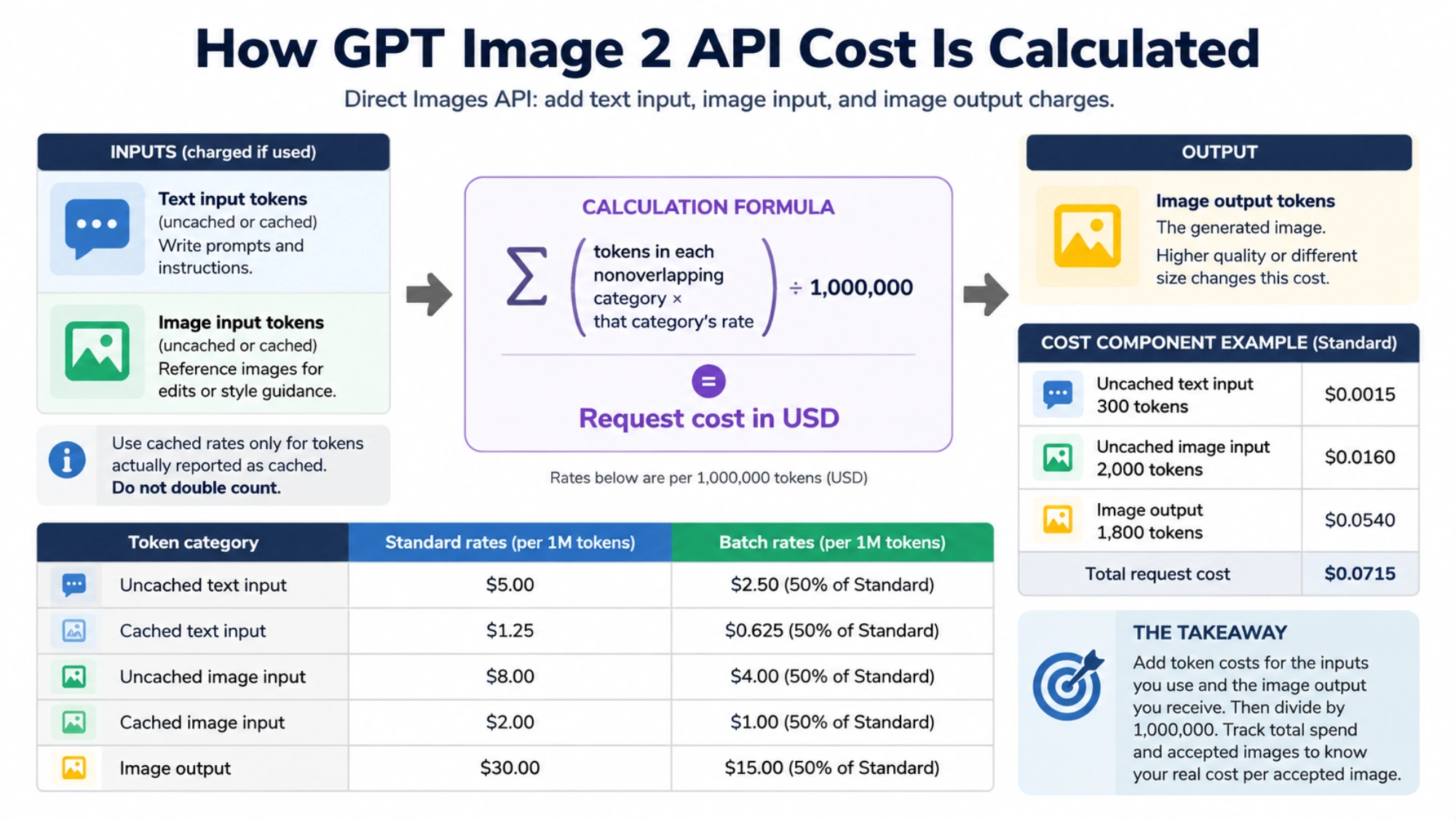
For the direct Images API, add the text input, image input, and image output charges. The current GPT Image 2 rates are:
| Token category | Standard, per 1 million tokens | Batch, per 1 million tokens |
|---|---|---|
| Uncached text input | $5.00 | $2.50 |
| Cached text input | $1.25 | $0.625 |
| Uncached image input | $8.00 | $4.00 |
| Cached image input | $2.00 | $1.00 |
| Image output | $30.00 | $15.00 |
Source: OpenAI API pricing. A cached rate applies only to usage actually reported as cached. Split cached tokens out of the input total; do not price them once at the full rate and again at the cached rate.
The calculation is:
textRequest cost in USD
= sum(tokens in each nonoverlapping category × that category's rate)
  ÷ 1,000,000
If you are forecasting before you have usage data, use the per-image estimate for the output component and add an input allowance. If you are reconciling a completed request, use its reported usage and applicable rates. Do not add the output estimate to the calculated output-token charge: those are two ways of estimating the same component.
An editing example, with every charge visible
Suppose a request reports the following hypothetical usage. These numbers illustrate the arithmetic; they are not a measured request or a prediction for a particular input image.
| Usage category | Tokens | Standard charge |
|---|---|---|
| Uncached text input | 300 | $0.0015 |
| Uncached image input | 2,000 | $0.0160 |
| Image output | 1,800 | $0.0540 |
| Total | $0.0715 |
The calculation is (300 × 5 + 2,000 × 8 + 1,800 × 30) ÷ 1,000,000 = $0.0715. For 1,000 identical requests, it would be $71.50. The same hypothetical token quantities at Batch rates would cost $0.03575 per request, or $35.75 for 1,000.
The 1,800 output tokens here are an example usage value. They are not the token count behind OpenAI's medium square estimate, and you should not infer GPT Image 2 token counts from the older models' 272/1,056/4,160 table.
There is no universal “editing costs twice as much” rule. Reference images add image-input usage, and successive edits may have different inputs and outputs. GPT Image 2 always uses high-fidelity image inputs; omit input_fidelity because it cannot be changed for this model. Price your actual reference-image workload instead of borrowing an editing multiplier. Image cost and input behavior.
Two additions that can change the total
Using image generation through the Responses API adds the mainline model's token usage on top of the image-generation cost. A conversation that plans an image, calls the image tool, and discusses the result can therefore cost more than a direct Images API request. Record both components when estimating that product experience. Choosing the API.
Streamed partial images add 100 image-output tokens each. At GPT Image 2's Standard rate, that is 100 × $30 ÷ 1,000,000 = $0.003 per partial image; three partial images add $0.009. If that usage is already included in your reported output total, do not add it a second time. Partial-image costs.
The current pricing table shows a dash for GPT Image 2 text output. Do not copy GPT Image 1.5's $10-per-million text-output rate into a GPT Image 2 estimate. Any separate mainline model in Responses has its own pricing.
Turn output volume into a realistic budget
Start with a volume estimate in generated outputs, before assuming every result will be usable:
| Planned GPT Image 2 outputs | Quality and size | Standard output estimate |
|---|---|---|
| 1,000 | Low, 1024×1024 | $6 |
| 1,000 | Medium, 1024×1024 | $53 |
| 1,000 | High, 1024×1024 | $211 |
| 1,000 | Medium, 1536×1024 | $41 |
| 10,000 | Medium, 1024×1024 | $530 |
Each row multiplies the official rounded output estimate by the number of outputs. Add inputs and any applicable Responses or preview charges separately.
For production planning, also track:
textCost per accepted image
= total settled API spend for the task ÷ number of accepted images
Imagine a campaign generates 600 medium square candidates and accepts 400. At the listed output estimate, those candidates account for $31.80. Suppose, purely for illustration, inputs and additional edits add $8.20, bringing the task's total settled API spend to $40. The cost per accepted image is $40 ÷ 400 = $0.10, even though the output estimate began at $0.053. At the same observed acceptance and spending pattern, planning for 2,000 accepted images would mean approximately $200.
The $8.20 allowance and acceptance rate in that example are assumptions, not OpenAI fees or measured performance. Replace them with your own records. Keep paid rejected candidates and edits in the numerator, and count each charge once. If no images are accepted, report the total spend and zero accepted outputs; a useful unit cost cannot yet be calculated.
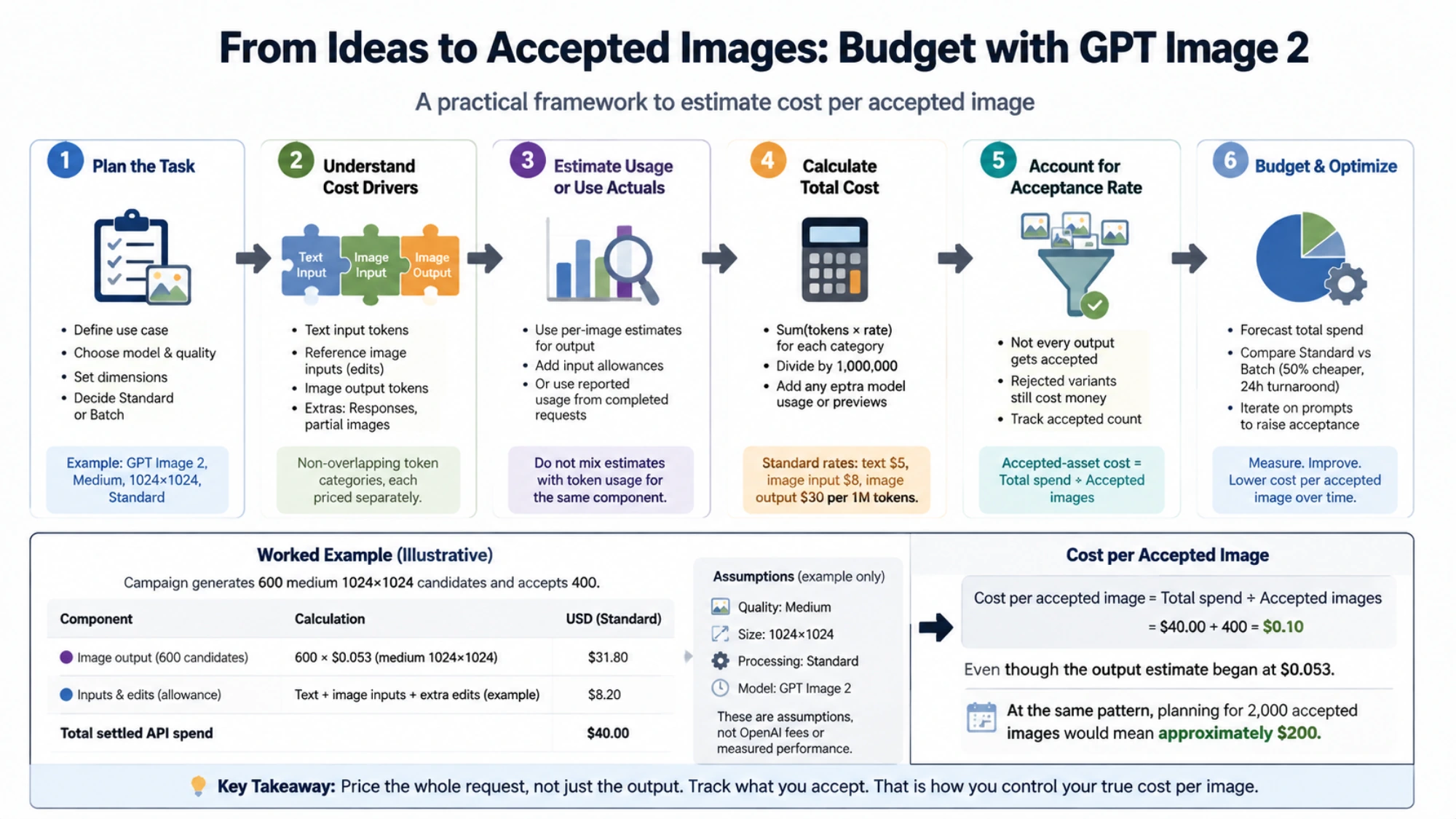
For a small pilot, record the model or snapshot, dimensions, quality, Standard or Batch processing, input/reference usage, output usage, settled cost, and accepted count. Separate generation and editing if the tasks differ materially. An HTTP error alone does not prove an image was billed; reconcile request records with actual usage and settlement before assigning a cost to a retry.
When Batch can cut the budget in half
OpenAI currently supports both /v1/images/generations and /v1/images/edits in the Batch API, with 50% lower rates and a 24-hour turnaround. You need to submit a supported Batch request; an ordinary synchronous image call does not receive that discount. Batch API guide.
At the same token usage, the GPT Image 2 token charges are half their Standard equivalents. For example, 10,000 medium square outputs estimated at $530 in Standard output charges would be approximately $265 in Batch output charges, before inputs and other applicable costs.
Batch is a useful option for overnight catalog images, scheduled content, and other work that can wait. An interactive editor that must return a result while someone is working needs a different latency budget. Compare the total turnaround your product can tolerate before choosing the cheaper processing option.
How older OpenAI image models compare
GPT Image 2 is now OpenAI's current flagship image generation and editing model. Its model ID is gpt-image-2, and the documented snapshot is gpt-image-2-2026-04-21. Older guidance calling GPT Image 1.5 the latest model is out of date, but the older models' prices remain useful for budget comparisons.
| Model | Low, 1024×1024 | Medium, 1024×1024 | High, 1024×1024 |
|---|---|---|---|
| GPT Image 2 | $0.006 | $0.053 | $0.211 |
| GPT Image 1.5 | $0.009 | $0.034 | $0.133 |
| GPT Image 1 | $0.011 | $0.042 | $0.167 |
| GPT Image 1 mini | $0.005 | $0.011 | $0.036 |
For 1024×1536 or 1536×1024 outputs, the older models' low/medium/high estimates are $0.013/$0.050/$0.200 for GPT Image 1.5, $0.016/$0.063/$0.250 for GPT Image 1, and $0.006/$0.015/$0.052 for mini. All are Standard output estimates. Official comparison tables.
There is no single price ordering across every setting. GPT Image 2 has the lower low-quality square estimate than 1.5, but the higher medium and high square estimates. Mini has the lowest square output estimates in this comparison. For 1,000 medium square outputs, the output-only comparison is $11 for mini, $34 for 1.5, $42 for 1, and $53 for 2.
Choose a small set of representative tasks and compare cost per accepted image, including inputs and edits. Price alone does not establish which model follows your instructions better or needs fewer attempts. A more expensive generation can still be economical if you accept more results; that is something to measure with your assets.
If you use chatgpt-image-latest, its current token rates match GPT Image 1.5 in the pricing table. The alias is not a promise that it will always name the same snapshot. Record the model you use when comparing runs. Current rates.
Common billing questions
Does ChatGPT Plus include image API credits?
ChatGPT subscriptions and API billing are separate. Set up and review your API billing independently; a subscription's image allowance does not substitute for API usage charges. OpenAI billing help.
Is there one fixed price for an edited image?
No. An edit can include text input, reference-image input, and image output, with optional additional costs depending on how you call the model. Use the token rates and the request's usage rather than a flat reference-image surcharge.
Why does a provider quote a different per-image price?
Check the exact model, quality, dimensions, Standard versus Batch processing, and whether the quote includes input charges. A third-party provider's package is its own offer; it does not redefine OpenAI's direct API rates. Compare like-for-like completed tasks before choosing on price.
What if I have credit but the request fails with a quota error?
A spending estimate does not confirm account access or throughput. Check the returned error and your project's current limits. The OpenAI API quota error guide covers that separate troubleshooting task.