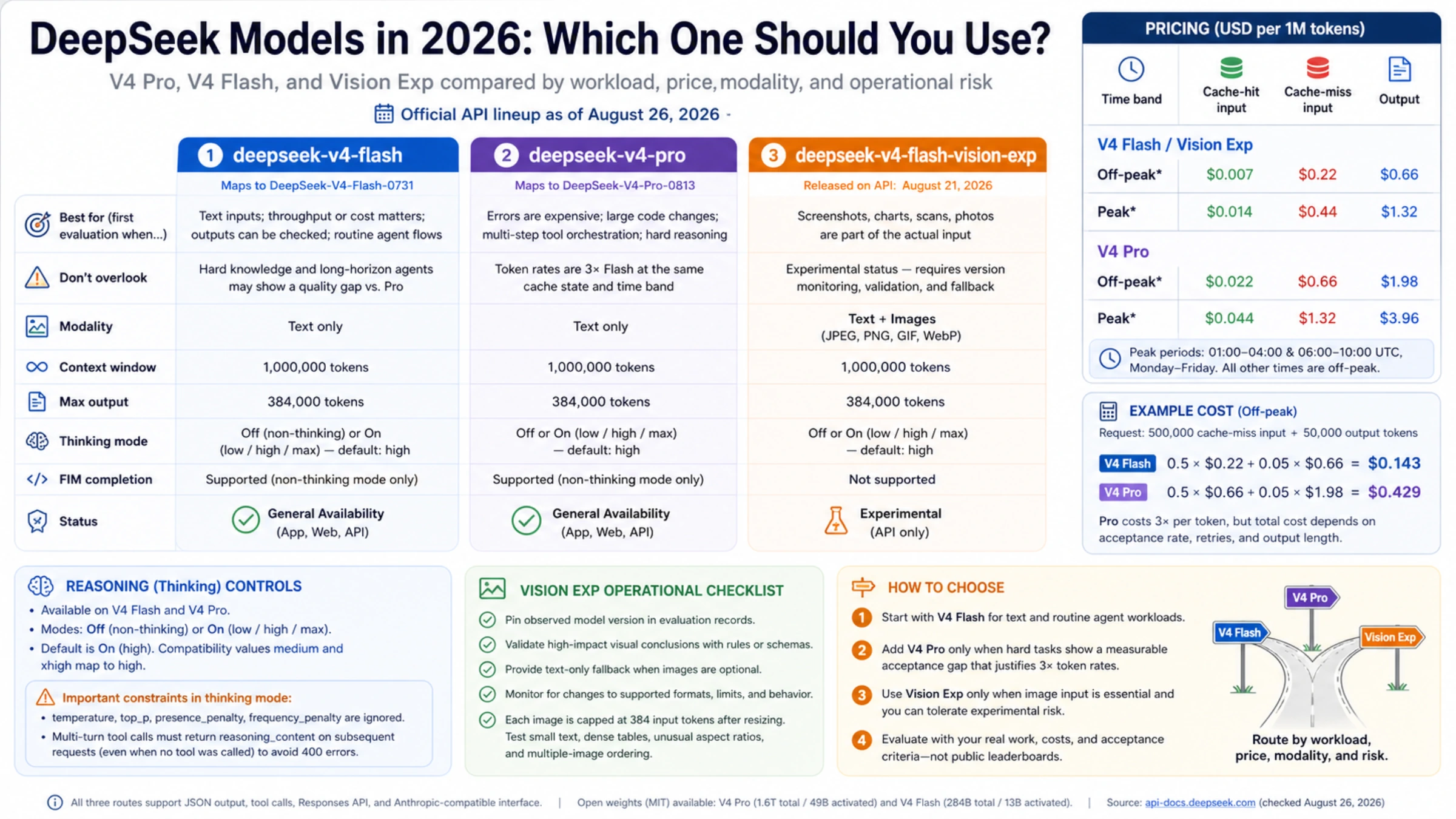
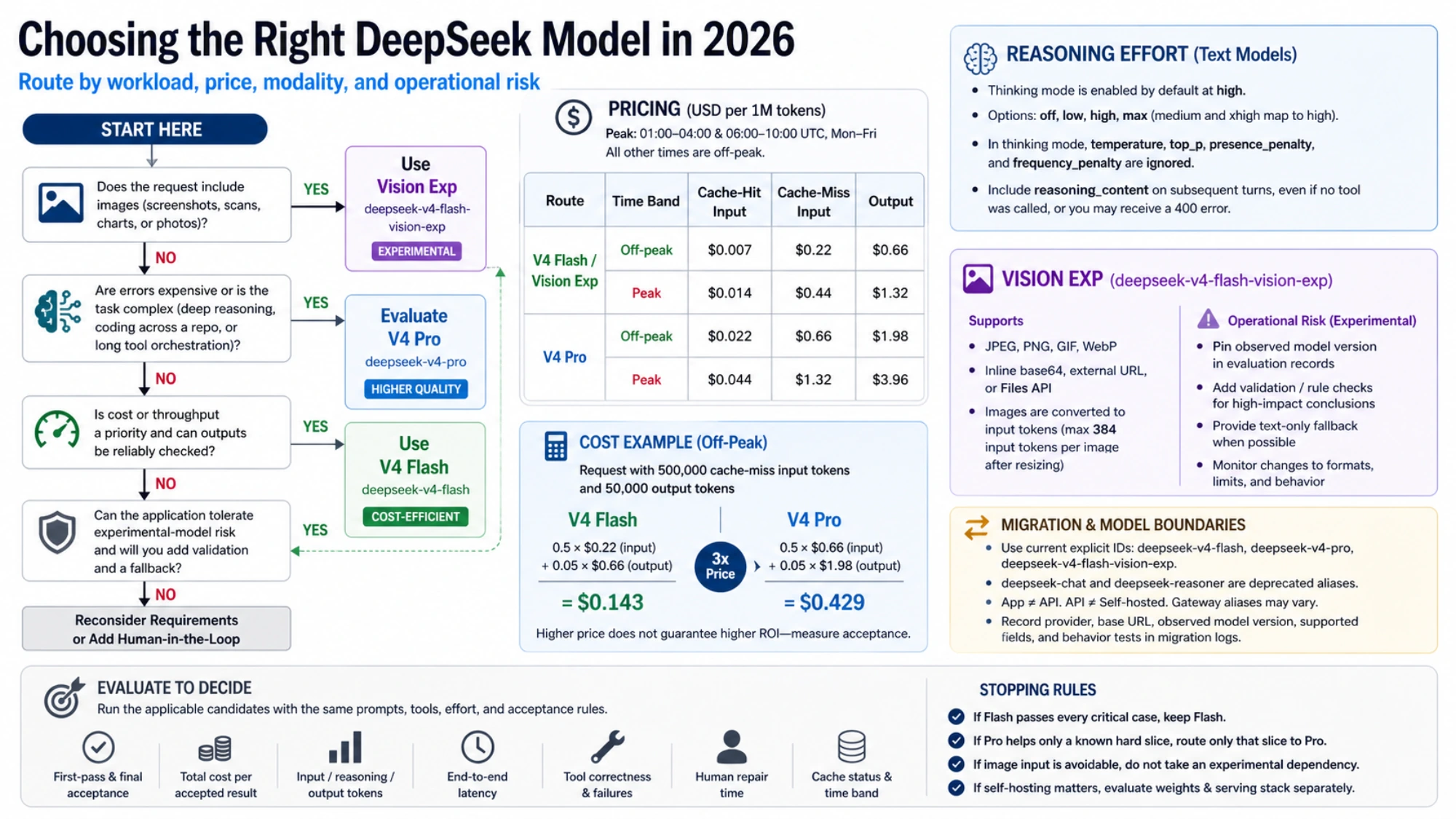
DeepSeek's current hosted lineup has changed enough that an R1-versus-V3 comparison no longer answers the practical question. As of August 26, 2026, the official API exposes three current choices: deepseek-v4-flash, deepseek-v4-pro, and the experimental deepseek-v4-flash-vision-exp.
The useful default is straightforward: start text and routine agent workloads on V4 Flash. Add V4 Pro to the evaluation when hard reasoning, coding, or tool orchestration creates a measurable acceptance gap. Use Vision Exp only when the request actually contains images and the application can tolerate an experimental dependency.
That rule applies to DeepSeek's hosted API. The model shown in the DeepSeek app, an API model ID, a Hugging Face repository, and a similarly named route sold by another gateway are separate contracts.
Three current products, not a leaderboard of every DeepSeek release
The official API quick start maps the two text IDs to DeepSeek-V4-Flash-0731 and DeepSeek-V4-Pro-0813. The third route, Vision Exp, was released on the API platform on August 21 and is explicitly experimental.
| Hosted API ID | Put it in the first evaluation when | Do not overlook |
|---|---|---|
deepseek-v4-flash | The input is text; throughput or cost matters; outputs can be checked; the agent flow is routine | Hard knowledge and long-horizon agents may reveal a quality gap versus Pro |
deepseek-v4-pro | Errors are expensive; code changes span a repository; tools must be coordinated over many steps | Token rates are three times Flash at the same cache state and time band |
deepseek-v4-flash-vision-exp | Screenshots, charts, scans, or photos are part of the actual input | Experimental status needs version monitoring, validation, and a fallback |
DeepSeek's changelog says V4 Pro reached general availability across the app, web, and API on August 13. That does not make all three surfaces interchangeable. App access is not an API entitlement, and API behavior does not describe a self-hosted quantization.
The specification removes one shortcut: context size
The current models and pricing table gives all three routes a 1-million-token context window and a 384,000-token maximum output. JSON output, tool calls, Responses API, and an Anthropic-compatible interface are listed for each. FIM completion is limited to non-thinking mode on the two text models and is not supported on Vision Exp.
Since the published context ceiling is shared, “I need a long context” does not select Pro. A long-context evaluation has to measure whether the model finds the right evidence, preserves instructions across the input, uses tools correctly, and produces a bounded answer. Accepting one million tokens is not the same as using them reliably or economically.
Open weights create another branch, not another hosted tier. DeepSeek's official V4 model repository lists Pro at 1.6T total parameters with 49B activated and Flash at 284B total with 13B activated. Both are MoE models with MIT-licensed weights and a 1M context. Those facts make self-hosting possible; they do not promise that a particular quantization, GPU topology, or inference server will reproduce the hosted API's latency, output, or tool behavior.
Price depends on three variables before model choice
DeepSeek now applies weekday peak and off-peak rates. Peak periods are 01:00–04:00 and 06:00–10:00 UTC, Monday through Friday; all other times are off-peak. Prices below are the official USD rates per 1M tokens checked on August 26, 2026.
| Route | Time band | Cache-hit input | Cache-miss input | Output |
|---|---|---|---|---|
| V4 Flash / Vision Exp | Off-peak | $0.007 | $0.22 | $0.66 |
| V4 Flash / Vision Exp | Peak | $0.014 | $0.44 | $1.32 |
| V4 Pro | Off-peak | $0.022 | $0.66 | $1.98 |
| V4 Pro | Peak | $0.044 | $1.32 | $3.96 |
A price comparison that quotes only the cheapest cache-hit number is not a workload estimate. The bill changes with cache behavior, scheduling, and output length. For an off-peak request containing 500,000 cache-miss input tokens and producing 50,000 output tokens:
- Flash costs
0.5 × $0.22 + 0.05 × $0.66 = $0.143; - Pro costs
0.5 × $0.66 + 0.05 × $1.98 = $0.429.
The 3x token-price ratio still does not prove Flash has the lower cost per accepted result. If Pro turns three failed attempts and a manual repair into one accepted result, it can be economical. If acceptance is already equal, the extra spend has no demonstrated return.
Reasoning effort is a second routing decision
Both text models can run with thinking disabled or enabled, with low, high, or max reasoning effort. DeepSeek's thinking-mode contract says thinking is enabled by default at high; compatibility values medium and xhigh currently map to high.
This creates a two-dimensional test:
- hold the model fixed and find the lowest effort that meets the acceptance bar;
- hold effort fixed while comparing Flash and Pro;
- route only the tasks that show a durable quality or reliability difference.
Do not assume familiar sampling controls still work. In thinking mode, temperature, top_p, presence_penalty, and frequency_penalty are ignored. Tool-using multi-turn flows also need to return reasoning_content on subsequent requests as documented, even on a turn where no tool was called; dropping it can produce a 400 response.
These constraints are more important than copying a generic prompt. They affect client compatibility, conversation state, and the validity of a model comparison.
Vision Exp changes the input type—and the operational risk
The Vision API guide says deepseek-v4-flash-vision-exp accepts JPEG, PNG, GIF, and WebP. Images can be sent inline as base64, fetched from an external URL, or referenced through the Files API. The ordinary Flash and Pro routes reject image input with a 400 response.
Vision Exp is therefore a sensible candidate for screenshot triage, chart reading, document-image extraction, and agents that must reason over visible application state. It is not a no-cost upgrade for a text pipeline. Images are converted into input tokens, file and request limits apply, and the experimental label means the integration should include:
- a pinned observed model version in evaluation records;
- schema or rule-based checks for high-impact visual conclusions;
- a text-only fallback when the image is optional;
- monitoring for changes in supported formats, limits, and behavior.
The current preprocessing rule caps each image at 384 input tokens after resizing, but that number does not remove the need to test small text, dense tables, unusual aspect ratios, and multiple-image ordering.
Where R1 and V3.2 still fit
R1 remains important to DeepSeek's reasoning history, while V3.2 appears in research, open-weight deployments, and older integrations. They are valid subjects for reproduction or a controlled self-hosted environment. They are not the clearest model names for new code targeting today's official hosted API.
When V4 arrived in April 2026, DeepSeek placed deepseek-chat and deepseek-reasoner on a deprecation path and temporarily mapped them to the non-thinking and thinking behavior of V4 Flash. New integrations should use the current explicit IDs. A gateway may keep an old alias or point it to a different snapshot, so migration records need the provider, base URL, effective model version, supported fields, and a behavior test—not only a changed model string.
A selection test that can end with a decision
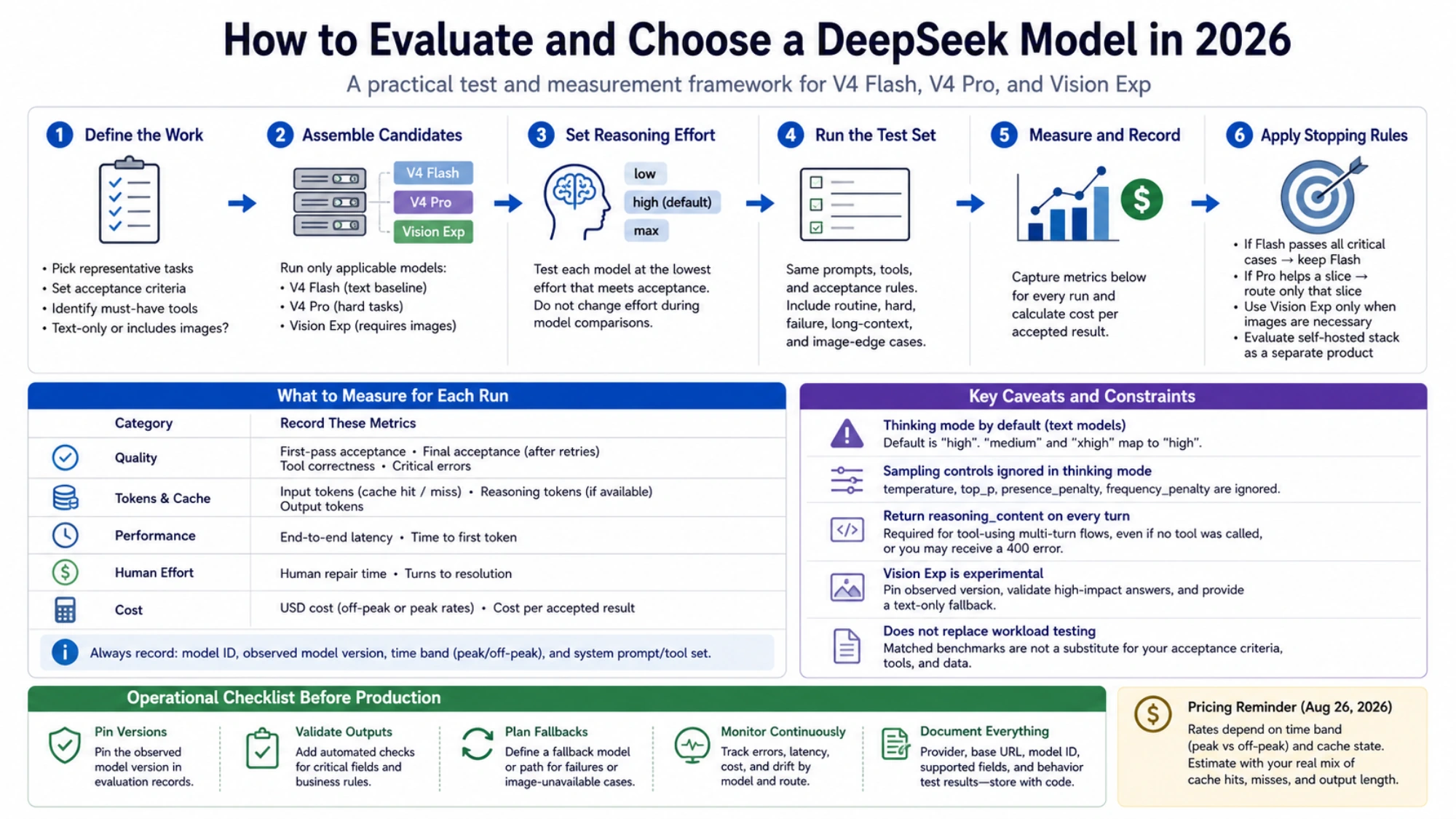
Build a small set of representative work rather than a large benchmark collage. A useful set might include six routine cases, four hard cases, two tool failures, and two long-context or image-edge cases. Run the applicable candidates with the same prompts, tools, effort, and acceptance rules.
For each configuration, record first-pass acceptance, final acceptance after retries, input/reasoning/output tokens, cache status, end-to-end latency, tool correctness, human repair time, and total cost per accepted result.
Then apply stopping rules:
- if Flash passes every critical case, keep Flash;
- if Pro helps only a known hard slice, route only that slice to Pro;
- if image input is avoidable, do not take an experimental model dependency;
- if self-hosting matters, evaluate the chosen weights and serving stack as a separate product.
Readers who need a deeper integration-focused treatment of the flagship can continue with the DeepSeek V4 Pro API guide. The durable choice is not “which model won a public table?” It is the lowest-cost configuration that repeatedly satisfies the acceptance criteria of the actual workload.