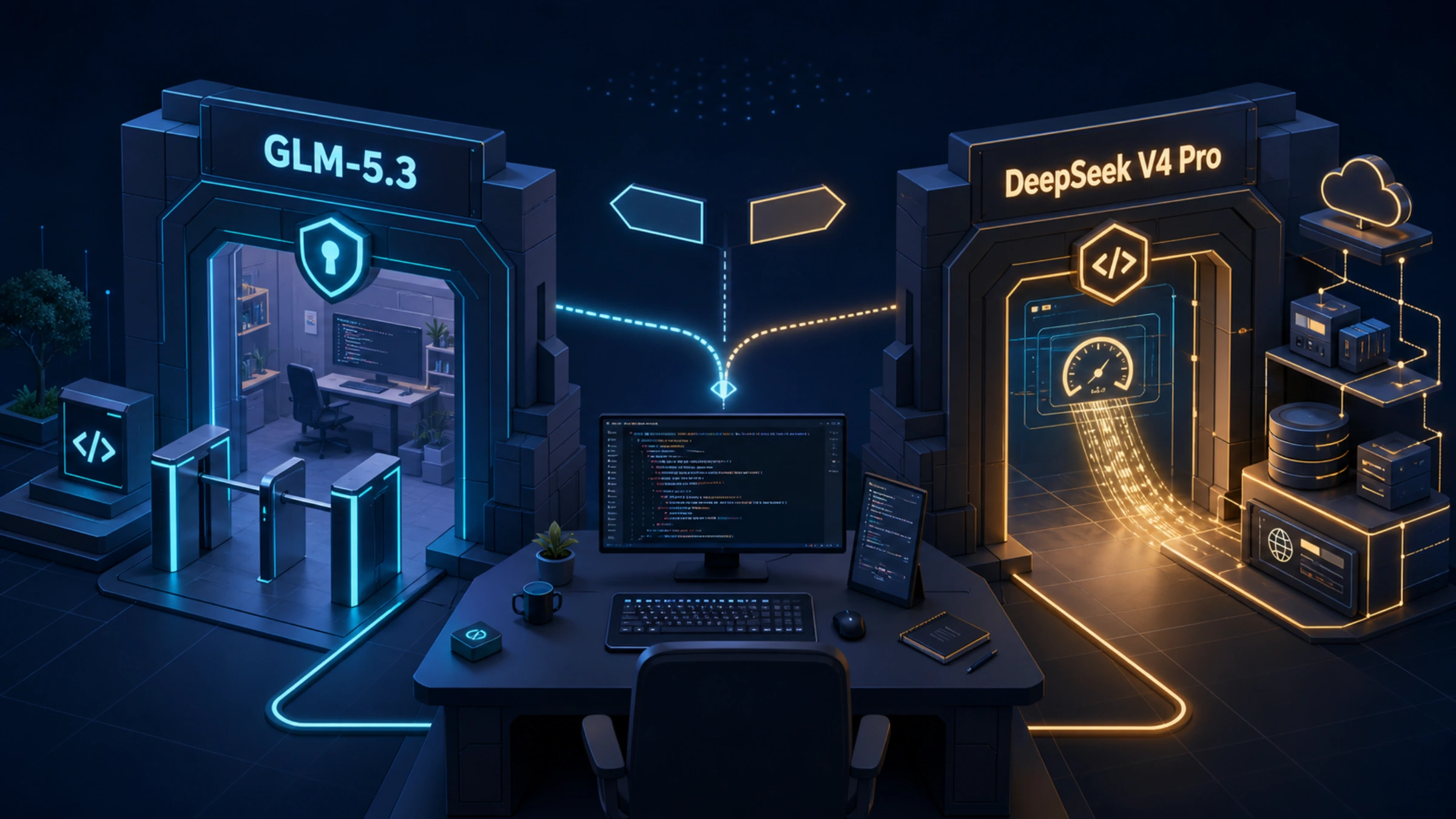
The first question is not which model tops a scorecard. It is which product you are able to use.
As of August 15, 2026, GLM-5.3 is available to every Z.ai Coding Plan tier, but its general pay-as-you-go Model API is still marked “coming soon.” DeepSeek V4 Pro reached general availability on August 13 across the DeepSeek app, web product, and API. That asymmetry changes any honest recommendation.
Use this practical split:
- Pick GLM-5.3 as a trial candidate when you already work in a supported coding agent and are comfortable evaluating a subscription with credit limits.
- Pick DeepSeek V4 Pro as the deployable candidate when you need a metered API today, app/web access, or a non-thinking mode.
- If both routes fit, do not crown a winner from the launch table. Put both through the same accepted-work test; the published rows move in both directions.
The names identify two different purchasing decisions
Z.ai’s GLM-5.3 model guide identifies the model as glm-5.3, with text input and output, a stated 1M-token context window, and 128K maximum output. Z.ai says it uses the same base model as GLM-5.2 and gets its gains from post-training. That does not make GLM-5.2’s API price or observed behavior a substitute for 5.3 evidence.
DeepSeek uses the stable API ID deepseek-v4-pro. Its current model table says that alias serves DeepSeek-V4-Pro-0813. Put the stable ID in requests; retain 0813 in evaluation and incident records so a future alias update does not erase what you tested.
| Contract on August 15 | GLM-5.3 | DeepSeek V4 Pro |
|---|---|---|
| Exact request name | glm-5.3 | deepseek-v4-pro |
| Available surface | GLM Coding Plan | App, web, and general API |
| General metered API | Coming soon | GA |
| Context / max output | 1M / 128K | 1M / 384K |
| Reasoning control | Always thinks; low/high/max | Thinking on or off; low/high/max |
| Current billing unit | Subscription credits | USD per token class |
| GLM-5.3 weights | Promised after roughly two weeks of safety work; not available on the check date | Not evaluated here as a self-hosting route |
Both 1M figures are capacity limits, not instructions to send an entire repository. Retrieval quality, prefill latency, cache pressure, and irrelevant files still matter. A useful evaluation records how much context the agent actually consumed, not just the largest number printed on a model page.
Access today: Coding Plan adapter versus general API
The Coding Plan model-switching guide gives GLM-5.3 separate endpoints for Anthropic-compatible coding tools, Codex via an OpenAI Responses-compatible route, and other OpenAI-compatible agents. In Claude Code, glm-5.3[1m] selects the plan’s 1M route. The suffix belongs to that client adapter; it is not the universal model ID for a future public API.
The same distinction prevents a common pricing mistake. Z.ai’s general API price table lists GLM-5.2 at $1.40 per million input tokens, $0.26 for cached input, and $4.40 for output. It does not list GLM-5.3. Until Z.ai publishes a 5.3 metered rate, those numbers belong to 5.2.
DeepSeek V4 Pro is callable through OpenAI-style Chat Completions at https://api.deepseek.com, a native Responses-compatible route, and an Anthropic-compatible route. Compatibility is not feature parity. DeepSeek’s Responses documentation says the implementation is stateless, ignores several unsupported state and tool parameters, and does not accept image or file input. Its Anthropic compatibility guide warns that unsupported model names can map to Flash, so an evaluation must explicitly request deepseek-v4-pro.
There is no honest one-line price comparison yet
GLM Coding Plan is a prepaid subscription. On the check date, the international landing page showed Lite at $18/month, Pro at $72, and Max at $160. The plan documentation applies rolling five-hour and weekly credit limits. For GLM-5.3, input, cached input, and output use multipliers of 6.9, 1.7, and 24; usage outside weekday 14:00–18:00 UTC+8 consumes 50% of standard credits.
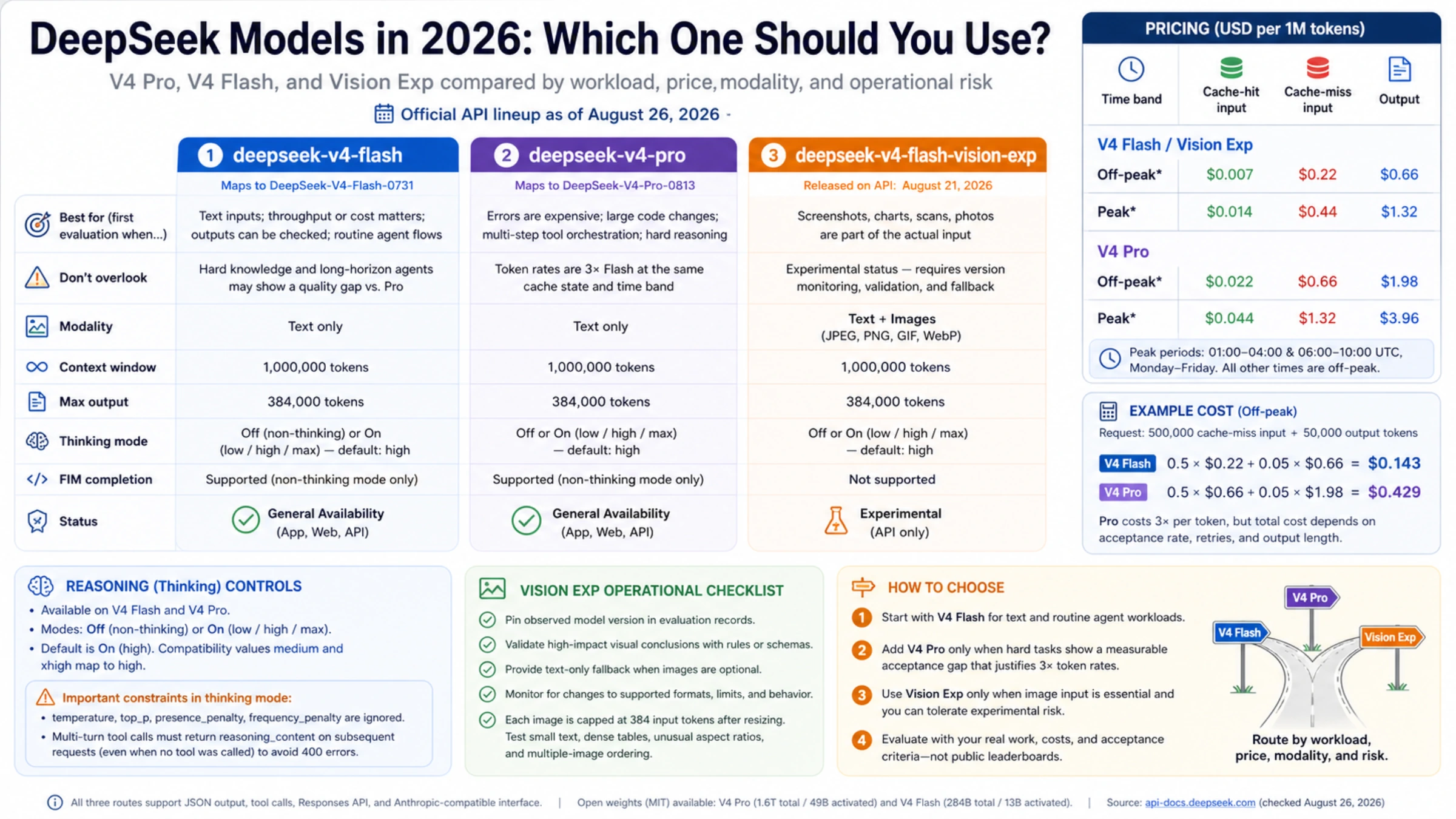
DeepSeek is metered directly, and its price changes less than two days after this article’s date. The official price page lists these USD rates per 1M tokens:
| V4 Pro token class | Through Aug 16, 15:59 UTC | Off-peak from Aug 16, 16:00 UTC | Peak from Aug 16, 16:00 UTC |
|---|---|---|---|
| Cache-hit input | $0.003625 | $0.022 | $0.044 |
| Cache-miss input | $0.435 | $0.66 | $1.32 |
| Output, including reasoning | $0.87 | $1.98 | $3.96 |
Peak windows are 01:00–04:00 and 06:00–10:00 UTC; all other hours are off-peak. Retries, tools, taxes, gateway fees, and human repair are outside this token arithmetic.
Consider a repository task with 100,000 uncached input tokens and 50,000 output tokens. Under the new schedule it costs about $0.165 off-peak or $0.33 at peak on direct DeepSeek. The same token shape consumes about 189 standard GLM-5.3 plan credits before off-peak adjustment. Dollars and credits still do not share a denominator: one comes from a metered balance, the other from a subscription with expiring limits.
The useful metric is:
accepted-task cost = all model, tool, and retry spend / tasks that pass the predefined acceptance check
A cheap request that fails twice may cost more than a successful expensive attempt. An underused subscription can also make a nominally generous allowance poor economics.
The launch scorecard gives hypotheses, not a universal winner
Z.ai’s GLM-5.3 release post includes exact rows for DeepSeek-V4-Pro-0813. These are vendor-published comparison values, not an independent rerun:
| Benchmark | GLM-5.3 | DeepSeek V4 Pro 0813 |
|---|---|---|
| Terminal-Bench 2.1 | 88.2 | 87.9 |
| DeepSWE v1.1 | 66.9 | 62.7 |
| NL2Repo | 58.0 | 61.1 |
| CyberGym | 84.5 | 83.3 |
| Toolathlon Verified | 73.0 | 74.1 |
| AutomationBench v1.0.6 | 48.2 | 43.2 |
| Agents’ Last Exam CLI | 28.5 | 25.7 |
GLM leads several listed rows; DeepSeek leads NL2Repo and Toolathlon. Even that sentence needs its footnotes. For example, Z.ai describes a specific Claude Code build, a 65,536-token generation cap, and a six-hour timeout for its GLM Terminal-Bench 2.1 run. Its NL2Repo setup uses a 1M context, 64K output, and additional anti-hack judgment. The opponent methodology is not disclosed with identical detail for every row.
DeepSeek’s own GA change log reports 87.9 on Terminal Bench 2.1 and 62.7 on DeepSWE under DeepSeek Harness minimal and max effort. That corroborates the identity of some values, not a shared end-to-end harness. Your file selection, context compaction, tool repair, timeout, and retries can reverse a narrow published margin.
The most defensible reading is task-specific:
- GLM’s launch evidence makes it a serious candidate for long coding loops and several agent evaluations.
- DeepSeek’s leads on NL2Repo and Toolathlon make it unreasonable to describe V4 Pro as uniformly behind.
- Neither table establishes English-writing quality, latency on your provider, JSON reliability in your client, or cost per accepted change.
Agent integration details can outweigh a small score gap
GLM-5.3 always reasons. Its standard contract accepts low, high, or max effort, defaulting to max. The Coding Plan adapter normalizes several client-specific values—including “disabled” or “none”—to a lower effort instead of truly turning reasoning off. That is relevant for short classification or transformation work where latency and output tokens matter more than deep planning.
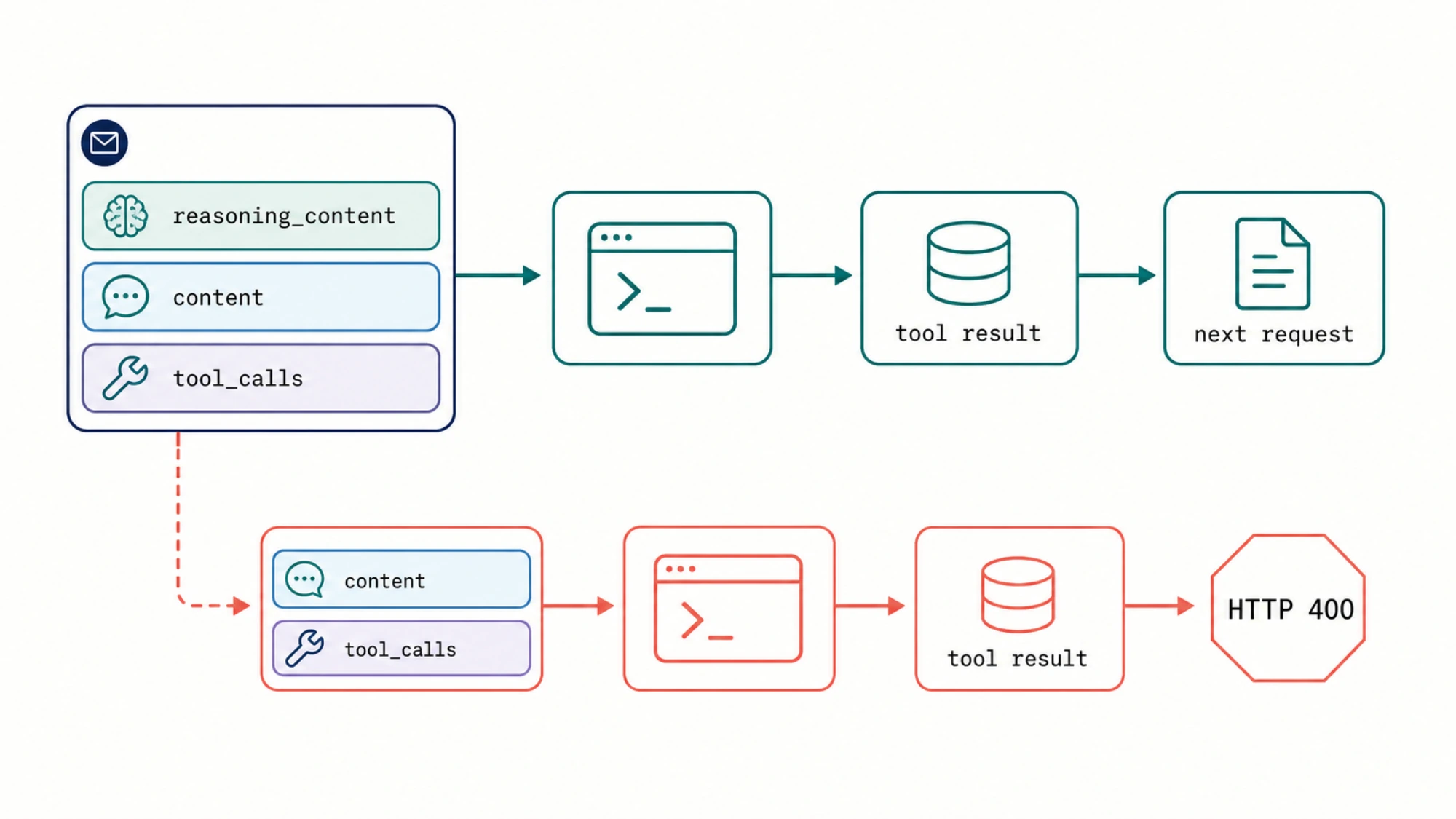
DeepSeek V4 Pro supports thinking and non-thinking modes. In thinking mode, sampling controls such as temperature and top_p are ignored. Tool loops also have a strict continuity requirement: preserve the entire assistant message—reasoning_content, content, and tool_calls—before appending the tool result. DeepSeek’s thinking guide warns that dropping the reasoning field can make the next request fail with HTTP 400.
For either model, test the actual client and route you intend to operate. “Function calling supported” does not prove the same schema enforcement, parallel-call behavior, MCP coverage, or error recovery in Claude Code, Codex, and a custom Chat Completions loop.
A 15-task trial will tell you more than another leaderboard
Build a small suite from paid work your team completed recently. Include a focused bug, a cross-file change, a long refactor, a tool-heavy investigation, and a structured-output task. Before either model runs, fix the repository commit, available files, tools, context policy, effort tier, timeout, retry cap, and acceptance checks.
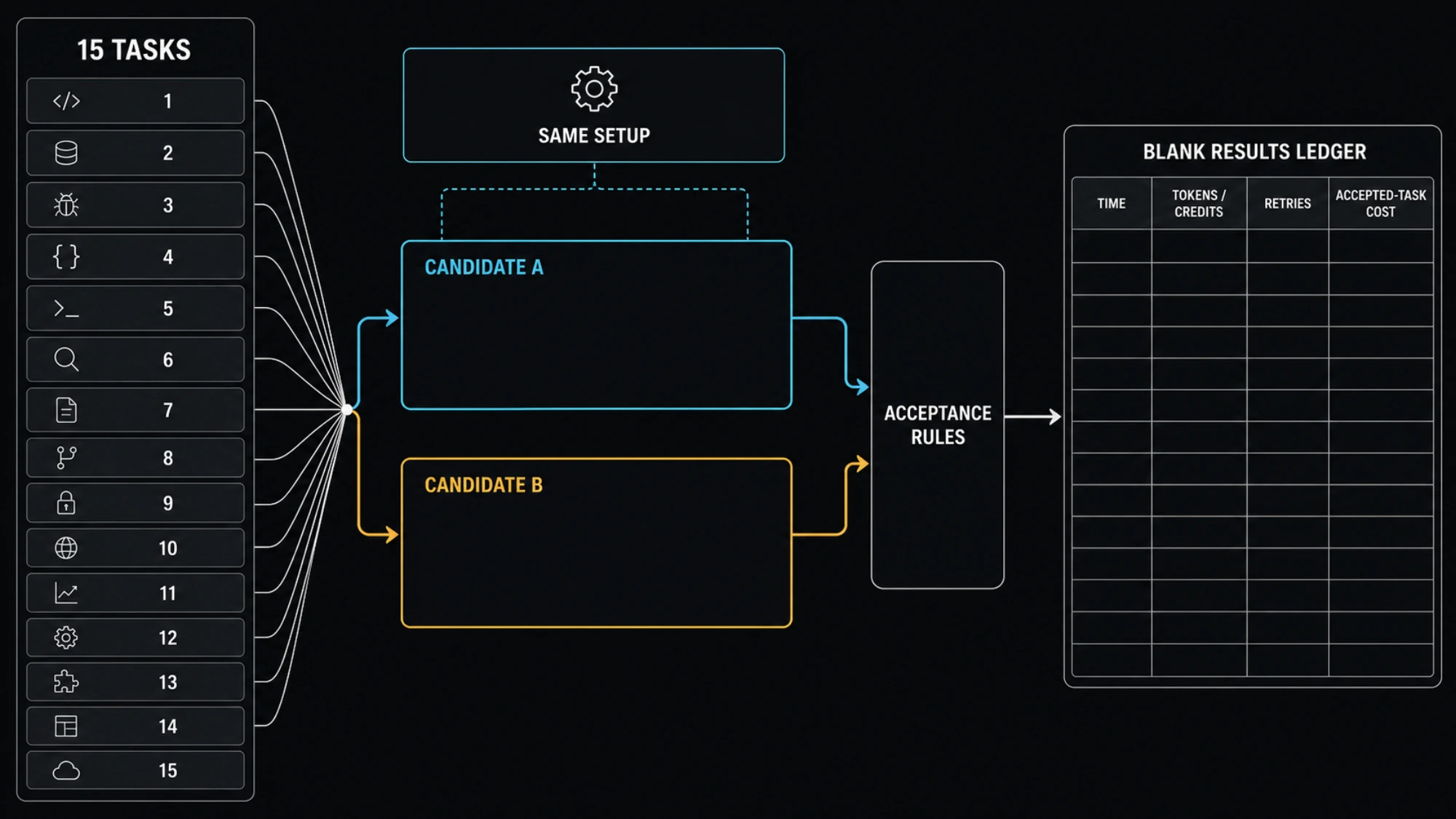
For every run, record:
- tests, schema, screenshot, or factual checks passed;
- total elapsed time and model turns;
- uncached, cached, output, and reasoning tokens;
- plan credits or direct API dollars plus tool cost;
- manual prompts, approvals, repairs, and restarts;
- protocol friction, including ignored parameters or malformed tool calls.
Use the same coding agent when possible. When one route cannot reproduce a tool feature, record that as an operational difference instead of silently compensating for it. Stop testing when a required route is unavailable, a candidate repeatedly misses a hard acceptance rule, or its accepted-task cost remains materially worse across a second representative batch.
The decision on August 15 is therefore conditional but useful: GLM-5.3 is the immediate coding-plan experiment; DeepSeek V4 Pro is the immediate general-API deployment. If your organization can use both, let matched accepted work—not launch-day arithmetic—decide which one owns the workload.