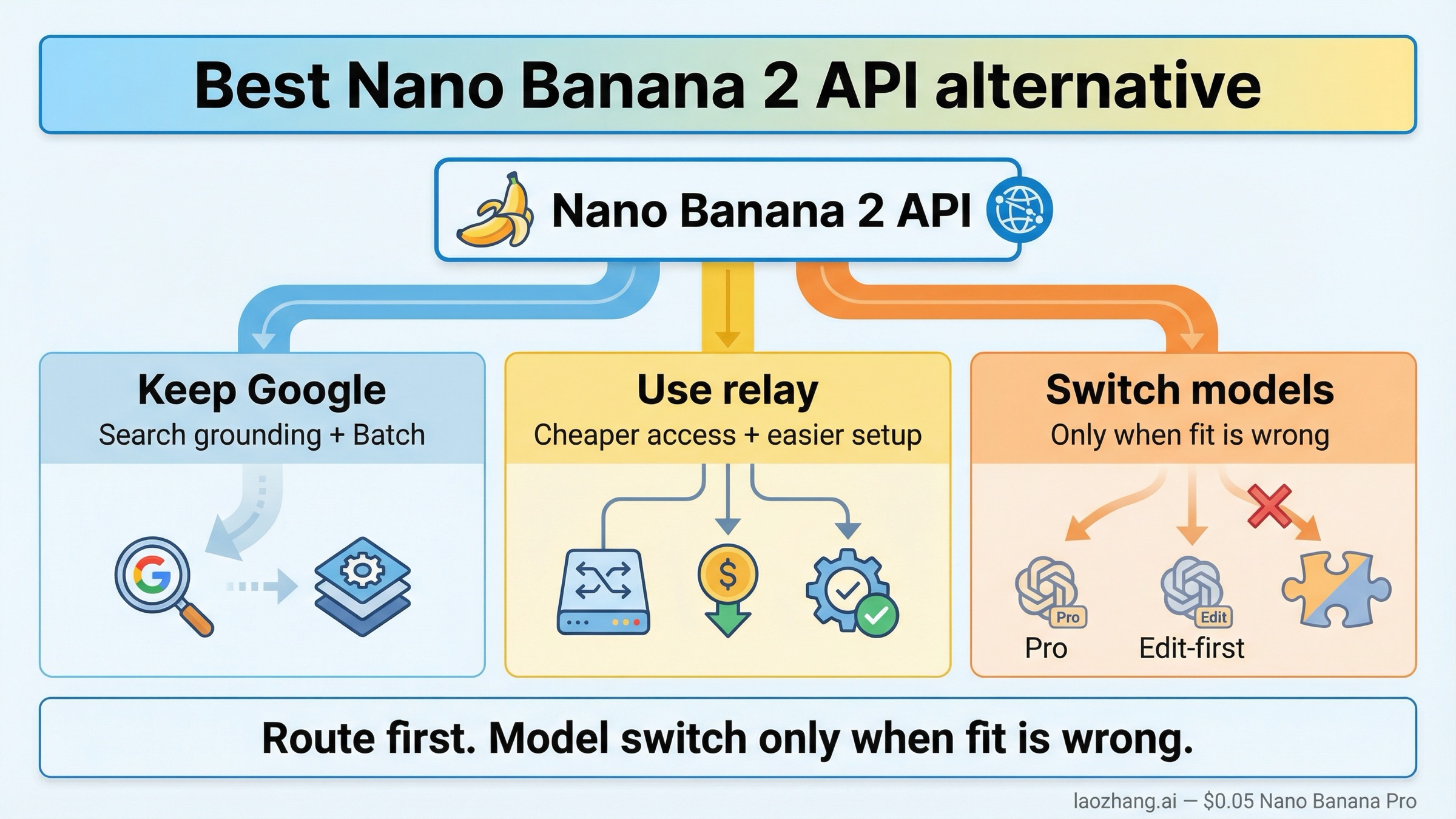
As checked on March 28, 2026, the best Nano Banana 2 API alternative is usually a different access route, not a different image model. If you still want Google's gemini-3.1-flash-image-preview, stay on the official Google route when you need Search grounding, Batch discounts, and direct limit visibility. Move to a relay only when your real blocker is Google Cloud setup or the standard per-image price. Leave Nano Banana 2 entirely only when the Flash image lane itself is the wrong fit for the work.
That distinction is what the current SERP still misses. The visible results are mostly provider landing pages, simple savings tables, or broad alternatives roundups. They are good at telling you that cheaper access exists. They are much worse at telling you when cheaper access is actually the right move, and when it is just a detour away from the real fix.
There is one more nuance worth naming early. This keyword is narrower than a broad Gemini image comparison. If you want a wider model-family answer that includes more non-Google routes, read Gemini image API alternative. This page is specifically about the Nano Banana 2 decision.
Key Takeaways
- Keep Google's direct route when Search grounding, Batch pricing, or project-level visibility are part of the job.
- Use a relay when the real blocker is Google setup friction or the standard direct price shape, not model behavior.
- Leave Nano Banana 2 only when you actually need a different capability tier such as Nano Banana Pro or an edit-first model.
| If your real problem is... | Best move | Why this is usually correct | Main tradeoff |
|---|---|---|---|
| you need official Google features such as Search grounding, Batch pricing, or direct AI Studio limit visibility | Stay on Google's direct Nano Banana 2 API | The official route still owns those benefits, and cheaper relays are not always full substitutes | You keep Google Cloud and AI Studio billing friction |
you still want gemini-3.1-flash-image-preview, but want flatter pricing or easier OpenAI-style migration | Use a relay-style alternative | This is the cleanest way to keep the same model while changing the buying and integration surface | Provider pricing and supported features can drift faster than Google's docs |
| your images now need harder text rendering, more polished layouts, or premium 4K output | Move up to Nano Banana Pro | That is a model-fit upgrade inside the same family, not a generic access problem | The output cost is much higher unless you have a very good reason to pay for it |
| your workflow is really about revision loops, controlled edits, or consistency across multiple changes | Switch to an edit-first model such as FLUX.1 Kontext | At that point the blocker is workflow behavior, not the Nano Banana 2 access surface | You are making a true model and API change, not just buying the same Google lane differently |
What nano banana 2 api alternative usually means in practice
Most readers who search this phrase are not asking for a random list of other image models. They are asking a smaller, more practical question: how do I keep Nano Banana 2's speed and image-editing behavior without inheriting the full Google billing and setup experience?
The official source set makes that interpretation clearer than the landing pages do. Google's models page currently positions Nano Banana 2 as the high-efficiency, production-scale visual-creation lane inside the Gemini family. Google's image generation guide maps it directly to gemini-3.1-flash-image-preview. So for many technical buyers, the model choice is already settled. The unresolved question is the route.
That is why so many ranking pages lean so hard on "lower than Google official" or "save over 50%" language. They are responding to the right fear, but only halfway. The real fear is not just cost. It is cost plus setup friction plus uncertainty about whether the cheaper route is actually equivalent enough for production.
This is also why the page-one quality is weak. One broad alternatives page now ranking for the family still says Nano Banana 2 is Google's Gemini 2.5 Flash Image model, which is already out of date. Other landing pages collapse together Nano Banana 2, Nano Banana Pro, and general Gemini image generation as if they were all the same buying decision. A good article should fix that confusion before it starts listing options.
Keep Google's direct route when official features are the reason you chose Nano Banana 2
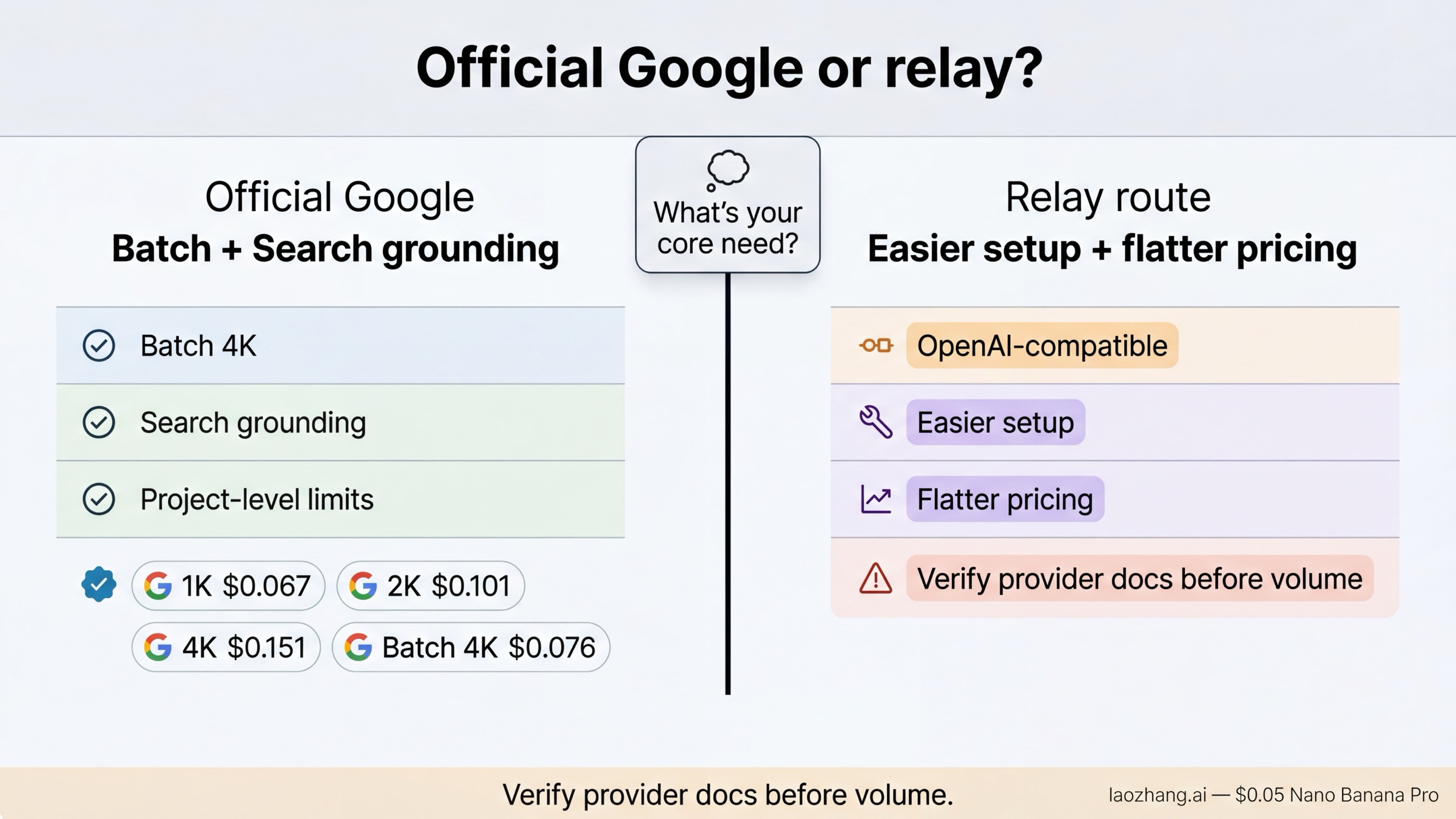
The official Google route is still the best answer when the features you actually need are tied to Google's own surface.
The biggest example is pricing shape, not just price level. Google's current Gemini pricing page, checked on March 28, 2026, lists Nano Banana 2 standard pricing at about $0.045 for 0.5K, $0.067 for 1K, $0.101 for 2K, and $0.151 for 4K output. That same page also lists Batch equivalents of roughly $0.022, $0.034, $0.050, and $0.076. If your workload is asynchronous, that Batch ladder changes the conversation immediately. Some "cheap alternative" pages act as if Google's direct route has only one expensive mode. It does not.
The second official advantage is Search grounding. Google's pricing page also says Nano Banana 2 can use Grounding with Google Search, with an included allowance and then a separate per-query price. If your image workflow genuinely depends on current web context, a cheap relay is not automatically the same product. Some providers may expose similar behavior. Some may not. Some may abstract it enough that the operational difference is hard to see until you ship. If Search grounding is part of why you chose Nano Banana 2 in the first place, staying on Google is usually the safer default.
The third official advantage is visibility into limits and quota behavior. Google's rate limits page says limits are applied per project, requests-per-day reset at midnight Pacific, preview models are more restrictive, and active limits should be checked inside AI Studio. That is not a sexy marketing benefit, but it is a real one. Teams that need first-party clarity on spend, quotas, and review status often care more about this operational visibility than about squeezing out another few cents per image.
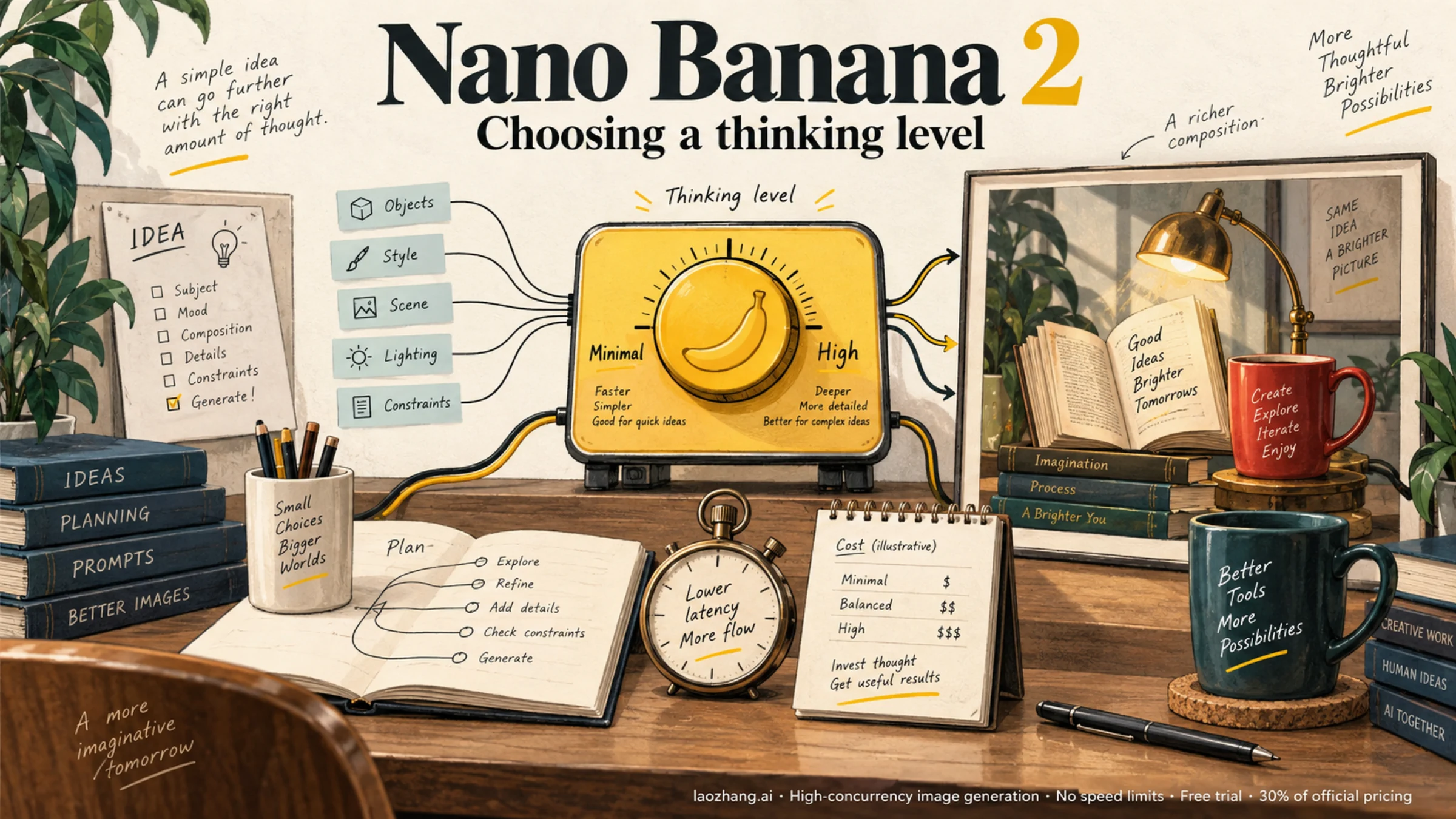
The official blog post announcing Build with Nano Banana 2 strengthens the same point. Google is not only selling the model. It is selling a direct product surface with improved text rendering, localization, configurable thinking, more aspect ratios, and a 512px quick-iteration tier. If those are the things you actually want, the cheapest relay is not always the best replacement.
So the clean rule is this: keep Google's direct route when official Google-native features or official Google visibility are more important than lowering the access cost. If you need the deeper cost ladder first, Nano Banana 2 API pricing is the right companion page. If you are deciding whether Batch is operationally acceptable, Gemini image generation workflow: batch vs realtime is the better next read.
Use a relay when price shape and setup friction are the real blockers
Relays are the right answer when you still want Nano Banana 2, but you do not want the official Google buying surface.
That includes a few common cases:
- your team already uses OpenAI-style SDKs and wants the smallest possible migration
- you want flatter per-image math instead of token-to-resolution translation
- you do not want to manage Google Cloud projects, billing, and account-tier interpretation just to test a production route
- you want one key that can switch across multiple image models without redesigning the client layer
This is why pages like EvoLink's Nano Banana 2 API page rank. The page gives buyers exactly what the current SERP wants: the same underlying model, lower quoted pricing than Google, OpenAI-compatible access, and no Google Cloud setup story. As of March 28, 2026, EvoLink's public page publishes $0.0806 per 2K image and $0.1210 per 4K image. That is not the absolute lowest number you will see on page one, but it is a clear example of the access-route alternative the keyword is really about.
Another current example is laozhang.ai, which is relevant here because this is specifically an image-model API query. The useful thing about its public Nano Banana2 docs is not only the route itself. It is the caution signal. The same page currently publishes two different prices: $0.045 in the summary and comparison table, but $0.03 in the supporting bullets, billing note, FAQ, and changelog. That inconsistency does not make the route useless. It does make trust part of the buying decision. A serious buyer should verify live billing before committing traffic just because a page says "cheaper than Google."
That trust caveat is the piece most weak landing pages skip. A relay is worth using when the problem is the official buying surface. It is not worth using just because the headline is aggressively simple. If you keep that rule in mind, the relay decision becomes much easier:
- Use a relay when setup friction and price shape are the blockers.
- Do not use a relay when official Google-native features are the reason you chose Nano Banana 2.
If you want the broader Gemini-family version of this decision, including when a relay starts making more sense across the whole image stack, Gemini image API alternative covers that wider question.
Stop shopping for Nano Banana 2 routes when the real problem is model fit
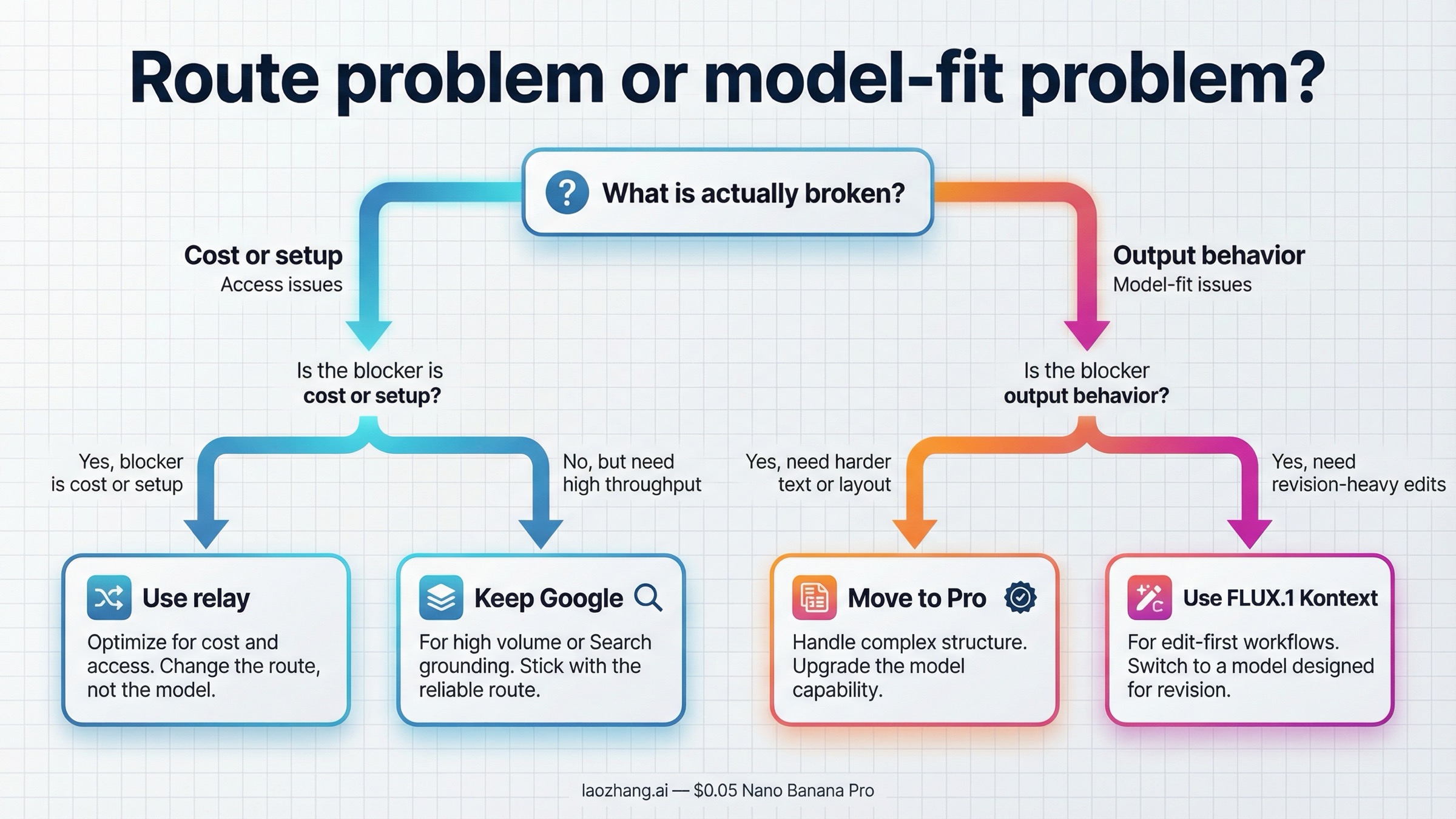
Some readers are looking for an "API alternative" only because they have not yet named the real blocker.
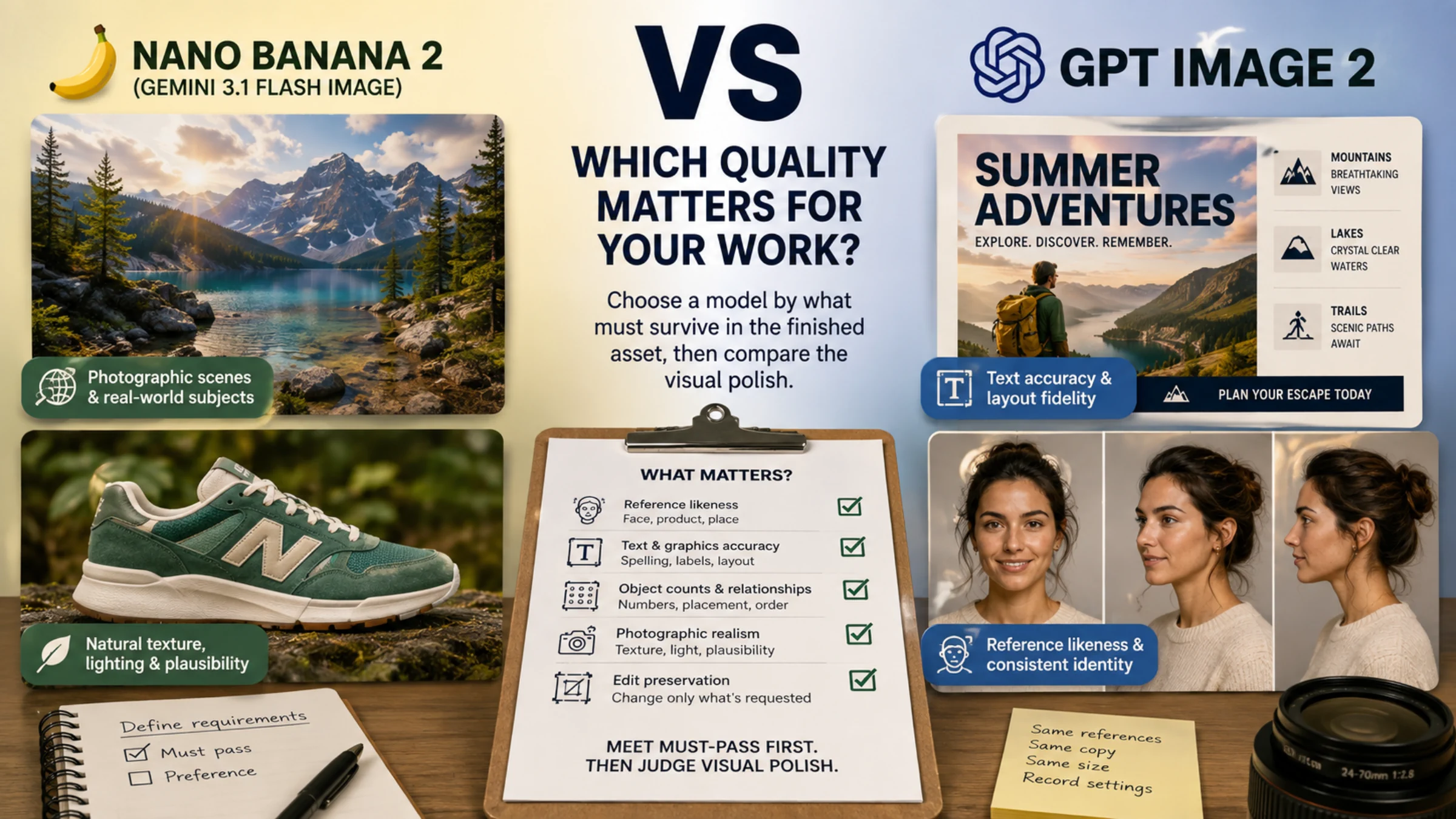
If the image failures are about harder text rendering, infographic-style layouts, or premium 4K polish, the better answer is often Nano Banana Pro, not another Nano Banana 2 access layer. Google's current pricing page still makes Pro much more expensive, but that is because it is a different lane. If your images are now final-form assets instead of fast iterations, the correct decision may be to move up rather than sideways. Our dedicated Nano Banana 2 vs Nano Banana Pro guide is the better page for that split.
If the blocker is revision-heavy editing rather than first-pass speed, a model switch can make more sense than yet another Flash-image route. In practice, this is where edit-first routes such as FLUX.1 Kontext start to make more sense than buying the same Google Flash lane through a different gateway. A reader in that situation should stop asking "which Nano Banana 2 API alternative is cheapest?" and start asking "which model fits a revision-first workflow?" That is a very different question from cheaper access to gemini-3.1-flash-image-preview.
This section matters because the current SERP keeps flattening all these needs into a single price conversation. A good decision page should not do that. Sometimes the honest answer is still a cheaper relay. Sometimes the honest answer is "you do not have a billing problem, you have a model-fit problem."
How I would test the alternative in one afternoon
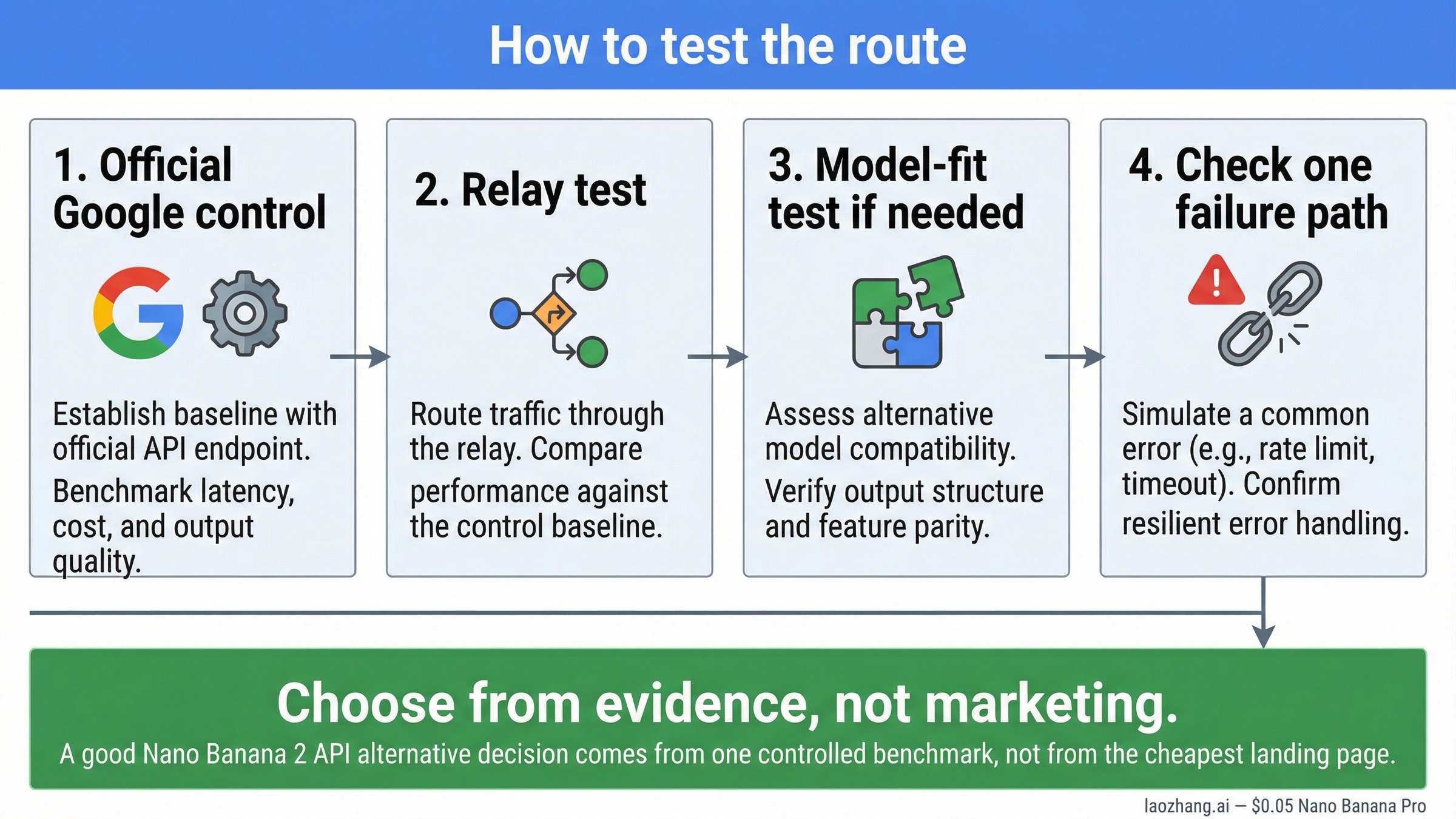
Do not choose this route from marketing copy. Choose it from one controlled comparison.
- Run one official Google control with the exact prompt or edit flow you actually care about. Use the route you would keep if you did nothing.
- Run one relay version of the same request. Measure not only cost but also latency, response stability, and how much client code had to change.
- If the output itself still is not good enough, run one model-fit test instead of another relay test. That is where you learn whether the real upgrade is Nano Banana Pro or a different workflow model.
- Check one failure path, not just one success path. A route that saves money on green-path prompts but becomes harder to debug under rate, billing, or response-shape problems is not automatically the better production choice.
That sequence sounds obvious, but it is exactly what most price-first landing pages try to help you skip. They want you to believe the route is decided as soon as the headline savings number looks good. Production decisions are not that simple.
If you are also normalizing clients around a shared OpenAI-style interface, Gemini image generation API base URL can help with the surface-level migration side of the work.
FAQ
Is Nano Banana 2 free on the API?
Not on the current direct developer route. Google's official pricing page still says the free tier has limited access to certain models, and Google's February 26, 2026 Nano Banana 2 developer post says a paid API key is required to use the model in Google AI Studio.
Is a relay the same model as Google's direct Nano Banana 2 API?
Usually it is marketed that way, and the better relay pages explicitly map their offer to gemini-3.1-flash-image-preview. But "same model" does not automatically mean "same product surface." Search grounding, Batch support, quota visibility, billing behavior, and docs quality can still differ in ways that matter operationally.
What is the cheapest current Nano Banana 2 API route?
The cheapest answer depends on whether you count Google Batch as the alternative. Google's own Batch ladder cuts the direct image-output price roughly in half. Relay pages can still be cheaper or simpler than the standard direct route, but their public pricing and feature claims need to be checked carefully because provider pages can drift faster than Google's docs.
When should I use Nano Banana Pro instead?
Use Pro when the problem is no longer "how do I buy Nano Banana 2 more easily?" and has become "the Flash image lane is not strong enough for this job." That usually means harder text, more polished layouts, or premium 4K deliverables where weak first passes are expensive.
Bottom line
The best Nano Banana 2 API alternative is usually not a different image model. It is a different access route to the same model.
Stay on Google's direct Nano Banana 2 API when Search grounding, Batch pricing, official docs, and direct limit visibility are the reasons you chose the model. Use a relay when your real blocker is Google Cloud setup or the standard direct price shape. Move up to Nano Banana Pro or another model only when the blocker is no longer the access surface, but the Nano Banana 2 lane itself.
That is the clearest rule the March 28, 2026 source set supports, and it is a much more useful answer than another generic "cheaper than Google" page.