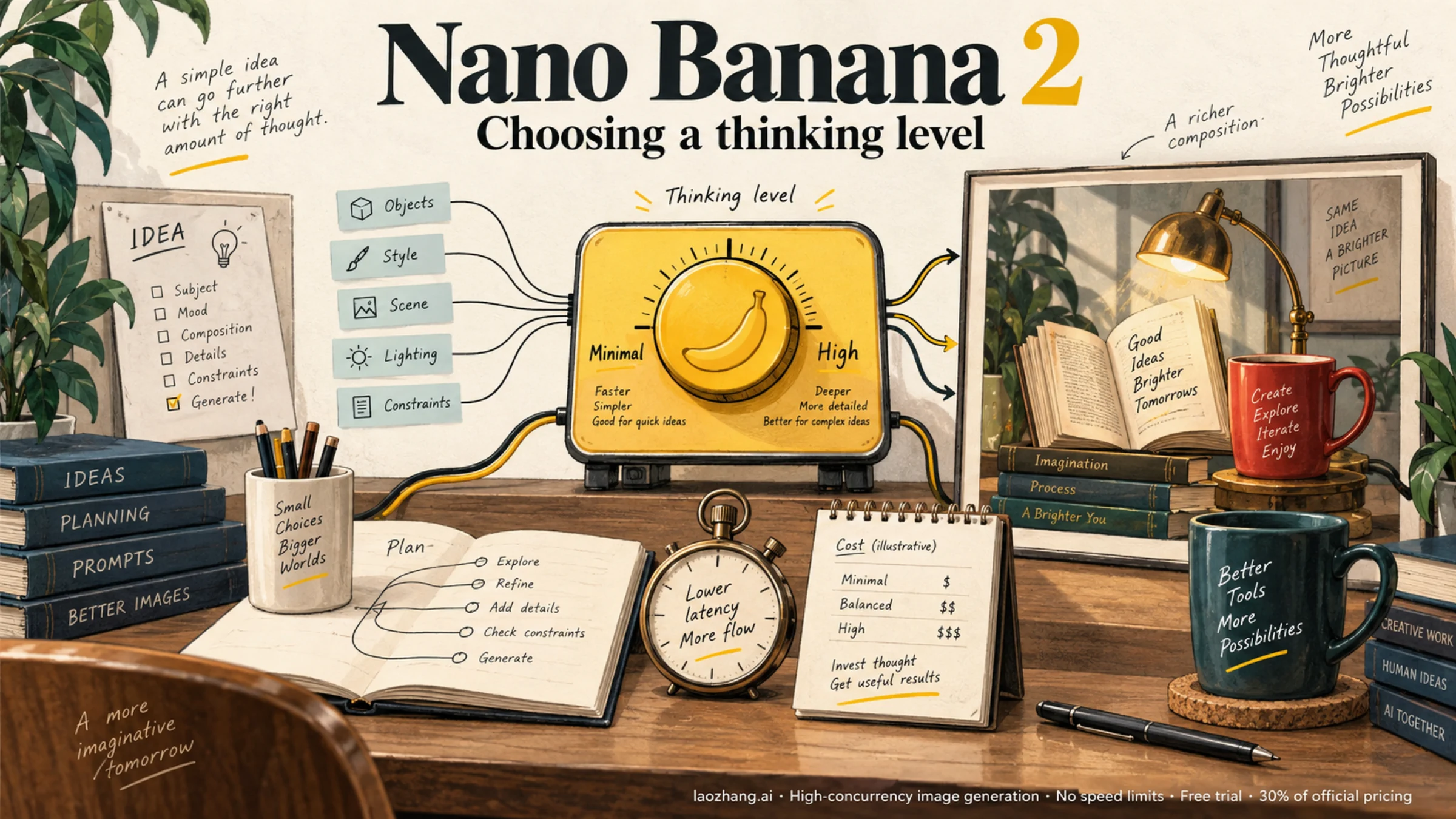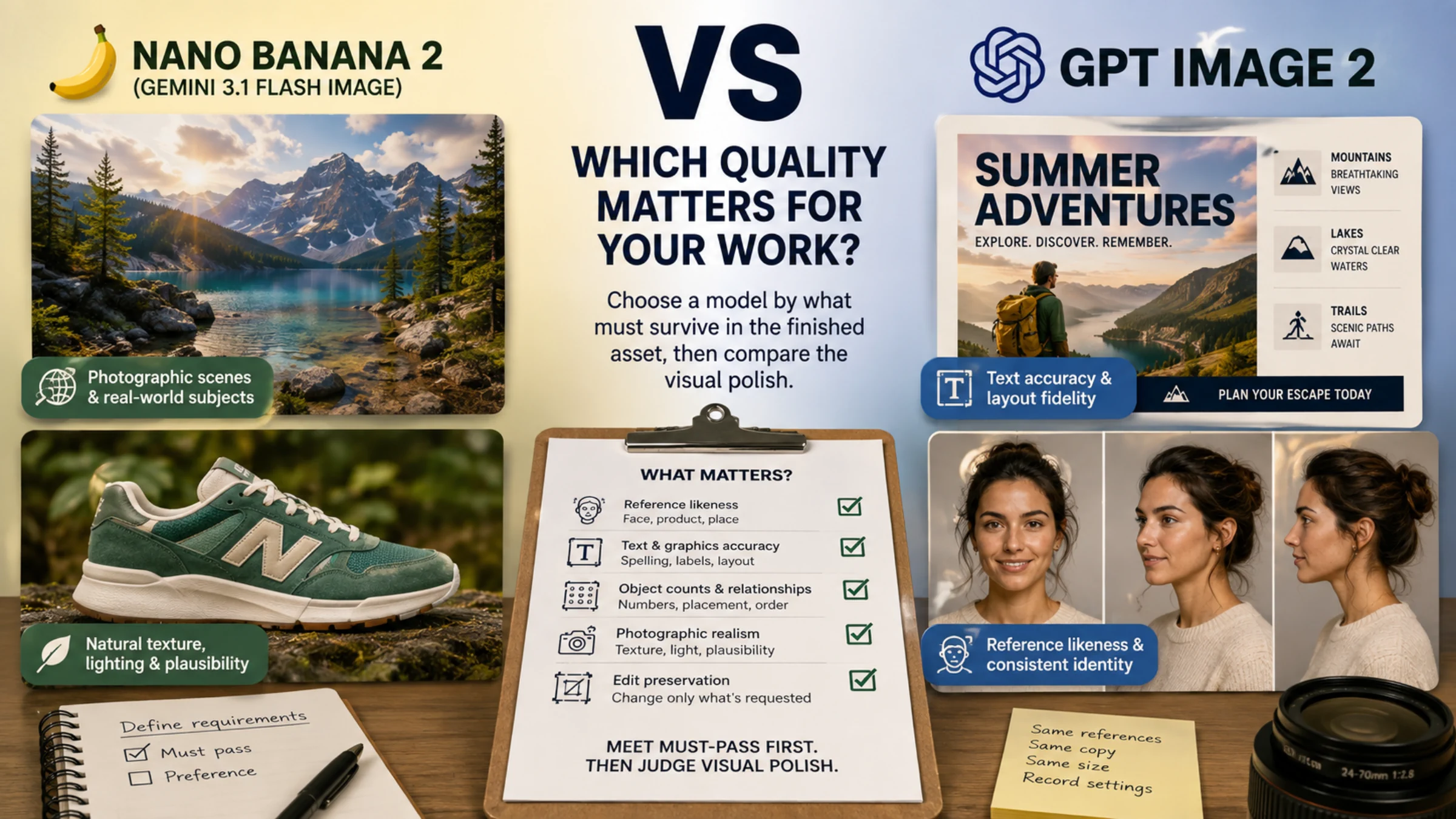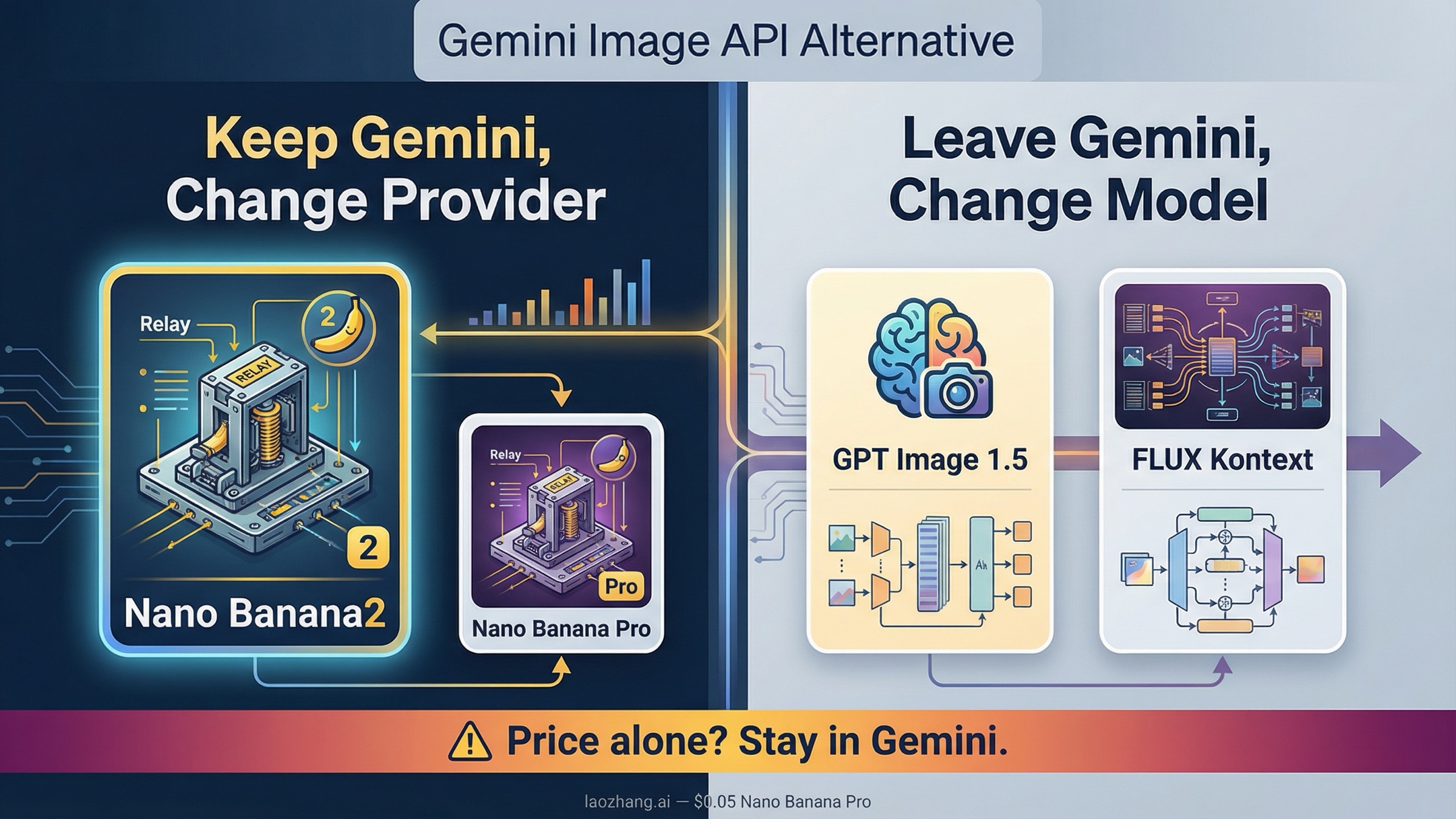
If you still want Gemini-native image generation, the best Gemini image API alternative for most developers is Nano Banana2 through LaoZhang API. It keeps the same underlying gemini-3.1-flash-image-preview model, adds an OpenAI-compatible route for easier migration, and publishes a meaningfully cheaper per-image rate than Google's direct Gemini image pricing.
That answer only holds if your real goal is to keep Gemini and change the access surface. If the actual problem is that you need stronger text-heavy design output, switch to GPT Image 1.5 instead. If the real problem is controlled edits, character consistency, or revision-heavy workflows, FLUX.1 Kontext is the better move. The mistake most ranking pages make is treating those as the same decision.
There is one caveat you should know before you choose Nano Banana2. The current LaoZhang docs, checked on March 26, 2026, publish two different prices on the same page: the headline and comparison table say $0.045/image, while supporting bullets, billing notes, FAQ, and changelog still say $0.03/image. I would plan around $0.045/image until those docs are synchronized. Even with that conservative number, the route is still cheaper than Google's direct Gemini 3.1 Flash Image pricing.
TL;DR
- Use Nano Banana2 via LaoZhang API if you still want Gemini-native image generation and your real problem is Google's direct price or billing surface.
- Use Nano Banana Pro via LaoZhang API if you still want Gemini-native output but need premium quality, harder text rendering, or 4K-heavy work.
- Switch to GPT Image 1.5 only when typography-heavy design is the blocker, and switch to FLUX.1 Kontext only when edit loops and consistency are the blocker.
- Treat $0.045/image as the safer current Nano Banana2 planning price until LaoZhang's page stops publishing both
$0.045and$0.03.
The fastest switch rule for Gemini image API users
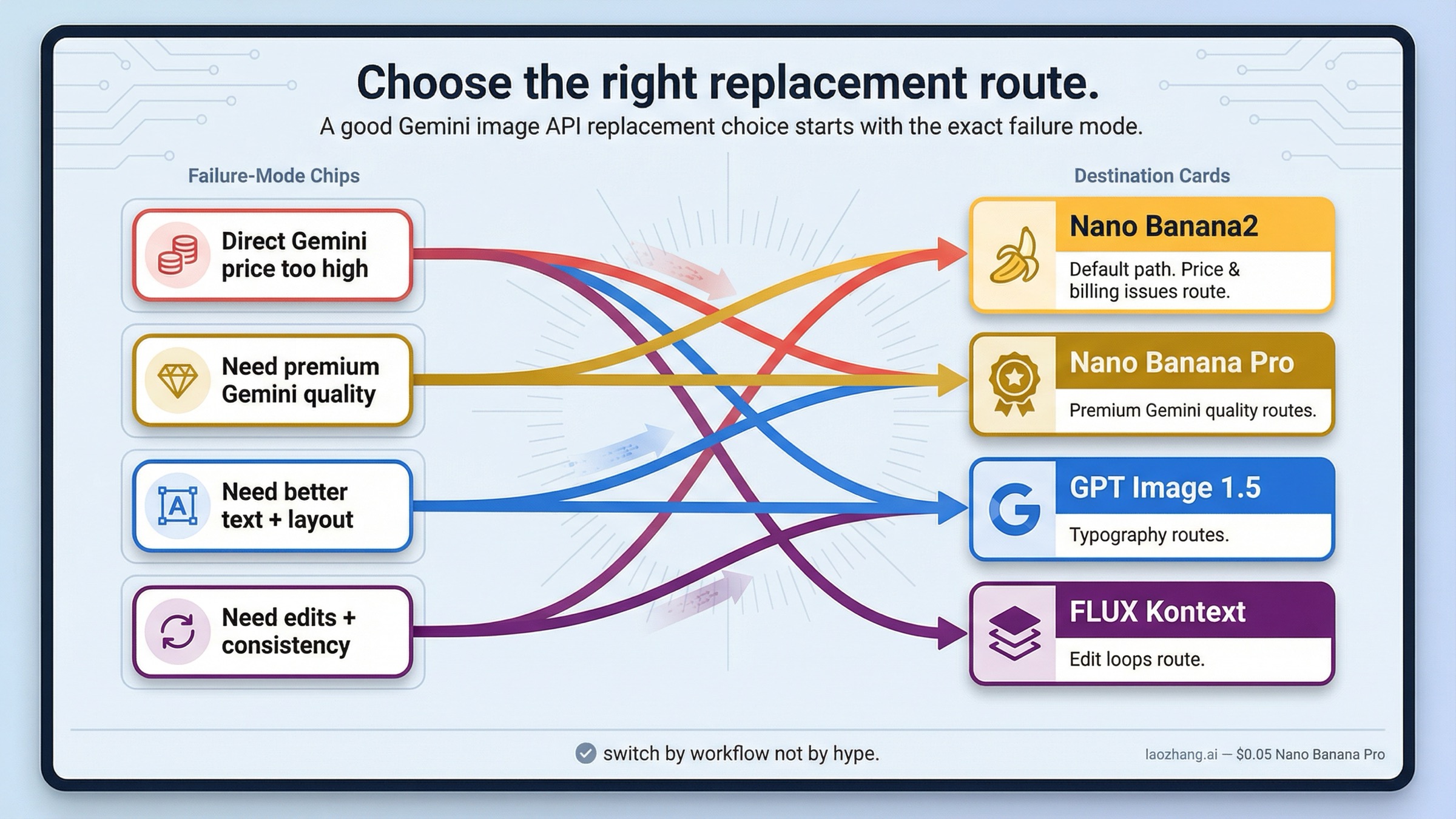
If you only need the routing rule, use this table.
| If the Gemini image API is failing because... | Use this instead | Why this is the right move | Main tradeoff |
|---|---|---|---|
| Google's direct pricing or billing surface is the problem, but you still want Gemini 3.1 Flash Image | Nano Banana2 via LaoZhang API | Keeps gemini-3.1-flash-image-preview, adds OpenAI-compatible access, and publishes a lower price than Google's direct route | You depend on a third-party relay, and the current docs show conflicting published prices |
| You want Gemini 3 Pro Image quality without paying Google's direct Pro image rates | Nano Banana Pro via LaoZhang API | Keeps gemini-3-pro-image-preview, supports Google-native 4K output, and publishes a much lower per-image rate than Google's direct Pro route | Still a third-party relay rather than Google's own billing and support surface |
| The real blocker is typography-heavy design, posters, ads, or polished marketing visuals | GPT Image 1.5 | OpenAI currently positions GPT Image around instruction following, text rendering, and detailed editing | This is a real model switch, not the cheapest Gemini-compatible replacement |
| The real blocker is iterative edits, character consistency, or controlled revision loops | FLUX.1 Kontext | Kontext is explicitly built around generation plus editing, text editing, and consistency across revisions | You leave the Gemini family and take on a different model behavior and API surface |
| You need official Google billing, direct Google support paths, or do not want a relay | Stay on Google's direct Gemini API | Best fit when procurement, compliance, or provider policy matters more than price | Higher direct cost and preview-model friction remain your problem |
The key point is that this keyword is really two questions disguised as one. Some readers want a cheaper Gemini-compatible API. Others actually want a better image model for a different workflow. Those should not be answered with the same recommendation.
Why Nano Banana2 is the best Gemini image API alternative for most developers
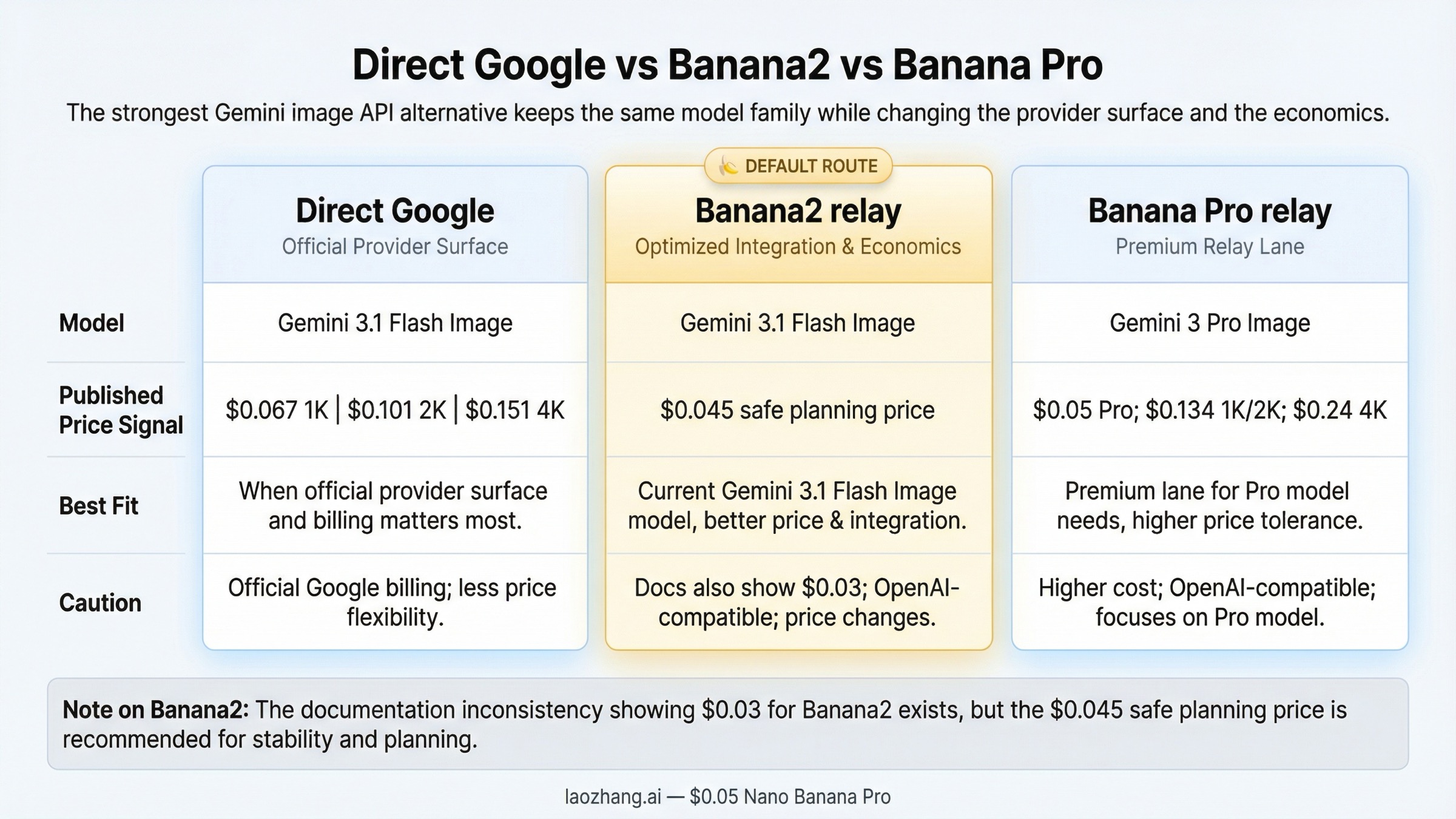
For most API users, the strongest replacement route is not leaving Gemini. It is keeping the current Gemini 3.1 Flash Image model and changing how you buy and call it.
Google's own docs make that model the right baseline. The official Gemini pricing page, checked on March 26, 2026, lists gemini-3.1-flash-image-preview at about $0.067 per 1K image, $0.101 per 2K image, and $0.151 per 4K image on the standard paid tier. Google's deprecations page also keeps that model live with no shutdown date announced, while the older gemini-2.5-flash-image route now has an October 2, 2026 shutdown date. So if you want the current forward Gemini image lane, this is the model you are trying to keep.
That is what makes Nano Banana2 interesting. LaoZhang's current Nano Banana2 page says the service is its name for gemini-3.1-flash-image-preview, and that usage is identical to Nano Banana Pro except for the model name. The page also exposes two surfaces that matter for migration: an OpenAI-compatible endpoint and a Google-native endpoint. If your team already has OpenAI-style tooling in production, that is a real operational advantage. You are not only chasing a lower headline price. You are reducing migration friction.
Even with the conservative interpretation of the current docs, the cost logic is still favorable. If you treat Nano Banana2 as $0.045/image instead of the lower inconsistent $0.03/image figure, it still beats Google's direct Gemini 3.1 Flash Image pricing at 1K and above. That means the buyer case is straightforward for many teams: keep the same model family, pay less, and preserve the option to use a friendlier integration surface.
There are still honest reasons to stay with Google's direct API. If you need an official Google billing relationship, want rate-limit visibility inside AI Studio, or do not want a relay in the middle of your image pipeline, the direct route is still the cleanest answer. But if the thing you are replacing is mostly price, billing friction, or integration surface, Nano Banana2 is the better default than a full model switch.
If you want the deeper pricing background before you choose, Gemini image generation API pricing is the right companion.
When Nano Banana Pro is worth paying for
Nano Banana Pro is the right answer when you still want Gemini-native output, but you no longer want the cheaper Flash image lane.
Google's official pricing currently puts gemini-3-pro-image-preview at about $0.134 per 1K or 2K image and $0.24 per 4K image. Google's models page also positions Nano Banana Pro as the premium Gemini image lane for studio-quality 4K visuals, complex layouts, and precise text rendering. In other words, Pro exists for the harder jobs: infographics, text-heavy promotional assets, more complex compositions, and premium deliverables where weak first-pass quality costs more than the model itself.
LaoZhang's current Nano Banana Pro page maps directly to that same gemini-3-pro-image-preview model and publishes a $0.05/image price. It also exposes both an OpenAI-compatible mode and a Google-native mode, with the native route supporting 10 aspect ratios and 1K, 2K, and 4K output. For buyers who want Gemini 3 Pro Image quality but not Google's direct price surface, that is a meaningful difference.
This is where many "best Gemini alternative" pages get sloppy. They treat Pro as the universal answer because it looks more premium. That is not the most useful rule. Pro is the right answer only when the improved quality, text rendering, or 4K-heavy output actually changes the economics of your work. If your job is high-volume product drafts, concept exploration, or fast asset generation, Banana2 is still the stronger default. If your job is polished premium output where bad first passes are expensive, Banana Pro becomes easy to justify.
The cleaner way to think about it is:
- Nano Banana2 when you want the best Gemini-compatible value
- Nano Banana Pro when you want the best Gemini-compatible quality
That split is much more useful than a generic "Pro is better" summary.
When you should leave Gemini for GPT Image 1.5
Some readers do not need a cheaper Gemini route. They need a different image model because the bottleneck is no longer price or provider surface. It is output behavior.
This is where GPT Image 1.5 becomes the better answer. OpenAI's current image generation guide positions GPT Image around instruction following, text rendering, detailed editing, and real-world knowledge. That makes it the strongest non-Gemini alternative when the thing that keeps failing is poster-style layout work, readable on-image text, marketing graphics, or polished creative output where typography matters as much as the image itself.
That is a different job from "cheapest way to keep Gemini 3.1 Flash Image." It is also why GPT Image 1.5 should not be the default answer to this keyword. If you still want Gemini-native capabilities and your main complaint is price or billing, GPT Image 1.5 is not the simplest or cheapest fix. But if the real sentence is "Gemini keeps missing the design brief when text and layout matter," then GPT Image 1.5 is the better switch.
This is also where a lot of searchers end up mixing two separate comparisons:
- Gemini-compatible vs cheaper: stay in the Gemini family, route through Banana2 or Pro
- Gemini vs better design output: leave Gemini, test GPT Image 1.5
If you skip that split, you either overpay for a model switch you did not need, or you keep forcing Gemini through a design job where another model is simply a better fit.
If that is your real comparison, Gemini vs OpenAI image generation goes deeper on the workflow tradeoff.
When FLUX.1 Kontext is the better move than any Gemini-compatible relay
FLUX.1 Kontext matters for a third reason: some users are not unhappy with Gemini's image quality or price. They are unhappy with the edit loop.
Black Forest Labs positions Kontext around text-to-image, image editing, character consistency, text editing, and style transformation. The current Kontext overview also keeps the pricing clean: $0.04 per image for Kontext Pro and $0.08 per image for Kontext Max. That matters because it makes FLUX a credible operational switch, not just an interesting experimental model.
This is the route to choose when your real workflow sounds like this:
- you need to update existing assets repeatedly
- you care about preserving identity across variations
- you need controlled revisions rather than only one-shot generations
- you want text replacement and layout edits to be first-class parts of the workflow
That is not the same job as cheap Gemini access. It is also not the same job as polished typography-first output. It is a revision-heavy production workflow, and FLUX is a better answer there than Banana2, Banana Pro, or GPT Image 1.5.
The price comparison is also useful. If you use the safer $0.045/image interpretation for Banana2, FLUX Kontext Pro is actually in the same rough price neighborhood. So when edit control is the real blocker, it is usually better to pick the edit-first model than to keep forcing a Gemini-compatible route because the brand name feels familiar.
For the deeper model background, our FLUX.1 API guide is the next step.
The price caveat most roundups miss
This is the trust section broad SERP pages still tend to skip.
LaoZhang's Nano Banana2 docs currently publish two prices at once.
The headline, summary sentence, and comparison table say $0.045/image. But the supporting bullet list, billing section, FAQ table, and changelog still say $0.03/image. That is not a tiny footnote. It is the kind of inconsistency that can distort the buyer decision if the article pretends it does not exist.
The safest way to handle it is:
- treat $0.045/image as the current working price because it is the more visible current publication on the page
- keep the
$0.03/imagereferences in mind as a documentation inconsistency, not as a guaranteed live rate - only treat the lower number as real after the docs are synchronized or billing confirms it
The good news is that this does not break the recommendation. Even at $0.045/image, Nano Banana2 still looks materially cheaper than Google's direct Gemini 3.1 Flash Image pricing at 1K, 2K, and 4K output. The caveat changes the tone of the recommendation, not the direction of it.
That is why the honest phrasing is not "Nano Banana2 costs $0.03, full stop." The honest phrasing is "Nano Banana2 currently publishes both $0.045 and $0.03; plan around $0.045 until the docs are synchronized."
What I would choose in four real situations
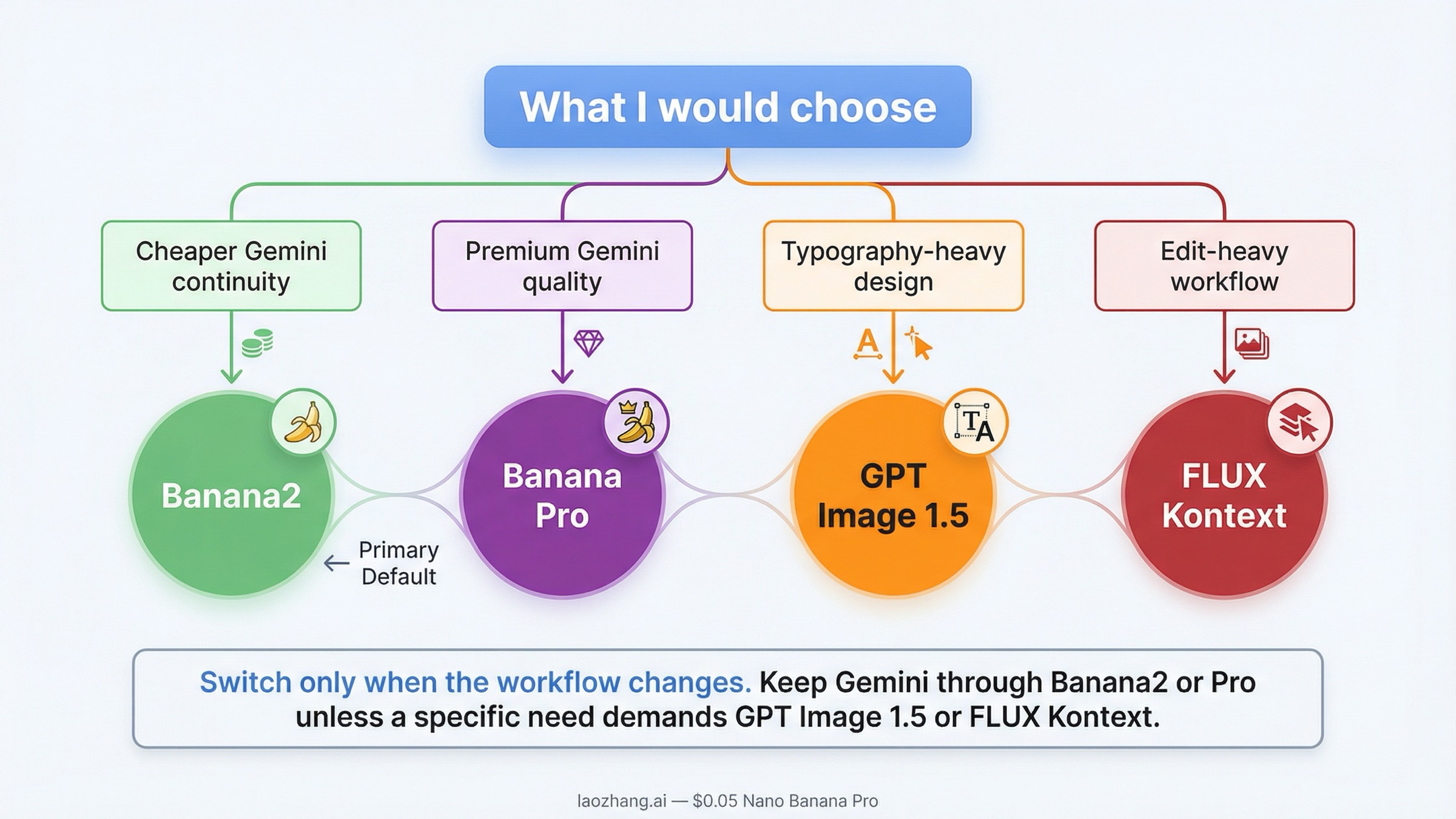
I want the same Gemini 3.1 Flash Image model, but cheaper and easier to migrate into my current stack. I would choose Nano Banana2. That is the cleanest answer when cost and provider surface are the real problem.
I want Gemini-native output, but my work is premium enough that weak first passes are expensive. I would choose Nano Banana Pro. This is the route for premium text-heavy, infographic-like, or 4K-heavy work where better first-pass quality matters more than absolute lowest cost.
I am tired of fighting layout, typography, and polished marketing graphics. I would switch to GPT Image 1.5. That is the better answer when the problem is no longer Gemini access but design-oriented output quality.
My workflow is really about revisions, consistency, and controlled editing. I would choose FLUX.1 Kontext. Once revision loops become the center of the job, an edit-first model beats a cheaper Gemini-compatible relay.
Bottom line
The best Gemini image API alternative depends on whether you are trying to replace Gemini itself or only Google's direct pricing and integration surface.
If you still want Gemini-native image generation, the best default is Nano Banana2 via LaoZhang API. If you need premium Gemini-native quality, move to Nano Banana Pro. If the real blocker is typography and polished design output, switch to GPT Image 1.5. If the real blocker is edit-heavy production work, switch to FLUX.1 Kontext.
The one caveat to keep visible is the current Nano Banana2 pricing inconsistency. Plan around $0.045/image until LaoZhang's docs stop publishing two different prices. Even with that conservative assumption, the route is still strong enough that most developers looking for a Gemini image API alternative should test Gemini-compatible relay first and only make a true model switch when the workflow requires it.