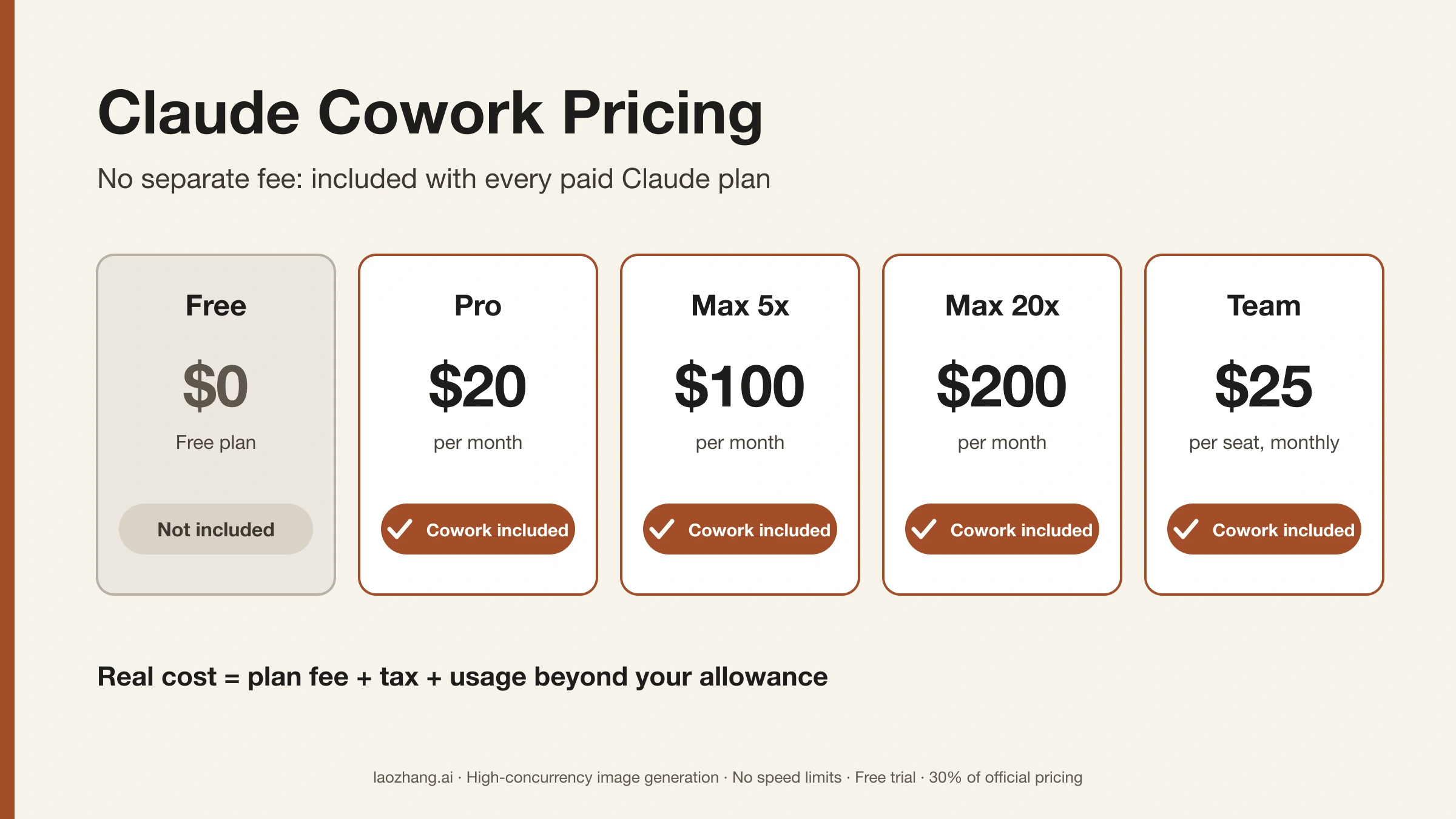
Claude Cowork has no price of its own. As of September 23, 2026, it comes with every paid Claude plan (Pro, Max, Team and Enterprise) at no extra charge, and it isn't part of the Free plan, according to Anthropic's Cowork getting-started guide. The cheapest way in is Pro at $20 a month, or $17 a month on an annual plan. The $100 figure you may have seen dates from January 2026, when Cowork launched as a preview for Max subscribers only.
What you actually pay is a usage question. Cowork tasks draw on the same usage limits as chat and Claude Code, and a task that reads files, runs code or browses the web uses more of that allowance than a quick question. When the allowance runs out, you wait for the reset, pay for extra usage at API rates, or move to a bigger plan.
| Plan | US price, before tax | Cowork | Allowance per 5-hour session (Pro = 1x) | After the included allowance |
|---|---|---|---|---|
| Free | $0 | Not included | Not applicable | Not applicable |
| Pro | $20/month, or $200/year (about $17/month) | Included | 1x | Wait for the reset, or pay-as-you-go usage credits |
| Max 5x | $100/month, monthly billing only | Included | 5x | Wait, or usage credits |
| Max 20x | $200/month, monthly billing only | Included | 20x | Wait, or usage credits |
| Team, Standard seat | $25 per member monthly, $20 billed annually | Included | 1.25x per member | Credits the team owner prepurchases |
| Team, Premium seat | $125 per member monthly, $100 billed annually | Included | 6.25x per member | Credits the team owner prepurchases |
| Enterprise | $20 per seat per month, billed annually | Included | No included usage | Every token billed at API rates |
Prices come from claude.com/pricing and the Team plan help page. The allowance column compares the five-hour session only. Anthropic doesn't publish weekly limits as multiples, and no plan lists a number of Cowork tasks per month.
What Free gets, and what the paid plans add
Free lets you chat, search the web, create files, run code, use connectors and keep up to five Projects. What it doesn't include is the Cowork part: handing Claude a task to finish on its own and scheduling recurring tasks. Those start at Pro on the pricing page, along with Claude Code, Research and Claude in Chrome. Free also has no Opus or Fable models and can't buy usage credits, so there is no pay-as-you-go path on Free either.
A few billing details change the number you'll see at checkout:
- Pro annual is billed as $200 up front. That works out to $16.67 a month, shown as $17.
- Max is monthly only. There's no annual discount on Max 5x or Max 20x, per the Max plan page.
- The listed prices are US web prices before tax. Buying through the iOS or Android app can cost a different amount, and local currency and tax handling vary by region. The exact price for your location is shown at claude.ai/upgrade.
- No standing discounts exist. Anthropic says it runs occasional limited-time promotions but has no student pricing or coupons on request, per the Pro plan page.
- The Claude API is a separate bill. A Pro or Max subscription doesn't include Claude Console usage, and an API key doesn't pay for Cowork.
Where Cowork runs on each plan
Cowork is not desktop-only anymore. Claude Desktop for macOS and Windows works on every paid plan. The web app at claude.ai and the Claude mobile apps work on Pro, Max and Team, and on Enterprise where an admin has turned them on. The Claude in Chrome side panel is available on Max and Team and is rolling out to Pro.
The desktop app still matters for one kind of work. Tasks that touch local files, your browser or other apps on your computer need Claude Desktop open, because that's how Claude reaches your machine. Research, drafting and scheduled tasks can run in Anthropic's cloud and keep going after you close your laptop.
On Team and Enterprise, admins decide some of this. Cowork is on by default and an owner can switch it off for the whole organization. Running Cowork tasks in the cloud is on by default for Team and off by default for Enterprise, per Anthropic's Team and Enterprise Cowork guide. These settings control availability, not price.
Why the Cowork button may have disappeared
On September 16, 2026, Anthropic announced that Claude Cowork and chat are merging into one Claude. That doesn't mean Cowork was discontinued. The separate Cowork mode is being folded into every conversation: you describe what you need, and Claude decides whether it's a quick answer or a task to work through.
If you're on Pro or Max and your message box no longer shows "Chat" and "Cowork" options, your account has the new experience. Your existing tasks, projects, connectors and skills carry over, and you can't switch back to the separate modes. The rollout reaches Pro and Max accounts over several weeks, so two people on the same plan can see different screens. Anthropic says Team and Free will follow, and Enterprise admins get at least 30 days' notice. For now, Team and Enterprise organizations keep chat and Cowork separate.
Two points matter for cost:
- The announcement lists no price change for any plan.
- While the rollout is under way, "usage may be measured slightly differently for accounts that have it and accounts that don't," according to the Help Center article on the merged experience. Anthropic hasn't said how large that difference is, so compare your own Settings > Usage readings over time rather than a colleague's.
What Free will get once the merged experience reaches it hasn't been announced. Don't plan on Cowork-style task hand-off arriving on Free.
How Cowork uses your plan's allowance
Pro and Max have two limits running at once: a session limit that resets every five hours and a weekly limit across all models that resets at a fixed time assigned to your account. Team seats have the same pair, set per member. Anthropic describes these limits in relative terms only. Max 5x gets five times Pro's per-session allowance, for example, but there's no published token or message count behind "1x."
Cowork adds no separate meter. "Everything you do with Claude counts toward your plan's usage limits," and those limits are shared across chat, Cowork and Claude Code. Cowork tasks feel more expensive because of what they do: "Each step Claude takes uses tokens," so a task that searches, opens files, runs code and writes a spreadsheet spends more than a single reply.
Two choices raise consumption without showing a price:
- Auto mode (automatically approve) "consumes more of your usage limit than the other modes," because Claude runs a safety check on each action. Manual, the default, asks you before each action instead.
- Heavier models use the allowance faster. On Max, Fable models draw from the same weekly pool and use it up faster than other models.
Anthropic's own suggestions for stretching the allowance are practical: group related work into one task, start a new conversation for unrelated work, tell Claude when a quick answer is all you need, and keep reference files in a Project, where cached content counts less when reused (usage limit best practices). Occasional free limit resets also exist, but they're given out at Anthropic's discretion and expire, so they can't go into a budget.
For the mechanics of session and weekly caps on each tier, see Claude Pro vs. Max usage limits.
What it costs when you hit the limit
On Pro and Max, you have three choices at the limit: wait for the reset, switch to a lighter model, or continue on usage credits. Nothing is charged automatically unless you set it up.
Usage credits
Usage credits are off until you enable them in Settings > Usage. Once they're on, you prepay a balance, and anything beyond your included allowance is billed at standard API rates as a separate charge. You can set a monthly spending cap and choose whether the balance auto-reloads. Credits don't change your reset times; the five-hour window still resets on schedule. If you subscribed through a mobile app, you have to enable credits on the web.
On Team, the owner prepurchases credits for the organization and sets spend limits at the organization and member level. Those credits cover Claude, Cowork and Claude Code.
Usage bundles
Usage bundles are prepaid credits at a discount. They require usage credits to be enabled and are only spent after your plan's limits are exceeded.
| Bundle value | You pay | Discount |
|---|---|---|
| $50 | $45 | 10% |
| $250 | $200 | 20% |
| $1,000 | $700 | 30% |
Pro and Max subscribers can buy up to $2,000 in bundle value per month; Team owners can buy up to $3,000. Usage beyond that is billed at standard rates.
What a long task could cost after the limit
Anthropic doesn't publish how many tokens a typical Cowork task uses, so any per-task dollar figure has to be an assumption. The formula is what's useful:
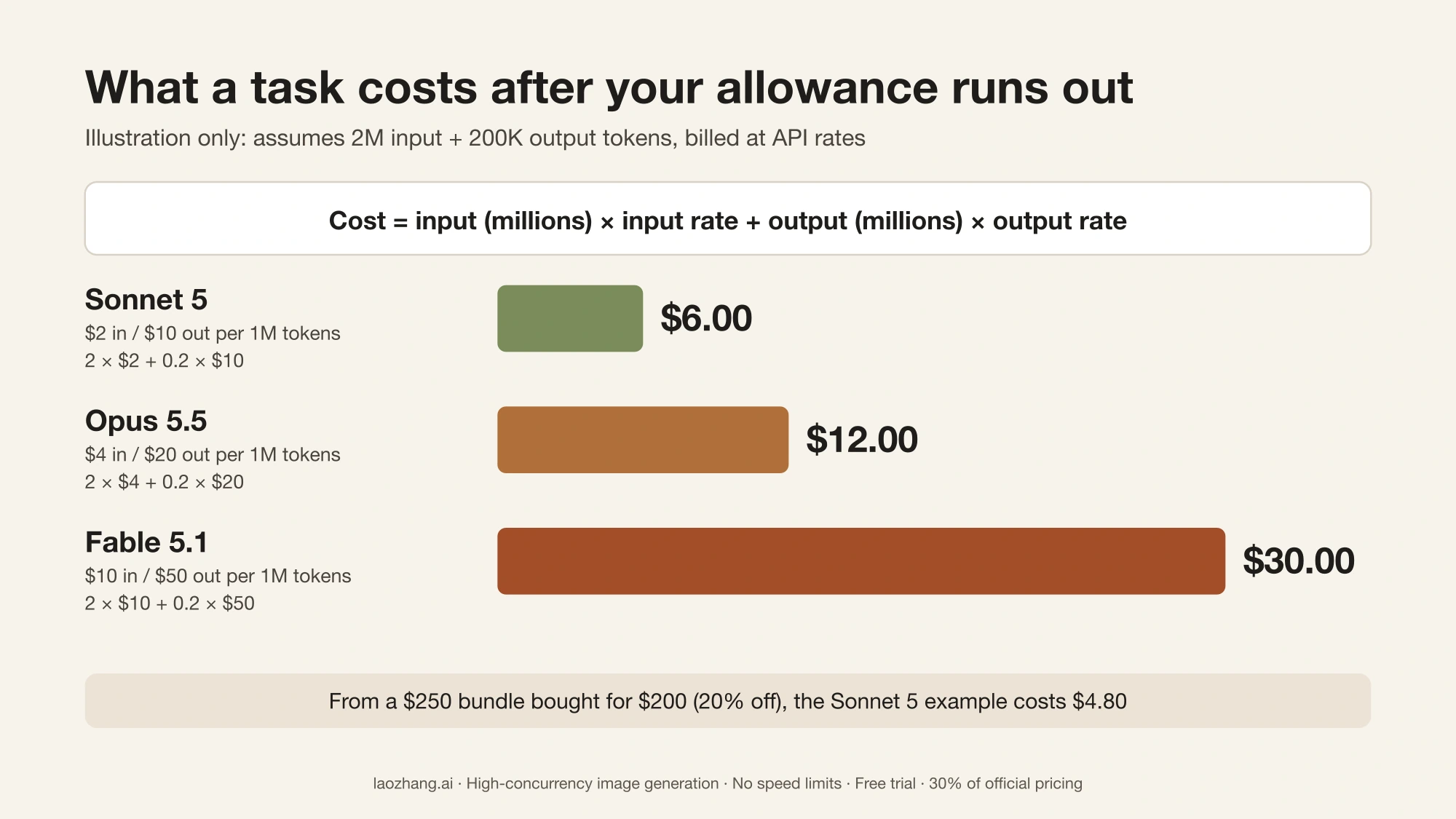
Cost = (input tokens in millions × input rate) + (output tokens in millions × output rate)
Suppose a long research task, run after your included allowance is gone, reads 2 million input tokens and writes 200,000 output tokens. Those counts are made up for illustration. At current API rates per million tokens:
| Model | Input / output rate | Illustrative task cost |
|---|---|---|
| Sonnet 5 | $2 / $10 | 2 × $2 + 0.2 × $10 = $6.00 |
| Opus 5.5 | $4 / $20 | 2 × $4 + 0.2 × $20 = $12.00 |
| Fable 5.1 | $10 / $50 | 2 × $10 + 0.2 × $50 = $30.00 |
At equal token counts, Fable costs five times as much as Sonnet 5. Paying from a $250 bundle bought for $200 takes 20% off, so the Sonnet example drops to $4.80. Cached content is billed at much lower read rates, so real tasks that reuse the same files can come in lower. Your own Settings > Usage history is the only reliable measure.
Fable in Cowork
Fable follows its own plan rules, and they apply in Cowork the same way as in chat (Fable plan guidance). On Pro and Team Standard seats, Fable isn't part of the included allowance, so it's billed as usage credits from the first token. On Max and Team Premium seats, Fable is included up to 50% of the weekly limit. That 50% is a ceiling within the same pool, not extra capacity. For the details, see Claude Fable 5.1 usage limits.
Estimate your monthly total
Your monthly bill comes to:
Plan or seat fees + sales tax + any extra usage you choose to buy
Using US list prices before tax:
| Setup | Fixed cost | What can add to it |
|---|---|---|
| Pro, annual | $200/year, about $16.67/month | Usage credits, if enabled |
| Pro, monthly, plus one $50 bundle | $20 + $45 = $65/month | More credits beyond the bundle |
| Max 5x | $100/month | Usage credits, Fable beyond 50% |
| Max 20x | $200/month | Usage credits, Fable beyond 50% |
| Team, 2 Standard seats | $50/month monthly, or $480/year | Credits the owner buys |
| Team, 4 Standard + 1 Premium | $225/month monthly (4 × $25 + $125), or $180/month annual (4 × $20 + $100) | Credits the owner buys |
| Enterprise, 10 seats | $2,400/year in seat fees | All usage at API rates, from the first token |
Moving from Pro to Max 5x adds $80 a month. Moving to Max 20x adds $180, and going from Max 5x to 20x adds $100.
Which plan to start with, and when to move up
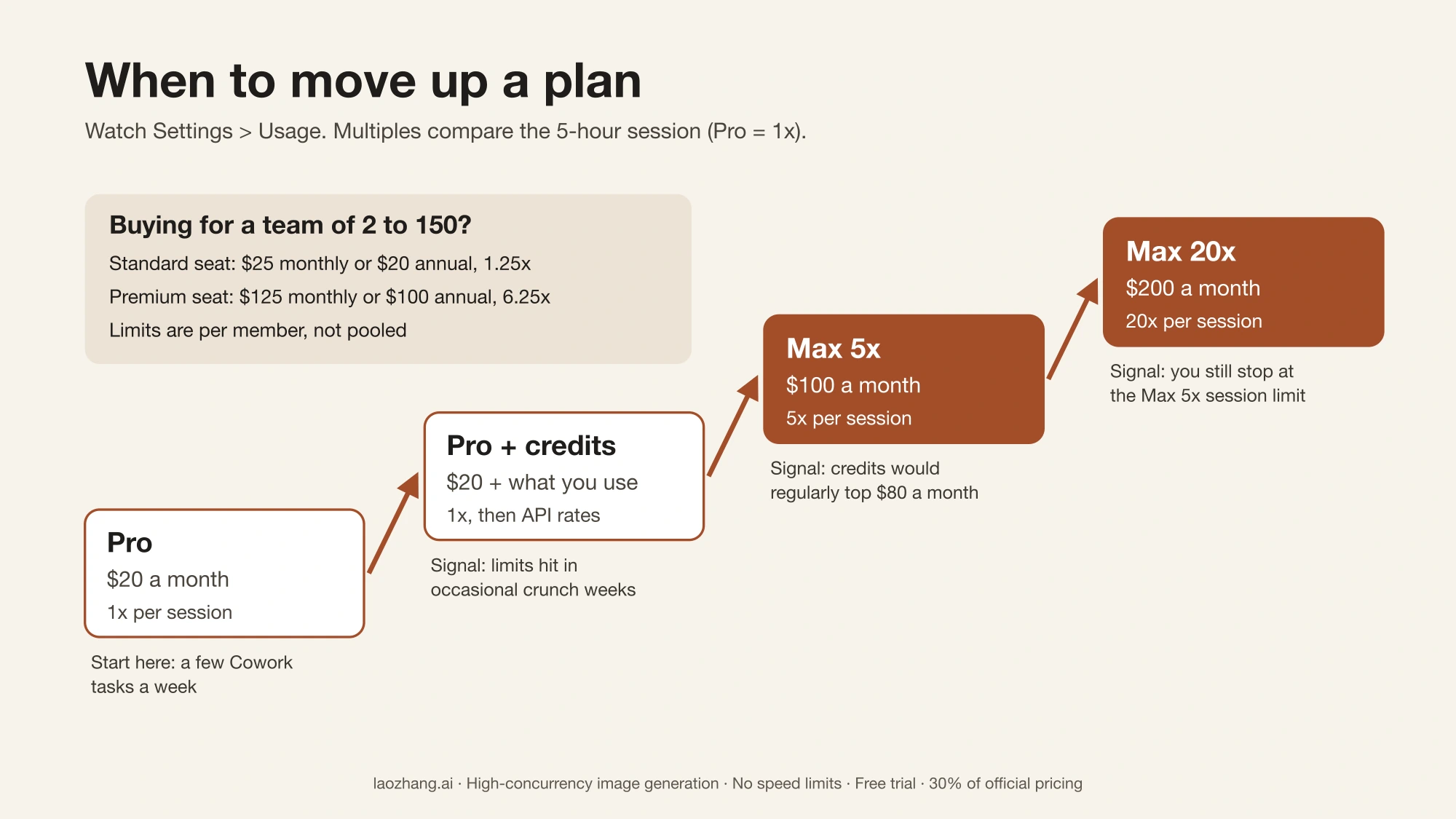
Start from how often you hand Claude a multi-step task, then let your Settings > Usage page tell you when to change.
| Your workload | Start with | Signal to change |
|---|---|---|
| Mostly chat, a few Cowork tasks a week | Pro (annual if you're sure you'll keep it) | You hit the session limit on most working days, or the weekly limit well before it resets |
| Pro, with an occasional crunch week | Pro plus usage credits with a monthly cap, or a $50 bundle | Extra usage turns into a monthly habit |
| Daily multi-step tasks, scheduled reports, Auto mode | Max 5x | You still stop at the Max 5x session limit regularly |
| You want Fable for Cowork tasks | Max 5x or 20x | Your Fable share runs out before the weekly reset |
| A team of 2–150 people | Team Standard seats, with Premium seats for the heaviest users | One member keeps running out while others don't; upgrade that seat rather than everyone's |
| An organization that wants central, usage-based billing or needs more than 150 seats | Enterprise | Budget both seats and tokens from day one |
The "extra usage" signal needs a number. If you'd regularly spend more than $80 a month on usage credits at standard rates, Pro plus credits already costs more than Max 5x's $100. That's a threshold for comparison, not a break-even: Max's larger allowance isn't sold in dollars, so it can't be converted into a credit amount. Because Max bills monthly and upgrades are prorated, testing it for one month is a small commitment.
The bundle math points the same way at higher volumes. Pro plus a $250 bundle costs $220 a month, which is more than Max 20x at $200. For a Pro user who needs only a small top-up, the $50 bundle keeps the total at $65, well under Max 5x.
Team isn't a cheaper route for one person. It needs at least two members and an organization account, and each member's limits are separate rather than pooled.
Team and Enterprise costs
Team bills per seat, from two to 150 members. Standard seats cost $25 per member monthly or $20 billed annually. Premium seats cost $125 or $100 and carry 6.25 times Pro's per-session allowance, five times a Standard seat. Both seat types include Cowork and Claude Code, and you can mix them. Because limits are per member, one heavy user running out doesn't stop anyone else. A member who keeps hitting limits is a candidate for a Premium seat, or for team credits with a per-member spend limit.
Enterprise works differently. The seat fee of $20 per seat per month, billed annually, covers access to Claude, Claude Code and Cowork but doesn't include any usage. Every token is billed at standard API rates, and US-only inference costs 1.1 times those rates for newer models. On self-serve plans, usage comes out of a prepaid credit pool shared by the whole organization, and it stops for everyone when the balance hits zero. Sales-assisted plans are billed monthly in arrears. Owners can set spend limits for the organization and for each user. The seat fee alone tells you nothing about the total, so pilot with a small group and watch token spend before rolling out. Organizations on legacy seat-based Enterprise plans move to this model at renewal.
The $1,000-per-user Enterprise credit promotion for first-time Claude Code and Cowork users had an activation window of June 2 to July 2, 2026, and it has closed.
Pricing claims that are out of date
These claims are still in circulation, and none of them is accurate as of September 23, 2026:
- "Cowork requires Max, so it starts at $100 a month." That was true when Cowork launched in January 2026. Pro gained access the same month, and every paid plan includes it now.
- "Max costs $100." Max has two tiers: Max 5x at $100 and Max 20x at $200.
- "Cowork only works in the desktop app." Web and mobile work on Pro, Max and Team. Only local-file, browser and computer-use tasks need Claude Desktop open.
- "Team needs at least five users." The minimum is two.
- "Team Standard seats don't include Claude Code." Both Team seat types include Claude Code and Cowork.
- "Enterprise is $20 a seat, all in." The seat fee includes no usage.
Quick answers
Is Claude Cowork free?
No. Cowork requires a paid plan, starting with Pro at $20 a month ($17 on annual billing). Free can create files and run code in a chat, but it can't take on tasks, schedule them or use usage credits.
Is there a Claude Cowork free trial or student discount?
Cowork has no trial of its own because it isn't sold separately. Anthropic says it has no standing discounts, including for students, and runs only occasional limited-time promotions. To check whether your account has an offer, see Does Claude Pro have a free trial?
Is Cowork worth $100 a month?
You don't need to spend $100 to use it. Start on Pro, run your usual tasks for a couple of weeks and check Settings > Usage. Max 5x is worth trying when you hit limits on most working days or would otherwise spend more than about $80 a month on credits.
Will the Cowork and chat merger change my price?
The September 16, 2026 announcement lists no price change. The separate Cowork button goes away as accounts move to the merged experience, and usage may be measured slightly differently while the rollout is under way.