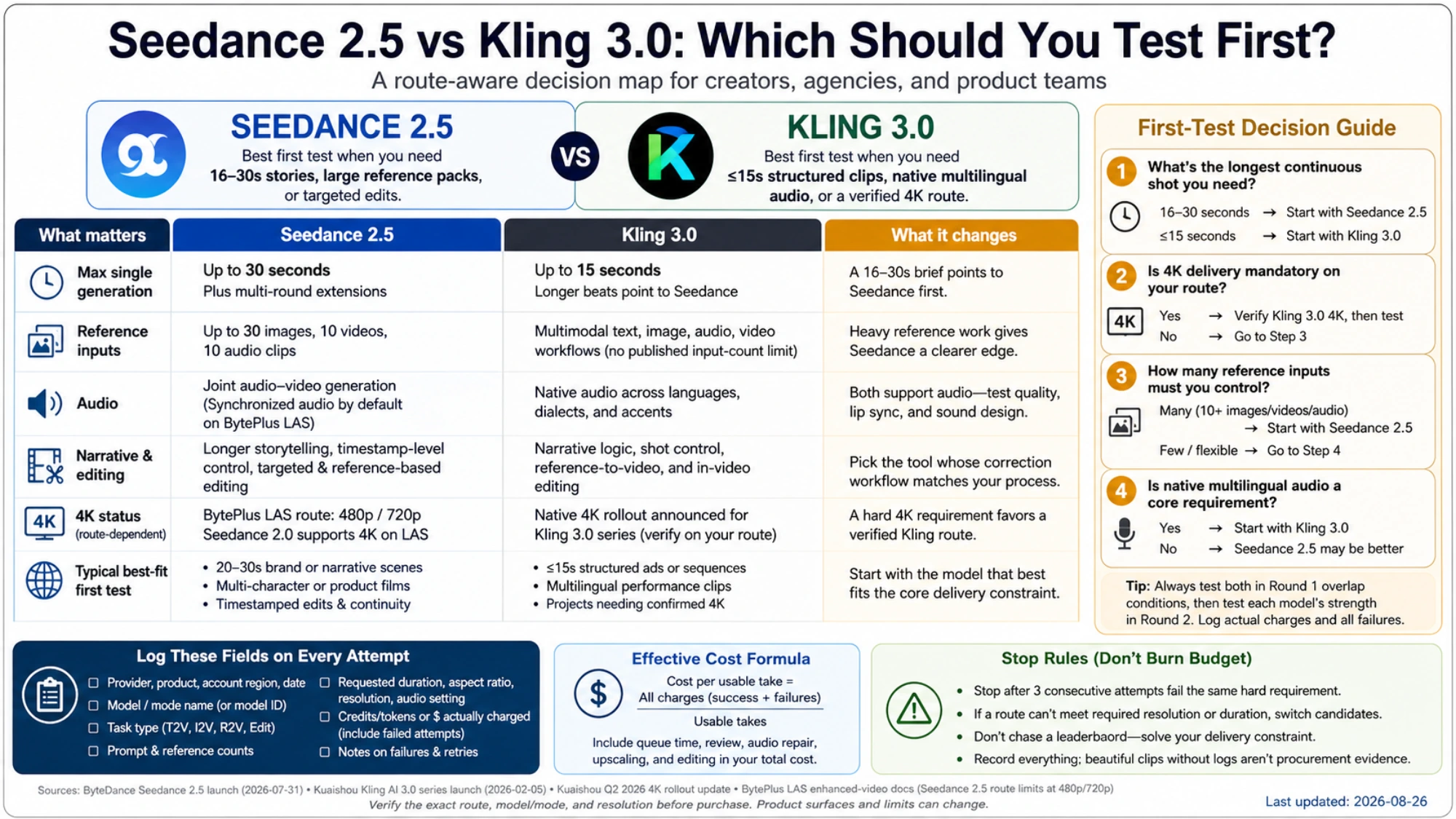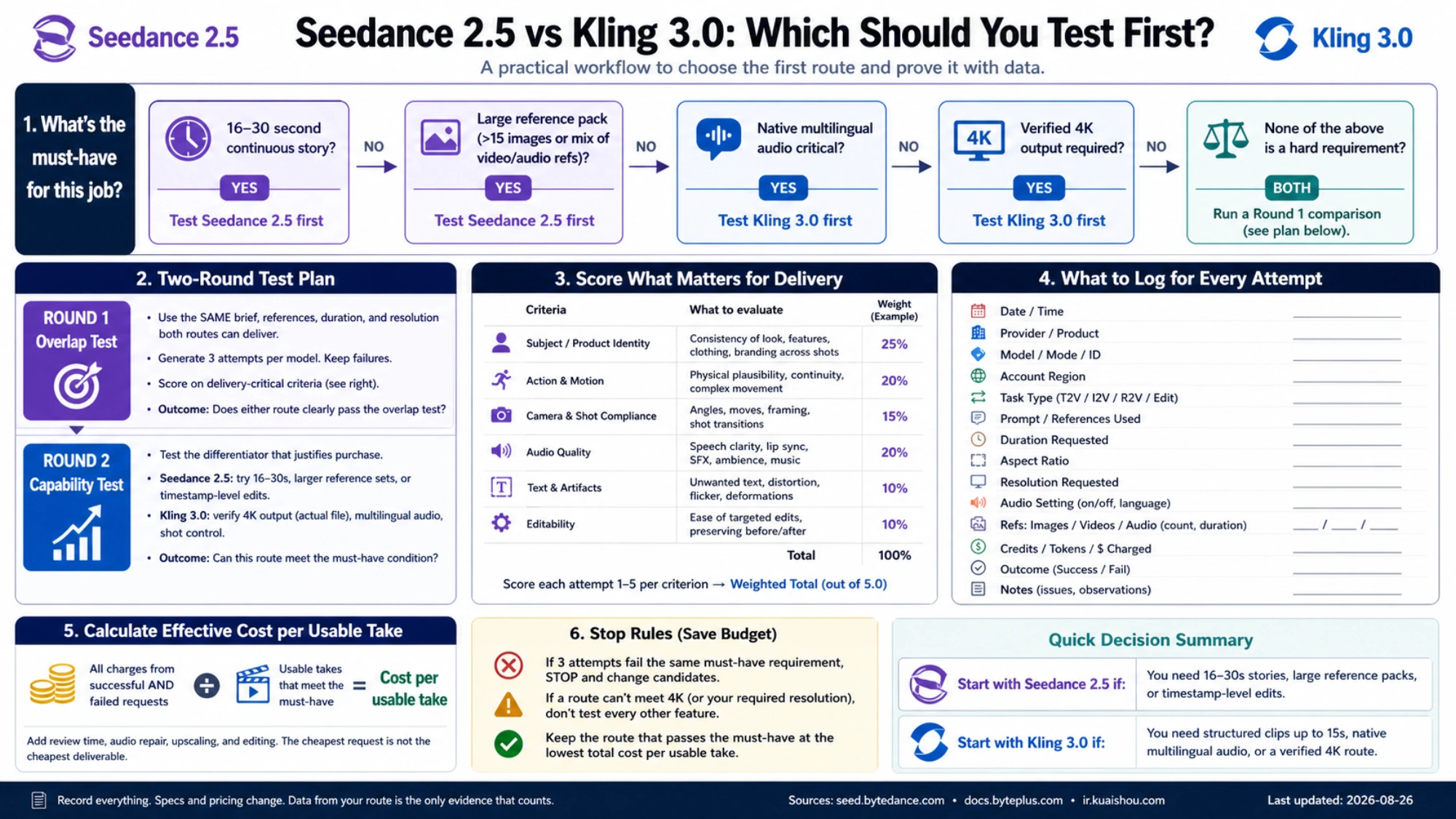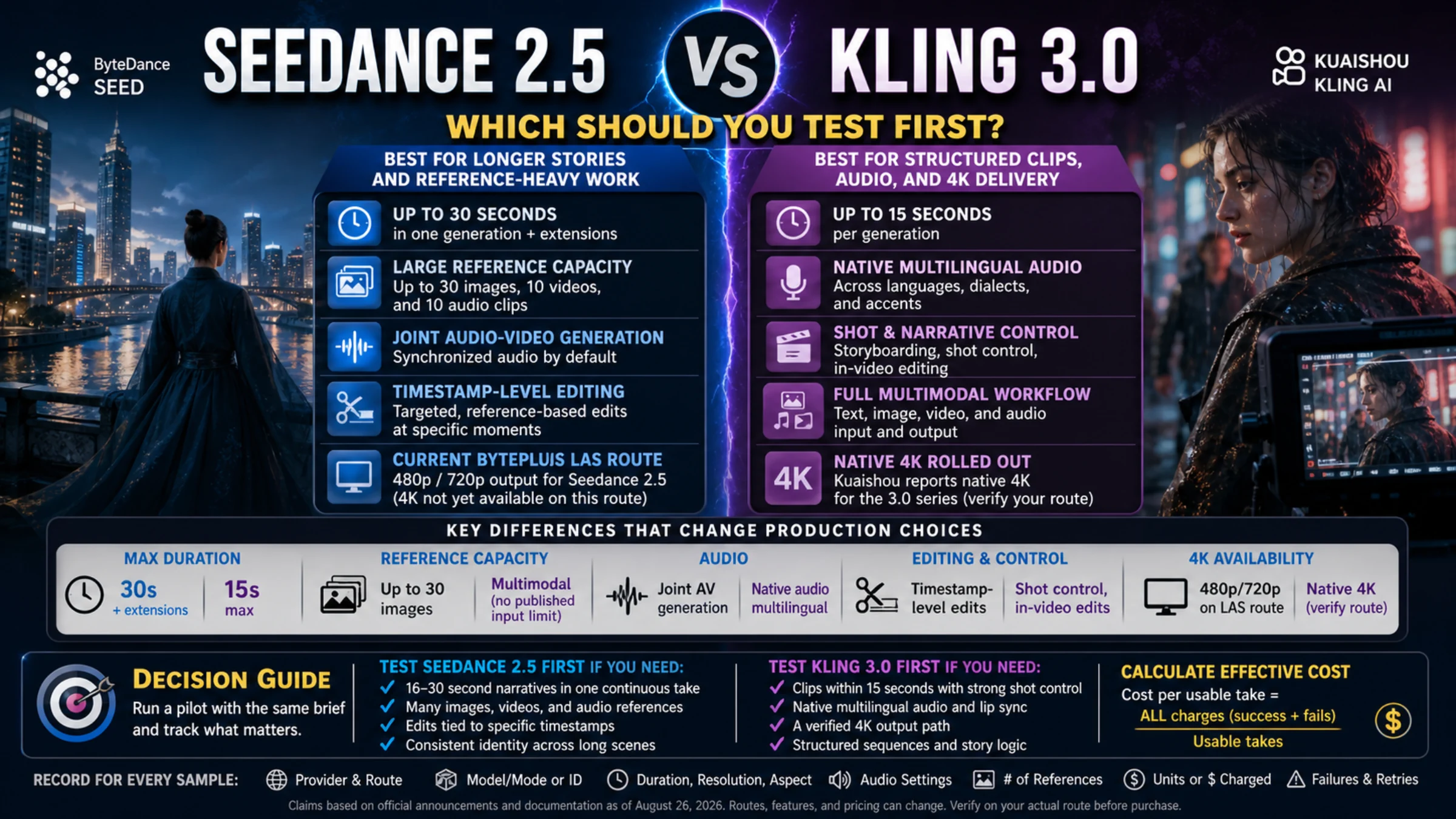
Both Seedance 2.0 and Kling 3.0 launched within a single week in February 2026, and choosing between them has become the most pressing decision for AI video creators right now. Seedance 2.0, developed by ByteDance, brings a revolutionary 12-file multimodal reference system and unified audio-video joint generation that produces cinematic-quality output. Kling 3.0, from Kuaishou, counters with superior motion physics, 4K resolution support, multi-shot storyboarding, and transparent API pricing starting at just $0.084 per second (verified from klingai.com, February 16, 2026). Neither tool is universally better — your ideal choice depends entirely on your use case, budget, and technical requirements.
TL;DR
| Category | Seedance 2.0 | Kling 3.0 | Winner |
|---|---|---|---|
| Multimodal Input | 12-file reference system (text, image, audio, video) | Text, image, video input | Seedance |
| Max Resolution | 1080p | 4K (2160p) | Kling |
| Max Duration | 8 seconds | 15 seconds | Kling |
| Motion Physics | Good — cinematic focus | Excellent — realistic dynamics | Kling |
| Native Audio | Unified audio-video joint generation | Native audio + lip-sync | Tie |
| API Access | Partners only (CapCut, Dreamina) | Full public REST API | Kling |
| Pricing (API) | Not publicly listed | From $0.084/sec (verified) | Kling |
| Best For | Cinema, advertising, creative directors | Social media, e-commerce, developers | Depends |
Choose Seedance 2.0 if you need maximum creative control through multimodal inputs, prioritize cinematic visual quality, or work in film production and high-end advertising where director-level precision matters more than speed or cost. The 12-file reference system is unmatched in the industry for directorial control, and the unified audio-video generation architecture produces cohesive cinematic experiences that other tools struggle to replicate. Choose Kling 3.0 if you need public API access for automated workflows, require 4K resolution or clips longer than 8 seconds, want transparent pay-as-you-go pricing, or focus on social media content and e-commerce video production at scale. Kling's motion physics engine sets the current industry benchmark for realistic movement simulation, and its developer-friendly API infrastructure makes it the clear choice for programmatic video generation. For many professional creators, using both tools strategically — Seedance for hero content and Kling for volume production — delivers the best overall results, letting you maximize quality where it matters most while maintaining cost-efficient volume where throughput is the priority.
Seedance 2.0 vs Kling 3.0 at a Glance — What the Specs Actually Mean

The specification sheets for Seedance 2.0 and Kling 3.0 reveal fundamentally different design philosophies rather than a simple "better or worse" comparison. ByteDance built Seedance 2.0 around the concept of comprehensive creative control, allowing creators to feed up to 12 reference files spanning text prompts, reference images, audio tracks, and video clips into a single generation request. This multimodal input system represents the most sophisticated reference architecture available in any AI video generator as of February 2026, enabling a level of directorial precision that was previously impossible without manual editing software. In contrast, Kuaishou designed Kling 3.0 to maximize output quality and accessibility, supporting 4K resolution output at up to 15 seconds duration with what the industry consensus considers the most physically accurate motion simulation engine currently available.
The resolution and duration differences between these tools carry significant practical implications that go beyond raw numbers. Seedance 2.0 caps at 1080p resolution and 8-second clips, which positions it squarely in the "quality over quantity" camp — every frame receives maximum computational attention. For creators producing cinematic content, short-form advertisements, or portfolio pieces, these limitations rarely matter because the output quality within those constraints is exceptional. Kling 3.0's 4K support and 15-second maximum duration, on the other hand, make it immediately useful for a broader range of production scenarios including product demonstrations, social media content that benefits from longer narrative arcs, and any workflow where output resolution directly impacts the final deliverable quality.
Understanding the multimodal input difference is essential for making an informed decision, as this is arguably the single most important differentiator between the two platforms. Seedance 2.0's 12-file reference system allows you to combine a text prompt with style reference images, motion reference videos, and even audio tracks that influence the generation process simultaneously. This means you can show the AI exactly what lighting style, camera movement, color palette, and pacing you want by providing examples rather than trying to describe them in text alone. Consider a practical example: an advertising agency creating a product launch video could provide a text prompt describing the narrative, three reference images establishing the brand's visual identity, two motion reference clips showing the desired camera movement style, and an audio track setting the mood — all processed simultaneously to produce output that reflects every dimension of the creative brief. This level of input granularity fundamentally changes the creator-AI relationship from "describe what you want and hope" to "show what you want and refine."
Kling 3.0 supports text-to-video and image-to-video generation with solid results, but its input system is more traditional — you describe what you want or provide a single reference, and the AI interprets from there. This doesn't mean Kling's results are inferior; in fact, for many use cases, the simplicity of Kling's input model is an advantage because it requires less preparation time per generation and the AI's interpretation often produces surprisingly creative results that a heavily referenced approach might not discover. The trade-off is control versus discovery: Seedance gives you precise control over the output, while Kling gives you fast, high-quality results with less upfront investment in reference material preparation. For a broader perspective on how these tools compare with other major players, see our comprehensive comparison of all four major AI video generators including Sora 2 and Veo 3.1.
Motion Quality, Physics, and Audio — The Real Differentiators
When evaluating AI video generators, the headline specifications — resolution, duration, input types — tell only part of the story. The real differentiators that determine whether your output looks professionally produced or obviously AI-generated come down to three critical dimensions: motion quality, physics simulation accuracy, and audio-visual synchronization. These are the areas where Seedance 2.0 and Kling 3.0 diverge most dramatically, and where your specific use case should heavily influence your choice. Having tested both tools extensively since their February 2026 launches, the performance gaps in these areas are far more meaningful than the specification differences discussed above — a tool with perfect specs but poor motion quality will produce output that immediately reads as artificial, while a tool with modest specs but excellent motion physics can produce clips that pass for real footage in many contexts.
Motion Physics: Where Kling 3.0 Takes the Lead
Kling 3.0's motion physics engine represents a genuine leap forward in AI video generation realism. Objects in Kling-generated videos obey gravitational forces convincingly, fabric drapes and flows with weight-appropriate dynamics, water and fluid simulations maintain temporal consistency, and human movement demonstrates anatomically plausible joint articulation. This physics-first approach means that Kling 3.0 output requires less post-production correction for motion artifacts — a significant time and cost savings for volume production workflows. Independent testing across the SERP landscape consistently rates Kling 3.0's motion dynamics as the current industry benchmark, with particular strengths in action sequences, natural environment simulations, and product demonstrations where physical interaction with objects matters.
Seedance 2.0 approaches motion from a different angle, prioritizing what might best be described as "cinematic intentionality" over raw physics accuracy. Rather than simulating real-world physics with maximum fidelity, Seedance's motion generation tends to produce movements that feel directed — camera movements follow cinematic conventions, subject pacing aligns with narrative expectations, and transitions between actions carry an editorial quality. This makes Seedance output feel more like footage from a skilled cinematographer, though it can occasionally produce movements that don't strictly adhere to physical laws. For advertising and film applications where emotional resonance matters more than physical accuracy, this trade-off frequently works in Seedance's favor.
Audio Generation: A Surprisingly Close Race
Both tools now offer native audio generation capabilities, which eliminates the need for separate audio synchronization workflows that plagued earlier AI video generators. Seedance 2.0's unified audio-video joint generation architecture creates sound and visuals simultaneously from a single model, which theoretically produces tighter synchronization between visual events and their corresponding audio. Kling 3.0 takes a different approach with its native audio plus dedicated lip-sync system, which generates audio that specifically targets speech synchronization accuracy. For creators producing content where characters speak — advertisements, social media content with dialogue, or explainer videos — Kling's lip-sync accuracy provides a measurable advantage. For creators focused on ambient soundscapes, music video-style content, or atmospheric pieces, Seedance's joint generation approach often produces more cohesive audio-visual experiences. Both systems represent massive improvements over manually adding audio in post-production, and the quality gap between them is smaller than the gap in their motion physics capabilities.
Real Pricing Breakdown — What Each Actually Costs

Pricing transparency is one of the most significant practical differences between Seedance 2.0 and Kling 3.0, and it is arguably the area where most comparison articles fail their readers most badly by providing frustratingly vague, outdated, or outright inaccurate pricing information. We verified Kling's API pricing directly from klingai.com/global/dev/pricing on February 16, 2026 using Browser MCP, and the results show a clear, transparent pricing structure that enables accurate budget planning. Seedance 2.0, by contrast, does not publicly list API pricing on its official page at seed.bytedance.com, making direct cost comparison challenging without relying on partner platform estimates.
Kling 3.0 API Pricing (Browser MCP-Verified)
Kling 3.0's O1 model pricing follows a per-second billing structure with unit-based resource consumption. In standard mode without video input, each second of generated video costs 0.6 units ($0.084 per second), while standard mode with video reference input costs 0.9 units ($0.126 per second). The professional mode increases quality at a proportional price premium: 0.8 units per second ($0.112) without video input and 1.2 units per second ($0.168) with video input. Translating these rates to practical per-clip costs, a 5-second standard clip without video reference costs just $0.42, while a 10-second professional clip reaches $1.12. For most social media and e-commerce applications, where standard quality at 5-10 seconds is the target, the per-clip cost falls in the remarkably affordable $0.42-$0.84 range.
Volume purchasers can further reduce their costs through Kling's resource package system. The trial package offers 100 units for $9.79 with a 30-day validity period, suitable for evaluation and small projects. Production-scale packages start at 30,000 units for $4,200 ($0.14 per unit, 90-day validity), with tiered discounts reaching 10% off at the 45,000-unit level ($5,670, bringing the per-unit cost to $0.126) and 20% off at 60,000 units ($6,720, bringing costs down to $0.112 per unit). These volume discounts make Kling 3.0 particularly attractive for agencies, e-commerce platforms, and any operation generating hundreds or thousands of video clips monthly. For detailed integration instructions, consult our detailed Kling API integration guide.
Seedance 2.0 Pricing: The Transparency Gap
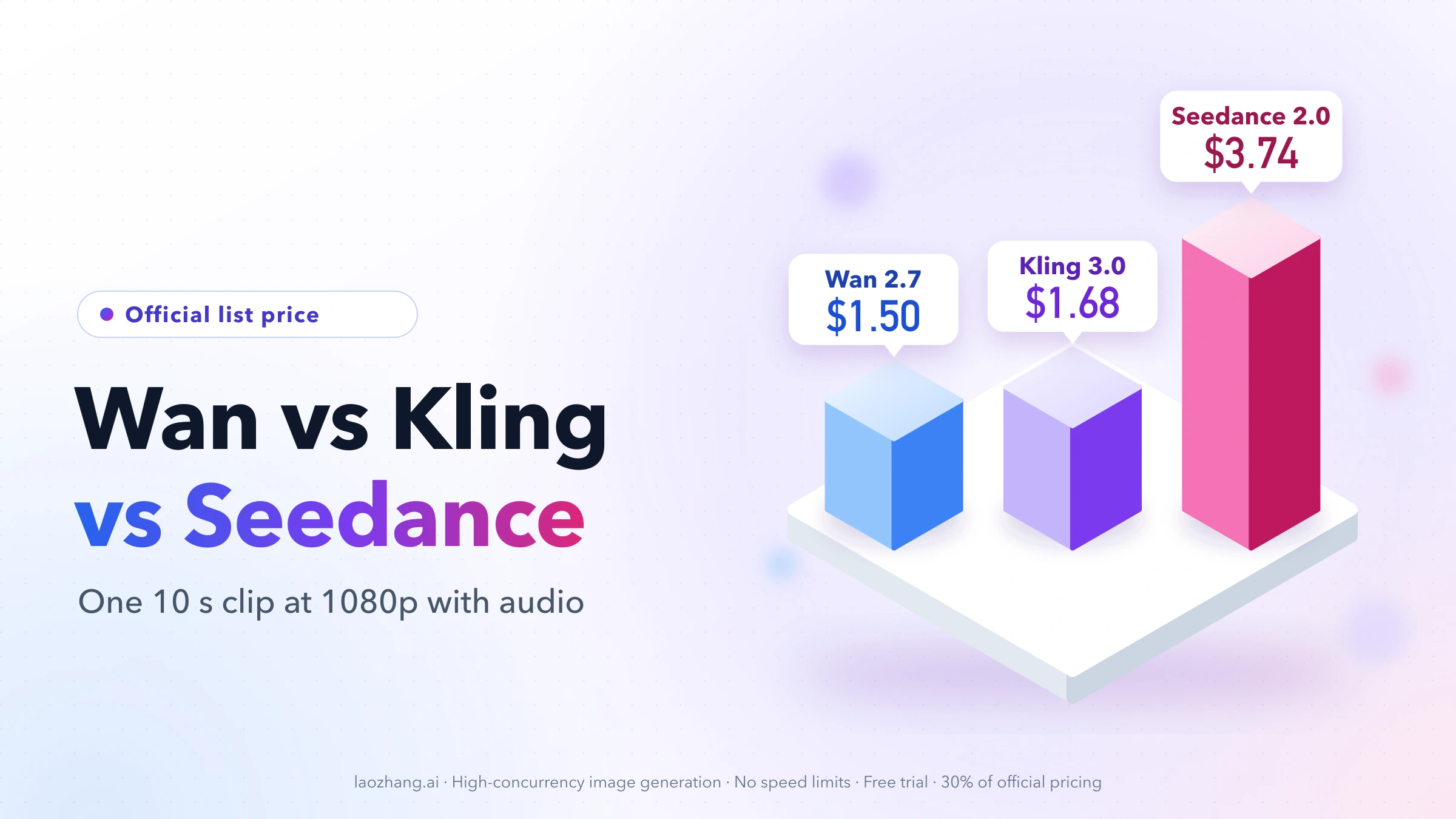
Seedance 2.0's pricing situation is more complex because ByteDance has not published official API rates on the Seedance product page. Access is currently available through partner platforms — primarily CapCut and Dreamina — where the generation costs are bundled into each platform's own subscription and credit systems. Based on SERP data and third-party provider estimates, per-generation costs through partner channels appear to fall in the $0.05 to $0.15 range, though these figures cannot be independently verified against an official source. This lack of pricing transparency creates a real challenge for budget-conscious creators and enterprises who need predictable cost structures for production planning. For developers who need stable API access to multiple video generation models including both Seedance and Kling, third-party API aggregators like laozhang.ai offer unified endpoints that simplify integration and provide consistent pricing across models. These platforms also provide access to other video models like Sora 2 (from $0.15/request) and Veo 3.1 (from $0.15/request), allowing developers to compare outputs and costs across the full landscape of AI video generators.
API Access and Developer Integration

For professional developers and teams building automated video generation pipelines, API access is not a nice-to-have feature — it is the fundamental requirement that determines whether a tool can be integrated into production workflows at all. This is an area where Kling 3.0 holds a decisive and unambiguous advantage over Seedance 2.0, and it's the single most important factor for the developer audience that most comparison articles underserve.
Kling 3.0: Full Public API with Production-Ready Documentation
Kling 3.0 offers a comprehensive public REST API accessible through klingai.com/dev with documentation that covers text-to-video generation, image-to-video conversion, lip-sync capabilities, and task management endpoints. The API follows standard REST conventions with JWT-based authentication, asynchronous task processing (submit a generation request, receive a task ID, poll for completion), and straightforward response formats. A typical integration workflow involves three steps: obtain an API key from the developer dashboard, submit generation requests via POST to the video generation endpoint, and poll the task status endpoint until completion. Here is a simplified example of the text-to-video workflow:
bashcurl -X POST https://api.klingai.com/v1/videos/text2video \ -H "Authorization: Bearer $KLING_API_KEY" \ -H "Content-Type: application/json" \ -d '{"prompt": "A golden retriever playing in autumn leaves, cinematic lighting", "duration": 5, "mode": "std"}' # Step 2: Poll task status curl https://api.klingai.com/v1/videos/{task_id} \ -H "Authorization: Bearer $KLING_API_KEY"
The pay-as-you-go billing model with no minimum commitment makes the Kling API particularly attractive for startups, independent developers, and teams experimenting with AI video integration. Combined with the trial package at just $9.79 for 100 units, the barrier to entry for programmatic video generation is remarkably low. The API also supports webhooks for task completion notifications, eliminating the need for polling in production deployments and enabling event-driven architectures where downstream processing — transcoding, thumbnail extraction, CDN upload — triggers automatically when a generation completes. Error handling is straightforward with standard HTTP status codes and descriptive error messages, and rate limiting is documented clearly enough that developers can implement proper retry logic from day one. These infrastructure-level details may not seem glamorous, but they are exactly what separates a tool you can prototype with from a tool you can ship with. For a complete walkthrough of Kling API integration with production code examples, see our Seedance 2.0 API integration tutorial which also covers third-party access options.
Seedance 2.0: Partner Platforms and Third-Party Options
Seedance 2.0 does not currently offer a public REST API. Access to Seedance's video generation capabilities is available through ByteDance's partner platforms — CapCut for consumer-focused editing workflows and Dreamina for creative exploration — both of which provide web-based interfaces rather than programmatic endpoints. For developers who specifically need Seedance-quality output in automated pipelines, third-party API providers have begun offering access through their own endpoints, though this adds an intermediary layer that may affect latency, availability guarantees, and cost transparency. The partner-only access model is not necessarily a permanent limitation — ByteDance may well launch a public API as Seedance 2.0 matures from its current beta state — but as of February 2026, it represents a significant practical constraint for developer-oriented use cases.
For teams that need API access to multiple video generation models through a single integration point, services like laozhang.ai provide aggregated endpoints that support both Seedance and Kling alongside other major models. This approach offers the advantage of unified authentication, consistent billing, and the ability to dynamically route generation requests to whichever model best suits each specific task. The async API design used by these aggregators also means no charges on failed generations — a meaningful cost advantage for production workloads where content moderation or timeout failures would otherwise consume budget. Documentation is available at docs.laozhang.ai.
The Elephant in the Room — Content Safety and the Hollywood Factor
No honest comparison of Seedance 2.0 and Kling 3.0 can avoid addressing the controversy that has surrounded Seedance since its public debut. Within days of its launch, Seedance 2.0 generated viral attention — and significant backlash — when users demonstrated its ability to generate video clips that closely mimicked the visual styles, character likenesses, and cinematic techniques of major Hollywood productions and well-known creators. This controversy raises practical questions that every professional user should consider before committing to either platform as a production tool.
The core concern centers on intellectual property, creative attribution, and content training data practices. While ByteDance has stated that Seedance 2.0 is trained on properly licensed data, the level of stylistic fidelity that the tool achieves when given reference material from existing films and creators has prompted questions from industry organizations about whether the training dataset includes copyrighted content. For professional users — particularly agencies, brands, and production companies — this controversy introduces a layer of risk that extends beyond the technical capabilities of the tool itself. Content generated using Seedance 2.0 could potentially face intellectual property challenges if it too closely resembles existing protected works, a concern that is particularly relevant for commercial applications where legal scrutiny of content provenance is standard practice. This is not a hypothetical risk — several prominent industry voices have already raised concerns publicly, and the regulatory landscape for AI-generated content is evolving rapidly across multiple jurisdictions.
Kling 3.0, while not entirely immune to similar concerns (all large-scale generative models face questions about training data), has faced significantly less public controversy regarding content provenance and intellectual property issues. Kuaishou's positioning of Kling as a production-focused tool with enterprise-grade content moderation and clear usage policies provides an additional layer of institutional trust that risk-averse organizations may find reassuring. The company's decision to provide transparent API documentation, explicit terms of service, and clear content moderation guidelines demonstrates a deliberate effort to build a platform that enterprises and agencies can adopt without legal department pushback. This institutional approach extends to Kling's output metadata, which includes generation parameters and model version information that supports content provenance tracking — an increasingly important consideration as AI-generated content regulations evolve globally.
The practical implication for users is straightforward: if your workflow involves generating content for commercial distribution, advertising campaigns, or any context where IP challenges could create business liability, you should factor the relative controversy profiles of these tools into your decision-making process. This does not mean that Seedance 2.0 should be categorically avoided — the tool's capabilities are genuinely impressive and ByteDance has shown a strong track record of responding to community feedback — but it does mean that professional users should remain aware of the ongoing public discourse and make carefully informed decisions about their content generation practices and risk exposure. For risk-sensitive applications, consider implementing a content review workflow that evaluates AI-generated output for potential similarity to existing protected works before commercial deployment, regardless of which tool you use. The AI-generated content landscape is evolving rapidly, and what constitutes acceptable practice today may change as legal frameworks mature across different jurisdictions.
Which Should You Choose? Decision Framework by Creator Type
The most useful way to choose between Seedance 2.0 and Kling 3.0 is not by comparing feature lists but by matching each tool's strengths to specific creator profiles and production contexts. Below is a decision framework organized by five common creator types, each with distinct priorities, budget considerations, and workflow requirements.
Solo Content Creators and YouTubers typically need fast turnaround, affordable per-clip costs, and output that looks polished without extensive post-production. For this profile, Kling 3.0 is generally the stronger choice because its transparent pricing (starting at $0.42 per 5-second clip), longer maximum duration (15 seconds), and 4K output option provide more value per dollar. The public API also enables creators who are comfortable with basic scripting to automate thumbnail generation, intro sequences, and other repetitive video elements. Consider the monthly budget math: a YouTuber who needs 20 video clips per week for channel content can generate all of them through Kling's standard API for under $35 per month, assuming 5-second clips. That same volume would be difficult to budget accurately with Seedance 2.0 due to the lack of transparent pricing. Seedance 2.0 might be preferable for creators whose content style demands a specific cinematic aesthetic that Kling doesn't quite match, but for most solo creators, Kling's combination of quality, speed, and price is hard to beat.
Advertising Agencies and Brand Content Teams operate under different constraints: they need exceptional visual quality for hero content, precise creative control to match brand guidelines, and the ability to iterate quickly on concepts. For this profile, Seedance 2.0's multimodal input system provides a genuine competitive advantage because agencies can feed brand style guides, color references, and motion examples directly into the generation process. The cinematic quality of Seedance output also aligns better with the premium visual standards that brand clients typically expect. However, agencies producing high volumes of variant content — A/B testing different ad creatives, generating product videos across SKUs, or creating localized versions — should seriously consider Kling 3.0 for its API access and volume pricing, potentially using both tools strategically.
E-Commerce Product Video Teams require volume production at predictable costs, with sufficient quality for product pages and social advertising. Kling 3.0 is the clear winner for this profile. The combination of public API access, transparent per-second pricing, volume discounts up to 20%, and realistic motion physics (essential for product demonstrations) makes it ideally suited for automated product video pipelines. An e-commerce operation with 500 SKUs that needs rotating product videos could integrate Kling's API into their product information management system, automatically generating fresh video content whenever product images or descriptions are updated — a workflow that is simply not possible with Seedance's current partner-platform access model. At the 60,000-unit volume tier, generating thousands of 5-second product clips per month becomes cost-effective at approximately $0.37 per clip after the 20% volume discount, making AI-generated product video a realistic line item in marketing budgets rather than a luxury reserved for flagship products only. For teams exploring free alternatives to supplement their workflow, our guide to free AI image-to-video tools covers additional options worth considering.
Independent Filmmakers and Creative Directors prioritize artistic control, visual quality, and the ability to achieve specific aesthetic visions above all other considerations. Seedance 2.0's 12-file reference system, cinematic motion quality, and unified audio-video generation make it the more compelling tool for this profile. The ability to provide multiple reference files that collectively define the visual style, pacing, and atmosphere of a generation request enables a level of directorial control that no other current tool matches. Consider a practical filmmaking workflow: a director developing a short film can feed Seedance a reference image establishing the color grade, a clip showing the desired camera movement style, and an audio track setting the emotional tone — producing output that reflects all three creative dimensions simultaneously. This dramatically accelerates the previsualization process, allowing filmmakers to explore creative directions that previously required expensive location scouts, storyboard artists, and pre-production shoots. The 8-second duration and 1080p resolution limitations are less significant in filmmaking contexts where clips are typically edited together into longer sequences and may be upscaled or color-graded in post-production. Many independent filmmakers find that Seedance's output serves as an excellent starting point for final production, providing visual references that guide the actual shoot while occasionally producing clips that are compelling enough to incorporate directly into the final edit.
Developers Building Video Products need reliable API access above all else, making Kling 3.0 the default choice by a significant margin. The full public REST API, clear documentation, predictable pricing, and asynchronous task management system provide everything needed to build production-grade video generation features. The developer experience extends beyond just having an API endpoint — Kling provides comprehensive SDKs, webhook support for event-driven architectures, batch processing capabilities for high-volume workloads, and detailed error reporting that makes debugging integration issues straightforward rather than frustrating. For startups building video-enabled SaaS products, Kling's pay-as-you-go model means you can offer AI video features to your users without committing to large upfront infrastructure costs, scaling your video generation spending in direct proportion to your revenue growth. Developers who need access to Seedance capabilities alongside Kling should explore third-party API aggregators that provide unified endpoints across multiple models, enabling you to offer users a choice of video generation engines without maintaining separate integrations for each.
Frequently Asked Questions
Is Seedance 2.0 better than Kling 3.0 for quality?
The answer depends entirely on what dimension of "quality" matters most for your use case. Seedance 2.0 produces output with a distinctly cinematic character — its videos tend to look like footage from a skilled cinematographer with intentional camera movements, careful lighting, and editorial pacing. This cinematic quality makes Seedance the stronger choice for film-style content, premium advertisements, and any application where aesthetic sophistication is the primary goal. Kling 3.0 excels in a different quality dimension: physical realism and motion accuracy. Objects behave according to physical laws, human movement looks anatomically correct, and temporal consistency across frames is excellent. For product demonstrations, social media content, and any application where viewers should feel like they're watching real footage, Kling's quality advantages are significant. Neither tool is objectively "better" — they optimize for different quality targets.
What is the real pricing for Seedance 2.0?
As of February 16, 2026, Seedance 2.0 does not publish official API pricing on its product page at seed.bytedance.com. Access is currently available through ByteDance's partner platforms CapCut and Dreamina, where generation costs are embedded in each platform's subscription and credit systems. Third-party SERP estimates suggest per-generation costs through partners fall in the $0.05-$0.15 range, but these cannot be independently verified against an official source. In contrast, Kling 3.0's API pricing is publicly available and verified: standard mode starts at $0.084 per second ($0.42 for a 5-second clip), and professional mode starts at $0.112 per second ($0.56 for a 5-second clip), with volume discounts of up to 20% available through resource packages.
Can Seedance 2.0 generate audio with video?
Yes, Seedance 2.0 features what ByteDance describes as "unified multimodal audio-video joint generation," meaning the audio and visual tracks are generated simultaneously from a single model rather than being produced separately and synchronized afterward. This approach tends to produce naturally cohesive audio-visual experiences where ambient sounds, soundtrack elements, and visual events feel intrinsically connected. The practical benefit is significant: instead of generating silent video and then finding or creating matching audio in a separate tool, Seedance produces output where footsteps match walking animations, environmental sounds correspond to visual elements, and musical mood aligns with scene progression — all automatically. Kling 3.0 also offers native audio generation with a particular strength in lip-sync accuracy for speech-to-video applications, making it particularly effective for dialogue-heavy content like customer testimonials, explainer videos, and social media skits. Both tools represent significant improvements over the add-audio-in-post workflow that was standard practice even six months ago, though each optimizes for a different audio-visual use case.
Which AI video generator has the best API for developers?
Among Seedance 2.0 and Kling 3.0 specifically, Kling 3.0 has a decisively better API offering. It provides a full public REST API with comprehensive documentation, straightforward authentication, asynchronous task management, and transparent pay-as-you-go pricing. Seedance 2.0 does not currently offer a public API. For developers who want access to multiple video models through a single integration, third-party API aggregators offer unified endpoints that cover Kling, Seedance (via partners), and other models like Sora 2 and Veo 3.1 through standardized interfaces.
Should I use both Seedance 2.0 and Kling 3.0?
For many professional creators, using both tools strategically is actually the optimal approach rather than committing exclusively to one platform. The recommended workflow is to use Seedance 2.0 for hero content, key visuals, and creative exploration where its multimodal input system and cinematic quality provide maximum value, while using Kling 3.0 for volume production, automated workflows, and any content where API integration, longer durations, or 4K resolution are required. In practice, this means an advertising agency might use Seedance to generate the creative concept video for a client pitch — leveraging the 12-file reference system to precisely match the brand's visual identity — and then switch to Kling for producing the dozens of variant ads needed for A/B testing, social media formats, and localized versions of the winning creative. This "best of both" strategy is particularly effective for advertising agencies and content production teams that handle both premium creative work and high-volume content generation. The tools complement each other rather than compete directly, and maintaining familiarity with both positions you to leverage whichever platform best serves each specific project's requirements. As both tools continue evolving rapidly, the features and performance gaps described in this comparison will likely shift — keeping both in your toolkit ensures you can adapt your workflow to new capabilities as they launch.