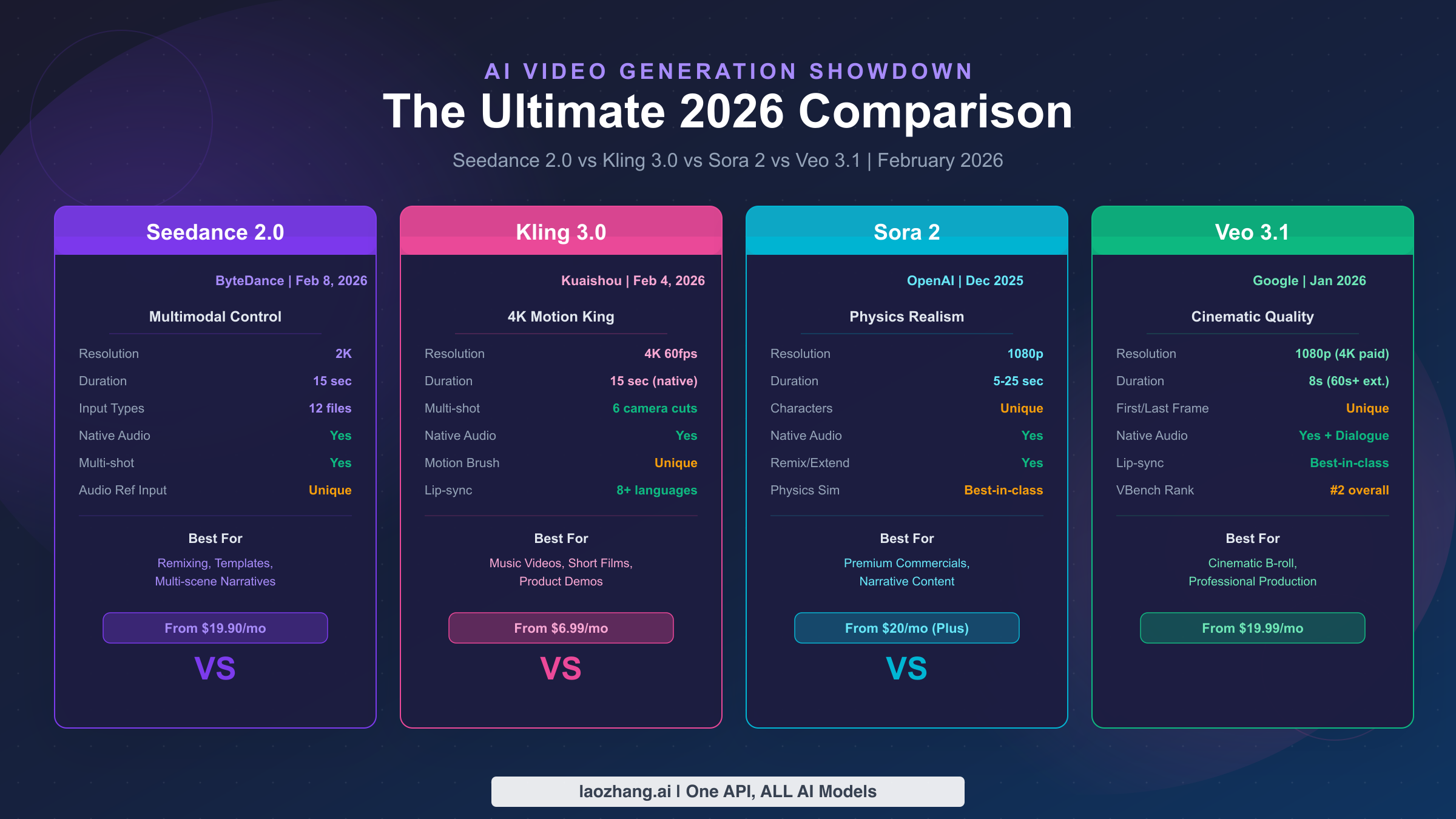
February 2026 marks a pivotal moment for AI video generation. ByteDance launched Seedance 2.0 on February 8 with unprecedented 12-file multimodal input capabilities, while Kuaishou released Kling 3.0 on February 4 as the first model to achieve native 4K resolution at 60 frames per second. Combined with OpenAI's Sora 2 and Google's Veo 3.1, creators and developers now face the most competitive landscape in AI video history. This guide cuts through the marketing noise with verified pricing data, real technical specifications, and a practical decision framework so you can choose the right tool for your specific needs.
TL;DR
Here is the quick comparison if you are short on time. Kling 3.0 wins on visual quality (4K/60fps) and value (free tier available). Veo 3.1 leads for developers with its official Google API and native audio generation. Seedance 2.0 offers the most creative control with 12-file multimodal input. Sora 2 provides the longest single-clip duration at 25 seconds with Storyboard editing. For budget-conscious creators, Kling 3.0's free tier with 66 daily credits is unbeatable. For production API workloads, Kling offers the cheapest per-second pricing at $0.029/sec through third-party providers. All pricing data verified from official sources on February 10, 2026.
What Changed in February 2026?
The AI video generation space underwent a seismic shift in early February 2026 with two major product launches within days of each other. Understanding what changed and why it matters is essential before diving into detailed comparisons, because these updates fundamentally altered the competitive dynamics that existed just weeks ago. If you followed our comprehensive AI video models comparison from 2025, you will notice that the pecking order has changed significantly.
Seedance 2.0 arrived on February 8, 2026, representing ByteDance's most ambitious video generation model to date. The headline feature is its 12-file multimodal input system, which allows users to combine text prompts, reference images, video clips, and even audio files into a single generation request. This is not just an incremental improvement over the original Seedance Pro model; it represents a fundamentally different approach to creative control. Where other models accept a text prompt and maybe one reference image, Seedance 2.0 lets creators provide an entire mood board of inputs. The model also introduced narrative mode for multi-shot storytelling and audio reference input for matching generated content to specific sound profiles. At 2K resolution and 15 seconds per clip with 24fps output, the technical specifications are competitive though not category-leading.
Kling 3.0 launched on February 4, 2026, making Kuaishou's video AI the first to achieve native 4K resolution at 3840x2160 pixels with 60 frames per second output. This is a significant technical achievement because previous models topped out at 1080p or required upscaling to reach higher resolutions. The 4K/60fps combination means Kling 3.0 can produce footage that matches professional camera quality without post-processing. Beyond raw specs, Kling 3.0 introduced a 6-cut multi-shot system for creating narrative sequences, motion brush controls for precise movement direction, and improved lip-sync support across eight languages. The native clip duration is 15 seconds, but an automated stitching system can extend output to over 60 seconds.
Meanwhile, Sora 2 and Veo 3.1 continue to hold strong positions despite being slightly older releases. Sora 2, available since December 2025, still offers the longest native single-clip duration at 25 seconds and features the unique Storyboard interface for timeline-based editing. Veo 3.1, updated in January 2026, maintains its lead in audio generation with native dialogue, sound effects, and music production built directly into the video generation pipeline. The first-and-last-frame control mode remains exclusive to Veo 3.1, allowing creators to define start and end states and let the AI generate the transition between them. These are not legacy products struggling to keep up; they are mature platforms with established ecosystems and features that the newer entrants have not yet matched.
Video Quality & Technical Specs Compared
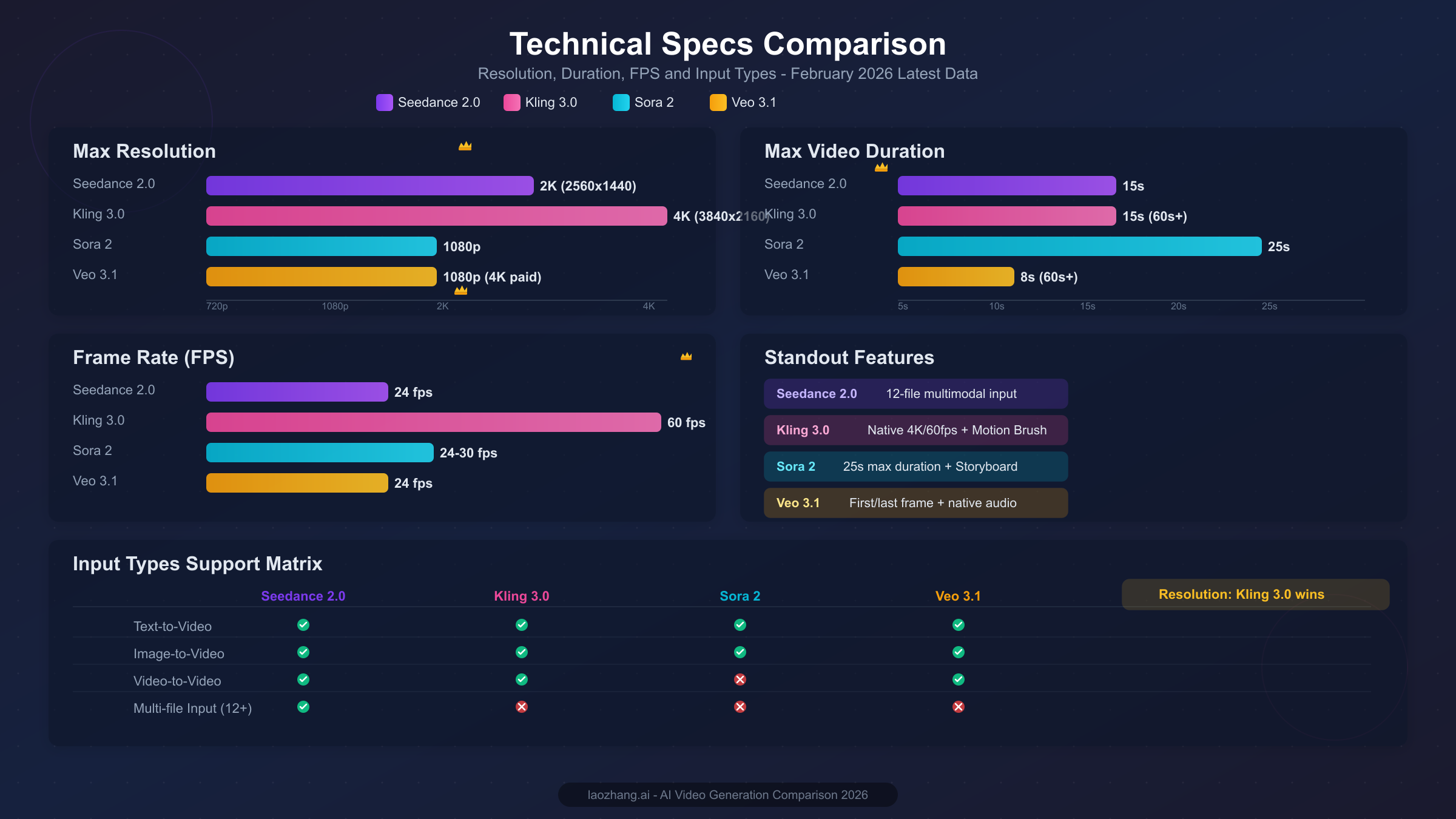
The technical specifications of these four models reveal distinct engineering philosophies and target use cases. Rather than declaring a single winner, the comparison shows that each model made deliberate trade-offs that benefit different types of users. The following breakdown covers the specifications that matter most for real-world video production, verified against official documentation as of February 10, 2026. For an in-depth look at Veo 3.1's capabilities, see our complete Veo 3.1 video generation guide.
| Specification | Seedance 2.0 | Kling 3.0 | Sora 2 | Veo 3.1 |
|---|---|---|---|---|
| Max Resolution | 2K (2560x1440) | 4K (3840x2160) | 1080p | 1080p (4K paid) |
| Max Duration | 15s | 15s (60s+ stitched) | 25s | 8s (60s+ extended) |
| Frame Rate | 24fps | 60fps | 24-30fps | 24fps |
| Text-to-Video | Yes | Yes | Yes | Yes |
| Image-to-Video | Yes | Yes | Yes | Yes |
| Video-to-Video | Yes | Yes | No | Yes |
| Multi-file Input | 12 files | No | No | No |
| Aspect Ratios | 16:9, 9:16, 1:1 | 16:9, 9:16, 1:1, 4:3 | 16:9, 9:16, 1:1 | 16:9, 9:16 |
Kling 3.0's 4K/60fps output is the most striking technical achievement in this comparison. For context, the jump from 1080p to 4K represents a four-fold increase in pixel count, and 60fps provides significantly smoother motion than the 24fps that other models produce. This matters enormously for content destined for large screens, professional presentations, or any context where viewers will scrutinize visual detail. According to community benchmark data from VBench and aifreeforever.com, the Kling series consistently scores among the top three models with an Elo rating of 1225, trailing only Runway Gen-4.5 (1247) and Veo 3 (1226) in overall quality perception as of early February 2026.
Sora 2's 25-second native clip duration deserves special attention because it is nearly double what any competitor offers in a single generation. For content creators producing short-form video for TikTok, Instagram Reels, or YouTube Shorts, getting 25 seconds of continuous footage from one prompt eliminates the need for stitching multiple clips together. The Storyboard feature adds another dimension by letting users place different prompts at specific timestamps within a single video, creating scene transitions and narrative progression that would otherwise require editing software. This makes Sora 2 uniquely suited for storytelling and narrative content where temporal coherence across a longer duration is essential.
Seedance 2.0's 12-file multimodal input system represents a different kind of innovation. Instead of pushing resolution or duration boundaries, ByteDance focused on creative control. A filmmaker can provide reference images for character appearance, a video clip showing the desired camera movement style, an audio track for pacing, and text descriptions for scene content, all in a single request. This approach mirrors professional production workflows where creative direction involves multiple reference materials rather than a single text prompt. The 2K resolution output, while not 4K, still exceeds 1080p and provides enough detail for most social media and web content applications.
Veo 3.1's first-and-last-frame mode is a genuinely unique capability that none of the other three models offer. By defining the starting image and ending image, creators gain precise control over the narrative arc of their generated clip without needing to describe every intermediate frame. This is particularly valuable for product showcases, morphing effects, and scene transitions. The 8-second native duration is the shortest in this group, but Google's extension system can stitch clips to over 60 seconds with reasonable coherence between segments. The 4K output option, available on paid tiers, also helps Veo 3.1 compete with Kling on resolution for users willing to pay the premium.
Audio Generation: The New Battleground
Audio capability has become one of the most important differentiators in the AI video generation space during early 2026, and it represents an area where the gap between models is substantial. The ability to generate synchronized audio alongside video eliminates a major post-production step and opens new creative possibilities for content creators who previously needed separate tools for sound design. Understanding each model's audio capabilities is crucial because adding audio in post-production can double or triple the time required to produce a finished video.
Veo 3.1 leads decisively in audio generation. Google's model generates native audio that includes dialogue, ambient sound effects, and background music as an integrated part of the video generation process. This is not a separate audio model bolted onto the video pipeline; the audio and visual content are generated together, which produces natural synchronization between what you see and what you hear. Dialogue generation supports lip-sync across multiple languages, and the sound effects are contextually aware, meaning a video of ocean waves will include appropriate wave sounds without requiring any audio prompt. The music generation layer can produce background tracks that match the mood and pacing of the visual content. For creators producing content where audio-visual coherence matters, such as commercials, social media content with voiceover, or narrative shorts, Veo 3.1's audio capabilities can save hours of post-production work per project.
Seedance 2.0 brings a unique audio approach through its reference input system. Rather than generating audio from scratch like Veo 3.1, Seedance allows users to provide an audio reference file as one of its 12 multimodal inputs. The model then generates video content that matches the rhythm, mood, and pacing of the reference audio. This is particularly powerful for music video creation, dance choreography visualization, and any project where the audio comes first and the visual content needs to follow. The lip-sync system supports eight or more languages, and the model can match mouth movements to dialogue tracks with impressive accuracy. While this is not the same as generating audio from nothing, it provides a different kind of creative control that many professional users actually prefer because it lets them maintain full control over the audio while leveraging AI for the visual component.
Kling 3.0 offers solid lip-sync and sound effect generation, though its audio capabilities are not as comprehensive as Veo 3.1's fully integrated approach. The lip-sync system supports eight languages and can generate dialogue-matched mouth movements from text input. Sound effects are generated based on the visual content, though the range and quality are considered slightly behind Veo 3.1 in community evaluations. Where Kling 3.0 shines is in the combination of its audio features with the 4K/60fps visual output; the high frame rate makes lip-sync appear more natural because there are more frames to work with for mouth movement transitions.
Sora 2 currently offers the most limited audio capabilities among the four models. While it can generate basic ambient audio and some sound effects, it does not match the comprehensive audio generation of Veo 3.1 or the reference-based approach of Seedance 2.0. OpenAI has indicated that enhanced audio features are in development, but as of February 2026, users who need high-quality synchronized audio will likely need to rely on separate audio tools or choose a different model for audio-critical projects. The Storyboard feature does allow users to specify audio cues at different timeline positions, but the generated audio quality remains below what Veo 3.1 and Seedance 2.0 can produce.
| Audio Feature | Seedance 2.0 | Kling 3.0 | Sora 2 | Veo 3.1 |
|---|---|---|---|---|
| Native Audio Generation | Reference-based | Partial | Limited | Full (best) |
| Dialogue/Speech | Via reference | Text-to-speech | Basic | Full generation |
| Sound Effects | Limited | Good | Basic | Excellent |
| Background Music | Via reference | Limited | No | Yes |
| Lip-sync Languages | 8+ | 8+ | Limited | 8+ |
| Audio Reference Input | Yes (unique) | No | No | No |
Real Cost Breakdown: What You'll Actually Pay
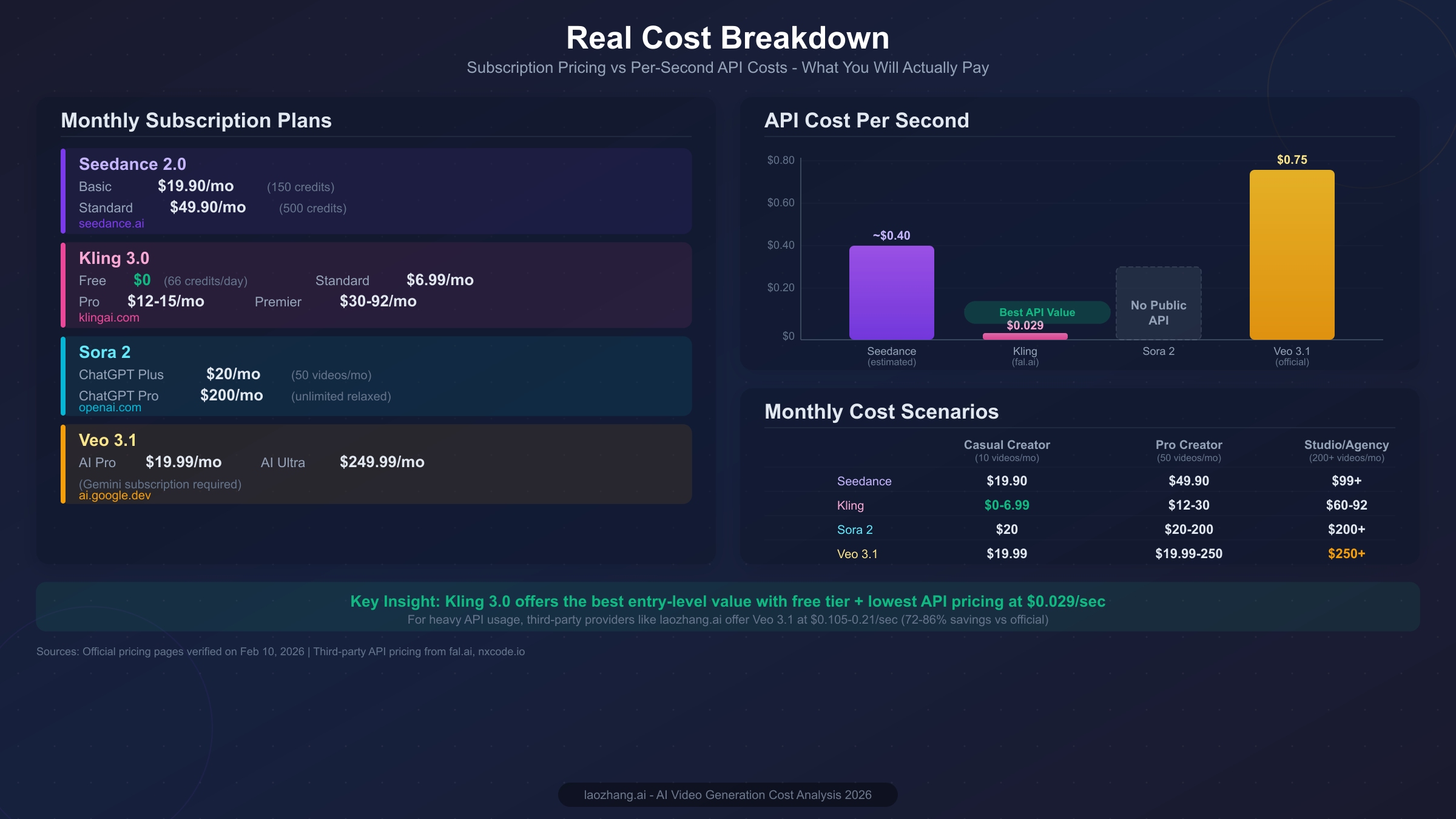
Pricing is where most comparison articles fall short, listing subscription tiers without translating them into real-world project costs. The truth is that the monthly subscription price tells only part of the story because credit systems, generation limits, resolution surcharges, and API per-second billing create vastly different cost structures depending on how you actually use these tools. All pricing data below was verified from official sources on February 10, 2026, and third-party API pricing comes from established providers. For detailed information on Sora's pricing model, check our guide on Sora 2 API pricing and quota details.
Kling 3.0 offers the most accessible entry point with a genuinely useful free tier. New users receive 66 credits per day, which translates to several standard-quality video generations at no cost. The paid tiers scale from Standard at $6.99/month through Pro at $12-15/month to Premier at $30-92/month depending on the specific plan configuration (klingai.com, verified February 10, 2026). This tiered approach means casual users can generate content without spending anything, while power users can scale up incrementally. For API usage through third-party providers like fal.ai, Kling 3.0 offers the lowest per-second rate at approximately $0.029 per second, making it exceptionally cost-effective for batch processing and automated workflows.
Sora 2 bundles with ChatGPT subscriptions, which creates an interesting value proposition for users who already pay for ChatGPT Plus or Pro. The Plus tier at $20/month includes access to Sora 2 with approximately 50 video generations per month, while the Pro tier at $200/month provides unlimited relaxed-speed generation (openai.com, verified February 10, 2026). There is currently no public API for Sora 2, which means developers cannot build Sora into their own applications through official channels. For users who already subscribe to ChatGPT Plus for its text capabilities, Sora 2 video generation is essentially a free bonus feature, which dramatically changes its effective cost calculation.
Veo 3.1 operates within Google's Gemini subscription ecosystem. The AI Pro tier at $19.99/month provides access to Veo 3.1 generation within reasonable limits, while the AI Ultra tier at $249.99/month unlocks higher quotas and 4K output (ai.google.dev, verified February 10, 2026). Where Veo 3.1 stands apart is in API availability: Google offers an official API at approximately $0.75 per second of generated video, which is the most expensive official API rate among the models that offer one. However, third-party providers offer significantly reduced rates; for instance, laozhang.ai provides Veo 3.1 API access starting at $0.15 per request for the fast variant and $0.25 per request for the standard version, with async endpoints that charge nothing on failed generations. This represents savings of 72-86% compared to the official per-second pricing for typical use cases.
Seedance 2.0 uses a credit-based subscription model with the Basic plan at $19.90/month providing 150 credits and the Standard plan at $49.90/month offering 500 credits (seedance.ai, verified February 10, 2026). The credit cost per video varies based on resolution and duration settings, with higher-quality outputs consuming more credits. API pricing through third-party providers is estimated at approximately $0.10-0.80 per minute depending on the resolution and model variant selected (nxcode.io, February 2026).
| Scenario | Seedance 2.0 | Kling 3.0 | Sora 2 | Veo 3.1 |
|---|---|---|---|---|
| Casual (10 videos/mo) | $19.90 | $0-6.99 | $20 | $19.99 |
| Pro Creator (50 videos/mo) | $49.90 | $12-30 | $20-200 | $19.99-250 |
| Studio (200+ videos/mo) | $99+ | $60-92 | $200+ | $250+ |
| API (per second) | ~$0.10-0.80/min | $0.029/sec | No public API | $0.75/sec (official) |
API Access: From Playground to Production
For developers building video generation into applications, products, or automated workflows, API access is not optional but essential. The availability, pricing, and reliability of APIs vary dramatically across these four models, and this section provides the practical information you need to make an integration decision. If you are specifically interested in image-to-video capabilities, our Kling AI image-to-video API guide covers that workflow in detail.
Veo 3.1 offers the most mature official API through Google's AI platform. Developers can access the Imagen and Veo API endpoints with standard Google Cloud authentication, and the API supports text-to-video, image-to-video, and the unique first-and-last-frame generation mode. The official pricing is approximately $0.75 per second of generated video, which adds up quickly for high-volume applications. However, the API is well-documented, reliable, and backed by Google's infrastructure with enterprise-grade SLAs. The ability to generate video with native audio through a single API call makes it particularly attractive for applications where end-to-end video creation needs to happen programmatically without human intervention.
Kling 3.0 API access is available primarily through third-party providers rather than a direct official API comparable to Google's offering. Providers like fal.ai offer Kling generation at approximately $0.029 per second, which represents the lowest per-second API cost among all four models. The trade-off is that you are routing through a third party, which can introduce latency and dependency risks. For applications where cost efficiency matters more than direct vendor relationships, Kling's third-party API ecosystem provides excellent value.
Sora 2 currently has no public API, which is perhaps the most significant limitation for developers evaluating these models. OpenAI has not released an API endpoint for Sora 2 video generation, meaning all access is through the ChatGPT web interface. This effectively excludes Sora 2 from any automated or programmatic workflow. For developers who need Sora-quality generation in their pipelines, third-party aggregation services provide a practical workaround. For example, laozhang.ai offers Sora 2 API access through async endpoints at $0.15 per request for the basic 720p variant and $0.8 per request for the 1080p HD version, with the critical advantage that failed generations are not charged. Here is a working example:
import requests
import time

API_KEY = "your_laozhang_api_key"
BASE_URL = "https://api.laozhang.ai/v1"

# Step 1: Create a video generation task
response = requests.post(
    f"{BASE_URL}/videos",
    headers={
        "Authorization": f"Bearer {API_KEY}",
        "Content-Type": "application/json"
    },
    json={
        "model": "sora-2",
        "prompt": "A golden retriever playing in autumn leaves, cinematic lighting",
        "size": "1280x720",
        "seconds": "15"
    }
)
task = response.json()

# Step 2: Poll for completion
while True:
    status = requests.get(
        f"{BASE_URL}/videos/{task['id']}",
        headers={"Authorization": f"Bearer {API_KEY}"}
    ).json()
    if status["status"] == "completed":
        break
    time.sleep(5)

# Step 3: Download the video
video = requests.get(
    f"{BASE_URL}/videos/{task['id']}/content",
    headers={"Authorization": f"Bearer {API_KEY}"},
    stream=True
)
with open("output.mp4", "wb") as f:
    for chunk in video.iter_content(8192):
        f.write(chunk)
Seedance 2.0 API access is emerging through third-party providers, though the ecosystem is less mature than what exists for Kling or Veo. The API supports the full range of multimodal inputs, including text, image, video, and audio references, though the complexity of configuring 12-input requests through an API is significantly higher than simpler text-to-video calls. Estimated API pricing ranges from $0.10 to $0.80 per minute depending on the provider and model variant (nxcode.io, February 2026).
| API Feature | Seedance 2.0 | Kling 3.0 | Sora 2 | Veo 3.1 |
|---|---|---|---|---|
| Official API | No | Limited | No | Yes (Google) |
| Third-party API | Emerging | Yes (fal.ai) | Yes (laozhang.ai) | Yes (laozhang.ai) |
| Best API Price | ~$0.10-0.80/min | $0.029/sec | $0.15/req | $0.15/req (fast) |
| Auth Method | API Key | API Key | API Key | API Key / OAuth |
| Async Support | Yes | Varies | Yes | Yes |
| Failure Billing | Varies | Varies | No charge (laozhang.ai) | No charge (laozhang.ai) |
Availability, Limitations & Workarounds
Geographic availability and content moderation policies are practical considerations that most comparison articles overlook entirely, yet they can be deal-breakers for users in certain regions or working on specific types of content. Understanding these limitations before committing to a platform saves significant frustration and prevents wasted subscription spending.
Sora 2 has the most restrictive geographic availability among the four models. OpenAI limits Sora access to specific countries, and users in many regions including most of Asia, parts of Europe, and various other territories cannot access the tool even with a paid ChatGPT subscription. Content moderation is also aggressive, with prompts involving recognizable public figures, violence references, or certain artistic themes being frequently blocked. For users in restricted regions, the only practical workaround is using third-party API providers that operate from supported locations and relay the requests. OpenAI's content policy also prohibits generating videos that depict realistic humans in certain contexts, which limits its utility for commercial advertising and marketing content.
Veo 3.1 is available in most countries where Google services operate, which gives it the broadest geographic reach among the four models. However, the AI Ultra tier required for 4K output and higher quotas is not available in all markets. Content moderation follows Google's standard policies, which are generally less restrictive than OpenAI's but still block content involving harmful or deceptive scenarios. The Gemini subscription requirement means users need to navigate Google's ecosystem, which can be complex for first-time users. On the positive side, Google's infrastructure means reliability is generally excellent, and downtime is rare.
Kling 3.0 operates globally through klingai.com, though the platform was originally built for the Chinese market and some interface elements and documentation may default to Chinese. The international version is fully functional, and pricing is consistent across regions. Content moderation policies are moderate, with the usual restrictions on explicit content but generally fewer blocks on artistic and creative expression compared to Sora 2. The free tier is available globally, which makes Kling 3.0 the most accessible model for users who want to experiment before committing financially.
Seedance 2.0 is accessible through seedance.ai and is available in most markets. Being a newer entrant, the platform is still building out its infrastructure, and some users have reported occasional generation queues during peak usage times. Content moderation policies are in line with industry standards. The platform interface is clean and well-designed for international users, with full English support and clear documentation for the multimodal input system.
For users facing geographic restrictions, the most reliable workaround is using third-party API aggregation services that route requests through supported regions. This approach works for all four models and has the additional benefit of providing unified billing and API interfaces across multiple video generation models, reducing the complexity of managing multiple vendor relationships and subscription tiers.
Which Model Should You Choose? A Decision Framework
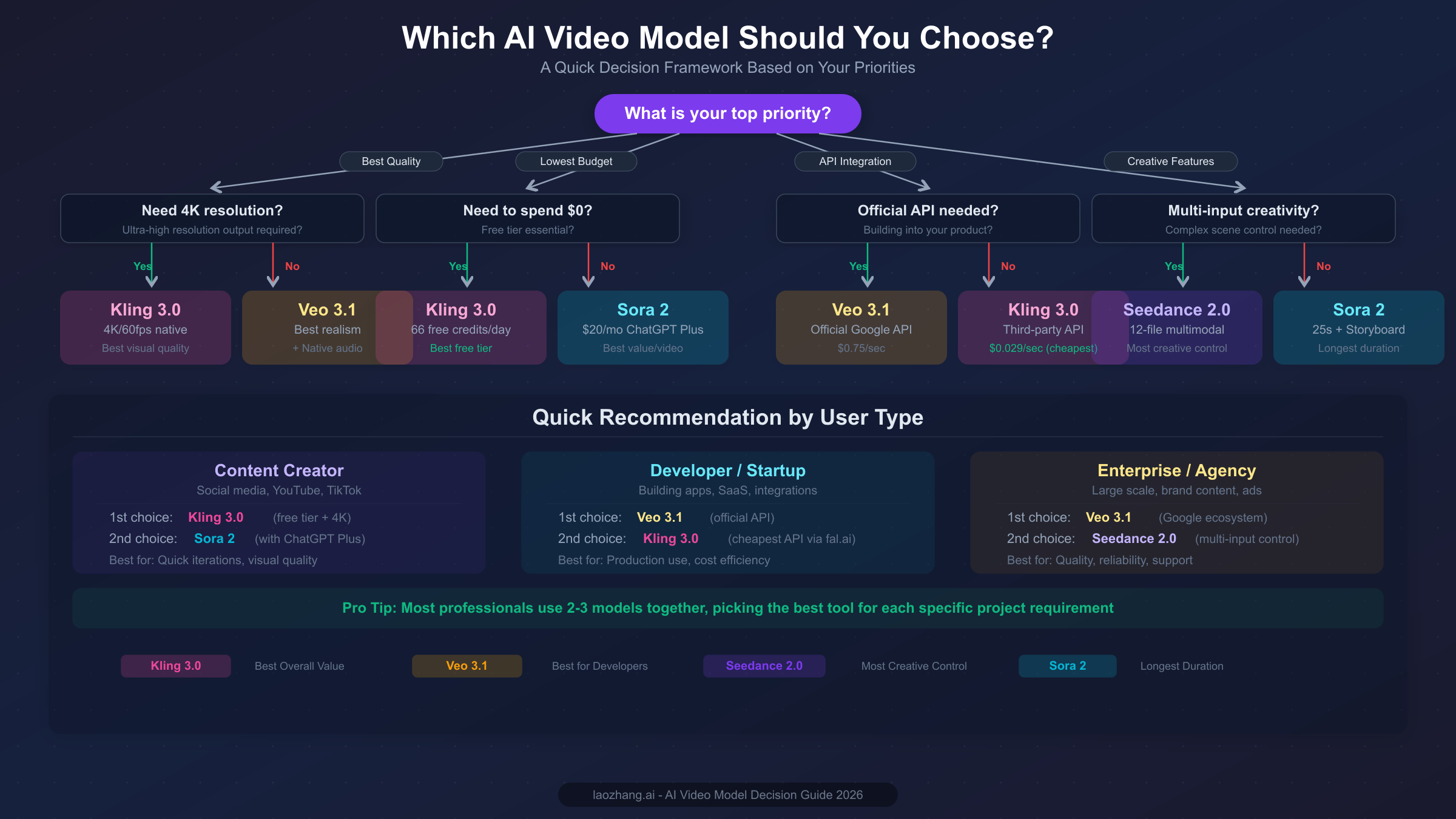
After examining specifications, pricing, audio capabilities, API access, and availability, the question remains: which model should you actually use? The answer depends entirely on your specific situation, and the decision framework below is designed to guide you to the right choice in under five minutes based on three key factors: what you are building, what you can spend, and how you need to access the tool.
If you are a content creator making social media videos, YouTube content, or marketing materials, your primary concerns are visual quality, ease of use, and cost efficiency. Kling 3.0 is the strongest recommendation here because it combines the highest visual output quality (4K/60fps) with the most generous free tier in the market. You can start generating professional-quality video content today without spending a dollar, and the Standard plan at $6.99/month is the cheapest paid option among all four models. If your content frequently requires audio, consider pairing Kling 3.0 with Veo 3.1, as Google's model produces the best native audio. For creators who need longer clips without editing, Sora 2's 25-second duration is uniquely valuable, especially if you already subscribe to ChatGPT Plus for other creative work.
If you are a developer or startup building video generation into a product, API reliability, cost predictability, and documentation quality are paramount. Veo 3.1 is the safest choice because it has an official Google API with enterprise-grade reliability, comprehensive documentation, and predictable pricing. The $0.75/sec official rate is high, but you can reduce costs significantly by using third-party providers that offer the same model at $0.15-0.25 per request with async endpoints and no-charge-on-failure policies. If your application needs the absolute lowest API cost and can tolerate third-party provider dependency, Kling 3.0 through fal.ai at $0.029/sec is remarkably affordable. Avoid building core product features around Sora 2 until OpenAI releases an official API, as relying entirely on third-party reverse-engineered access introduces stability risks for production workloads.
If you are an enterprise or agency producing high-volume branded content, you need a combination of quality, reliability, and scale. The recommended approach is to use Veo 3.1 as your primary model for its audio capabilities and official API support, with Kling 3.0 as a secondary option for projects requiring 4K output. Seedance 2.0 deserves serious evaluation for projects requiring complex creative direction because its 12-file multimodal input system most closely mirrors the reference-based workflows that professional creative teams already use. Enterprise users should also consider negotiating custom pricing directly with Google (for Veo) or through established third-party providers that offer volume discounts and dedicated support.
Quick decision by priority:
- Best visual quality: Kling 3.0 (4K/60fps native)
- Best audio generation: Veo 3.1 (full native audio)
- Most creative control: Seedance 2.0 (12-file multimodal)
- Longest clip duration: Sora 2 (25 seconds native)
- Lowest cost entry: Kling 3.0 (free tier with 66 daily credits)
- Best API for developers: Veo 3.1 (official Google API)
- Cheapest API per second: Kling 3.0 ($0.029/sec via fal.ai)
The most important insight from this comparison is that no single model dominates every category. Most professional users in 2026 are adopting a multi-model strategy, using different generators for different projects based on the specific requirements of each job. The low cost of switching between models, especially through aggregation platforms that provide unified API access to multiple generators, makes this multi-tool approach practical and cost-effective. Choose your primary model based on your most frequent use case, but stay flexible enough to leverage the unique strengths of each platform when a project demands it.
FAQ
Is Seedance 2.0 better than Kling 3.0?
Neither is categorically better because they excel in different areas. Seedance 2.0 offers superior creative control through its 12-file multimodal input system, allowing you to combine text, images, video clips, and audio references in a single generation request. This makes it ideal for complex creative projects where you need precise control over the output. Kling 3.0 wins on pure visual quality with native 4K resolution at 60fps and offers a free tier that Seedance does not match. If visual fidelity is your priority, choose Kling 3.0. If creative control and complex scene direction matter more, Seedance 2.0 is the better choice. At the subscription level, both are comparably priced with Kling starting lower at $6.99/month versus Seedance's $19.90/month entry tier.
Can I use Sora 2 through an API?
OpenAI has not released an official public API for Sora 2 as of February 2026. All official access is through the ChatGPT web interface, requiring either a Plus ($20/month) or Pro ($200/month) subscription. For developers who need programmatic access to Sora 2 video generation, third-party aggregation services provide API endpoints that interface with the model. These services typically charge $0.15-0.80 per request depending on quality settings and offer async processing with no billing on failed generations. However, relying on third-party access for production workloads carries inherent stability risks compared to official APIs. If API reliability is critical for your application, Veo 3.1's official Google API is the safer choice.
Which AI video generator is cheapest in 2026?
Kling 3.0 is the most affordable option across both subscription and API pricing tiers. Its free tier provides 66 credits per day, which is enough for several video generations without any cost. The Standard paid plan starts at just $6.99/month, the lowest entry price among all four models. For API usage, Kling offers the cheapest per-second rate at approximately $0.029/sec through providers like fal.ai. For comparison, Veo 3.1's official API is $0.75/sec, though third-party providers reduce this to $0.15-0.25 per request. Sora 2 can be cost-effective if you already pay for ChatGPT Plus ($20/month) since video generation is included in the subscription.
What is the best AI video generator for professional use?
For professional and enterprise use, the answer depends on your specific workflow. Veo 3.1 is the best choice for teams that need reliable API access, native audio generation, and Google ecosystem integration. Kling 3.0 is ideal for projects demanding the highest visual resolution (4K/60fps). Seedance 2.0 fits professional workflows that involve complex creative briefs with multiple reference materials. Most professional teams in 2026 use two or more models, selecting the best tool for each specific project rather than committing to a single platform.
Does Veo 3.1 generate audio with video?
Yes, Veo 3.1 is currently the industry leader in integrated audio-video generation. It produces native audio that includes dialogue with lip-sync, ambient sound effects matched to visual content, and background music that fits the mood and pacing of the generated video. This audio is generated simultaneously with the visual content rather than being added as a separate post-processing step, which results in natural synchronization. The audio generation works automatically based on the visual content, though users can also provide audio direction in their text prompts to guide the style of generated sound. This capability eliminates significant post-production work for content that requires audio, making Veo 3.1 the preferred choice for creators who need complete audio-visual output from a single generation request.