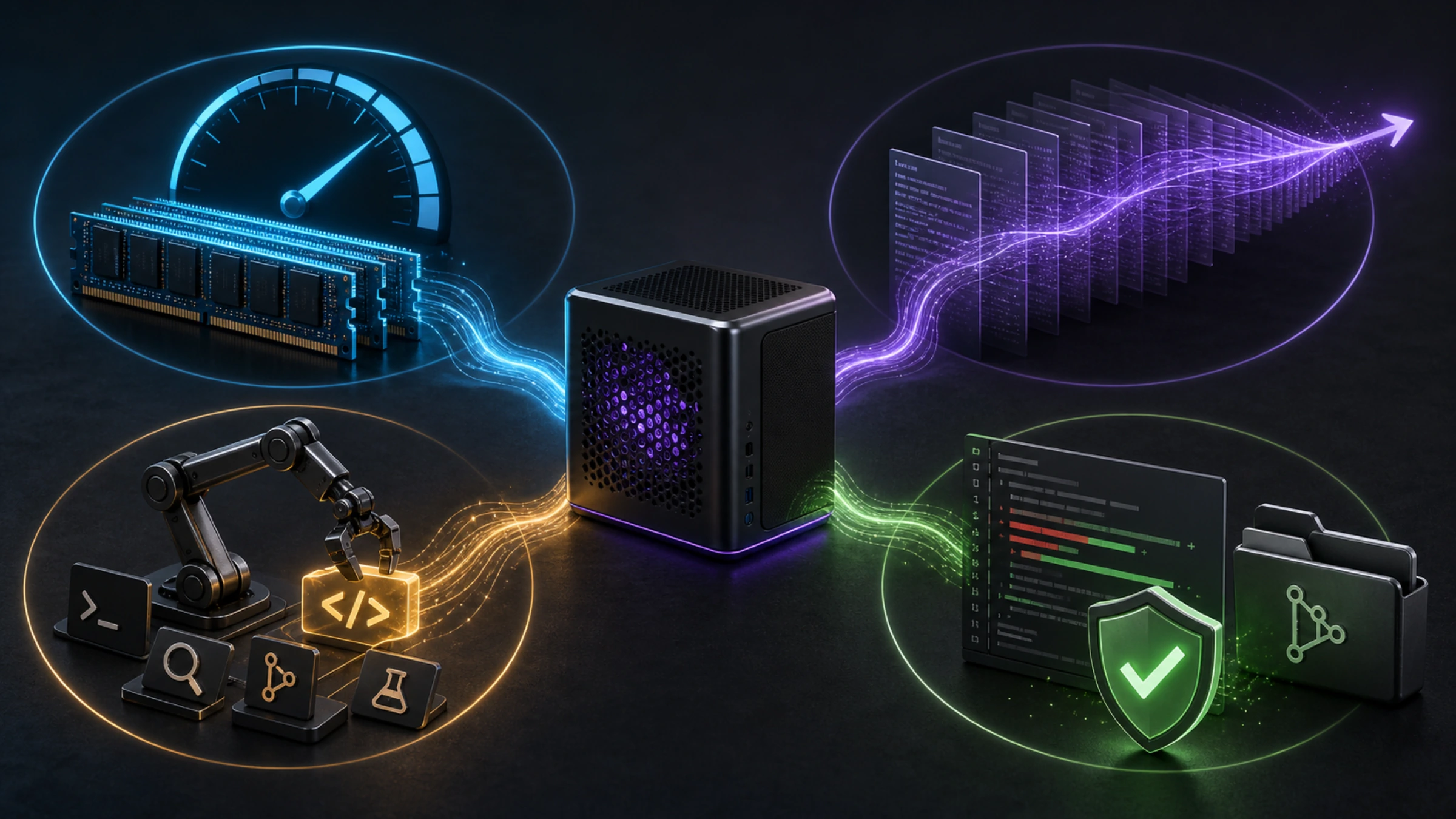
Qwen3.8-27B is a serious candidate for local agentic coding, especially if you want a dense model that can fit on high-end consumer hardware. It is not an automatic winner.
The useful question is not “Can I load it?” It is: Can this quantization, on this machine, inside this agent harness, finish repository tasks with valid tool calls and acceptable repair cost? A 24 GB GPU may load a Q4 file and still lack the headroom for a useful long-context loop.
The verdict depends on two gates
Qwen3.8-27B passes the capability gate. Its official model card describes a 27B dense vision-language model with native image and video understanding, a 262,144-token native context window, and optional YaRN scaling to one million tokens. Thinking is enabled by default; reasoning_effort and preserve_thinking let supported runtimes control reasoning depth and retain reasoning context across turns.
Qwen also reports strong coding results: 73.0 on Terminal-Bench 2.1, 61.7 on SWE-bench Pro, 42.3 on NL2Repo-Bench, 42.2 on DeepSWE 1.1, and 79.0 on QwenSWEBench.
Those numbers make the model worth evaluating. They do not pass the deployment gate for you. The results come from Qwen's stated harnesses and settings; some tasks were corrected and some benchmarks are in-house. They are not independent evidence for your GGUF, runtime build, repository, or agent protocol.
Your deployment gate has five separate conditions:
- the model and a useful KV cache fit without destructive CPU offload;
- the runtime applies the right chat template and thinking behavior;
- tool calls remain structurally valid over multiple turns;
- the model can turn failures into repairs rather than loops;
- accepted work arrives faster and with less human repair than your current route.
Fail any one of those and a smaller local model—or a hosted model for the hard tail—may be the better coding system.
What the download size hides
The current ggml-org GGUF repository exposes a useful capacity-planning baseline:
| Artifact | Current file size | Practical meaning |
|---|---|---|
Qwen3.8-27B-Q4_K_M.gguf | about 18.97 GB | The realistic starting point for 24 GB-class hardware |
Qwen3.8-27B-Q8_0.gguf | about 28.60 GB | More weight fidelity, but it needs a larger memory envelope |
| BF16 vision projector | about 0.93 GB | Additional overhead when the workflow needs image input |
These are files, not total process memory. Add the KV cache, runtime buffers, operating system, coding-agent process, repository index, and whatever your build or test suite needs. Longer context makes the KV cache larger. Partial CPU offload can preserve functionality while making a multi-step agent painfully slow.
That leads to a more honest hardware map:
- 24 GB VRAM or roughly 24 GB of available unified memory: Q4 can be a compatibility test. Start text-only and do not assume 64K context will remain fully accelerated.
- 32–48 GB available: Q4 has more realistic context headroom; higher quantization becomes possible, but full GPU residency still needs verification.
- 48 GB and above: 64K-plus agent runs become more comfortable. Native 262K is still a ceiling, not a mandatory default.
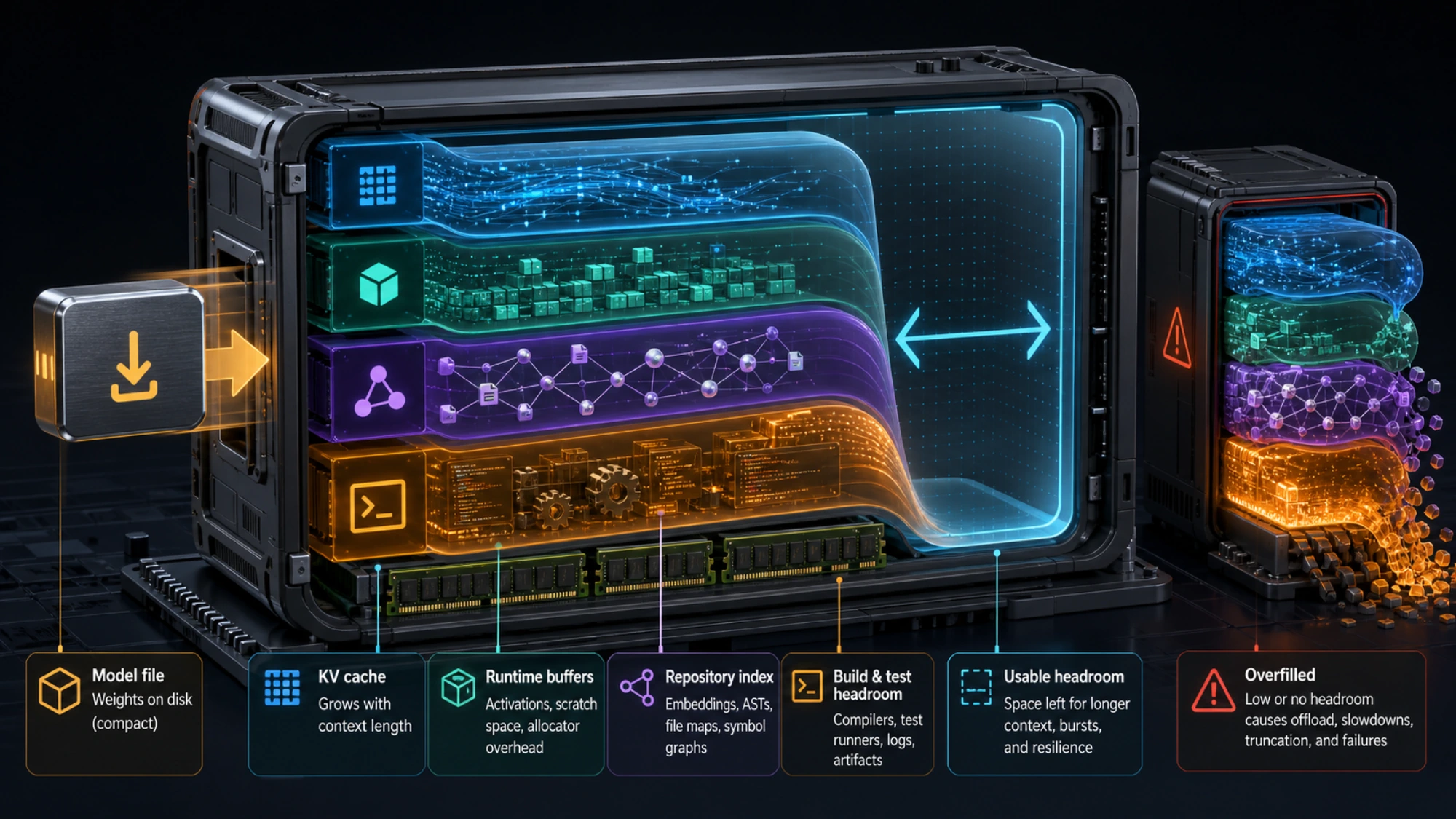
Ollama's current context-length guidance reinforces the point. It recommends at least 64K for agents and coding tools, while warning that larger context requires more memory. Its automatic default is only 32K on systems with 24–48 GiB VRAM.
So a 24 GB product label does not answer the coding question. Check the actual processor split, actual context, and tokens per second after the agent has loaded repository context—not just on an empty chat prompt.
Start with a text-only local server
The official ggml-org conversion gives the shortest llama.cpp path:
llama serve -hf ggml-org/Qwen3.8-27B-GGUFThis is a clean first test for model loading and the OpenAI-compatible serving surface. Use a current llama.cpp build because Qwen3.8-27B was released on August 14, 2026 and conversion support is still fresh.
If you already operate Ollama, its official import workflow accepts a local GGUF through a Modelfile:
FROM ./Qwen3.8-27B-Q4_K_M.gguf
PARAMETER num_ctx 65536
PARAMETER temperature 1
PARAMETER top_p 0.95
PARAMETER top_k 20ollama create qwen3.8-27b-local -f ./Modelfile
ollama run qwen3.8-27b-local
ollama psollama ps is part of the test. Confirm the active context and processor split. If the model is heavily offloaded or the context is lower than your agent needs, reduce the workload, change quantization, or move the hard tasks elsewhere.
For coding-agent integration, Qwen Code's model-provider documentation supports local OpenAI-compatible endpoints from Ollama, LM Studio, and vLLM. A provider entry for the Ollama model can look like this:
{
  "env": { "OLLAMA_API_KEY": "ollama" },
  "modelProviders": {
    "openai": [{
      "id": "qwen3.8-27b-local",
      "name": "Qwen3.8-27B Local",
      "envKey": "OLLAMA_API_KEY",
      "baseUrl": "http://your-ollama-host:11434/v1",
      "generationConfig": {
        "timeout": 300000,
        "maxRetries": 1,
        "contextWindowSize": 65536
      }
    }]
  }
}
Replace your-ollama-host with a hostname that the agent process can resolve. The id must match the name exposed by the local server. When tool calls fail, check the runtime version, chat template, context truncation, and API schema before concluding that the model itself cannot reason.
Test work, not demos
A one-shot game or landing-page demo measures generation appeal. Agentic coding requires a closed engineering loop.
Build an 8–12 task acceptance set from work your team already knows how to review. Include a small bug, a cross-file change, a test failure that requires recovery, a task that depends on repository instructions, and at least one change where the tempting implementation should be rejected.
Record the full route for every task:
| Measure | What counts |
|---|---|
| Accepted completion | The diff meets review standards and relevant tests pass |
| Tool-call validity | Calls are structurally valid, correctly named, and adequately parameterized |
| Retries | Restarts, repeated calls, or new prompts needed to finish |
| Human repair | Manual edits or steering required after the model's attempt |
| Wall time | Time from task start to accepted result, not raw generation speed |
| Peak resources | VRAM/unified memory, CPU offload, active context, and build/test pressure |
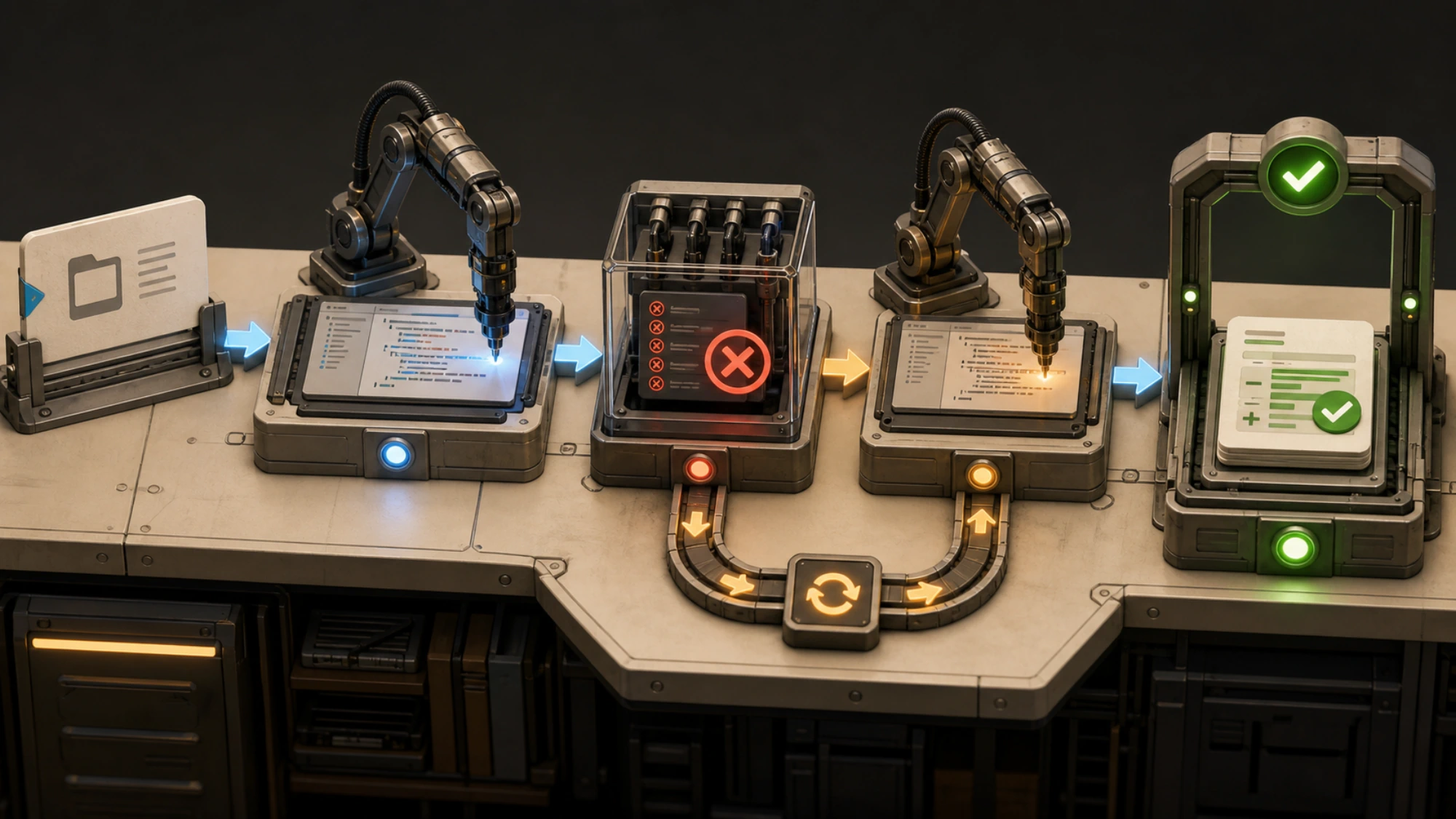
Keep the quantization, runtime, context, agent harness, and task set fixed when comparing alternatives. A vendor benchmark score and a different harness cannot substitute for that control.
The most revealing metric is accepted-task cost: total machine time plus human repair for work you would actually merge. A slower model with cleaner tool calls can beat a faster model that needs three retries. A Q4 model that completes narrow patches may still belong in a hybrid system even if it cannot own architecture work across a huge monorepo.
Who should use Qwen3.8-27B locally
Choose it as a priority test when you have at least 32 GB of usable VRAM or unified memory, local-data requirements, and enough operational tolerance to keep a newly released runtime current. At 24 GB, test Q4 with a bounded text-only workload and treat the result as conditional.
Do not make it your only coding route when your machine relies on heavy CPU offload, your repositories regularly need very long context, or your unattended success requirement is more important than local control. In those cases, a smaller local worker plus a stronger hosted escalation path often produces better accepted work.
Qwen3.8-27B may become your best local coding model. The evidence is not that it carries the newest 27B label or a strong launch benchmark. The evidence is that it repeatedly turns your repository tasks into reviewable, tested changes inside your actual memory and latency budget.