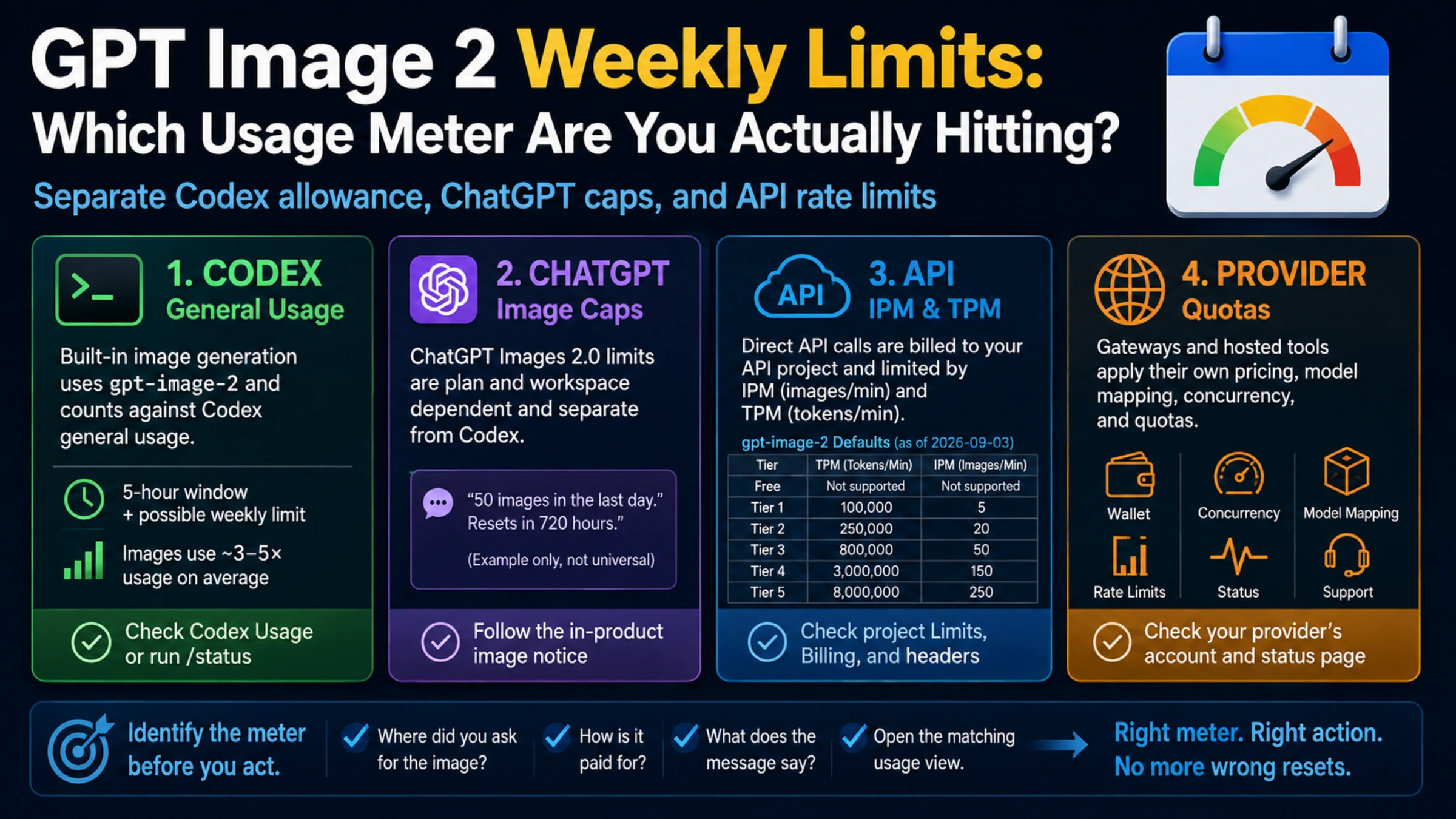
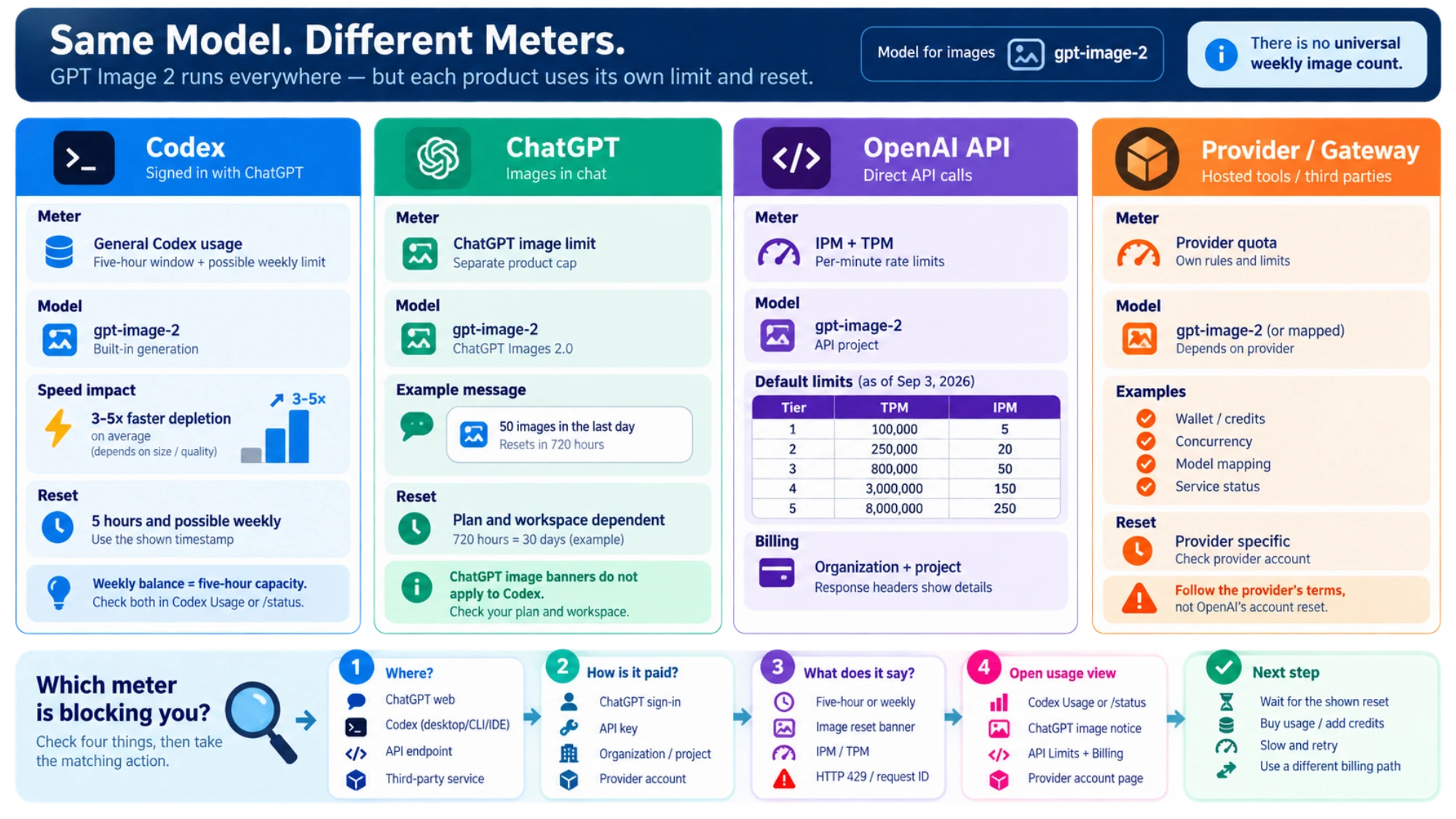
There is no single answer to “How many GPT Image 2 images can I make per week?” The model name may be the same, but the meter changes with the product and the way you pay.
Generate an asset with Codex while signed in to ChatGPT and the work draws from your general Codex allowance. Create an image in ChatGPT and a separate product limit applies. Call gpt-image-2 with an API key and the request belongs to an API project with its own billing and per-minute limits. A gateway or hosted tool adds a fourth set of rules.
That distinction is the difference between waiting for a reset that matters and waiting for one that has nothing to do with the blocked request.
Why images can drain Codex usage quickly
OpenAI's Codex image-generation documentation says built-in generation uses gpt-image-2 and counts against general Codex usage. Depending on image quality and size, it consumes included usage about three to five times faster on average than a comparable turn without image generation.
The multiplier is not a fixed price per picture. A request with several references, a large working context, high-quality output, or multiple generated assets can cost differently from a small one-off image. It is therefore normal for an image-heavy task to move the usage meter more than a text edit that appears equally short in the chat.
When Codex is authenticated with a ChatGPT plan, local messages and cloud tasks share a five-hour window and may also be subject to a weekly limit. OpenAI directs users to the usage dashboard for current limits; an active Codex CLI session can show remaining usage with /status.
Two details prevent common reset mistakes:
- Remaining weekly usage does not prove that the shorter five-hour window still has capacity.
- A weekly window does not necessarily reset at the start of a calendar week. Use the timestamp displayed for the active account instead of assuming Monday at midnight.
If the account offers credits or an eligible reset, those can extend or refresh usage under the terms shown in the product. They do not convert Codex work into API traffic, and they do not change an unrelated ChatGPT image cap.
A ChatGPT image banner is a different limit
ChatGPT Images 2.0 is available across ChatGPT tiers, but OpenAI says availability and limits depend on the plan and workspace settings. The current official help pages do not provide one permanent plan-by-plan table of images per day or per week. Numbers reported in forums may describe a particular account at a particular time, not your entitlement.
OpenAI makes the product separation explicit in its guide to using Codex with a ChatGPT plan. Image limits and reset banners seen inside ChatGPT do not apply to Codex. The guide uses examples such as “50 images in the last day” and “resets in 720 hours” to illustrate the distinction; those examples are not a promise that every account receives those values.
Also, 720 hours is 30 days, not one week. If that message appears in a ChatGPT conversation, check the ChatGPT plan and workspace that owns the conversation. If a five-hour or weekly bar appears in Codex Usage, check Codex instead. The underlying image model does not merge those meters.
API capacity is measured in IPM and TPM
Direct API calls do not consume a ChatGPT subscription allowance. They are billed to the API organization and project associated with the key, and the public capacity table is expressed as image-per-minute and token-per-minute limits.
As of September 3, 2026, the official gpt-image-2 model page lists these defaults:
| API usage tier | TPM | IPM |
|---|---|---|
| Free | Not supported | Not supported |
| Tier 1 | 100,000 | 5 |
| Tier 2 | 250,000 | 20 |
| Tier 3 | 800,000 | 50 |
| Tier 4 | 3,000,000 | 150 |
| Tier 5 | 8,000,000 | 250 |
TPM means tokens per minute; IPM means images per minute. Neither value is a weekly image allowance. The official image API rate-limit help also tells developers to check the current limits page for their own account. A public tier row cannot account for project settings, temporary restrictions, organization verification, or a more specific limit exposed in response headers.
An API 429 may indicate request pace, but it can also accompany a billing or project-spend problem. Preserve the response body, error.code, request ID, and rate-limit headers before changing the system. A rate-limit 429 calls for pacing and bounded retries; exhausted credit or a spend ceiling calls for the correct Billing or Limits page.
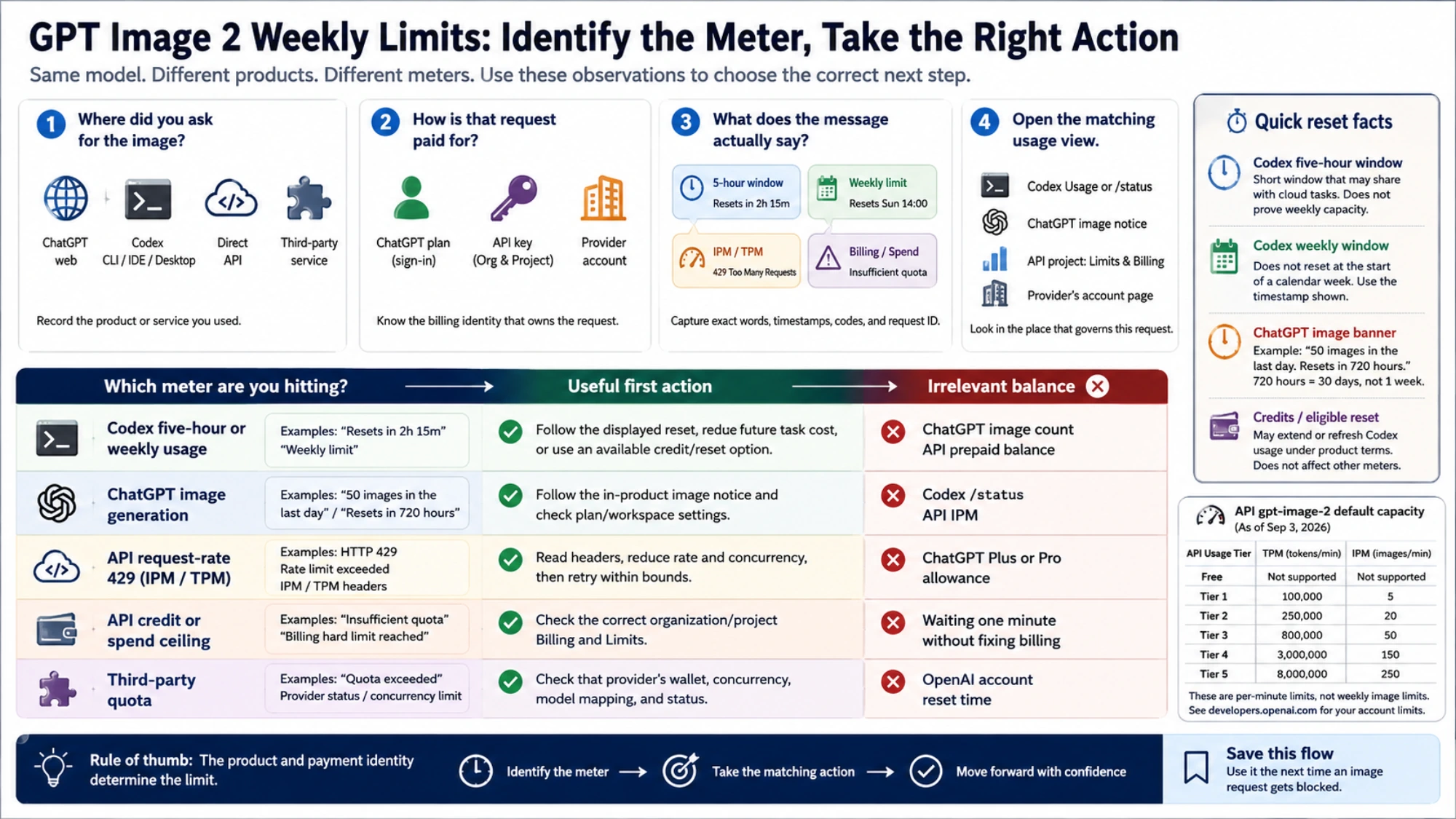
Identify the meter in four observations
Keep the failed state long enough to classify it. Changing the model, account, network, key, and concurrency at once can make the symptom disappear without revealing why.
- Where did you ask for the image? Record ChatGPT web, Codex desktop/CLI/IDE, a direct API endpoint, or a named third-party service.
- How is that request paid for? In Codex, confirm ChatGPT sign-in versus an API key. For API work, identify the organization and project without exposing the key.
- What does the message actually say? Capture five-hour, weekly, a reset timestamp, IPM, TPM, HTTP 429, provider name, and request ID where present.
- Open the matching usage view. Use Codex Usage or
/status, the ChatGPT image notice, the API project's Limits and Billing pages, or the provider's own account page.
The next step follows from that classification:
| What is blocking the request | Useful first action | Irrelevant balance |
|---|---|---|
| Codex five-hour or weekly usage | Follow the displayed reset, reduce future task cost, or use an available credit/reset option | ChatGPT image count or API prepaid balance |
| ChatGPT image generation | Follow the in-product image notice and check plan/workspace settings | Codex /status or API IPM |
| API request-rate 429 | Read headers, reduce rate and concurrency, then retry within bounds | ChatGPT Plus or Pro allowance |
| API credit or spend ceiling | Check the correct organization/project Billing and Limits | Waiting one minute without fixing billing |
| Third-party quota | Check that provider's wallet, concurrency, model mapping, and status | OpenAI's displayed account reset |
For the terminal message exceeded retry limit, last status: 429 Too Many Requests, use the Codex 429 diagnostic. If the next task is implementing Images API or Responses correctly, continue with the GPT Image 2 API route guide. If direct API access remains blocked after choosing the endpoint, use the GPT Image 2 API tier and account-readiness guide.
When API billing is the better fit
Built-in Codex generation is convenient for an occasional cover, diagram, UI asset, or edit that belongs with repository work. Large batches are different. Producing many candidates, several sizes, or repeated high-quality edits can consume the shared Codex allowance quickly, so a separately metered API project may be easier to budget and queue.
Moving to an API key is not a quota bypass. It creates engineering responsibilities for credential safety, model access, organization verification, storage, moderation, retries, and spend controls. A third-party gateway has its own access and billing rules and must be evaluated using its own pricing, model mapping, logs, and support terms.
Use the model name only as the start of the diagnosis. The product, account, and billing method determine the limit. Codex image work draws from Codex's general five-hour and possible weekly allowance; ChatGPT images follow ChatGPT rules; direct API calls use project billing plus TPM/IPM; provider tools enforce their own quotas. Once the correct meter is visible, waiting, buying usage, slowing requests, or changing the billing path becomes a defensible decision rather than a guess.