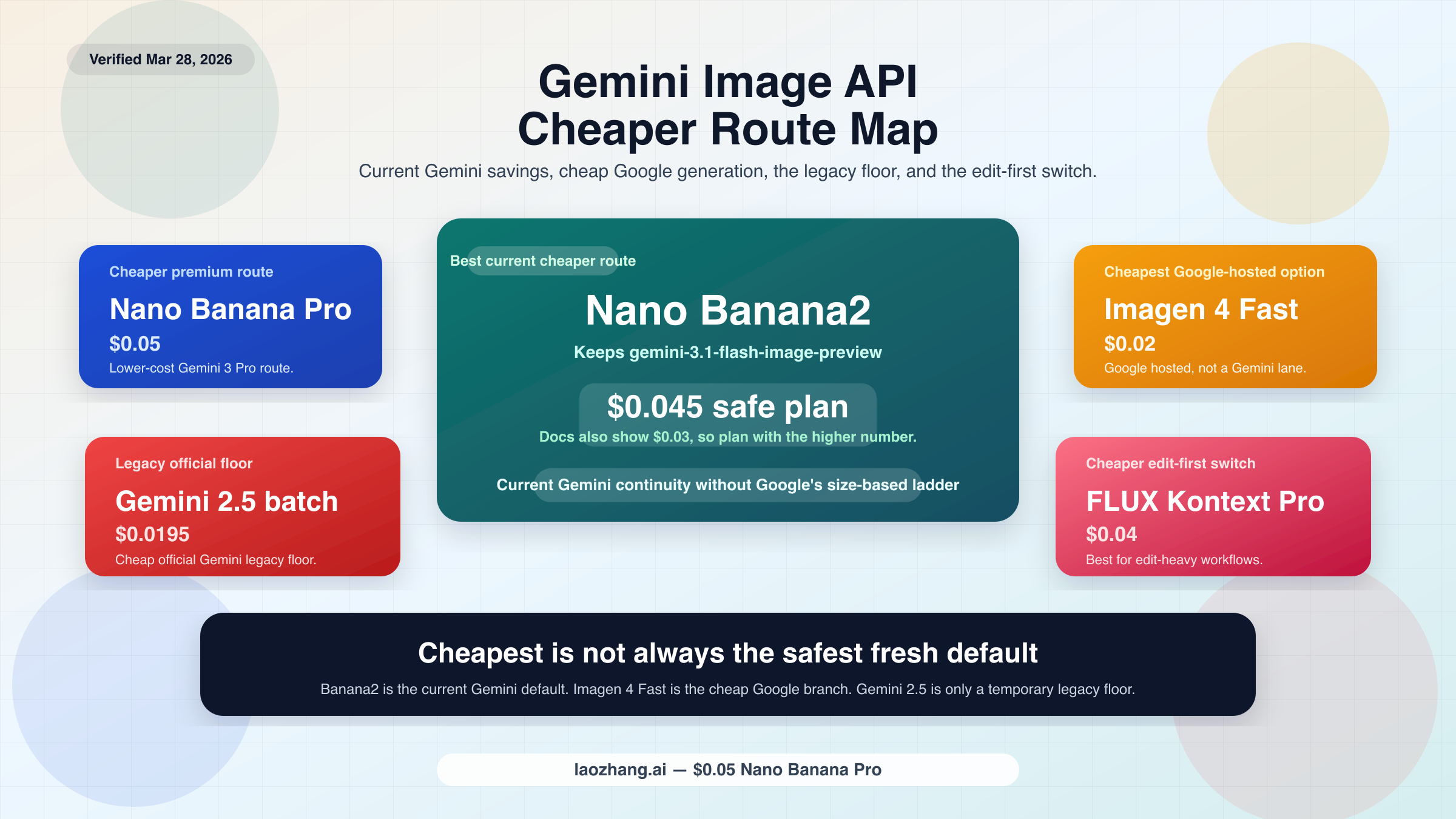
As checked on March 28, 2026, the best cheaper Gemini image API alternative for most developers is Nano Banana2 via LaoZhang API. It keeps the current gemini-3.1-flash-image-preview model, but the published price surface is lower than Google's direct Gemini image pricing. If your actual benchmark is direct gemini-3-pro-image-preview cost, the cleaner cheaper premium route is Nano Banana Pro. If your real goal is simply the cheapest Google-hosted image generator, Imagen 4 Fast is cheaper still.
That short answer matters because page one keeps flattening several different cost decisions into one headline. The cheapest official native Gemini lane is still gemini-2.5-flash-image, but Google also lists that route for shutdown on October 2, 2026. That makes it a temporary cost floor, not the best fresh default.
There is also one caveat you should not skip. The current Nano Banana2 page still publishes two different prices: $0.045/image in the headline and comparison table, and $0.03/image in later support sections. I would budget around $0.045 until those docs are synchronized. Even with that conservative reading, it still undercuts Google's direct gemini-3.1-flash-image-preview pricing at 1K and above.
TL;DR: the fastest cheaper routes if Gemini already feels too expensive
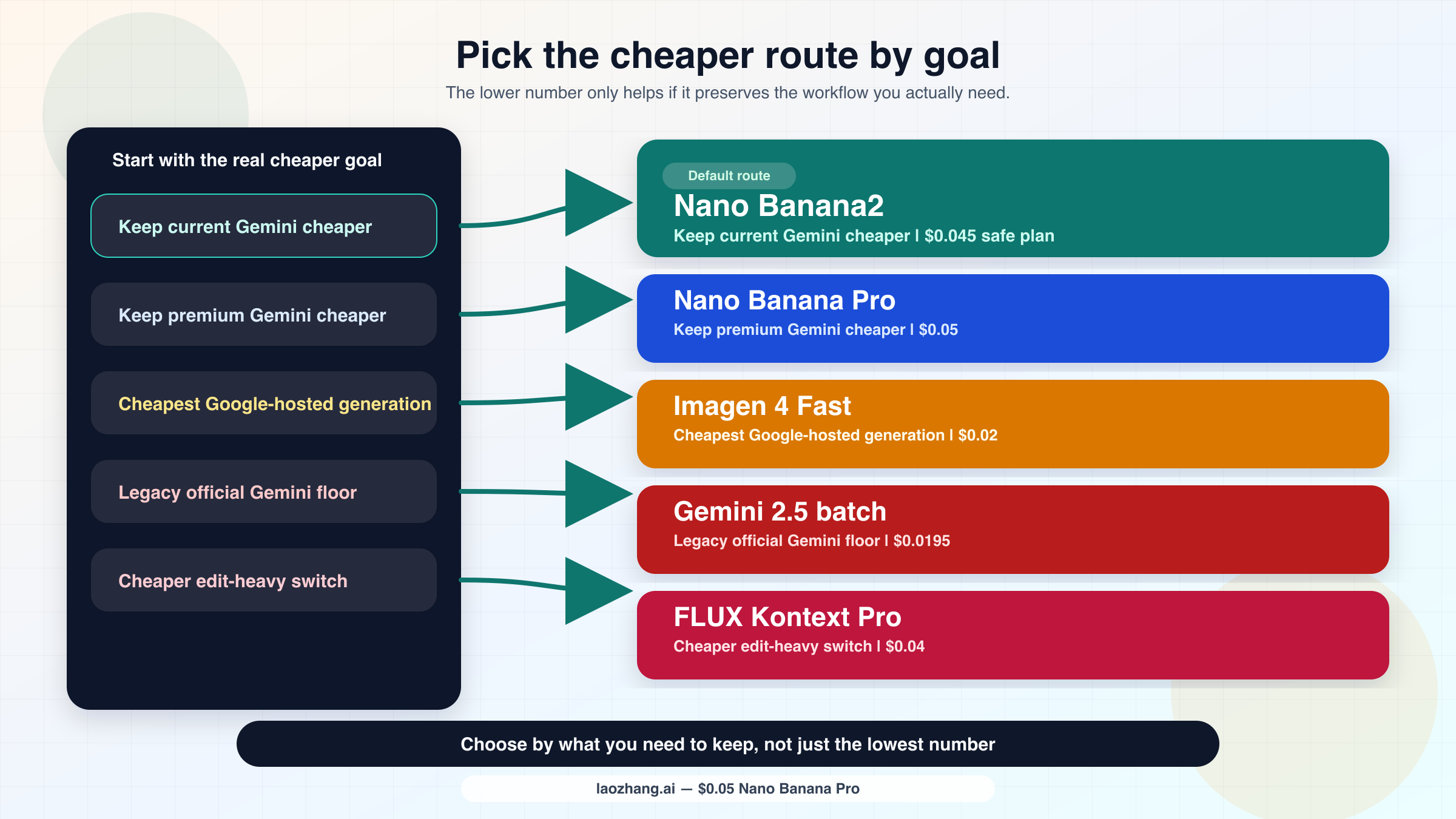
If you only need the routing answer, start here.
| If your real goal is... | Cheaper route | Current published price | Why it saves money | Main tradeoff |
|---|---|---|---|---|
| keep the current Gemini 3.1 image family cheaper | Nano Banana2 | $0.045/image on the headline price card, with older sections still showing $0.03 | keeps gemini-3.1-flash-image-preview but avoids Google's size-based ladder | third-party relay and a live doc mismatch |
| keep Gemini Pro quality cheaper | Nano Banana Pro | $0.05/image | far below Google's direct gemini-3-pro-image-preview pricing | still a third-party relay, not Google's own billing surface |
| use the cheapest Google-hosted generator | Imagen 4 Fast | $0.02/image | lower than current direct Gemini image lanes | not a Gemini route |
| use the lowest official native Gemini cost floor | gemini-2.5-flash-image batch | about $0.0195/image | Google's lowest listed native Gemini batch price | legacy lane with a published shutdown date |
| leave Google for a cheaper edit-first route | FLUX.1 Kontext Pro | $0.04/image | cheaper than current direct Gemini 3.1 Flash 1K pricing and better for revision-heavy work | not Gemini, different workflow and model behavior |
That table is the real answer this keyword needs. The mistake current ranking pages keep making is pretending these routes are interchangeable. They are not. One route keeps the current Gemini family. One route stays on Google but drops Gemini. One route is cheap because it is retiring. One route is cheap because it is built for a different job.
The practical default is therefore simple:
- If you still want the current Gemini image family, start with Nano Banana2.
- If you are replacing direct Gemini 3 Pro Image pricing, test Nano Banana Pro first.
- If you only care about the cheapest Google-hosted generation, use Imagen 4 Fast.
- If you are tempted by
gemini-2.5-flash-image, treat it as a short-term bargain, not a long-term foundation.
Nano Banana2 is the best current cheaper Gemini-compatible route
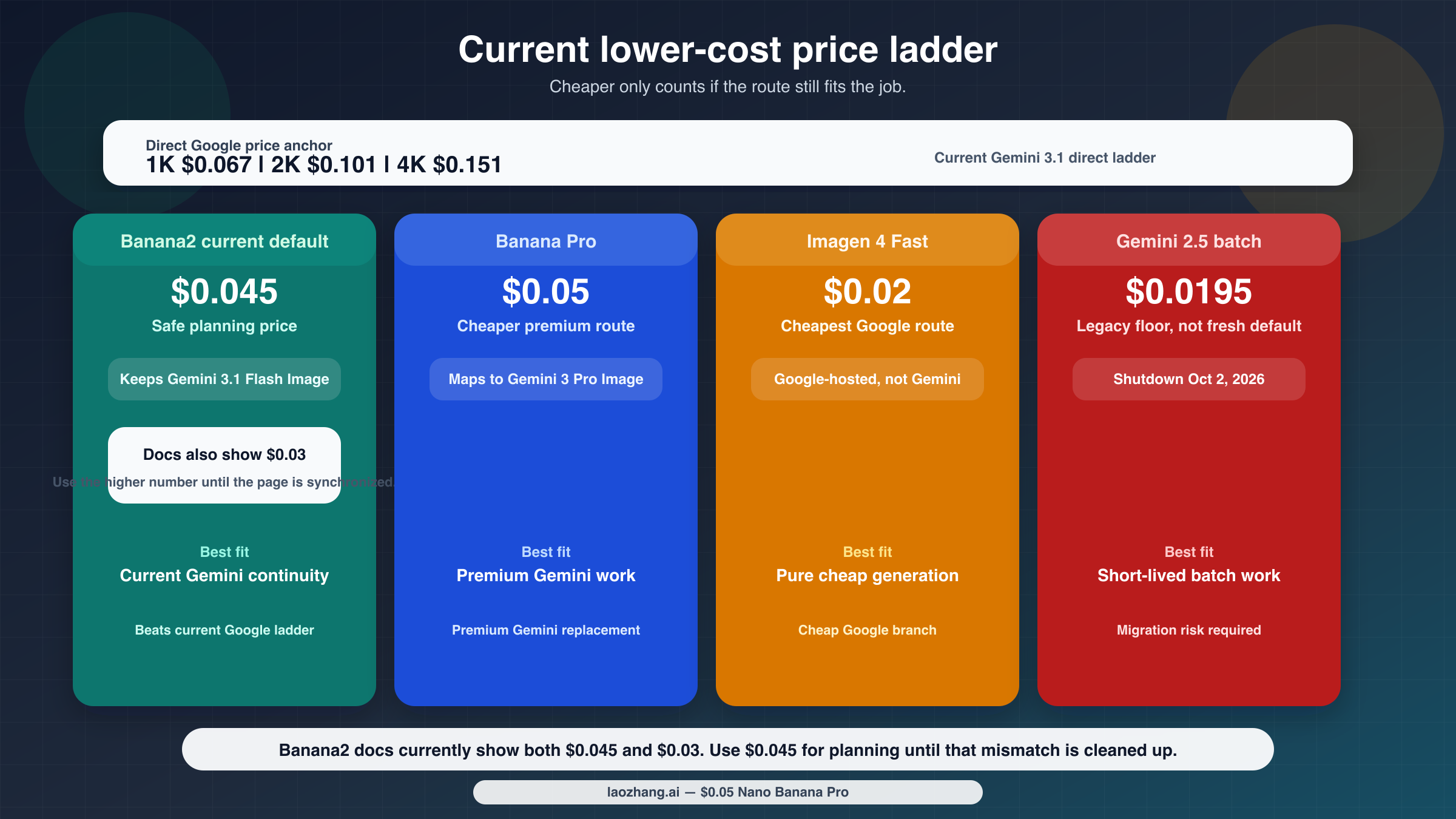
For most developers, the best cheaper route is not leaving Gemini. It is keeping the current Gemini 3.1 Flash Image model and changing how you buy it.
That distinction matters because Google's direct pricing is not one flat number. On the current Google pricing page, Google lists gemini-3.1-flash-image-preview at about $0.067 for 1K, $0.101 for 2K, and $0.151 for 4K, with batch pricing roughly half that. So even before you worry about rate limits or preview-model caveats, the official price climbs as the output size gets more serious.
That is what makes Nano Banana2 interesting. The current Nano Banana2 docs say it maps directly to gemini-3.1-flash-image-preview, supports both OpenAI-compatible and Google-native endpoints, and supports 1K / 2K / 4K output. In other words, it is not selling a different image model. It is selling a different access path to the same current Gemini 3.1 image line.
This is the cheaper route I would start with when the sentence is:
I still want current Gemini image behaviorI do not want Google's direct image price ladderI would rather keep the model family than reopen the whole stack choice
That is also why this page should not be read as a generic alternative roundup. When the user still wants Gemini-native image generation, a broad vendor jump is often the wrong first move. You do not need Midjourney, Firefly, GPT Image, or another full stack just because Google's direct price card feels high. First check whether you can keep the model you already want while paying less.
There is one trust caveat, and it matters. The current Nano Banana2 documentation is internally inconsistent. The headline and comparison table say $0.045/image, while later FAQ and changelog sections still say $0.03/image. That is why I would plan around $0.045, not the lower number. The route remains attractive even with the conservative number. But the article should not pretend the inconsistency does not exist.
If you want the deeper current math on this route, our cheaper Gemini 3.1 Flash Image Preview guide goes further into the size-by-size comparison.
Nano Banana Pro is the cheaper premium route when your baseline is Gemini 3 Pro Image
Some cheaper-alternative searches are not really about Gemini 3.1 Flash Image. They are about how to keep Gemini Pro Image quality without paying Google's direct Pro Image price surface.
That is where Nano Banana Pro becomes the relevant answer.
Google's current pricing page lists gemini-3-pro-image-preview at about $0.134 for 1K or 2K output and $0.24 for 4K, again with batch pricing roughly half that. So if you are using Pro for text-heavy marketing assets, structured diagrams, higher-confidence layouts, or more demanding premium work, the direct bill moves up fast.
The current Nano Banana Pro page maps directly to gemini-3-pro-image-preview and publishes a flat $0.05/image price. The docs also say the route supports both OpenAI-compatible and Google-native usage, with the native path keeping 10 aspect ratios plus 1K / 2K / 4K output. That makes it the right cheaper route when your current comparison is not Flash vs something cheaper, but direct Gemini Pro vs a lower-cost way to keep Gemini Pro.
This should not be oversold as the default answer for every reader. If your work is mostly high-volume drafts, quick variations, or internal concept work, Banana2 is still the better default. Banana Pro is the cheaper answer only when the work is premium enough that you were already paying, or planning to pay, direct Gemini Pro rates.
The clean rule is:
- Banana2 for value and current Gemini continuity
- Banana Pro for cheaper premium Gemini
If your real question is broader than cost and you are trying to decide whether to leave the premium Gemini lane entirely, our Gemini 3 Pro Image alternative guide is the better follow-up.
When Imagen 4 Fast is the cheaper Google answer
Some readers are not really asking for a cheaper Gemini route. They are asking for the cheapest Google-hosted image generator.
That is a different question, and the answer changes.
Current official Google pricing still surfaces Imagen 4 Fast at about $0.02/image. That is cheaper than the current direct Gemini image lanes, and it matters because many page-one results quietly assume the word Gemini must stay in the answer. For price-first buyers, that is not always true.
Imagen 4 Fast is the better answer when:
- you want to stay on Google infrastructure
- you care more about low-cost prompt-to-image generation than about Gemini-native image editing
- you do not need the Gemini image workflow's Search grounding or its broader conversational image stack
This is exactly the kind of split most cheaper-alternative pages miss. They treat the decision as if it were Gemini vs not Gemini. In practice, many buyers are really deciding between current Gemini, cheap Google image generation, and some cheaper external path. Those are not the same job.
So if your sentence is I just need the cheapest Google-hosted image generator, Imagen 4 Fast is the better answer than Banana2, Banana Pro, or the direct Gemini routes. If your sentence is I want to keep the Gemini image workflow but spend less, Imagen 4 Fast is the wrong shortcut.
Why Gemini 2.5 Flash Image is the cheapest official Gemini lane but the wrong fresh default
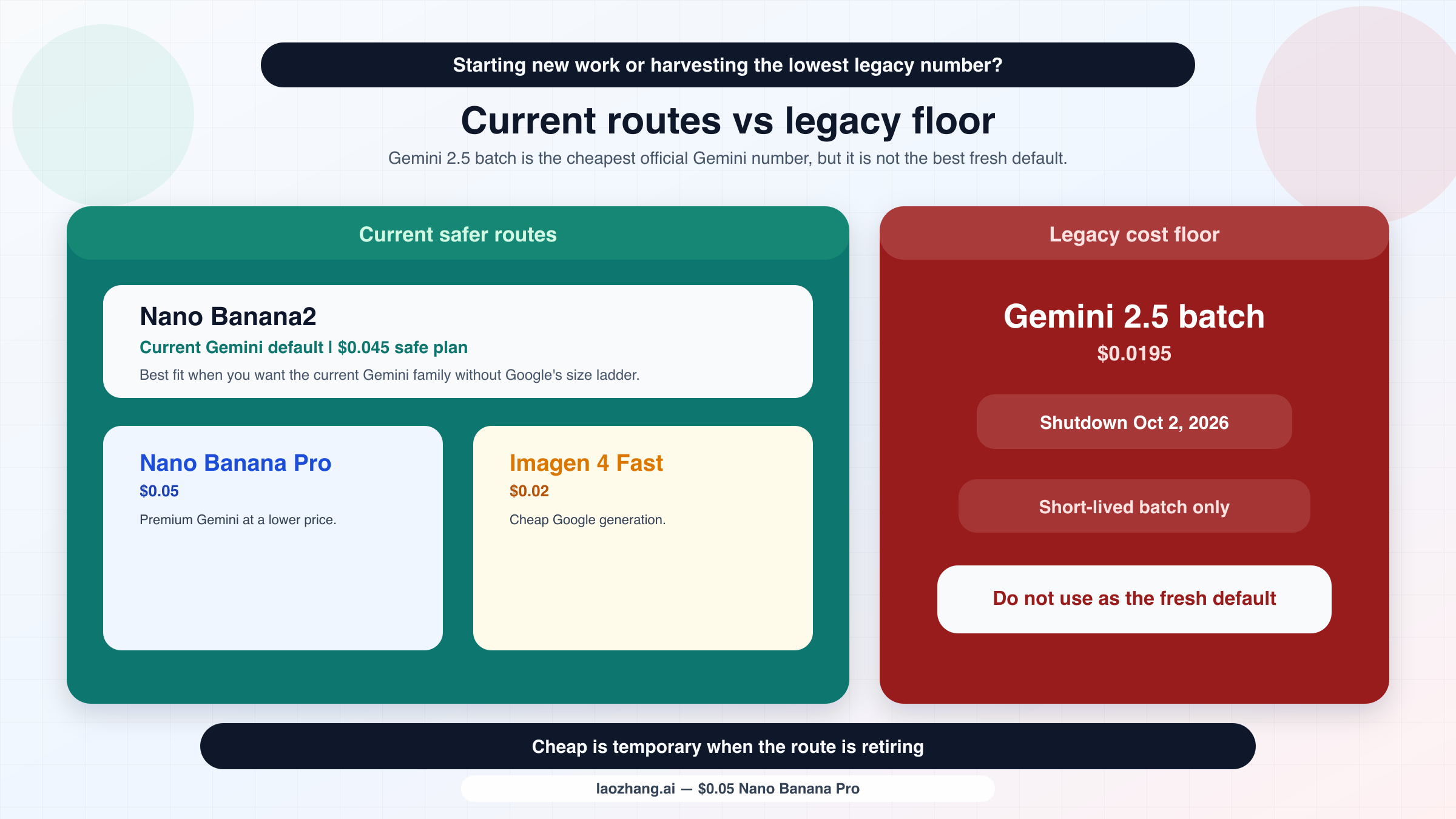
This is the section cheaper roundups usually handle badly.
If you insist on the lowest official native Gemini price, the answer is still gemini-2.5-flash-image. Google's pricing lists it at about $0.039 standard and $0.0195 in batch, which is lower than the direct current Gemini 3.1 Flash Image pricing.
But price is not the whole decision.
Google's deprecations page also lists October 2, 2026 as the shutdown date for gemini-2.5-flash-image, with gemini-3.1-flash-image-preview as the recommended replacement. That one line changes the editorial answer. It means the lowest official native Gemini price is attached to a route Google has already put on a retirement path.
So what is the honest recommendation?
Use gemini-2.5-flash-image only when all of these are true:
- you care about the absolute lowest official Gemini price
- 1K output is good enough
- the workload is short-lived enough that a planned migration is acceptable
- you are deliberately optimizing for a temporary cost floor
Do not choose it as the best fresh default for a new production build. The wrong conclusion current price guides keep inviting is that cheapest official equals smartest new route. For this keyword family, that is no longer true.
If your actual goal is free or near-free testing rather than the lowest official production price, our Gemini image API free-tier guide is the better next read.
When FLUX.1 Kontext Pro is the better cheap switch than staying in Gemini
Sometimes the cheaper answer should also solve a workflow problem, not only a billing problem.
That is the best case for FLUX.1 Kontext Pro.
Black Forest Labs currently lists FLUX.1 Kontext [pro] at $0.04/image and Kontext Max at $0.08/image. That means Kontext Pro lands below current direct Gemini 3.1 Flash 1K pricing and well below direct Gemini Pro pricing, while also shifting the workflow toward edit-heavy, revision-heavy production.
This route makes sense when the sentence is no longer I want Gemini but cheaper. It is:
I need repeated edits and consistencyI need lower cost and a better revision loopI do not actually need Gemini-family continuity
That is a narrower recommendation than the broader Gemini image generation alternatives page, and it should stay narrower. FLUX is not the default cheaper answer when your real goal is to preserve the current Gemini family. It becomes the better cheap switch only when your real work is editing and controlled iteration, not only first-pass generation.
This is why the article's route order matters:
- keep current Gemini cheaper if that is still the real goal
- stay on Google more cheaply if that is the real goal
- only then leave Google for a cheaper external route that solves the actual workflow better
The price caveats most cost-comparison pages hide
This is the trust layer page one still handles badly.
The first caveat is the Nano Banana2 doc mismatch. If a page tells you Banana2 is $0.03/image without mentioning that the same docs also publish $0.045/image, it is asking you to trust the article more than the source. That is not a good sign. The safer current planning number is $0.045 until the docs are synchronized.
The second caveat is that free testing and cheap production are different questions. Google's current image pricing rows show Free Tier: Not available for the live Gemini image models. That does not mean you cannot test image generation cheaply or for free in certain Google surfaces. It means you should not confuse those testing surfaces with the current paid production price cards. This is one reason the keyword family stays messy.
The third caveat is that batch pricing and realtime pricing are not the same thing. Google's official gemini-2.5-flash-image and current Gemini 3.x image lanes both look much cheaper in batch than in standard mode. That matters because some cheapest guides quietly compare batch prices against standard third-party routes or vice versa. If the workload is not actually a batch workload, the lower number is not your real answer.
The fourth caveat is that cheapest Google-hosted is not the same as cheapest Gemini. Imagen 4 Fast can be the cheaper Google answer while still being the wrong answer for a reader who wants Gemini-native image editing, grounded generation, or model-family continuity.
One useful way to keep the market honest is to compare every cheap route against the current job it is actually replacing:
| Route | Underlying model or family | Price anchor | Cheaper than what | Caveat |
|---|---|---|---|---|
| Nano Banana2 | gemini-3.1-flash-image-preview | $0.045/image safer current reading | direct Google gemini-3.1-flash-image-preview at 1K / 2K / 4K | current docs still also show $0.03 |
| Nano Banana Pro | gemini-3-pro-image-preview | $0.05/image | direct Google gemini-3-pro-image-preview | relay route, not direct Google billing |
| Imagen 4 Fast | Google-hosted Imagen lane | $0.02/image | current direct Gemini image lanes | not Gemini |
gemini-2.5-flash-image batch | legacy official Gemini lane | about $0.0195/image | current official Gemini 3.x image pricing | shutdown scheduled for October 2, 2026 |
| FLUX.1 Kontext Pro | external edit-first model | $0.04/image | direct Gemini 3.1 Flash 1K pricing and most Gemini Pro routes | only the right answer if Gemini continuity no longer matters |
That table is the important correction to current SERP behavior. It turns raw lower numbers into actual route advice.
What I would choose in four real situations
I want to keep the current Gemini image family, spend less, and avoid reopening the whole stack choice. I would start with Nano Banana2, budget it at $0.045, and treat the lower $0.03 mentions as unresolved documentation drift until the page is synchronized.
I am already comparing against direct Gemini 3 Pro Image and the work is premium enough that Flash is not the right fallback. I would choose Nano Banana Pro. This is the cleanest cheaper route when the thing you are replacing is premium Gemini price, not Gemini itself.
I only care about the cheapest Google-hosted image generation path. I would use Imagen 4 Fast. If the job does not actually need Gemini-native editing or grounding, this is the better cheap Google answer.
I want a cheaper route, but the real production pain is edits, revisions, and keeping outputs consistent. I would move to FLUX.1 Kontext Pro. At that point, a cheaper edit-first workflow is more valuable than staying loyal to the Gemini family.
The one route I would not treat as the best fresh default is gemini-2.5-flash-image. I would use it only when I knowingly want the cheapest official native Gemini lane for a short-lived workload and am willing to plan for migration.
Bottom line
The best Gemini image API cheaper alternative depends on what you are trying to keep while spending less.
If you still want the current Gemini image family, start with Nano Banana2. If your baseline is direct Gemini 3 Pro Image, test Nano Banana Pro. If your real goal is the cheapest Google-hosted generator, use Imagen 4 Fast. If you insist on the lowest official native Gemini price, gemini-2.5-flash-image is still that route, but it is also a legacy lane with a published shutdown date. And if your real need is cheaper edit-heavy production, FLUX.1 Kontext Pro is the better switch.
That is the buyer rule page one still does not explain cleanly enough. The cheapest number is not always the best current answer. The best cheaper route is the one that still fits the job after the price drop.