The shortest useful answer is this: choose the owner of the workspace before you choose the amount of usage. ChatGPT Plus and personal Pro belong to one person. ChatGPT Business gives an organization a managed workspace with paid seats. A team does not get that governance layer by buying several unrelated Plus subscriptions, and a solo professional does not need Business merely because the work is commercial.
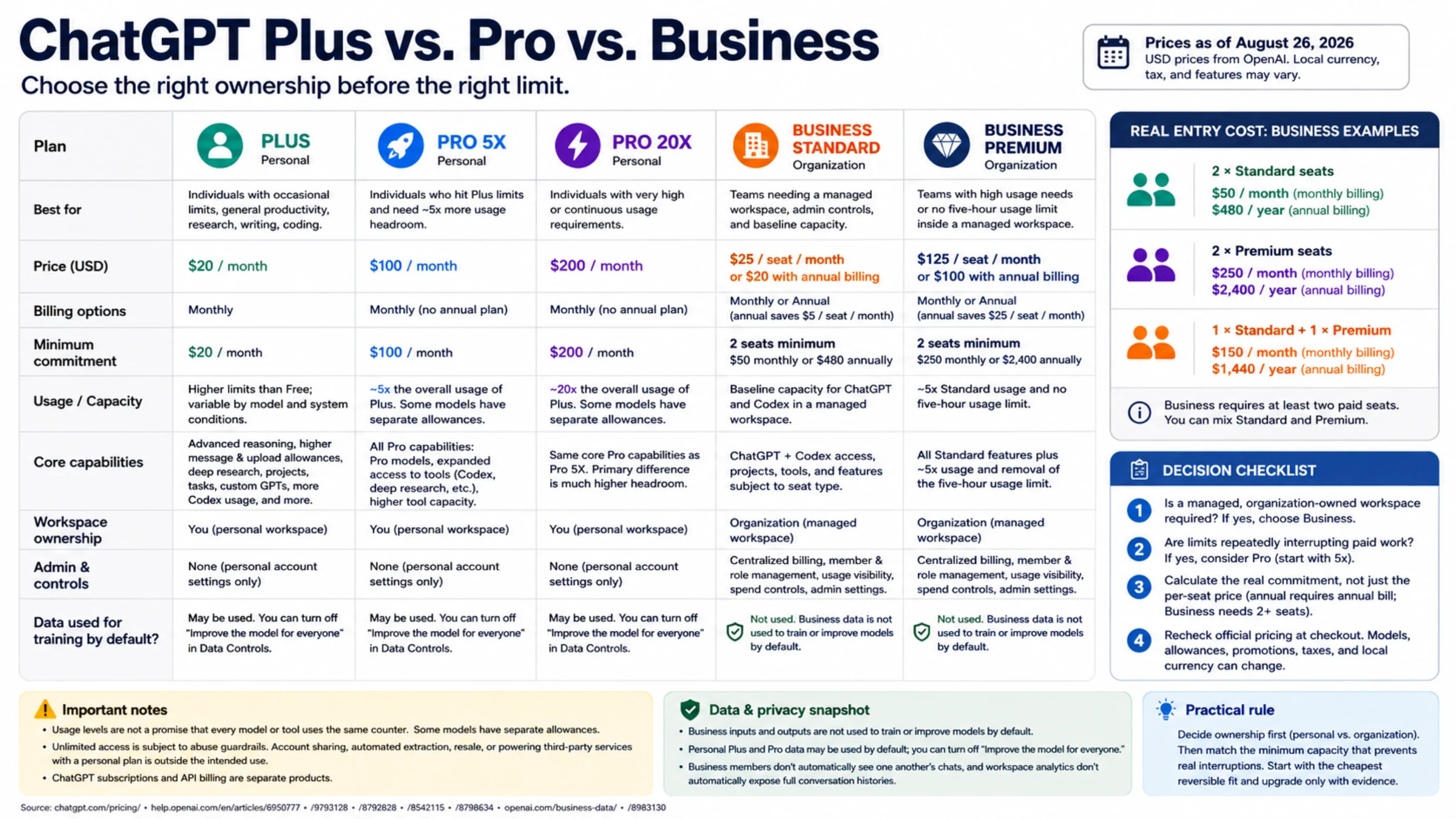
The prices also changed. As of August 26, 2026, the official ChatGPT pricing page lists Plus at $20 per month and personal Pro starting at $100 per month. Pro now has $100 and $200 usage levels, while Business has Standard and Premium seat types. Comparisons that show one $200 Pro plan or the old $30 monthly Business price no longer describe the full decision.
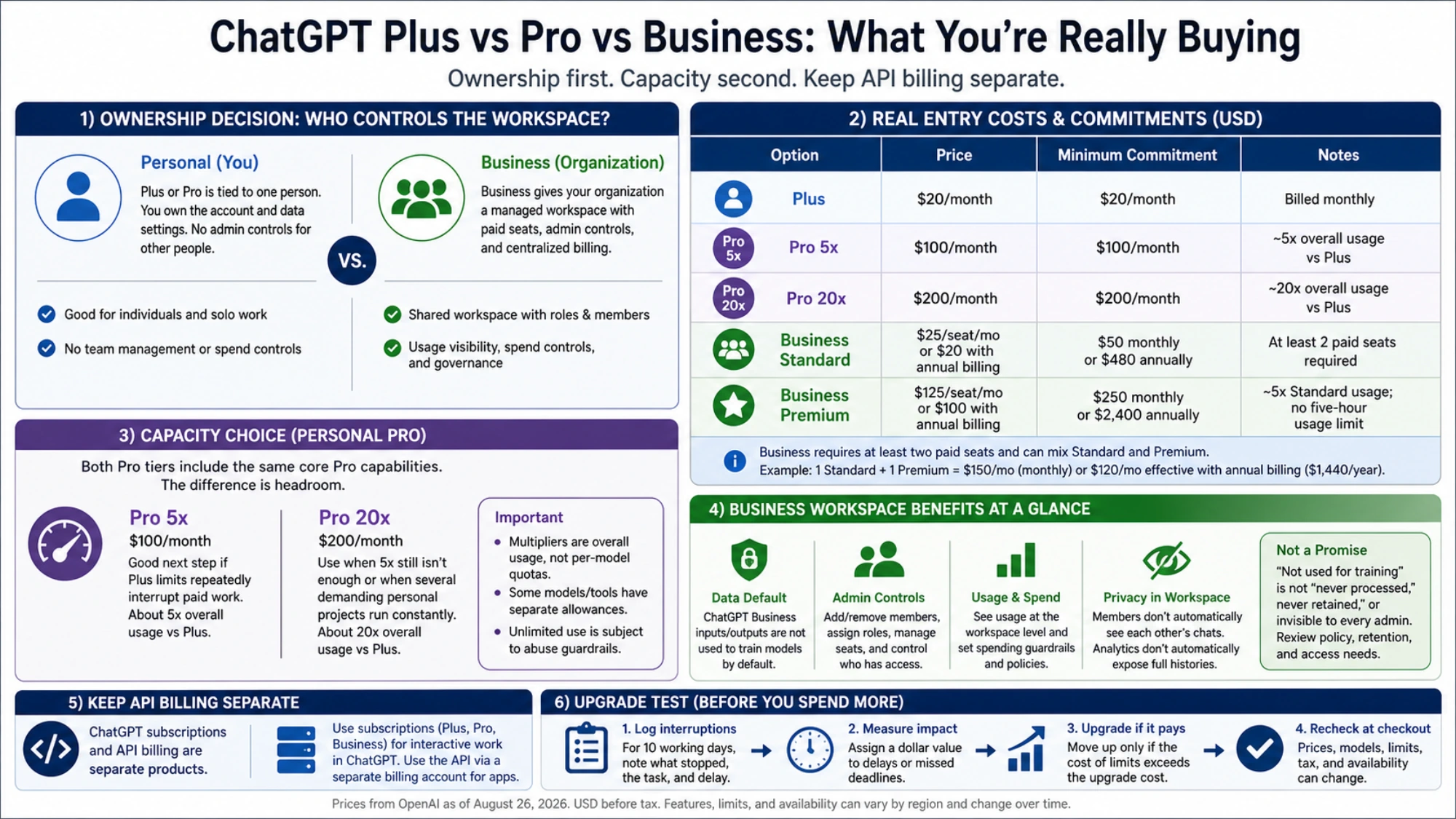
The actual choices and their minimum costs
| Purchase | Base price | Minimum commitment | What it controls |
|---|---|---|---|
| Plus | $20/month | $20/month | One person's advanced ChatGPT access |
| Pro 5x | $100/month | $100/month | One person's Pro capabilities with roughly 5x Plus usage |
| Pro 20x | $200/month | $200/month | The same core Pro capabilities with roughly 20x Plus usage |
| Business Standard | $25/seat/month, or $20 with annual billing | $50 monthly, or $480 billed annually | Standard capacity inside a managed workspace |
| Business Premium | $125/seat/month, or $100 with annual billing | $250 monthly, or $2,400 billed annually | Higher capacity inside that managed workspace |
Business requires at least two paid seats. It can mix Standard and Premium seats, so a two-person company does not have to give both people the highest allowance. One Standard plus one Premium costs $150 on monthly billing. On annual billing, the effective monthly cost is $120, but the annual commitment is $1,440.
The apparent $100 tie is especially easy to misread. Personal Pro 5x costs $100 monthly. A Business Premium seat also works out to $100 monthly on annual billing. The first is a complete personal subscription; the second is one seat in a workspace that still needs a second paid seat and an annual commitment. They solve different problems.
These are base US-dollar figures from OpenAI. Local currency, tax, checkout availability, and feature rollout can change the amount a buyer actually sees.
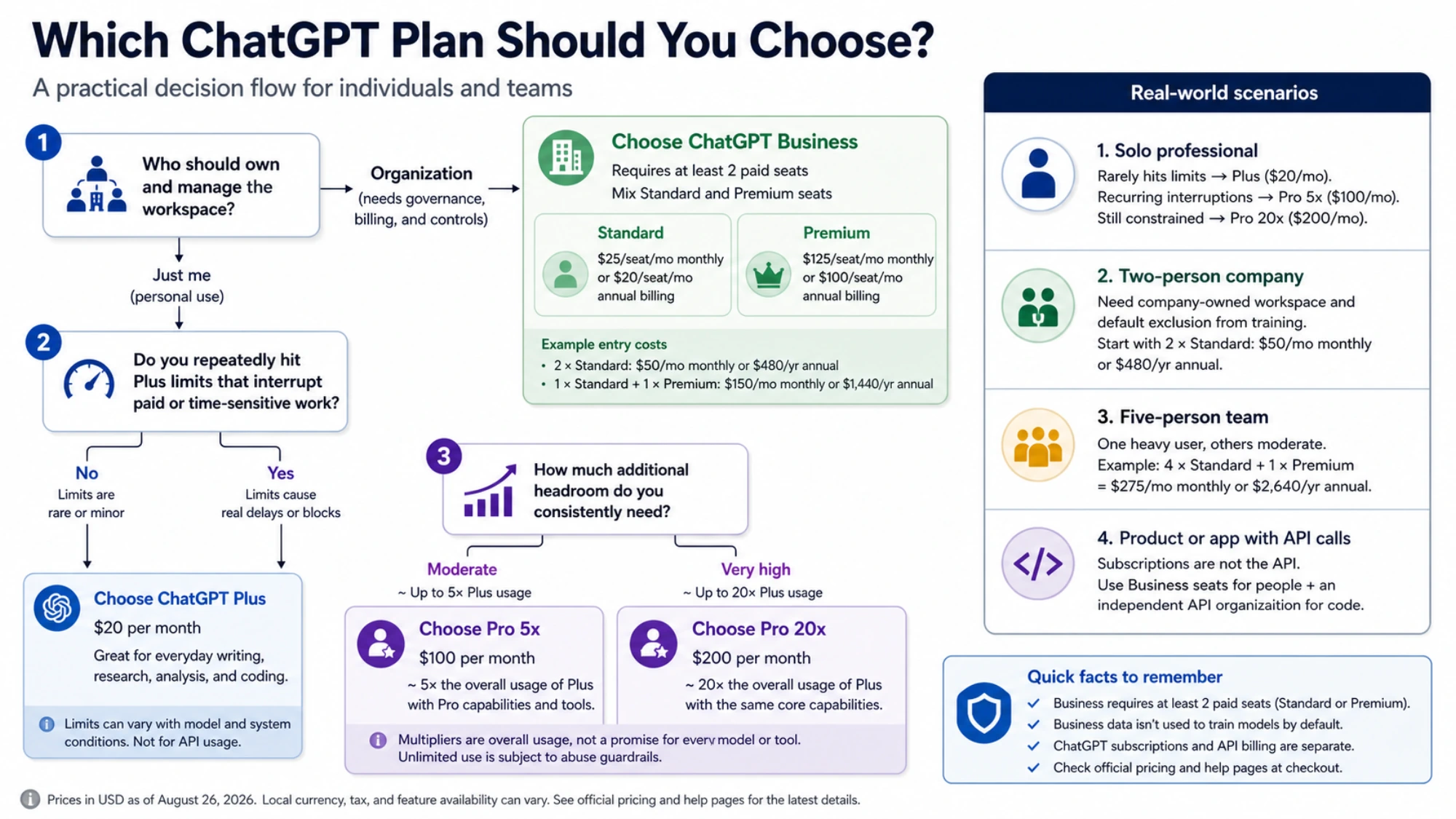
Pick Plus when interruptions are occasional, not costly
Plus includes advanced reasoning, higher message and upload allowances, enhanced deep research, projects, scheduled tasks, custom GPTs, more Codex usage, and other personal features. For regular writing, file analysis, research, and moderate coding, it is the sensible baseline.
Do not justify an upgrade with a fixed message-count table. OpenAI's Plus help page says limits can vary with system conditions, and individual tools or models may have their own allowances. A more durable test is whether limits repeatedly interrupt time-sensitive paid work.
Keep a simple record for ten working days: which model or tool stopped, what task was blocked, whether another available model could continue, and how long the delay lasted. One inconvenient reset is weak evidence for spending another $80 every month. Repeated interruptions with a measurable delivery cost are much stronger evidence.
Personal Pro is a capacity decision, not a team plan
OpenAI's current Pro guidance describes two levels. Pro at $100 provides about 5x the overall usage of Plus; Pro at $200 provides about 20x. Both include the same core Pro capabilities, including Pro models and expanded access to tools such as Codex and deep research. The primary tier difference is headroom.
Those multipliers are not a promise that every model, image, research run, or coding task converts into one common counter. Some models keep separate allowances. Unlimited access is also subject to abuse guardrails: account sharing, automated extraction, resale, or using a personal subscription to power a third-party service is outside the intended boundary.
Move from Plus to Pro 5x when Plus has repeatedly blocked work and five times the headroom is likely to cover the observed peaks. Consider Pro 20x only after the 5x level is still an operational constraint or when several demanding personal projects must run continuously. Buying 20x simply for “better answers” is a poor test because the two Pro tiers share their core capabilities.
Business changes who manages the work
ChatGPT Business adds a shared organizational workspace, centralized billing, member and role administration, usage visibility, and spend controls. Standard seats cover baseline ChatGPT and Codex use. Premium seats provide roughly 5x Standard usage and remove the five-hour usage limit, while remaining inside the same managed workspace.
Its data default is materially different. OpenAI says on its business data privacy page that inputs and outputs from ChatGPT Business are not used to train or improve models by default. Personal Plus and Pro users can turn off “Improve the model for everyone” in Data Controls, but that personal setting does not create an organization-owned workspace or centralized administration.
“Not used for training” should not be stretched into “never processed,” “never retained,” or “invisible to every administrator under every circumstance.” Business members do not automatically see one another's chats, and workspace usage analytics do not automatically expose full conversation histories. Organizations handling client, employee, or regulated data should still evaluate contractual, retention, and access requirements.
Four scenarios that expose the right plan
For a solo consultant who rarely hits a limit, Plus is enough even when the work is professional. If that consultant loses billable hours to recurring Plus limits, Pro 5x is the next reversible step; Pro 20x needs evidence that the lower Pro tier remains inadequate.
For two founders who need a company-owned workspace and default exclusion from training, Business Standard starts at $50 per month on monthly billing. Two personal Plus plans cost $40, but the $10 difference buys governance rather than merely more messages.
For a five-person team with one heavy analyst, five Premium seats would waste capacity. Four Standard seats plus one Premium seat align the subscription with the actual workload and keep all users in the same workspace.
For a product that sends prompts from code, none of these subscriptions is the answer. ChatGPT plans and API billing are separate. The team can have Business seats for interactive work and still need an independently funded API organization for the application.
A purchase rule that survives the next pricing change
- Decide whether the workspace must belong to an organization. If yes, compare Business seat types; personal plans fail that requirement regardless of price.
- Measure real interruptions rather than estimated prompt counts. Buy higher capacity only for members or individuals who repeatedly need it.
- Calculate the commitment, not just the displayed per-seat price. Business annual rates require an annual bill, and every Business workspace needs at least two paid seats.
- Recheck the official pricing and help pages at checkout. Models, allowances, promotions, taxes, and local currency are volatile.
For most individuals, Plus remains the starting point. Pro is justified by sustained personal workload. Business is justified by ownership, administration, and data-policy requirements, then sized with Standard and Premium seats. That sequence prevents the most expensive mistake: paying for more capacity when the real need was governance, or buying a managed workspace when only one person needed additional headroom.