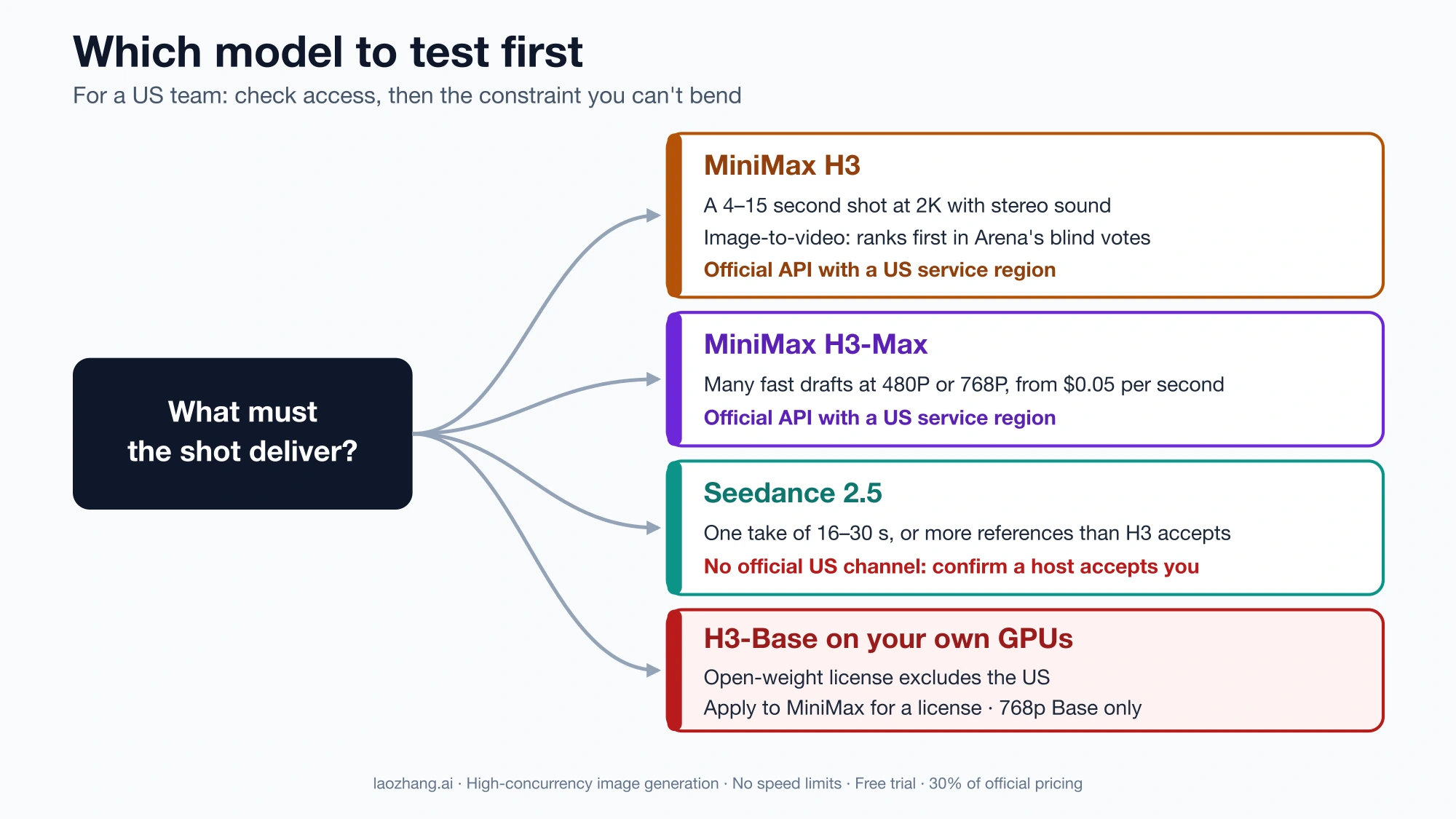
For a US team, test MiniMax H3 first. H3 and its faster sibling, H3-Max, are sold through MiniMax's own pay-as-you-go API, which offers the United States as a service region. As of September 23, 2026, Seedance 2.5 has no official US channel. BytePlus ModelArk's country list leaves out the United States, and Dreamina's Seedance 2.5 rollout names Europe, Asia, the Middle East and South America.
Seedance 2.5 is still worth chasing through a third-party host when a shot has to be one continuous take longer than 15 seconds or depends on a large stack of references. fal.ai lists it at up to 720p, at about twice the ModelArk rate, and you need to confirm with fal that your account is eligible. For everything that fits in 4–15 seconds, H3 gives you 2K with stereo sound at a lower per-second price. H3-Max is the draft engine.
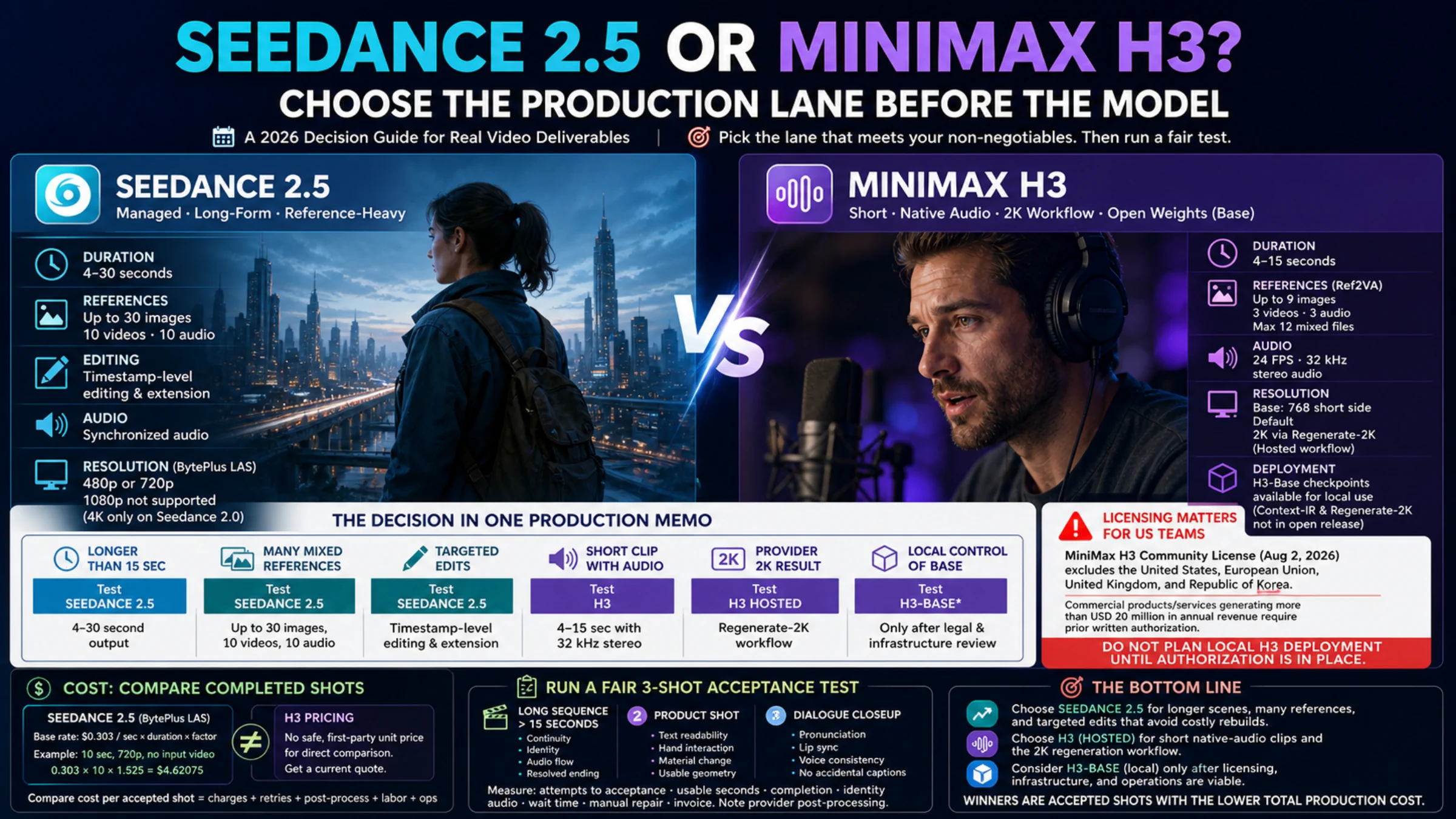
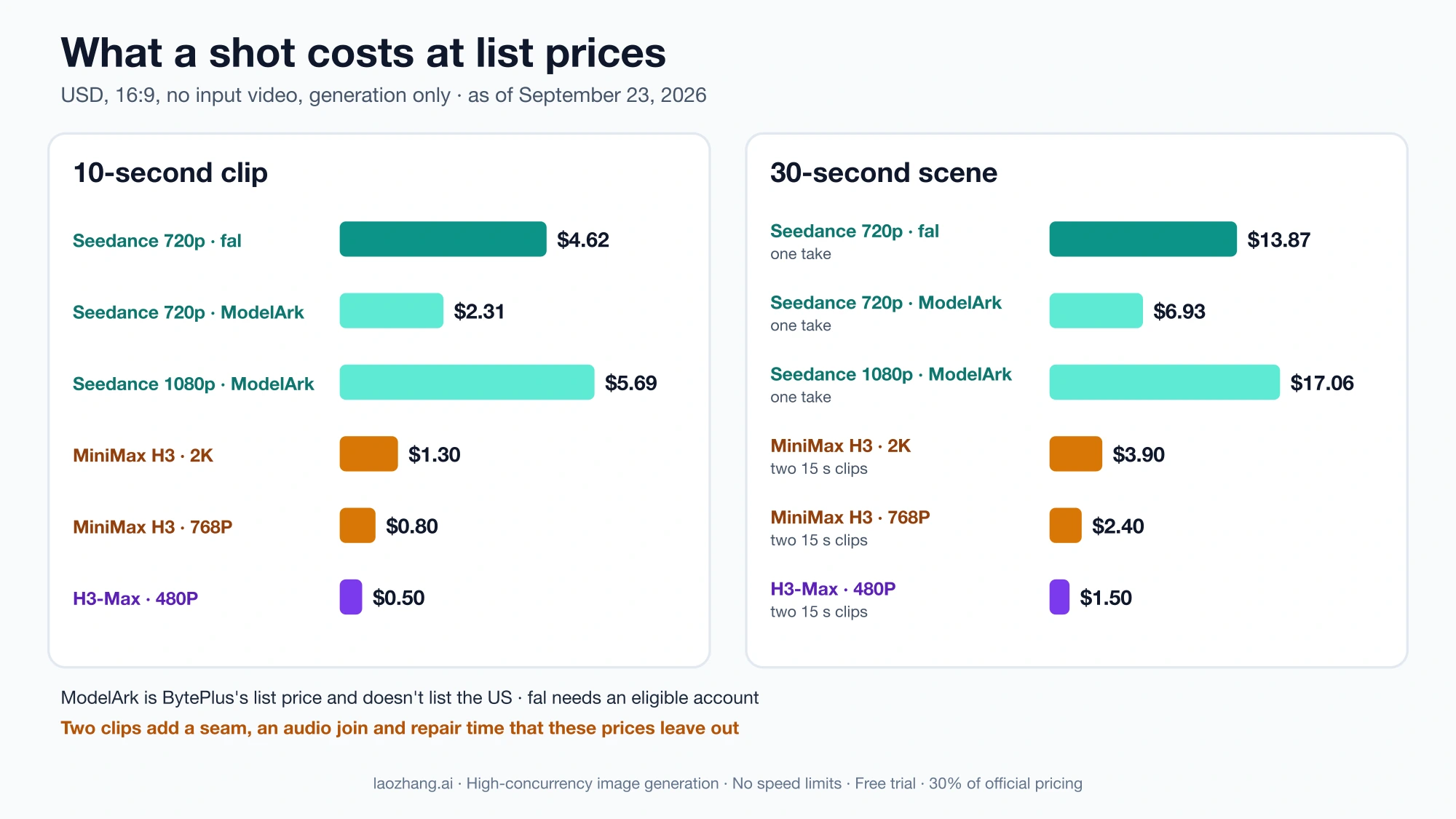
A 10-second clip costs $0.80 at 768P or $1.30 at 2K from MiniMax H3, and $0.50 at 480P from H3-Max. Seedance 2.5 costs $2.31 at 720p at ModelArk's list price, or about $4.62 through fal. In Arena's blind preference votes, text-to-video is a near-tie and H3 leads in image-to-video. Neither result predicts which model will pass your shot, so run a short test before committing.
One more US gate: the H3 open weights are licensed everywhere except the US, the EU, the UK and South Korea. MiniMax says the hosted H3 API stays available globally, so the restriction bites only if you want to self-host.
Who can buy each model in the US
Access decides the shortlist before specs do.
- Seedance 2.5 on BytePlus ModelArk: the ModelArk availability list (updated April 21, 2026) includes Japan, South Korea, the UK and most EU countries, but not the United States. BytePlus adds that availability is determined at the point of purchase.
- Seedance 2.5 in Dreamina: the Seedance 2.5 launch post rolls it out to subscribers over 16 in Europe, Asia, the Middle East and South America. The same post lists Seedream 5.0 Pro for the United States, but Seedance 2.5 isn't listed there.
- Seedance 2.5 on fal.ai: fal's Seedance 2.5 page offers 30-second takes at up to 720p with up to 50 references. It routes questions about eligibility for the model to a sales form, and it doesn't state US availability. Ask before you plan a production around it.
- MiniMax H3 and H3-Max: MiniMax's platform terms, effective March 30, 2026, offer the United States as a service region, with limits on ITAR and HIPAA data. They bill through Stripe and bar only comprehensively sanctioned regions and listed persons.
If your company also operates somewhere ModelArk does serve, the official Seedance pricing and specs below apply there.
Which model to test first for your shot
Once access is settled, start from the delivery constraint you can't bend.
| Your shot needs | Test first | Why |
|---|---|---|
| An official API you can sign up for from the US | MiniMax H3 or H3-Max | MiniMax offers a US service region. Seedance 2.5 has no official US channel listed. |
| One continuous take of 16–30 seconds | Seedance 2.5, through a host that accepts your account | It generates 4–30 seconds per request. H3 and H3-Max stop at 15 seconds. |
| More than 9 reference images, or more than 3 reference videos or audio clips | Seedance 2.5, same condition | It accepts up to 30 images, 10 videos and 10 audio clips, and audio alone can be the reference. H3 caps at 9 images, 3 videos and 3 audio clips. |
| Animating a still image | MiniMax H3 first | It ranks #1 in Arena's image-to-video votes, ahead of Seedance 2.5. |
| A 4–15 second shot delivered at 2K with stereo sound | MiniMax H3 | 768P or 2K output, 24 FPS, 32 kHz stereo audio, $0.13 per second at 2K |
| Many quick drafts for storyboards or motion tests | MiniMax-H3-Max | Built for speed, 480P or 768P only, $0.05 per second at 480P |
| The lowest generation cost for a clip of 15 seconds or less | MiniMax H3 or H3-Max | $0.05–$0.13 per second, against $0.23 for Seedance 2.5 at 720p at ModelArk's list price, or about $0.46 through fal |
| Running the model on your own GPUs | H3-Base, only with a license from MiniMax | Only the 768p Base checkpoints are open, and the open-weight license excludes the US |
When two rows pull in different directions, test both on that shot. A 25-second product spot with small on-pack lettering is the classic case. Continuity favors one Seedance take, while lettering at 2K favors H3 clips joined in the edit. Only your footage can say which failure costs more to fix.
Seedance 2.5 and MiniMax H3 specs side by side
Seedance 2.5 is documented in the ModelArk Seedance 2.5 tutorial, and H3 in the MiniMax video generation guide.
| Seedance 2.5 (BytePlus ModelArk) | MiniMax H3 | MiniMax H3-Max | |
|---|---|---|---|
| Model ID | dreamina-seedance-2-5-260628 | MiniMax-H3 | MiniMax-H3-Max |
| Length per generation | 4–30 s | 4–15 s | 5–15 s |
| Resolution | 480p, 720p (8-bit), 1080p (10-bit); fal lists up to 720p | 768P or 2K | 480P or 768P |
| References per request | Up to 50: 30 images, 10 videos, 10 audio clips | Up to 9 images, 3 videos (15 s total), 3 audio clips (15 s total); 12 files max | Image, video or audio references |
| Audio | Generated with the picture; native multilingual support for 11 languages, including English and Spanish | 32 kHz stereo, generated with the picture | fal says every generation includes synchronized audio; MiniMax's docs don't state it |
| Edit, extend, upscale | Edit and extend tasks | 768P to 2K regeneration | None documented |
| Cheap preview | Draft mode at 480p | Generate at 768P, regenerate keepers at 2K | The model itself is the fast option |
| Billing | Per million tokens | Per second | Per second |
| US access | ModelArk doesn't list the US; third-party hosts only | Pay-as-you-go API with a US service region | Pay-as-you-go API with a US service region |
A few details change how you read that table:
- 720p is not 768P, and 1080p is not 2K. Compare each model at your actual delivery spec.
- H3-Max is a separate model, not a speed setting. fal announced it on August 27, 2026, as a version of the open-weight H3 that fal post-trained for speed. MiniMax describes it as jointly released with fal. It has no 2K option.
- Seedance editing works through a request, not a timeline. An edit task requires
ratio=adaptive,duration=-1and a 4–30 second reference video, and the edited output can run up to 0.4 seconds shorter than the input. - H3 in 4K only exists on fal.ai, which upscales a 768P base to 2K or 4K. MiniMax's own API stops at 2K.
What a shot costs at official list prices
All figures below are list prices in USD as of September 23, 2026, for a 16:9 clip with no input video. Discounts from savings plans or prepaid packs are not included.
Seedance 2.5: ModelArk token math, and what fal charges
ModelArk isn't sold in the US, but its list price is the official USD rate for Seedance 2.5 and the baseline for judging any reseller's quote. The ModelArk pricing page bills per million tokens:
- $10.70 for 480p and 720p without input video, or $6.40 with input video
- $11.70 for 1080p without input video, or $7.00 with input video
Tokens are estimated as (input video seconds + output seconds) × width × height × frame rate ÷ 1024. At 24 fps that formula reproduces BytePlus's own 5-second examples exactly: $1.156 at 720p and $2.843 at 1080p. For a 10-second 720p clip:
10 × 1280 × 720 × 24 ÷ 1024 = 216,000 tokens × $10.70 per million = $2.31
The same math gives $5.69 for 10 seconds at 1080p (486,000 tokens at $11.70 per million). Only successful generations are billed, and a failure caused by content moderation costs nothing. A take you reject still counts as a successful generation, though, so you pay for it. Edits and extensions also count the input video's seconds, at the lower with-video rate, and a minimum charge applies.
Draft mode is ModelArk's budget tool for long shots. It renders a 480p preview billed like any 480p video, about $1.03 for 10 seconds. The final render from that Draft ID, valid for 7 days, currently comes out at 1080p only. Draft plus final for 10 seconds comes to about $1.03 + $5.69 = $6.72.
fal.ai charges $0.0214 per 1,000 tokens up to 720p, according to its comparison page. That's $21.40 per million, exactly twice ModelArk's rate. The same 216,000 tokens for 10 seconds at 720p cost $4.62 there.
MiniMax H3 and H3-Max: per-second math
MiniMax's pay-as-you-go pricing bills output seconds:
- MiniMax-H3: $0.08 per second at 768P, $0.13 per second at 2K
- MiniMax-H3-Max: $0.05 per second at 480P, $0.08 per second at 768P
Inputs can add to the bill. For H3, audio references are free and the first 5 images are free, then $0.04 per image. Reference video is billed per input second at the output resolution's rate. H3-Max includes only 2 free images, then $0.074 each.
So a 10-second 2K H3 clip with 8 reference images and a 10-second reference video costs $1.30 + (3 × $0.04) + (10 × $0.13) = $2.72. The references roughly double the price.
Regeneration from 768P to 2K costs $0.05 per output second, and the request must resend all the original inputs, which are billed again. Ten seconds at 768P ($0.80) plus regeneration ($0.50) comes to the same $1.30 as a direct 2K render. The advantage is that you approve at 768P and pay for 2K only on keepers.
Cost for 10, 15 and 30 seconds
| Clip length | Seedance 2.5 720p on fal | Seedance 2.5 720p, ModelArk list | Seedance 2.5 1080p, ModelArk list | H3 768P | H3 2K | H3-Max 480P |
|---|---|---|---|---|---|---|
| 10 s | $4.62 | $2.31 | $5.69 | $0.80 | $1.30 | $0.50 |
| 15 s | $6.93 | $3.47 | $8.53 | $1.20 | $1.95 | $0.75 |
| 30 s | $13.87, one take | $6.93, one take | $17.06, one take | $2.40, two clips | $3.90, two clips | $1.50, two clips |
Generation charges only, no input video, one accepted attempt per clip. H3-Max at 768P costs the same as H3 at 768P. ModelArk prices apply only where ModelArk sells, and fal prices only if fal accepts your account.
The 30-second row compares different products. One Seedance take has no seam. Two H3 clips need a cut or transition that hides the join, an audio bed that survives the splice, and possibly a repair pass. The dollar gap is real, and so is the extra editing.
Why you've seen $4.62 for 10 seconds, or 23 cents per second
Several Seedance 2.5 prices are in circulation, and each comes from a different place to buy it:
- About $0.23 per second is the ModelArk 720p list price ($1.156 for 5 seconds).
- $4.62 for 10 seconds at 720p is fal's price, as worked out above. It's also the price on BytePlus LAS, a separate BytePlus product: $0.303 per second × 10 seconds × a 720p factor of 1.525. LAS still lists only 480p and 720p for Seedance 2.5, which is where the claim that Seedance 2.5 has no 1080p comes from.
Before you compare against H3, make sure both numbers come from the same kind of seller, in the same currency, at the same duration.
What blind preference votes show
Arena runs blind votes in which people pick the better of two anonymous videos. As of September 22, 2026, the results split by task:
- Text-to-video: Seedance 2.5 at 720p scores 1474 ±9 and H3 scores 1460 ±9, a near-tie. In their 251 direct matchups, Seedance won 52.6%.
- Image-to-video: H3 ranks first at 1495 ±5, and Seedance 2.5 at 720p scores 1477 ±7. The ranges don't overlap, so H3's lead is real on this board, though narrow. In 620 direct matchups, H3 won 52.4%.
- Video editing (August 27 board): Seedance 2.5 scores 1410 ±26 and H3 1392 ±19. The ranges overlap.
Both head-to-head splits sit close enough to 50% that the sample sizes can't separate them. Artificial Analysis, which scores clips with audio, ranks H3-Max slightly above H3 in both text-to-video (1227 against 1220) and image-to-video (1195 against 1181). Seedance 2.5 isn't on that board yet.
These votes measure general preference on the arena's prompts, with Seedance at 720p. They don't tell you which model will hold your actor, your product lettering or your cut. There is no universal winner. The data does support testing H3 first for image-to-video work.
Price per second is not cost per usable shot
What you actually pay for a finished shot looks more like this:
cost per usable shot = generation charge × attempts + upscaling or regeneration + minutes spent fixing seams, audio and artifacts
Suppose a 30-second scene. Through fal, a 720p Seedance take costs $13.87, so two attempts to get a keeper cost $27.73. At ModelArk's list rate, where it's sold, the same two attempts cost $13.87. H3 at 2K needs two 15-second clips at $1.95 each. If each clip takes three attempts, that's six generations, or $11.70, before anyone hides the seam.
Neither outcome is a prediction. The attempt counts are made up to show how quickly they swamp the per-second rate. Log your real counts during the test below.
Turnaround matters too. fal says H3-Max renders a 5-second clip in under 3 seconds. In one same-prompt test reported by Kie.ai, citing AskVenice, H3-Max returned a 15-second 768p clip in 18 seconds, while Seedance 2.5 took 4 minutes 56 seconds for a 15-second 1080p clip. The resolutions differed and it was a single run. It still shows how many more drafts per afternoon a team can review with H3-Max.
The US license gate for H3 open weights
MiniMax released one part of H3 as open weights: H3-Base, which generates at 768p. According to the H3 model card, H3-Context-IR (the input-interpretation stage) and H3-Regenerate-2K stay API-only. A local install therefore gives you Base quality at 768p, without the official 2K stage or the stage MiniMax calls critical to output quality. MiniMax documents local deployment through ComfyUI or an SGLang service.
The MiniMax H3 Community License, dated August 2, 2026, applies worldwide except for its Excluded Territories: the European Union, the United Kingdom, the Republic of Korea and the United States. Under it, using or distributing the H3 works or their outputs in those territories is not authorized. For a US company, that rules out self-hosting H3 under this license. US organizations can apply to MiniMax for a formal license, which MiniMax may grant after reviewing the deployment and its safeguards.
The hosted API is a different matter. MiniMax's license Q&A says the H3 API is "globally available with built-in safeguards," while open weights are "temporarily limited in certain regions." It also commits to keeping the API available globally. API use runs under MiniMax's platform terms.
Two more license conditions apply to anyone deploying the weights:
- Commercial products and services with more than $20 million in yearly revenue need prior written authorization from MiniMax.
- Anyone offering H3 generation to third parties must run safeguards against misuse and a way to report violations.
None of this is legal advice. Have counsel read the current texts before commercial delivery.
A three-shot test to confirm the choice
Give both models the same shot plan, but write each prompt in the syntax that model's docs recommend. Forcing one identical string on both tends to reward whichever parser happens to like it. Three shots cover most failure modes:
- A scene longer than 15 seconds with two camera changes. Run it as one Seedance take and as two H3 clips joined in your editor. Check identity, set continuity, the audio join and whether the action resolves.
- A short product shot with small text, a hand interaction and a material change. Render H3 at 2K and Seedance at the highest resolution your provider offers, which is 720p on fal. Check lettering and product geometry, not just mood.
- A close dialogue shot in your delivery language. Check pronunciation, lip sync, voice consistency and any unwanted captions.
For each shot, record the attempts to the first keeper, the generation charges from the console, the wait per render and the minutes of repair. Use H3-Max, H3 at 768P or Seedance Draft mode for early iterations, and render at full resolution only once the composition works. Keep labels honest. A fal.ai 4K upscale is not native H3 output, and a local H3-Base result is not the hosted 2K pipeline.
Reading the results:
- Choose Seedance 2.5 if you have a provider that will serve your account, and cutting the scene under 15 seconds would cost more in seams and repair than the higher price.
- Choose H3 if short native-audio shots at 2K get accepted in a similar number of tries at a fraction of the price.
- Keep H3-Max in the loop for storyboards and motion tests even if the final render goes elsewhere.
- Choose neither if both repeatedly break the product, the actor or the required action. Redesign the shot or widen the shortlist with the guide to the AI video models that matter in 2026.
If Seedance wins and the open question is which Seedance version to run, see when to use Seedance 2.5, 2.0, Fast or Mini. For other head-to-heads, see Seedance 2.5 or Wan 3.0 and Seedance 2.5 vs Gemini Omni.
Quick answers
Can I use Seedance 2.5 in the US?
Not through an official channel as of September 23, 2026. BytePlus ModelArk's country list excludes the United States, and Dreamina's rollout doesn't include it. Third-party hosts such as fal.ai list the model, but confirm with the host that your account is eligible.
Is Seedance 2.5 worth it over MiniMax H3?
It's worth the extra cost and effort when the shot needs one continuous take longer than 15 seconds or more references than H3 accepts. For shots of 15 seconds or less, H3 costs less per second, $0.08–$0.13 against about $0.46 at 720p through fal. It also ties or leads Seedance in Arena's blind votes.
Is MiniMax H3 good?
On Arena as of September 22, 2026, H3 ranks first for image-to-video and roughly ties Seedance 2.5 for text-to-video. That's general viewer preference, not proof it will pass your shot, so run the three-shot test.
How long can MiniMax H3 videos be?
MiniMax-H3 generates 4–15 seconds per request in whole seconds, and H3-Max generates 5–15 seconds. Anything longer is built from several clips joined in editing.
Does MiniMax H3 support 1080p or 4K?
On MiniMax's own API, H3 outputs 768P or 2K, and H3-Max outputs 480P or 768P. There is no 1080p setting. 4K H3 comes only from fal.ai, which upscales a 768P base.
Can a US team run MiniMax H3 locally for free?
Not under the current community license, which excludes the United States for the open weights and their outputs. US organizations can apply to MiniMax for a formal license, and local use covers only the 768p H3-Base. The hosted API isn't affected: MiniMax says it stays available globally under its platform terms.