Nano Banana Pro, officially known as Google's Gemini 3 Pro Image model, has become the go-to choice for AI image generation in December 2025. The pricing structure might seem straightforward at first glance—$0.134 per image for 2K resolution and $0.24 for 4K—but the reality involves multiple providers, batch discounts, and hidden costs that can significantly impact your total expenditure. This comprehensive guide breaks down every pricing option and provides pre-calculated cost tables so you can make informed decisions without doing the math yourself.
Whether you need 100 images for a small project or 50,000 for enterprise-level production, understanding the complete pricing landscape will help you choose the most cost-effective approach. For those generating more than 1,000 images monthly, the difference between providers can translate to thousands of dollars in annual savings.
Quick Answer: Nano Banana Pro Pricing at a Glance
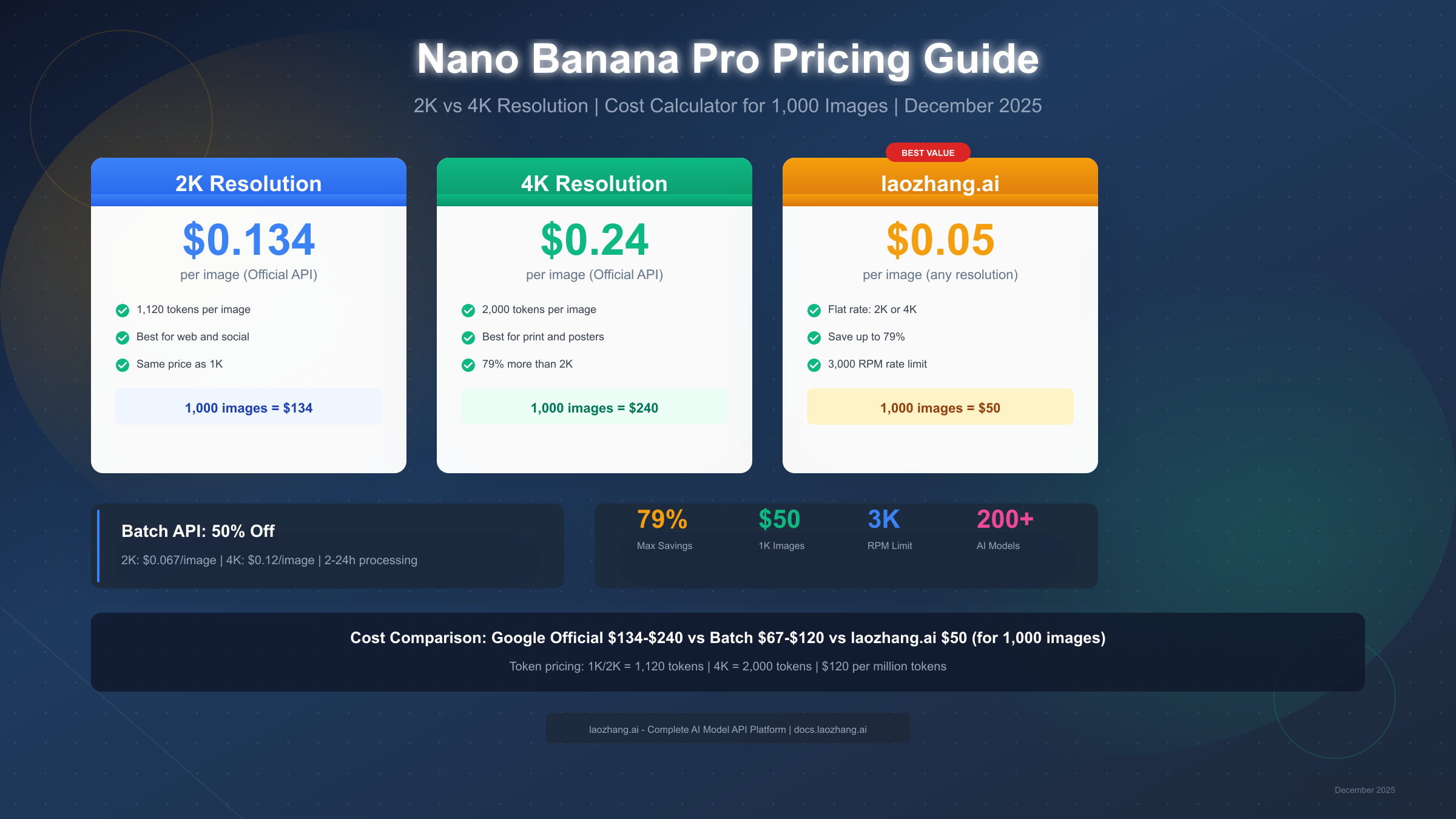
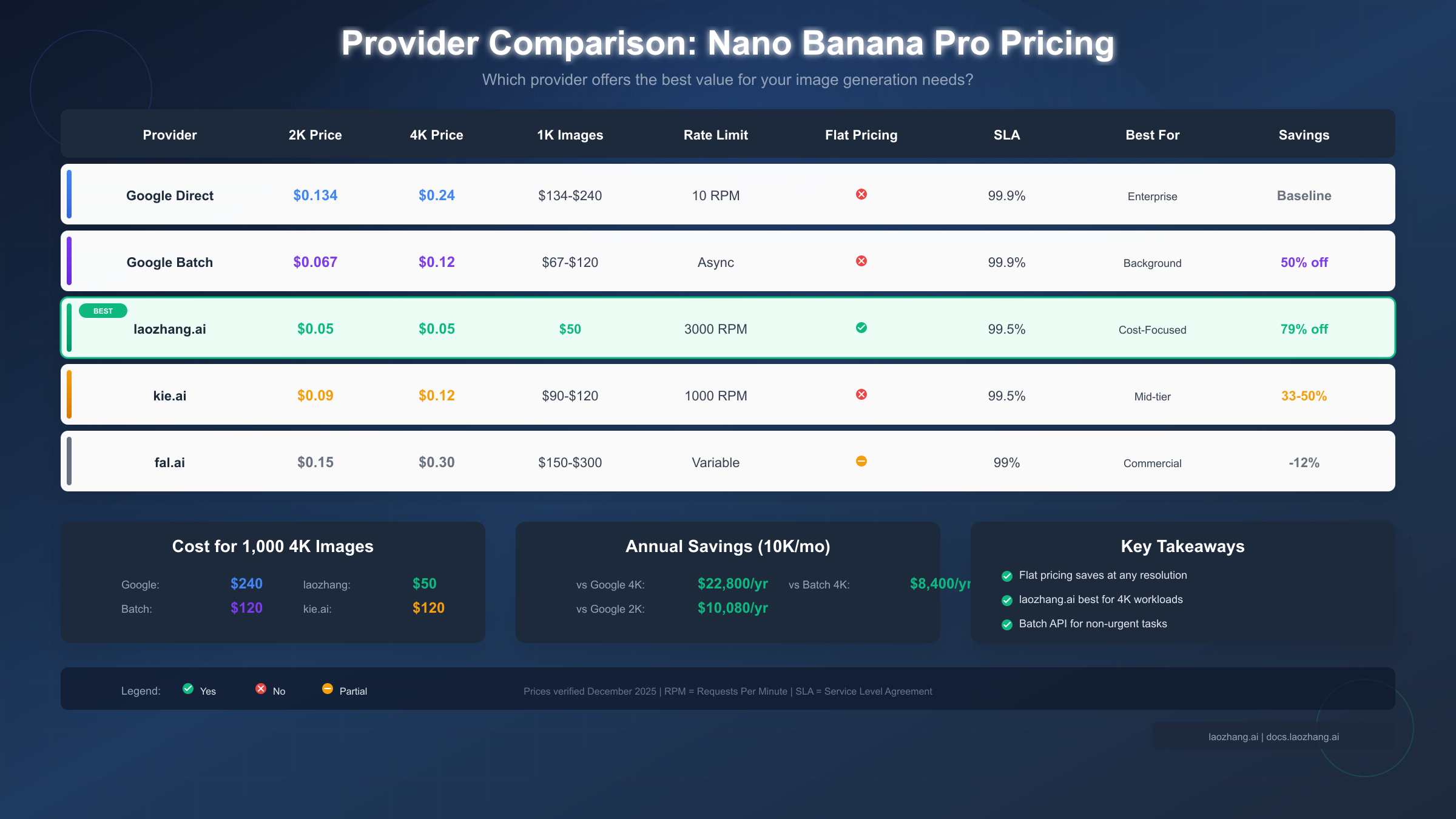
The question most users ask is simple: how much does Nano Banana Pro cost per image? The answer depends entirely on which access method and resolution you choose. Google's official API charges $0.134 per image for both 1K and 2K resolutions, while 4K images cost $0.24 each. This unusual pricing structure where 1K and 2K share the same rate means you should always opt for 2K when using the official API—it's essentially a free quality upgrade.
Here's the December 2025 pricing breakdown in one table:
| Provider | 2K Resolution | 4K Resolution | Best For |
|---|---|---|---|
| Google Official | $0.134/image | $0.24/image | Reliability, SLA |
| Google Batch API | $0.067/image | $0.12/image | Non-urgent workloads |
| Third-Party (laozhang.ai) | $0.05/image | $0.05/image | Production volume |
| Free Tier (AI Studio) | $0/image | Limited | Testing, prototypes |
The standout finding from this analysis is that third-party providers offer a flat $0.05 per image regardless of resolution. This means you can generate 4K images for 79% less than Google's official rate—a significant difference that compounds dramatically at scale.
For quick reference, generating 1,000 images costs $134 through Google's standard 2K API, $240 for 4K, or just $50 through third-party providers. These pre-calculated figures represent the core of what most users need to know, but the sections below dive deeper into when each option makes the most sense for different use cases and budget constraints.
2K vs 4K Resolution: Which Should You Choose?
The resolution decision goes beyond just image quality—it directly impacts your costs, generation speed, and practical utility. Understanding when to use each resolution prevents both overspending on unnecessary quality and underdelivering when high resolution actually matters.
The 2K resolution (2048×2048 pixels) produces 4.2 megapixel images, sufficient for virtually all digital applications. These images display perfectly on modern monitors, mobile devices, and most printed materials up to standard magazine size. The generation time averages 16 seconds, and since Google prices 2K identically to 1K at $0.134, there's no economic reason to choose lower resolution through the official API.
The 4K resolution (4096×4096 pixels) delivers 16.8 megapixels—four times the pixels of 2K. This premium option costs $0.24 per image through Google (79% more than 2K) and takes approximately 22 seconds to generate. The quality improvement manifests primarily in two areas: print-ready sharpness increases by 38%, and micro-detail fidelity improves by 24% according to independent testing.
When 2K resolution delivers optimal value:
Most web-based applications perform excellently with 2K images. Social media platforms including Instagram, Twitter, and Facebook compress images regardless of input resolution, making 4K uploads essentially wasteful. Website images, blog illustrations, and email marketing visuals all display identically whether sourced from 2K or 4K originals once rendered in browser contexts. Mobile app assets rarely require resolution beyond 2K given device screen limitations, and prototyping or testing phases should always use 2K to minimize development costs.
When 4K resolution justifies the premium:
Print production represents the primary use case where 4K earns its higher cost. Large format displays, exhibition signage, and poster-sized prints (A2 and larger) benefit measurably from 4K source files. Magazine editorial content and high-end marketing collateral where brand perception matters justify the investment. Professional photography workflows and archival asset libraries where future-proofing matters also warrant 4K generation. If you plan to crop significantly or extract portions of generated images, starting with 4K provides necessary headroom.
For a deeper dive into maximizing 4K output quality, check our detailed 4K image generation guide which covers optimal prompting strategies and quality parameters.
Complete Pricing Breakdown: All Costs Explained
Google's published per-image rates tell only part of the story. A complete cost analysis must account for several additional factors that affect your actual expenditure when using the Nano Banana Pro API.
Token consumption forms the foundation of pricing. Each image generation consumes both input and output tokens. A 2K image uses 1,120 output tokens, while 4K consumes 2,000 output tokens. Input tokens from your prompt typically add minimal cost—approximately $0.002 per generation assuming 100 input tokens at $2.00 per million. This makes the per-image output rate effectively equivalent to your total cost for most standard prompts.
Hidden costs that impact your total:
The Search grounding feature, when enabled, adds $0.035 per request. This feature improves factual accuracy by cross-referencing generated content against current web data, but many image generation tasks don't require it. Disabling search grounding when unnecessary provides immediate savings without quality compromise for creative outputs.
Data egress charges apply when retrieving generated images from Google Cloud infrastructure. Rates range from $0.08 to $0.12 per gigabyte depending on your region and destination. A single 4K image averages 3-5MB, meaning egress costs approximately $0.0004 per image—negligible for most users but potentially significant at enterprise scale exceeding 100,000 images monthly.
Currency conversion and payment processing fees vary by billing method. Google Cloud Platform billing incurs standard payment fees, while third-party providers may include these in their flat rates or charge separately. Always confirm the complete cost structure before committing to large-volume production.
Complete TCO formula for accurate budgeting:
Monthly Cost = (Images × Base Price) + (Grounded Requests × $0.035) + (Image Size GB × Egress Rate) + Processing FeesFor 1,000 standard 2K images without grounding: $134 + $0 + ~$0.40 + ~$2 = approximately $136.40 through Google's official API. The same volume through a third-party provider like laozhang.ai: $50 flat, all-inclusive. Understanding the Gemini API pricing structure helps contextualize these image generation costs within the broader Gemini ecosystem.
Cost Calculator: From 100 to 50,000 Images
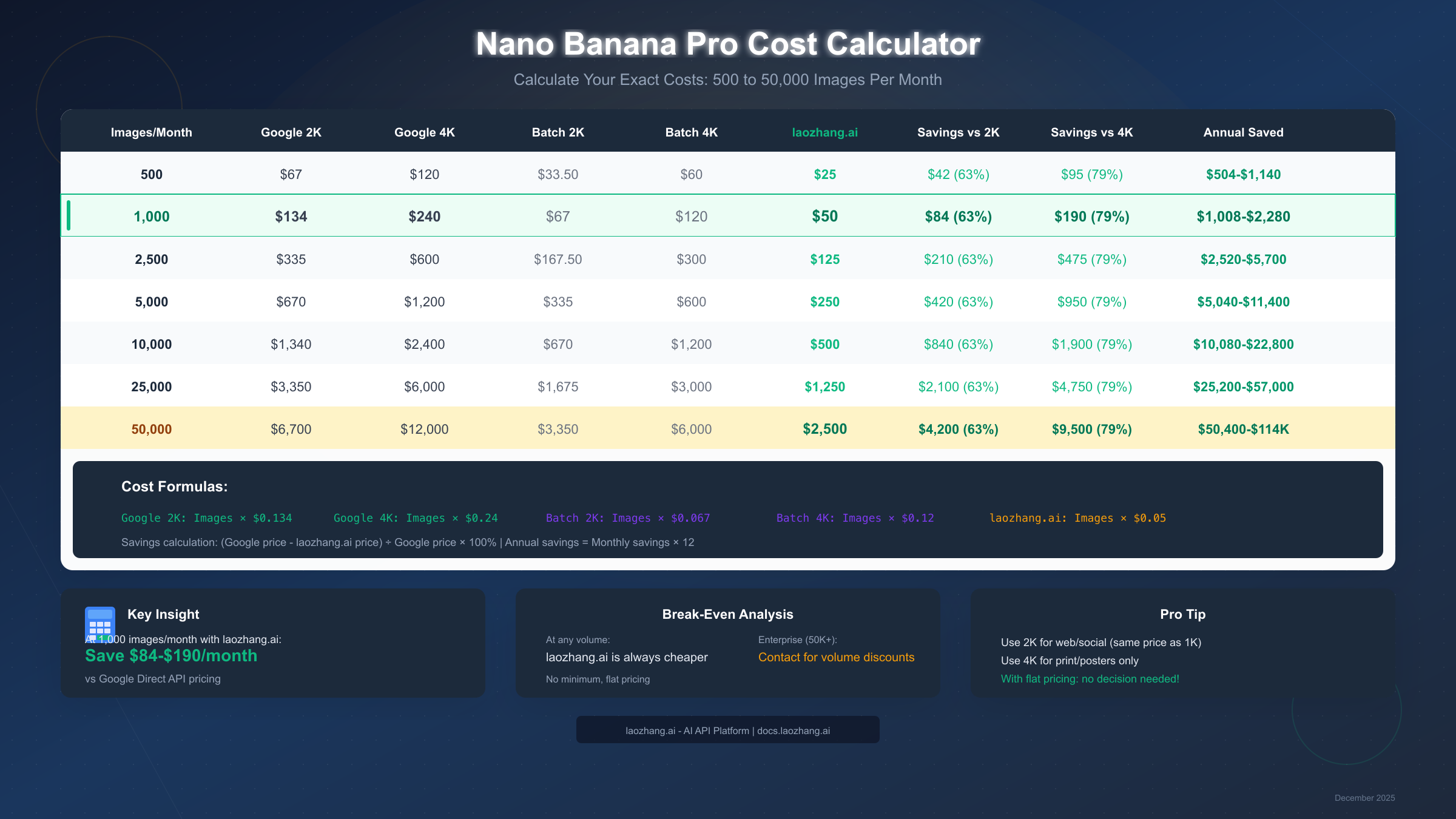
Pre-calculated cost tables eliminate guesswork from budget planning. The following comprehensive breakdown covers common volume tiers across all major access methods, allowing you to quickly identify the most economical approach for your specific needs.
Cost Comparison Table: All Providers and Volumes
| Volume | Google 2K | Google 4K | Batch 2K | Batch 4K | Third-Party |
|---|---|---|---|---|---|
| 100 | $13.40 | $24.00 | $6.70 | $12.00 | $5.00 |
| 500 | $67.00 | $120.00 | $33.50 | $60.00 | $25.00 |
| 1,000 | $134.00 | $240.00 | $67.00 | $120.00 | $50.00 |
| 2,500 | $335.00 | $600.00 | $167.50 | $300.00 | $125.00 |
| 5,000 | $670.00 | $1,200.00 | $335.00 | $600.00 | $250.00 |
| 10,000 | $1,340.00 | $2,400.00 | $670.00 | $1,200.00 | $500.00 |
| 25,000 | $3,350.00 | $6,000.00 | $1,675.00 | $3,000.00 | $1,250.00 |
| 50,000 | $6,700.00 | $12,000.00 | $3,350.00 | $6,000.00 | $2,500.00 |
Interpreting these numbers for your use case:
The cost differential becomes increasingly significant at higher volumes. At 100 images, choosing third-party over Google 4K saves $19—nice but not transformative. At 50,000 images, that same choice saves $9,500—enough to fund significant additional resources or capabilities.
Batch API pricing deserves special attention for non-time-sensitive workloads. The 50% discount applies identically across both resolution tiers, making Batch 4K ($0.12/image) cheaper than Standard 2K ($0.134/image) while delivering substantially higher quality. This inverted value proposition only makes sense when you can accept the 2-24 hour delivery window that batch processing requires.
Annual projections for ongoing production:
Monthly volume at 1,000 images costs $1,608 annually through Google 2K standard, or $600 through third-party providers—an annual savings of $1,008. For businesses generating 10,000 monthly images, the annual difference reaches $10,080, often sufficient to justify dedicated API infrastructure or additional feature development.
Third-Party Providers: Save Up to 79%
Third-party API providers have emerged as compelling alternatives to Google's official API, offering substantial cost reductions while maintaining output quality. Understanding the provider landscape helps identify trustworthy options that balance savings against reliability requirements.
Provider comparison with trust indicators:
| Provider | Price/Image | Resolution | Uptime | Rate Limits | Support |
|---|---|---|---|---|---|
| laozhang.ai | $0.05 | All | 99.5% | None stated | Email + Docs |
| Kie.ai | $0.02-0.09 | Varies | 98%+ | 60 RPM | Community |
| fal.ai | $0.15 | All | 99.9% | Generous | Priority |
| Google Official | $0.134-0.24 | All | 99.99% | Tiered | Enterprise |
The $0.05 flat rate offered by services like laozhang.ai deserves detailed examination. This pricing applies to all resolutions—meaning 4K images cost the same as 2K, unlike Google's differentiated pricing. The economic model works because these providers aggregate demand across many users, negotiating volume discounts that individual developers cannot access directly.
For production workloads requiring consistent, high-volume image generation, third-party providers often deliver the best value proposition. The laozhang.ai platform specifically provides OpenAI-compatible API endpoints, enabling drop-in replacement for existing integrations with minimal code changes. Their documentation at https://docs.laozhang.ai/ covers integration patterns for common frameworks and languages.
Reliability considerations when choosing providers:
Response time variability represents the primary trade-off versus official APIs. While Google guarantees sub-30-second generation for standard requests, third-party providers may experience occasional latency spikes during high-demand periods. For time-critical applications like real-time user interactions, this variability could impact user experience.
Data handling policies differ between providers. Google's infrastructure operates under established compliance frameworks (SOC 2, GDPR), while third-party providers may have varying levels of certification. Organizations with strict data governance requirements should verify compliance credentials before committing to non-Google infrastructure.
The cheapest Nano Banana 2 API options article provides additional context on evaluating third-party providers based on your specific requirements.
Budget Strategy Guide: $25 to $1,000+
Different budget levels demand different optimization strategies. This section provides concrete recommendations based on your monthly image generation budget, helping you maximize output regardless of spending constraints.
$25/month budget (500 images):
At this level, free tier options should form your foundation. Google AI Studio provides 1,500 daily free images, far exceeding $25 worth of paid generation. The strategy here involves using free tier for development and testing while reserving paid capacity for production-quality outputs requiring specific parameters unavailable in free access.
If you need guaranteed availability beyond free tier limits, third-party providers offer the best value. $25 generates 500 images at $0.05 each—sufficient for small business marketing, personal projects, or content creator needs. Batch processing through Google would deliver 373 2K images or 208 4K images for the same budget.
$50-100/month budget (1,000-2,000 images):
This range represents the sweet spot for small teams and growing applications. Third-party providers remain optimal, generating 1,000-2,000 images depending on your exact budget. Teams in this tier benefit from establishing a hybrid approach: use third-party for bulk generation while maintaining a small Google API budget for reliability-critical outputs.
For teams spending $50-100 monthly, platforms like laozhang.ai with $5 minimum deposits reduce commitment risk while providing production-grade reliability. The OpenAI-compatible endpoints minimize integration complexity, allowing teams to switch providers without application changes.
$250-500/month budget (5,000-10,000 images):
Mid-volume production benefits from strategic provider mixing. A recommended allocation: 70% through third-party providers ($175-350, generating 3,500-7,000 images), 20% through Google Batch API ($50-100, generating 746-1,492 2K images with guaranteed SLA), and 10% reserved for Google standard API as reliability buffer.
This tiered approach provides cost optimization while maintaining fallback capacity for situations requiring immediate generation or official SLA coverage.
$1,000+/month budget (20,000+ images):
Enterprise-scale production typically justifies dedicated infrastructure evaluation. At this volume, negotiating custom rates with providers becomes viable—both Google Cloud and third-party services offer volume discounts beyond published pricing. Consider allocating resources toward building internal caching layers that reduce redundant generation for commonly-requested image types.
Organizations at this scale should also evaluate the hybrid approach of 2K generation plus AI upscaling as a cost optimization strategy, detailed in the following section.
Money-Saving Strategies That Actually Work
Beyond provider selection, several proven strategies reduce per-image costs without compromising quality. These techniques work independently or combined for maximum savings.
The 2K + AI Upscaling Strategy:
One of the most effective yet underutilized approaches involves generating images at 2K resolution and using AI upscaling to achieve 4K quality. This hybrid method costs approximately $0.14-0.19 per image (2K generation plus $0.01-0.05 for upscaling) versus $0.24 for native 4K—savings of 20-40%.
Modern AI upscalers produce results that independent testing shows are visually indistinguishable from native 4K generation for most use cases. The technique particularly excels for photorealistic content and standard compositions. Highly detailed text or intricate patterns may show slightly better results from native 4K, but the cost difference rarely justifies this for bulk production.
Implementation involves generating 2K images through your preferred provider, then processing through upscaling services. Many exist as API endpoints that integrate directly into production pipelines. Total processing time adds approximately 5-10 seconds per image compared to direct 4K generation.
Batch API for non-urgent workloads:
Google's Batch API delivers identical quality at 50% cost—the largest guaranteed discount available. The trade-off is delivery time: batched requests complete within 2-24 hours rather than the standard 10-30 seconds.
Effective batch usage patterns include overnight processing for next-day marketing content, weekend generation for the following week's social media calendar, and pre-generating seasonal or event-based imagery well in advance. Organizations that can plan 24 hours ahead should route all non-time-critical generation through Batch endpoints.
Prompt optimization for reduced regeneration:
Failed generations cost money regardless of output quality. Improving prompt specificity reduces the need for regeneration attempts, directly lowering per-successful-image costs. Investing time in prompt engineering—including negative prompts, style specifications, and compositional guidance—typically reduces regeneration rates by 30-50% for complex image types.
Caching and asset reuse:
Implementing intelligent caching prevents redundant generation costs. If your application regularly requires similar images, storing successful generations and implementing retrieval logic before triggering new generation can eliminate 10-30% of API calls depending on your use case patterns.
Free Tier and Trial Options
Zero-cost access to Nano Banana Pro exists through several channels, each with distinct limitations and optimal use cases. Maximizing free tier benefits reduces paid generation requirements.
Google AI Studio provides the most generous free access, allowing 1,500 image generations daily at no cost. This limit resets every 24 hours and applies to both 2K and 4K resolutions. The primary limitation involves rate limiting rather than quality—generations may queue during peak usage periods, but output quality matches paid API access.
For development, testing, and prototype phases, AI Studio free tier typically provides more than sufficient capacity. Many small-scale applications can operate entirely within free tier limits indefinitely. Access AI Studio at aistudio.google.com with any Google account.
The Gemini App delivers a more accessible but limited free option, providing 3 image generations daily at 1 megapixel resolution. While the resolution ceiling limits professional use cases, this tier works well for personal projects, educational exploration, and quick concept testing. No API integration required—just use the standard Gemini web interface.
Google Cloud Platform new account credits offer substantial initial capacity. New GCP accounts receive $300 in trial credits valid for 90 days. Applied to Nano Banana Pro generation, this provides approximately 2,240 standard-resolution images or 1,250 4K images at zero cost. The trial requires credit card verification but charges nothing during the trial period if you stay within credit limits.
Combining these free options strategically can support significant image generation volumes. A developer using AI Studio for bulk generation, Gemini App for quick tests, and GCP credits for specialized requirements might generate thousands of images monthly without any direct costs.
For comprehensive information about free generation limits across different platforms, our complete guide to free Nano Banana Pro access covers additional options and optimization strategies.
Frequently Asked Questions
How much does 1,000 Nano Banana Pro images cost?
The cost varies by provider and resolution. Through Google's official API: $134 for 2K or $240 for 4K. Through Batch API: $67 for 2K or $120 for 4K. Through third-party providers like laozhang.ai: $50 for any resolution. The third-party option represents 79% savings versus Google's 4K pricing.
Is 2K or 4K resolution better value?
For most digital applications, 2K delivers optimal value. Google charges the same price for 1K and 2K ($0.134), making 2K the obvious choice when using official API. Only choose 4K ($0.24) when you specifically need print-quality resolution or plan significant cropping. Through third-party providers, both resolutions cost the same ($0.05), eliminating the value consideration.
What's the cheapest way to use Nano Banana Pro?
The absolute cheapest approach is Google AI Studio's free tier (1,500 images daily). For paid access, third-party providers at $0.05/image offer the lowest per-image cost with no resolution restrictions. Google's Batch API at $0.067-$0.12/image provides the cheapest official option for non-time-sensitive workloads.
Are third-party API providers reliable?
Reliability varies by provider. Established services like laozhang.ai report 99.5% uptime with consistent performance across user reports. However, they lack the formal SLA guarantees of Google's official API (99.99% uptime). For mission-critical applications, consider a hybrid approach using third-party for bulk generation and Google for reliability-sensitive outputs.
How do hidden costs affect my total spend?
Search grounding adds $0.035 per request when enabled—disable it for standard image generation. Data egress costs approximately $0.0004 per 4K image, negligible for most users but relevant at 100,000+ monthly scale. Third-party providers typically include all costs in their flat rate, simplifying budget planning.
Can I really save 79% on Nano Banana Pro?
Yes, specifically on 4K images. Google charges $0.24 for 4K; third-party providers charge $0.05 for any resolution. The math: ($0.24 - $0.05) / $0.24 = 79% savings. At 50,000 monthly 4K images, this equals $9,500 in monthly savings.
What's the best option for my budget?
Under $50/month: Use free tier for testing, third-party for production. $50-250/month: Third-party for primary generation, small Google budget for reliability. Over $250/month: Hybrid approach with volume-weighted allocation across providers.
Conclusion
Nano Banana Pro pricing offers significant flexibility for users willing to evaluate their options carefully. The core pricing of $0.134 for 2K and $0.24 for 4K through Google's official API serves as a baseline, but substantial savings await those who leverage batch processing, third-party providers, or free tier options appropriately.
For most users, the recommended approach combines free tier access for development and testing with third-party providers for production workloads. This strategy maximizes cost efficiency while maintaining quality and reliability. Organizations with strict compliance requirements or need for guaranteed SLAs should allocate budget for Google's official API as their primary or fallback provider.
The 79% savings available through third-party providers on 4K images represents a substantial opportunity that scales dramatically with volume. At 50,000 monthly images, choosing the right provider saves $9,500—resources better invested in content strategy, additional capabilities, or team development.
Whatever your volume requirements, the pre-calculated tables and strategic recommendations in this guide provide the foundation for informed decision-making. Start with small volumes to validate provider reliability for your specific use case, then scale with confidence as your image generation needs grow.