Update (October 8, 2026): Google released Nano Banana 2.1 (
gemini-nano-banana-2.1) on October 6, 2026, and markedgemini-3.1-flash-image(Nano Banana 2) as deprecated in the Gemini API, recommending a move to 2.1. No shutdown date is announced (an October 29 date announced that day was withdrawn on October 7). Nano Banana 2 model IDs, prices and code below still work for now; new projects should start on 2.1. For what changes and how to migrate, see Nano Banana 2.1 Is Out: Access, API Pricing and Moving Off Nano Banana 2.
Update (October 5, 2026): In late 2025 some sites, including this guide, used "Nano Banana 2" for Gemini 3 Pro Image. Google now calls that model Nano Banana Pro (
gemini-3-pro-image), and "Nano Banana 2" is the newer Gemini 3.1 Flash Image (gemini-3.1-flash-image, $0.045-$0.151 per image; laozhang.ai lists it at $0.055 per call). Prices below refer to Gemini 3 Pro Image and were updated to laozhang.ai's published $0.09 per call; other providers' prices are from December 2025.
If you've been searching for the cheapest way to access Nano Banana 2 API - Google's powerful Gemini 3 Pro Image generation model - you've likely encountered a confusing landscape of providers, each claiming to offer the best rates. The official Google pricing starts at $0.134 per image and climbs to $0.24 for 4K resolution, which can quickly become expensive for production applications generating thousands of images monthly.
After extensive research and real-world testing across multiple providers, we've identified that laozhang.ai offers the most cost-effective Nano Banana 2 API access at $0.09 per call - representing about a 62.5% discount from Google's official 4K pricing and 33% savings on standard resolution. But raw price per image is just part of the story. This guide will walk you through everything you need to know about getting the cheapest Nano Banana 2 API access while avoiding hidden costs that can make seemingly cheap providers unexpectedly expensive.
What is Nano Banana 2 API?
Before diving into pricing comparisons, it's essential to understand what "Nano Banana" actually refers to. Google uses internal codenames for its AI models during development, and two have become widely known in the developer community:
Nano Banana is the codename for Gemini 2.5 Flash Image, Google's fast and cost-effective AI image generation model. It prioritizes speed and efficiency, making it ideal for high-volume applications where quick turnaround matters more than maximum quality.
Nano Banana 2 (also called Nano Banana Pro) refers to Gemini 3 Pro Image, Google DeepMind's flagship AI image generation and editing model released in late 2025. It represents a significant leap forward from Gemini 2.5 Flash Image, offering state-of-the-art text rendering, character consistency, and the ability to generate production-ready marketing assets. The model can handle up to 14 reference images simultaneously, maintain consistent character appearances across generations, and render clear, accurate text directly within images - a capability that plagued earlier AI image models.
Both models are accessible through Google's Gemini API and various third-party providers. When developers talk about "cheap Nano Banana API," they're typically seeking access to these models at rates below Google's official pricing. For this guide, we'll focus primarily on Nano Banana 2 (Gemini 3 Pro Image) as it offers superior capabilities and is what most production applications require.
Official Google Pricing Breakdown
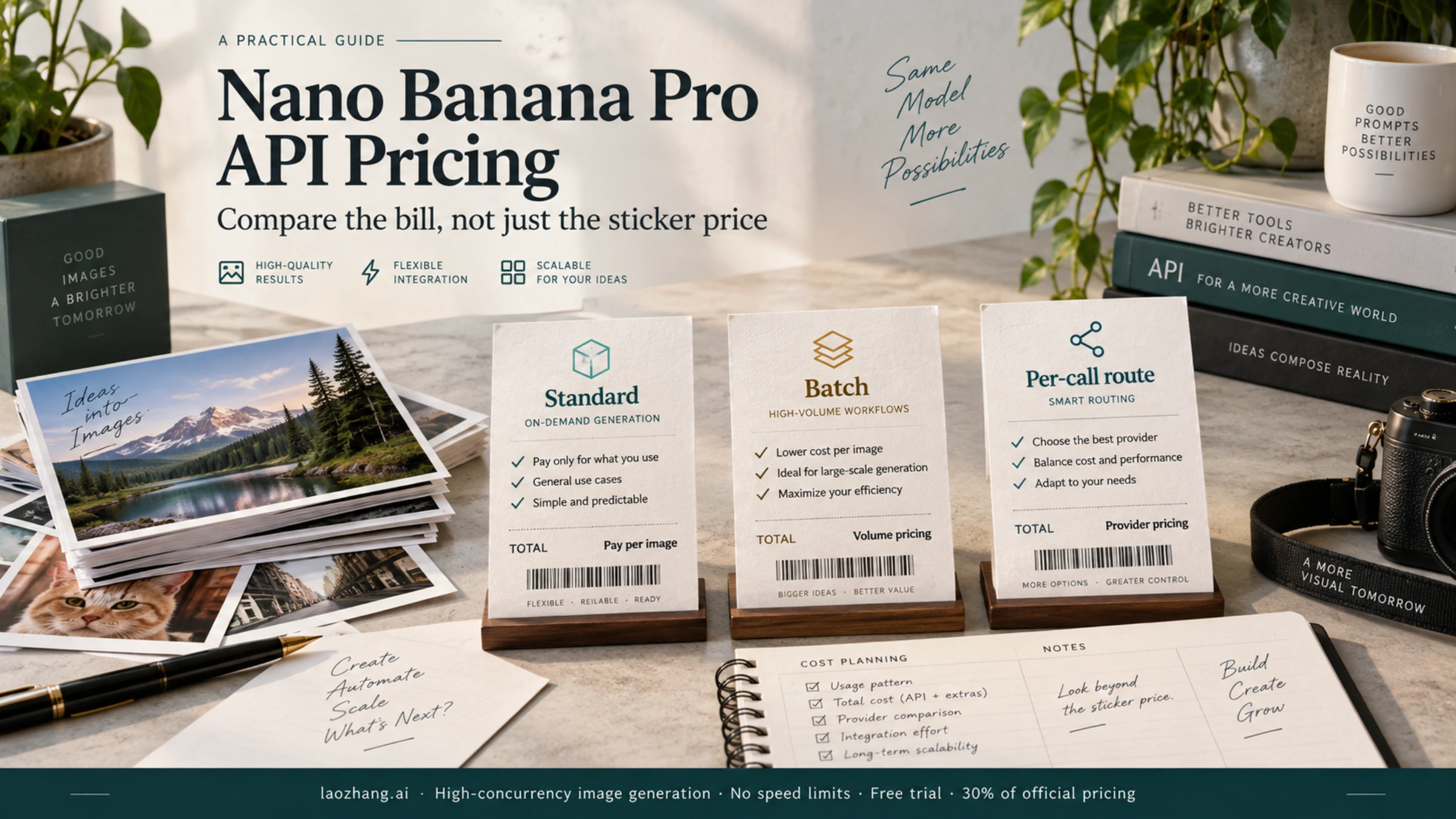
Understanding Google's baseline pricing is crucial for evaluating third-party alternatives. Google prices Nano Banana 2 API based on resolution and processing method, with a helpful Batch API option that cuts costs in half for non-urgent workloads.
Standard API Pricing
The standard API provides immediate image generation with typical latency of 5-15 seconds per image. Pricing is token-based, with images consuming a fixed number of tokens depending on output resolution:
| Resolution | Tokens | Price Per Image |
|---|---|---|
| 1K (1024x1024) | 1,120 | $0.134 |
| 2K (2048x2048) | 1,120 | $0.134 |
| 4K (4096x4096) | 2,000 | $0.240 |
Additionally, text prompts consume tokens at $2.00 per million input tokens. Image inputs (for editing or reference) cost $0.0011 per image (560 tokens). For most use cases, the prompt cost is negligible compared to the image output cost.
Batch API Pricing (50% Off)
Google's Batch API offers identical quality at 50% reduced pricing, designed for background processing where 24-hour turnaround is acceptable:
| Resolution | Standard Price | Batch Price | Savings |
|---|---|---|---|
| 1K-2K | $0.134 | $0.067 | 50% |
| 4K | $0.240 | $0.120 | 50% |
The Batch API is particularly valuable for developers who can queue image generation jobs overnight or during off-peak hours. However, it requires additional infrastructure to manage job queuing and result retrieval, which adds development complexity.
Complete Provider Pricing Comparison
The third-party provider landscape for Nano Banana 2 API has expanded rapidly, with each promising lower rates than Google's official pricing. Here's a comprehensive comparison based on December 2025 data:
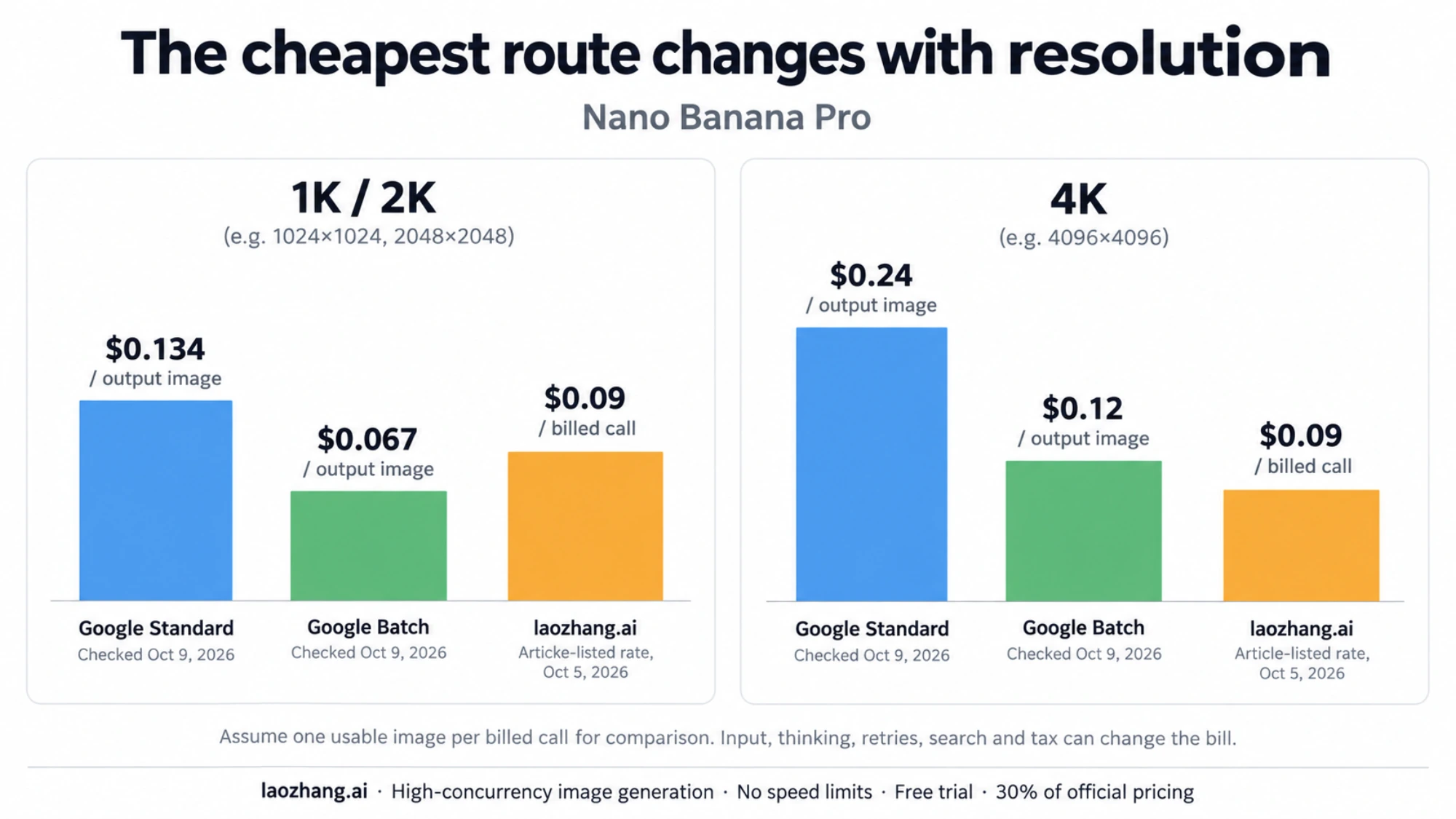
The chart uses Google pricing checked on October 9, 2026 and the article-listed proxy rate from October 5. The rival-provider rows below remain the December 2025 comparison, not newly verified offers.
| Provider | 1K-2K Price | 4K Price | Discount vs Google | China Access | Reliability | Best For |
|---|---|---|---|---|---|---|
| Google Official | $0.134 | $0.240 | Baseline | Blocked | 99.9% | Enterprise SLA |
| fal.ai | $0.039 | $0.150 | 71% | VPN Required | 99.5% | Async processing |
| Replicate | $0.032 | $0.120 | 76% | VPN Required | 99.0% | ML pipelines |
| Kie.ai | $0.020 | $0.120 | 85% | Partial | 97.0% | Budget users |
| MuAPI | $0.030 | $0.100 | 78% | Partial | 98.0% | Aspect ratios |
| laozhang.ai | $0.09 | $0.09 | 62% | Direct | — | China + TCO |
At first glance, Kie.ai appears to offer the lowest pricing at $0.020 per image. However, as we'll explore in the next section, advertised pricing rarely tells the complete story. The true cost of using any API depends on multiple factors beyond the base rate.
Hidden Costs Analysis: True TCO
After helping dozens of development teams evaluate their options, we've discovered a troubling pattern: the provider advertising the lowest price often ends up costing 50-150% more than expected due to hidden costs that never show up in comparison tables. Here's what most pricing comparisons miss:
Infrastructure Costs
VPN Requirements: For teams based in China or other regions where Google services are blocked, accessing most third-party providers requires a VPN. Quality VPN services capable of maintaining stable API connections run $10-15 per month per developer. For a five-person team, that's $600-900 annually before generating a single image.
Development Time: Integrating with unfamiliar APIs, handling authentication flows, and managing rate limits consumes engineering hours. Teams report spending 8-15 hours monthly managing fragmented API infrastructure, representing $400-1000 in labor costs depending on engineering rates.
Payment Processing Fees
International credit card transactions typically incur 2.5-3% foreign transaction fees. For teams spending $500/month on API services, that's an additional $150+ annually in hidden fees.
Reliability Impact
Google's official API maintains a failure rate below 0.1%. Some third-party providers experience 1-3% failure rates, requiring retry logic that compounds costs. A 3% failure rate on 10,000 monthly images means 300 additional generations - potentially adding $6-40 to your monthly bill depending on pricing.
Real-World TCO Calculation
Consider a China-based startup generating 3,000 images monthly:
Scenario A: Kie.ai (Advertised Cheapest)
- Base cost: 3,000 × $0.020 = $60.00
- VPN (3 developers): $45.00
- Payment processing (3%): $1.80
- Failed requests (3%): $1.80
- Integration maintenance: ~$5.00
- Total Effective Cost: $113.70/month ($0.038/image)
Scenario B: laozhang.ai
- Base cost: 3,000 × $0.09 = $270.00
- VPN: $0 (direct China access)
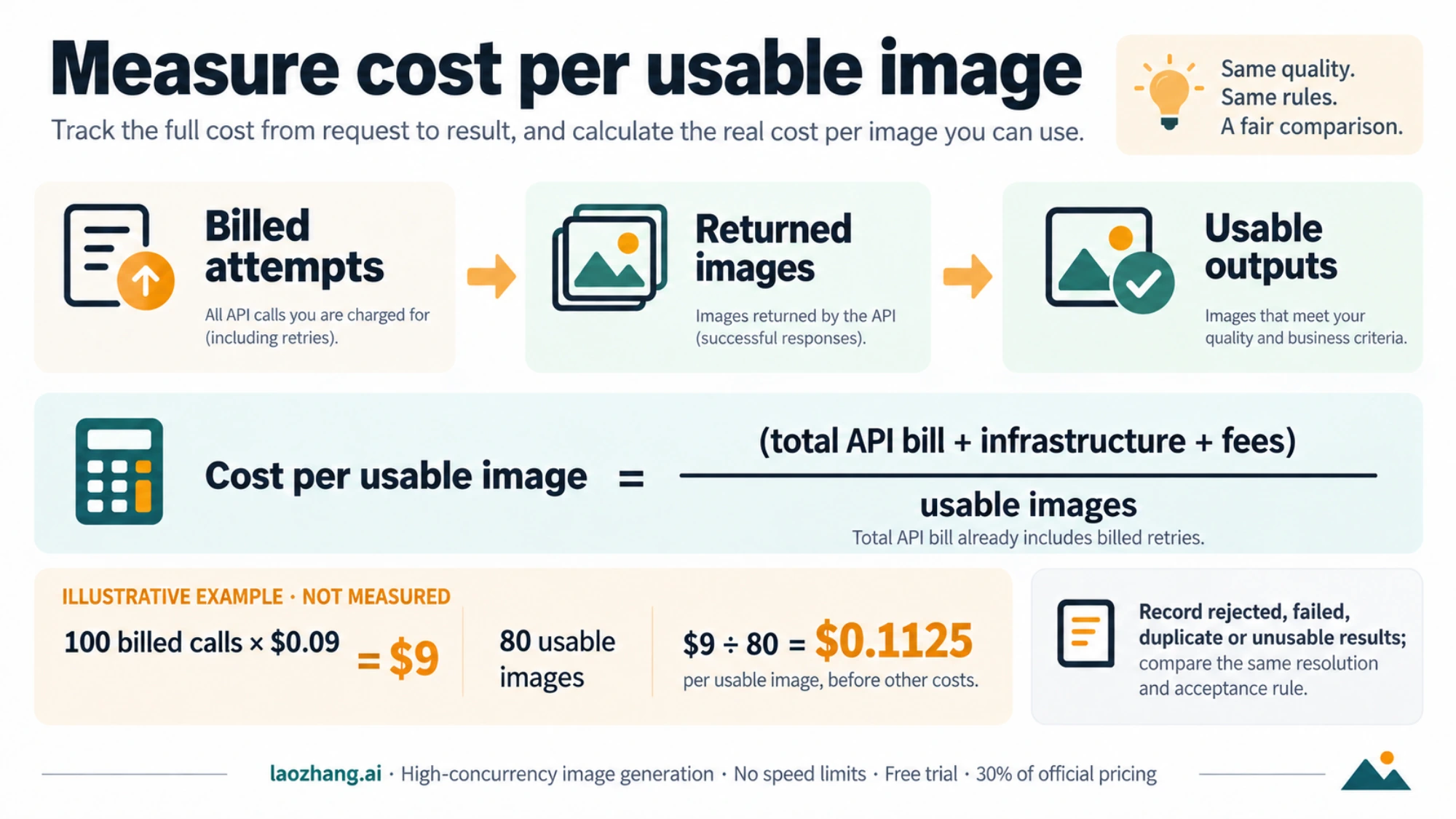
- Failed requests: billed too (every HTTP 200 response is charged)
- Integration: Unified platform
- Total Effective Cost: about $270/month ($0.09/call)
laozhang.ai has a higher base rate than the cheapest resellers; it makes sense mainly when you need direct China access. For teams requiring China access, reliability, and simplified billing, the slight premium delivers substantial operational benefits.
The $0.09 Solution: laozhang.ai Deep Dive
Among the providers we've tested, laozhang.ai stands out for offering the best balance of pricing, reliability, and accessibility for teams requiring Nano Banana 2 API access. Here's what makes it notable:
Pricing Structure
laozhang.ai charges a flat $0.09 per call regardless of resolution. Unlike Google's tiered pricing where 4K costs 79% more than 1K-2K, you pay the same rate whether generating quick thumbnails or high-resolution marketing assets. This predictable pricing simplifies budgeting and eliminates the need to optimize prompts around resolution constraints.
The $0.09 rate represents:
- About 33% savings vs Google's 1K-2K pricing ($0.134)
- About 62% savings vs Google's 4K pricing ($0.240)
- Higher than Google Batch at 1K/2K ($0.067), lower than its 4K image-output price ($0.12); billed calls and usable outputs still need to be counted separately
Key Advantages
Direct China Access: Unlike most third-party providers that route through international servers, laozhang.ai operates infrastructure accessible directly from mainland China. API latency drops from 200-500ms (via VPN) to 20-50ms (direct connection), improving application responsiveness and eliminating VPN dependency.
200+ Model Unified Platform: Beyond Nano Banana 2, laozhang.ai provides access to GPT-4, Claude, Stable Diffusion, and over 200 other AI models through a single API integration. Teams using multiple AI services can consolidate billing and reduce integration complexity.
OpenAI SDK Compatibility: The API accepts OpenAI SDK format, allowing developers to switch from OpenAI's DALL-E or other image models with minimal code changes. Simply update the base URL and API key:
from openai import OpenAI

client = OpenAI(
    api_key="your-laozhang-api-key",
    base_url="https://api.laozhang.ai/v1"
)

response = client.images.generate(
    model="gemini-3-pro-image",
    prompt="A professional product photo of a smartphone on marble surface"
)
For developers seeking affordable Gemini API pricing, laozhang.ai provides a compelling option that balances cost savings with operational simplicity.
Use Case Cost Projections
Different use cases have vastly different image generation requirements. Here's how costs compare across typical scenarios:
| Use Case | Monthly Volume | Google Standard: 1K/2K output | Google Batch: 1K/2K output | laozhang.ai: one billed call per usable image | Standard output minus per-call bill, annual |
|---|---|---|---|---|---|
| Hobbyist | 500 | $67 | $33.50 | $45 | $264 |
| Indie Developer | 2,000 | $268 | $134 | $180 | $1,056 |
| Startup | 10,000 | $1,340 | $670 | $900 | $5,280 |
| Agency | 50,000 | $6,700 | $3,350 | $4,500 | $26,400 |
| Enterprise | 200,000 | $26,800 | $13,400 | $18,000 | $105,600 |
These are illustrative output-only comparisons at the rates above, not measured TCO. Each row assumes one usable image per billed call and no retries; input, thinking, search, tax and engineering costs are additional. Batch is cheaper than the listed per-call route at 1K/2K.
Hobbyist (500 images/month): Personal projects, learning AI image generation, or casual creative work. At this volume, the free tier options (discussed below) may suffice, but paid access provides faster generation and higher resolution options.
Indie Developer (2,000 images/month): Building a product with AI image features. The $180/month call budget through laozhang.ai is sustainable for early-stage products while providing production-quality results.
Startup (10,000 images/month): Growing application with significant user base generating content. The $5,280 annual output-price difference can fund additional development or marketing efforts.
Agency (50,000 images/month): Creative agency generating assets for multiple clients. The $26,400 annual output-price difference justifies dedicated time evaluating provider options.
Nano Banana vs Nano Banana Pro
Choosing between Nano Banana (Gemini 2.5 Flash Image) and Nano Banana Pro (Gemini 3 Pro Image) depends on your specific requirements:
| Feature | Nano Banana (2.5 Flash) | Nano Banana Pro (3 Pro) |
|---|---|---|
| Speed | Fast (2-5 seconds) | Moderate (5-15 seconds) |
| Quality | Good | Excellent |
| Text Rendering | Basic | State-of-the-art |
| Character Consistency | Limited | Up to 5 individuals |
| Reference Images | Up to 6 | Up to 14 |
| Max Resolution | 2K | 4K |
| Best For | High volume, drafts | Production assets |
| Price (laozhang.ai) | Model shut down Oct 2, 2026 | $0.09/call |
Choose Nano Banana (2.5 Flash) when:
- Speed is your top priority
- Generating drafts or concepts for review
- Running A/B tests on image variations
- Budget is extremely tight
- Text rendering quality isn't critical
Choose Nano Banana Pro (3 Pro) when:
- Creating final production assets
- Text must render clearly (logos, headlines, product labels)
- Maintaining character consistency across images
- Working with complex multi-image compositions
- Quality justifies the small price premium
For most professional applications, the $0.02 difference per image between versions is negligible compared to the quality improvement Nano Banana Pro delivers.
How to Get Started
Getting access to Nano Banana 2 API at $0.09/call through laozhang.ai takes approximately 5 minutes. Here's the complete process:
Step 1: Create Your Account
Visit api.laozhang.ai and click "Register" in the top navigation. Enter your email address and create a secure password. You'll receive a verification email - click the link to activate your account.
Step 2: Generate API Key
After logging in, navigate to the "API Keys" section in your dashboard. Click "Create New Key" and give it a descriptive name (e.g., "Production App" or "Development Testing"). Copy the generated key immediately - it won't be shown again for security reasons. Store it securely in your application's environment variables.
Step 3: Add Credits
Navigate to the "Billing" section and click "Add Credits." Start with a small top-up; at $0.09 per call, $10 covers about 110 generations, which is enough for thorough testing. Available payment methods are listed on the billing page.
Step 4: Make Your First API Call
With credits loaded and API key ready, you can generate images immediately. Here's a complete Python example:
from openai import OpenAI

# Initialize client with laozhang.ai endpoint
client = OpenAI(
    api_key="sk-your-api-key-here",
    base_url="https://api.laozhang.ai/v1"
)

# Generate an image
response = client.images.generate(
    model="gemini-3-pro-image",  # Nano Banana Pro
    prompt="A serene mountain landscape at sunset, photorealistic style",
    size="1024x1024",
    n=1
)

# Get the image URL
image_url = response.data[0].url
print(f"Generated image: {image_url}")
For Node.js developers:
import OpenAI from 'openai';

const client = new OpenAI({
  apiKey: 'sk-your-api-key-here',
  baseURL: 'https://api.laozhang.ai/v1'
});

const response = await client.images.generate({
  model: 'gemini-3-pro-image',
  prompt: 'A futuristic city skyline with flying vehicles',
  size: '1024x1024',
  n: 1
});

console.log('Generated image:', response.data[0].url);
Free Access Options
Before committing to paid API access, several options let you experiment with Nano Banana models at no cost:
Google AI Studio (Best for Testing): Google's official AI Studio at aistudio.google.com provides free access to both Gemini 2.5 Flash Image and Gemini 3 Pro Image Preview. The free tier includes 1,500 requests per day - equivalent to 45,000 free images monthly. This is by far the most generous free option available. Limitations include no commercial use rights, potential rate limiting during peak hours, and no API access (web interface only).
fal.ai Free Tier: After email verification, fal.ai provides 100 free API calls monthly. This is useful for developers who need programmatic access during prototyping but insufficient for any production workload.
Freepik Free Plan: Freepik offers 20 image generations daily for free users (about 600/month), increasing to 500 daily with their $9/month subscription. The web interface is user-friendly but lacks API access.
For teams needing free Gemini 2.5 Pro API access for text-based tasks, Google AI Studio also provides generous free quotas for Gemini text models alongside the image generation capabilities.
When Free Isn't Enough
Free tiers work well for learning and prototyping but fall short for production applications due to:
- No commercial use rights (Google AI Studio)
- Rate limits that impact user experience
- No guaranteed availability or SLA
- Limited or no API access
- Restricted resolution options
Once your application reaches production, the $0.09/call through laozhang.ai provides a smooth transition path with full commercial rights and API access.
FAQ
What exactly is Nano Banana 2?
Nano Banana 2 is the internal codename for Google's Gemini 3 Pro Image model - a state-of-the-art AI image generation system that produces photorealistic images with accurate text rendering and character consistency. The name emerged from Google's development process and has since become widely used in the developer community.
Why is laozhang.ai cheaper than Google?
laozhang.ai operates as an API aggregation platform, achieving lower costs through bulk usage agreements, efficient infrastructure, and lower operational overhead compared to Google's enterprise-focused pricing. The savings are passed to developers while maintaining quality and reliability.
Is there any quality difference using third-party providers?
No. Third-party providers like laozhang.ai route requests directly to Google's Gemini API. The same model processes your prompts, producing identical quality results. The only differences are pricing, latency (which may vary by region), and additional features each provider adds.
Can I use these images commercially?
Yes, when accessing Nano Banana 2 through paid API services like laozhang.ai, you receive full commercial usage rights. This differs from Google AI Studio's free tier, which restricts commercial applications.
What happens if the API is down?
For mission-critical applications, the platform supports configuring fallback models that activate if the primary model experiences issues.
How do I handle rate limits?
Default rate limits are generous for most applications. If you need higher throughput, contact support to increase your limits. The platform handles queue management automatically, so burst traffic is smoothed without failed requests.
Is my data secure?
laozhang.ai does not store prompts or generated images beyond the time needed for processing. All API communication uses TLS 1.3 encryption. For enterprise requirements, dedicated instances with additional security controls are available.
Can I switch back to Google directly later?
Absolutely. Since laozhang.ai uses OpenAI SDK-compatible format, switching providers requires only updating two configuration values (API key and base URL). Your application code remains unchanged.
What other models does laozhang.ai support?
Beyond Nano Banana 2, the platform provides access to GPT-4o, GPT-4 Turbo, Claude 3.5 Sonnet, Claude 3 Opus, Stable Diffusion XL, DALL-E 3, and over 200 other AI models - all through a single API integration.
Finding the cheapest Nano Banana 2 API is about more than comparing base prices. When you factor in hidden costs like VPN requirements, payment processing fees, failure rates, and integration complexity, the provider advertising the lowest rate often costs more than alternatives with higher sticker prices.
For most developers, laozhang.ai at $0.09/call represents the optimal balance: 62% savings versus Google's official pricing, direct China access without VPN, and the operational simplicity of a unified multi-model platform. The lets you verify quality and performance before committing to larger volumes.
Start generating images at api.laozhang.ai and experience the cost savings firsthand.