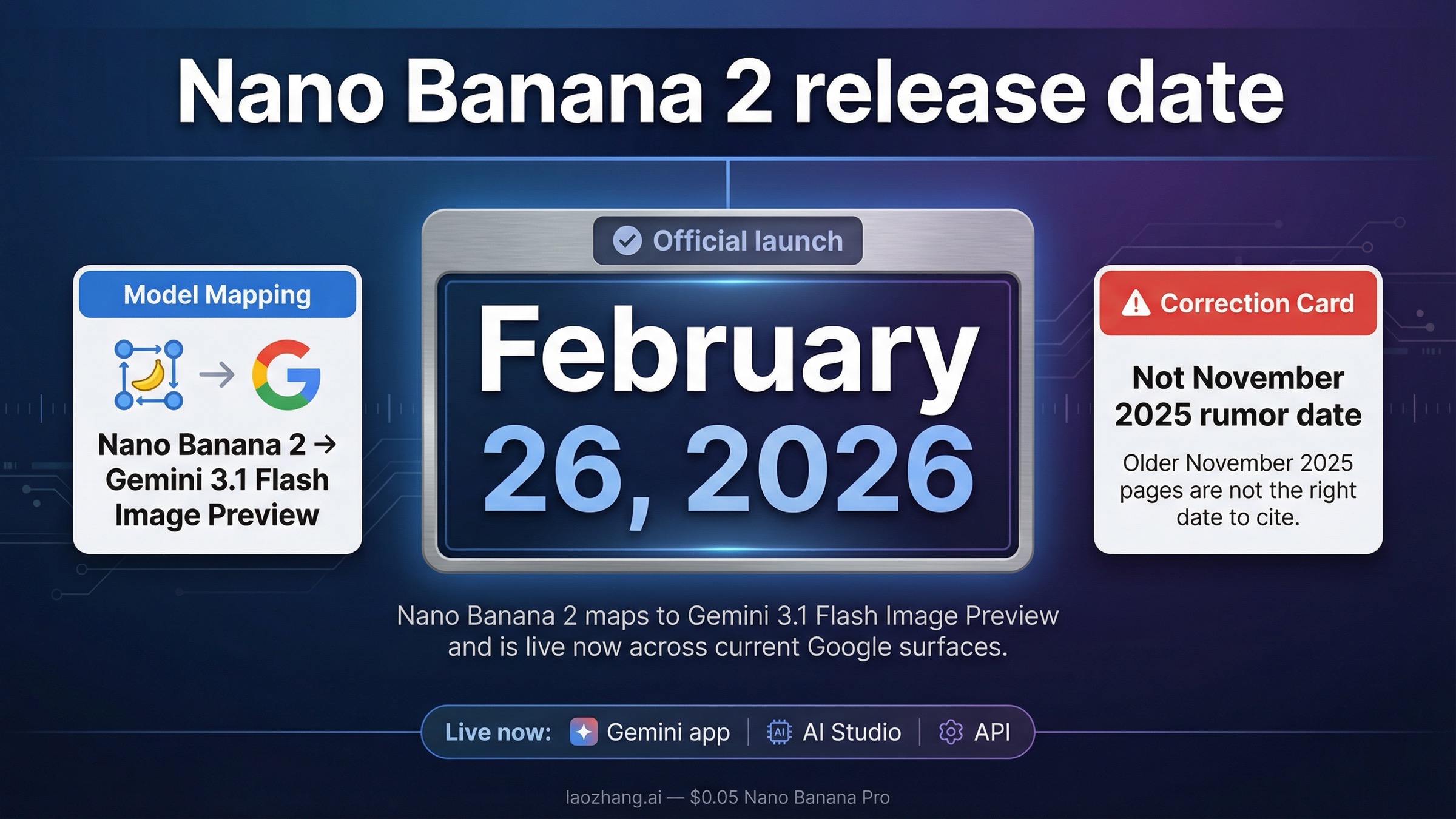
If you need one date to cite, Nano Banana 2 officially launched on February 26, 2026. That is the clean public date Google now supports across its consumer launch post, developer launch post, Gemini API release notes, and Gemini API deprecations table.
The reason this query is still messy is that page one keeps mixing three different stories together: late-2025 rumor posts about an unreleased "Nano Banana 2" or "GemPix2," the November 2025 launch of Nano Banana Pro, and the actual February 26, 2026 public rollout of Nano Banana 2 as Google's current Flash image lane. If you copy the first November 2025 date you see, you are very likely citing the wrong event.
The useful follow-up is whether Nano Banana 2 is only a dated announcement or a live product you can use right now. As checked on March 29, 2026, Google's current Gemini Apps limits page still lists Nano Banana 2 image-generation quotas in the Gemini app, and Google's developer post says a paid API key is required to use the model in Google AI Studio. So the best answer is not just a historical date. It is a date plus a current surface map.
TL;DR
If you want the shortest trustworthy answer, use this first.
| Question | Short answer |
|---|---|
| What is the official Nano Banana 2 release date? | February 26, 2026 |
| What does Nano Banana 2 map to in Google's current docs? | gemini-3.1-flash-image-preview |
| Why do some pages say November 2025? | They are usually citing leak-era speculation or confusing Nano Banana 2 with Nano Banana Pro |
| Is Nano Banana 2 live now? | Yes. It is live in the Gemini app and current Google developer surfaces, but AI Studio requires a paid API key for the model |
| What date should you cite in a blog post, doc, or comparison? | February 26, 2026, unless you are explicitly talking about a different Nano Banana family event |
If you need the wider family map after this page, the best companion read in this repo is Nano Banana AI Image Generator. If you are deciding between the current Flash lane and the premium lane, use Nano Banana 2 vs Nano Banana Pro.
That split between date answer and surface answer is what weaker pages usually miss. A release-date lookup sounds simple, but with Nano Banana 2 it is really a trust problem. The reader is not only asking "when did it launch?" They are asking "which source should I trust when one page says November 2025, another says February 2026, and a third page suddenly talks about Gemini 3.1 Flash Image Preview instead of Nano Banana 2?"
The official Nano Banana timeline: Nano Banana, Pro, and 2
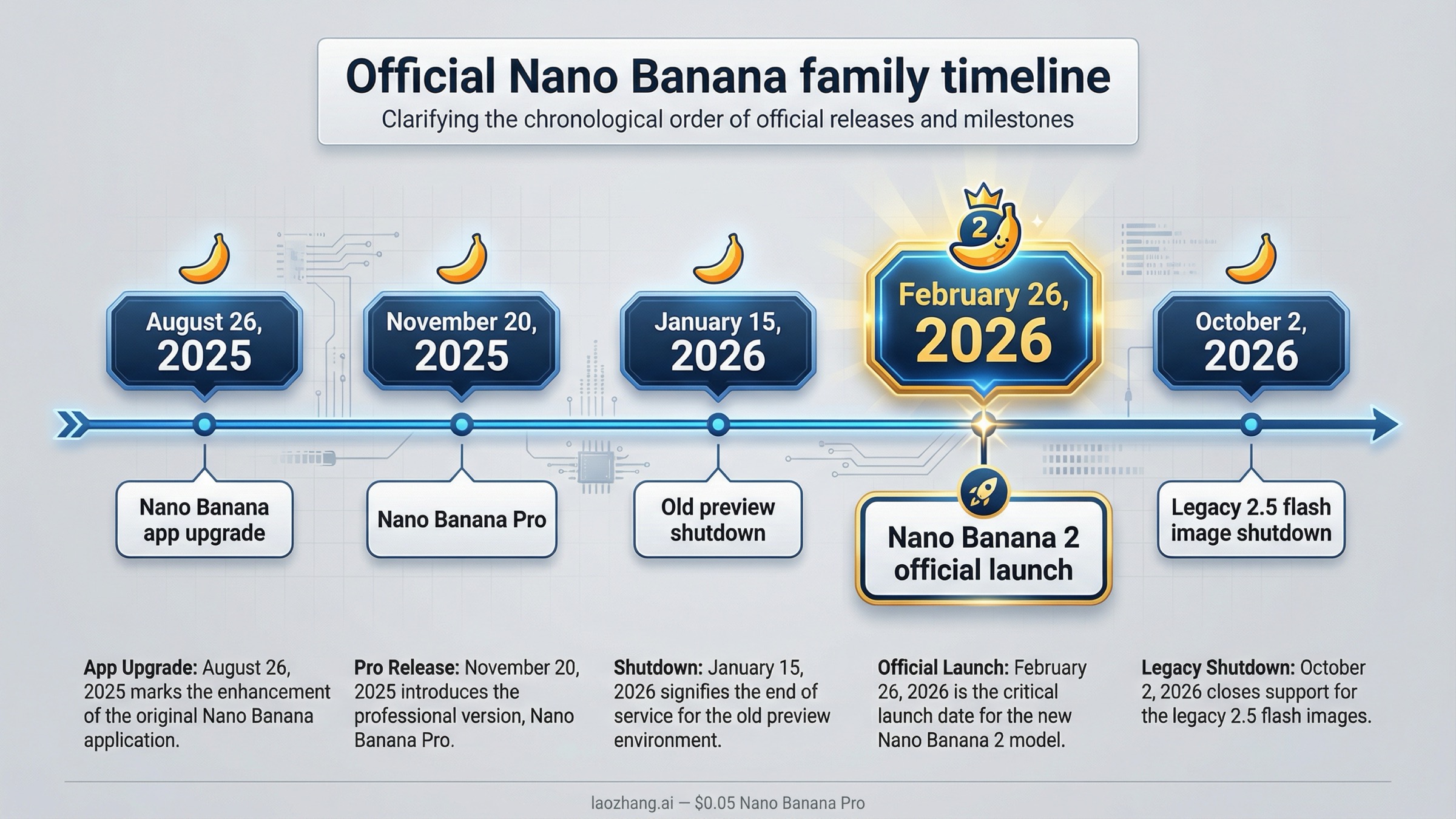
The cleanest way to stop this query from drifting is to separate the family timeline instead of forcing every page into one release date. Google did not go straight from the original Nano Banana to Nano Banana 2 in one smooth public story. There was an app upgrade, a Pro launch, a preview-model shutdown, and then the Nano Banana 2 launch that current official docs now map to gemini-3.1-flash-image-preview.
| Date | Event | Official meaning | Why readers confuse it |
|---|---|---|---|
| August 26, 2025 | Gemini app image editing upgrade | Google said Nano Banana was the latest upgrade to image generation in the Gemini app | Many people treat this as the start of the whole Nano Banana family timeline |
| November 20, 2025 | Gemini API release notes introduce Gemini 3 Pro Image Preview | This is the official Nano Banana Pro-era launch event in Google's current model story | Some pages relabel this as a Nano Banana 2 launch even though it is the Pro lane |
| January 15, 2026 | Older gemini-2.5-flash-image-preview shuts down | Official lifecycle cleanup before the current naming settles | Older tutorials still cite the preview line as if it were current |
| February 26, 2026 | Nano Banana 2 launch post and developer launch post | This is the clean public Nano Banana 2 release date Google now supports | This is the date most readers actually want, but it arrives after months of rumor coverage |
| October 2, 2026 | gemini-2.5-flash-image earliest shutdown date | Google keeps the older Nano Banana lane live for now but marks Nano Banana 2's model as the replacement | Readers can mistake the old lane still being live for proof that Nano Banana 2 was not a distinct launch |
Once you see the family this way, the date confusion gets much easier to explain. Nano Banana 2 did not officially launch in November 2025. What happened in late 2025 was a mix of real leaks, prelaunch sightings, and Nano Banana Pro-era coverage. The first clean official public Nano Banana 2 answer arrives on February 26, 2026.
This is also why the source hierarchy matters. If the consumer launch post, the developer launch post, the Gemini API release notes, and the Gemini API lifecycle table all converge on the same date, that date should override rumor coverage that existed before Google publicly locked the naming. For this query, that convergence is exactly what happens on February 26, 2026.
What Google means by Nano Banana 2 today
The second major source of confusion is that Google's best official answer does not live on one tidy release date page. It lives across the model docs. Google's current image-generation guide says Nano Banana is the family name for three distinct models:
- Nano Banana 2 =
gemini-3.1-flash-image-preview - Nano Banana Pro =
gemini-3-pro-image-preview - Nano Banana =
gemini-2.5-flash-image
That mapping matters because many exact-match pages talk as if Nano Banana 2 were a standalone consumer brand with one simple history. Google's own docs do not treat it that way. They treat Nano Banana 2 as the current Flash image lane inside the broader Gemini image family.
The naming mismatch is not a minor branding detail. It is the main reason official Google pages can look harder to parse than SEO-friendly unofficial pages. Consumer-facing pages say Nano Banana 2 because that is the friendly product label. Developer-facing pages say gemini-3.1-flash-image-preview because that is the actual model ID builders have to call. Both can be correct at the same time, but only if the article makes the bridge explicit.
That is also why the Gemini API release notes and deprecations table are so important for this query. They are the pages that let you translate the nickname into the exact model name and release date. If you skip that translation step, the official Google pages can look inconsistent when they are actually describing the same model from different angles.
For practical use, the mapping rule is simple: when Google says Nano Banana 2 today, the clean model-side reference is gemini-3.1-flash-image-preview. If you need the broader product explanation rather than the release date, use Gemini Image Generator: Nano Banana or Imagen? or Gemini Image-to-Image Editing Guide.
Why so many pages still show November 2025
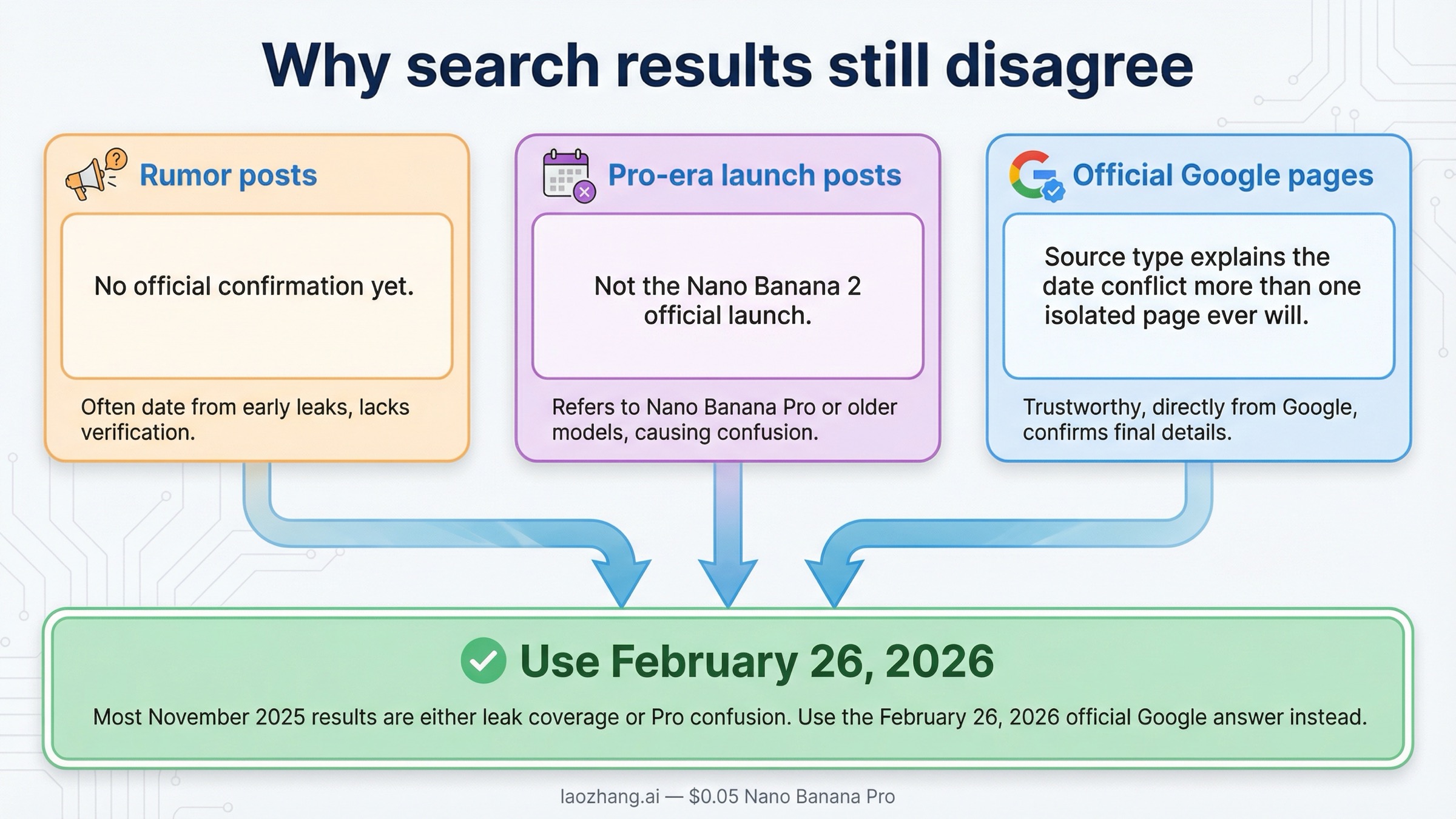
This is the section page one usually skips. The November 2025 dates are not completely random. They come from a real prelaunch rumor cycle and from pages that blur together multiple Nano Banana family events.
Late-2025 coverage from sites like TestingCatalog and BananaNano treated Nano Banana 2 as an upcoming model still in internal testing. Some of those posts explicitly said there was no official confirmation yet and guessed at a November or December 2025 launch window. Those pages were useful as rumor tracking. They were never the clean official release answer.
Even more confusing, the rumor trail did not stay static. TestingCatalog later updated its own story in February 2026 to say Google had shifted from the earlier "Nano Banana 2 Flash" preparation toward Gemini Flash 3.1 Image Preview. That kind of mid-cycle rename is exactly what makes old leak posts stay partially recognizable but still dangerous to cite as final release history.
Other pages introduced a different problem: they used the exact phrase Nano Banana 2 in the title because it is what users search, but then they described the Nano Banana Pro launch or a Gemini 3 Pro image event inside the article body. That mismatch is one reason the query still feels contradictory even when one page looks confident and another page looks official.
There is also a simple SEO reason the confusion persists. Exact-match titles like Nano Banana 2 release date or Nano Banana 2 is out now are easier clicks than official Google pages titled things like Nano Banana 2: Google's latest AI image generation model or Build with Nano Banana 2, our best image generation and editing model. The unofficial pages win on keyword match. The official pages win on trust. The user gets stuck comparing them.
That is why this article should not stop at one sentence like "the date is February 26, 2026." A good page here has to explain why the other dates exist. Otherwise the reader just bounces back into the same rumor loop.
Is Nano Banana 2 live now in Gemini, AI Studio, and the API?
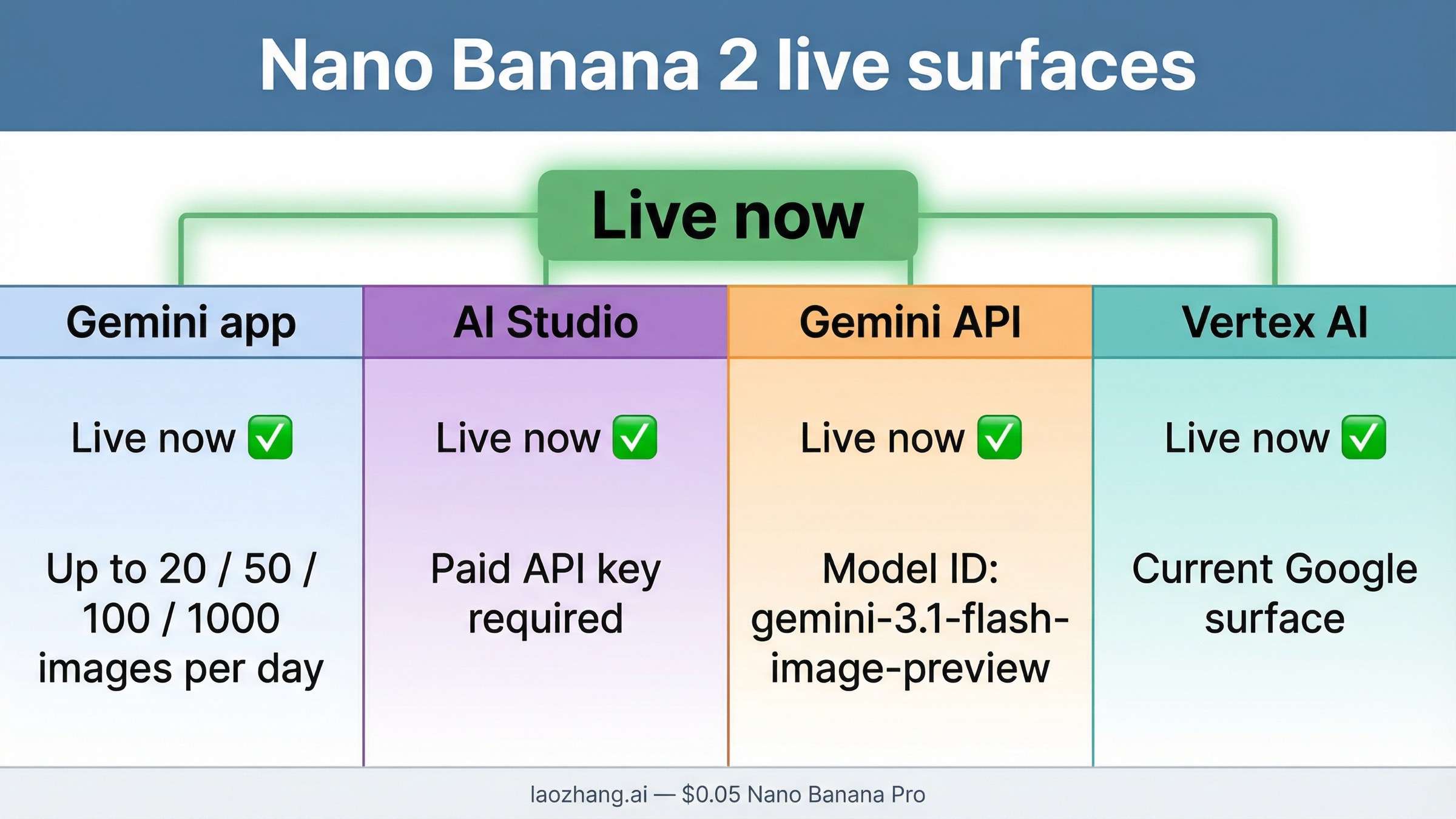
Yes, Nano Banana 2 is not just a dated announcement. It is a live current Google surface. The important detail is that live means something slightly different depending on which product surface you mean.
| Surface | Current status | What Nano Banana 2 means there | Main caveat |
|---|---|---|---|
| Gemini app | Live | The current Gemini Apps limits page still lists Nano Banana 2 image-generation and editing quotas | Limits vary by plan and Google says they may change frequently |
| Google AI Studio | Live for the current developer lane | Google's developer launch post says you can build with Nano Banana 2 there | A paid API key is required for this model in AI Studio |
| Gemini API | Live | The current docs map Nano Banana 2 to gemini-3.1-flash-image-preview | You need to think in model IDs, not only in the nickname |
| Vertex AI | Live as a current Google surface | Google's current DeepMind Nano Banana 2 page points to Vertex AI as one of the active usage surfaces | Enterprise or Cloud workflow context may differ from consumer Gemini usage |
For most readers, the two most useful current-status facts are these:
First, the Gemini app help page still lists Nano Banana 2 quotas of up to 20, 50, 100, or 1000 images per day depending on plan. That is strong official evidence that Nano Banana 2 is not some abandoned launch story.
Second, the developer launch post says a paid API key is required to use the model in Google AI Studio. That means you should not answer is it live now? with a vague yes. It is live, but the access rules are not identical across consumer and developer surfaces.
The DeepMind product page reinforces that this is a current surface, not a retired announcement. Google currently presents Nano Banana 2 through active links to Gemini, Google AI Studio, the Gemini API, and Vertex AI. That makes the current-status answer much stronger than "it launched once." It shows Nano Banana 2 as the live Flash image lane Google still expects people to use across multiple parts of its stack.
So if your real question is "did Nano Banana 2 ship and can I use it today?" the answer is yes, but the right next step depends on whether you mean the Gemini app, AI Studio, or an API integration.
Which date should you use in docs, content, or product notes?
This is the practical section missing from most ranking pages. Different readers need different date rules, but the default answer is still straightforward.
Use February 26, 2026 when:
- you are writing a blog post or article about the official Nano Banana 2 release
- you are updating internal docs to explain when Nano Banana 2 became the current public Google image lane
- you are comparing Nano Banana 2 with current alternatives or with Nano Banana Pro
- you are writing developer-facing material that maps the nickname to
gemini-3.1-flash-image-preview
Use an older date only when you are explicitly talking about a different event:
- August 26, 2025 if you mean the earlier Gemini app image-editing upgrade tied to Nano Banana
- November 20, 2025 if you mean the Nano Banana Pro / Gemini 3 Pro Image Preview-era launch
- late 2025 rumor windows only if you are documenting prelaunch speculation or leak history, not the official Nano Banana 2 public release
If you are writing product or migration notes, the safest wording is usually this:
Nano Banana 2 officially launched on February 26, 2026 as Google's Gemini 3.1 Flash Image Preview lane.
That one sentence gives the date, the official family mapping, and enough context to stop a reader from mixing it up with Nano Banana Pro or older Nano Banana posts.
For buyer comparisons, one extra sentence often helps: "Nano Banana 2 is the current Flash image lane, while Nano Banana Pro is the premium lane that launched earlier." For internal engineering notes, the better wording is even more explicit: "Nano Banana 2 maps to gemini-3.1-flash-image-preview, released February 26, 2026." The more technical the audience, the more important the model ID becomes.
Bottom line
The official Nano Banana 2 release date is February 26, 2026. That is the date Google now supports across its public launch post, developer launch post, release notes, and lifecycle table for the model it maps to gemini-3.1-flash-image-preview.
If you still see November 2025 pages, treat them as one of two things: rumor-era coverage that guessed at a future launch, or pages that are really talking about Nano Banana Pro and not explaining the difference clearly. And if your real question is whether Nano Banana 2 is live now, the answer is also yes: Google still lists it on the Gemini app limits page, while the developer surface remains available with a paid API key in AI Studio.
If you need the broader family map after this, continue with Nano Banana AI Image Generator. If your next decision is whether to stay on Nano Banana 2 or move up to Pro, go straight to Nano Banana 2 vs Nano Banana Pro.