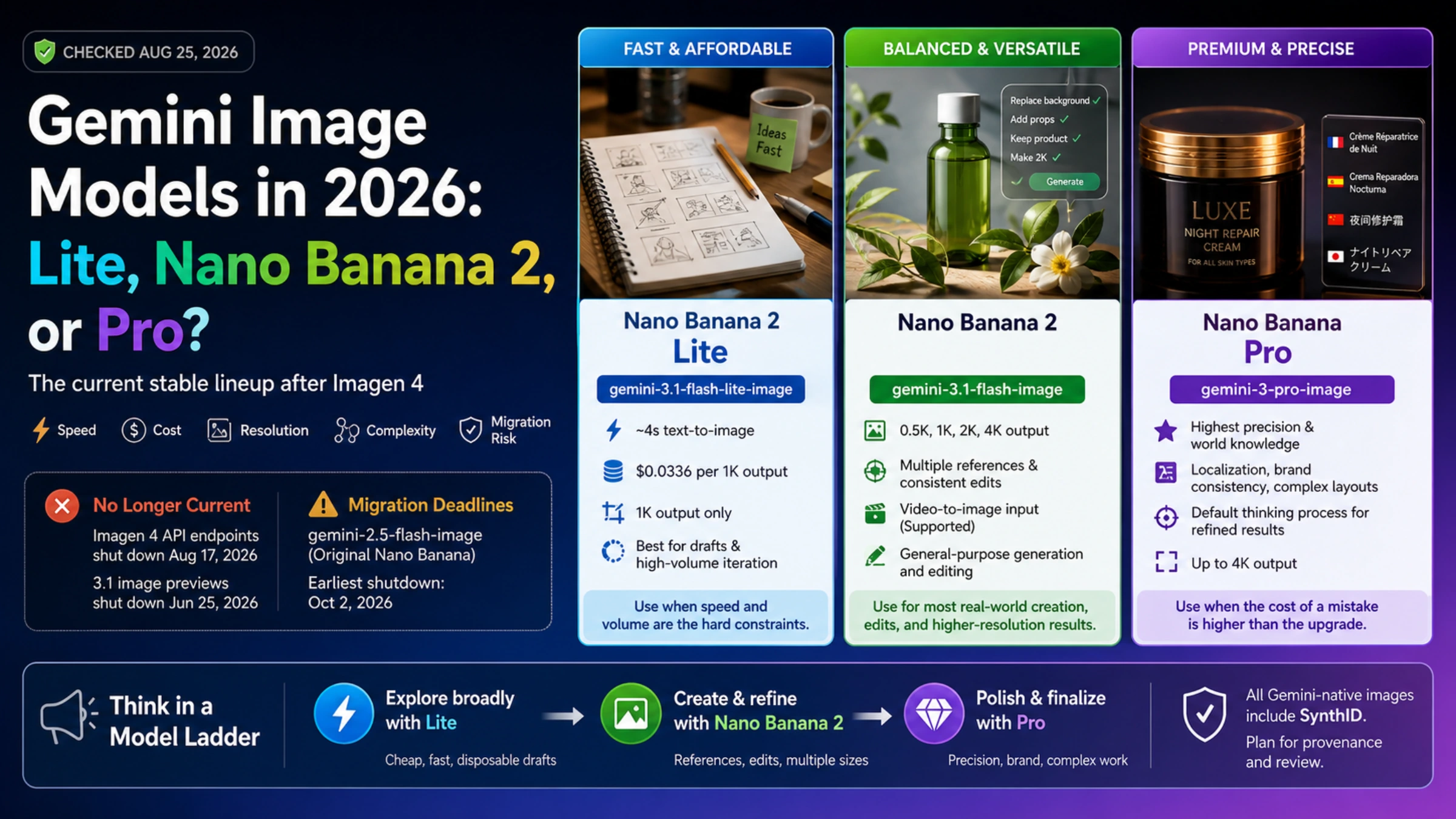
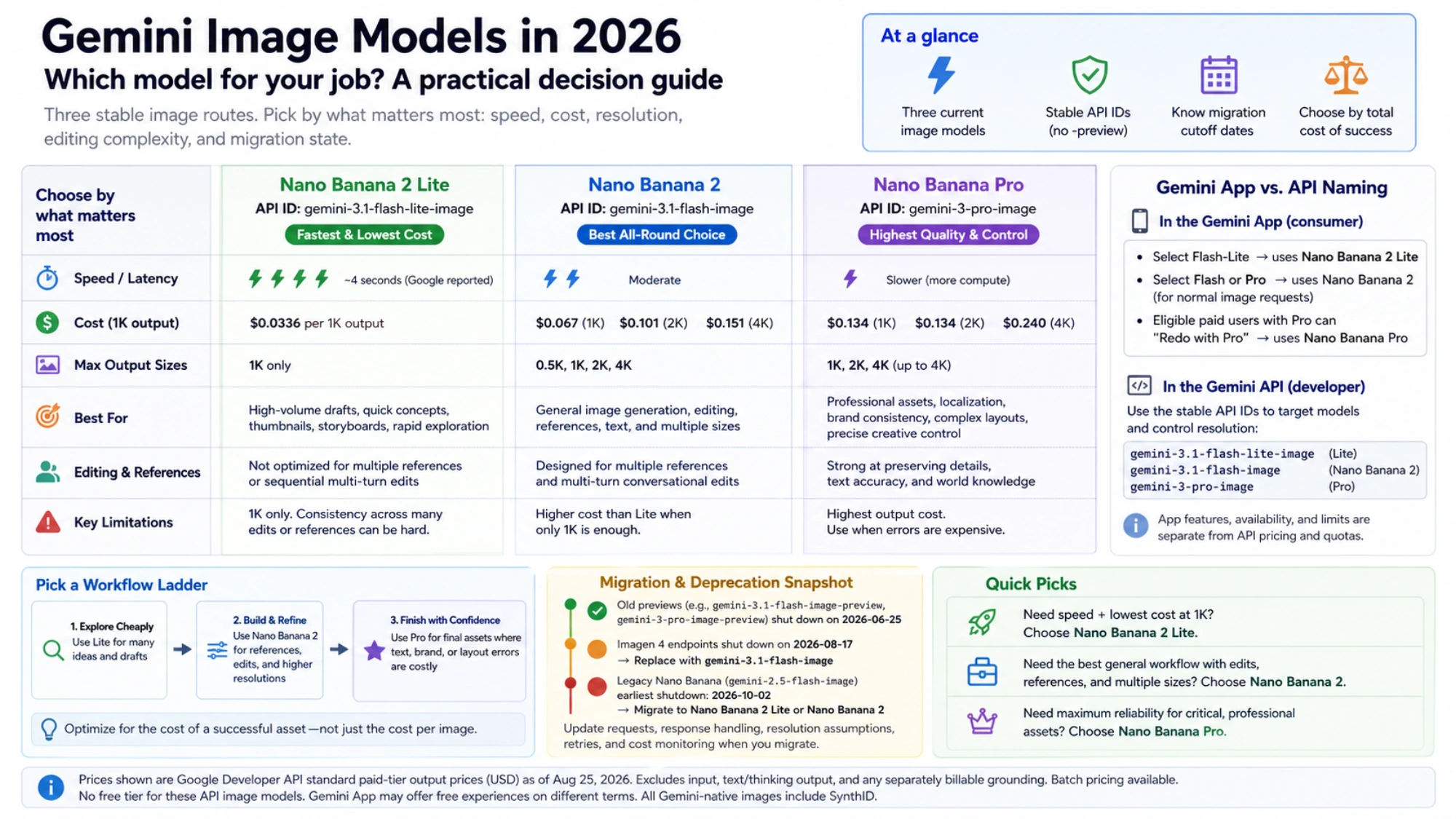
Gemini now has three stable image-generation routes, and each one solves a different bottleneck. Nano Banana 2 Lite minimizes latency and cost. Nano Banana 2 is the general-purpose generator and editor. Nano Banana Pro spends more compute and money on complex professional work.
That is the useful answer as checked on August 25, 2026. Imagen 4 is no longer a fourth current option in the Gemini Developer API: its shutdown date passed on August 17. The original Nano Banana remains a legacy endpoint with its own migration deadline.
Start with the product surface, not the nickname
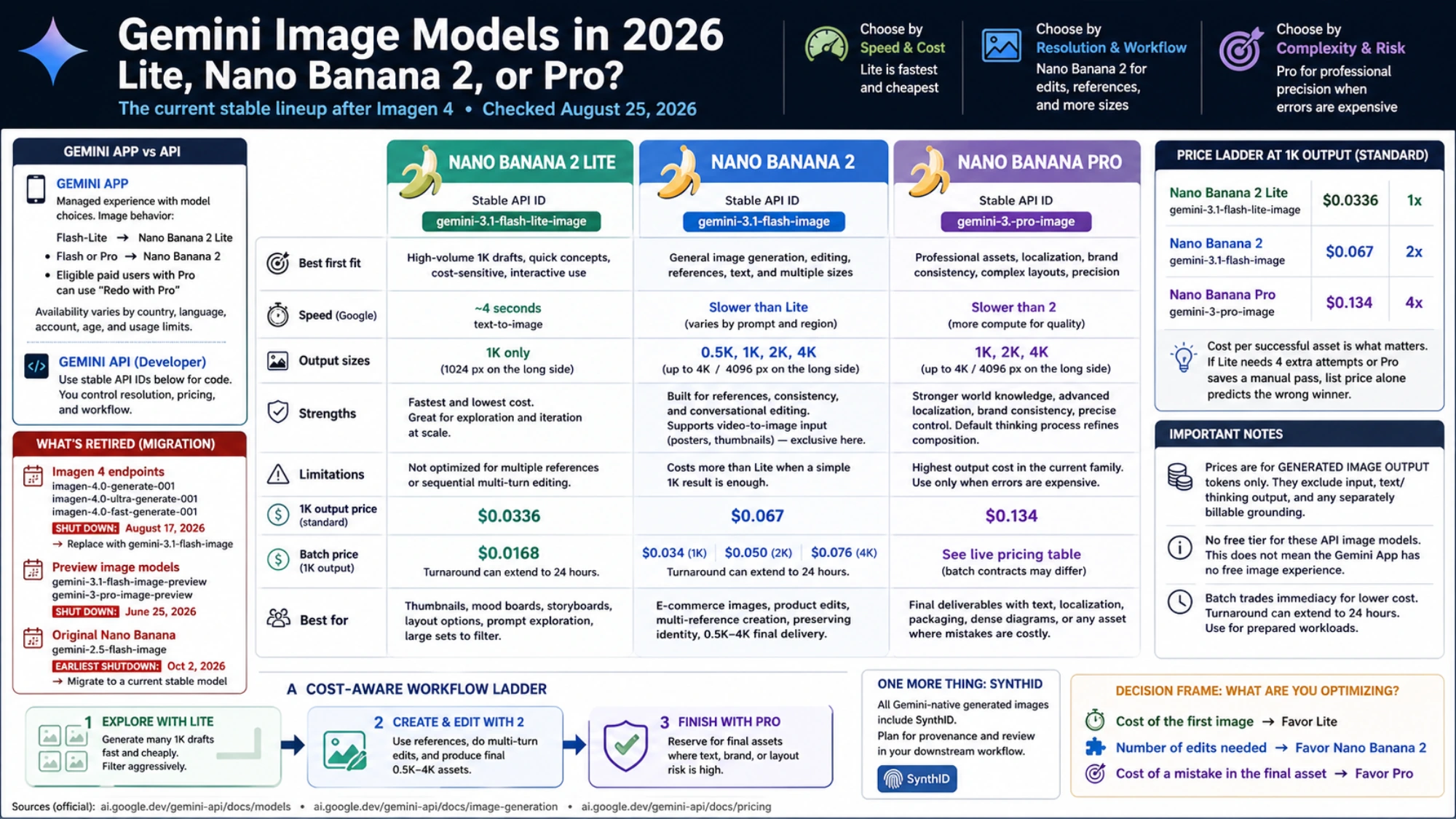
The model names only become useful after you separate the Gemini app from the Gemini API. The app offers model choices and a managed image workflow. The API exposes exact endpoints, resolution controls, token-based billing, and response contracts. A recommendation for one surface does not automatically transfer to the other.
Google's current Gemini Apps image help maps the app this way:
- with Flash-Lite selected, image requests use Nano Banana 2 Lite;
- with Flash or Pro selected, a normal image request uses Nano Banana 2;
- eligible paid users with Pro selected can regenerate a result with Redo with Pro.
Country, language, account, age, and usage-limit rules can change on the app side. Those rules are separate from Developer API model IDs and prices.
For code, Google's current model directory lists these stable endpoints:
| Current model | Stable API ID | Best first fit | Important limit |
|---|---|---|---|
| Nano Banana 2 Lite | gemini-3.1-flash-lite-image | high-volume 1K drafts, quick concepts, cost-sensitive interactive use | not optimized for multiple references or sequential multi-turn edits |
| Nano Banana 2 | gemini-3.1-flash-image | general image generation, editing, references, text, and multiple output sizes | costs more than Lite when a simple 1K result is enough |
| Nano Banana Pro | gemini-3-pro-image | professional assets, localization, brand consistency, complex layouts, precise control | highest output cost in the current family |
The absence of -preview matters. Google's API release notes record that gemini-3.1-flash-image-preview and gemini-3-pro-image-preview shut down on June 25, 2026. A tutorial that still copies either ID is not merely old branding; its request target is obsolete.
Lite is for cheap iteration, not every long workflow
Google launched Nano Banana 2 Lite on June 30 as its fastest and most cost-efficient Gemini image model. Its launch post reports roughly four-second text-to-image generation and a roughly $0.034 1K output price. Treat the speed as Google's reported product figure, not a guarantee for every region, prompt, and traffic level.
Lite is an excellent fit when the useful output is a disposable draft: thumbnail candidates, rough storyboards, layout options, rapid prompt exploration, or a large set that will be filtered aggressively. It only supports 1K output, which keeps the decision simple.
The trap is measuring the first image instead of the completed job. Google's image-generation guide says Lite is not optimized for multiple reference inputs or sequential multi-turn editing. If a product, person, or setting must stay consistent across references—and you expect several local revisions—the cheapest first call can produce an expensive chain of retries.
Nano Banana 2 is the generalist default
Nano Banana 2 is the sensible starting point when you do not have a strong reason to choose either extreme. It supports 0.5K, 1K, 2K, and 4K output, combines generation with conversational editing, and is the family member Google highlights for multiple-reference processing and consistency.
That broader contract matters more than a vague claim that it has “better quality.” A general e-commerce image workflow may begin with several product references, replace a local object, preserve the subject through another edit, and only then render a 2K or 4K result. Nano Banana 2 is designed to keep that work on one route. Lite is optimized for a different constraint, while Pro may be unnecessary for most of those iterations.
There is one more 2026 capability boundary worth knowing: Google's release notes say video-to-image input—such as generating a poster or thumbnail from a video—is supported exclusively on gemini-3.1-flash-image. That is a concrete reason to choose Nano Banana 2 rather than a general “quality” preference.
Pro earns its price when errors are expensive
Nano Banana Pro is not a universal upgrade switch. Google positions gemini-3-pro-image for the hardest professional visual tasks: stronger world knowledge, advanced localization, brand consistency, and precise creative control. It also uses a default thinking process to refine composition and can produce up to 4K.
The practical trigger is the cost of a wrong detail. Pro is easier to justify when image text must survive localization, a packaging system must stay on-brand, a dense diagram needs reliable layout, or a final asset will create substantial review and rework if one element is wrong. It is harder to justify for an internal mood board or the first 30 composition ideas.
Official positioning is not an independent benchmark. Before committing a production pipeline, run the same representative prompts and real reference assets through the candidate models. Judge the failures that matter to your business—misspelled copy, identity drift, incorrect product geometry, or too many edit rounds—not a generic winner label.
What the paid API prices actually compare
Google's current Developer API pricing table prices generated image output in tokens and provides per-image equivalents. These standard paid-tier figures exclude input, text/thinking output, and any separately billable grounding.
| Model | 1K output | 2K output | 4K output | Batch signal |
|---|---|---|---|---|
| Nano Banana 2 Lite | $0.0336 | not supported | not supported | $0.0168 for 1K |
| Nano Banana 2 | $0.067 | $0.101 | $0.151 | about $0.034 / $0.050 / $0.076 |
| Nano Banana Pro | $0.134 | $0.134 | $0.24 | use the live table for the exact batch contract |
Nano Banana 2 also offers 0.5K output at $0.045 standard and about $0.022 in batch. Batch trades immediacy for a turnaround that can extend to 24 hours, so it fits prepared workloads rather than interactive editing.
At 1K, the ladder is close to 1x, 2x, and 4x: Lite at $0.0336, Nano Banana 2 at $0.067, and Pro at $0.134. But cost per successful asset is usually more useful than cost per call. If Lite needs four extra attempts to preserve a reference or Pro saves a manual localization pass, the list price alone predicts the wrong winner.
The pricing page shows no free tier for these Developer API image models. That statement does not mean the consumer Gemini app has no free image experience, and it does not turn an AI Studio test surface into a free production API contract. Keep those three billing surfaces separate.
Imagen and the original Nano Banana are migration routes now
Imagen 4 used to be a legitimate branch in Google's image-model decision. It is no longer a current Gemini API choice. Google's deprecation schedule lists imagen-4.0-generate-001, imagen-4.0-ultra-generate-001, and imagen-4.0-fast-generate-001 with an August 17, 2026 shutdown date and gemini-3.1-flash-image as the replacement.
Migration involves more than changing a string. Google's Imagen migration page explains that Imagen used a dedicated image-generation method, while Nano Banana returns image parts through Gemini content generation. Update request construction, response handling, resolution assumptions, retries, and cost monitoring together.
The original Nano Banana, gemini-2.5-flash-image, still appears as a legacy model. The deprecation table gives it an earliest shutdown date of October 2, 2026, while the current image guide recommends Nano Banana 2 Lite as the lower-cost replacement. For a new build, use a current stable endpoint. For an existing build, compare the old Nano Banana migration paths before the deadline rather than waiting for a failed request.
A model ladder works better than one permanent default
You do not need to force every asset through one model. A cost-aware workflow can use Lite to explore broadly, Nano Banana 2 to perform the main reference-based creation and editing, and Pro only for the small set of final assets whose text, brand, or layout risk justifies the premium.
Use Lite when latency and volume are the hard constraints. Use Nano Banana 2 when the image must survive references, edits, or higher-resolution delivery. Use Pro when a subtle production error costs more than the model upgrade.
For a deeper billing decision, continue with what is actually free in the Gemini image API. If your constraint is the managed app rather than API cost, use the current Nano Banana Pro app limits guide instead. API price does not predict a consumer app quota.
All Gemini-native generated images include SynthID. That does not choose the model for you, but it belongs in downstream provenance and review planning. The decisive question remains operational: are you optimizing the cost of the first image, the number of edits needed, or the cost of a mistake in the final asset?