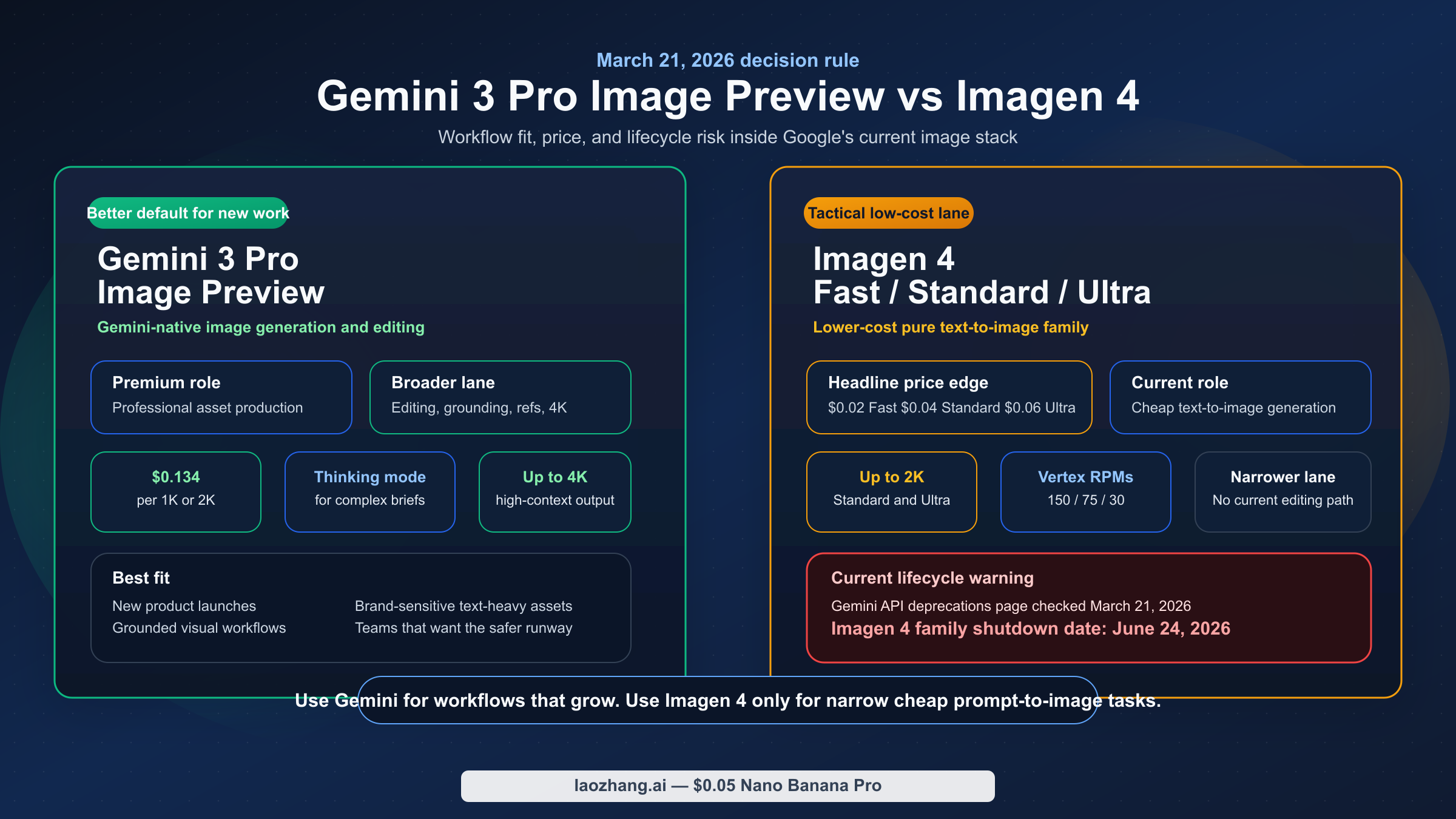
Choose gemini-3-pro-image-preview if you are starting a new long-lived Google image workflow. Choose Imagen 4 only when you specifically want the cheaper pure text-to-image lane and can accept its shorter lifecycle.
That lifecycle caveat matters because Google's deprecations page puts the Imagen 4 family on a June 24, 2026 shutdown path, while Gemini 3 Pro Image Preview is the forward image lane. So the real question is not only price or image quality. It is whether you want to build on the route Google is actively extending.
TL;DR
If you only need the route decision, use the table below.
| Model or lane | Main job | Current official price | Resolution ceiling in current docs | What it does best | Biggest risk |
|---|---|---|---|---|---|
gemini-3-pro-image-preview | Gemini-native multimodal image generation and editing | $0.134 per 1K or 2K image, $0.24 per 4K image | 4K | Conversational editing, grounded generation, references, complex instructions, text-heavy premium assets | Still a preview model with premium pricing |
imagen-4.0-fast-generate-001 | Cheapest Imagen 4 text-to-image lane | $0.02 per image | Smaller resolution set only | Fast low-cost prompt-to-image output | Narrow feature surface and current family shutdown date |
imagen-4.0-generate-001 | Default Imagen 4 text-to-image lane | $0.04 per image | Up to 2K-class output | Cheap high-quality text-to-image generation | No current editing surface on the Imagen 4 model page and current family shutdown date |
imagen-4.0-ultra-generate-001 | Premium Imagen 4 prompt-following lane | $0.06 per image | Up to 2K-class output | Better instruction alignment at a still-low per-image price | Same lifecycle and narrow-lane risk as the rest of Imagen 4 |
The practical rule is simple:
- choose Gemini 3 Pro Image Preview if you are starting a new product, need multimodal image editing, want native Google Search grounding, or expect the route to live past June 2026 without a forced migration
- choose Imagen 4 only if your real task is cheap, simple, pure text-to-image generation and you accept both the narrower capability surface and the current shutdown window shown on Google's deprecations page
Why This Comparison Changed in 2026
If you searched this topic in mid-2025, the obvious framing was "premium Gemini image model versus Google's best text-to-image model." That frame is no longer enough.
The biggest change is lifecycle. Google's current Gemini API deprecations page says the live Imagen 4 family entries imagen-4.0-generate-001, imagen-4.0-ultra-generate-001, and imagen-4.0-fast-generate-001 are scheduled to shut down on June 24, 2026. The same table recommends Gemini image replacements including gemini-3-pro-image-preview. That is not a minor footnote. It changes how a serious buyer should interpret this comparison.
The second change is that Google's own surface descriptions are now much clearer. On the current models page, Nano Banana Pro is framed as a state-of-the-art image generation and editing model for highly contextual native image creation, while Imagen 4 is framed as a text-to-image model with clarity up to 2K. That is a workflow distinction, not just a ranking statement.
The third change is that the current Vertex Imagen 4 page lists what Imagen 4 supports and, more importantly, what it does not. The supported list is image generation. The unsupported list includes mask-based image editing, insert/remove object workflows, outpainting, product image editing, and negative prompting. So if you came into this query assuming Imagen 4 is simply "the cheaper version of the same thing Gemini Pro Image does," the current docs do not support that assumption.
This is why a good March 2026 answer has to be lifecycle-aware and workflow-aware at the same time. The market signal from page one still leans launch-era and surface-level. The official docs now give a much sharper route.
Why Gemini 3 Pro Image Preview Is the Better Default for New Work
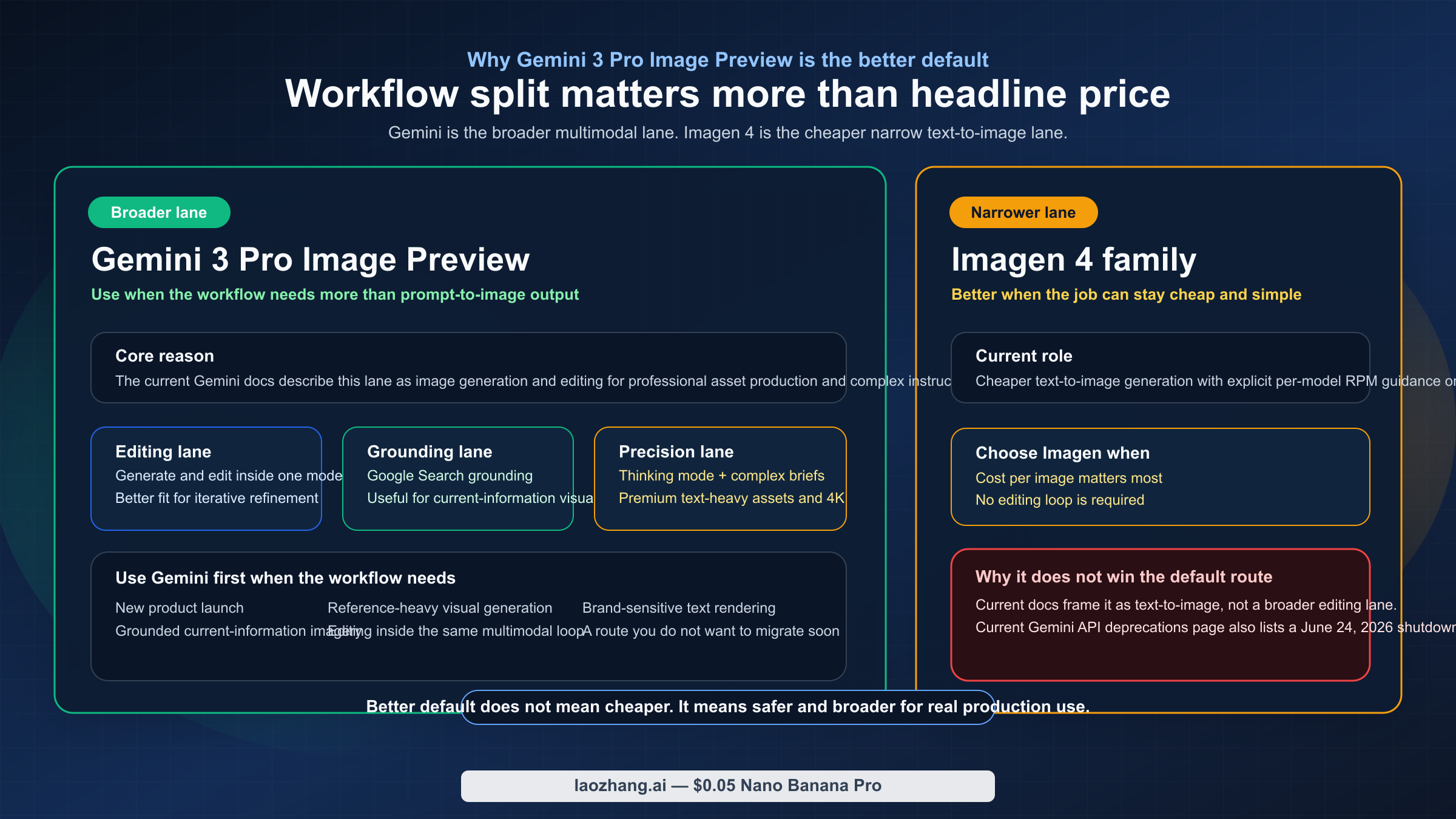
The strongest case for Gemini 3 Pro Image Preview is not that it is the cheapest route. It clearly is not. The strongest case is that it fits the broader class of image workflows teams actually end up building once the first prototype succeeds.
Google's current Gemini API image-generation guide says Gemini 3 Pro Image Preview is designed for professional asset production and complex instructions. The same page also attributes three capabilities that matter a lot in real production work: Google Search grounding, a default thinking process that refines composition before final generation, and support for up to 4K output. This is not the language of a narrow prompt-to-image SKU. It is the language of a multimodal production surface.
That difference matters the moment your image job stops being "draw a nice picture" and becomes "take context, reason through constraints, preserve fidelity, and keep iterating until the image is actually usable." If your team wants to generate an infographic, refine a branded asset, preserve details from multiple references, or produce grounded visuals around current information, the route matters more than the sticker price. Imagen 4 can still be strong for text-to-image generation, but the current docs do not present it as the same kind of system.
The models page also frames Nano Banana Pro as image generation and editing, while Imagen 4 remains text-to-image. That one difference explains a lot of the buying logic. Editing is not a cosmetic extra. It changes how you structure a workflow, how many retries you need, and how much cleanup your team has to do outside the model. If your designers or developers expect a model to stay inside a conversational loop with text, image inputs, and iterative changes, Gemini 3 Pro Image Preview matches that expectation much better.
Then there is the lifecycle issue. A premium route that remains part of Google's recommended replacement path is more attractive than a cheaper route that already sits on the deprecations table. The current deprecations page does not automatically make Imagen 4 unusable today, but it does make Gemini 3 Pro Image Preview the safer default for a new build that you do not want to revisit in a few months.
There is still one important caveat. Gemini 3 Pro Image Preview is also a preview model. Preview status means changing limits, occasional rough edges, and possible operational friction. If you need an introduction to the current Studio and Vertex surfaces, our Gemini 3 Pro Image Preview tutorial for Vertex AI and AI Studio is the better next read. But preview risk and premium pricing still do not overturn the core recommendation for long-lived, multimodal image work.
When Imagen 4 Is Still the Better Pick
A good article should not turn deprecation risk into fake absolutism. Imagen 4 is still the better pick for some workflows right now.
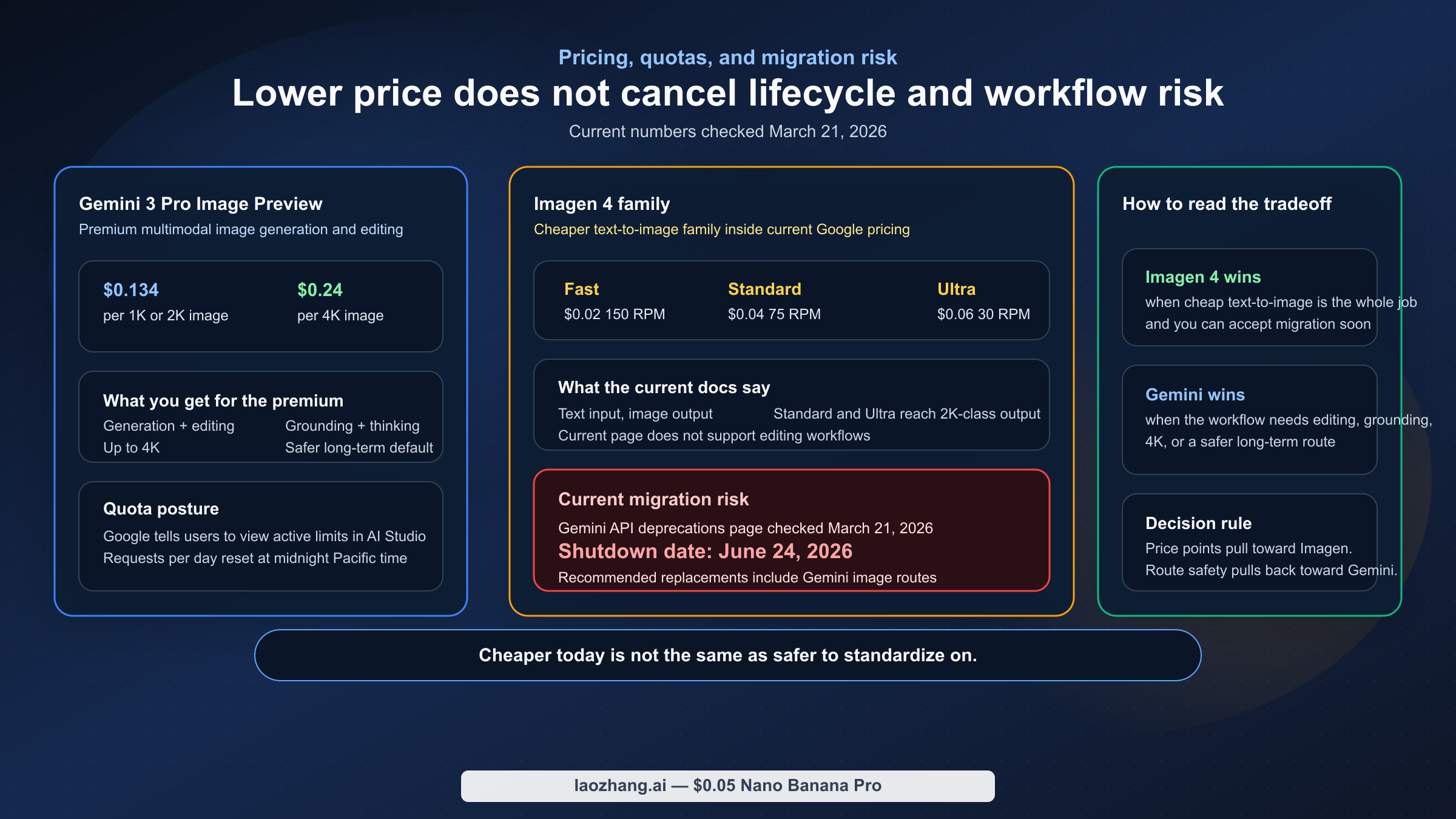
The cleanest case is narrow text-to-image generation where price discipline matters more than broader feature scope. Google's current pricing page lists Imagen 4 Fast at $0.02, Imagen 4 Standard at $0.04, and Imagen 4 Ultra at $0.06 per image. Compare that with Gemini 3 Pro Image Preview at $0.134 per 1K or 2K image and $0.24 per 4K image. If your task is simply "turn text prompts into images as cheaply as possible inside the current Google stack," Imagen 4 is still hard to ignore.
The second strong case is clarity of operational planning. The current Vertex Imagen 4 page publishes explicit per-model RPM guidance: 75 RPM for Imagen 4 Standard, 150 RPM for Imagen 4 Fast, and 30 RPM for Imagen 4 Ultra. Google's Gemini rate-limits page, by contrast, tells you to check active limits in AI Studio rather than rely on one static inline table for Gemini-native image requests. That does not mean Imagen 4 is the more powerful system. It does mean it is easier to capacity-plan from the docs alone.
The third case is when your job really is just prompt-to-image generation with no meaningful editing loop. The current Imagen 4 docs are clear about the lane: text input, image output. If the team does not need multimodal editing, grounding, or reference-heavy conversational iteration, the lower Imagen 4 price may be the rational choice for a short-lived campaign, internal experiment, or disposable batch of creative drafts.
The right way to say this is not "Imagen 4 is obsolete." The right way to say it is: Imagen 4 is now a narrower and more tactical choice. It wins when low per-image cost and simple text-to-image generation are the whole job. It loses when the workflow expands beyond that.
Pricing, Quotas, and Migration Risk
The mistake most comparison pages make here is to isolate price from everything else. The better view is to treat price, operational posture, and migration risk as one bundle.
| Requirement | Choose Gemini 3 Pro Image Preview | Choose Imagen 4 | Why |
|---|---|---|---|
| New product launching in 2026 | Yes | No, unless you already planned the migration | Lifecycle risk matters more than the cheaper per-image rate |
| Cheapest current Google image generation among these two options | No | Yes | Imagen 4 Fast/Standard/Ultra are dramatically cheaper per image |
| Conversational editing and multimodal iteration | Yes | No | Gemini is documented as image generation and editing; current Imagen 4 docs are text-to-image only |
| Search-grounded image generation | Yes | No comparable current Imagen 4 path in the model page | The Gemini image guide explicitly supports Google Search grounding |
| Straight text-to-image generation with published Vertex RPMs | Sometimes | Yes | Imagen 4 is simpler and easier to plan for in that narrow lane |
| Safer long-term default | Yes | No | Current deprecations table favors Gemini replacements over the Imagen 4 family |
The current Gemini API pricing page tells the cost story in the simplest possible numbers. Gemini 3 Pro Image Preview costs $0.134 at 1K or 2K and $0.24 at 4K. Imagen 4 Standard is $0.04, Ultra is $0.06, and Fast is $0.02. If your analysis stops there, Imagen 4 looks like the obvious winner.
But that price gap only answers the wrong question: "which one is cheaper per finished image?" The actual buying question is "which one is cheaper for the workflow I really need to support?" If the cheaper model forces you to leave the model loop for editing, iteration, or grounded corrections, its effective cost can stop looking so cheap. And if you have to migrate off the model family in a few months anyway, the operational savings can shrink even further.
Quota posture also differs. On the current Imagen 4 docs, Google publishes fixed Vertex RPM numbers by model. On the current Gemini rate-limits page, Google says rate limits depend on your tier and can be viewed in AI Studio, with requests per day resetting at midnight Pacific time. For teams that care about doc-level planning certainty, Imagen 4 looks cleaner. For teams that care more about system capability and route longevity, Gemini still has the better default case.
If your real question is broader than this two-model comparison, our Gemini image generation API pricing guide goes wider across the rest of Google's current image model lineup.
What the Model Names and Product Surfaces Actually Mean
Part of the confusion in this topic is not model quality. It is product-surface chaos.
In the Gemini API model directory, Nano Banana Pro maps to gemini-3-pro-image-preview. That same page also warns that gemini-3-pro-preview was shut down on March 9, 2026. Those are not the same thing. One is the active image model. The other was a text reasoning model. If your team writes "Gemini 3 Pro" in tickets or configs without the -image- part, you are building future support problems for yourself.
Then there is the app versus API problem. Community threads still ask where Imagen 4 actually appears inside Google products because users see image generation in the Gemini app, image-generation options in AI Studio, and separate Imagen model IDs on Vertex or the API side. Those are related surfaces, but they are not interchangeable. A simple prompt in one Google UI can still hide the underlying route decision that matters to an API buyer.
The safest operational rule is:
- use the official model ID in code and internal docs
- treat the consumer-facing labels like Nano Banana Pro as parenthetical helpers, not primary identifiers
- separate Gemini app behavior, AI Studio media generation, Vertex AI, and Gemini API when you document how a workflow works
If you need to productionize Gemini 3 Pro Image Preview despite its preview status, our stable-channel guide for Gemini 3 Pro Image Preview covers the access-path question in more detail.
Best Choice by Use Case
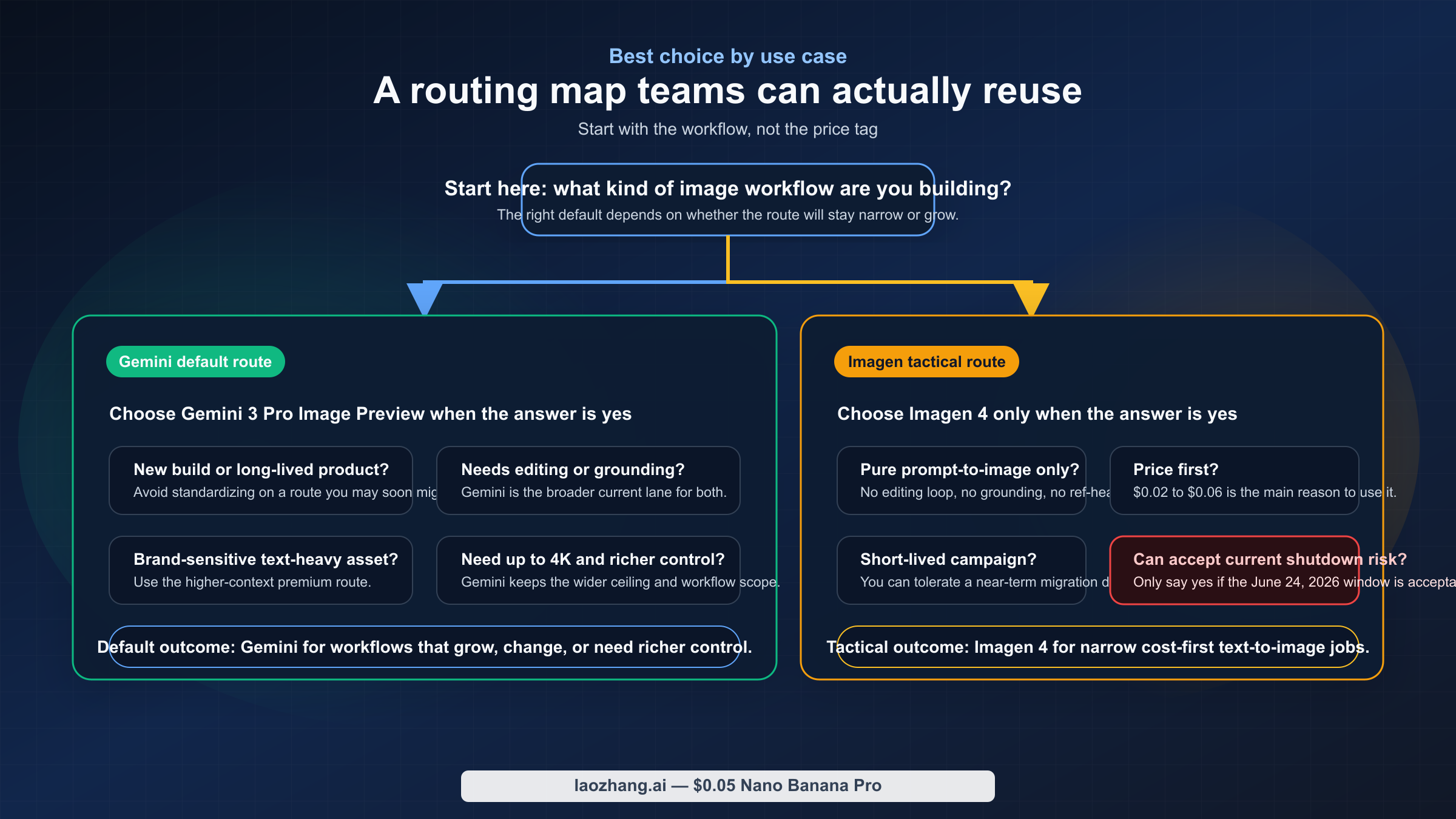
If you are building a new production workflow that may still be live after June 2026, choose Gemini 3 Pro Image Preview. That is the better default because the model fits multimodal creation and editing, and the official deprecations table currently points in its direction rather than away from it.
If you are running a cheap short-lived text-to-image batch where the outputs do not need iterative editing and you care mostly about cost per image, choose Imagen 4 Standard or Imagen 4 Fast. This is the cleanest case where Imagen 4 still wins.
If you are making brand-sensitive, text-heavy, or diagram-like assets, choose Gemini 3 Pro Image Preview. Google's current image-generation guide is explicit about the premium asset-production and complex-instruction positioning, and that is the kind of workflow where broader multimodal control is worth paying for.
If you are doing rapid low-stakes creative drafts with little need for reference handling or post-generation editing, choose Imagen 4. It is cheaper, simpler, and easier to explain to a team that only wants prompt-to-image output.
If you are still undecided, the strongest practical rule is this: use Imagen 4 only when the workflow can stay narrow. Use Gemini 3 Pro Image Preview when you expect the workflow to grow. That is the cleanest way to map today's docs onto tomorrow's maintenance reality.
FAQ
Is Imagen 4 really being shut down?
As checked on March 22, 2026, Google's Gemini API deprecations page lists the Imagen 4 family entries with a shutdown date of June 24, 2026. Because this is a volatile lifecycle claim, you should recheck that page before making a final production decision.
Does Imagen 4 support image editing right now?
The current Imagen 4 model page on Vertex documents text input and image output, and its unsupported list currently includes mask-based image editing, insert/remove object workflows, outpainting, product image editing, and negative prompting.
Why is Gemini 3 Pro Image Preview so much more expensive?
Because it is not positioned as a direct per-image substitute for Imagen 4. Google positions it as a multimodal premium image-generation-and-editing model for more complex, grounded, and higher-context work.
Is Gemini 3 Pro Image Preview the same as the retired Gemini 3 Pro Preview model?
No. gemini-3-pro-image-preview is the active image model. gemini-3-pro-preview was the text reasoning model that the current models page says shut down on March 9, 2026.
Which one should a new product team standardize on first?
Standardize on Gemini 3 Pro Image Preview if the product is long-lived or editing-heavy. Standardize on Imagen 4 only if the product's needs are strictly text-to-image, price-sensitive, and tolerant of the current migration horizon.
Bottom Line
The best March 2026 answer is not "Gemini is better" or "Imagen 4 is cheaper." Both statements are too shallow to help.
The better answer is this: Gemini 3 Pro Image Preview is the stronger default for new, long-lived, high-context Google image workflows. Imagen 4 is the tactical low-cost text-to-image lane when you specifically want cheap prompt-to-image generation and can accept its current lifecycle and feature-surface limits.
That route is harder-edged than most page-one results, but it is also closer to what the current official docs actually say.