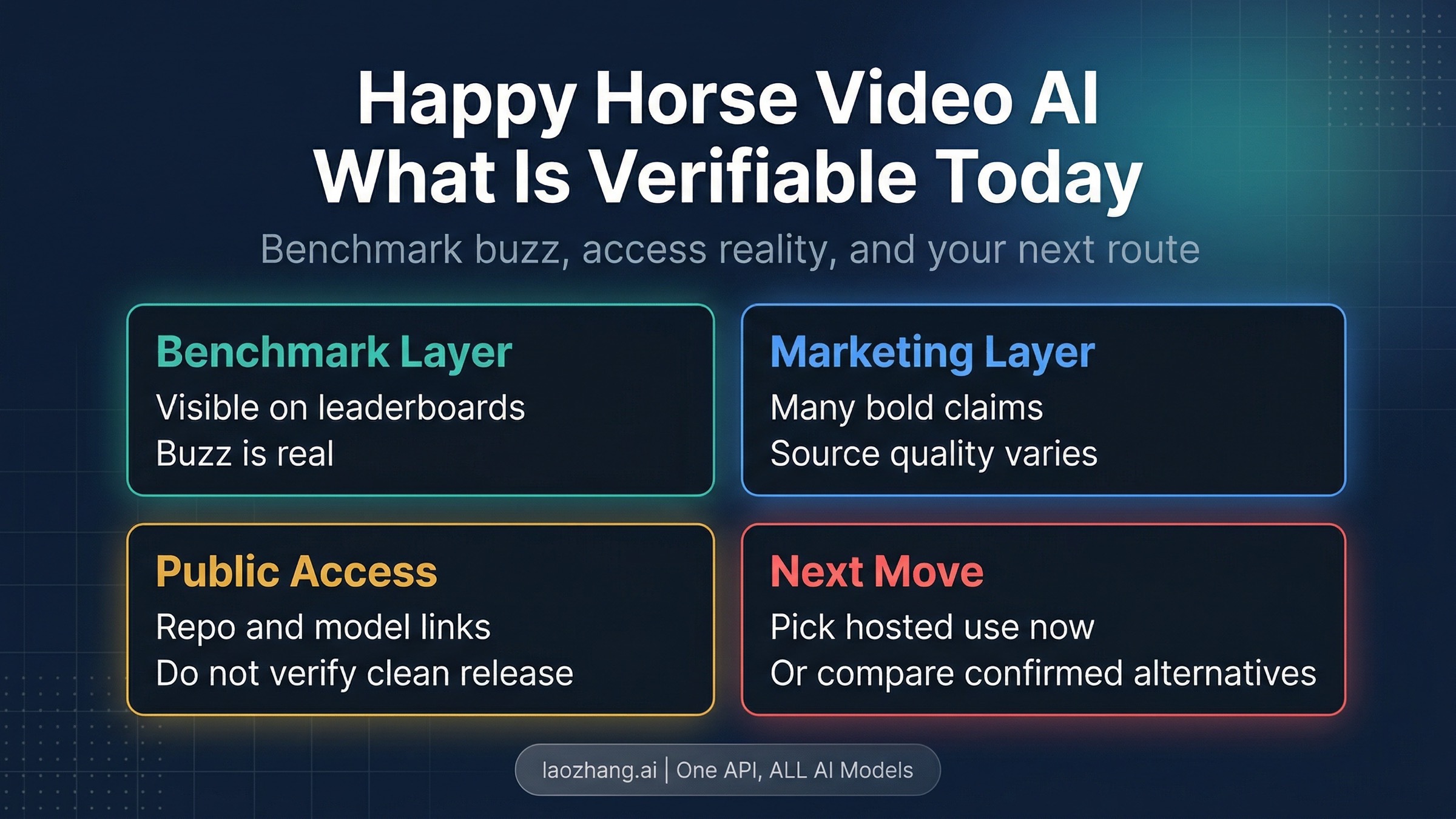
Happy Horse video AI currently points to real benchmark visibility and real hosted product surfaces, but not to a clean public open-weight release you can verify from the GitHub and Hugging Face endpoints most often cited in search results. As of April 9, 2026, the reliable reading is that HappyHorse is visible, discussed, and usable through platform-style routes, while the public-release claim remains unconfirmed.
That distinction matters because the query can easily collapse three different things into one story: benchmark presence, promotional language, and public model access. The accessible English HappyHorses site presents HappyHorse as part of a broader platform experience, while the public repo and model surfaces that should make an open release easy to confirm still do not do that cleanly.
If you want to try the capabilities now, the practical route is to evaluate hosted access and treat the experience as a product-access question. If your real requirement is confirmed public weights, the better move is to stop chasing this ambiguity and compare alternatives whose release state is already clear.
Use the claim-tier board and route table below to choose your branch before you spend time on the deeper evidence details.
| What you actually need | Best route now | Why it fits | What not to assume |
|---|---|---|---|
| You want to try whatever people mean by HappyHorse today | Start with the live HappyHorses product surface | That is the clearest currently accessible route for actual use | Do not assume the hosted experience proves a public model release |
| You need a model you can publicly download, inspect, or self-host | Skip the HappyHorse ambiguity and compare confirmed alternatives such as Wan | Your real requirement is release clarity, not hype visibility | Do not spend hours chasing a 404 repo path and empty model org page |
| You only want to understand whether the model buzz is real | Treat benchmark visibility as a signal, not as release proof | Leaderboard presence can confirm attention without confirming public access | Do not turn ranking mentions into an access conclusion |
| You are deciding which AI video route to evaluate this week | Use this page to sort into hosted-now versus confirmed-open route | That is the actual decision surface most searchers need | Do not wait for every rumor to resolve before making a practical choice |
Checked on April 9, 2026: repo availability, Hugging Face visibility, and benchmark positions are freshness-sensitive and can change quickly.
What This Query Actually Means Right Now
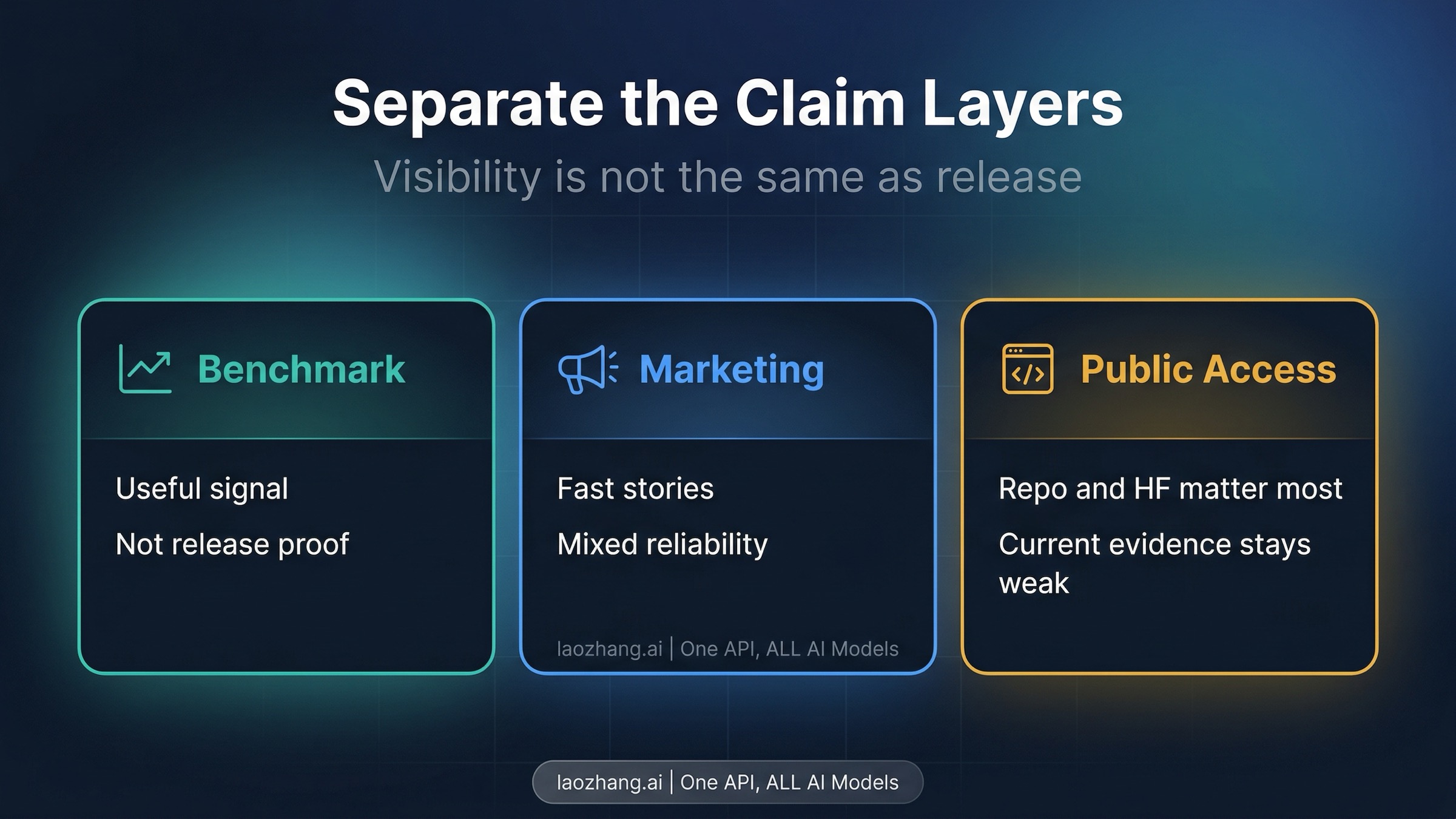
The fastest useful answer is that Happy Horse video AI is not behaving like a normal single-product search. It currently bundles together at least three layers that readers naturally want to separate but search results often blend together.
The first layer is benchmark visibility. Pages and snippets around HappyHorse 1.0 show that the name has been circulating in AI video discussions and leaderboard contexts. That part matters because it tells you the topic is not pure fiction or a random mis-typed keyword.
The second layer is promotional framing. Some pages describe HappyHorse as if it were already an openly available video model with stable public access, detailed architecture, and a clear provider story. That is the part that creates most of the confusion, because those pages often sound more settled than the underlying public evidence supports.
The third layer is actual user access. On the accessible English surface we checked, HappyHorses presents itself as an AI video platform and treats HappyHorse as part of that broader product environment. That means a reader looking for something usable today may indeed find a hosted route. It does not automatically mean the same reader can verify a downloadable or self-hostable public release.
So the right question is not simply "Is HappyHorse real?" The better question is "Which contract am I trying to verify?" If you need a hosted product you can try, the answer may be yes. If you need confirmed public weights or a clean open-source release path, the answer is still not cleanly verified from the public endpoints most often cited in search.
What the Current Evidence Actually Confirms
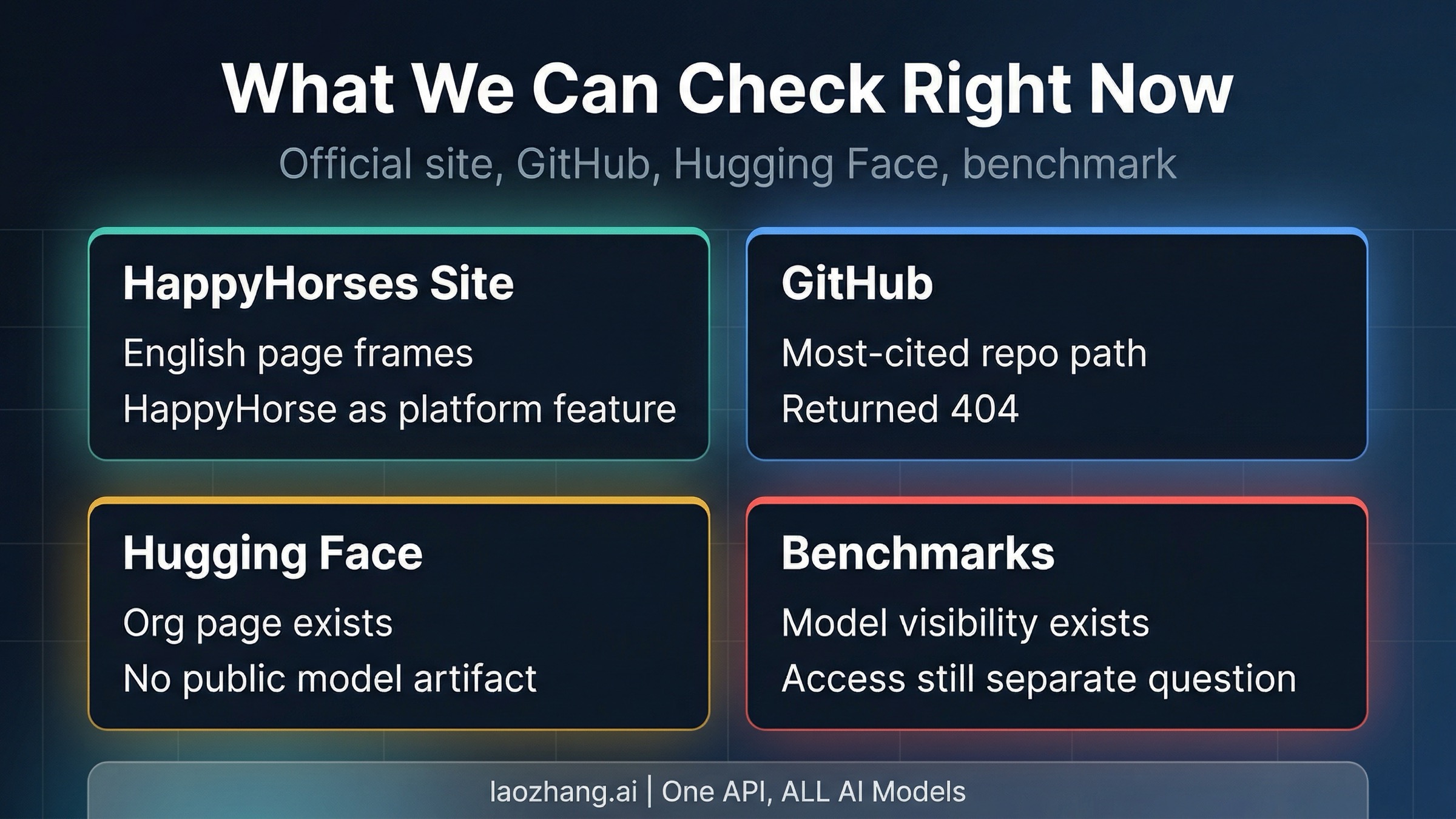
The cleanest way to read the topic is to separate what each source surface can prove from what it cannot prove. Once you do that, the contradictions become much easier to manage.
| Surface | What it confirms | What it does not confirm |
|---|---|---|
| happyhorses.io | The English site presents HappyHorses as an AI video creation platform and frames HappyHorse as a capability inside that platform | It does not clearly function as a public model card or a release note for open weights |
| Open-source attribution page | The site publicly attributes some components to Tongyi-MAI/Z-Image-Turbo under Apache-2.0 | It does not by itself prove that HappyHorse is publicly released as its own downloadable model |
| GitHub path most often cited in secondary pages | The path is a real public URL people are pointing to | On April 9, 2026, it returned 404, which means it cannot serve as clean public-release proof |
| Hugging Face org | A public organization named happy-horse exists | We did not find a public model artifact there at check time |
| Artificial Analysis search surfaces | The name has benchmark visibility and is part of the current model conversation | Benchmark visibility does not prove that public repo and model access exist |
That evidence set supports a narrower and more useful conclusion than many hype-forward explainers do. HappyHorse appears to be real enough to have platform identity and benchmark visibility, but the strongest public-access claims are exactly where the evidence weakens. The public surfaces that should make release status easy to verify are the same surfaces that currently fail the cleanest test.
That is why access reality matters more than model lore here. If the public repo later works, the Hugging Face org exposes a model card, and the official site explicitly states release terms, the conversation can widen into feature comparison, technical capabilities, or pricing. For now, the first job is still claim boundary control.
Why So Many Pages Sound More Certain Than the Evidence
The search confusion around HappyHorse is not hard to explain. AI video coverage often rewards momentum faster than it rewards source discipline. Once a model name starts appearing in benchmark chatter, summary pages, translated snippets, and social posts, a loose story can solidify before the clean public artifacts catch up.
That is especially risky in this case because the topic contains just enough truth to make overstatement feel plausible. The model name shows up in discussions. The product surface exists. Some official-looking language points toward open-source-related components. A reader can move from those facts to "therefore the full model is publicly released" in one mental step, even though that final step still needs evidence that is currently missing or inaccessible.
The practical consequence is simple. Treat detailed architecture claims, founder stories, speed metrics, and provider-attribution narratives as optional, not essential, until a primary source locks them down. None of those details matter more than the access contract. If you cannot verify the release boundary, a beautiful spec paragraph does not help you make a safer decision.
This is also where many result pages choose the wrong first-screen move. They open like model-review articles, as if the reader's main problem were quality ranking. For most searchers, it is not. The real problem is whether this is something they can use, trust, or download today without reverse-engineering a rumor trail.
If You Want to Use HappyHorse Right Now, Treat It as a Hosted Route
For readers who want action more than certainty, the best move is not to keep refreshing repo pages. It is to treat HappyHorse as a hosted-use question first.
That means starting from the live HappyHorses product surface and evaluating it the same way you would evaluate any other AI video platform: what inputs it accepts, what outputs you can actually generate, how stable the workflow feels, and whether the product experience is good enough for your project. Check three things early: whether it supports the input mode you actually need, whether pricing or watermark rules are acceptable, and whether a short real test prompt holds up on motion and consistency. This route respects what the current evidence actually supports. It does not require you to claim more than the public-access record currently proves.
That approach also saves time. If your goal is "Can I generate clips that are useful for me this week?", a hosted route can answer that faster than a release-status investigation. You can judge the platform on results, not on a speculative backstory about whether every public artifact is perfectly aligned.
The boundary to keep in mind is that hosted use and open release are different claims. A platform can expose real capability through its own interface while still leaving the broader public-release picture unresolved. Treating those as separate questions is not hair-splitting. It is the difference between a correct purchase decision and a misleading one.
If You Need Confirmed Public Weights, Compare Proven Alternatives Instead
Some readers do not actually need HappyHorse. They need a video model they can publicly access, evaluate, and possibly self-host. For that reader, the right move is to stop digging in the wrong place.
The clearest example in our current English cluster is Kling vs Wan. That page is useful here not because Kling and Wan are substitutes for every HappyHorse claim, but because it makes the route boundary explicit. Kling is a cloud product. Wan is an openly available model route for users who want self-hosting and deeper control. If your real question is about public availability, Wan-style comparisons are much closer to the decision you are actually trying to make.
For a broader market map, MiniMax vs Kling vs Wan vs Veo vs Seedance is the better follow-up when you have already decided that product reality matters more than rumor momentum. That page helps you compare open and closed routes by capability, cost shape, and workflow fit instead of anchoring on an unresolved release story. When you compare those alternatives, focus on three decision points before anything else: release clarity, hardware burden, and workflow maturity.
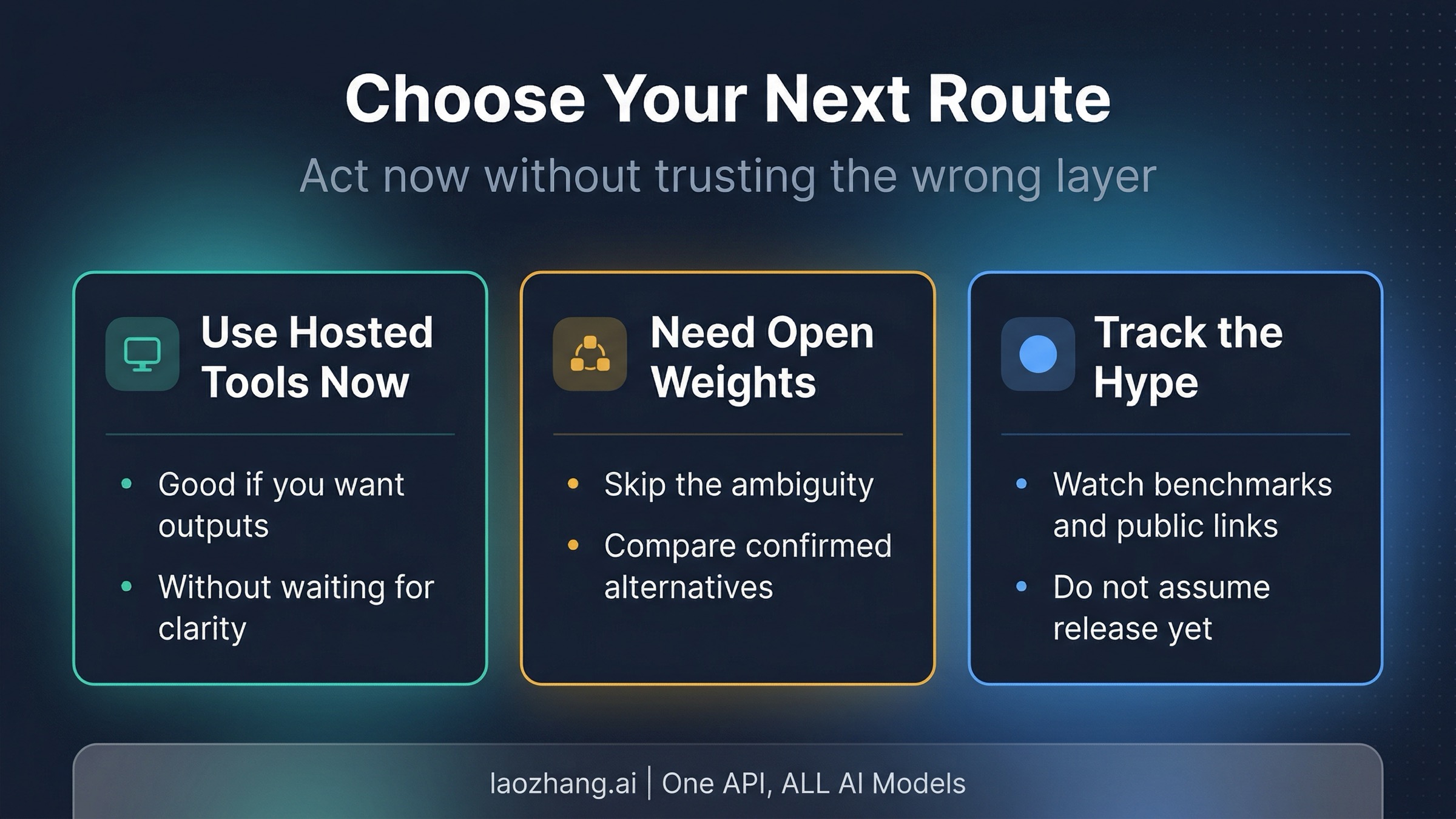
This is the key shift in reader logic:
- If you want the thing behind the HappyHorse buzz, test the hosted route.
- If you want public release clarity, compare models whose release state is already obvious.
- If you only want to monitor the story, watch for a verifiable repo, a real public model card, or an official page that explicitly states release terms.
That last branch is important. Waiting is not irrational. It is just a different job. If a future update exposes a public repo, a public Hugging Face model card, or an official release statement that resolves the current contradiction, the article can be refreshed into a normal model-access page. On April 9, 2026, it is still more honest to frame the topic as a route choice.
FAQ
Is Happy Horse video AI real?
Yes, in the limited sense that the name has benchmark visibility and an accessible product surface connected to HappyHorses. The unresolved part is not whether the topic exists at all. The unresolved part is whether the public open-weight release claims are cleanly verifiable from the public repo and model endpoints most often cited in search.
Is HappyHorse publicly open source right now?
Not in a way we could cleanly verify on April 9, 2026. The GitHub path most often cited by secondary pages returned 404, and the public Hugging Face organization did not expose a model artifact at check time.
Does the HappyHorses site prove there is a public model release?
No. It supports the claim that there is a hosted product surface and that HappyHorse is part of that product story. It does not, by itself, settle the separate question of whether public downloadable weights are available.
Why mention the open-source attribution page if it does not prove release?
Because it is still relevant evidence. It shows that the site publicly references open-source components and therefore contributes to the confusion readers are seeing. The important part is reading that evidence narrowly instead of inflating it into a full release confirmation.
What should I do if I only want a dependable open model for AI video?
Skip the unresolved HappyHorse release question and compare alternatives whose release state is already clear. Our Kling vs Wan guide is a good place to start if you want the practical cloud-versus-open route decision.
Is benchmark visibility enough to trust commercial-use or download assumptions?
No. Benchmark visibility can tell you that a model name matters in the conversation. It cannot replace release terms, licensing information, download availability, or commercial-use documentation.
Happy Horse video AI is worth paying attention to, but right now it is more useful as a claim-sorting problem than as a normal open-model recommendation. On April 9, 2026, the durable answer is straightforward: the buzz is real, the hosted route appears real, and the public open-weight release story is still not cleanly verifiable from the public endpoints most readers would rely on.