As of August 27, 2026, xAI does not publish a universal number of free Grok video generations per day or per 24 hours. Exact figures circulating online can describe an old rollout, a short promotion, one account, or a third-party service. They are not a durable allowance for every account.
The official language needs careful reading. The Grok product page says the service is free to try and presents video generation as an Imagine capability. The current individual plan page, however, does not assign a numeric video allowance to Free and explicitly includes image and video generation with SuperGrok. Those statements support a practical rule: your live account screen determines whether you can generate now; public marketing copy does not give you a count.
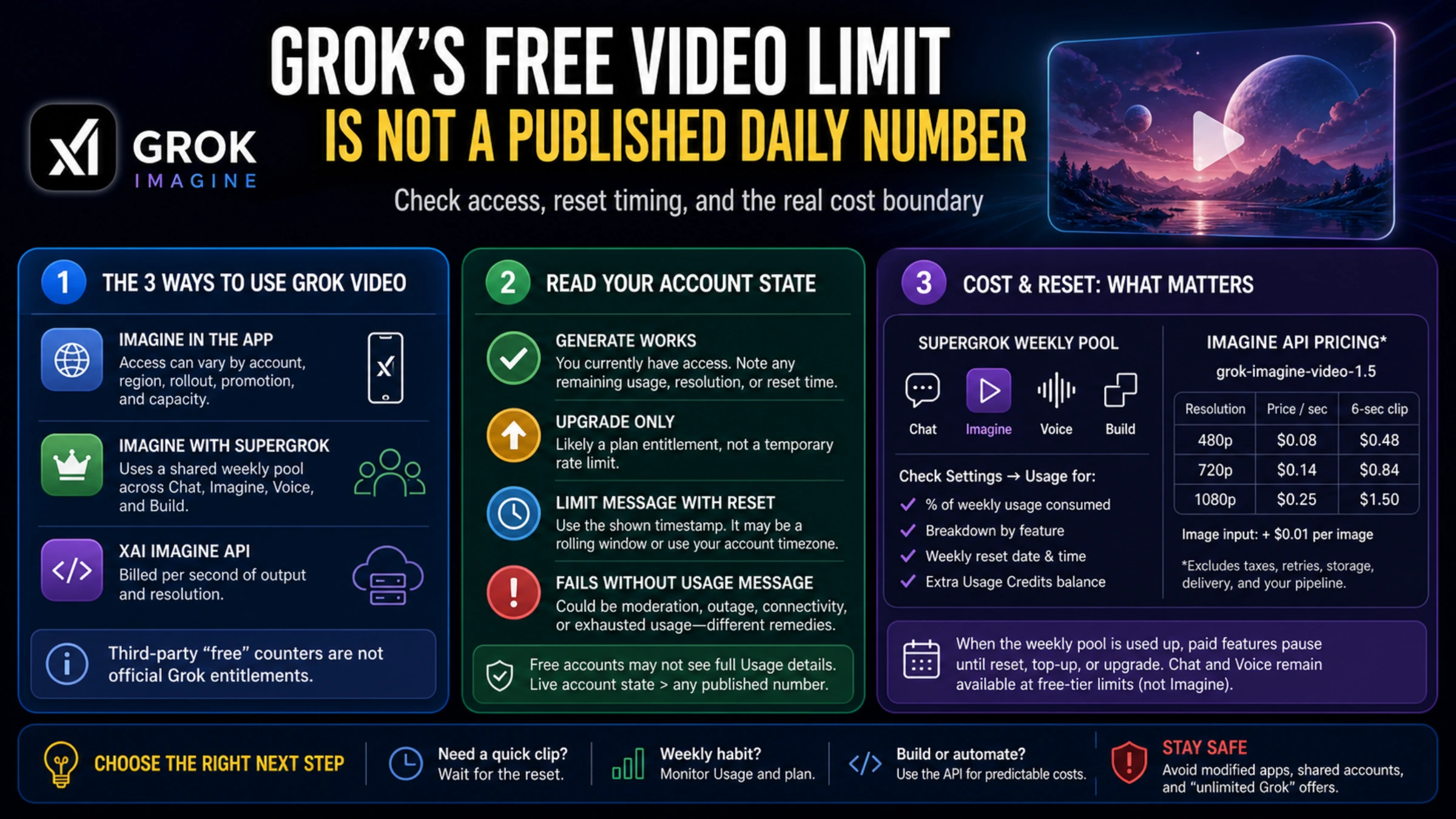
“Grok video” can mean three different contracts
A limit only makes sense after identifying the surface:
- Imagine on grok.com or in the mobile app. A Free account may see a trial, an upgrade gate, or no video option at all. Availability can depend on the account, region, rollout, promotion, and service capacity.
- Imagine inside a paid SuperGrok plan. Usage comes from a shared weekly pool rather than a separately published daily video bucket.
- The direct xAI Imagine API. Developers pay for generated output by the second. App trials and SuperGrok allowances do not carry over.
A website advertising “five free Grok videos” is often describing its own credits. It may use another model or act as a reseller. Its counter says nothing about the entitlement at grok.com.
Read the state your account actually shows
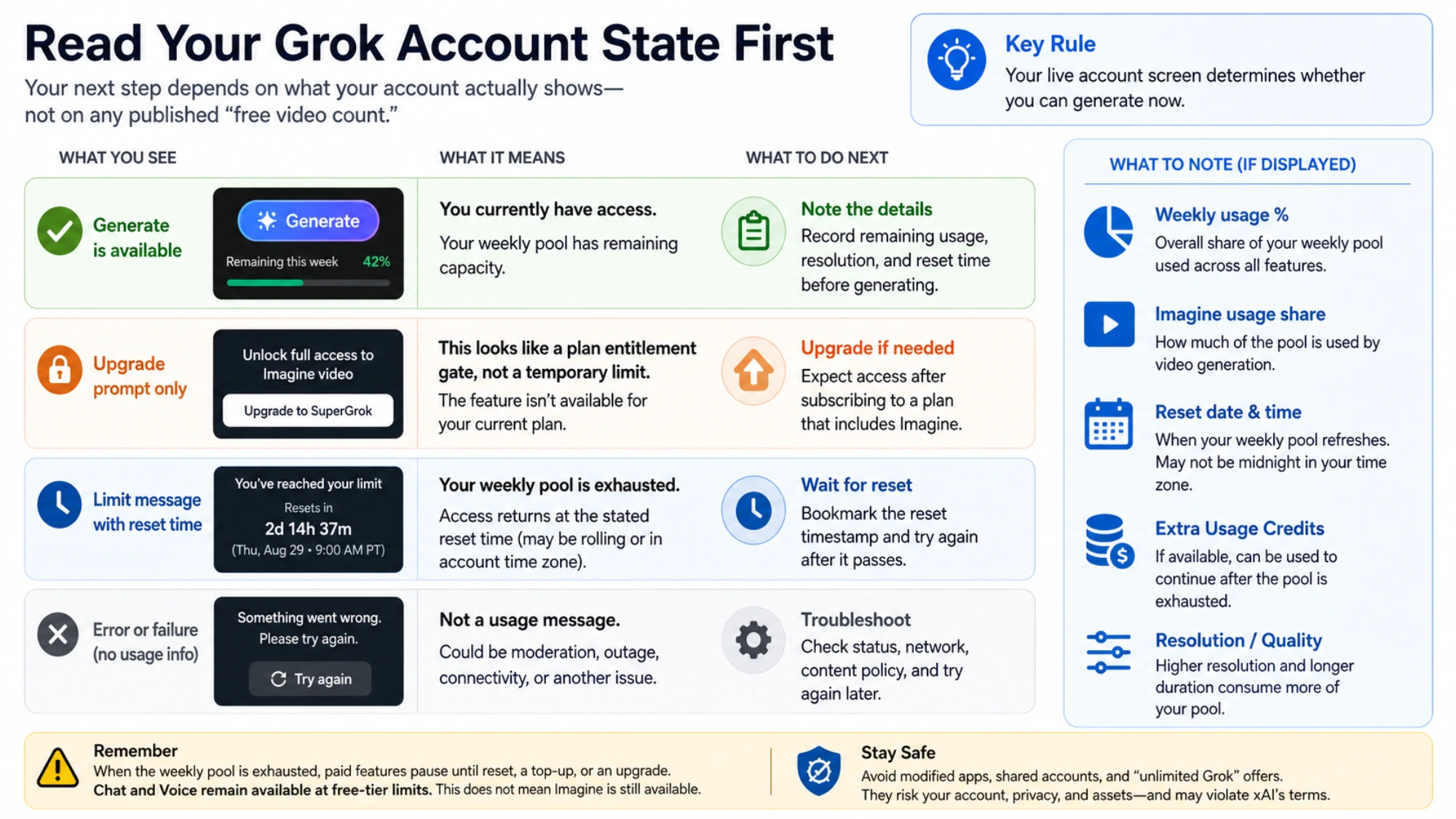
Open grok.com, sign in, and enter Imagine. The next action depends on the observable state.
The Generate control works. Your account currently has access. Before creating several clips, note any displayed remaining usage, resolution, reset time, or upgrade notice. That evidence applies to the current account and moment, not to everyone.
Imagine shows only an upgrade prompt. This looks more like a plan entitlement than a temporary rate limit. Do not assume the feature will reappear at midnight because an older guide promised daily free clips.
A limit message includes a reset time. Use that timestamp. It may be a rolling window or use an account timezone, so “tomorrow” does not necessarily mean midnight where you live.
Generation fails without a usage message. Check whether the error concerns moderation, an outage, connectivity, or exhausted usage. These failures have different remedies, and none by itself proves that all free video access has ended.
Free accounts may not receive the complete Usage view available to paid plans. If the interface gives only an upgrade gate and xAI publishes no count, there is no trustworthy calculation that can recover a hidden remaining quota.
SuperGrok uses a weekly pool, not a fixed clip count
xAI's Grok website and apps FAQ says paid SuperGrok plans now draw from one weekly allowance shared across Chat, Imagine, Voice, and Build. A high-quality video consumes substantially more compute than a chat message. Longer or higher-quality work can also consume more than a lightweight clip. A percentage therefore cannot be converted into one stable number of videos.
In the web or mobile app, open Settings → Usage. xAI says this view includes:
- the percentage of weekly usage consumed;
- a breakdown by API, Build, Chat, Imagine, and Voice;
- the weekly reset date and time;
- any Extra Usage Credits balance.
That view is the best operational answer for a paid account. Two people with 20% remaining can finish different numbers of clips if their duration, resolution, and other weekly activity differ.
When the weekly pool is exhausted, paid features pause until reset, a top-up, or an upgrade. The FAQ explicitly says Chat and Voice remain available at free-tier limits. It does not make the same promise for Imagine. Continuing to chat is therefore not evidence that free video generations remain.
The Imagine API is metered separately
The API is appropriate when you need automation, a calculable unit cost, or production integration. It is not a way to inherit an app allowance.
On August 27, 2026, xAI's API pricing page lists these output rates for grok-imagine-video-1.5:
| Output resolution | Output price | Output cost for a 6-second clip |
|---|---|---|
| 480p | $0.08/second | $0.48 |
| 720p | $0.14/second | $0.84 |
| 1080p | $0.25/second | $1.50 |
An image input adds $0.01 per image under the published table. These examples exclude taxes, retries, failed requests, storage, delivery, and your editing pipeline. Check the console and current documentation before committing a budget because models and rates can change.
The Video 1.5 release confirms that the model family is available on grok.com, iOS, Android, and the direct API. Shared branding does not mean shared billing or usage.
Choose the least expensive legitimate next step
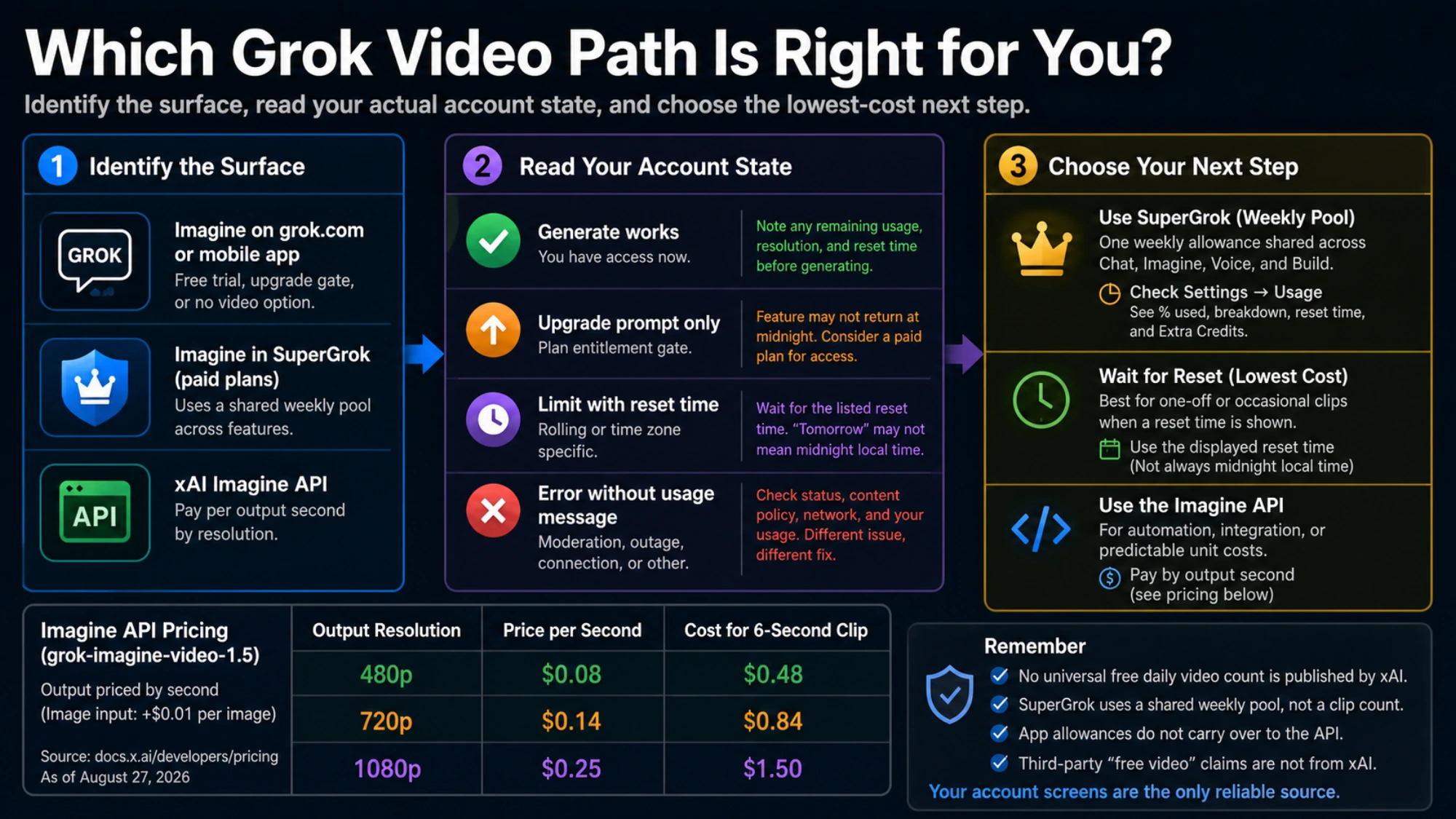
If you need only one or two clips and the app gives a clear reset time, waiting is usually cheaper than subscribing. If Imagine is a weekly habit, watch the Imagine share in Usage before deciding whether a larger plan beats repeated Extra Usage Credits. Choose the API when programmatic access, traceable unit costs, or workflow integration matters enough to justify metered billing.
Avoid modified apps, shared credentials, account cycling, and “unlimited Grok” offers from unknown sites. Besides violating service rules, they create account, payment, privacy, and asset-ownership risks.
The reliable method is simple: identify the surface, read the live account state, and evaluate the next step in that surface's actual unit. Until xAI publishes a universal free-video number, an exact daily count should be treated as a temporary observation that needs reconfirmation—not as the rule.