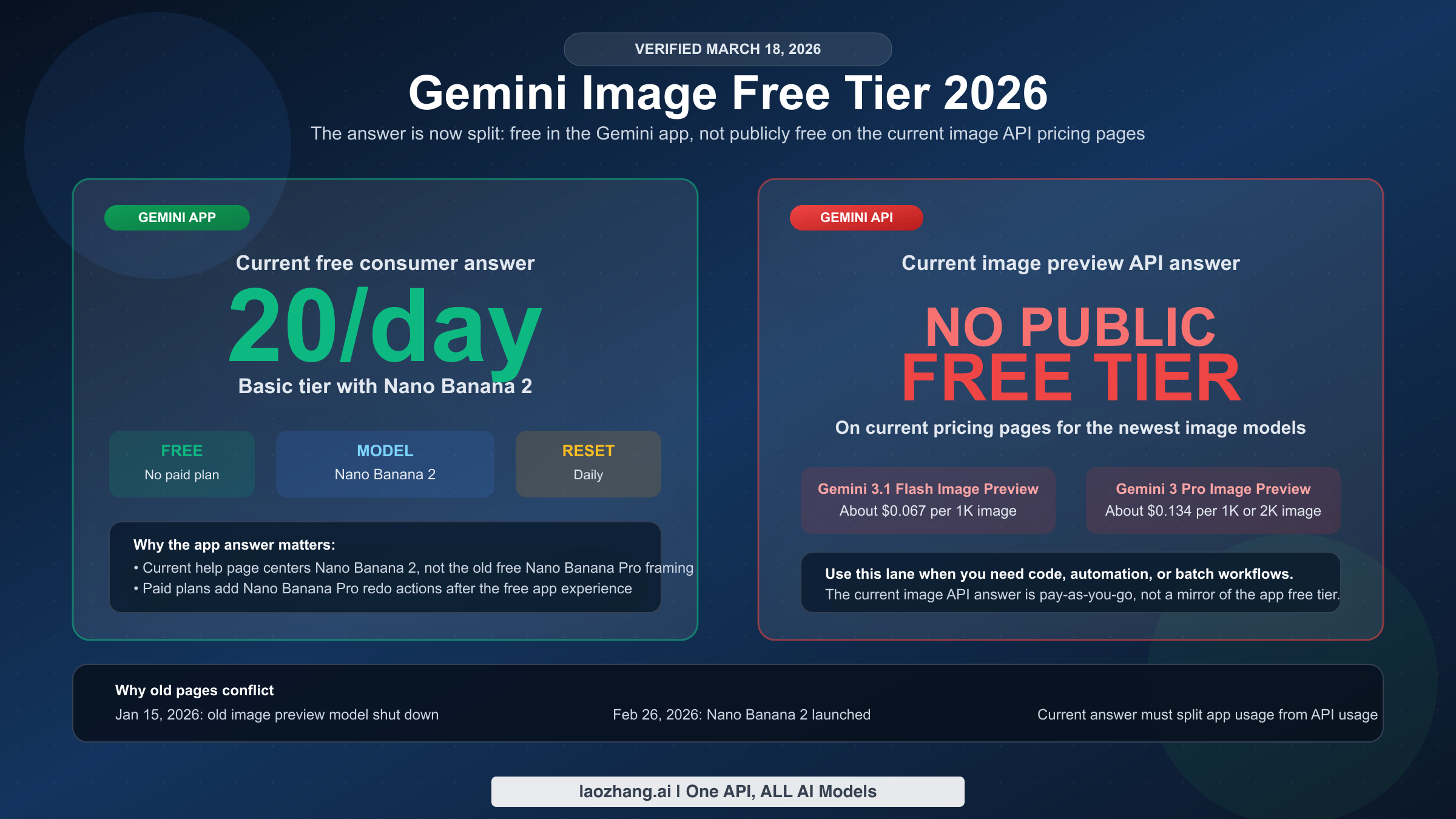
As of March 18, 2026, Gemini still has a real free image tier in the Gemini app, but the simple answer most people remember from 2025 is no longer current. Google's current help page lists up to 20 images per day on the Basic tier with Nano Banana 2, while the current Gemini image preview API pricing pages list Free Tier: Not available for the newest image models. If you searched for "Gemini image free tier" expecting one universal number, the first thing to know is that the Gemini app and the Gemini API now need separate answers.
That split is exactly why search results look contradictory. Some pages still quote old Nano Banana Pro daily caps. Some older API guides still center gemini-2.5-flash-image-preview, even though Google announced that model would shut down on January 15, 2026. And some snippets mix the Gemini app with other Google surfaces. The useful answer in 2026 is not one magic number. It is: free in the app, paid-by-default on the current image preview API models, with dynamic limits and recent model changes that made older articles stale.
TL;DR
If you only need the current answer, use this table.
| Surface | Is there a free tier? | Current official daily limit | What changes after you hit it? |
|---|---|---|---|
| Gemini app Basic | Yes | Up to 20 images/day with Nano Banana 2 | Limits are dynamic and reset daily; the app tells you when they refresh |
| Google AI Plus | Paid | Up to 50 images/day with Nano Banana 2 | Also includes up to 50 "Redo images with Nano Banana Pro" actions/day |
| Google AI Pro | Paid | Up to 100 images/day with Nano Banana 2 | Also includes up to 100 Nano Banana Pro redo actions/day |
| Google AI Ultra | Paid | Up to 1,000 images/day with Nano Banana 2 | Also includes up to 1,000 Nano Banana Pro redo actions/day |
| Gemini 3.1 Flash Image Preview API | Not on current pricing page | No published free tier on the current pricing table | Paid image output starts around $0.067 for 1K images |
| Gemini 3 Pro Image Preview API | Not on current pricing page | No published free tier on the current pricing table | Paid image output starts around $0.134 for 1K/2K images |
Short version: if you mean the consumer Gemini app, yes, Gemini image generation is still free. If you mean the current Gemini image API models, the official answer is much stricter: Google's current pricing tables for the newest image preview models do not advertise a free tier.
The most important caveat is that Google's app limits are explicitly dynamic. The current Gemini Apps Help page says limits may change frequently, are distributed throughout the day, and reset daily. So the practical question is not only "what is the headline cap?" but also "which Gemini surface am I using, and is Google treating this as app usage or API usage?"
The Current Gemini App Free Tier: What You Actually Get Today
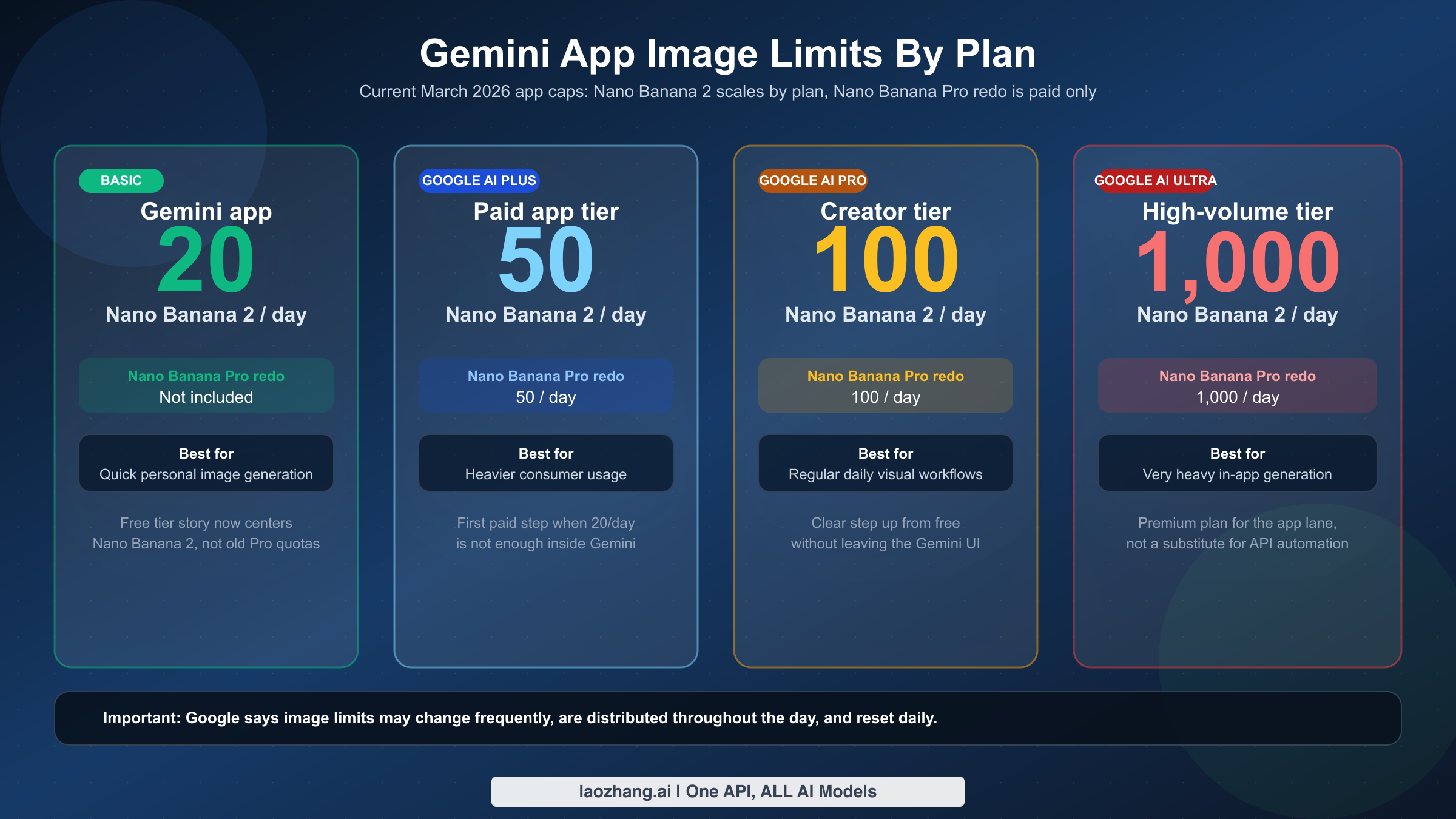
If you are using gemini.google.com or the Gemini mobile app, the current free answer comes from Google's live help-center table, not from 2025 blog posts. On that page, Google now frames the image feature around Nano Banana 2, not the older "Nano Banana Pro is free" story that dominated late 2025. The table currently shows up to 20 images per day on the Basic tier, 50 on Google AI Plus, 100 on Google AI Pro, and 1,000 on Google AI Ultra.
That is already a major change in framing. The same help page also breaks out a separate line for "Redo images with Nano Banana Pro." In other words, Google's current app messaging treats Nano Banana 2 as the default image-generation path and Nano Banana Pro as a paid enhancement path, not as the main free experience. This is the single biggest reason older limit guides are now confusing people. If you do not see every paid plan mentioned here, remember that Google AI plan availability still varies by country, even though the U.S. is in the currently supported list on the help page.
Here is the current app plan view in a simpler format:
| Plan | Nano Banana 2 image generation | Nano Banana Pro redo | Best fit |
|---|---|---|---|
| Basic | Up to 20/day | Not included | Casual testing, social posts, quick mockups |
| Google AI Plus | Up to 50/day | Up to 50/day | Frequent consumer use without going fully premium |
| Google AI Pro | Up to 100/day | Up to 100/day | Heavier creators who need more consistent daily room |
| Google AI Ultra | Up to 1,000/day | Up to 1,000/day | Power users who stay inside the app and need very high volume |
Two details matter more than the raw numbers.
First, Google warns that image generation is in high demand. That means the visible cap is not a legal guarantee that every user will experience the same smooth throughput at every hour. The help page specifically says limits may change frequently. If you are working during a high-demand window, the app may feel tighter than the simple table suggests.
Second, the app treats limits as daily rather than as a fixed public timezone promise on the help table. The page says Gemini will notify you when you are close to the cap and will tell you when the limit refreshes after you hit it. That is safer language than the older blog habit of hard-asserting the same midnight time for every Gemini surface.
For most non-technical readers, this section is the answer they were actually searching for. If you only want free image generation inside Gemini itself, the free tier still exists. The issue is that the free tier is now a Nano Banana 2 story, not a broad "free Nano Banana Pro forever" story.
Why Search Results Disagree So Much in 2026
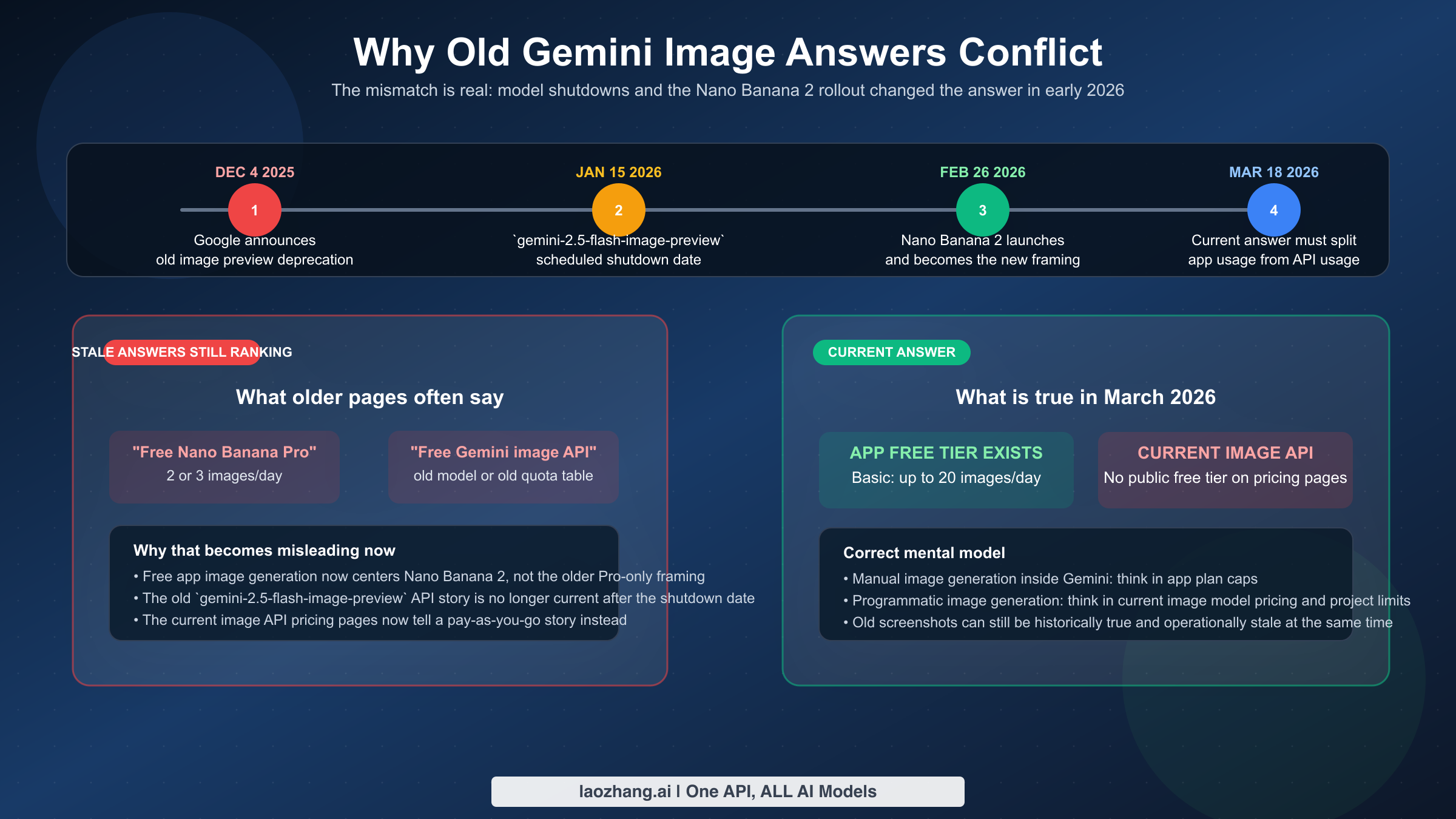
The SERP is messy because multiple product changes landed close together.
On February 26, 2026, Google published its official Nano Banana 2 launch post. That post introduced Nano Banana 2 (Gemini 3.1 Flash Image) as the new image model that combines much of Nano Banana Pro's quality and reasoning with Flash-like speed. In practical terms, it explains why Google's live help page now centers Nano Banana 2 for app image generation.
But older ranking pages were written before that shift. They usually fit into one of three buckets:
- Late-2025 Nano Banana Pro app guides that led with "2-3 images per day" for free users.
- Older Gemini image API guides that were built around models and quota tables Google has already changed or retired.
- General Gemini free-tier roundups that mixed text-model limits, app usage, and image generation into one umbrella answer.
That creates the impression that Google has contradictory documentation when the deeper problem is simpler: the product moved, the plan names changed, and many content pages did not keep up.
This is the old-vs-current correction that most ranking pages still fail to explain clearly:
| Older claim you may still see | Why it existed | Current March 2026 status |
|---|---|---|
| "Nano Banana Pro free users get 2 images/day" | This matched the late-2025 app framing after Google tightened free Pro access | The current Gemini app help page now centers Nano Banana 2 with up to 20/day on Basic and treats Nano Banana Pro as a paid redo path |
| "Gemini image API has a generous free tier" | Older guides often reused earlier AI Studio quota tables or older image-model documentation | The current pricing tables for Gemini 3.1 Flash Image Preview and Gemini 3 Pro Image Preview show Free Tier as unavailable |
"gemini-2.5-flash-image-preview is the free Gemini image API model" | That model was a real part of the 2025 story | Google announced on 2025-12-04 that it would shut down on 2026-01-15 |
This is why freshness matters more than usual for this keyword. The user is not just asking for a definition. They are asking for the current truth after a product transition.
If you are comparing this page against older Gemini image limit posts in this repo or elsewhere, use a simple rule: if the article does not mention the February 26, 2026 Nano Banana 2 rollout or the January 15, 2026 shutdown of gemini-2.5-flash-image-preview, it is probably missing part of today's answer.
Gemini API Reality in 2026: App Free Tier Does Not Equal API Free Tier
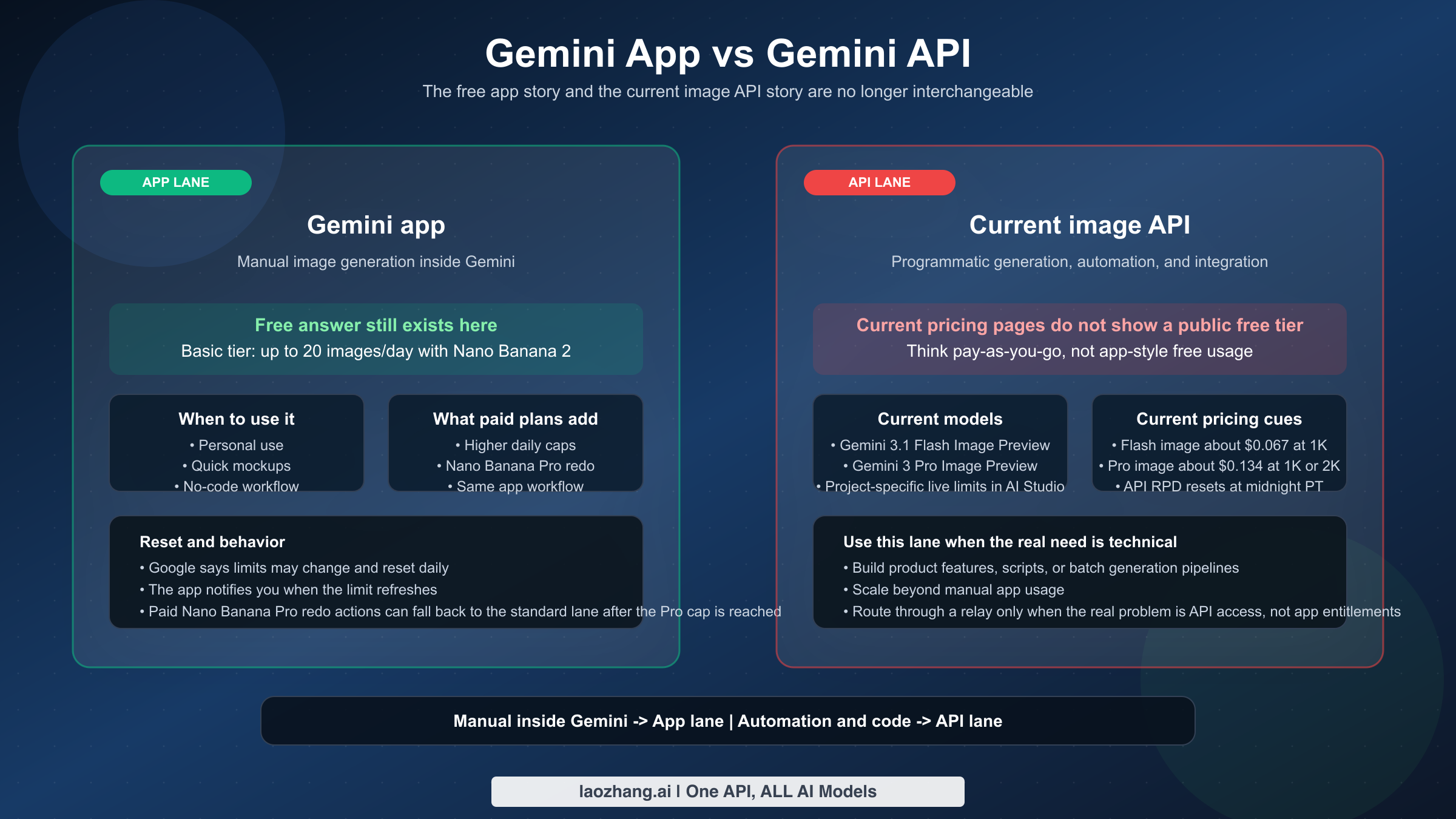
This is the part many readers need, but most pages bury it or gloss over it.
If you move from the Gemini app to programmatic generation through the Gemini API, the current official answer changes sharply. Google's live Gemini Developer API pricing page now lists Free Tier: Not available for both of the main current image preview models:
| Current API model | Free Tier on current pricing page | Paid image output pricing | Practical takeaway |
|---|---|---|---|
gemini-3.1-flash-image-preview | Not available | About $0.067 for 1K, $0.101 for 2K, $0.151 for 4K | Fast, current image API path, but not marketed as free |
gemini-3-pro-image-preview | Not available | About $0.134 for 1K/2K, $0.24 for 4K | Higher-end image API path, also not marketed as free |
This does not mean the Gemini API has no free tiers at all. Google's broader Gemini API still offers free access for several text and multimodal text-first models, which is why broad API roundups can sound generous. But for the current image preview models themselves, the official pricing tables are clear: Google is not presenting them as a public free-tier offer.
That is the key distinction searchers miss:
- Gemini app: still has free image generation.
- Current Gemini image preview API models: current official pricing tables do not advertise a free tier.
The current Gemini API rate-limits page adds another important nuance. Google says active rate limits can be viewed in AI Studio, and it no longer publishes a full standard table inline for every current model the way older docs did. So if your project UI shows some specific limit or temporary access on a given account, treat that as project-specific live state, not as a stable article-wide promise you can assume every reader gets.
For developers, that leads to a much better decision framework:
- If you just want a few images for personal use, stay in the Gemini app.
- If you need automation, integrations, or predictable programmatic access, assume the current image API path is pay-as-you-go unless your own AI Studio dashboard explicitly shows something else.
- If you only need broader Gemini API free access for text or non-image workflows, read a general Gemini API free tier guide rather than an image-specific quota post.
That separation sounds obvious, but it is the difference between a page that helps and one that sends a developer down a dead-end setup path.
What Happened to the Older Free Gemini Image API Answers?
The current API confusion is not just about pricing. It is also about model lifecycle.
Google's official Gemini API changelog says that on December 4, 2025, Google announced gemini-2.5-flash-image-preview would be shut down on January 15, 2026. That single line explains a lot of broken search expectations in 2026.
Why? Because many older guides were not lying at the time they were published. They were describing a real earlier stage of the product. The problem is that those pages often kept ranking after the model and quota picture changed.
So when you see an article that says something like:
- "use
gemini-2.5-flash-image-previewfor free image generation" - "Gemini image API gives you 500 free requests per day"
- "all you need is an API key and you're set"
ask two questions immediately:
- Which model does the article mean?
- Was the article updated after January 15, 2026?
If it fails either test, it is no longer a safe primary reference.
This matters operationally, not just academically. A developer who believes an outdated free-tier image API article may spend time wiring up code, only to hit a pricing wall, a quota mismatch, or a model-availability problem that the old article never warned about. If your actual goal is programmatic generation, jump straight to the current model docs and current pricing page. If your real goal is just to generate images without paying, stay in the app first.
For readers who are already troubleshooting failed API calls, the most relevant next steps are not generic limit hacks. They are:
- verify that you are calling a current model
- check whether your project is in a paid image-access state
- read the live AI Studio limits for your own project
- use a dedicated Gemini image rate limit solution guide if the problem is now a quota or billing issue rather than a consumer-app cap
What Happens When You Hit the Limit and When It Resets
This is where app users and API users need different mental models.
For the Gemini app, the current official wording is intentionally conservative. Google says limits may change frequently, are distributed throughout the day, and reset daily. It also says Gemini will tell you when the limit refreshes after you hit it. That means the safest current advice is:
- expect a daily refresh cycle
- do not assume every app surface uses the same public timezone rule
- trust the in-product refresh notice over an older blog's universal midnight claim
The same help page also says that once your Nano Banana Pro redo allowance is exhausted, additional image requests shift back to Nano Banana until that limit is also exhausted. In practical terms, paid users can see a quality or capability step-down even before they run out of all image generation for the day.
For the Gemini API, the rule is clearer. The rate-limits page says Requests per day reset at midnight Pacific time. So if you are building against the API and hit a daily quota ceiling, that is the official reset rule to plan around.
This difference is why so many limit posts feel "almost right" but still leave readers frustrated. They take the API's clean midnight-Pacific rule and paste it onto the app experience, or they take the app's consumer-facing free limit and paste it onto the API. In 2026, that shortcut is no longer reliable.
If you are trying to diagnose what kind of limit you hit, use this quick comparison:
| Symptom | More likely app issue | More likely API issue |
|---|---|---|
| You hit a visible daily image cap inside Gemini and see a refresh notice | Yes | No |
You are seeing 429 or quota/billing errors in code or AI Studio | No | Yes |
| You expected Nano Banana Pro quality but are suddenly back on the lower tier | Possible, especially after redo limits are exhausted | No, this is usually an app-surface story |
| You need a precise reset clock | App only gives daily-refresh guidance in the help page | API officially resets RPD at midnight Pacific |
If your problem is API-side rather than app-side, the next useful reads are Gemini image 429 error fixes and how to increase Gemini 3 Pro Image quota, not general free-tier articles.
Should You Stay Free, Upgrade, or Move to Pay-As-You-Go?
The right choice depends on which of the three jobs you are actually trying to do.
Stay on the free Gemini app tier if you are a casual user generating a handful of concept images, profile graphics, social assets, or quick idea boards. In that case, the current Basic allowance of up to 20 Nano Banana 2 images per day is already better than the old 2-image Nano Banana Pro framing many readers still have in mind. For light personal use, paying just to escape a vague old fear of "Gemini only gives me two images now" usually does not make sense.
Upgrade inside the app if your problem is still app-first. That means you want more daily room, more consistent access, or paid Nano Banana Pro redo actions without changing your workflow. If you spend most of your time in the Gemini UI and do not need an API, the app plans are the simplest fix because they solve the right problem directly.
Move to pay-as-you-go API access if your real need is automation, batching, or integration. This is the line many readers blur. If you need images from scripts, products, or workflows, a consumer Gemini subscription is only a partial answer. The real requirement is programmatic image access, which is why the current API pricing tables matter more than the app table at that point. For some teams, a relay such as laozhang.ai can be useful in this context because the problem is API routing and operational access, not consumer app entitlements.
This is the simplest decision tree:
- Need casual image generation inside Gemini itself: use the free app tier first.
- Need more images but still want the app experience: upgrade the app plan.
- Need code, automation, or product integration: treat the current image API as a paid workflow and plan accordingly.
If you want the shortest version of that decision, use this matrix:
| You are trying to do | Best path | Why |
|---|---|---|
| Make a few images manually inside Gemini | Gemini app Basic | It is still genuinely free and the current official cap is enough for light usage |
| Generate images every day in the Gemini UI | Google AI Plus or Pro | You stay in the same interface and unlock higher daily room plus Nano Banana Pro redo actions |
| Build a tool, batch workflow, or automation | Paid API workflow | The current image preview API models are not positioned as a public free tier |
| Keep a flexible multi-model API setup | API gateway or relay workflow | This solves routing and billing problems, not app entitlements |
That last point is where many expensive mistakes start. People often upgrade the wrong thing because they searched the right keyword but were actually solving a different problem.
FAQ
Are Gemini images still free in 2026?
Yes, in the Gemini app they are still free on the Basic tier. As checked on March 18, 2026, Google's current help page lists up to 20 Nano Banana 2 images per day on Basic. The confusing part is that the current image API models do not show the same free-tier story on the pricing page.
How many free Gemini images can I generate per day?
If you mean the Gemini app Basic tier, the current official help page says up to 20 images per day with Nano Banana 2. Paid tiers go higher. If you mean the current Gemini image preview API models, Google's current pricing tables do not advertise a free tier for them.
Is Nano Banana Pro still free?
Not in the way many 2025 articles describe it. Google's current help page presents Nano Banana Pro as a paid redo path, with daily caps for Google AI Plus, Pro, and Ultra. The default free image story is now centered on Nano Banana 2.
Does the Gemini API still have a free image tier?
For the current image preview models on the official pricing page, the answer is effectively no public free tier is advertised. The pricing tables for gemini-3.1-flash-image-preview and gemini-3-pro-image-preview both show Free Tier as unavailable. That is separate from the broader Gemini API free tier for several non-image models.
When do Gemini image limits reset?
For the Gemini app, Google currently says limits reset daily and the app will tell you when the limit refreshes. For the Gemini API, the official rate-limits page says Requests per day reset at midnight Pacific time.
Why do older articles show 2 images, 3 images, 100 images, or 500 API requests?
Because they were often written against different product states. The late-2025 app story centered on Nano Banana Pro free limits. The February 26, 2026 Nano Banana 2 rollout changed the app framing. And Google announced the shutdown of gemini-2.5-flash-image-preview for January 15, 2026, which made many older API guides partially obsolete.
What is the safest current takeaway?
If you want free image generation today, use the Gemini app and think in terms of Nano Banana 2 plan caps. If you want programmatic image generation, stop assuming the app free tier carries over to the API and check the current pricing page first.
Key Takeaways
Gemini image generation is still free in 2026, but only if you mean the Gemini app. The current official help page shows a real Basic-tier allowance with Nano Banana 2, while the current image preview API pricing tables do not show a public free tier for the newest image models. That is the central correction most readers need.
The second key takeaway is freshness. The answer changed because the product changed. Google rolled out Nano Banana 2 on February 26, 2026, and the older gemini-2.5-flash-image-preview API model was scheduled to shut down on January 15, 2026. Any article that ignores those dates is likely preserving part of an old truth rather than the current one.
If your goal is simple free image generation, stay in the app first. If your goal is automation, integrations, or stable API output, treat today's Gemini image API as a pay-as-you-go workflow, not as a copy of the consumer free tier.