As of September 24, 2026, Claude Opus 5.5 and GPT-5.6 Sol carry the same headline API rate: $4 per 1M input tokens and $20 per 1M output tokens. The match may not last. OpenAI labels Sol's rate promotional and "available at least through November 21, 2026" on its pricing page.
The bills still differ, and the direction depends on your workload:
- Prompts above 272K input tokens: Opus 5.5 is cheaper. GPT-5.6 Sol bills the whole request at $8/$30 once input passes 272K.
- Heavy cache reuse: Opus 5.5 is cheaper. Its cache reads cost $0.20 per 1M, versus $0.40 on GPT-5.6 Sol.
- Long reasoning or long answers: GPT-5.6 Sol tends to be cheaper per task. On Artificial Analysis's index, Opus 5.5 produced about twice as many output tokens per task.
- Quality on hard agentic work: Opus 5.5 leads on Artificial Analysis's independent Intelligence Index (51 vs 42) and on every shared row of Anthropic's launch table.
If you already run GPT-5.6 Sol and its results are good enough, test GPT-6 Sol before either switch. OpenAI released it on September 22, 2026, the same day as Opus 5.5, at half of GPT-5.6 Sol's promotional price on every token category. Whatever you pick, decide with a short trial on your own tasks, measured as cost per accepted result.
Which to try first
| Your situation | Try first | Why |
|---|---|---|
| On GPT-5.6 Sol, quality is fine, cost matters | GPT-6 Sol | $2/$10 vs $4/$20, same context window and effort levels |
| On GPT-5.6 Sol, too many results get rejected on long agentic or coding tasks | Opus 5.5 | Higher independent index score; judge it on accepted results, not token price |
| Many prompts above 272K input tokens | Opus 5.5 over GPT-5.6 Sol | No long-context premium on Opus 5.5; GPT-5.6 Sol doubles its input rate for the whole request |
| Large reused prefix (codebase, policy doc, long system prompt) | Opus 5.5 over GPT-5.6 Sol | Cache reads cost half as much |
| Short prompts with long outputs or long reasoning | GPT-5.6 Sol or GPT-6 Sol | Opus 5.5 used about twice the output tokens per task in Artificial Analysis's runs |
| Budget planning beyond November 21, 2026 | Price GPT-5.6 Sol at $4/$20 and at its $5/$30 launch list | The promotional rate has no fixed end date or published successor rate |
These are starting points, not verdicts. A model that costs 20% more per request can still be cheaper per finished task if fewer attempts get thrown away.
Current API prices side by side
All figures are USD per 1M tokens on each vendor's direct API, Standard tier, before tax, data-residency uplifts, tool fees and cloud or reseller markups. Sources: Anthropic's pricing page and Opus 5.5 model page, and OpenAI's pricing page, GPT-5.6 Sol page and GPT-6 Sol page.
| Rate per 1M tokens | Claude Opus 5.5 | GPT-5.6 Sol (promotional) | GPT-5.6 Sol, input over 272K | GPT-6 Sol | GPT-6 Sol, input over 272K |
|---|---|---|---|---|---|
| Input | $4.00 | $4.00 | $8.00 | $2.00 | $4.00 |
| Cache read (cached input) | $0.20 | $0.40 | $0.80 | $0.20 | $0.40 |
| Cache write | $5.00 (5-min), $8.00 (1-hour) | $5.00 | $10.00 | $2.50 | $5.00 |
| Output | $20.00 | $20.00 | $30.00 | $10.00 | $15.00 |
| Model ID | claude-opus-5-5 | gpt-5.6-sol | same | gpt-6-sol | same |
| Context / max output | 1M / 128K | 1,050,000 / 128,000 | same | 1,050,000 / 128,000 | same |
Three details change real bills:
- The 272K rule re-rates the whole request. On both Sol models, a request with more than 272K input tokens pays the long rates on every token, not just the tokens past the line. Anthropic bills Opus 5.5's full 1M window at standard rates; its pricing page says a 900K-token request uses the same per-token rate as a 9K-token one.
- GPT-5.6 Sol's rate is below its launch list. When OpenAI introduced GPT-5.6 on July 9, 2026, Sol listed at $5 input and $30 output. OpenAI has not published what Sol costs after the promotion. Any $5/$30 figure below is labeled "launch list price." It is a reference point, not a forecast.
- Batch halves both headline rates. Opus 5.5 Batch is $2/$10, and GPT-5.6 Sol Batch and Flex are half its Standard rates. Compare batch with batch, not batch with Standard.
For model IDs, platform availability and the full price breakdown on the Claude side, see Claude Opus 5.5: API Price, Model ID, and Migration Checks. For the GPT-5.6 family, see OpenAI Text Models in 2026: GPT-5.6 Sol, Terra, and Luna Compared.
Same tokens, different totals
The formula is the same for every row: tokens in each category ÷ 1,000,000 × that category's rate, summed. The examples assume both models see and produce the same number of tokens, with no tools and no batch discount.
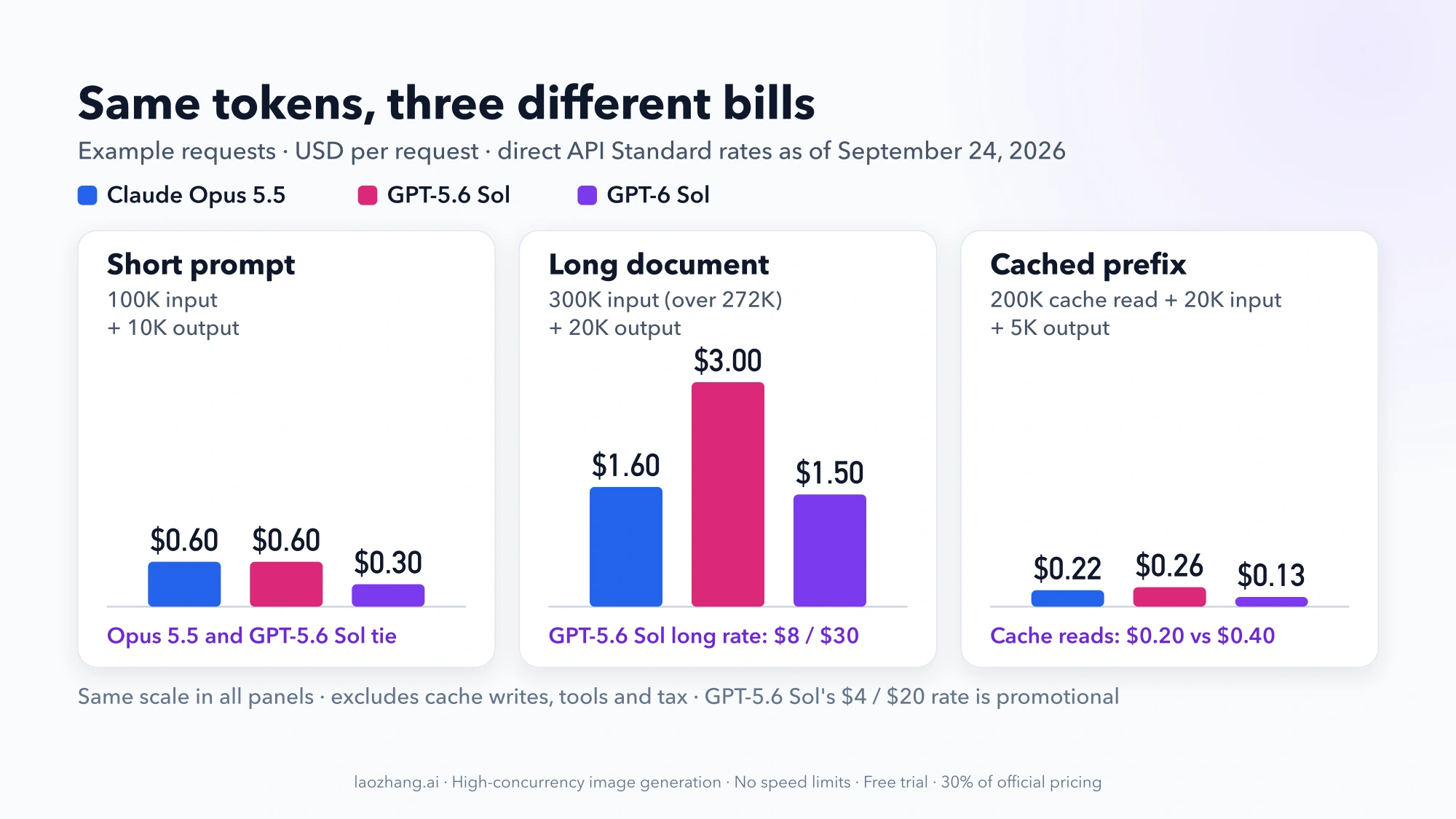
Short prompt: 100,000 input + 10,000 output
- Opus 5.5: 0.1 × $4 + 0.01 × $20 = $0.60
- GPT-5.6 Sol (promotional): 0.1 × $4 + 0.01 × $20 = $0.60
- GPT-5.6 Sol at the launch list price: 0.1 × $5 + 0.01 × $30 = $0.80
- GPT-6 Sol: 0.1 × $2 + 0.01 × $10 = $0.30
At today's rates, the two models in the title tie on a short request.
Long document: 300,000 input + 20,000 output
- Opus 5.5: 0.3 × $4 + 0.02 × $20 = $1.60
- GPT-5.6 Sol (long rate): 0.3 × $8 + 0.02 × $30 = $3.00
- GPT-6 Sol (long rate): 0.3 × $4 + 0.02 × $15 = $1.50
The jump is a cliff, not a slope. Check both sides of the line. At 270,000 input and 20,000 output, Opus 5.5 and GPT-5.6 Sol both cost 0.27 × $4 + 0.02 × $20 = $1.48. At 280,000 input, Opus 5.5 costs $1.52 and GPT-5.6 Sol costs 0.28 × $8 + 0.02 × $30 = $2.84. If your prompts sit near 272K, trimming retrieved context can matter more than the choice of model. The line is "more than 272K," so a request at exactly 272K still gets the short rate.
Cached prefix: 200,000 cache read + 20,000 fresh input + 5,000 output
- Opus 5.5: 0.2 × $0.20 + 0.02 × $4 + 0.005 × $20 = $0.22
- GPT-5.6 Sol: 0.2 × $0.40 + 0.02 × $4 + 0.005 × $20 = $0.26
- GPT-6 Sol: 0.2 × $0.20 + 0.02 × $2 + 0.005 × $10 = $0.13
This excludes the earlier request that wrote the cache. Opus 5.5's 5-minute cache write and GPT-5.6 Sol's cache write both cost $5 per 1M, so that first write costs the same on either model. The saving comes on every later hit. Hit rates depend on how stable your prompt prefix is. On Opus 5.5, the minimum cacheable prompt is 512 tokens.
Output volume can reverse the tie
Equal token prices only matter if both models use equal tokens. In Artificial Analysis's comparison of Opus 5.5 at medium effort against GPT-5.6 Sol at high effort, Opus 5.5 produced about 26,000 output tokens per task versus about 13,000 for Sol. At $20 per 1M, that is roughly $0.52 versus $0.26 of output per task.
Running Artificial Analysis's full index cost $1,627 for Opus 5.5 and $1,487 for GPT-5.6 Sol, about 9% more for Opus at identical headline rates. At maximum effort on both, the gap widened to $8,708 versus $3,465, about 2.5×. Opus 5.5 always thinks and defaults to medium effort, so the effort level you set is a direct cost lever. Claude Opus 5.5 Effort: Choose a Level, Set It, and Measure the Cost covers how to set and measure it.
Tokenizers add another unknown. Anthropic says Claude 4.7 and later models produce about 30% more tokens for the same text than its previous tokenizer. No public source gives a Claude-to-OpenAI token ratio for identical text. Count tokens from each API's own usage report rather than from one shared estimate.
What the benchmark tables can and cannot settle
Anthropic's Opus 5.5 launch page compares the two models directly:
| Benchmark in Anthropic's table | Opus 5.5 | GPT-5.6 Sol |
|---|---|---|
| Terminal-Bench 4.0 (Opus at xhigh effort) | 66.4% | 37.3% |
| FrontierCode v1.1 (Main) | 54.4% | 47.5% |
| CursorBench 4.0 | 57.8% | 41.7% |
| GDPval-AA v2.1 | 1846 | 1588 |
| AutomationBench (run and reported by Zapier) | 40.0% | 28.8% |
OpenAI's GPT-5.6 launch table reports Sol on different rows and versions. These include Terminal-Bench 2.1 at 88.8%, SWE-Bench Pro at 64.6%, OSWorld 2.0 at 62.6% and BrowseComp at 90.4%. Terminal-Bench and GDPval-AA appear in both tables, but in different versions. AutomationBench appears in both under the same name, and it gives Sol 28.8% in Anthropic's table and 18.1% in OpenAI's. That spread does not show which run is correct. It shows that scores from two vendors' tables, with different harnesses, versions and effort settings, cannot be lined up row by row.
An independent index runs both models through one harness. Artificial Analysis scores Opus 5.5 (medium) at 51 and GPT-5.6 Sol (high) at 42 on its Intelligence Index. At maximum effort on both, the scores are 58 and 47. The same comparison lists Opus 5.5 at 78 output tokens per second versus 69, but a slower time to first answer token: 21.62 seconds versus 14.72. That is one evaluator's suite, and the numbers can be revised. It supports the view that Opus 5.5 is stronger on broad, hard evaluations. It does not tell you how often each model's output passes your own review.
If you are on GPT-5.6 Sol today
The same-day GPT-6 release changes the first move. GPT-6 Sol costs half of GPT-5.6 Sol's promotional rate on input, cache read, cache write and output. It keeps the same 1,050,000-token context, 128,000-token output limit and effort levels from none to max. In the three examples above, it is the cheapest option every time. Against Opus 5.5 on the long-document example, it is close: $1.50 versus $1.60.
Two facts limit how far that goes:
- Quality against GPT-5.6 Sol is not established. OpenAI's changelog says GPT-6 Sol reaches Codex and ChatGPT Work "at lower token prices than their GPT-5.6 predecessors," which is a statement about price. The GPT-6 Sol model page lists rates and limits but no comparison with GPT-5.6 Sol. Whether GPT-6 Sol matches GPT-5.6 Sol on your workload is something only your own tasks can show.
- GPT-5.6 Sol has no announced retirement date. Its model page shows no deprecation notice as of September 24, 2026. You do not have to move before the promotion ends, but you should re-price after November 21, 2026.
One hands-on data point shows why cost per request is not enough. In DataCamp's single-task test, a one-file Tetris game with a gravity flip, GPT-6 Sol took 6 turns and 9 tool calls, cost $0.26 and scored 5.0 on DataCamp's rubric. Opus 5.5 took 3 turns and 2 tool calls, cost $0.87 and scored 4.3. It is one task and one run, and it compares GPT-6 Sol, not GPT-5.6 Sol. It shows that fewer turns do not guarantee a cheaper or better result.
GPT-6 Sol's billing details, including Codex credits, are covered in GPT-6 Luna vs. Sol pricing: calculate the cost of your workload.
Run a cost-per-accepted-result trial
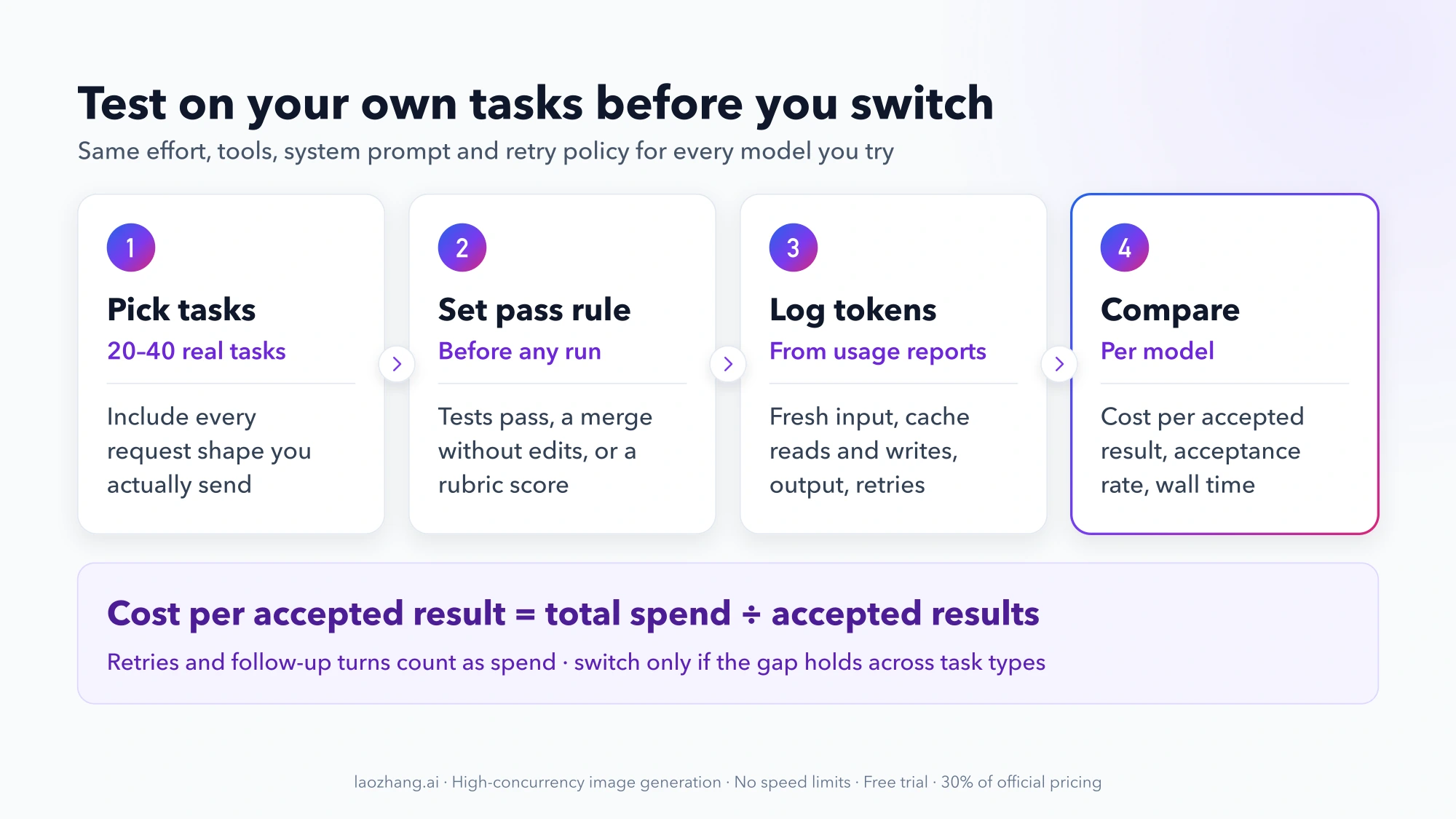
A short trial on real work answers what no table can. Keep it small and decide the pass rule before you look at outputs.
- Pick 20–40 real tasks from recent tickets, documents or agent runs. Include each shape you actually send: short prompts, long documents, cached-prefix requests and long-output jobs. If some of your prompts exceed 272K input tokens, include them.
- Write the acceptance rule first. Examples: tests pass, a reviewer merges without edits, or a rubric score meets your bar. Use one rule for every model.
- Fix the settings. Use the effort you would run in production. Both Opus 5.5 and GPT-5.6 Sol default to
medium. Keep tools, system prompt and retry policy the same. Add GPT-6 Sol as a third arm if you are on GPT-5.6 Sol now. - Log billed tokens per request from each API's usage report: fresh input, cache reads, cache writes and output. Include retries and follow-up turns, because they are part of the cost of getting a result.
- Compute cost per accepted result as total spend on all attempts ÷ number of accepted results. Also note the acceptance rate and wall-clock time.
- Switch only if the gap holds across task types. If one model wins only on long documents, route those alone and keep the rest where they are.
This helper prices one request from logged token counts. It uses the rates in the table above and applies OpenAI's 272K rule to the whole request.
# USD per 1M tokens, direct API Standard tier, as of September 24, 2026.
# Tuple order: (fresh input, cache read, cache write, output)
PRICES = {
    "claude-opus-5-5": {"short": (4.00, 0.20, 5.00, 20.00)},  # 5-minute cache write; 1-hour is $8
    "gpt-5.6-sol": {"short": (4.00, 0.40, 5.00, 20.00),       # promotional rate
                    "long":  (8.00, 0.80, 10.00, 30.00)},
    "gpt-6-sol":   {"short": (2.00, 0.20, 2.50, 10.00),
                    "long":  (4.00, 0.40, 5.00, 15.00)},
}
OPENAI_LONG_THRESHOLD = 272_000  # "more than 272K input tokens" re-rates the whole request

def request_cost(model, fresh, cache_read=0, cache_write=0, output=0):
    tiers = PRICES[model]
    total_input = fresh + cache_read + cache_write
    # Assumption: cached tokens count toward the 272K line. Confirm on your first invoice.
    tier = "long" if "long" in tiers and total_input > OPENAI_LONG_THRESHOLD else "short"
    p_in, p_read, p_write, p_out = tiers[tier]
    return (fresh * p_in + cache_read * p_read
            + cache_write * p_write + output * p_out) / 1_000_000

for model in PRICES:
    print(model,
          f"${request_cost(model, 100_000, output=10_000):.2f}",
          f"${request_cost(model, 300_000, output=20_000):.2f}",
          f"${request_cost(model, 20_000, cache_read=200_000, output=5_000):.2f}")
# claude-opus-5-5 $0.60 $1.60 $0.22
# gpt-5.6-sol $0.60 $3.00 $0.26
# gpt-6-sol $0.30 $1.50 $0.13
Sum request_cost over every attempt for a task, then divide the total by accepted tasks. To see the launch-list case for GPT-5.6 Sol, add a copy of its entry with (5.00, 0.50, 6.25, 30.00) short rates. That applies the launch price with OpenAI's stated cache ratios (90% off for reads, 1.25× input for writes). Treat it as a what-if, not a published price.
Before you point production at Opus 5.5
Swapping the model ID is not enough if your code was built on Opus 5. On Opus 5.5, thinking cannot be disabled, forced tool choice returns an error, and text between tool calls arrives inside thinking blocks. Check these before the trial, or failed requests will distort your cost numbers. The full list is in Claude Opus 5.5: API Price, Model ID, and Migration Checks. If the question is which Claude model to run rather than which vendor, see Claude Opus 5.5 vs Fable 5.1: Which Should You Run?.
The comparison above also leaves out things that can decide a rollout: per-account rate limits, regional availability, cloud-partner pricing, and ChatGPT or Claude app allowances. Check those for your own account.
Quick answers
Is GPT-5.6 Sol better than Claude Opus 5.5?
Not on the broad measures available. Opus 5.5 scores 51 to Sol's 42 on Artificial Analysis's Intelligence Index (medium vs high effort) and leads every shared row in Anthropic's launch table. GPT-5.6 Sol answers faster to first token and uses about half the output tokens per task. For your work, the deciding number is cost per accepted result.
Will GPT-5.6 Sol stay at $4/$20?
OpenAI says the promotional rate runs "at least through November 21, 2026." It has not published the rate that follows. Sol launched at $5/$30 on July 9, 2026. Re-run your cost math when OpenAI changes the pricing page.
Is Opus 5.5 cheaper than GPT-6 Sol for long documents?
Almost even, but no. With 300,000 input and 20,000 output tokens, Opus 5.5 costs $1.60 and GPT-6 Sol costs $1.50 at its long-context rate. Below 272K input, GPT-6 Sol costs half as much as Opus 5.5 for the same tokens.
Is Opus 5.5 worth paying more for?
At today's rates you do not pay more per token than on GPT-5.6 Sol. You may pay more per task, because Opus 5.5 tends to write more. That is worth it when its higher acceptance rate saves retries or review time on your tasks, which only a trial can show.