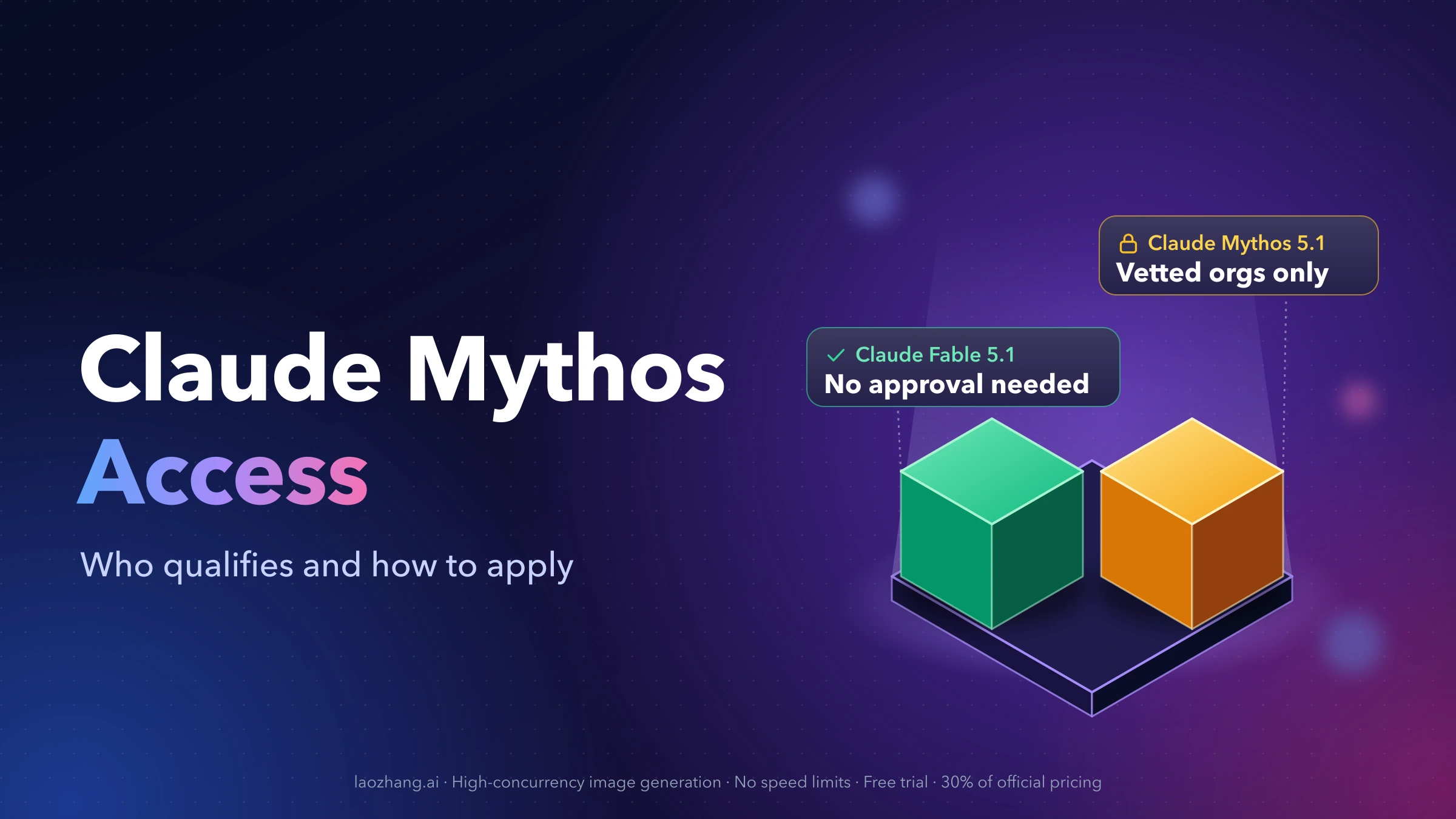
As of September 24, 2026, there's no signup page, waitlist, or free tier for Claude Mythos. The current model, Claude Mythos 5.1, replaced Mythos Preview and Mythos 5. Anthropic offers it only to vetted organizations through its trusted access programs, and for now, Anthropic's Mythos page says that means a set of US organizations.
That makes access a question about your organization, not your account. Security teams can apply to the Cyber Verification Program, life-science teams can apply to the Life Sciences Verification Program, and existing Glasswing or cloud customers go through their account team. If none of those fits, the option without an approval step is Claude Fable 5.1: the same underlying model with safeguards for cybersecurity and biology, offered on the Claude API, major cloud platforms, and paid Claude plans.
| If you are... | Official path to Mythos 5.1 | Next step | Keep in mind |
|---|---|---|---|
| An individual on Claude Free, Pro, or Max, including students | None today | Use Fable 5.1 on a paid plan or the API | Anthropic plans to open the life-science program to Pro and Max "over time," with no date |
| An organization doing defensive security work | Cyber Verification Program | Apply through the CVP portal or the Claude Mythos access form | Mythos-class models join the program "in the near future," with no date |
| A life-science team or institution on Claude Enterprise, Team, or the Claude API | Life Sciences Verification Program (beta) | Have your org admin submit the LSVP application | Completing the form doesn't guarantee access |
| A Glasswing partner, or an enterprise that works with an Anthropic, AWS, or Google Cloud account team | Project Glasswing | Contact that account team | Access is for approved Glasswing customers; there's no public application |
| A Claude Enterprise customer that wants vulnerability scanning | Claude Security (public beta) | Ask an admin to enable Claude Security | You get Mythos-powered scans, not API or chat access to the model |
Registering interest or applying starts a review. It doesn't grant access by itself.
Individuals: no signup, waitlist, or free access
If you're applying as yourself, there's nothing to apply to yet. Anthropic's pages describe no self-serve signup, waitlist, trial, or free tier for Mythos 5.1. The Claude Mythos access form promises a follow-up only "if your organization may be eligible," and the LSVP application states that "Free, Pro, and Max plans are not eligible at this time."
The same goes for students, independent researchers, and bug-bounty hunters. The only official path runs through an employer, lab, or institution that fits one of the programs, and that organization applies.
Two changes could open a door, but neither has a date. Anthropic says it will "expand access to individual Pro and Max plans over time" in the life-science program (LSVP announcement). It also says the Cyber Verification Program will add Mythos-class models "in the near future."
Anthropic doesn't list any reseller or third-party API gateway as a way to reach Mythos. Every official path runs through an approved organization, so a service that sells Mythos access to an individual account sits outside all of them.
For personal projects, Fable 5.1 is the version of this model that needs no approval, through the API or a paid Claude plan. Its limits are covered further down.
Security teams: apply to the Cyber Verification Program
The Cyber Verification Program (CVP) is where Anthropic sends cyberdefenders. Today it gives approved organizations certain Opus- and Sonnet-class models with reduced cyber safeguards for defensive security work. Mythos isn't in it yet. Anthropic's September 1 announcement says the program will "also include access to Claude Mythos-class models" in the near future, and it gives no date. In June, Anthropic described a larger CVP as the way to bring Mythos-class capabilities to "many more organizations for specific cyberdefense tasks" (Expanding Project Glasswing).
To get in line:
- Apply through the CVP portal. Anthropic's September 1 announcement links it both for joining the CVP, with its current Opus- and Sonnet-class access, and for registering interest in Mythos 5.1. The Mythos page links a second official entry, the Claude Mythos access form.
- Apply on behalf of your organization. The Mythos access form says Anthropic will follow up with more information if your organization may be eligible for Mythos.
- If your organization runs zero data retention, decide where you'd turn retention on. Mythos 5.1 requires 30-day retention by default, as the retention section below explains.
A submission doesn't approve you, and it doesn't add Mythos to your console. It also doesn't change today's limit: Mythos 5.1 is "only available to a set of US organizations" while Anthropic works with the US government to widen access to domestic and international partners.
If you need vulnerability discovery before then, two options don't wait on the CVP. Fable 5.1 can now identify vulnerabilities in source code, and Claude Enterprise customers can run Mythos-powered scans through Claude Security.
Life-science teams: apply to the Life Sciences Verification Program
The Life Sciences Verification Program (LSVP) opened applications on September 17, 2026. It's a beta aimed first at teams and institutions, from academic labs to startups and pharma companies. It's also the only program with an open application whose grants already cover Mythos 5.1. Anthropic's Mythos page still calls it an invite-only beta, but the application form is public, and Anthropic decides who gets in. At launch, Anthropic said it expected to enroll hundreds of organizations in the first week and to scale to most of the life-science community in the weeks after.
Who can apply
- Organizations on Claude Enterprise, Claude Team, or the Claude Platform (API).
- Not Free, Pro, or Max accounts.
- Not on third-party platforms such as Amazon Bedrock yet. Grants apply in Anthropic's own console for API usage and in Claude Enterprise and Team.
- Not BAA-enabled organizations during the beta. Anthropic tells customers with protected health information (PHI) to use a separate, non-BAA organization.
Neither LSVP page mentions a country limit, but Mythos 5.1 itself is still limited to a set of US organizations. Outside the US, eligibility isn't stated either way. Confirm with Anthropic whether Mythos 5.1 would be part of your grant before you plan around it.
How the application works
- Your organization's admin completes the LSVP application. The form registers interest; it isn't an approval.
- Anthropic verifies the organization by reviewing its research credentials, security standards, and ethical research oversight.
- Verified teams apply for grants and describe their intended use at a high level, "like one would share in a job listing," without sensitive information or IP.
- If you're eligible, Anthropic follows up. The form says completing it "does not guarantee your organization access."
Standard Use or High-risk Use
| Standard Use | High-risk Use (add-on) | |
|---|---|---|
| Covers | A whole team's daily work | One specific research project |
| Renewal | Once a year | Every six months |
| Models | Mythos 5.1 plus Opus and Sonnet models | Opus and Sonnet models; Mythos High-risk grants go only to a small set of entities with extra vetting |
| Safeguards | Biology classifiers that are more permissive for science tasks | Removes all safeguards that block life-science requests |
Under either grant, the other safeguards stay on, including the cyber classifiers. LSVP traffic is retained for 30 days so Anthropic can monitor it offline. Anthropic says that data is compartmentalized and isn't used for model training.
Grants work in Claude Science, Claude.ai, Claude Code, and the API. The API and Claude Science let you switch between grants. Claude.ai and Claude Code apply a preselected default grant for now, unless you run Claude Code with API authentication.
Glasswing partners and cloud customers: go through your account team
Project Glasswing, where Mythos started, has no public application. Anthropic added partners in announced groups. The April launch partners included AWS, Apple, Broadcom, Cisco, CrowdStrike, Google, JPMorganChase, the Linux Foundation, Microsoft, NVIDIA, and Palo Alto Networks, alongside more than 40 organizations that build or maintain critical software (Project Glasswing). On June 2, Anthropic extended Glasswing to about 150 more organizations in over 15 countries, each of which had to meet its security requirements before gaining access. Anthropic said later rounds would prioritize essential infrastructure providers, maintainers of critical open-source software, and safety testers (Expanding Project Glasswing).
Claude's documentation spells out the next step: Mythos 5.1 "is offered only to approved customers in Project Glasswing. For access, contact your Anthropic, AWS, or Google Cloud account team" (What's new in Claude Fable 5.1). That wording doesn't mention the LSVP, which also grants Mythos 5.1 to verified life-science organizations, so treat Glasswing as one path rather than the only one. If your organization used Mythos Preview or Mythos 5, start with that account team. Being part of the June expansion doesn't guarantee Mythos 5.1 today, though. After the June suspension, Mythos came back only for a set of US organizations.
A cloud model page isn't an access grant
AWS's Bedrock model card for Claude Mythos 5 reads like any model page. It lists a model ID (anthropic.claude-mythos-5), a bedrock-mantle endpoint in us-east-1, AWS Marketplace billing, and sample code. It also says "Access is currently limited due to the dual-use nature of these domains," labels the model a Preview offered as a Beta Service, and requires opting in to provider data sharing (provider_data_share). Copying that model ID into your code doesn't put your account on the access list.
For Mythos 5.1, the docs list only the Claude API ID, claude-mythos-5-1, and send every access request to an Anthropic, AWS, or Google Cloud account team. Fable 5.1, by contrast, has published IDs on the Claude API, Amazon Bedrock, Google Cloud, and Microsoft Foundry.
Claude Enterprise: Mythos-powered scans without model access
On Claude Enterprise, you can put Mythos 5.1 to work on your code without being approved for the model. Claude Security, in public beta for Claude Enterprise, scans a connected GitHub repository with Mythos 5.1. It runs an adversarial check on its own findings and returns validated issues with confidence ratings and suggested patches. In Anthropic's words, "You get Mythos-quality vulnerability findings without needing direct access to the model."
To start, an admin enables Claude Security in the admin console, and then you connect a GitHub repository.
What it doesn't give you:
- Mythos in the API, in chat, or in Claude Code. Mythos-powered scans run only in the Claude Security app on Claude.ai.
- Mythos in the Claude Security plugin for Claude Code. The plugin uses the models available in your Claude Code account.
- Mythos for the follow-up work. When you open a finding in Claude Code on the web, you fix it with the models your account already has, and every patch needs human review and approval.
If you don't qualify: what Fable 5.1 can and can't do
Claude Fable 5.1 is the same underlying model as Mythos 5.1, released with safeguards for cybersecurity and biology. It needs no approval. You can call it on the Claude API as claude-fable-5-1, on Amazon Bedrock as anthropic.claude-fable-5-1, and on Google Cloud and Microsoft Foundry. It's also available on Pro, Max, Team, and Enterprise plans.
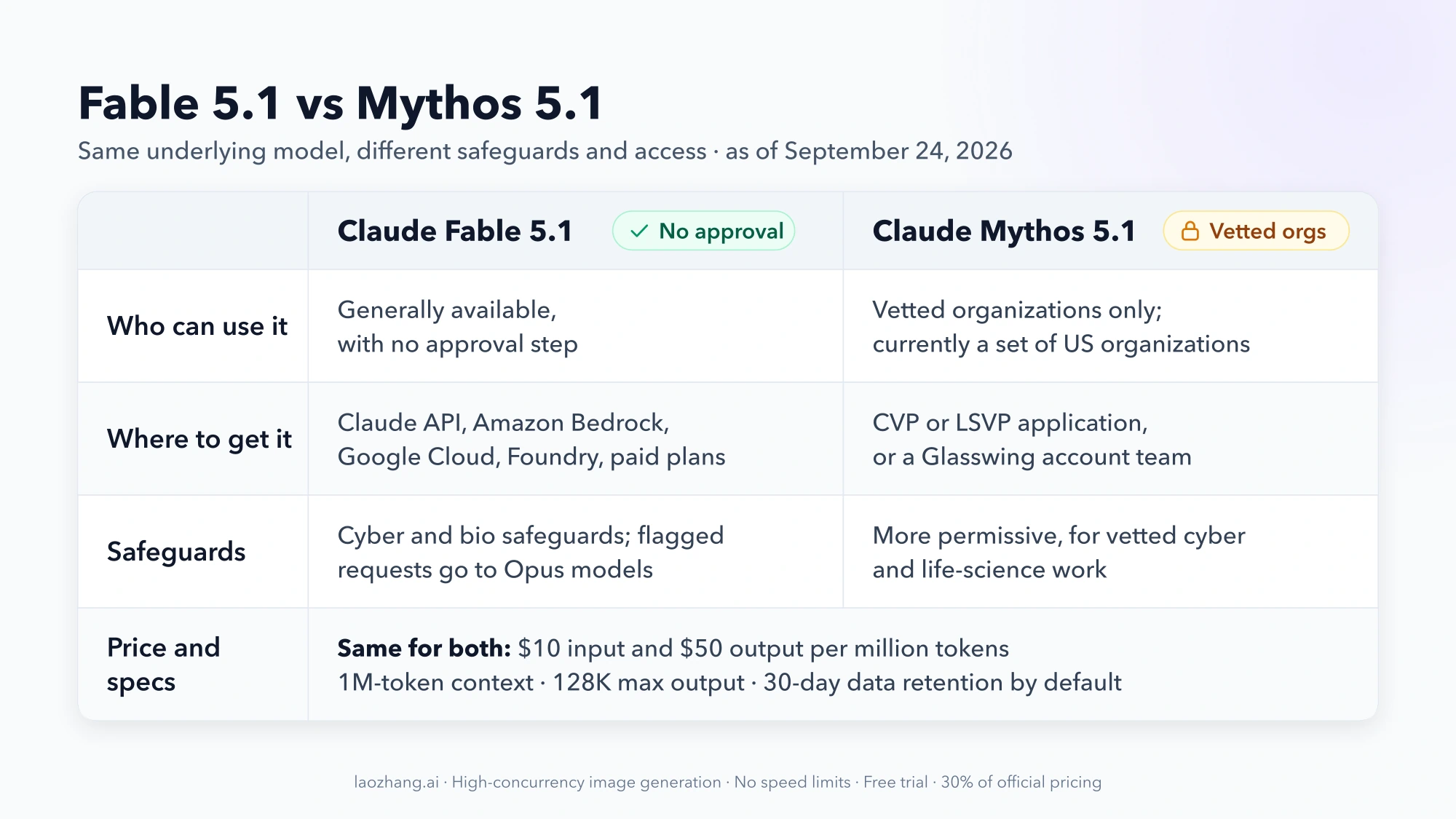
The September 1 release narrowed those safeguards:
- Fable 5.1 can now be used to identify software vulnerabilities in source code, though not to develop exploits for them.
- Anthropic expects Claude Code users to see around 60% fewer cyber-safeguard interventions per session than under Fable 5's safeguards.
- Its biology safeguards intervene on benign requests 85% less often than the ones Fable 5 launched with.
Some work is still off-limits. Penetration testing, exploit generation, and binary-based vulnerability scanning are redirected to Opus models, and so are dual-use biology and chemistry research questions (Mythos page). Claude's apps reroute those requests automatically, and you aren't charged Fable prices for rerouted requests. On the API, your code has to handle it. A declined request comes back as HTTP 200 with stop_reason: "refusal" and a stop_details object. The permitted fallback models for Fable 5.1 are Claude Opus 4.8 and Claude Opus 5, and a refusal that arrives before any output isn't billed (What's new in Claude Fable 5.1).
Fable 5.1 costs $10 per million input tokens and $50 per million output tokens, with cache reads at $0.25 per million. If your work doesn't need that much model, Claude's models overview suggests starting most workloads on Claude Opus 5.5 ($4 input and $20 output per million tokens) and moving to Fable 5.1 for demanding reasoning or long-horizon agentic work.
Where to go next depends on how you'll use it:
- Calling it through the API or migrating from Fable 5: Claude Fable 5.1: API Pricing, Changes, and Migration Guide
- Using it on a Pro or Max subscription: Claude Fable 5.1 Usage Limits: Weekly Allowance, Extra Usage, and Model Switching
- Deciding whether Opus 5.5 is enough: Claude Opus 5.5 vs Fable 5.1: Which Should You Run?
Mythos price, model IDs, and the 30-day retention rule
Anthropic lists Mythos 5.1 pricing as starting at $10 per million input tokens and $50 per million output tokens. That matches Fable 5.1, which also shares its 1M-token context window and 128K maximum output. The price only applies once Anthropic has approved your organization, so there's no way to buy your way in at that rate. If you've seen $25/$125 per million tokens, that was the participant price Anthropic announced for Mythos Preview in April. Mythos 5 and 5.1 dropped to $10/$50.
| Model | Model ID | Who can call it |
|---|---|---|
| Claude Mythos 5.1 | claude-mythos-5-1 (Claude API) | Approved organizations only |
| Claude Mythos 5 | anthropic.claude-mythos-5 (Amazon Bedrock, us-east-1) | Approved customers; AWS says access is "currently limited" |
| Claude Fable 5.1 | claude-fable-5-1; anthropic.claude-fable-5-1 on Bedrock | Listed for all customers on the Claude API and partner platforms; no approval |
Using Mythos 5.1 also requires accepting 30-day data retention for safety monitoring by default. Anthropic classes both Mythos and Fable as Covered Models, which aren't available under zero data retention (ZDR) unless Anthropic expressly authorizes it (Data retention practices for Covered Models). Organizations with standard retention have nothing to configure. If yours uses ZDR, set up retention before an approval arrives:
- Claude API, directly or through Claude Platform on AWS: turn on retention for the workspace you'll use under Workspace > Manage > Privacy Controls in the developer console. Your other ZDR workspaces keep ZDR.
- Amazon Bedrock or Google Cloud's Agent Platform: enable retention in your cloud environment, and the retained data stays with that provider. On Bedrock, that means the
provider_data_shareretention mode. - Claude Enterprise with ZDR: the Primary Owner can change the retention setting in the admin console as those controls roll out, or Anthropic can help set up a separate sandbox organization.
Retained data is deleted after 30 days unless automated safety systems flag it or the law requires keeping it, and every human access is logged. If ZDR is non-negotiable, Fable 5.1 may be the practical choice for now. Eligible customers can use it with zero data retention until Anthropic's Enterprise Frontier Safeguards roll out in phases, starting this fall.
From Mythos Preview to Mythos 5.1: how access changed
Every Mythos name and price you may run into belongs to one of these stages. All dates are in 2026.
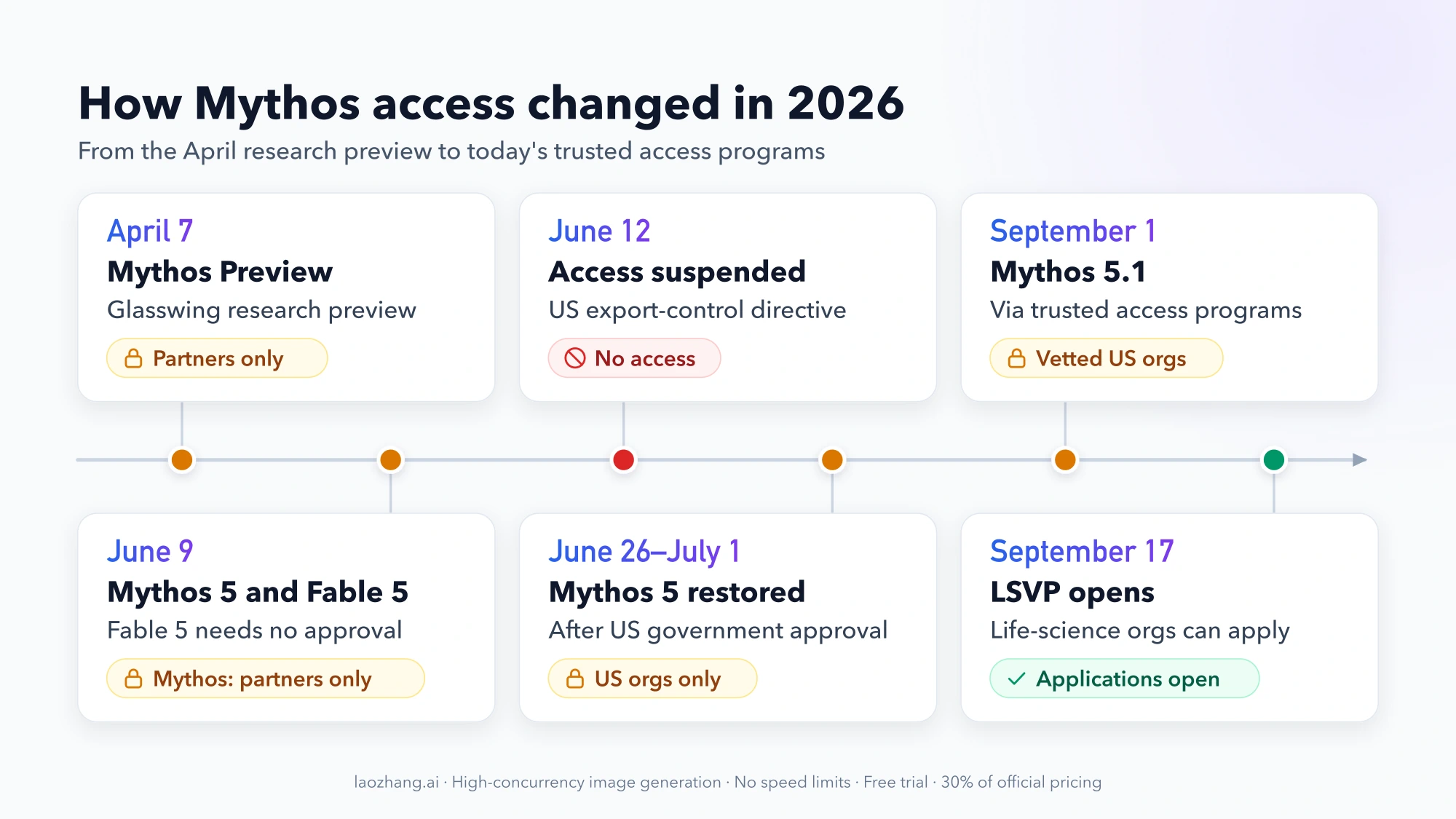
| Date | What changed | What it means for access |
|---|---|---|
| April 7 | Project Glasswing launched with Claude Mythos Preview, an unreleased model for launch partners and 40+ critical-software organizations, on the Claude API, Amazon Bedrock, Vertex AI, and Microsoft Foundry | Research-preview era; the $25/$125 participant price dates from here |
| June 2 | Glasswing expanded to about 150 more organizations in over 15 countries | Partners chosen by Anthropic, each subject to security requirements |
| June 9 | Claude Fable 5 and Claude Mythos 5 launched on the same underlying model at $10/$50; Mythos 5 succeeded Mythos Preview | Fable became the no-approval version of the model |
| June 12 | A US export-control directive suspended access to Fable 5 and Mythos 5 for any foreign national; unable to verify nationality in real time, Anthropic suspended both models for all users | Other Anthropic models weren't affected |
| June 26–July 1 | After US government approval on June 26, Anthropic restored Mythos 5 for a set of US organizations; export controls were lifted June 30, and Fable 5 returned globally July 1 | Mythos access narrowed to US organizations |
| September 1 | Fable 5.1 and Mythos 5.1 launched; Mythos 5.1 moved to trusted access programs, and Claude Security switched to it | The current model and rules |
| September 17 | The Life Sciences Verification Program opened applications in beta | First open application that covers Mythos 5.1 |
FAQ
Is Claude Mythos public?
No. As of September 24, 2026, Mythos 5.1 is available only to vetted organizations through Anthropic's trusted access programs, and currently only to a set of US organizations. The generally available version of the same model is Claude Fable 5.1.
Who has access to Claude Mythos right now?
The September 1 announcement doesn't name them. It says only that Mythos 5.1 is available to "a set of US organizations," and Claude's docs name Project Glasswing participants as one group with access. Life-science organizations come in through the LSVP, which onboarded dozens of them in early access before opening applications. Claude Enterprise customers use Mythos 5.1 indirectly, through Claude Security scans.
Is Claude Mythos available outside the US?
Not yet, by Anthropic's own description. Mythos 5.1 is "only available to a set of US organizations" while Anthropic coordinates with the US government to expand access to domestic and international partners. The LSVP pages don't mention a country limit, so for a non-US institution, whether Mythos is included depends on Anthropic's review. The US-organizations limit is stated for Mythos only; Fable 5.1 is generally available and needs no approval.
Does a Bedrock or other cloud listing mean my account can use Mythos?
No. AWS's model card for Mythos 5 says access "is currently limited due to the dual-use nature of these domains," and Claude's docs send Mythos requests to your Anthropic, AWS, or Google Cloud account team. Being able to read a model ID doesn't mean your account can call it.
Can I pay the listed price to get Mythos?
No. The $10/$50 per million tokens rate applies after Anthropic approves your organization, and there's no checkout for Mythos. Fable 5.1 costs the same and needs no approval.
What happened to Claude Mythos Preview, the April research preview?
It was replaced twice. Mythos 5 succeeded the April research preview on June 9, and Mythos 5.1 succeeded Mythos 5 on September 1. The research-preview rules and the $25/$125 participant price belong to the April phase. Today's access runs through the programs above.
Can I download Mythos or install it in Claude Code?
No. Mythos runs only as a hosted model for approved organizations, so there's nothing to download. A note-taking platform called MythOS, which connects to Claude through MCP, is a separate product, and its own site says it isn't related to Anthropic.