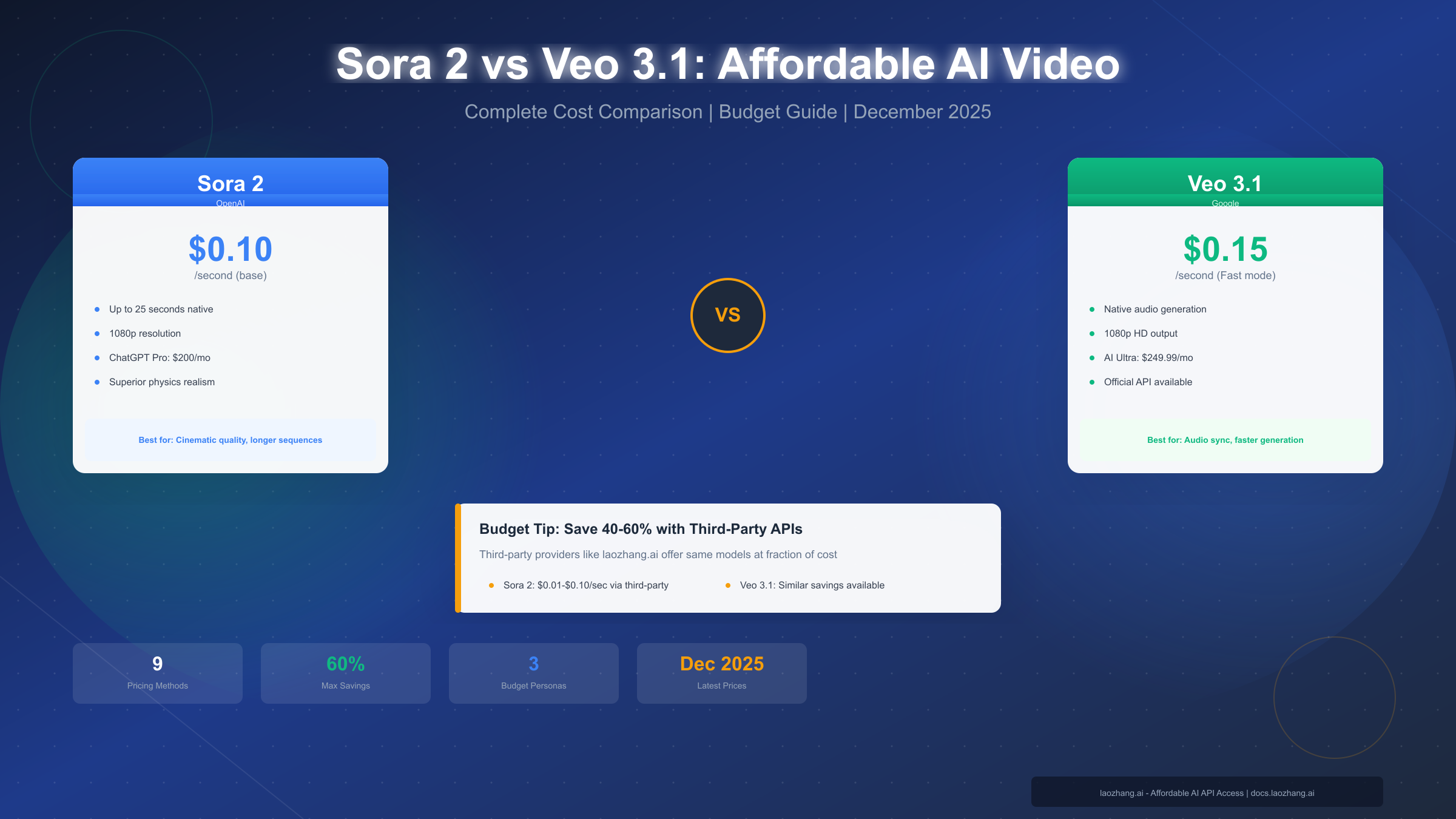
When comparing Sora 2 and Veo 3.1 for affordability, Sora 2's base API costs $0.10 per second while Veo 3.1 Fast runs at $0.15 per second without audio. For subscription users, ChatGPT Pro at $200 per month includes full Sora 2 Pro access, while Google AI Ultra at $249.99 per month provides comprehensive Veo 3.1 access. Budget-conscious developers can save 40-60% through third-party API providers like laozhang.ai. This December 2025 guide compares real monthly costs for different usage levels and reveals the most affordable path for AI video generation.
Quick Price Comparison Overview
The AI video generation landscape has evolved dramatically in 2025, with both OpenAI's Sora 2 and Google's Veo 3.1 offering compelling options for creators at different price points. Understanding the pricing differences between these two powerhouse platforms can save you hundreds of dollars monthly, especially if you're planning to integrate AI video generation into your regular workflow.
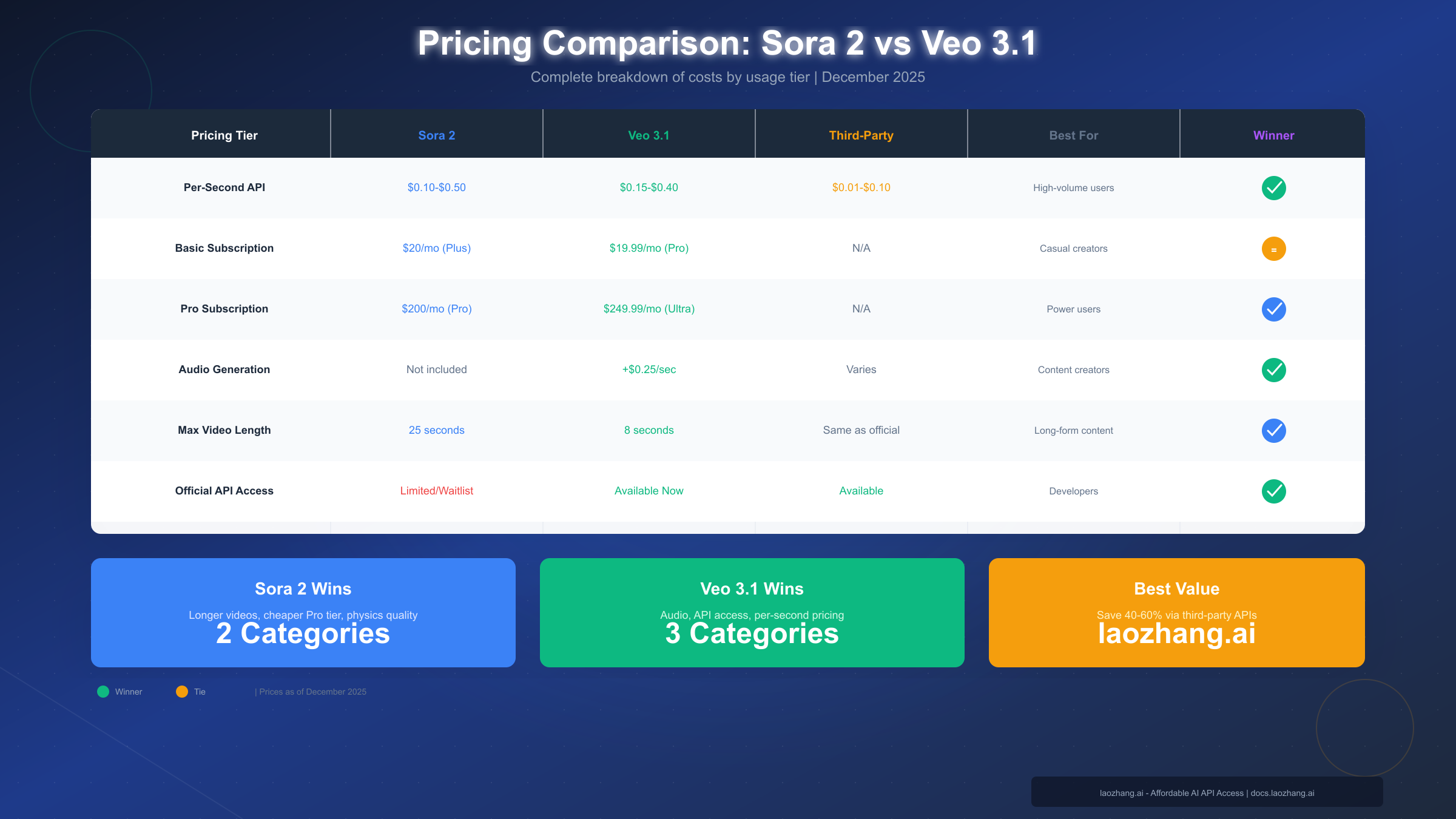
At a glance, here's how the core pricing compares as of December 2025. Sora 2 operates on a hybrid model combining subscription access through ChatGPT tiers with API-based pricing for developers. The base API rate starts at $0.10 per second for 720p content, scaling up to $0.50 per second for premium Sora 2 Pro output at higher resolutions. Veo 3.1 takes a similar approach but with a notable twist: its "Fast" mode offers a competitive $0.15 per second rate, while the standard quality tier with native audio generation costs $0.40 per second.
The subscription landscape reveals interesting trade-offs. ChatGPT Plus subscribers at $20 per month get limited Sora 2 access with 720p resolution and 5-second maximum video length, making it suitable for casual experimentation but not serious production work. ChatGPT Pro at $200 monthly unlocks the full Sora 2 Pro experience with 1080p resolution and videos up to 25 seconds. Google's competing tiers include AI Pro at $19.99 monthly providing 1,000 credits for Veo 3 access, and AI Ultra at $249.99 offering 12,500 credits with premium features.
For developers requiring programmatic access, the distinction becomes clearer. Veo 3.1 currently offers official API access through Google's Vertex AI platform, while Sora 2's official API remains in limited availability with waitlist access for many users. This accessibility difference often drives budget-conscious developers toward Veo 3.1 or third-party alternatives that aggregate multiple AI video models. For a broader perspective on AI video capabilities, you might find our comprehensive AI video model comparison helpful for understanding the full landscape.
Sora 2 Pricing Deep Dive
OpenAI's Sora 2 pricing structure reflects the company's strategy of balancing consumer accessibility with professional-grade capabilities. Understanding each tier helps identify where your usage patterns fit and whether you're overpaying for features you don't need.
Free and Basic Access
The most accessible entry point to Sora 2 comes through the ChatGPT Plus subscription at $20 per month. However, this tier imposes significant limitations that many creators find restrictive. Video generation is capped at 720p resolution with a maximum duration of 5 seconds per generation. The monthly quota system allocates approximately 1,000 credits, translating to roughly 50 short video clips depending on complexity and resolution choices. For users simply exploring AI video capabilities or creating short social media clips, this tier provides adequate functionality without additional investment.
Free tier access remains available through OpenAI's invite system, though availability fluctuates based on server capacity. Invited users can generate videos subject to computational limits, with no guaranteed monthly quota. The practical implication is that free access works for occasional experimentation but proves unreliable for any consistent content creation workflow.
Pro and Premium Tiers
ChatGPT Pro at $200 monthly represents the serious creator's entry point into Sora 2's full capabilities. This subscription unlocks Sora 2 Pro, delivering 1080p resolution output with support for videos up to 25 seconds in length. The "unlimited relaxed videos" feature means that after exhausting 500 priority generations, users can continue creating videos at slower processing speeds without additional charges. For high-volume creators, this unlimited fallback eliminates the anxiety of hitting hard usage caps.
The API pricing for developers introduces per-second billing. Standard Sora 2 API access costs $0.10 per second at 720p resolution, scaling to approximately $0.30 per second for Pro-quality output. Premium configurations pushing 1080p and extended durations reach $0.50 per second. A practical calculation: generating ten 10-second videos at standard quality costs roughly $10, while the same production run at Pro quality approaches $30-50 depending on resolution and complexity settings.
For context on how OpenAI structures API pricing across their model portfolio, our OpenAI API pricing guide provides comprehensive details on token costs and billing patterns.
Veo 3.1 Pricing Deep Dive
Google's Veo 3.1 represents a different pricing philosophy, emphasizing API accessibility and native audio generation as key differentiators. The platform's pricing reflects its positioning as an enterprise-ready solution with consumer-friendly tiers.
Subscription Plans
Google AI Pro at $19.99 monthly offers an attractive entry point with 1,000 credits per month. These credits translate to approximately 50 Veo 3 Fast videos or around 10 standard quality videos with audio generation enabled. The Gemini app integration limits usage to roughly 3 Veo 3 Fast videos daily, creating predictable constraints for casual users. This tier suits hobbyists and content creators testing AI video capabilities without committing to professional-grade spending.
Google AI Ultra at $249.99 monthly delivers the premium experience with 12,500 credits, sufficient for approximately 83 high-quality video generations monthly. The subscription includes access to Google's Flow filmmaking tools, providing additional creative capabilities beyond raw video generation. For agencies and production studios, this tier often proves more cost-effective than accumulating API charges for equivalent usage.
API Access and Per-Second Pricing
Veo 3.1's API pricing through Vertex AI demonstrates Google's commitment to developer accessibility. The Fast mode at $0.15 per second (audio disabled) or $0.25 per second (audio enabled) offers the most affordable per-second rate among premium AI video generators. Standard quality generation costs $0.40 per second with audio or $0.20 per second silent, while premium configurations reach $0.75-1.00 per second through official channels.
Third-party platforms often provide significant discounts on Veo 3.1 access. Services like fal.ai offer Veo 3 at $0.25-0.50 per second for audio-enabled generation, representing 30-40% savings compared to direct Vertex AI pricing. For developers building applications requiring consistent video generation, these alternative access points can substantially reduce operational costs.
Understanding Google's broader API pricing ecosystem helps contextualize Veo 3.1 costs. Our Gemini API pricing guide covers the full spectrum of Google AI services and their billing structures.
Real Cost Scenarios Compared
Abstract pricing figures matter less than understanding what you'll actually pay for your specific use case. The following scenarios break down monthly costs for three distinct user personas, helping you identify where you fit and which platform delivers better value for your needs.
Hobbyist: 10 Videos Per Month
The casual creator generating 10 short videos monthly for social media or personal projects represents the entry-level use case. Assuming 8-second average video length and standard quality requirements, here's how costs compare:
Sora 2 Options:
- ChatGPT Plus ($20/month): Adequate for 10 videos at 720p/5 seconds. Technically underpowered but functional.
- API Direct: 10 videos × 8 seconds × $0.10/second = $8/month
Veo 3.1 Options:
- Google AI Pro ($19.99/month): Easily covers 10 videos within the 1,000 credit allocation.
- API Direct: 10 videos × 8 seconds × $0.15/second = $12/month (Fast mode, no audio)
- API with Audio: 10 videos × 8 seconds × $0.25/second = $20/month
Third-Party Alternative:
- Aggregated APIs: 10 videos × 8 seconds × $0.05/second = $4/month
Verdict for Hobbyists: Third-party APIs deliver the best value at approximately $4-5 monthly, representing 60-75% savings compared to official subscription tiers. If audio generation is unnecessary, this approach proves dramatically more affordable than any official option.
Creator: 50 Videos Per Month
Content creators producing consistent video output for YouTube, TikTok, or client work fall into this category. Assuming 10-second average videos with quality requirements demanding 1080p output:
Sora 2 Options:
- ChatGPT Pro ($200/month): Covers 50 videos with priority access plus unlimited relaxed generations. Best for quality-focused creators.
- API Direct: 50 videos × 10 seconds × $0.30/second = $150/month (Pro quality)
Veo 3.1 Options:
- Google AI Ultra ($249.99/month): Provides 12,500 credits, covering approximately 83 quality videos. Overkill for 50 videos but includes Flow tools.
- API Direct: 50 videos × 10 seconds × $0.40/second = $200/month (standard with audio)
- Fast Mode: 50 videos × 10 seconds × $0.15/second = $75/month (no audio)
Third-Party Alternative:
- Aggregated APIs: 50 videos × 10 seconds × $0.08/second = $40/month
Verdict for Creators: The ChatGPT Pro subscription at $200 offers excellent value for quality-focused Sora 2 users with its unlimited relaxed generation feature. However, third-party APIs at $40-50 monthly provide similar output quality at 75-80% lower cost for creators willing to manage API integration.
Business: 100+ Videos Per Month
Production studios and agencies generating high volumes of AI video content require enterprise-grade solutions with cost predictability and scalability.
Sora 2 Options:
- ChatGPT Pro ($200/month) + API Overages: Base subscription covers first 50-100 videos depending on relaxed queue usage. Additional API costs variable.
- Pure API: 100 videos × 15 seconds × $0.30/second = $450/month
Veo 3.1 Options:
- Google AI Ultra ($249.99/month) + API: Subscription covers approximately 83 videos; remainder via API.
- Pure API: 100 videos × 15 seconds × $0.40/second = $600/month (with audio)
- Fast Mode Only: 100 videos × 15 seconds × $0.15/second = $225/month
Third-Party Alternative:
- Aggregated APIs: 100 videos × 15 seconds × $0.06/second = $90/month
Verdict for Businesses: The cost differential at volume becomes stark. Third-party APIs offering aggregated access save businesses $400-500 monthly compared to direct API usage, potentially exceeding $5,000 in annual savings. For production workflows where official support isn't critical, third-party solutions present compelling economics.

Hidden Costs You Should Know
Published pricing tells only part of the story. Several additional cost factors affect your actual monthly spending and can surprise unwary users who budget based solely on headline rates.
Audio Generation Premiums represent the most significant hidden cost for Veo 3.1 users. While Sora 2 produces silent video requiring separate audio post-production, Veo 3.1's native audio generation adds $0.15-0.25 per second to every video. For a 10-second video, this translates to $1.50-2.50 in audio charges alone. Creators planning to use Veo 3.1's audio capabilities should factor this 40-60% premium into their budget calculations.
Resolution upscaling costs can accumulate quickly. Both platforms charge premium rates for 1080p output compared to 720p. Sora 2's jump from $0.10/second (720p) to $0.30/second (1080p Pro) represents a 200% increase. Veo 3.1's progression from Fast mode to premium quality follows similar patterns. Creators focused on platform-specific requirements (YouTube preferring 1080p while TikTok often compresses to 720p anyway) should match resolution choices to actual output needs rather than defaulting to maximum quality.
Failed generation policies differ between platforms. Google's Veo 3.1 notably doesn't charge for failed generations due to safety filter triggers or technical issues. OpenAI's Sora 2 policies are less explicitly documented, though generally follow similar practices. Nevertheless, complex prompts pushing content boundaries may result in multiple generation attempts, effectively multiplying costs for challenging creative briefs.
API rate limits impose indirect costs through workflow disruption. Both platforms throttle generation rates for free and basic tier users, potentially stretching what should be an hour of production work into a full day. The time cost of waiting translates directly into productivity losses that don't appear on any invoice but absolutely affect total cost of ownership.
Budget Alternatives via Third-Party APIs
The most effective cost optimization strategy for AI video generation often involves bypassing official channels entirely. Third-party API providers aggregate access to multiple AI models, frequently offering substantial discounts while maintaining output quality.
Understanding Third-Party Options
Third-party API providers operate by purchasing enterprise access to AI video models and reselling that capacity to individual developers and small businesses. This aggregation model creates economies of scale that translate into meaningful savings for end users. Third-party providers in this space typically offer pricing 40-60% below official rates while providing unified API interfaces across multiple models.
The reliability trade-off requires honest assessment. Third-party providers generally cannot match the uptime guarantees and official support channels offered by OpenAI and Google directly. For mission-critical applications requiring 99.9% availability and enterprise SLAs, official API access remains the appropriate choice despite higher costs. However, for content creation workflows tolerant of occasional delays or requiring human quality review regardless, third-party economics prove compelling.
Quality consistency varies by provider. Reputable third-party services deliver identical output to official APIs since they're calling the same underlying models. The infrastructure surrounding that model access—request queuing, error handling, rate limit management—differs between providers. Evaluating third-party options should include test generations comparing output quality and generation success rates against direct API access.
laozhang.ai Integration Example
For developers seeking affordable video generation API access, platforms like laozhang.ai provide aggregated access to multiple AI models including video generation capabilities. The typical pricing structure offers significant savings: approximately $0.05-0.10 per second for video generation, representing 50-80% discounts compared to official rates.
Integration follows standard REST API patterns, making adoption straightforward for developers already familiar with AI API workflows. Basic authentication and request formatting match common patterns, reducing integration time compared to learning multiple vendor-specific SDKs. For teams building applications requiring video generation at scale, this approach can reduce monthly API costs from $500+ to under $100 for equivalent output.
For developers exploring related image and video tools, our guide to free image-to-video AI tools covers additional budget-friendly options across the creative AI landscape.
# Example: Basic video generation API call pattern
import requests

# Third-party API integration example
api_endpoint = "https://api.example.com/v1/video/generate"
headers = {
    "Authorization": "Bearer YOUR_API_KEY",
    "Content-Type": "application/json"
}

payload = {
    "prompt": "A serene mountain landscape at sunset",
    "duration": 8,
    "resolution": "1080p",
    "model": "sora-2"  # or "veo-3.1"
}

response = requests.post(api_endpoint, headers=headers, json=payload)
video_url = response.json().get("video_url")
Rate limit handling becomes critical at scale. Third-party providers typically implement their own rate limiting independent of underlying model limits. Robust error handling should include exponential backoff for rate limit responses and queue management for high-volume workflows. The following pattern demonstrates resilient request handling:
import time
import requests
from requests.exceptions import RequestException

def generate_video_with_retry(prompt, max_retries=3):
    for attempt in range(max_retries):
        try:
            response = requests.post(api_endpoint, headers=headers,
                                    json={"prompt": prompt, "duration": 8})
            if response.status_code == 429:  # Rate limited
                wait_time = int(response.headers.get("Retry-After", 60))
                time.sleep(wait_time)
                continue
            response.raise_for_status()
            return response.json()
        except RequestException as e:
            if attempt == max_retries - 1:
                raise
            time.sleep(2 ** attempt)  # Exponential backoff
    return None
For comprehensive documentation on available video generation APIs and their pricing structures, check docs.laozhang.ai for current rate information.
Choosing Based on Your Budget
After analyzing pricing tiers, real-world scenarios, and third-party alternatives, concrete recommendations emerge for different budget levels and use cases. The following framework synthesizes all factors into actionable guidance.
Under $50 Monthly: Third-Party APIs Dominate. For budget-conscious creators and hobbyists, official subscription tiers simply cannot compete with third-party pricing. Spending $40-50 monthly through aggregated API services provides equivalent output to $200+ official subscriptions. The key requirements: tolerance for occasional service interruptions and willingness to integrate via API rather than consumer-facing interfaces.
$50-$200 Monthly: Platform Choice Matters. This budget range creates genuine competition between official subscriptions and enhanced third-party access. ChatGPT Pro at $200 offers compelling value for Sora 2's superior physics and longer video capabilities. Google AI Pro at $19.99 provides affordable Veo 3.1 access with audio generation for lower-volume creators. The decision hinges on specific output requirements: choose Sora 2 for cinematic quality and longer sequences; choose Veo 3.1 for native audio and faster turnaround.
$250+ Monthly: Hybrid Strategies Win. High-volume users benefit from combining subscription access for priority processing with third-party APIs for overflow capacity. A practical approach: maintain ChatGPT Pro or Google AI Ultra for time-sensitive productions requiring guaranteed turnaround, while routing bulk generation tasks through cost-optimized third-party channels. This hybrid model captures quality benefits of premium tiers while controlling costs on volume work.
The audio requirement often proves decisive. Creators needing synchronized audio in generated videos have a clearer choice: Veo 3.1's native audio generation eliminates post-production audio work, potentially saving hours per video. Sora 2's silent output requires separate voice-over, music, and sound effect integration regardless of subscription tier. For workflows where audio is essential, Veo 3.1's premium for native audio may actually represent savings compared to Sora 2 plus professional audio production.
API availability influences developer decisions strongly. As of December 2025, Veo 3.1 offers broader official API access while Sora 2 maintains waitlist restrictions for many developers. Teams requiring immediate programmatic access without uncertainty should weight Veo 3.1 or third-party Sora 2 access accordingly. The API landscape continues evolving, but current availability favors Google's offering for developers unwilling to navigate waitlists.
Cost Optimization Strategies
Beyond choosing the right platform and pricing tier, several tactical approaches can reduce AI video generation costs by 20-40% without sacrificing output quality.
Resolution matching saves significant money. Generating 1080p video for eventual compression to 720p (common on mobile-focused platforms) wastes budget on unused quality. Analyze your distribution channels' actual requirements and generate at the minimum resolution meeting those needs. The 200-300% premium for high-resolution output becomes pure waste when the final delivery medium compresses that quality away.
Batching generations improves efficiency and can reduce costs with some providers. Submitting multiple related generations in sequence often triggers better rate treatment than sporadic individual requests. Some third-party providers offer volume discounts kicking in at 10+ generations per session. Planning content calendars to concentrate video generation into focused production sessions rather than spreading across weeks captures these efficiencies.
Prompt refinement reduces regeneration waste. The most expensive video is one you generate twice because the first attempt missed the creative brief. Investing time in detailed, specific prompts with style references and explicit constraints reduces the regeneration rate that silently inflates actual production costs. Track your first-attempt success rate; if it falls below 70%, prompt engineering improvements likely offer better ROI than switching platforms or tiers.
Disabled audio when not needed cuts Veo 3.1 costs dramatically. For video content receiving custom audio treatment regardless, enabling Veo 3.1's audio generation wastes $0.15-0.25 per second. Creators using separate audio production tools should explicitly disable audio in API calls, potentially reducing per-video costs by 40%.
Monitor and audit spending regularly. Both platforms provide usage dashboards, but third-party aggregators may offer less visibility. Implement your own tracking for API calls, generation success rates, and per-video costs. Monthly audits identifying usage patterns often reveal optimization opportunities invisible without data review.
Summary and FAQ
Choosing between Sora 2 and Veo 3.1 ultimately depends on your specific requirements, budget constraints, and workflow preferences. Both platforms offer professional-grade AI video generation with distinct strengths justifying their pricing structures.
Key takeaways from this comparison:
-
Sora 2 excels at longer video sequences (up to 25 seconds) with superior physics simulation, best for cinematic and narrative content. The ChatGPT Pro subscription at $200 monthly offers excellent value for heavy users.
-
Veo 3.1 provides native audio generation and faster turnaround, ideal for content requiring synchronized sound. Official API access availability gives developers certainty that Sora 2's waitlist cannot match.
-
Third-party API providers offer 40-60% savings for users willing to accept minor trade-offs in support and occasional availability. For budget-focused creators, these alternatives provide the most cost-effective path to professional AI video generation.
-
The $50-200 monthly budget range requires the most careful analysis, as both subscription and API approaches can prove optimal depending on specific usage patterns.
FAQ
Which is cheaper overall, Sora 2 or Veo 3.1?
For base API pricing, Sora 2's $0.10/second narrowly beats Veo 3.1's $0.15/second Fast mode. However, Veo 3.1 includes audio generation that Sora 2 lacks, so total production costs may favor Veo 3.1 for audio-inclusive content. Third-party alternatives priced at $0.05-0.08/second offer substantial savings compared to either official option.
Can I use Sora 2 API right now?
Sora 2 API access remains limited with waitlist availability as of December 2025. ChatGPT Pro subscribers get direct access through the interface, but programmatic API access requires approval. Third-party providers offer Sora 2 API access without waitlist restrictions, though through unofficial channels.
What's the best option for a small business with $100/month budget?
At $100 monthly, third-party API access provides the best value, enabling approximately 100+ short videos through aggregated services. Official subscriptions at this budget level would limit you to either ChatGPT Plus (inadequate for professional use) or consuming API credits quickly.
Does Veo 3.1 quality match Sora 2?
Both platforms produce professional-quality output competitive for production use. Sora 2 demonstrates superior physics simulation and temporal consistency in longer sequences. Veo 3.1 excels at prompt adherence and offers native audio that Sora 2 lacks. Quality differences are marginal enough that cost and feature considerations should drive most decisions.
How do third-party APIs maintain lower prices?
Third-party providers purchase enterprise access to AI models at volume discounts, then resell that capacity to individual developers. This aggregation model creates cost efficiencies passed to users. Trade-offs include reduced support and potentially variable availability compared to official channels.