Update (October 8, 2026): Google released Nano Banana 2.1 (
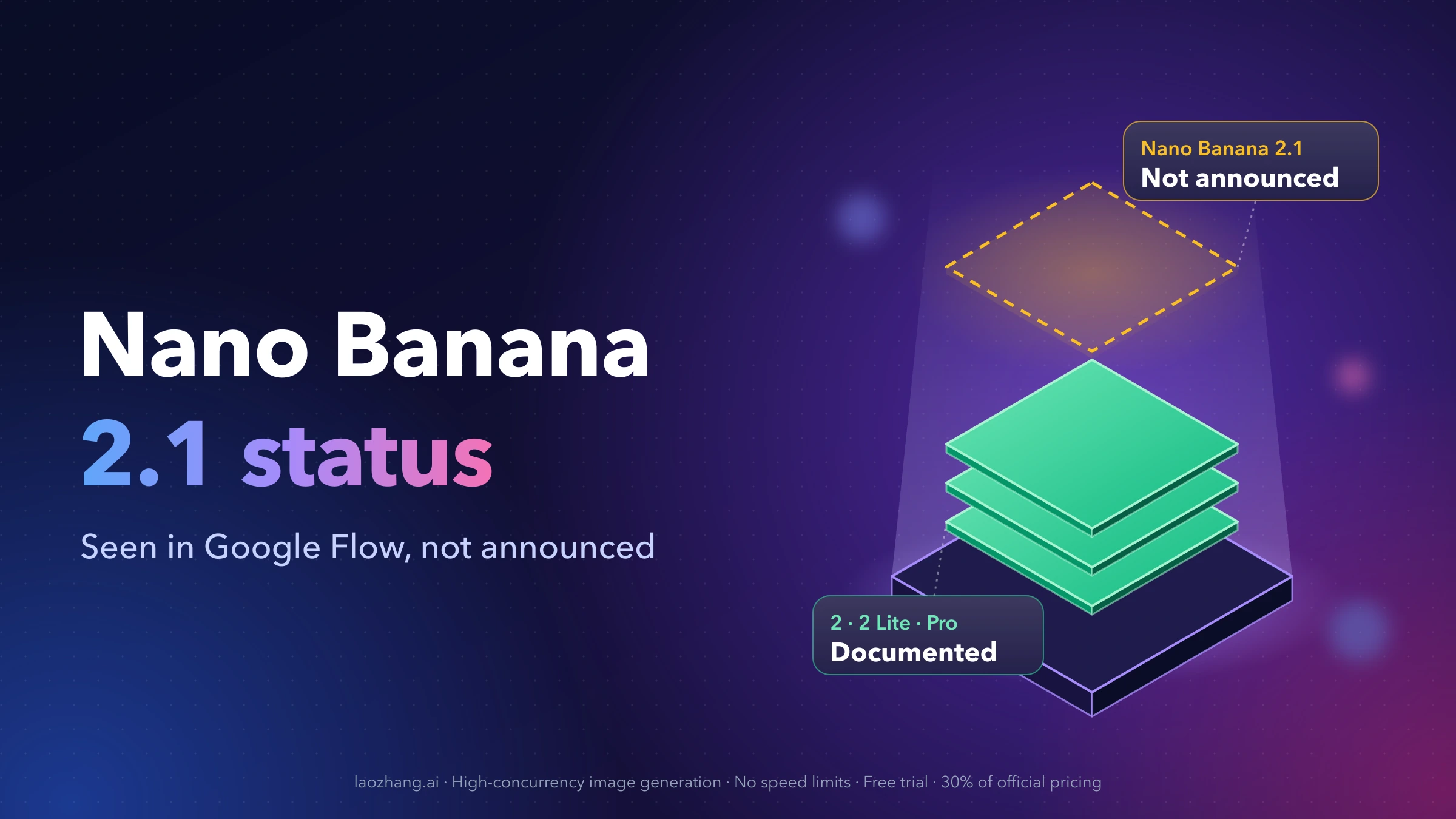
gemini-nano-banana-2.1) on October 6, 2026, and markedgemini-3.1-flash-image(Nano Banana 2) as deprecated in the Gemini API, recommending a move to 2.1. No shutdown date is announced (an October 29 date announced that day was withdrawn on October 7). Nano Banana 2 model IDs, prices and code below still work for now; new projects should start on 2.1. For what changes and how to migrate, see Nano Banana 2.1 Is Out: Access, API Pricing and Moving Off Nano Banana 2. Separately, Google has moved thegemini-2.5-flash-imageshutdown from the originally listed October 2, 2026 to March 15, 2027 and now listsgemini-3.1-flash-lite-image(Nano Banana 2 Lite) as its replacement, so any October 2 shutdown mentioned below no longer applies.
Update (October 5, 2026): Gemini's image models are now GA: use
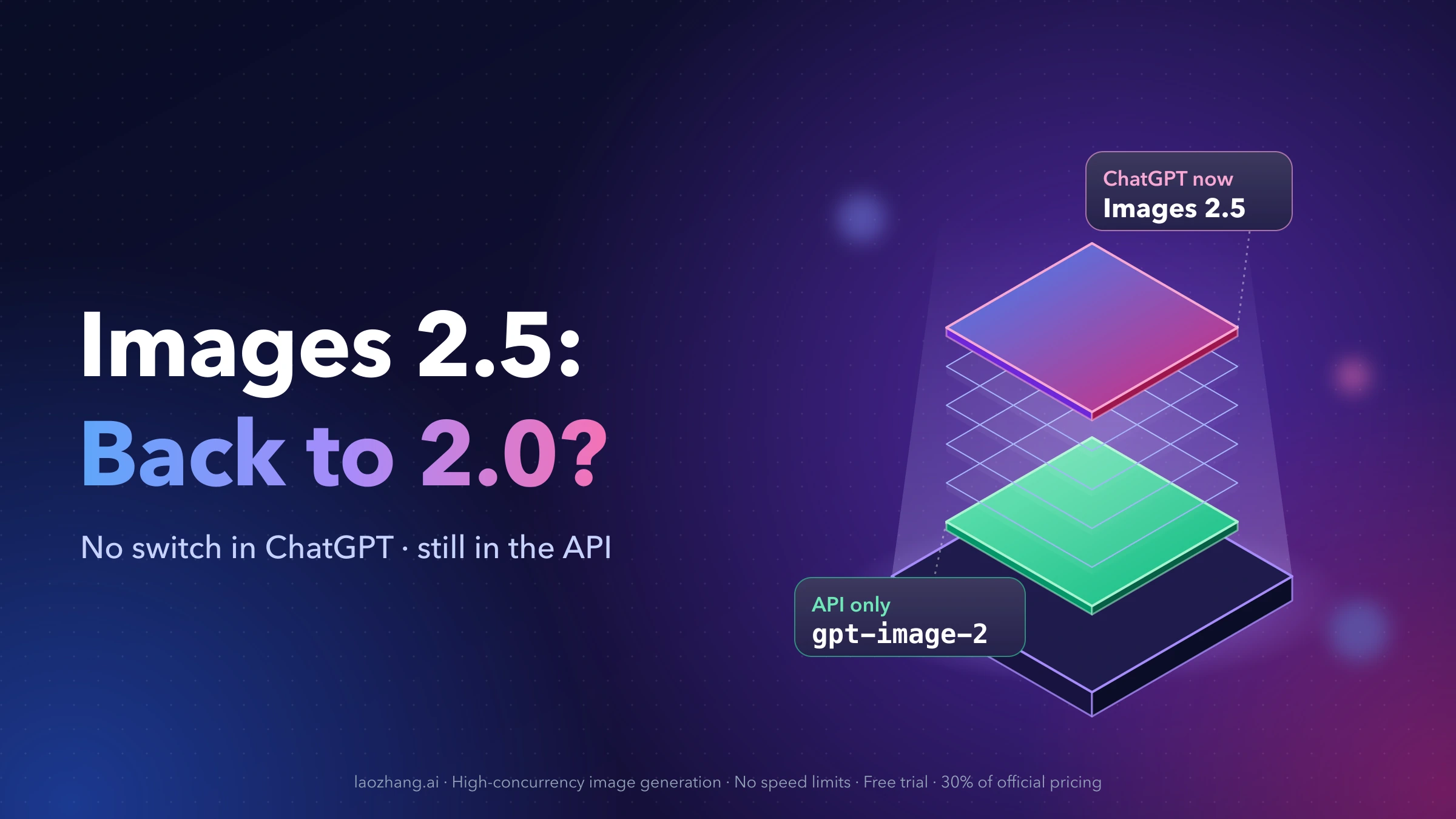
gemini-3-pro-image(Nano Banana Pro: $0.134 per 1K/2K image, $0.24 per 4K) andgemini-3.1-flash-image(Nano Banana 2: $0.045-$0.151 per image). The-previewIDs that appear below were shut down on June 25, 2026, Gemini 2.5 Flash Image on October 2, 2026, and Imagen 4 on August 17, 2026. There is no free API tier for image models; API tiers are now Tier 1 with billing linked, Tier 2 after $100 paid and 3 days, Tier 3 after $1,000 paid and 30 days (rate limits). laozhang.ai prices below reflect its October 2026 price page.
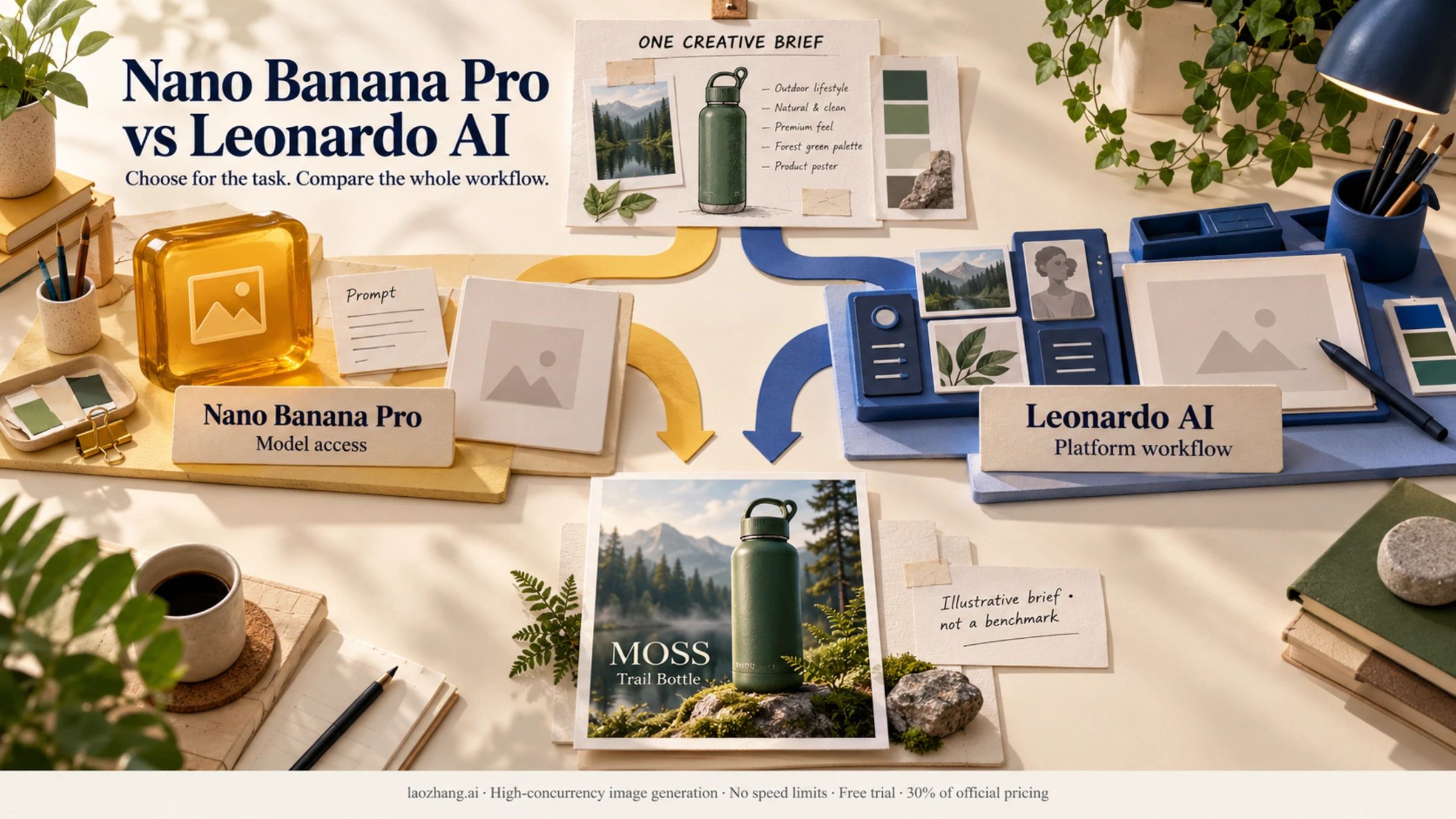
Nano Banana Pro and Leonardo AI represent two fundamentally different approaches to AI image generation available in January 2026. Understanding this distinction is essential before comparing them: Nano Banana Pro is a single AI model developed by Google DeepMind, built on the Gemini 3 Pro architecture and optimized for photorealism and text rendering. Leonardo AI, by contrast, is a multi-model platform hosting over 10 different AI models—including Nano Banana Pro itself—along with creative tools like Real-time Canvas and custom model training. For users prioritizing text accuracy and photorealistic output, Nano Banana Pro delivers superior results, particularly when accessed at $0.09 per call through aggregator platforms like laozhang.ai rather than official pricing. For users needing artistic variety, multiple model options, and integrated creative workflows, Leonardo AI offers a compelling all-in-one solution. This comprehensive guide examines every aspect of both options to help you make an informed decision.
Model Overview and Background
Understanding the origins and architecture of these two options provides essential context for evaluating their capabilities. The fundamental distinction between a specialized model and a multi-model platform shapes every aspect of how you'll use them.
Nano Banana Pro represents Google DeepMind's most advanced image generation technology, officially known as Gemini 3 Pro Image. The codename "Nano Banana" originated from internal placeholder naming at Google that caught on with the internet community. According to Google's official blog (blog.google/technology/ai/nano-banana-pro/), the model was released on November 20, 2025, bringing sophisticated reasoning capabilities to image generation through its Gemini 3 Pro backbone.
The technical foundation enables unique capabilities that simpler models cannot match. Unlike standard image generators that operate purely on pattern recognition, Nano Banana Pro's architecture provides semantic understanding that excels at interpreting complex prompts. The model understands how the world works before rendering pixels—from accurate text placement to complex object relationships. This explains why it produces particularly strong results for scenarios requiring logical coherence: product photography where text must be legible, marketing materials where multiple elements need precise placement, and technical diagrams where accuracy matters.
Leonardo AI emerged as a comprehensive creative platform that aggregates multiple AI models into a single ecosystem. With over 55 million registered creators and more than 2 billion images generated, the platform has established itself as a major player in the AI art space. Rather than developing a single model, Leonardo's strategy involves providing access to multiple models—including Phoenix (their proprietary model), Flux, and notably Nano Banana Pro itself—through a unified interface with additional creative tools.
The platform approach offers distinct advantages for creative exploration. Leonardo's Real-time Canvas allows interactive sketching with AI assistance, while Flow State enables rapid iteration across different models. The ability to train custom models (10-50 per month depending on plan) appeals to users with specific aesthetic requirements. This multi-model strategy means users can experiment with different approaches without managing multiple subscriptions or APIs.
The model-versus-platform distinction creates an interesting dynamic. Leonardo AI actually integrates Nano Banana Pro as one of its available models, charging 140-250 API credits per generation. This means users comparing these options aren't choosing between competitors in the traditional sense—they're deciding whether to access Nano Banana Pro directly (through Google or third-party APIs) or through Leonardo's platform layer with its additional features and costs.
Technical Specifications Comparison
A direct comparison of technical specifications reveals the trade-offs each option makes and helps identify which aligns better with specific workflow requirements.
| Feature | Nano Banana Pro | Leonardo AI |
|---|---|---|
| Type | Single AI Model | Multi-Model Platform |
| Developer | Google DeepMind | Leonardo.Ai |
| Max Resolution | 5632×3072 (Native 4K+) | Varies by Model |
| Generation Speed | ~15 seconds | Model Dependent |
| Reference Images | Up to 14 | Up to 8 |
| Text Rendering | Best in Class (30+ Languages) | Good (Phoenix model) |
| Custom Training | Not Available | 10-50 models/month |
| Built-in Editor | Limited (Gemini App) | Full Canvas + Flow State |
| Official Pricing | $0.134-$0.24/image | $10-48/month subscription |
Resolution capabilities reveal Nano Banana Pro's technical superiority. Native 5632×3072 output exceeds standard 4K, making it suitable for print materials and large-format displays without upscaling. Leonardo's resolution varies by model—Phoenix offers high quality but not the same native resolution ceiling. For billboard advertising, exhibition graphics, and high-end product catalogs, this difference matters significantly.
Generation speed tells a nuanced story about each platform's priorities. Nano Banana Pro completes most generations in approximately 15 seconds through direct API access, providing a responsive creative experience. Leonardo's generation times vary considerably based on model selection, current load, and tier—free users may experience 5-20 minute waits during peak times while paid users get priority access.
The reference image disparity significantly impacts certain workflows. Nano Banana Pro supports up to 14 reference images, nearly doubling Leonardo's 8-image limit when using most models. This proves crucial for complex editing tasks that require mixing multiple design elements—combining product shots, background scenes, lighting references, and style guides. Character-driven content creators particularly benefit from Nano Banana Pro's expanded reference capacity for maintaining consistency across generations.
Performance and Quality Analysis

Raw specifications tell only part of the story. Real-world performance determines whether either option delivers value in production environments where consistency, reliability, and output quality directly impact business outcomes.
Photorealism represents Nano Banana Pro's defining strength. Testing across portrait, product, and environmental photography scenarios consistently shows Nano Banana Pro producing images that could pass as professionally shot photographs. The model handles subtle details exceptionally well—skin textures appear natural without the waxy quality common in AI generations, fabric shows appropriate drape and light interaction, and metallic surfaces display realistic reflections and highlights.
The Gemini 3 Pro backbone creates tangible quality differences. When generating images involving text, complex lighting, or multiple elements that need to interact logically, Nano Banana Pro's understanding of physical properties produces more believable results. A product shot with text overlay maintains legibility and proper perspective. Light refracts through glass convincingly. These details matter enormously for commercial applications where customers make decisions based on visual accuracy.
Leonardo AI excels in stylization and artistic interpretation. Where Nano Banana Pro aims for photographic truth, Leonardo's model variety embraces creative transformation. Phoenix produces what users describe as having unique artistic flair, while access to Flux and other models allows exploration of different aesthetic directions. For brand content, social media imagery, and artistic projects, this stylized output often requires less post-processing than Nano Banana Pro's clinical precision.
Text rendering capabilities show the clearest quality gap. Nano Banana Pro delivers the best text rendering currently available in any AI image generator, reliably producing correctly spelled, properly formatted text in over 30 languages. This includes not just Latin alphabets but also Chinese, Japanese, Arabic, Hebrew, and other complex writing systems. Leonardo's Phoenix model handles text adequately for short strings but shows higher error rates with longer passages or smaller text sizes.
Practical applications for superior text rendering span numerous industries. Social media marketers can generate ready-to-post images with text overlays. Product designers can create packaging mockups with realistic label text. Educational content creators can produce infographics with accurate information. Real estate professionals can generate property marketing materials with address and feature callouts. For teams exploring advanced prompting techniques, our AI image prompting guide provides comprehensive strategies applicable to both platforms.
API Access and Cost Optimization
Understanding the full cost picture requires looking beyond official pricing to include alternative access points, batch processing options, and total cost of ownership for production workflows.
Official pricing establishes the baseline but not the floor. Google's published rates for Nano Banana Pro range from $0.134 to $0.24 per image depending on resolution and features. Leonardo AI operates on a subscription model ranging from $10/month (Apprentice) to $48/month (Maestro Unlimited), with API plans starting at $9/month for 3,500 credits.
Leonardo's credit system adds complexity to cost calculations. Using Nano Banana Pro through Leonardo costs 140 credits for 1K/2K images and 250 credits for 4K images. On the $9/month API Basic plan (3,500 credits), that translates to 25 standard images or 14 4K images—effectively $0.36-0.64 per image. Higher-tier plans reduce per-credit costs but require larger commitments.
Third-party API aggregators offer substantial savings for direct Nano Banana Pro access. Platforms like laozhang.ai provide access to Nano Banana Pro at approximately $0.09 per call—roughly 33-62% below official Google pricing. This pricing makes premium-quality generation economically viable for production workflows that would be prohibitively expensive at official rates. The platform aggregates multiple models with unlimited concurrency, eliminating rate limit concerns during high-volume production runs. For detailed API documentation, visit docs.laozhang.ai.
Batch processing economics favor different options at different scales. Consider monthly production volumes:
| Monthly Volume | NBP Official | NBP (laozhang.ai) | Leonardo Maestro |
|---|---|---|---|
| 100 images | $24.00 | $5.00 | $48.00 (subscription) |
| 500 images | $120.00 | $45.00 | $48.00 (subscription) |
| 1,000 images | $240.00 | $90.00 | $48.00 (subscription) |
| 5,000 images | $1,200.00 | $250.00 | $48.00 + credits |
| 10,000 images | $2,400.00 | $900.00 | Custom pricing |
The cost comparison reveals nuanced decision points. For low-volume users (under 500 images/month), Leonardo's subscription model may provide better value if you need the platform features. For medium to high-volume production focused on Nano Banana Pro specifically, aggregator pricing delivers dramatic savings. The $50 difference between laozhang.ai ($50) and Leonardo subscription ($48) for 1,000 images becomes negligible when weighted against quality requirements—but the aggregator path offers pure Nano Banana Pro output without the platform layer. For detailed pricing analysis, our Nano Banana Pro pricing guide provides comprehensive cost breakdowns.
Hidden costs affect total ownership calculations. Leonardo's token consumption varies by feature—enabling Alchemy or PhotoReal increases costs per generation. Queue times for free users add labor costs through waiting. Iteration requirements impact effective pricing; if generations require multiple attempts due to quality inconsistencies, actual per-usable-image costs increase proportionally.
Which Should You Choose?
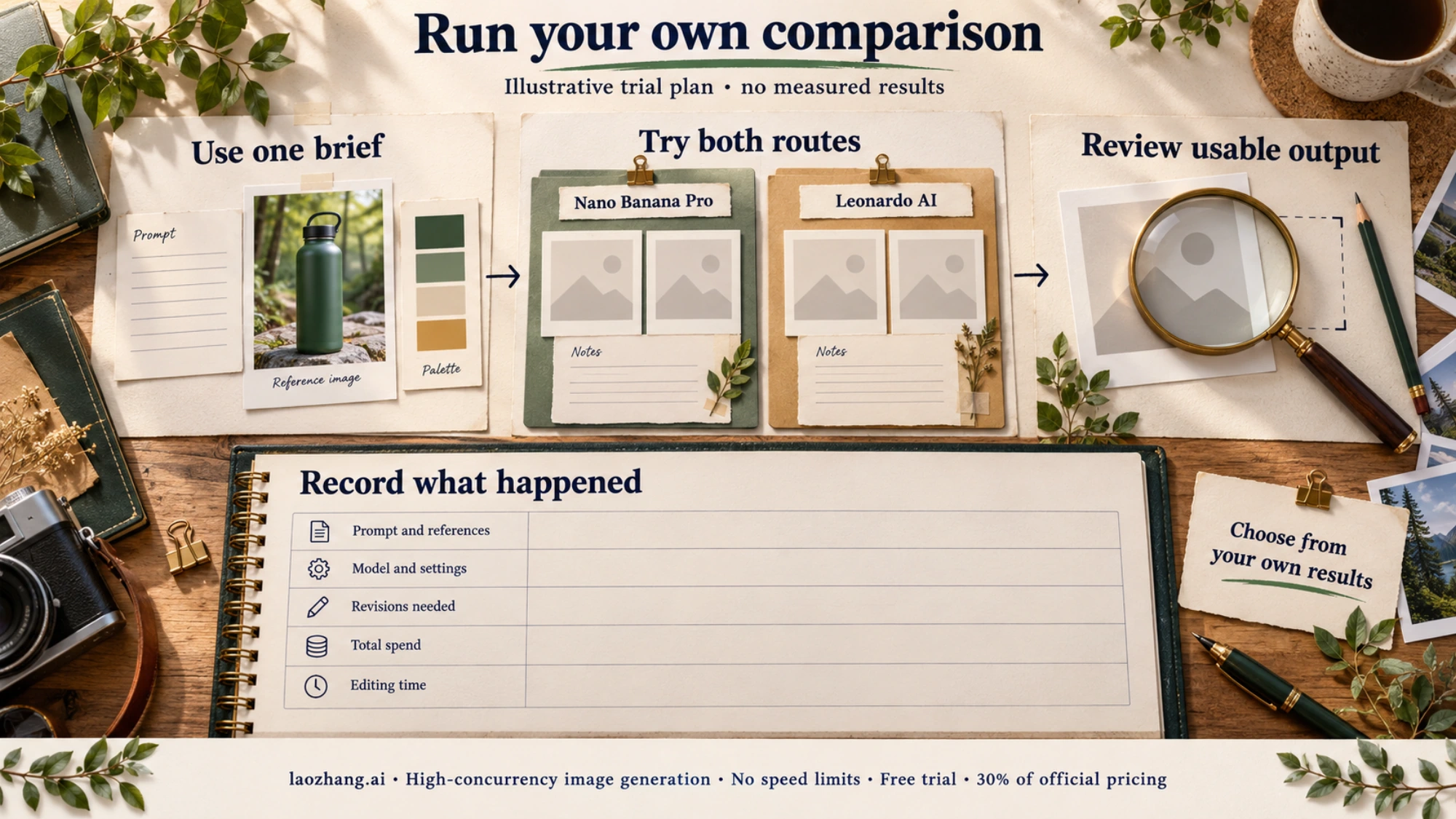
The optimal choice depends entirely on your specific requirements. Neither option universally outperforms the other—they represent different optimization choices that align with different use cases.
Choose Nano Banana Pro directly when text accuracy is non-negotiable. Marketing materials, product packaging, infographics, and any content where text must be correct on first generation favor Nano Banana Pro. The model's superior text rendering eliminates the regeneration cycles and manual corrections that other models require. If your workflow involves significant text elements, accessing Nano Banana Pro through laozhang.ai at $0.09 per call often costs less than the labor required to fix text errors from cheaper alternatives.
Choose Nano Banana Pro for maximum photorealism. Product photography, real estate marketing, portrait applications, and any scenario where images must appear indistinguishable from professional photography benefit from Nano Banana Pro's physics-aware generation. The model's understanding of light, materials, and physical properties produces images that require minimal retouching. For users exploring high-resolution capabilities, our 4K image generation guide provides detailed optimization strategies.
Choose Leonardo AI for artistic exploration and model variety. If your workflow benefits from experimenting with different aesthetic directions, Leonardo's platform approach provides access to 10+ models through a single subscription. Phoenix for quick iterations, Flux for certain styles, custom-trained models for specific looks—this variety suits creative agencies, digital artists, and content creators who value exploration over consistency.
Choose Leonardo AI when you need integrated creative tools. Real-time Canvas, Flow State rapid iteration, and the ability to train custom models justify Leonardo's platform costs for users who'll actively use these features. If your workflow involves interactive sketching, frequent model switching, or specific custom aesthetic requirements, the platform layer adds genuine value.
Consider hybrid workflows for production environments. Many professional teams use both options strategically. Nano Banana Pro (via laozhang.ai for cost efficiency) handles text-heavy hero images and photorealistic product shots requiring maximum quality. Leonardo processes volume content, variations, and artistic pieces where platform features accelerate workflow. This approach optimizes both quality and cost across diverse content needs.
| Use Case | Recommended Option | Reason |
|---|---|---|
| Marketing with text | Nano Banana Pro | Superior text rendering |
| Product photography | Nano Banana Pro | Best photorealism |
| E-commerce bulk | Depends on budget | NBP via laozhang.ai for quality/cost |
| Artistic creation | Leonardo AI | Model variety + tools |
| Custom model training | Leonardo AI | Platform feature |
| High-volume production | NBP via laozhang.ai | Cost-effective quality |
| Quick experimentation | Leonardo AI | Multi-model access |
| Technical diagrams | Nano Banana Pro | Accuracy + text |
Leonardo AI Platform Features
For users considering Leonardo specifically, understanding its platform capabilities beyond model access helps evaluate the subscription value.
Leonardo Phoenix serves as the platform's flagship proprietary model. Optimized for prompt adherence and rapid iteration, Phoenix excels at translating complex prompts into coherent images. The model handles text reasonably well for a non-Google model and produces consistent results across generations. For users not requiring Nano Banana Pro's text perfection, Phoenix provides a capable alternative at lower per-generation credit costs.
Real-time Canvas enables interactive AI-assisted creation. Rather than submitting prompts and waiting, Canvas allows sketching with AI filling in details dynamically. This tool suits concept art development, storyboarding, and creative exploration where the iterative process matters as much as final output. The interactive nature provides faster feedback loops than traditional prompt-and-generate workflows.
Custom model training unlocks personalized aesthetics. Training on your own images (10-50 models per month depending on plan) creates models that understand your specific style requirements. For brands with established visual languages or artists with distinctive styles, custom training ensures consistent output without complex prompt engineering. The feature requires sufficient training images and iteration to achieve desired results.
Flow State accelerates multi-generation workflows. Rapid iteration across generations with quick parameter adjustments suits exploration phases where you're refining concepts. The feature reduces friction compared to traditional interfaces requiring full parameter re-entry for each generation.
API access enables programmatic integration. Starting at $9/month for 3,500 credits, Leonardo's API supports automation, e-commerce integration, and custom workflows. The unified API provides access to all platform models including Nano Banana Pro, though at credit costs that may exceed direct access for high-volume users. For developers exploring alternative image generation APIs, the consistent interface patterns across modern platforms simplify multi-model architectures.
Conclusion and Best Practices
The Nano Banana Pro versus Leonardo AI decision ultimately reflects your priority ranking across quality, cost, flexibility, and platform features. Neither option fails to deliver professional-grade output—the question is which professional-grade characteristics matter most for your applications.
For teams prioritizing premium quality and cost efficiency, Nano Banana Pro accessed through aggregator platforms like laozhang.ai delivers the optimal combination. At $0.09 per call, you get Google DeepMind's best image technology at costs competitive with Leonardo's subscription—without the platform layer overhead. This approach suits production workflows requiring consistent quality, text accuracy, and predictable per-image costs.
For teams prioritizing creative flexibility, Leonardo's platform provides genuine value through model variety, creative tools, and the ability to experiment across different aesthetic directions. The subscription model makes sense when you'll actively use multiple models, train custom models, or benefit from Real-time Canvas.
For teams with diverse requirements, implementing hybrid workflows optimizes across use cases. Route text-heavy and photorealistic requests to Nano Banana Pro via laozhang.ai; route artistic, exploration, and custom-training work to Leonardo. Modern API aggregation platforms simplify this multi-option approach.
Best practices for either option:
- Test with your specific prompts before committing to production volumes
- Track regeneration rates to calculate true cost per usable image
- Document prompt patterns that produce consistent quality
- Build quality assurance checkpoints into automated workflows
- Consider post-processing requirements when comparing costs
- Evaluate API reliability and support responsiveness
The AI image generation landscape continues evolving rapidly. Both Google and Leonardo actively develop their respective platforms, with capability improvements arriving through regular updates. Staying current with model capabilities ensures your workflows leverage the latest improvements. For comprehensive platform documentation and current pricing, visit docs.laozhang.ai.