Google's Nano Banana Pro has rapidly become one of the most powerful AI image generators available, but its complex tiered limits system leaves many users confused about exactly what they can generate. Since its launch in October 2025, the platform has undergone significant changes—most notably the controversial reduction of free tier limits from 3 images per day down to just 2 in November 2025. Understanding these limits is essential whether you're a casual user testing the waters, a content creator needing reliable output, or a developer integrating the API into production applications. This comprehensive guide breaks down every tier, explains exactly what changed and why, compares Nano Banana Pro against competitors like DALL-E 3 and Midjourney, and reveals cost-effective alternatives for users who need higher limits without breaking the bank.
What Is Nano Banana Pro?
Nano Banana Pro represents Google's flagship image generation model, officially known as Gemini 3 Pro Image within Google's AI ecosystem. The "Nano Banana" nickname originated from the developer community during early beta testing and has since become the widely-recognized name across forums, documentation, and social media discussions. Unlike previous image generation models that struggled with text rendering and photorealistic consistency, Nano Banana Pro leverages the advanced reasoning capabilities of Gemini 3 Pro to produce remarkably coherent images with accurate typography and consistent character representations.
The model distinguishes itself through several technical capabilities that set it apart in the crowded AI image generation market. According to Google's official benchmarks (https://blog.google/technology/ai/nano-banana-pro/ ), the model achieves 94% text accuracy in generated images—a dramatic improvement over competitors like Midjourney at 71% and DALL-E 3 at approximately 85%. This makes Nano Banana Pro particularly valuable for creating marketing materials, social media content, product mockups, and any use case requiring legible text integration.
Resolution and quality specifications demonstrate why many professionals consider Nano Banana Pro the current industry leader. The model outputs native 4K resolution images at 2048x2048 pixels for paid tiers, with free users receiving 1-megapixel outputs (approximately 1024x1024). This resolution capability exceeds Midjourney's current 1024px cap and matches DALL-E 3's maximum output. The model supports up to 14 input reference images per generation request, allowing for sophisticated multi-image workflows with consistent subject representation across up to 5 human characters.
Generation speed represents another significant advantage. While Midjourney typically requires 20-30 seconds per image and DALL-E 3 averages 15-25 seconds, Nano Banana Pro completes standard generations in approximately 3 seconds. This 10x speed advantage becomes particularly meaningful for high-volume users and API integrations where generation time directly impacts user experience and infrastructure costs.
Complete Tier Limits Breakdown (December 2025)
Understanding the complete tier structure requires separating consumer subscription limits from API-based access, as these operate under different quota systems with distinct pricing models. Many users conflate these categories, leading to confusion when their expected limits don't match reality. The December 2025 limits represent the current state following the November free tier reduction.
Consumer Subscription Tiers
The consumer tier system operates through Google's Gemini Apps platform, accessible via the web interface at gemini.google.com and through mobile applications. Each tier includes specific daily image generation quotas, resolution caps, and feature access levels.
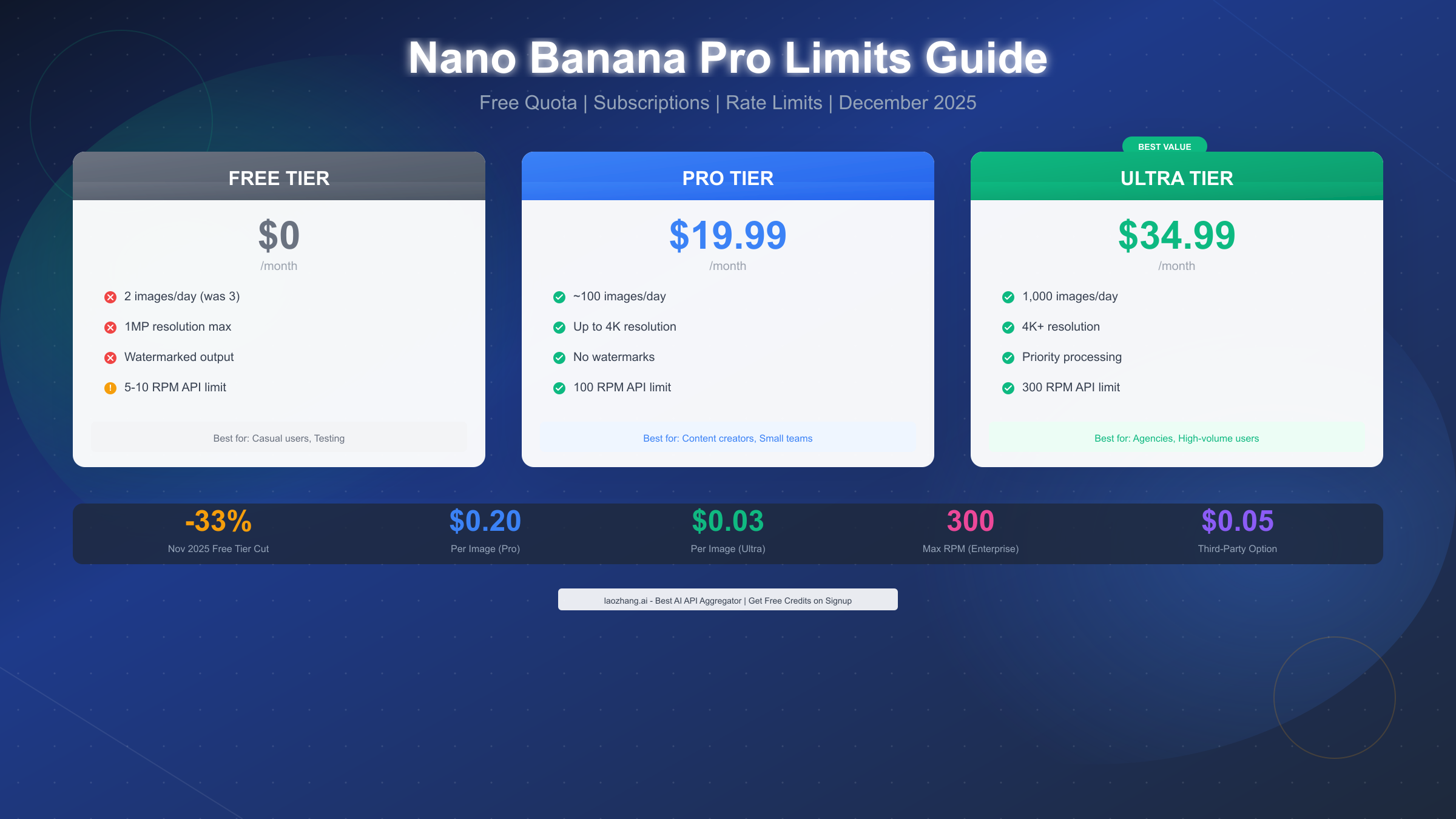
Free Tier provides the entry point for casual users exploring Nano Banana Pro's capabilities. As of December 2025, free users receive exactly 2 images per day—reduced from the original 3-image limit in November 2025. All free tier outputs are limited to 1-megapixel resolution (approximately 1024x1024 pixels) and include visible watermarks that cannot be removed. The daily quota resets at midnight Pacific Time (UTC-8), and unused images do not roll over to subsequent days. During peak usage periods, free tier requests experience deprioritization, often resulting in generation times of 30-60 seconds compared to the standard 3-second processing. Free users also lack access to advanced features including aspect ratio customization, style presets, and reference image inputs.
Pro Tier costs $19.99 per month through Google One AI Premium subscription and represents the sweet spot for most serious users. Pro subscribers receive approximately 100 images per day, though community reports from the Gemini Apps Community suggest actual limits may fluctuate between 85-120 images depending on server load and usage patterns. Pro tier unlocks full 4K resolution output (2048x2048 pixels), removes watermarks entirely, provides access to all style presets and aspect ratio options, and enables reference image inputs for consistent character generation. API access through Pro subscription includes enhanced rate limits of approximately 100 requests per minute.
Ultra Tier targets high-volume users and small agencies, priced between $34.99 and $99.99 per month depending on billing region and promotional offers. Ultra subscribers enjoy up to 1,000 images per day at full 4K+ resolution with priority processing that maintains consistent 2-3 second generation times even during peak demand. Additional Ultra benefits include early access to new features, priority customer support, and the ability to generate images with up to 14 reference inputs simultaneously.
API Rate Limits and Quotas
Developer API access operates independently of consumer subscriptions, following Google's standard AI Studio billing model. The free API tier provides a useful testing environment: 15 requests per minute (RPM), up to 1,500 requests per day (RPD), and 1 million tokens per minute for text processing associated with image prompts. According to Google's API documentation (https://ai.google.dev/pricing ), these limits reset at midnight UTC.
Paid API tiers unlock significantly higher throughput. After enabling billing on your Google Cloud project, you can access up to 300 RPM for enterprise-grade applications, with daily quotas scaling based on your billing tier. API pricing follows a per-image model: $0.134 per image for standard 1K/2K resolution outputs and $0.24 per image for 4K generation. The Batch API offers reduced rates—$0.067 per 1K/2K image and $0.12 per 4K image—for applications that can tolerate slight processing delays.
| Tier | Daily Images | Resolution | API RPM | Cost/Image |
|---|---|---|---|---|
| Free | 2 | 1MP | 5-10 | $0 |
| Pro ($19.99/mo) | ~100 | 4K | 100 | ~$0.20 |
| Ultra ($34.99+/mo) | 1,000 | 4K+ | 200 | ~$0.03 |
| API (Pay-per-use) | Based on billing | 4K | Up to 300 | $0.13-0.24 |
For teams requiring higher throughput without complex tier management, third-party API aggregators like laozhang.ai offer simplified pricing at approximately $0.05 per image with no daily caps—representing significant savings over Google's official API rates while providing comparable quality through their multi-model aggregation system.
What Changed: November 2025 Limit Reduction
The November 2025 reduction of free tier limits from 3 images to 2 images per day represents the most significant change to Nano Banana Pro's accessibility since launch. Understanding why this happened and what it signals for future policy helps users make informed decisions about their tier selection and alternative platforms.
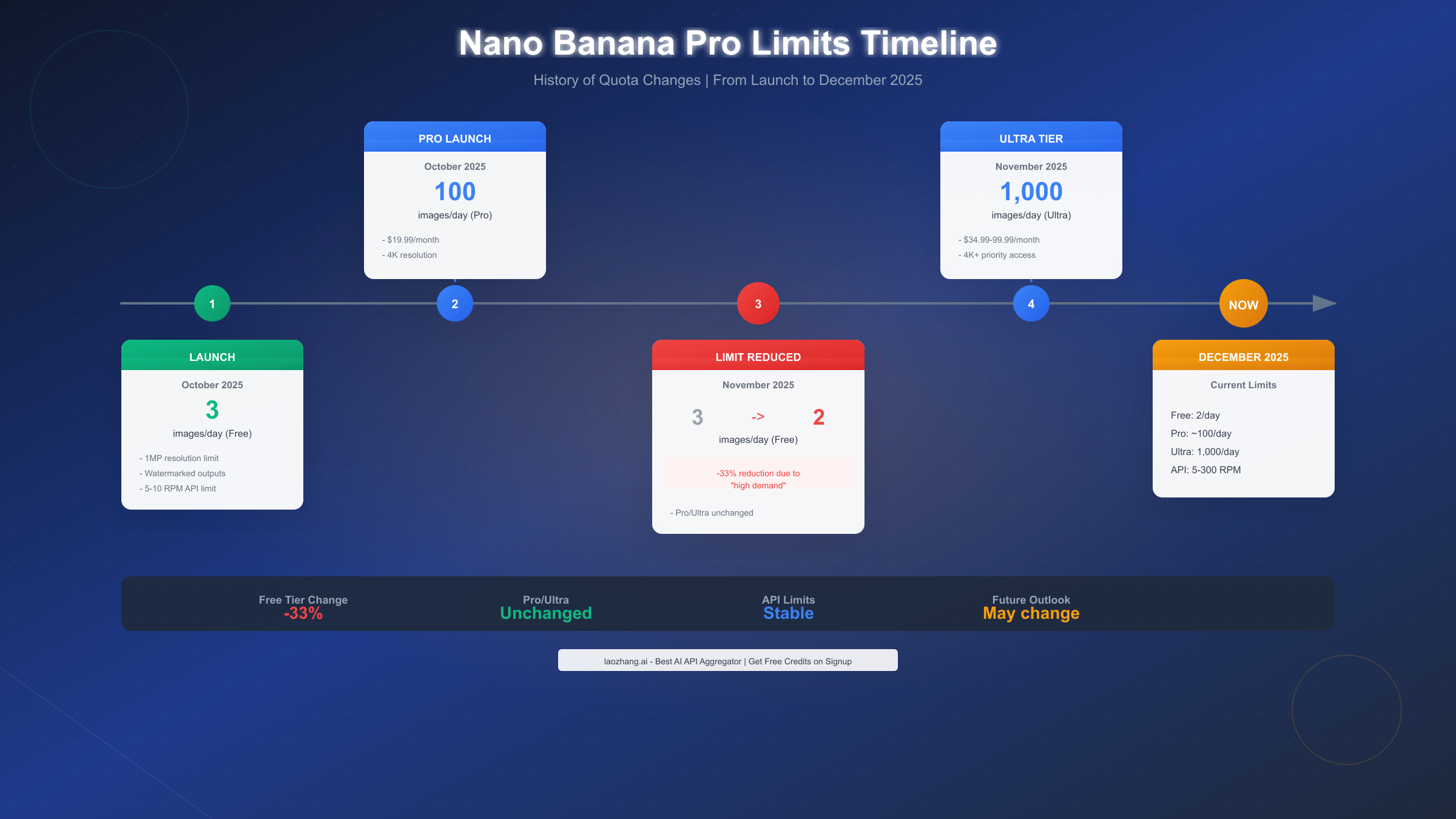
Google officially announced the reduction through the Gemini Apps interface with a brief notification stating that "image generation and editing is in high demand" and acknowledging that "limits may change frequently." This explanation, while accurate, left many users frustrated by the lack of advance notice and the 33% reduction in free tier capability. According to coverage from Engadget (https://www.engadget.com/ai/google-gemini-nano-banana-pro-limits-reduced/ ) and community discussions on Reddit's r/GoogleGemini, the backlash was immediate and substantial.
The underlying economics driving this decision involve computational costs that far exceed text-based AI interactions. Each Nano Banana Pro image generation requires significant GPU processing time—approximately 10-15 seconds of high-end NVIDIA A100 or H100 compute. At scale, the 3-image free tier was reportedly costing Google substantial infrastructure resources without corresponding revenue. The reduction to 2 images represents an estimated 33% decrease in free tier computational burden.
Pro and Ultra tiers remained unchanged during the November update, suggesting Google's strategy focuses on encouraging subscription conversions rather than broad limit reductions. Users generating more than 60 images per month (2 daily × 30 days) effectively need Pro tier to maintain productivity, which Google likely considers the natural conversion point.
Historical context shows this isn't the first AI platform to reduce free limits under demand pressure. OpenAI's DALL-E free tier went through similar contractions during 2024, and Midjourney eliminated its free trial entirely in early 2023 due to abuse. The pattern suggests that generous free tiers for image generation models face inherent sustainability challenges as user adoption grows.
Looking forward, Google's statement that "limits may change frequently" indicates the current 2-image free tier may not represent a permanent floor. Users relying on free access should maintain awareness of alternatives and consider whether the reliability of a paid tier better serves their needs. For those unwilling to commit to subscriptions, API aggregators provide a middle ground—if you need to generate more images than your free tier allows, pay-as-you-go services offer flexibility without monthly commitments.
Nano Banana Pro vs Competitors: Limits Comparison
Choosing the right AI image generator requires understanding how Nano Banana Pro's limits compare against alternatives like DALL-E 3, Midjourney, and third-party API providers. Each platform offers distinct trade-offs between price, quality, limits, and access models.
Free Tier Comparison
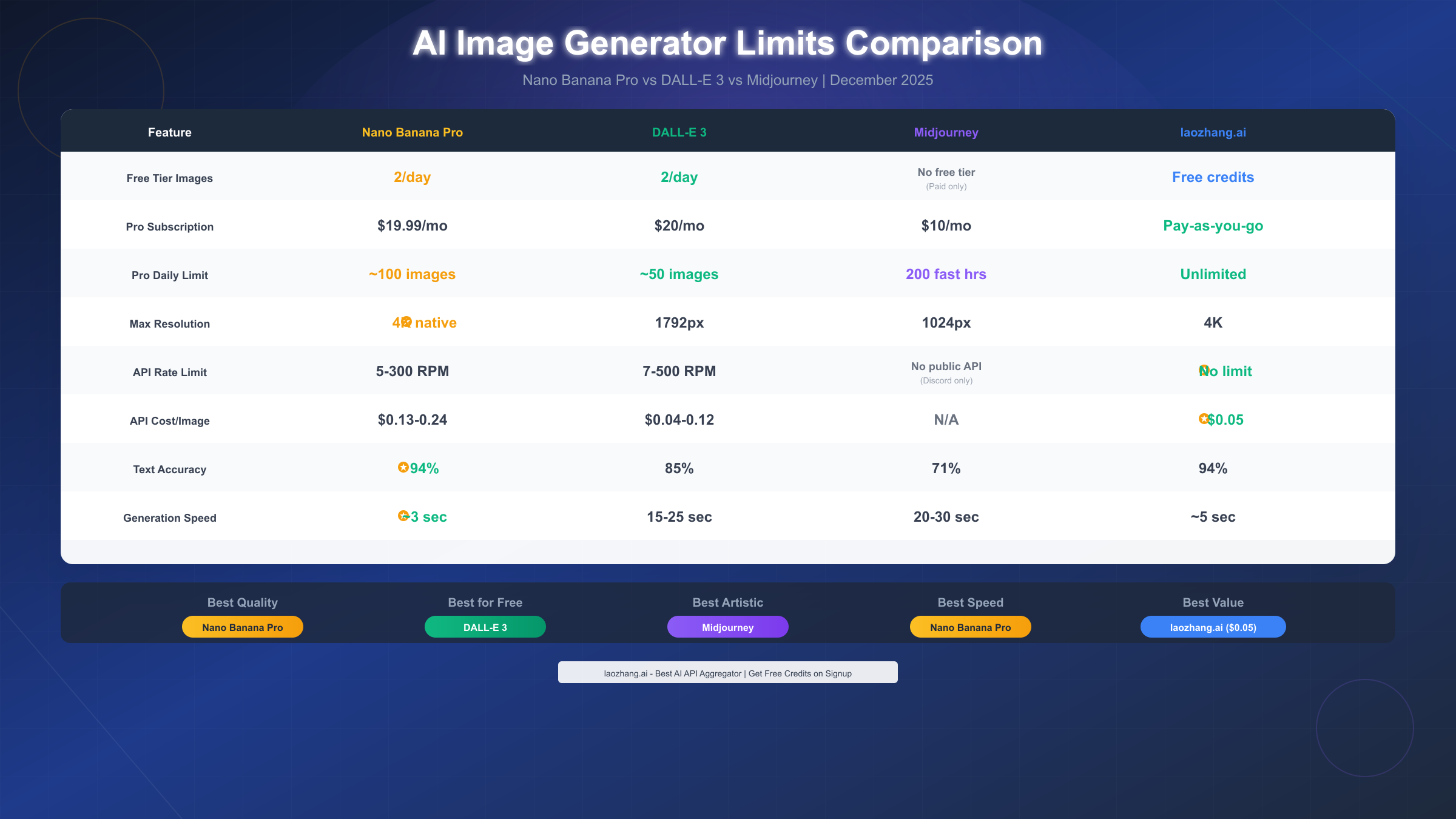
The free tier landscape varies dramatically across platforms. Nano Banana Pro and DALL-E 3 (through ChatGPT free) both offer 2 images per day as of December 2025. Midjourney, notably, provides no free tier whatsoever—users must subscribe from their first image. Stability AI's Stable Diffusion offers unlimited free generations through the open-source model, but requires local hardware capable of running inference, making it impractical for most casual users.
For users exploring AI image generation without financial commitment, DALL-E 3 through ChatGPT provides the most straightforward experience with comparable limits to Nano Banana Pro. However, Nano Banana Pro's superior text accuracy (94% vs 85%) and 10x faster generation times make it preferable for users who prioritize these capabilities over accessing a single unified interface.
Subscription Tier Comparison
Subscription economics favor different platforms depending on usage patterns. Midjourney's $10/month Basic plan offers the lowest entry price, but provides only 200 "fast hours" of generation time rather than discrete image counts—a confusing metric that roughly translates to 200-400 images depending on complexity. The "Relax" mode provides unlimited generations at deprioritized speeds, making Midjourney technically the cheapest option for users willing to accept slower processing.
Nano Banana Pro's $19.99 Pro tier at ~100 images/day (3,000/month) delivers a cost-per-image of approximately $0.007 at maximum usage—exceptional value for high-volume creators. DALL-E 3's $20/month ChatGPT Plus subscription provides approximately 50 images daily with DALL-E 3, translating to roughly $0.013 per image at full utilization. Understanding these subscription costs matters significantly when you're evaluating options for regular usage patterns.
API Access Comparison
Professional developers face the starkest differences in API accessibility. Nano Banana Pro provides official API access through Google AI Studio with clear per-image pricing ($0.13-0.24). DALL-E 3's API through OpenAI charges similar rates ($0.04-0.12 per image depending on resolution and quality settings). Midjourney, critically, offers no official public API—integrations require unofficial Discord automation or third-party proxy services, creating reliability and terms-of-service concerns.
For developers seeking straightforward, cost-effective API access, platforms like laozhang.ai aggregate multiple image models (including Nano Banana Pro equivalents) at $0.05 per image with no rate limits and simplified billing. This approach eliminates the complexity of managing multiple API relationships while delivering consistent pricing across different generation models. The Gemini API pricing structure provides additional context on official Google pricing tiers.
| Platform | Free Tier | Pro Price | Pro Images/Day | API Access | Cost/Image (API) |
|---|---|---|---|---|---|
| Nano Banana Pro | 2/day | $19.99/mo | ~100 | Official | $0.13-0.24 |
| DALL-E 3 | 2/day | $20/mo | ~50 | Official | $0.04-0.12 |
| Midjourney | None | $10/mo | 200 fast hrs | None (unofficial) | N/A |
| laozhang.ai | Free credits | Pay-as-you-go | Unlimited | Official | $0.05 |
Which Tier Is Right for You? Cost Analysis
Selecting the optimal tier requires honest assessment of your usage patterns, budget constraints, and feature requirements. This section provides concrete recommendations based on monthly image volume to help you make an informed decision.
Casual Users (1-60 images/month): The free tier adequately serves occasional users who need infrequent image generations for personal projects, social media posts, or curiosity-driven exploration. At 2 images per day, you can generate up to 60 images monthly without spending anything. The 1MP resolution limit and watermarks present minor inconveniences for most personal use cases. If you find yourself frequently hitting daily limits, consider whether your needs have outgrown the free tier rather than attempting workarounds that provide frustrating user experiences.
Content Creators (60-500 images/month): The Pro tier at $19.99/month represents the optimal choice for most content creators, marketers, and small business owners. At approximately 100 images daily (3,000 monthly capacity), you'll have substantial headroom beyond your actual needs. The 4K resolution, watermark removal, and advanced features justify the investment for anyone creating public-facing content. The effective cost of $0.007 per image at maximum usage beats every competitor's subscription economics.
High-Volume Users (500-3,000 images/month): Pro tier continues to deliver value at this volume, but users pushing toward the upper limits should evaluate Ultra tier economics. At $34.99/month for 1,000 daily images (30,000 monthly), Ultra's effective cost drops to $0.001 per image—virtually free at scale. The priority processing also eliminates queue delays that can impact production workflows during peak platform usage periods.
Developers and Agencies (3,000+ images/month): API-based billing becomes economically superior for high-volume programmatic usage. At $0.134 per standard image, 3,000 monthly generations cost $402 through official channels—significantly more than Ultra's $34.99. However, API access provides programmatic control, custom integration capabilities, and the ability to scale instantly without tier limitations. Third-party aggregators offer dramatic savings at $0.05 per image ($150 for 3,000 images), making them worth serious consideration for cost-conscious agencies.
Cost Optimization Strategies can significantly reduce your effective spending regardless of tier. Batch your generations during off-peak hours (typically 2-6 AM Pacific) when server load is lowest. For API users, implement caching for repeated prompts and utilize the Batch API's reduced pricing when immediate results aren't required. Consider maintaining multiple accounts for different projects to isolate quota consumption, though ensure this complies with Google's terms of service.
Unlimited Alternatives: Third-Party APIs
Users frustrated by Nano Banana Pro's limits have viable alternatives through third-party API aggregators and open-source solutions. These options trade certain conveniences for higher limits, lower costs, or different capability profiles.
Third-Party API Aggregators provide the most straightforward path to higher limits without operational complexity. Services like laozhang.ai aggregate access to multiple image generation models—including Gemini-based alternatives comparable to Nano Banana Pro—at significantly reduced per-image costs. The typical pricing of $0.05 per image represents approximately 80% savings versus Google's official API rates, with no daily caps or rate limit restrictions beyond reasonable abuse prevention. These platforms handle authentication, billing, and model routing, simplifying integration for developers who would otherwise manage multiple vendor relationships.
The primary trade-off involves dependency on a third-party intermediary. Response times may vary slightly, and you're relying on the aggregator's continued operation and pricing stability. For production applications, evaluate the provider's track record, uptime guarantees, and support responsiveness before committing. The documentation at https://docs.laozhang.ai/ provides detailed API specifications for integration planning.
Open-Source Alternatives offer maximum control and effectively unlimited generations, but require local compute resources. Stable Diffusion 3, FLUX.1, and similar open-source models can run on consumer GPUs (NVIDIA RTX 3070 or better) or cloud compute instances. The initial setup complexity is higher, and quality varies compared to commercial offerings, but operational costs drop to electricity and cloud compute fees only.
For users interested in the Midjourney API approach, unofficial integrations exist but carry terms-of-service risks and reliability concerns. The lack of official API access makes Midjourney problematic for production applications despite its excellent artistic output quality.
Hybrid Approaches often deliver the best practical outcomes. Use free tier for initial concept iteration, then generate final outputs through paid tier or API for production quality. Implement local Stable Diffusion for high-volume exploratory work where quality variability is acceptable, reserving commercial APIs for client deliverables and polished content.
API Rate Limits Deep Dive
Developers integrating Nano Banana Pro require detailed understanding of rate limit mechanics beyond simple RPM figures. This section covers technical implementation details, error handling, and optimization strategies for production deployments.
Understanding Rate Limit Tiers
Google's API rate limiting operates on rolling windows rather than hard resets, meaning your available capacity continuously regenerates as older requests age out of the window. The free tier's 5-10 RPM limit provides approximately one request every 6-12 seconds sustained. Exceeding this rate triggers HTTP 429 responses with Retry-After headers indicating when to resume requests.
Paid tier limits scale with billing level: 100 RPM for standard paid access, 200 RPM for high-volume accounts, and up to 300 RPM for enterprise agreements. Request the specific limits for your account through Google Cloud Console's quotas dashboard, as promotional periods or account history may affect your actual allocation.
Token consumption adds complexity beyond simple request counting. Each image generation request consumes tokens based on prompt length, with approximately 1,000 tokens per average prompt. The free tier's 1 million tokens per minute limit rarely constrains image generation workflows, but complex multi-turn conversations with extensive prompt engineering may approach this ceiling.
Production Implementation Patterns
Robust production implementations require exponential backoff with jitter to handle rate limit responses gracefully:
import time
import random
from google import generativeai as genai

def generate_with_retry(prompt, max_retries=5, base_delay=1):
    for attempt in range(max_retries):
        try:
            response = genai.GenerativeModel('gemini-3-pro-image').generate_content(prompt)
            return response
        except Exception as e:
            if '429' in str(e) or 'rate limit' in str(e).lower():
                delay = base_delay * (2 ** attempt) + random.uniform(0, 1)
                print(f"Rate limited. Retrying in {delay:.2f} seconds...")
                time.sleep(delay)
            else:
                raise
    raise Exception("Max retries exceeded")
For high-throughput applications, implement request queuing with rate-aware scheduling. Track your remaining quota through response headers (X-RateLimit-Remaining, X-RateLimit-Reset) and proactively throttle requests before hitting hard limits. This prevents 429 cascades that can severely impact user experience.
Monitoring and Optimization
Production deployments should implement comprehensive monitoring for rate limit metrics. Track 429 response rates, average generation times, and quota utilization patterns. Set alerts for approaching limits (e.g., 80% quota consumption) to enable proactive scaling or request redistribution.
Request optimization reduces quota consumption without sacrificing output quality. Cache frequently-used prompts and their outputs when appropriate for your use case. Batch similar requests when the Batch API's slightly higher latency is acceptable. Consider implementing a hybrid architecture that routes time-sensitive requests to primary API access while queueing non-urgent generations for batch processing at reduced rates.
For applications requiring consistent high throughput without rate limit management complexity, API aggregators handle this infrastructure layer, providing effectively unlimited access at predictable per-request pricing.
Troubleshooting: When You Hit the Limit
Even with careful planning, users encounter limit-related issues requiring prompt resolution. This section covers common scenarios, diagnostic approaches, and resolution strategies.
"You've reached your daily limit" appears when consumer tier quotas are exhausted. This message is definitive—no workaround exists within the same account until the midnight Pacific reset. Verify your actual quota status through Gemini App settings, as occasionally this error triggers prematurely due to backend synchronization issues. If your count shows available quota but errors persist, wait 15-30 minutes for system synchronization before contacting support.
HTTP 429 "Too Many Requests" in API contexts indicates rate limit violations. The response includes a Retry-After header specifying the wait time in seconds. Implement the exponential backoff pattern from the previous section rather than immediately retrying. Persistent 429 errors may indicate your requests are being flagged for suspicious patterns—vary your request timing and ensure prompt diversity to avoid automated abuse detection.
"Image generation temporarily unavailable" typically indicates platform-wide capacity constraints rather than personal limit issues. Check Google's status page (status.cloud.google.com) and community forums for confirmation. During major outages, all tiers experience degradation regardless of subscription level. Consider maintaining failover to alternative generation platforms for mission-critical applications.
Quota consumed by failed generations frustrates users whose limit decreases despite receiving error responses. This occurs when content policy violations or generation failures happen after resource allocation. Google's system allocates compute resources before generating output, and policy-rejected images still consume quota. Review your prompts for policy compliance—explicit content, real person likeness, and certain protected subjects trigger rejection. The Gemini regional restrictions guide provides additional context on content policies.
Resolution escalation path: If standard troubleshooting fails, consumer tier users should contact Google One support through their subscription portal. API users should file issues through Google Cloud Console's support system, providing request IDs and timestamps for specific failures. Enterprise agreements typically include dedicated support channels with faster response times.
Summary and FAQ
Nano Banana Pro's limit structure balances accessibility with sustainability, offering meaningful free access while reserving higher capabilities for paying users. The November 2025 free tier reduction from 3 to 2 images reflects platform growth pressures common across AI image services. Understanding your usage patterns enables optimal tier selection, whether that's maximizing free tier value, subscribing for professional capability, or leveraging API access for development applications.
The competitive landscape offers viable alternatives depending on priorities. DALL-E 3 matches free tier limits with a different creative aesthetic. Midjourney delivers distinctive artistic output but requires subscription from day one. Third-party API aggregators provide cost-effective unlimited access for users prioritizing volume over vendor relationship simplicity.
Frequently Asked Questions
How many images can I generate for free with Nano Banana Pro?
Free tier users can generate 2 images per day as of December 2025. This limit reset at midnight Pacific Time and does not roll over. Free images are limited to 1-megapixel resolution and include watermarks.
Did Nano Banana Pro reduce its limits recently?
Yes, in November 2025, Google reduced free tier limits from 3 images to 2 images per day, citing high demand. Pro and Ultra tier limits remained unchanged at approximately 100 and 1,000 images per day respectively.
What are the Nano Banana Pro API rate limits?
Free API access provides 5-10 RPM with 1,500 daily requests. Paid API tiers offer 100-300 RPM depending on billing level, with per-image costs of $0.134-0.24 for standard to 4K resolution.
Is there an unlimited Nano Banana Pro option?
Google's official tiers have daily caps, but third-party API aggregators offer effectively unlimited access at approximately $0.05 per image. The Ultra tier's 1,000 daily images approaches practical unlimited for most individual users.
How does Nano Banana Pro compare to DALL-E and Midjourney limits?
Nano Banana Pro and DALL-E 3 both offer 2 free images daily. Midjourney has no free tier. For subscriptions, Nano Banana Pro's ~100 images/day at $19.99 exceeds DALL-E's ~50/day at $20 and Midjourney's time-based model at $10.
When do Nano Banana Pro limits reset?
Consumer tier limits reset at midnight Pacific Time (UTC-8). API rate limits operate on rolling windows, continuously regenerating capacity. Token limits reset at midnight UTC.
For the most current limit information and alternative access methods, consult Google's official documentation and third-party API aggregator services that provide transparent pricing and simplified access for high-volume users.