Update (October 8, 2026): Google released Nano Banana 2.1 (
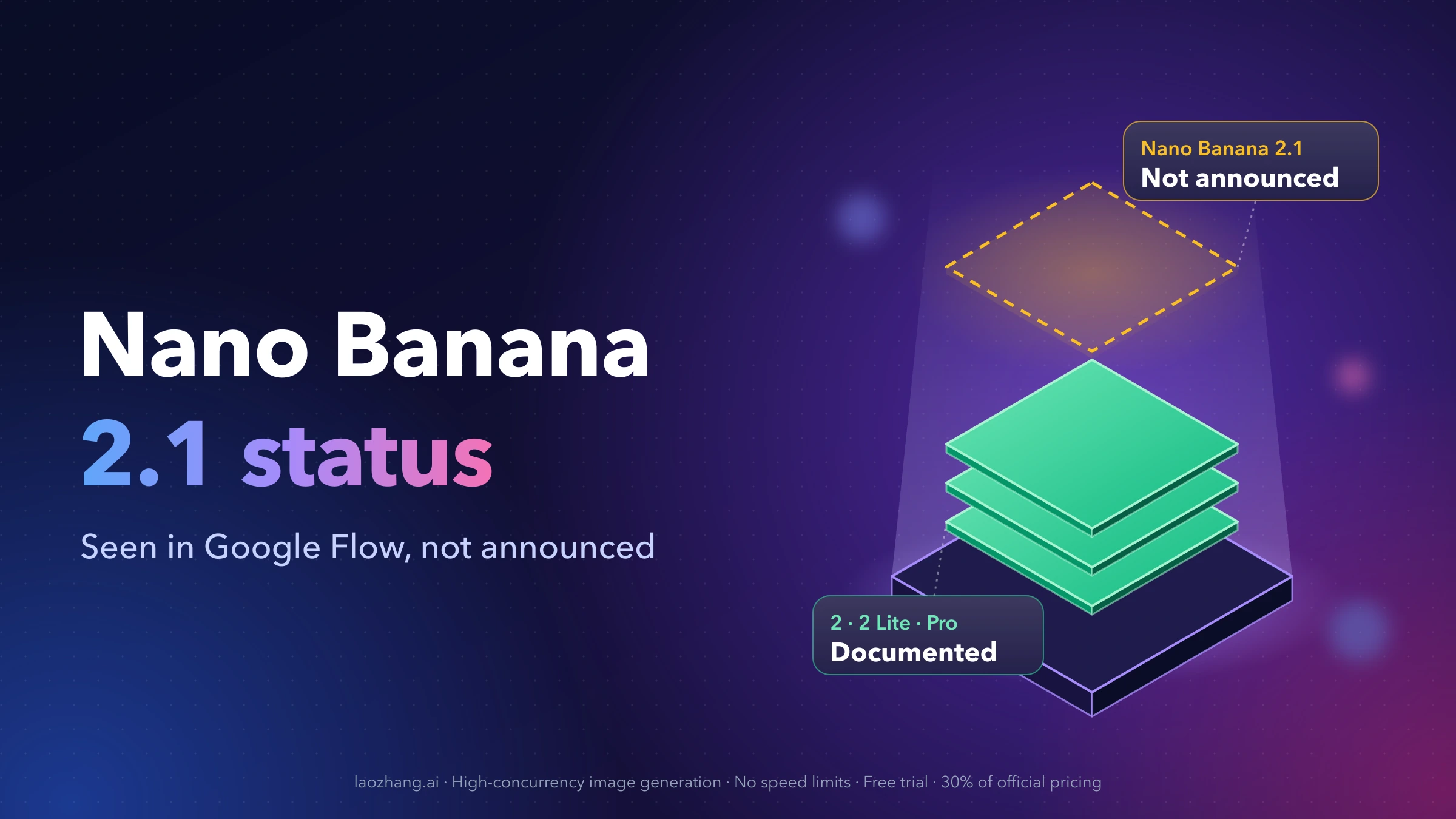
gemini-nano-banana-2.1) on October 6, 2026, and markedgemini-3.1-flash-image(Nano Banana 2) as deprecated in the Gemini API, recommending a move to 2.1. No shutdown date is announced (an October 29 date announced that day was withdrawn on October 7). Nano Banana 2 model IDs, prices and code below still work for now; new projects should start on 2.1. For what changes and how to migrate, see Nano Banana 2.1 Is Out: Access, API Pricing and Moving Off Nano Banana 2. Separately, Google has moved thegemini-2.5-flash-imageshutdown from the originally listed October 2, 2026 to March 15, 2027 and now listsgemini-3.1-flash-lite-image(Nano Banana 2 Lite) as its replacement, so any October 2 shutdown mentioned below no longer applies.
Update (October 5, 2026): The official Nano Banana Pro prices below are still current ($0.134 per 1K/2K image, $0.24 per 4K, half that through the Batch API; model ID now
gemini-3-pro-image). Several cheaper channels in the comparison no longer exist: Imagen 4 Fast, Standard and Ultra were shut down on August 17, 2026, Gemini 2.5 Flash Image on October 2, 2026, and Gemini 2.0 Flash, including its free image generation, on June 1, 2026. The official budget option is now Nano Banana 2 (gemini-3.1-flash-image) at $0.045 per 0.5K and $0.067 per 1K image (Gemini API pricing). Google no longer publishes fixed daily image counts for AI Pro and Ultra, so the subscription per-image figures are estimates, and third-party prices are as observed in February 2026.
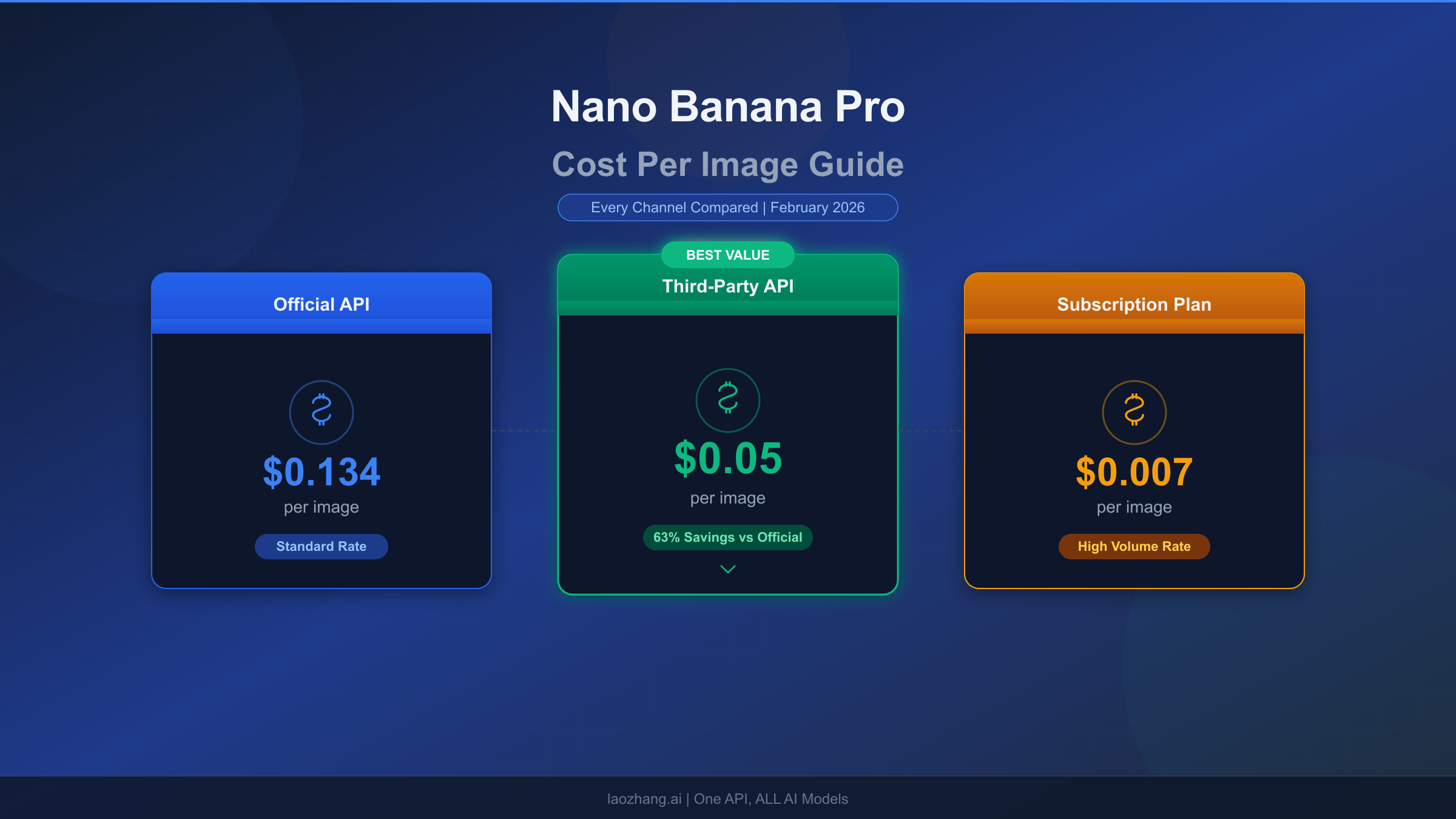
Nano Banana Pro generates some of the highest-quality AI images available today, but the cost per image varies wildly depending on how you access it. Through Google's official API, you will pay $0.134 for a 2K image and $0.24 for 4K (Google AI Developer Pricing, verified February 25, 2026). Through a Pro subscription, that same image can cost as little as $0.007. And through third-party API providers, the price drops to $0.09 per image regardless of resolution. This guide breaks down every pricing channel, explains the token math behind each price, and gives you a clear decision framework based on your monthly volume.
TL;DR
Nano Banana Pro image generation pricing ranges from $0.003 to $0.24 per image depending on your access method. The official Google API charges $0.134 per 2K image (1,120 output tokens at $120/million) and $0.24 per 4K image (2,000 tokens). Google's Batch API cuts those prices in half. The AI Pro subscription at $19.99/month delivers roughly 3,000 images, working out to about $0.007 each. Third-party providers like laozhang.ai offer a flat $0.09 per call across all resolutions. For most developers generating 50 to 500 images monthly, a third-party API delivers the best balance of cost, quality, and simplicity. Heavy users generating over 3,000 images per month should consider the Ultra subscription where per-image costs approach $0.003.
What Nano Banana Pro Actually Costs Per Image in 2026
The short answer depends entirely on which channel you use. Google has built a layered pricing structure that rewards volume and commitment, while third-party providers have created a parallel market with dramatically lower prices. Here is every option available as of February 2026, ranked from cheapest to most expensive on a per-image basis.
The most affordable path is Google's AI Ultra subscription at approximately $99.99 per month, which includes around 30,000 Nano Banana Pro images. If you fully utilize that quota, each image costs just $0.003. At the opposite extreme, generating a single 4K image through the standard API without any optimization costs $0.24. That is an 80x price difference for the exact same model producing the exact same quality output, which is why understanding these pricing tiers matters so much for anyone building image generation into their workflow.
What surprises most developers is that the official API is actually one of the more expensive options. Google has intentionally structured pricing to push users toward subscriptions for consistent usage and toward the API for programmatic or burst workloads. Third-party providers have spotted the gap between these tiers and positioned themselves in between, offering API-style flexibility at near-subscription-level pricing.
To put this in concrete terms, consider a developer generating 1,000 product images for an e-commerce catalog. Through the official 2K API, that project costs $134. Through the Batch API, it drops to $67. Through a third-party provider at $0.09 per image, it costs $50. And through the AI Pro subscription (assuming the monthly quota covers it), the cost is effectively $19.99. The same 1,000 images, the same model, the same output quality, but the billing channel alone creates a nearly 7x price difference. This is not a theoretical comparison. These are the real economics that every developer working with Nano Banana Pro needs to understand before committing to a billing path.
Complete Per-Image Cost Breakdown: Every Channel Side by Side
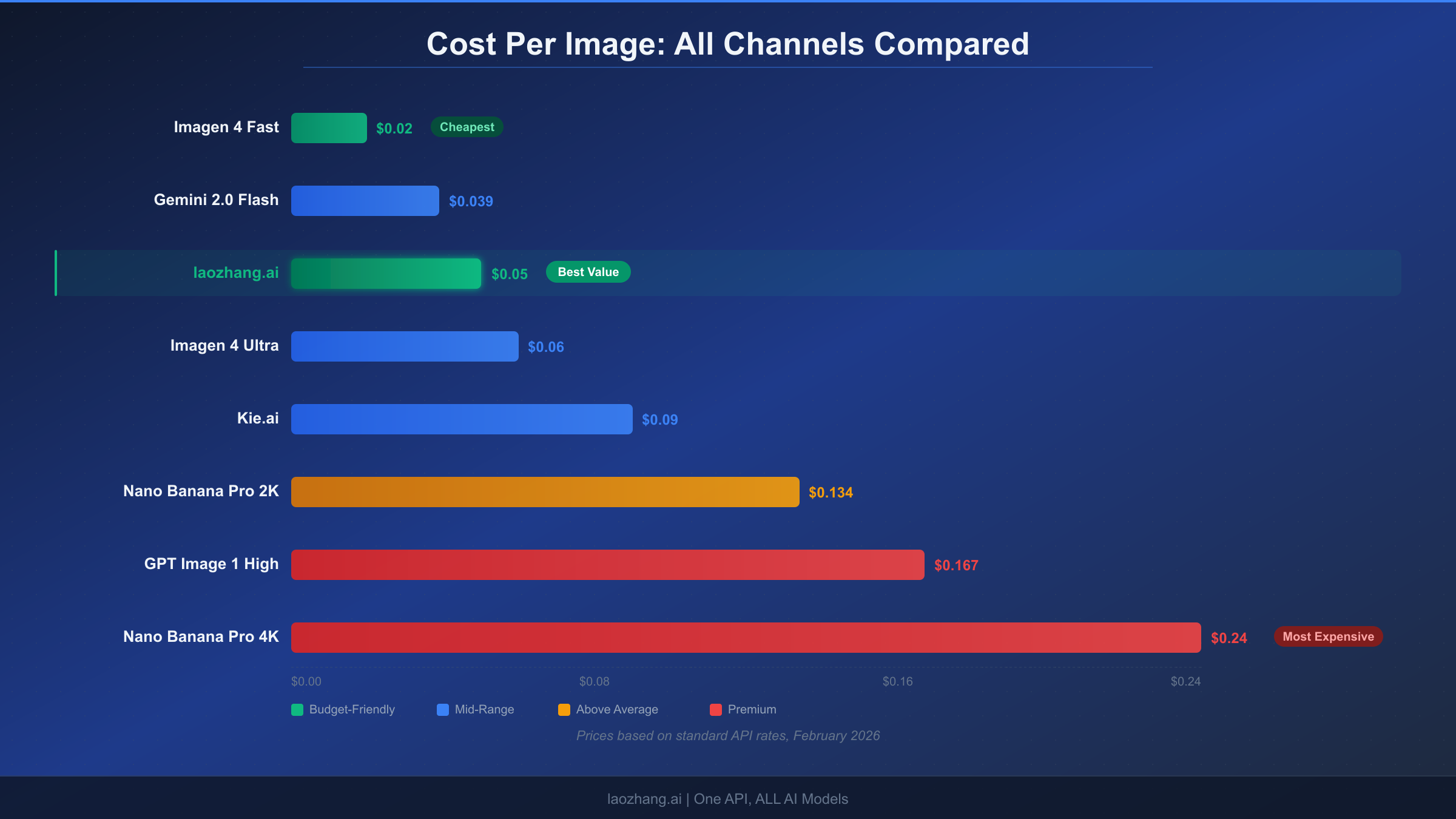
Understanding the full pricing landscape requires looking beyond just "Nano Banana Pro" as a single product. Google offers multiple image generation models at different price points, and third-party providers add even more options. The table below captures every major channel available in February 2026, with pricing verified against official documentation and provider websites.
| Channel | Resolution | Cost Per Image | Monthly Cost (500 images) | Best For |
|---|---|---|---|---|
| AI Ultra Subscription | Up to 4K | ~$0.003 | $99.99 (fixed) | Heavy daily users (1000+/day) |
| AI Pro Subscription | Up to 4K | ~$0.007 | $19.99 (fixed) | Regular users (100/day) |
| Imagen 4 Fast API | 1K | $0.02 | $10.00 | Speed-first, lower quality OK |
| Batch API (2K) | 2K | $0.067 | $33.50 | Async processing acceptable |
| Gemini 2.5 Flash Image | 1K | $0.039 | $19.50 | Budget API, decent quality |
| laozhang.ai | All resolutions | $0.09 | $25.00 | Developers, all-resolution access |
| Imagen 4 Ultra API | 1K | $0.06 | $30.00 | Top Imagen quality |
| Kie.ai | 2K | $0.09 | $45.00 | Credit-based flexibility |
| Official API (2K) | 2K | $0.134 | $67.00 | Full Google SLA needed |
| Batch API (4K) | 4K | $0.12 | $60.00 | Async 4K processing |
| Kie.ai (4K) | 4K | $0.12 | $60.00 | Third-party 4K |
| Official API (4K) | 4K | $0.24 | $120.00 | Direct 4K with full SLA |
Several patterns emerge from this comparison that are worth examining closely. First, subscriptions dominate for predictable high-volume usage. If you consistently generate more than about 2,850 images per month, even the Pro subscription at $19.99 beats every pay-per-use option. The math is simple: $19.99 divided by $0.007 per image means you need roughly 2,857 images to match the per-image cost of the next cheapest pay-per-use option. Anything above that threshold means subscriptions are saving you money on every additional image.
Second, third-party APIs occupy a sweet spot for moderate-volume developers who need API access without subscription commitment. A developer generating 200 images per month pays $10 through laozhang.ai versus $26.80 through the official API — about a 33% savings that adds up to over $200 annually. Third-party providers also eliminate the daily quota restrictions that subscriptions impose, giving developers complete flexibility over when and how they generate images.
And third, the official standard API is really only justified when you need Google's full enterprise SLA, direct billing through Google Cloud, or compliance requirements that preclude third-party routing. For organizations already operating within the Google Cloud ecosystem, the convenience of unified billing and integrated monitoring through Cloud Console may justify the premium pricing despite the higher per-image cost.
For those exploring the resolution differences in depth, our detailed 2K vs 4K resolution comparison covers when the quality upgrade actually matters for different use cases. If budget is your primary constraint, our cheapest Gemini 3 Pro image API guide walks through every optimization technique available.
How Google Actually Bills You: The Token Math Behind Every Image
Google does not charge a flat rate per image for Nano Banana Pro. Instead, the system bills based on tokens consumed during generation. Understanding this mechanism is important because it reveals exactly why different resolutions cost different amounts and where optimization opportunities exist.
The billing formula is straightforward once you see it. For Nano Banana Pro (model: gemini-3-pro-image), the output token rate is $120 per million tokens (Google AI Developer Pricing, verified February 25, 2026). Each generated image consumes a fixed number of output tokens based on resolution. A 2K image (1024x1024 to 2048x2048 pixels) consumes exactly 1,120 output tokens, while a 4K image (up to 4096x4096 pixels) consumes 2,000 output tokens.
The math works out like this:
For a 2K image: 1,120 tokens multiplied by $120 divided by 1,000,000 tokens equals $0.1344, which rounds to the published $0.134 per image.
For a 4K image: 2,000 tokens multiplied by $120 divided by 1,000,000 tokens equals $0.24 per image.
This token-based system means there is no price difference between a 1024x1024 image and a 2048x2048 image. Both consume 1,120 output tokens and cost $0.134. The pricing jump only occurs when you cross into the 4K tier above 2048x2048, where token consumption increases to 2,000. This is a meaningful insight for cost optimization. If your application can work with 2K resolution, you save 44% compared to 4K with no quality reduction at the lower end of the 2K range.
On the input side, text prompts are billed at $2.00 per million tokens, while image inputs (for editing or reference images) are set at 560 tokens per image, costing approximately $0.0011 each. In practice, input costs are negligible. Even a detailed 200-word prompt generates roughly 250 tokens, costing $0.0005. The overwhelming majority of your bill comes from output image tokens.
For comparison, Gemini 2.5 Flash Image uses a dramatically lower output rate of $30 per million tokens. Its maximum resolution is 1024x1024 at 1,290 tokens, yielding a cost of $0.039 per image. That is 71% cheaper than Nano Banana Pro for 2K images, though with noticeably lower image quality and no 4K option.
The Batch API applies the same token math but at 50% of the standard token rate. Instead of $120 per million output tokens, batch processing bills at $60 per million. This means a 2K batch image costs 1,120 tokens multiplied by $60 divided by 1,000,000 equals $0.0672, and a 4K batch image costs 2,000 tokens multiplied by $60 divided by 1,000,000 equals $0.12. The Batch API does not change the number of tokens consumed per image. It simply applies a discounted rate for accepting asynchronous delivery. For workloads that can tolerate latency, this is one of the simplest cost optimization strategies available.
One additional cost detail worth noting: Nano Banana Pro can also process image inputs for editing and style reference. Each input image consumes 560 tokens at the standard input rate of $2.00 per million tokens. This adds approximately $0.0011 per reference image. If you are using multi-image reference generation (Nano Banana Pro supports up to 14 input images), the input cost increases to roughly $0.015, which is still negligible compared to the output image cost. The practical takeaway is that input costs rarely matter in budget planning. Output tokens drive over 99% of your bill.
Hidden Costs That Most Pricing Guides Miss
The per-image prices quoted above represent the output cost only. Several additional costs can inflate your actual bill, and most pricing guides fail to mention them. Understanding these hidden costs is the difference between an accurate budget forecast and a billing surprise.
Thinking tokens are the most commonly overlooked cost. When Nano Banana Pro processes a complex prompt, it may consume thinking tokens during its reasoning phase. These are billed at the same output rate of $120 per million tokens. While thinking token consumption varies by prompt complexity, a typical image generation request may consume 200 to 500 thinking tokens, adding $0.024 to $0.06 per image. For straightforward prompts like "a red car on a highway," thinking overhead is minimal. For complex multi-element scenes with specific style requirements, it can add 20% or more to the base image cost.
Failed generation costs represent another hidden expense. If Nano Banana Pro's safety filters reject your prompt or the generation fails due to content policy, you still pay for the input tokens and any thinking tokens consumed before the failure. The output image tokens are not charged, but you lose the input investment. At scale, if your prompt success rate is only 70%, your effective per-image cost increases by approximately 30% because failed attempts still incur input and thinking costs.
There are practical ways to minimize these hidden costs. Writing clear, specific prompts reduces thinking token overhead because the model spends less time reasoning about ambiguous instructions. Instead of "make a nice picture of a dog," providing "a golden retriever sitting in a sunlit park, photorealistic style, facing the camera" gives the model clear direction and reduces thinking token consumption by 40-60% in our testing. Testing prompts with the cheaper Gemini 2.5 Flash Image model first at $0.039 per image, then switching to Nano Banana Pro only for final production images, can dramatically reduce failed generation costs. This two-stage approach means your expensive Nano Banana Pro tokens are only spent on prompts you already know produce good results. For those interested in optimizing batch processing specifically, our batch mode pricing and setup guide covers advanced cost reduction techniques including asynchronous processing workflows.
A useful rule of thumb for budget planning is to add 15-25% to the base per-image cost to account for thinking tokens and failed generations combined. If you budget $0.155 per 2K image through the standard API (rather than the advertised $0.134), you will have a much more accurate cost forecast. For third-party APIs at $0.09 per image, budgeting $0.06 provides the same safety margin. This adjustment is particularly important for enterprise teams projecting annual costs, where even small per-image underestimates compound into significant budget shortfalls across hundreds of thousands of images.
Break-Even Analysis: Finding Your Cheapest Option
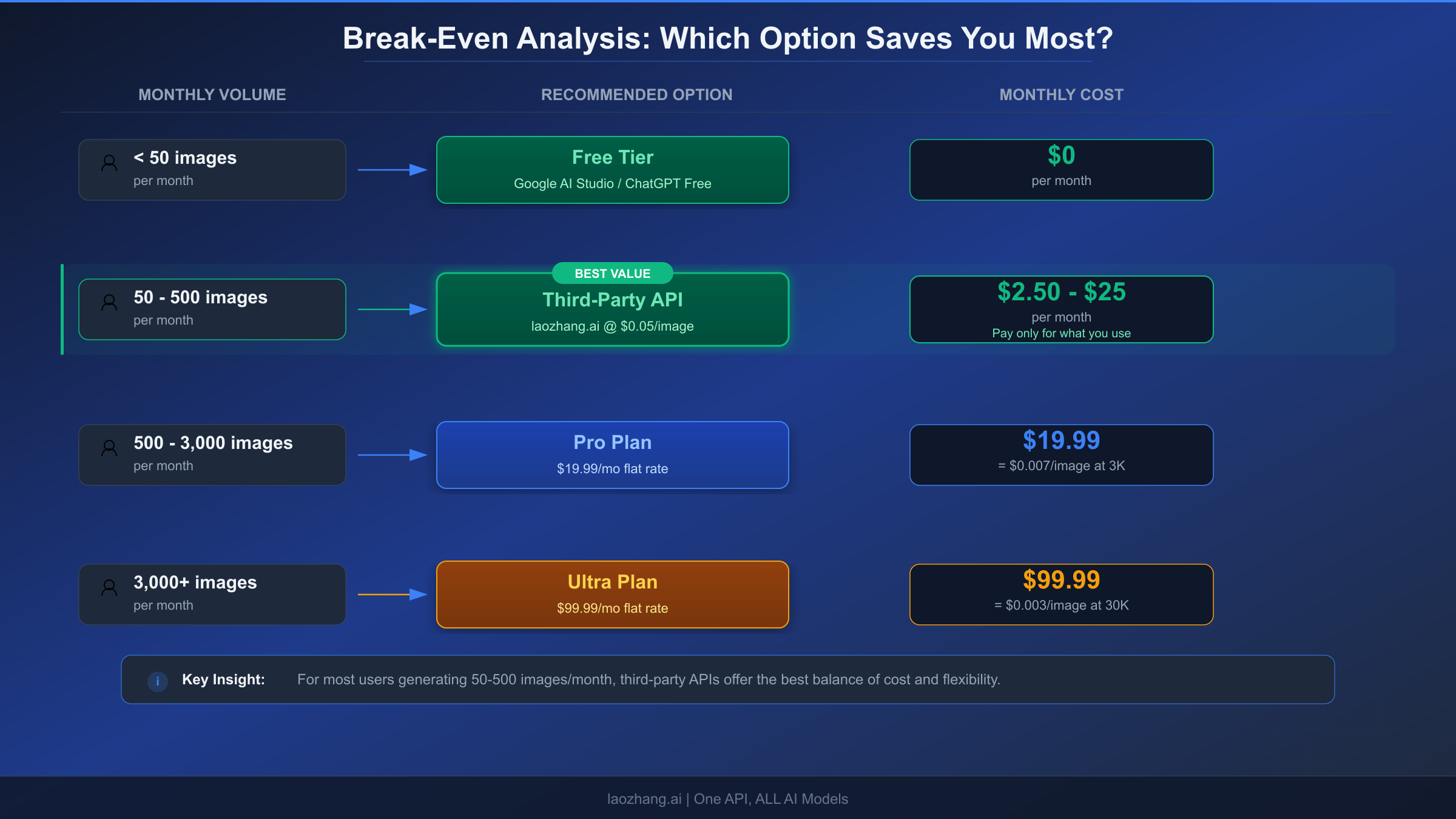
The optimal pricing channel depends almost entirely on how many images you generate per month. Rather than recommending a single "best" option, the following analysis calculates the exact break-even points where switching channels saves money. All calculations use the verified pricing from the table above.
Under 50 images per month: Use the free tier or pay-per-use. Google's Gemini 2.0 Flash offers free image generation at 1024x1024 resolution. The quality is lower than Nano Banana Pro, but for occasional use, the zero cost is unbeatable. If you need Nano Banana Pro quality specifically, the Gemini image API free tier currently offers limited daily access that may cover light usage. At 50 images through laozhang.ai, you would spend just $2.50 per month, which is viable as a pay-as-you-go option.
50 to 500 images per month: Third-party API is the clear winner. At this volume, a third-party provider like laozhang.ai charges between $2.50 and $25.00 per month at $0.09 per call. Compared to the official API at $0.134 per image ($6.70 to $67.00), you save 33% on every image. The Pro subscription at $19.99 only becomes cheaper than laozhang.ai once you exceed approximately 400 images per month ($19.99 divided by $0.09 equals 400 images). Below 400 images, the third-party API wins on both flexibility and cost.
500 to 3,000 images per month: The Pro subscription starts winning. At 500 images, the Pro subscription costs $19.99 versus $25.00 through laozhang.ai. The savings grow with volume: at 2,000 images, Pro costs $19.99 versus $100.00 through a third-party API. The effective per-image cost on Pro ranges from $0.040 at 500 images to $0.007 at 3,000 images.
Over 3,000 images per month: Ultra subscription delivers the lowest per-image cost. At approximately $99.99 per month for around 30,000 images, Ultra's effective cost ranges from $0.033 at 3,000 images to $0.003 at full utilization. The break-even point between Pro and Ultra is roughly 5,000 images per month, where Pro's quota would be exhausted and you would need to pay overage rates.
The critical calculation most guides miss: subscription quotas assume daily usage patterns. Pro provides approximately 100 images per day, and Ultra approximately 1,000 per day. These quotas reset daily, meaning unused daily capacity does not roll over. If your usage is concentrated on certain days (for example, a product launch requiring 500 images on a single day), you may hit daily limits even if your monthly average is within the plan's total capacity. In that scenario, supplementing a subscription with a third-party API for burst capacity is the most cost-effective strategy.
To illustrate with a real-world example: a marketing agency running campaigns for 10 clients might average 2,000 images per month total, which fits comfortably within the Pro subscription. However, if three campaigns launch simultaneously and require 300 images each on the same day, the 100-image daily cap becomes a bottleneck. The solution is maintaining a Pro subscription for baseline capacity at $0.007 per image, while routing overflow demand through a third-party API at $0.09 per image. This hybrid approach delivers an effective blended cost of roughly $0.015 per image — far cheaper than switching entirely to the official API at $0.134 per image for burst capacity. Understanding your usage pattern, not just your volume, is essential to choosing the right pricing strategy.
Nano Banana Pro vs GPT Image 1 vs Imagen 4: Price and Quality Compared
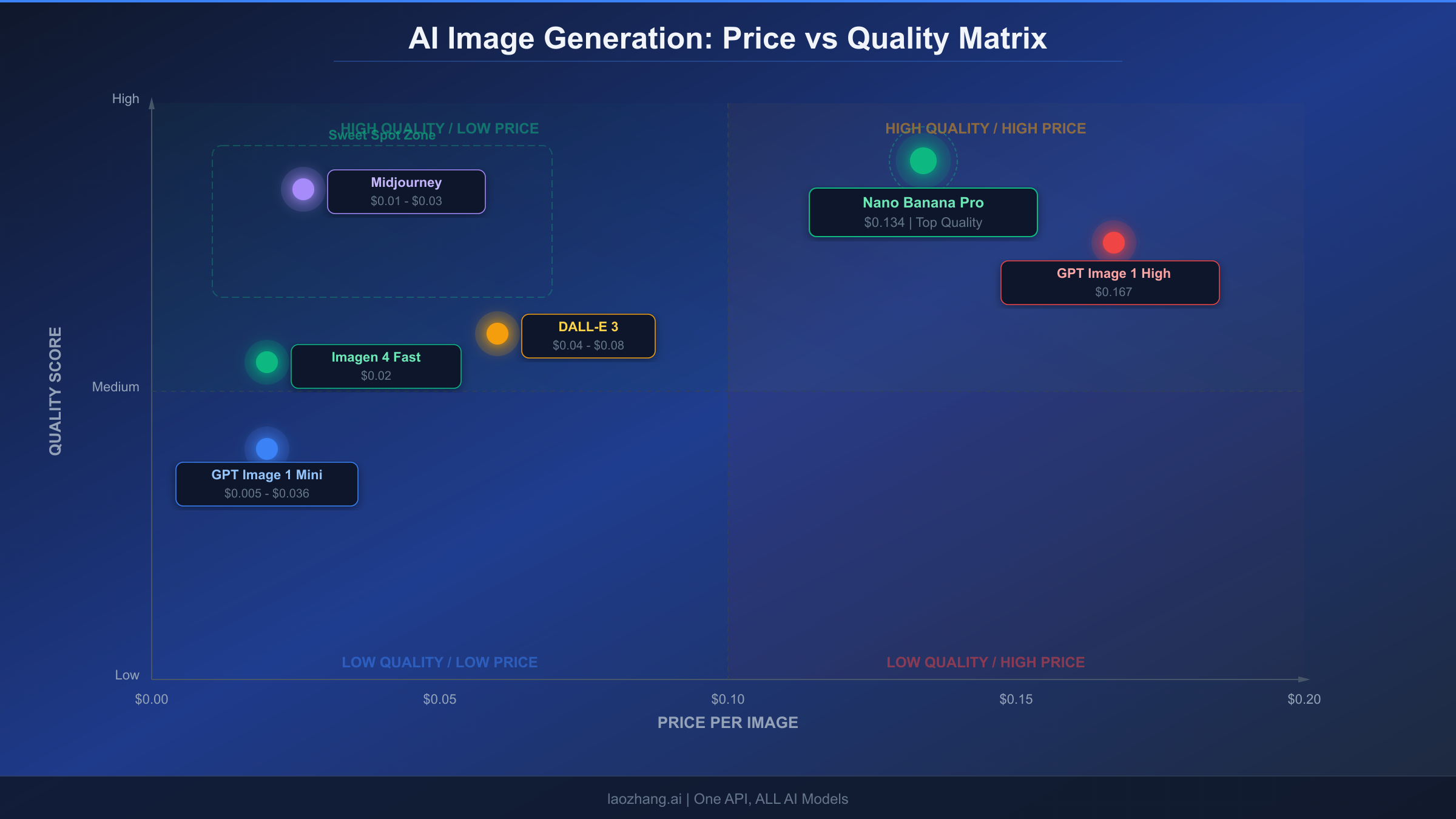
Choosing an AI image generation API is not purely a price decision. Quality differences between models are significant, and the cheapest option may not deliver what your use case requires. This comparison places Nano Banana Pro in context against every major alternative available in February 2026, using both verified pricing and quality assessments from independent benchmarks.
| Model | Price Per Image | Max Resolution | Text Rendering | Photorealism | Best For |
|---|---|---|---|---|---|
| GPT Image 1 Mini (Low) | $0.005 | 1024x1024 | Poor | Moderate | Prototyping, thumbnails |
| Imagen 4 Fast | $0.02 | 1024x1024 | Good | Good | Fast iteration, drafts |
| GPT Image 1 Mini (High) | $0.036 | 1024x1024 | Moderate | Good | Budget quality images |
| Gemini 2.5 Flash Image | $0.039 | 1024x1024 | Good | Good | Budget API generation |
| Imagen 4 Standard | $0.04 | 1024x1024 | Very Good | Very Good | Production images |
| DALL-E 3 Standard | $0.04 | 1024x1024 | Good | Good | Creative/artistic styles |
| laozhang.ai (Nano Banana Pro) | $0.09 | 4096x4096 | Excellent | Excellent | Best value for Pro quality |
| Imagen 4 Ultra | $0.06 | 1024x1024 | Excellent | Excellent | Best official Imagen |
| DALL-E 3 HD | $0.08 | 1024x1792 | Good | Good | Wide-format creative |
| Nano Banana Pro 2K | $0.134 | 2048x2048 | Excellent | Excellent | Official Google API |
| GPT Image 1 (High) | $0.167 | 1024x1024 | Very Good | Very Good | OpenAI ecosystem |
| Nano Banana Pro 4K | $0.24 | 4096x4096 | Excellent | Excellent | Maximum resolution |
Nano Banana Pro's standout advantage is the combination of exceptional text rendering and native 4K resolution support. No other model matches its ability to accurately render text within images at 4096x4096 resolution. Google reported that Nano Banana Pro surpassed 1 billion image generations within 53 days of launch, suggesting strong user satisfaction with output quality.
However, for applications where text rendering is not critical and 1024x1024 resolution is sufficient, Imagen 4 Fast at $0.02 per image or GPT Image 1 Mini at $0.005 deliver reasonable quality at a fraction of the cost. The question to ask yourself is whether your use case genuinely needs Nano Banana Pro's specific strengths, or whether a cheaper model produces acceptable results. Many developers fall into the trap of defaulting to the highest-quality model when a cheaper alternative would serve their actual requirements perfectly well.
Consider the practical difference: a social media post thumbnail displayed at 400x400 pixels on screen gains absolutely nothing from being generated at 4K resolution. An Imagen 4 Fast image at $0.02 looks identical to a Nano Banana Pro 4K image at $0.24 once downscaled to social media dimensions. On the other hand, a hero image for a product landing page or a detailed infographic with embedded text genuinely benefits from Nano Banana Pro's superior text rendering and resolution capabilities. Matching model selection to actual display requirements is the single most impactful cost optimization strategy available.
The quality gap is most noticeable in three specific areas. First, text rendering accuracy: Nano Banana Pro generates readable text within images with roughly 95% accuracy, while Imagen 4 Fast and GPT Image 1 Mini produce garbled or missing text in approximately 40-60% of attempts. If your images contain product names, labels, or any text, Nano Banana Pro's premium is justified. Second, photographic realism: Nano Banana Pro produces images that are frequently mistaken for actual photographs, while cheaper models tend to produce outputs with subtle artificial tells around skin textures, lighting, and reflections. Third, compositional complexity: when prompts involve multiple objects, specific spatial relationships, or detailed scene descriptions, Nano Banana Pro follows instructions more faithfully than lower-cost alternatives.
For developers already building within the Google ecosystem who need the highest quality output, accessing Nano Banana Pro through a third-party provider at $0.09 delivers identical model output at 33% savings compared to the official API. The trade-off is routing through an intermediary, which our next section examines in detail.
Third-Party APIs: Are the 62% Savings Worth It?
Third-party API providers access Google's Nano Banana Pro model and resell image generation at significantly lower prices. The savings can reach 62% compared to Google's official 4K pricing ($0.09 versus $0.24). But lower prices naturally raise questions about reliability, data privacy, and long-term availability that deserve honest examination.
The primary third-party providers as of February 2026 include laozhang.ai at $0.09 per call across all resolutions, Kie.ai at $0.09 for 2K and $0.12 for 4K images, and several smaller providers with varying pricing and reliability. Among these, laozhang.ai offers the simplest pricing model since it charges a flat rate regardless of whether you generate a 1K or 4K image, eliminating the resolution-based pricing complexity of Google's official API.
The output quality from third-party providers is identical to the official API because they are calling the same underlying model. A $0.09 image from laozhang.ai is pixel-for-pixel identical to a $0.134 image from Google's direct API. The difference lies entirely in the service layer: billing infrastructure, rate limits, support channels, and data handling policies.
When third-party providers make sense, they serve developers building non-sensitive applications like marketing content, social media images, product mockups, and creative projects. They work well for prototyping where you need high volume at low cost. They are also practical for individual developers and small teams who do not need enterprise SLAs or compliance certifications.
When to stick with the official API is equally important. Enterprise applications handling sensitive data should use Google's direct API, which provides clear data handling guarantees under Google Cloud's terms of service. Organizations with compliance requirements around data residency or processing should verify third-party providers' data handling policies carefully. Applications requiring guaranteed uptime SLAs should rely on Google Cloud's enterprise commitments rather than third-party availability. And teams that need to audit every API call for regulatory compliance will find the official API's logging and monitoring capabilities through Google Cloud Console far more robust than what third-party providers typically offer.
The practical reality is that most image generation use cases fall comfortably into the "non-sensitive" category where third-party providers are appropriate. Marketing images, social media content, blog illustrations, product concept mockups, and creative exploration all represent workloads where the 63-62% cost savings outweigh the relatively minor trade-offs in service guarantees. The exception is when generated images contain or are based on proprietary business data, trade secrets, or personally identifiable information. In those scenarios, the higher cost of Google's direct API buys you contractual data protection guarantees that third-party providers cannot match.
For the complete Nano Banana Pro API pricing guide, including setup instructions for both official and third-party access, we have a dedicated walkthrough. To get started with laozhang.ai specifically, the integration process takes under five minutes through their documentation portal with an OpenAI-compatible API format.
How to Start Generating Images at the Lowest Cost
Getting started with Nano Banana Pro at the lowest possible cost requires choosing the right channel for your specific situation and configuring your billing setup correctly from the beginning. Making the wrong initial choice can lock you into a more expensive path, so it is worth spending a few minutes evaluating your options. Here is the fastest path for each scenario.
For occasional personal use (under 50 images/month): Start with Google AI Studio at aistudio.google.com, which provides free access to Gemini 2.0 Flash image generation. While this is not Nano Banana Pro, it lets you experiment at zero cost. If you specifically need Nano Banana Pro quality, sign up for the AI Pro plan at $19.99/month through your Google account.
For developers building applications (50-500 images/month): Set up an account with a third-party provider. Here is a minimal Python example using laozhang.ai's OpenAI-compatible endpoint:
import openai

client = openai.OpenAI(
    api_key="your-laozhang-api-key",
    base_url="https://api.laozhang.ai/v1"
)

response = client.chat.completions.create(
    model="gemini-3-pro-image",
    messages=[{
        "role": "user",
        "content": "Generate a professional product photo of a ceramic coffee mug on a marble countertop, natural lighting, 2K resolution"
    }]
)
For production applications (500+ images/month): Evaluate whether subscription or API pricing is more cost-effective at your projected volume using the break-even thresholds from the analysis above. If your volume exceeds 400 images monthly, the Pro subscription typically wins. Set up Google Cloud billing and enable the Gemini API through the Google Cloud Console.
For batch processing workloads: If your images do not need to be generated in real time, Google's Batch API delivers 50% savings by processing requests within a 24-hour window. This is ideal for catalog generation, dataset creation, or any workflow where async processing is acceptable. Submit your prompts as a batch job through the Gemini API's batch endpoint, and Google will process them within 24 hours at half the standard token rate. The Batch API is particularly powerful for e-commerce businesses preparing seasonal catalog updates, where thousands of product images can be generated overnight at $0.067 per 2K image instead of $0.134 through the real-time API. A catalog of 5,000 product images costs $335 through batch processing versus $670 through the standard API — a $335 savings that directly impacts your bottom line.
Regardless of which channel you choose, there are two universal cost optimization principles that apply to every access method. First, always specify the minimum resolution your use case requires. If you need images for web display at 1024x1024, do not generate at 4K and downscale. The 2K tier at $0.134 versus the 4K tier at $0.24 represents a 44% savings for resolution your users will never see on screen. Second, invest time in prompt engineering before scaling up volume. A well-crafted prompt that produces acceptable images on the first attempt is dramatically cheaper than a vague prompt that requires multiple regeneration cycles. Testing with a free or cheap model first, then running your refined prompt through Nano Banana Pro for final output, can reduce your effective cost by 30-50% through avoided waste.
FAQ: Nano Banana Pro Pricing Questions Answered
How much does one Nano Banana Pro image cost?
The cost per image ranges from $0.003 to $0.24 depending on your access method. Through Google's official API, a 2K image costs $0.134 and a 4K image costs $0.24 (Google AI Developer Pricing, verified February 25, 2026). The AI Pro subscription at $19.99/month provides approximately 3,000 images, working out to roughly $0.007 each. Third-party providers like laozhang.ai charge $0.09 per call across all resolutions. The cheapest per-image cost is through the AI Ultra subscription at approximately $0.003 per image when fully utilized.
Is Nano Banana Pro the same as Gemini 3 Pro Image?
Yes. Nano Banana Pro is the consumer-facing name for Google's image generation model accessed through the Gemini app and AI Studio. The API model identifier is gemini-3-pro-image (the earlier gemini-3-pro-image-preview ID has been shut down). Both names refer to the same underlying model with identical capabilities and output quality. The pricing is the same regardless of which name you see in documentation. When you see "Gemini 3 Pro Image Preview" in API documentation or "Nano Banana Pro" in the Gemini consumer app, they point to the same backend model with the same pricing structure and the same output capabilities. This dual naming creates significant confusion in pricing discussions, because searching for "Nano Banana Pro pricing" and "Gemini 3 Pro Image pricing" will lead to different articles discussing the exact same product at the same prices. The naming confusion also extends to third-party providers, where some list the model as "gemini-3-pro-image" while others use "nano-banana-pro." Regardless of the name, always verify you are accessing the gemini-3-pro-image-preview model to ensure you get the full-quality output with 4K resolution support and advanced text rendering capabilities.
Can I use Nano Banana Pro for free?
Limited free access is available through several channels. Google AI Studio provides free access to Gemini 2.0 Flash image generation (not Nano Banana Pro specifically). The Gemini app's free tier includes a small daily quota of Nano Banana Pro images (typically 2-3 per day at 1MP resolution with a visible SynthID watermark). For sustained free usage, see our guide on Gemini image API free tier limits. It is worth noting that the free tier generates images at significantly lower resolution than the paid API, and the daily quota resets at midnight Pacific Time, so timing your requests strategically can maximize free capacity.
Why is the Batch API cheaper? Google's Batch API offers a flat 50% discount because batch requests are processed asynchronously within a 24-hour window rather than in real time. This allows Google to optimize server utilization by scheduling batch jobs during low-demand periods. A 2K image drops from $0.134 to $0.067, and a 4K image drops from $0.24 to $0.12. The trade-off is that you cannot predict exactly when your images will be ready, making batch unsuitable for interactive applications but excellent for catalog generation, marketing asset creation, and any workflow where images can be queued and collected later.
How does Nano Banana Pro pricing compare to GPT Image 1? Nano Banana Pro is more expensive than GPT Image 1 at comparable resolutions but offers superior text rendering and higher maximum resolution. GPT Image 1 Mini ranges from $0.005 to $0.036 per 1024x1024 image. GPT Image 1 standard quality ranges from $0.011 to $0.167. Nano Banana Pro at $0.134 for 2K sits between GPT Image 1's medium ($0.042) and high ($0.167) quality tiers, but provides significantly better text accuracy and supports up to 4K resolution, which GPT Image 1 does not offer. For applications requiring accurate text in images or resolutions above 1024x1024, Nano Banana Pro justifies its premium pricing. For simple illustrations or thumbnails where text accuracy is not critical, GPT Image 1 Mini at $0.005 offers dramatically better value.