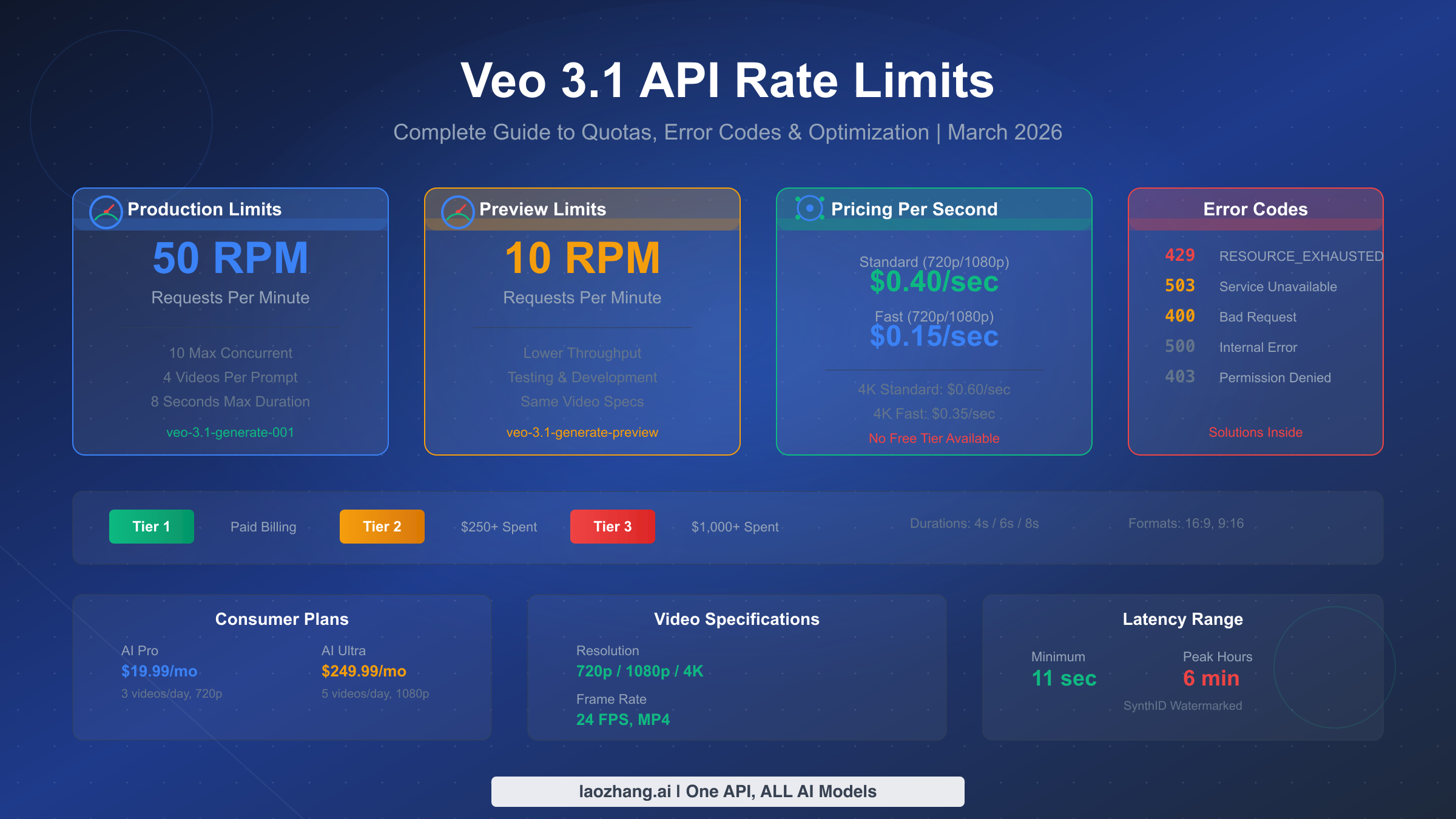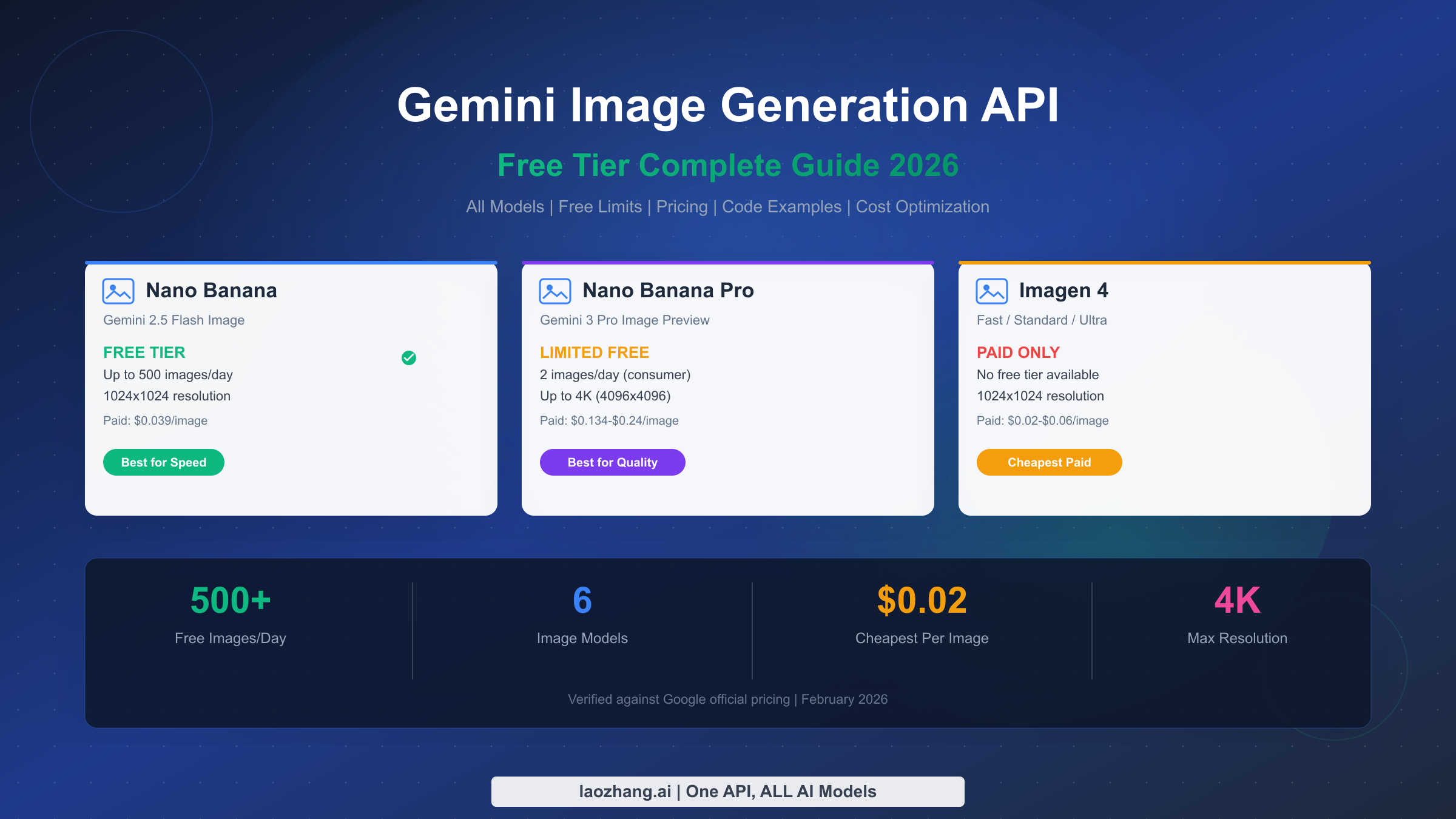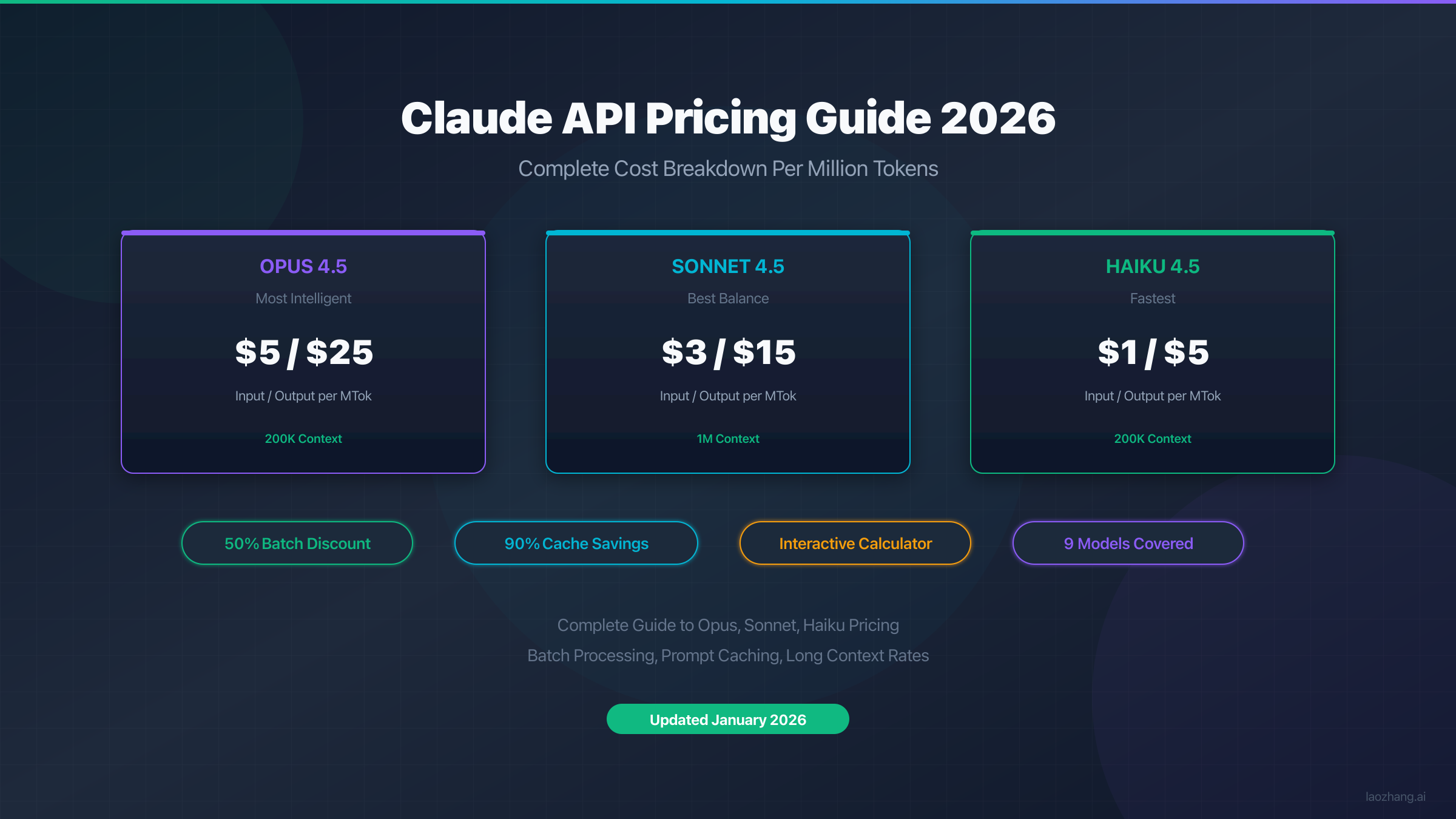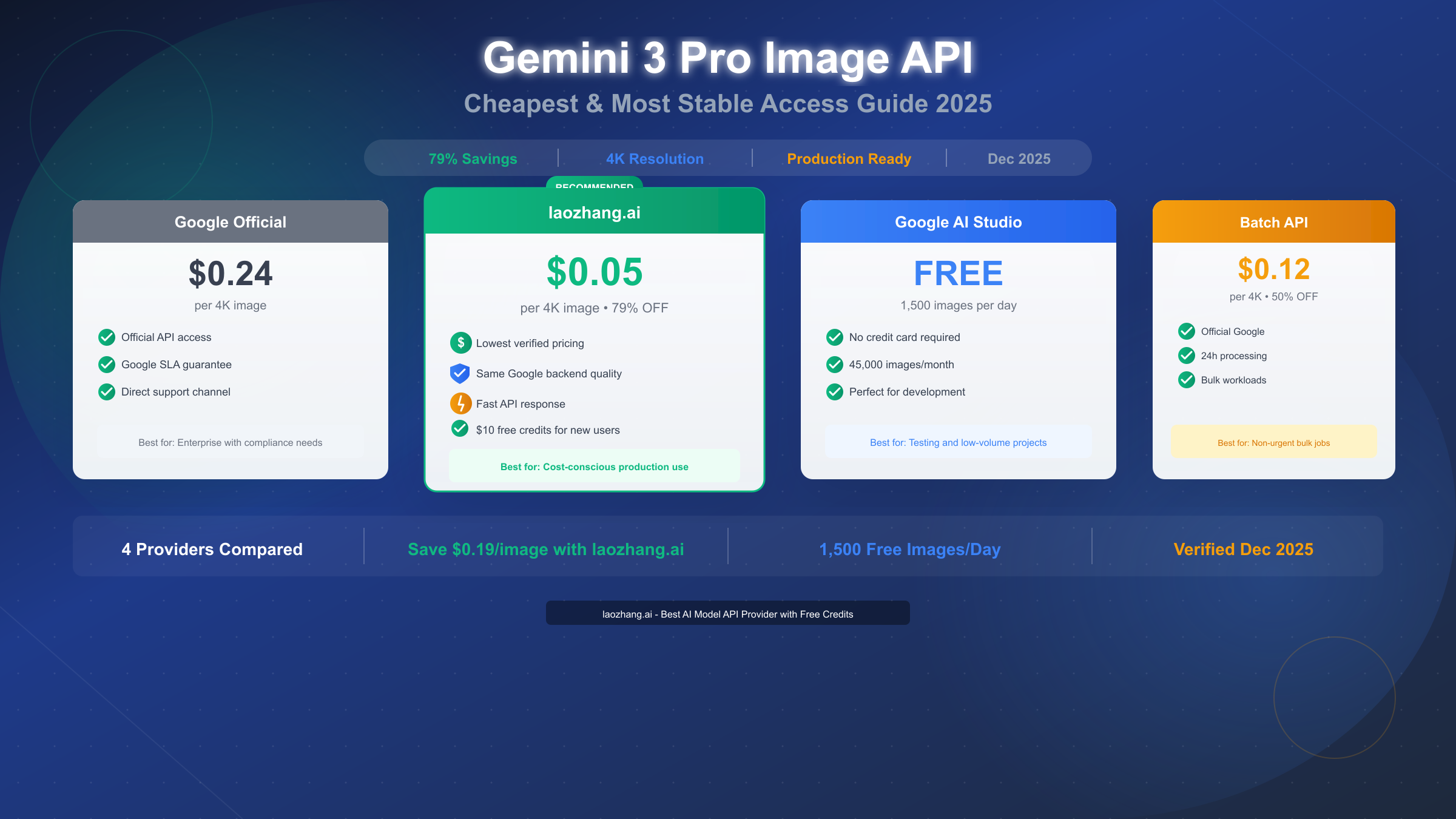
The cheapest stable Gemini 3 Pro Image API access is through laozhang.ai at $0.05 per image, representing 79% savings compared to Google's official $0.24/image rate for 4K resolution. Third-party providers like Kie.ai offer $0.09-$0.12/image, while Google's Batch API provides 50% discounts at $0.12/image. For completely free access, Google AI Studio offers 1,500 images daily. This December 2025 guide covers all pricing options, provider stability comparison, and production-ready integration code with automatic failover.
Quick Answer: Cheapest Gemini 3 Pro Image API Options
For developers seeking the most cost-effective Gemini 3 Pro Image (Nano Banana Pro) API access, the pricing landscape in December 2025 offers several compelling options at different price points. Understanding these options helps you make an informed decision based on your specific requirements for cost, speed, and reliability.
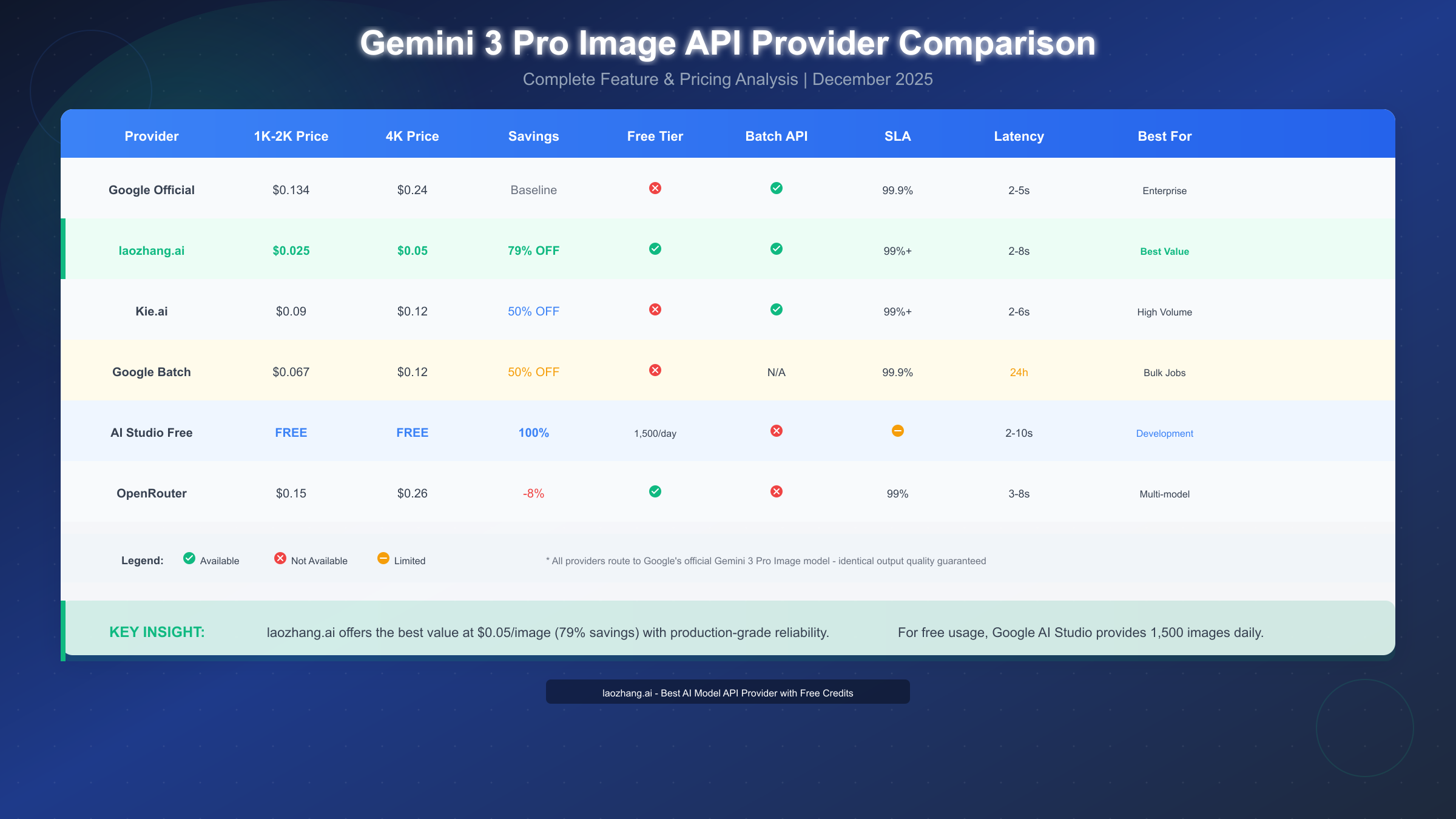
laozhang.ai leads the market at $0.05 per 4K image, representing a 79% discount compared to Google's official pricing. This makes it the most cost-effective option for production workloads that require real-time image generation. The platform routes requests directly to Google's infrastructure, ensuring identical output quality while dramatically reducing costs.
Google AI Studio provides completely free access with a generous daily limit of 1,500 images. This option works perfectly for development, testing, and low-volume production use cases. The free tier requires no credit card and includes access to the latest Gemini 3 Pro Image model capabilities.
Google's official Batch API offers 50% savings at $0.12 per 4K image for workloads that can tolerate 24-hour processing delays. This makes it ideal for e-commerce catalog generation, content pipelines, and any scenario where immediate results aren't required.
| Provider | 4K Price | Savings | Best For |
|---|---|---|---|
| laozhang.ai | $0.05 | 79% | Production with cost focus |
| Google Batch | $0.12 | 50% | Non-urgent bulk jobs |
| Kie.ai | $0.12 | 50% | High-volume applications |
| Google Official | $0.24 | - | Enterprise compliance needs |
| AI Studio | FREE | 100% | Development and testing |
The key insight here is that all third-party providers route to Google's actual Gemini 3 Pro Image model. You receive identical output quality regardless of which provider you choose. The price difference reflects infrastructure costs, not quality differences. This understanding fundamentally changes how developers should approach provider selection—focus on price and reliability rather than worrying about output quality variations that simply don't exist.
Complete Official Google Pricing Breakdown
Understanding Google's official pricing structure provides the baseline for evaluating all alternative options. The Gemini 3 Pro Image API uses a token-based pricing model that translates to specific per-image costs depending on resolution and usage patterns.
Standard synchronous API pricing charges $120 per million output tokens for Gemini 3 Pro Image generation. This translates to specific per-image costs based on resolution. For 1K-2K resolution images, each output consumes 1,120 tokens, resulting in a cost of approximately $0.134 per image. Moving to 4K resolution increases token consumption to 2,000 tokens per image, bringing the cost to $0.24 per image.
The calculation formula works as follows: Image Cost = (Tokens per Image × $120) / 1,000,000. For a 4K image: (2,000 × $120) / 1,000,000 = $0.24. Understanding this formula helps when estimating costs for mixed-resolution workloads or when comparing against fixed per-image pricing from third-party providers.
Input pricing adds minimal overhead at 560 tokens or approximately $0.0011 per image when providing reference images for editing or style guidance. This becomes relevant for image-to-image workflows where you're modifying existing images rather than generating from text prompts alone.
Batch API pricing cuts costs by 50% for workloads that can tolerate delayed processing. Instead of immediate results, batch requests queue for processing during off-peak hours with results typically available within 24 hours. The trade-off between real-time response and cost savings makes batch processing ideal for content pipelines, catalog generation, and scheduled production workflows.
| Resolution | Tokens | Standard Price | Batch Price |
|---|---|---|---|
| 1K (1024×1024) | 1,120 | $0.134 | $0.067 |
| 2K (2048×2048) | 1,120 | $0.134 | $0.067 |
| 4K (4096×4096) | 2,000 | $0.240 | $0.120 |
Google's pricing structure rewards higher usage volumes through better rates, but these negotiated enterprise discounts typically require commitments of 100,000+ images monthly and formal agreements. For most developers and startups, third-party providers offer more accessible cost reduction without volume commitments.
Why Cheaper Doesn't Mean Lower Quality
A common concern when evaluating cheaper third-party API providers is whether the reduced price reflects reduced quality. For Gemini 3 Pro Image API access specifically, this concern is unfounded due to how these services technically operate. Understanding the architecture eliminates this objection and allows confident adoption of cost-effective alternatives.
Third-party providers function as routing layers, not alternative image generation engines. When you send an image generation request to laozhang.ai or Kie.ai, your request travels through their infrastructure to Google's official Gemini API endpoints. The actual image generation happens on Google's servers using the identical Gemini 3 Pro Image model. Your prompt reaches the same neural network, and the generated image returns through the provider's routing layer to your application.
This architecture means several things practically. First, output quality is mathematically identical—the same model weights, the same generation process, the same image. Second, feature parity follows model updates automatically since providers route to Google's latest endpoints. Third, the cost difference comes from infrastructure optimization, volume purchasing, and different profit margin structures rather than any quality compromise.
The technical flow works like this: Your application sends an API request to the provider's endpoint. The provider validates your credentials, tracks usage for billing, and forwards your request to Google's API using their aggregated credentials. Google's servers process the request using the Gemini 3 Pro Image model and return the result. The provider receives the response and forwards it to your application with any necessary format adjustments.
Some developers worry about data privacy when using third-party routing. Reputable providers implement secure transit encryption and don't store generated images beyond the brief time needed for response delivery. Checking a provider's privacy policy and data handling practices addresses these concerns for sensitive applications.
The routing architecture also explains why providers can offer lower prices. They purchase API access in bulk volumes that qualify for better rates than individual developers could negotiate. They optimize infrastructure for efficient request handling. They operate on lower profit margins in competitive markets. None of these factors affect the underlying image generation quality.
Third-Party Providers Deep Dive
Evaluating third-party Gemini 3 Pro Image API providers requires understanding their pricing structures, reliability characteristics, and practical considerations for integration. This section examines the leading options with specific details for informed decision-making.
laozhang.ai offers the most competitive pricing at $0.05 per 4K image, representing 79% savings compared to Google's official rates. The platform supports both Nano Banana (Gemini 2.5 Flash Image) at $0.025 per image and Nano Banana Pro (Gemini 3 Pro Image) at $0.05 per image. New users receive $10 in free credits upon registration, enough to generate 200+ images for evaluation before committing funds. The API maintains compatibility with standard Gemini API request formats, simplifying migration from direct Google API usage.
Registration at laozhang.ai takes under two minutes: create an account, verify email, and receive API credentials. The platform dashboard shows real-time usage statistics and credit balance. For developers concerned about vendor stability, the platform has operated continuously since early 2024 with consistent pricing and service quality. API documentation at https://docs.laozhang.ai/ provides comprehensive integration guides in multiple programming languages.
Kie.ai positions itself for high-volume applications with pricing at $0.09 per 1K-2K image and $0.12 per 4K image. While more expensive than laozhang.ai, Kie.ai emphasizes production reliability with 24/7 technical support and infrastructure optimized for consistent performance under heavy workloads. The platform suits applications generating tens of thousands of images daily where support responsiveness matters more than marginal cost differences.
OpenRouter aggregates multiple AI providers including Gemini image models, though at slightly higher prices ($0.15-$0.26 per image). The value proposition centers on multi-model access through a unified API. If your application needs to switch between different image generation models dynamically, OpenRouter's abstraction layer simplifies that flexibility despite the cost premium.
| Provider | Nano Banana | Nano Banana Pro | Free Credits | Support |
|---|---|---|---|---|
| laozhang.ai | $0.025 | $0.05 | $10 | Documentation |
| Kie.ai | $0.09 | $0.12 | None | 24/7 Technical |
| OpenRouter | $0.12 | $0.26 | Credits available | Community |
For most developers, laozhang.ai represents the optimal balance of cost and capability. The 79% savings compound significantly at scale—generating 10,000 images monthly costs $500 through laozhang.ai versus $2,400 through Google's official API, saving $1,900 monthly or $22,800 annually.
Free Access Methods
Accessing Gemini 3 Pro Image API at zero cost is possible through several legitimate channels. Understanding these options helps developers reduce costs during development, testing, and low-volume production scenarios without compromising on model capabilities.
Google AI Studio provides the most generous free tier with 1,500 images per day (45,000 monthly) at no cost. Access requires only a Google account—no credit card or billing setup needed. The free tier includes full access to the Gemini 3 Pro Image model with all generation capabilities. For many individual developers and small projects, this quota exceeds actual usage requirements, effectively providing unlimited free access for practical purposes.
To access Google AI Studio's free tier, visit ai.google.dev and sign in with your Google account. Navigate to the API section to generate credentials. The platform provides an interactive playground for testing prompts before integrating into applications. Rate limits apply (typically 10-15 requests per minute) but accommodate most development workflows. According to the official documentation (https://ai.google.dev/gemini-api/docs/pricing ), these free tier limits remain stable and provide legitimate development access.
laozhang.ai's free credits offer additional flexibility with $10 in credits for new user registrations. This translates to 200 images with Nano Banana Pro or 400 images with Nano Banana—sufficient for comprehensive testing and initial production deployment. The credits never expire, allowing gradual usage while evaluating the platform.
Google Cloud Platform's $300 new user credits apply to Vertex AI services including Gemini image generation. This option suits developers already working within the GCP ecosystem who want to test production-grade deployment configurations. The credits expire after 90 days, so plan usage accordingly.
For development workflows, the free access strategy typically involves using Google AI Studio for rapid iteration and testing, then migrating to laozhang.ai for production deployment to capture the 79% cost savings. This approach maximizes free resources while establishing a cost-effective production path. If you're exploring free Gemini Flash image API options, these same strategies apply with slightly different model characteristics.
Production-Ready Integration Code
Implementing Gemini 3 Pro Image API access requires production-grade code that handles failures gracefully, tracks costs accurately, and maintains service reliability. The following implementation demonstrates best practices for real-world deployment with automatic failover between providers.
Python implementation with multi-provider support:
import os
import httpx
import time
from typing import Optional, Dict, Any
from dataclasses import dataclass

@dataclass
class ImageResult:
    image_data: bytes
    provider: str
    cost: float
    latency_ms: int

class GeminiImageClient:
    def __init__(self):
        self.providers = [
            {
                "name": "laozhang",
                "base_url": "https://api.laozhang.ai/v1",
                "api_key": os.getenv("LAOZHANG_API_KEY"),
                "cost_per_image": 0.05,
                "priority": 1
            },
            {
                "name": "google",
                "base_url": "https://generativelanguage.googleapis.com/v1",
                "api_key": os.getenv("GOOGLE_API_KEY"),
                "cost_per_image": 0.24,
                "priority": 2
            }
        ]
        self.total_cost = 0.0
        self.request_count = 0

    async def generate_image(
        self,
        prompt: str,
        resolution: str = "4k",
        timeout: int = 60
    ) -> Optional[ImageResult]:
        """Generate image with automatic failover."""

        sorted_providers = sorted(
            self.providers,
            key=lambda x: x["priority"]
        )

        for provider in sorted_providers:
            if not provider["api_key"]:
                continue

            try:
                start_time = time.time()
                result = await self._call_provider(
                    provider, prompt, resolution, timeout
                )
                latency = int((time.time() - start_time) * 1000)

                self.total_cost += provider["cost_per_image"]
                self.request_count += 1

                return ImageResult(
                    image_data=result,
                    provider=provider["name"],
                    cost=provider["cost_per_image"],
                    latency_ms=latency
                )

            except Exception as e:
                print(f"Provider {provider['name']} failed: {e}")
                continue

        raise Exception("All providers failed")

    async def _call_provider(
        self,
        provider: Dict[str, Any],
        prompt: str,
        resolution: str,
        timeout: int
    ) -> bytes:
        """Call specific provider API."""

        async with httpx.AsyncClient(timeout=timeout) as client:
            response = await client.post(
                f"{provider['base_url']}/images/generate",
                headers={"Authorization": f"Bearer {provider['api_key']}"},
                json={
                    "model": "gemini-3-pro-image",
                    "prompt": prompt,
                    "resolution": resolution
                }
            )
            response.raise_for_status()
            return response.content

    def get_cost_summary(self) -> Dict[str, Any]:
        """Return usage statistics."""
        return {
            "total_cost": round(self.total_cost, 4),
            "request_count": self.request_count,
            "avg_cost_per_image": round(
                self.total_cost / max(self.request_count, 1), 4
            )
        }
This implementation prioritizes the lower-cost laozhang.ai provider while automatically falling back to Google's official API if the primary provider fails. Cost tracking enables budget monitoring and usage analysis. For a complete understanding of pricing implications, see the Nano Banana Pro API pricing guide which covers detailed cost calculations across different usage patterns.
JavaScript/TypeScript implementation follows similar patterns with fetch API or axios for HTTP requests. The key architectural principles remain consistent: provider abstraction, automatic failover, cost tracking, and graceful error handling.
Stability and Reliability Considerations
Choosing between API providers requires evaluating stability alongside price. Production applications need consistent uptime, predictable latency, and reliable error handling. This section examines reliability characteristics across providers to inform deployment decisions.
Google's official API offers the strongest reliability guarantees with documented 99.9% uptime SLA for Vertex AI services. This translates to maximum expected downtime of approximately 8.76 hours annually. Enterprise agreements include support escalation paths and guaranteed response times for critical issues. For applications where API failures directly impact revenue or user experience, these guarantees justify the higher cost.
Third-party providers generally achieve 99%+ practical uptime based on community reports and monitoring data, though formal SLA guarantees vary. laozhang.ai has maintained consistent availability since launch without major outage incidents. Kie.ai explicitly markets production reliability with dedicated support channels. However, neither provides the contractual SLA guarantees available through Google Enterprise agreements.
Latency characteristics differ subtly between providers. Google's official API typically responds in 2-5 seconds for 4K image generation. Third-party providers add minimal routing overhead (typically 100-500ms) but may show higher variance during peak usage periods. For latency-sensitive applications, testing during your specific usage hours provides more relevant data than averaged benchmarks.
Rate limits protect service stability across all providers. Google's free tier limits requests to 10-15 per minute. Paid tiers scale higher based on account standing. Third-party providers typically offer higher concurrent limits as part of their value proposition—useful for batch processing or high-traffic applications.
For production deployment, implement health checking and monitoring regardless of provider choice. Regular availability probes detect issues before they impact users. The multi-provider failover architecture shown in the code section provides resilience against individual provider outages while optimizing for cost during normal operation.
Gemini 3 Pro vs Competitors
Evaluating Gemini 3 Pro Image against competing image generation APIs helps contextualize its pricing and capabilities. Understanding the competitive landscape informs both provider selection and model selection decisions.
DALL-E 3 from OpenAI prices at $0.040-$0.080 per image depending on resolution, positioning it competitively with Gemini's official pricing. DALL-E excels at artistic interpretation and creative prompt following but offers less control over photorealistic outputs. The OpenAI API provides reliable service with strong documentation but lacks the free tier generosity of Google's AI Studio offering.
Midjourney API access remains limited to Discord bot interactions and unofficial API wrappers. Official API pricing hasn't been publicly announced. For production applications requiring programmatic access, this limitation makes Midjourney impractical despite its strong image quality reputation. Developers should evaluate official alternatives rather than relying on unofficial endpoints.
Flux image generation models offer competitive pricing through various providers. The Flux image generation API guide covers specific pricing and integration details. Flux excels at certain artistic styles and offers faster generation times for some use cases, though Gemini 3 Pro Image generally produces more consistent photorealistic outputs.
| Model | Official Price | Best Via | Strength |
|---|---|---|---|
| Gemini 3 Pro Image | $0.24/4K | laozhang.ai ($0.05) | Photorealism, text rendering |
| DALL-E 3 | $0.04-0.08 | OpenAI direct | Creative interpretation |
| Flux | $0.03-0.10 | Various | Speed, artistic styles |
| Stable Diffusion | Free (self-host) | Self-hosted | Control, no per-image cost |
For most production applications requiring high-quality image generation with reliable API access, Gemini 3 Pro Image through laozhang.ai offers the best value proposition. The 79% cost savings compared to official pricing makes it significantly cheaper than alternatives while maintaining Google's quality standards.
Frequently Asked Questions
Is the image quality from laozhang.ai identical to Google's official API?
Yes, absolutely identical. laozhang.ai routes requests directly to Google's Gemini 3 Pro Image model. The same neural network processes your prompt on Google's servers. Third-party providers function as routing and billing layers, not as alternative image generators. You receive mathematically identical outputs at 79% lower cost.
What happens if laozhang.ai goes down during production?
Implement the multi-provider failover pattern shown in the integration code section. Configure Google's official API as a backup provider. When the primary provider fails, requests automatically route to the fallback. This architecture ensures service continuity while maintaining cost optimization during normal operation.
Can I use Google AI Studio's free tier for commercial applications?
Yes, Google AI Studio's free tier permits commercial use according to the terms of service. The 1,500 daily image limit applies regardless of use case. For applications exceeding this limit, transition to paid access through laozhang.ai or Google's official paid tier while staying compliant with terms.
How do I calculate my expected monthly cost?
Multiply your expected monthly image count by the per-image price. For example, 10,000 images monthly through laozhang.ai: 10,000 × $0.05 = $500/month. Through Google official: 10,000 × $0.24 = $2,400/month. The savings of $1,900 monthly often justify the minimal integration effort for third-party providers.
Does Gemini 3 Pro Image support image editing, not just generation?
Yes, the model supports image-to-image workflows including style transfer, inpainting, outpainting, and guided editing. Pricing remains consistent at $0.05 per output image through laozhang.ai regardless of whether you're generating from scratch or editing existing images.
What resolution options are available?
Gemini 3 Pro Image supports output resolutions from 1024×1024 (1K) through 4096×4096 (4K). Aspect ratios include 1:1, 2:3, 3:2, 3:4, 4:3, 4:5, 5:4, 9:16, 16:9, and 21:9. Higher resolutions consume more tokens with official API pricing but remain flat $0.05 per image through laozhang.ai regardless of resolution.
How do I handle rate limiting errors?
Implement exponential backoff retry logic in your API client. Start with 1-second delays, doubling on each retry up to a maximum of 32 seconds. Most rate limiting resolves within 2-3 retry cycles. For sustained high-volume needs, contact providers about increased limits or use Google's batch API for non-time-sensitive workloads.
Summary and Recommendations
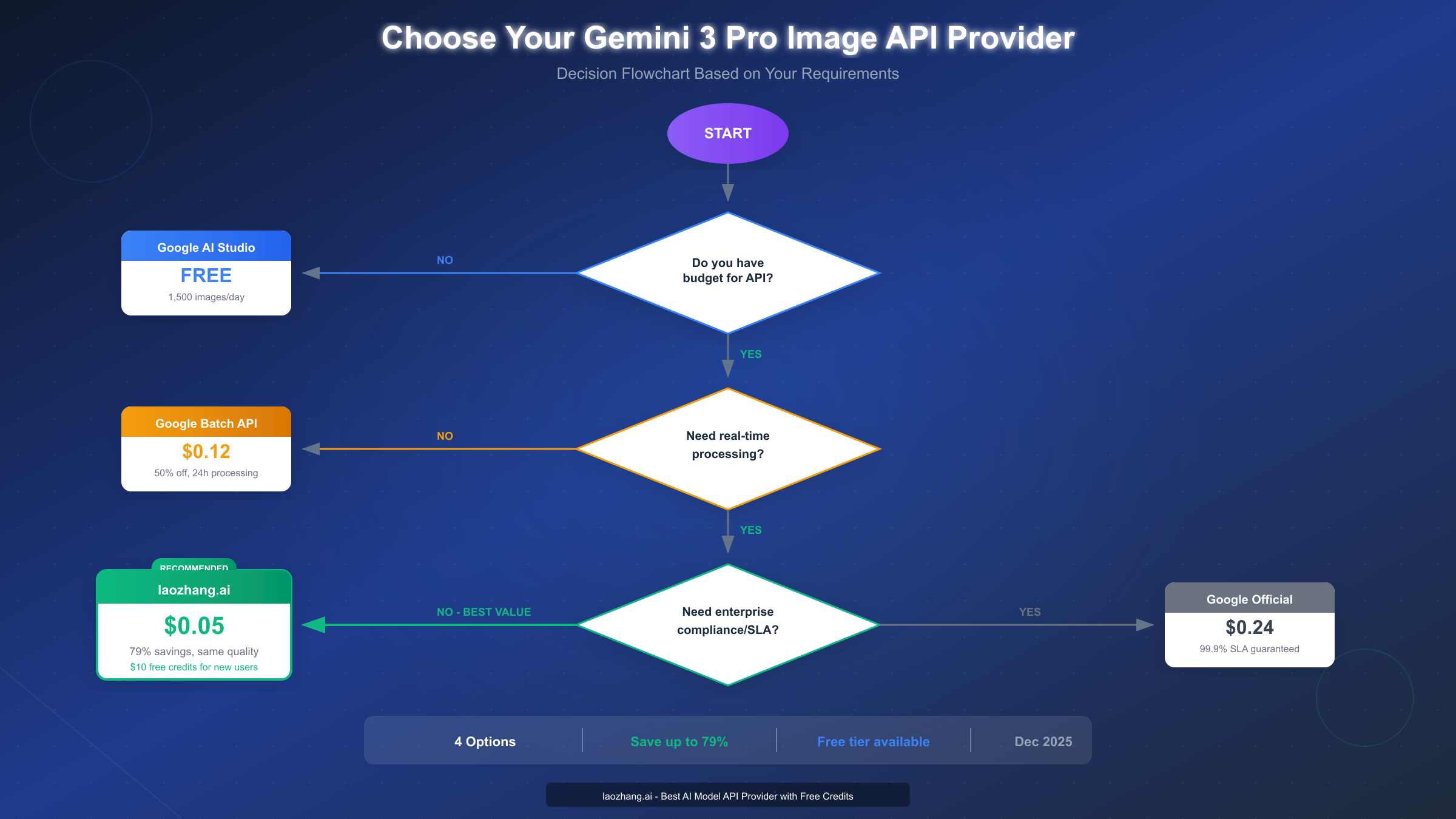
Selecting the optimal Gemini 3 Pro Image API access method depends on your specific requirements for cost, reliability, and usage volume. Based on comprehensive analysis of all available options, here are clear recommendations for different use cases.
For cost-conscious production deployment, laozhang.ai at $0.05 per image provides the best value. The 79% savings compared to official pricing compound significantly at scale. New user credits ($10 free) allow thorough evaluation before committing. API compatibility with standard Gemini formats simplifies migration. Documentation at https://docs.laozhang.ai/ covers all integration scenarios.
For development and testing, Google AI Studio's free tier of 1,500 images daily covers most needs without cost. No credit card required. Full access to Gemini 3 Pro Image capabilities. Transition to laozhang.ai for production once you've validated your application.
For enterprise compliance requirements, Google's official API at $0.24 per image provides documented SLA guarantees, enterprise support, and compliance certifications (SOC 2, ISO 27001, HIPAA). The premium reflects these guarantees rather than quality differences.
For non-urgent batch workloads, Google's Batch API at $0.12 per image (50% off) suits overnight processing, catalog generation, and scheduled pipelines where 24-hour turnaround is acceptable.
The decision flowchart above summarizes these recommendations visually. Most developers should start with Google AI Studio for development, then deploy through laozhang.ai for production. Implement multi-provider failover as shown in the code section for maximum reliability while capturing cost savings.
Gemini 3 Pro Image represents Google's current best image generation capability. By understanding the provider landscape and implementing cost-effective access strategies, developers can leverage this powerful model at 79% reduced cost without sacrificing quality or reliability. The savings enable more ambitious image generation applications that would otherwise be cost-prohibitive.