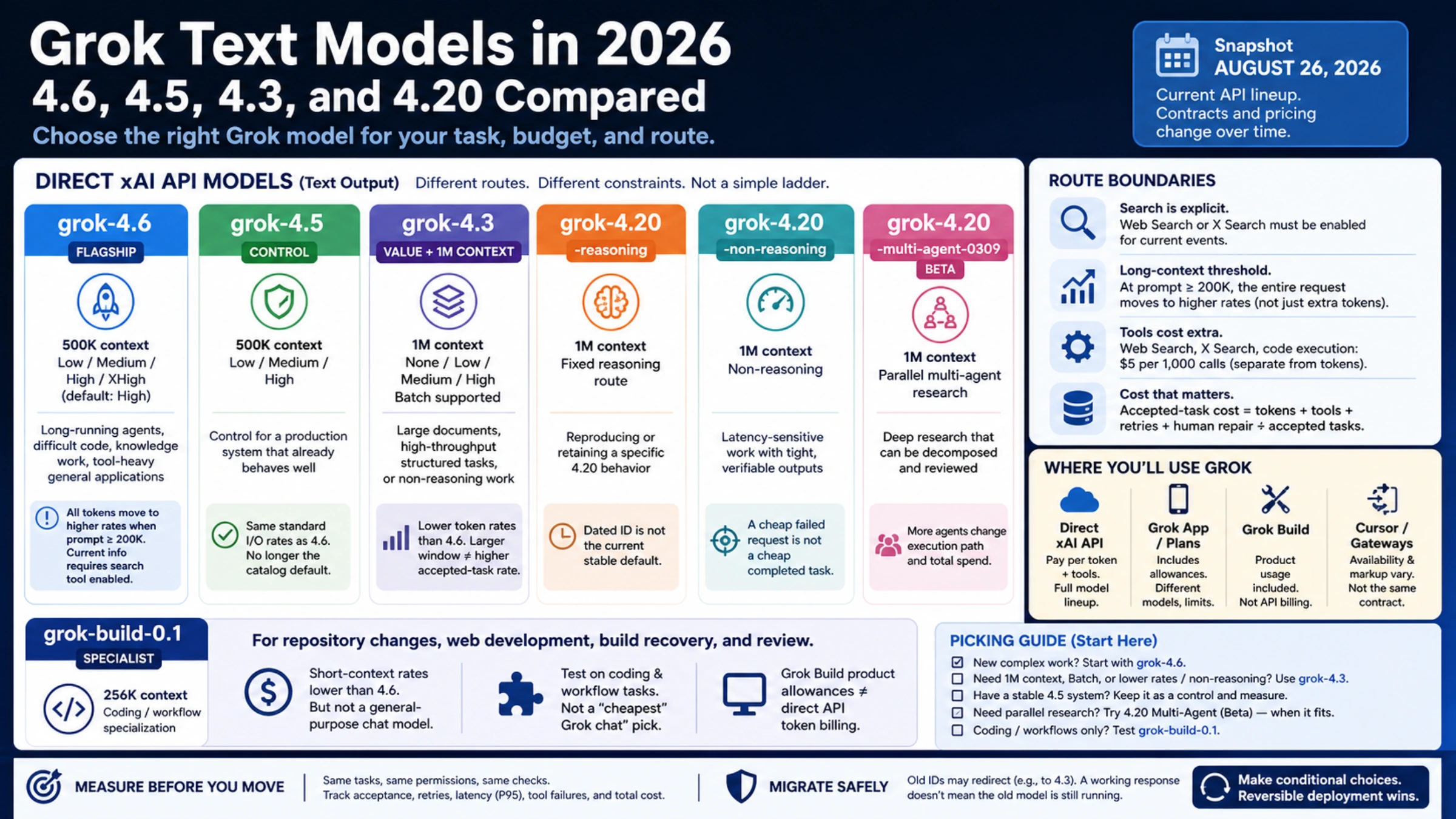
As of August 26, 2026, SpaceXAI's live model catalog recommends grok-4.6 for code and general-purpose work. The direct API price sheet still lists grok-4.5, grok-4.3, three Grok 4.20 routes, and the coding-specific grok-build-0.1. Those names do not form a simple weak-to-strong ladder.
For a new complex application, 4.6 is the cleanest first candidate. Keep 4.3 in the trial when a one-million-token window, Batch support, lower token rates, or a true non-reasoning mode matters. Treat 4.20 Multi-Agent and Grok Build as specialized routes that must earn a role on their own tasks. An existing 4.5 deployment needs a regression test, not a version-number reflex.
This page compares text-output contracts in the direct xAI API. The model picker and allowances in the Grok app, included usage in Grok Build, Cursor availability, and a gateway's markup are separate product contracts. Seeing an API model ID in official docs does not guarantee that the same choice appears in every plan, region, or third-party interface.
“Latest” is a contract snapshot, not a permanent model property
The current lineup makes more sense when each model is tied to a route and a constraint.
| Direct API model | Context and reasoning | A useful first hypothesis | Boundary to preserve |
|---|---|---|---|
grok-4.6 | 500K; low, medium, high, xhigh | Long-running agents, difficult code, knowledge work, tool-heavy general applications | All tokens move to higher rates when the prompt reaches 200K; current information requires an enabled search tool |
grok-4.5 | 500K; low, medium, high | A control for a production system that already behaves well | Standard input/output rates match 4.6; it is no longer the catalog default |
grok-4.3 | 1M; none, low, medium, high; Batch supported | Large-document work, high-throughput structured tasks, or requests that should skip reasoning | The larger window and lower rate do not prove a higher accepted-task rate |
grok-4.20-0309-reasoning | 1M; fixed reasoning route | Reproducing or retaining a specific 4.20 behavior | A dated ID is not the current stable default |
grok-4.20-0309-non-reasoning | 1M; non-reasoning | Latency-sensitive work with tight, verifiable outputs | A cheap failed request is not a cheap completed task |
grok-4.20-multi-agent-0309 | 1M; parallel multi-agent research; Beta | Research that can be decomposed and whose sources and synthesis can be reviewed | More agents alter the execution path and total spend |
grok-build-0.1 | 256K; coding/workflow specialization | Repository changes, web development, and Grok Build workflows | It is not a discounted general-purpose 4.6 |
The Grok 4.6 model page specifies text and image input with text output, a 500,000-token window, and a February 1, 2026 knowledge cutoff. It supports Responses API and Chat Completions, function calling, Web Search, X Search, and code execution. High is the default reasoning effort.
Search is an explicit tool, not an invisible property of the model. SpaceXAI's catalog says Grok has no access to events beyond training data unless Web Search or X Search is enabled. A system that needs current answers must test source selection, citations, tool failures, latency, and invocation cost—not merely put “latest” in the prompt.
What 4.6 changes, and what the launch data cannot decide
SpaceXAI describes 4.6 as an extension of 4.5 focused on longer-running agents and more ambitious interactive and visual work. The launch announcement reports higher 4.6 High scores than 4.5 High across its displayed agentic, coding, and knowledge-work evaluations.
Those are provider-reported or provider-collected results. The ordering also changes by evaluation: a model that looks close on a composite score can be far apart on a terminal task. The data justifies hypotheses such as “4.6 may stay productive through more steps” or “4.6 may produce a stronger first pass on interactive work.” It does not establish a winner for a private support corpus, a legal extraction pipeline, or a repository with a particular tool harness.
Run 4.6 and the current control under the same permissions, task statement, context assembly, reasoning effort, timeout, and acceptance checks. Record first-pass acceptance, interventions, retries, P95 time, tool failures, and the cost of all attempts. Upgrade when the improvement survives repeated samples and exceeds migration overhead.
For a stable 4.5 system, this makes 4.5 valuable even when it is not the new default. It provides a clean behavioral control. Removing it before measuring 4.6 turns every difference into an anecdote and removes the quickest rollback.
4.3 can cost less and accept more context
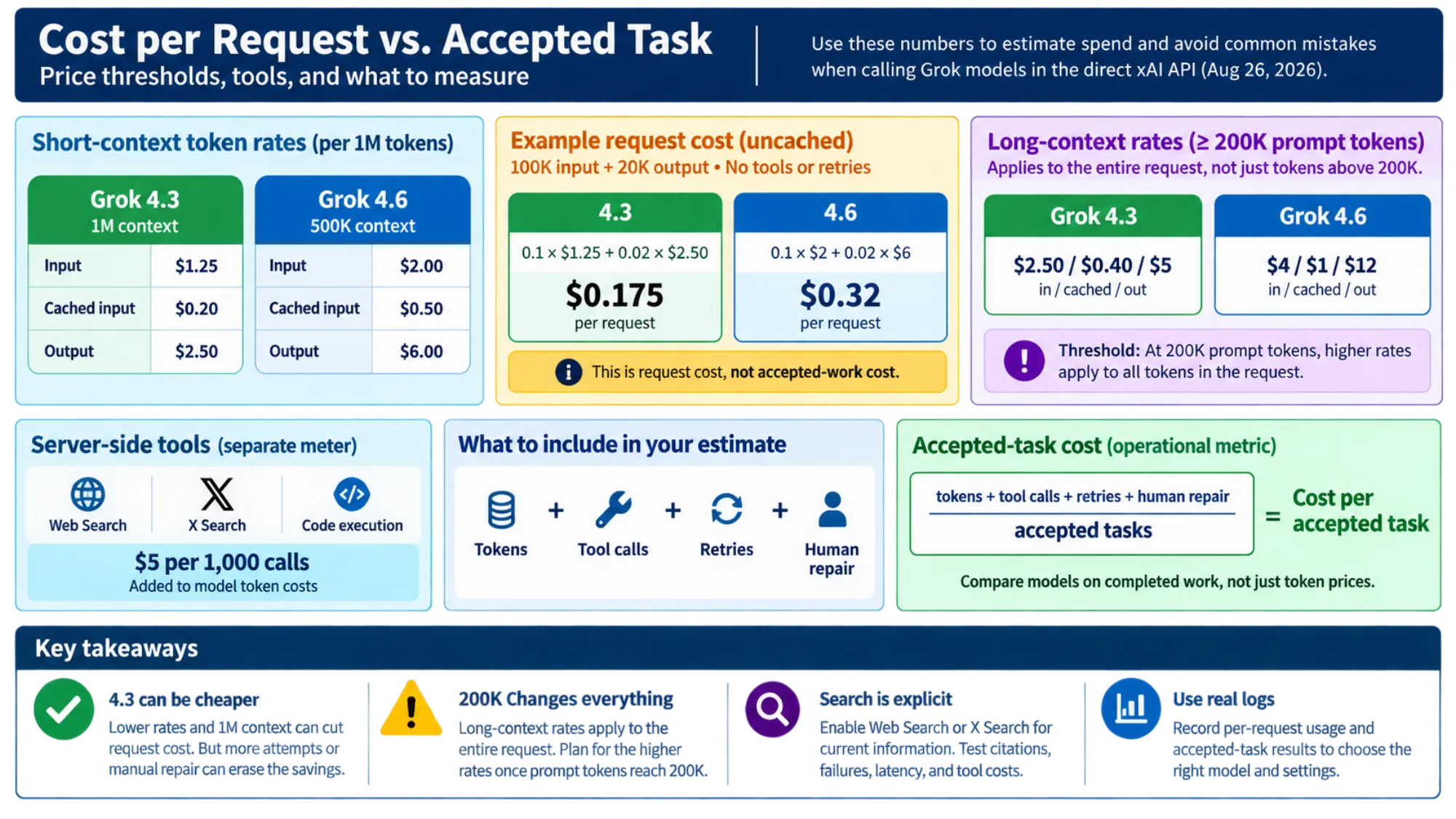
The 4.3 model contract has a one-million-token context window, supports Batch, and allows none, low, medium, or high reasoning. Its short-context rates per million input, cached input, and output tokens are $1.25 / $0.20 / $2.50. For 4.6 they are $2 / $0.50 / $6.
For an uncached request with 100K input and 20K output, excluding tools and retries:
- 4.3 is
0.1 × $1.25 + 0.02 × $2.50 = $0.175; - 4.6 is
0.1 × $2 + 0.02 × $6 = $0.32.
That is request cost, not accepted-work cost. If 4.3 needs two attempts or manual repair and 4.6 passes once, the lower sticker price may lose. A better operational equation is:
accepted-task cost = tokens + tool calls + retries + human repair, divided by accepted tasks
Context size creates another non-obvious break. The current pricing page applies long-context rates to the entire request once prompt tokens reach 200K. At that point 4.3 becomes $2.50 / $0.40 / $5, and 4.6 becomes $4 / $1 / $12. The surcharge is not limited to tokens above the threshold.
Retrieval, deduplication, prompt-prefix caching, and context compaction can matter more than the advertised maximum window. A one-million-token model is useful when the task needs that evidence together; it is not permission to ship an unfiltered document warehouse on every call.
Server-side tools add a separate meter. SpaceXAI currently lists Web Search, X Search, and code execution at $5 per 1,000 calls, in addition to model tokens. An autonomous agent decides how often it invokes them, so the reliable number comes from per-request usage and completed-task logs.
4.20 and Build solve narrower problems
The three currently priced 4.20 IDs share a one-million-token window and the same token rates as 4.3, but their execution contracts differ. The reasoning and non-reasoning IDs pin those behaviors. grok-4.20-multi-agent-0309 runs agents in parallel for deep research and is explicitly marked Beta on its model page.
Multi-agent becomes interesting when a task genuinely decomposes, missing a perspective is costly, and a reviewer can inspect sources and synthesis. It can also create more intermediate work and tool calls. Compare total accepted deliverables, not its output-token rate against a single-agent request.
grok-build-0.1 is a separate coding model with a 256K window and short-context rates of $1 / $0.20 / $2. It is trained for agentic coding and workflow tasks. Test it on repository edits, web development, build recovery, and review—not as a generic answer to “which Grok chat model is cheapest?” Product-included Grok Build usage is not interchangeable with direct API token billing.
Migrate old IDs without mistaking a redirect for compatibility
SpaceXAI's May 2026 retirement guide redirects old Grok 4 Fast, 4.1 Fast, grok-4-0709, and grok-3 slugs to 4.3 with specified reasoning settings. grok-code-fast-1 routes to grok-build-0.1. A successful response from an old slug therefore does not prove that the old model still runs; billing follows the destination model.
Inventory model IDs in application code, environment variables, configuration services, queues, and gateways. Record where every alias routes today. Use one evaluation set that includes ordinary input, context near 200K, tool failure, structured output, and safety refusals. Put both model and reasoning effort behind a reversible configuration, then expand traffic only after a small cohort stays within acceptance, latency, and cost limits.
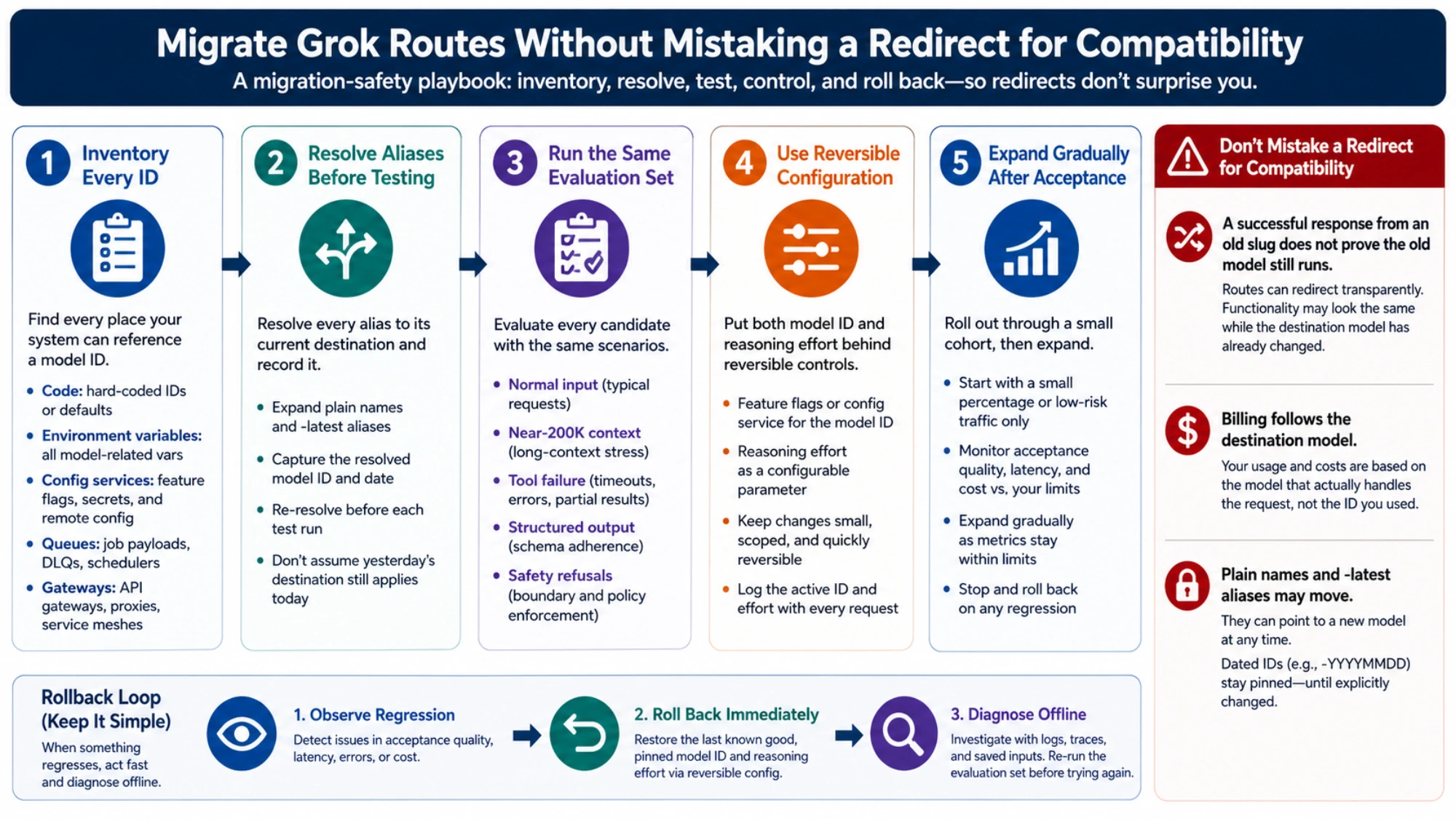
The official alias guidance distinguishes moving aliases from pinned releases: a plain model name or -latest can follow a newer version, while a dated ID remains fixed. Moving aliases are convenient in development. High-risk production workflows often benefit from a dated ID plus deliberate upgrade tests and a known rollback target.
The durable choice is conditional: start general complex work with grok-4.6; keep grok-4.3 as the lower-cost, 1M-context, optionally non-reasoning control; retain 4.5 long enough to measure a real upgrade; and make 4.20 Multi-Agent or Build 0.1 prove value only on their specialist workloads.
If the decision expands beyond the Grok family, use the separate Grok 4.6 vs GPT-5.6 Sol vs Claude Fable 5 coding comparison. The model label can open the trial. Identical tasks, explicit contracts, and reversible deployment determine what stays.